
You’re probably dealing with this right now. Your ads are live, the clicks are coming in, Google is spending your money, and the leads are either weak, outside your service area, or not turning into real jobs.
That usually isn’t a Google problem. It’s an account structure problem, a targeting problem, or a landing page problem.
I’ve owned a home service business. I know what wasted ad spend feels like when payroll, trucks, materials, and callbacks are already eating enough margin. Google ads for roofing can work very well, but only if you stop treating it like a basic keyword auction and start treating it like a local lead machine built for buyer intent.
In 2026, the search page is crowded. A homeowner looking for roof repair doesn’t just see ads. They see AI summaries, Local Service Ads, Maps, reviews, organic listings, and then your standard paid search result. If your campaign isn’t built for that reality, you’ll pay for attention without earning trust.
Why Your Roofing Ads Are Failing in 2026
Most roofing campaigns fail because owners still think the job is to “show up on Google.” That was enough a few years ago. It isn’t enough now.
Today, a homeowner can scan one search result page, compare your reviews, check your map listing, see whether you serve their area, and decide whether you look legit before they ever click. According to Roofing Revenue Marketing’s write-up on roofing search ads in 2026, AI summaries, Maps, Local Service Ads, and paid search now compete on the same page, and homeowners are filtering harder and contacting fewer companies.
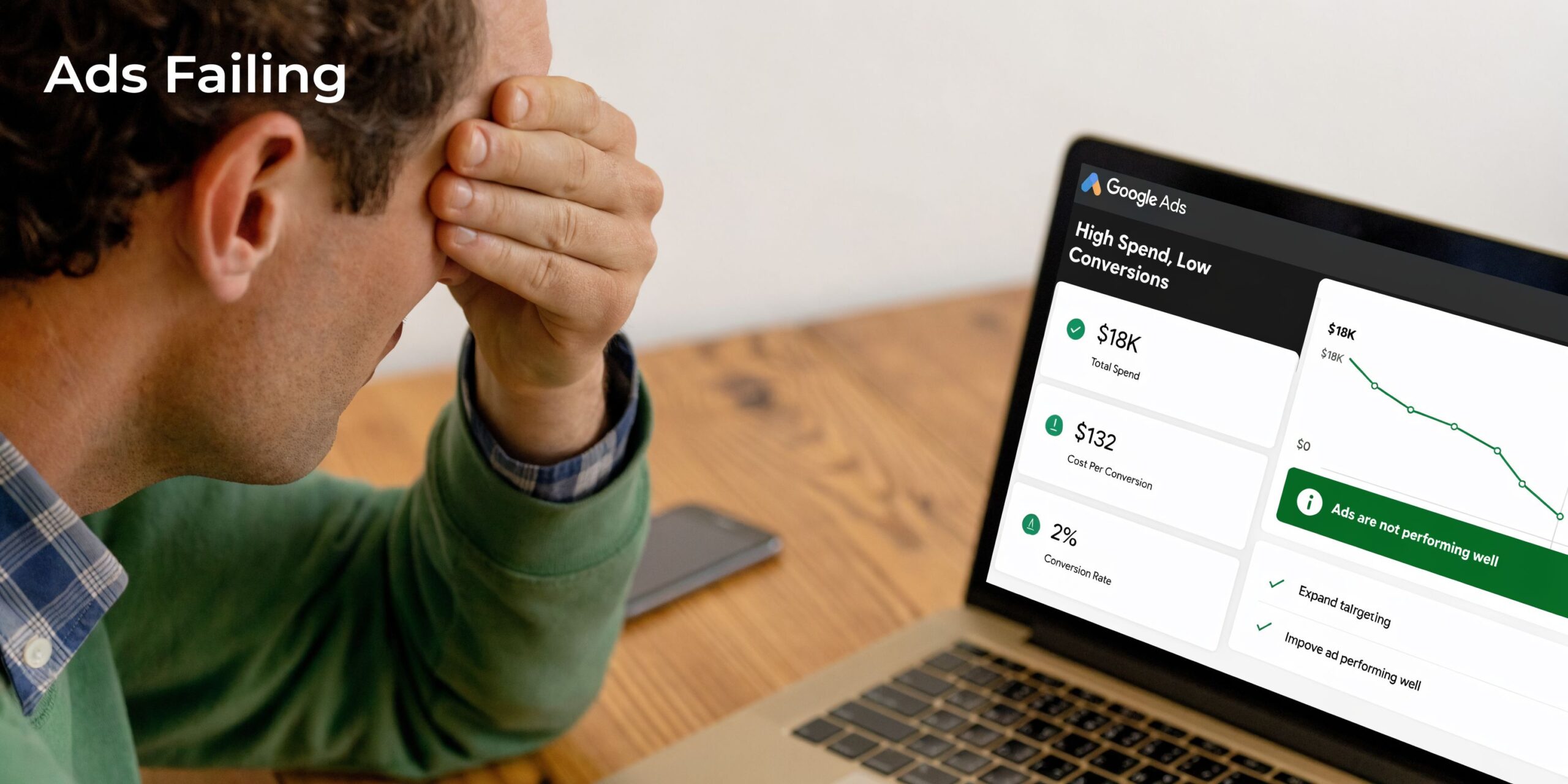
The old playbook is dead
A lot of roofers still run ads like this:
- One campaign: everything from repairs to replacements to inspections jammed together
- One landing page: usually the homepage
- Loose targeting: broad locations, no exclusions, weak negative keyword list
- No local trust signals: no location extensions, weak Google Business Profile, generic ad copy
That setup burns money because it forces Google to guess. Google will gladly spend your budget while it guesses.
Practical rule: If your ad account doesn’t clearly separate service type, location, and buyer intent, you’re paying for confusion.
The click isn’t the goal
The goal is a qualified call from someone in your service area who needs a roofer now, or very soon.
That means your ad has to fit the whole page. In this blended search environment, your Google Ads strategy should work alongside your Google Business Profile, your location extensions, your reviews, and your service area targeting. If you’re serving Southwest Florida, that means being ruthless about excluding cities you don’t cover and making sure your ad presence supports your local credibility.
Why this matters more for roofers
Roofing isn’t an impulse buy. It’s a trust decision under stress.
If someone has a leak, storm damage, or a looming replacement, they aren’t clicking ten companies. They’re narrowing the list fast. The roofer who looks local, clear, available, and credible gets the call. The roofer with sloppy campaigns gets the bill from Google.
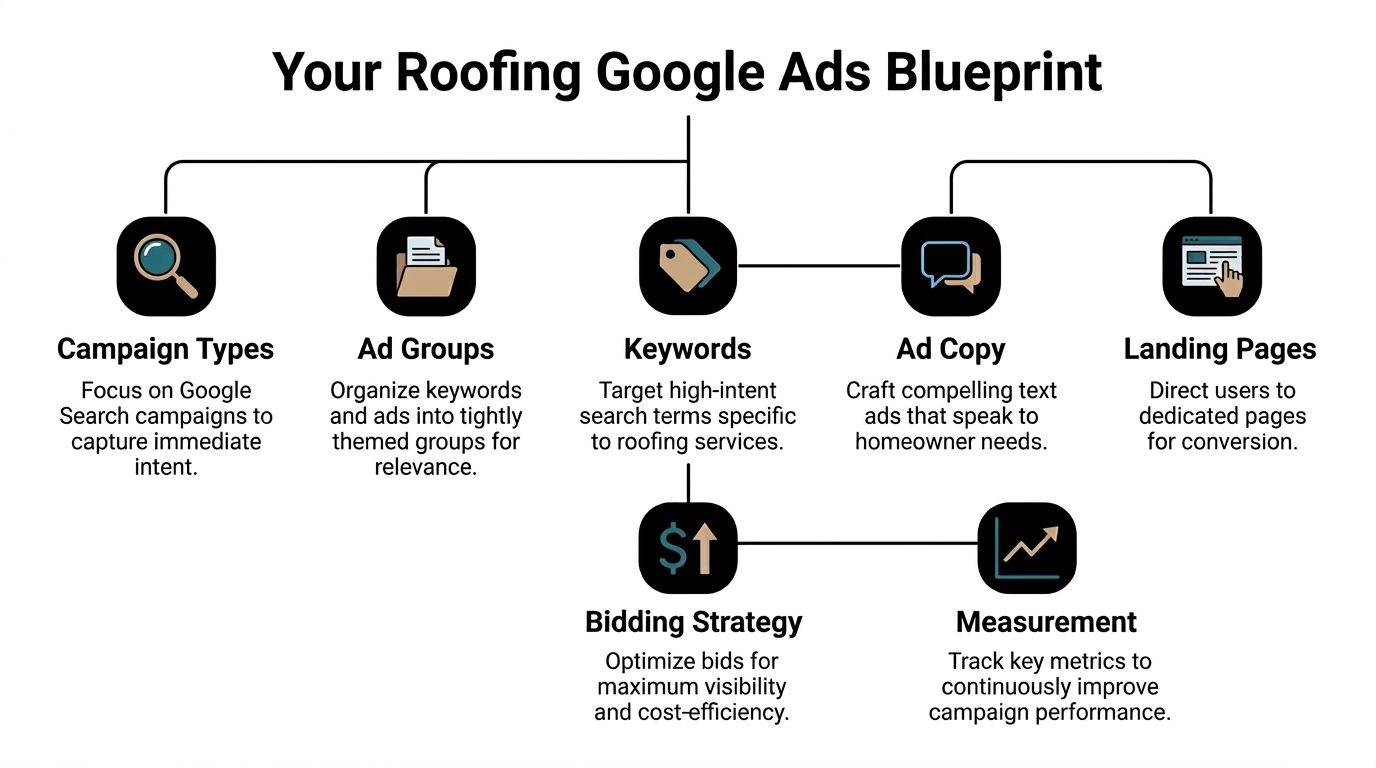
Your Roofing Google Ads Campaign Blueprint
If you want google ads for roofing to produce calls instead of chaos, build the account like an operator, not like a hobbyist. Keep it simple, segmented, and easy to manage.
The first call: focus on Google Search first. That’s where the strongest intent lives. Roofing benchmarks published by MDM PPC show Google Search campaigns reached a 5.82% conversion rate in 2025, compared with 0.96% for cross-network campaigns. The same benchmark lists an average roofing Google Ads CPC of $11.13, with Google Search campaigns at $12.87. That higher Search click cost is worth it when the traffic is stronger.
Start with campaign separation
Don’t build one giant campaign called “Roofing.”
Build separate campaigns by service line and geography. That gives you control over budget, ad copy, search terms, and landing pages.
A practical account structure might look like this:
| Campaign | Purpose | Example ad groups |
|---|---|---|
| Search | Roof Repair | Fort Myers | Capture repair demand in Fort Myers | Leak Repair, Storm Damage, Flashing Repair |
| Search | Roof Replacement | Cape Coral | Capture replacement demand in Cape Coral | Shingle Replacement, Tile Roof Replacement, Full Roof Replacement |
| Search | Emergency Roofing | Naples | Capture urgent calls | Emergency Tarping, Emergency Leak Repair, After Storm Roofing |
| Search | Commercial Roofing | Fort Myers | Keep commercial separate from residential | Flat Roof Repair, TPO Roofing, Commercial Replacement |
| Brand | Company Name | Defend branded searches cheaply | Company Name, Company Name Reviews, Company Name Roofing |
That structure does two things fast. It stops mixed intent, and it shows you where the money is really working.
Use a naming convention that stays clean
Most accounts get messy because nobody names anything clearly. Then nobody knows what’s winning.
Use a format like:
- Campaign: Search | Roof Repair | Fort Myers
- Ad Group: Emergency Leak Repair
- Landing Page: /fort-myers-roof-repair
- Conversion Goal: Calls and estimate forms
If you serve multiple nearby markets, keep each city separate when volume supports it. If volume is lower, group nearby areas carefully, but still split by service.
Don’t start with every network
Roofers get sold on “more reach.” Ignore that at the start.
You don’t need Display first. You don’t need YouTube first. You don’t need Performance Max as your first move unless your tracking is already clean and your landing pages are solid. Search is where homeowners raise their hand and say they need help. Take that demand first.
If you want a solid outside explainer on how paid search works at a practical level, this guide on PPC marketing Google is worth a skim.
Build for the business, not the ad platform
A roofing ad account should mirror how you sell.
If your company handles these jobs differently, your campaigns should too:
- Repairs: usually faster decisions, often mobile-heavy, often urgent
- Replacements: higher-ticket, more comparison shopping, trust matters more
- Emergency work: needs call-focused ads and strong after-hours handling
- Commercial: different search language, different landing page, different close process
Search campaigns should match the way your office answers calls and the way your estimators sell jobs. If they don’t, the campaign structure is wrong.
Keep branded and non-branded separate
Branded clicks behave differently from non-branded clicks. Someone searching your company name already knows you. Someone searching “roof repair near me” does not.
Put branded traffic in its own campaign. Let non-branded campaigns do the harder, more expensive work of bringing in new demand. That’s where most roofing growth from.
One practical build order
If you need a no-nonsense rollout, do it in this order:
- Launch non-branded Search campaigns for repair, replacement, and emergency service
- Split by city or service area where you can support a dedicated landing page
- Create a separate branded campaign
- Turn on call tracking and form tracking before scaling
- Add location extensions and align them with your Google Business Profile
- Review performance weekly and move budget to the campaigns producing real leads
If your pipeline is thin and you need leads quickly, build this before you chase advanced tactics. A clean structure is what gives you the control to improve results later.
If you need a broader lead generation model beyond paid search alone, Polaris also has a useful resource on roofing lead flow at https://polarismarketingsolutions.com/how-to-get-roofing-leads/.
Winning Keywords and Laser-Focused Targeting
Keywords decide whether you buy real opportunities or garbage clicks. Many roofers lose money here because they target what sounds relevant instead of what signals buying intent.
The strongest roofing accounts use tight keyword segmentation by service and review search terms every week. According to Max Conversion’s roofing Google Ads guide, that combination can reduce wasted spend by 20% to 30%, and properly segmented campaigns can produce 15% to 20% higher relevance scores, which helps lower CPC by 8% to 12%. The same source says a useful benchmark is to aim for CPL under $185, which can yield about 8.5 leads per month for every $1,000 spent in major U.S. markets.
Start with service intent, not roofing trivia
A homeowner searching “roof repair near me” is different from one searching “roof types.” Don’t mix them.
Break keywords into buckets like these:
Urgent repair intent
- emergency roof repair
- roof leak repair
- storm damage roof repair
- roof tarp service
Replacement intent
- roof replacement
- new roof estimate
- shingle roof replacement
- tile roof replacement
Evaluation intent
- roof inspection
- roof repair estimate
- roof replacement cost
- hail damage roof inspection
Commercial intent
- commercial roofer
- flat roof repair
- TPO roof contractor
- commercial roof replacement
Each bucket needs its own ad copy and landing page. Someone with an active leak should not land on a general “all services” page with a paragraph about gutters and siding.
Match types that make sense
If you’re launching fresh, don’t go fully loose and don’t go fully rigid.
A practical approach:
- Use broad match carefully to gather data when paired with strong negatives and regular search term reviews.
- Use phrase match for your core service terms to keep intent tighter.
- Use exact match for your strongest money terms after you know what converts.
Broad match is useful when you’re paying attention. It’s a disaster when you aren’t.
Segment by location the way you operate
If you serve Fort Myers, Cape Coral, Bonita Springs, Estero, and Naples, don’t let Google drift into places your crews don’t want to go.
Do this instead:
- Target your real service cities
- Use location-specific campaigns or ad groups where possible
- Exclude cities, counties, or zip codes you won’t service
- Align your ads with local landing pages
- Make sure location extensions reflect your business presence
That matters even more in the blended 2026 search page, where local relevance shows up before the click.
If your estimator won’t drive there, your ads shouldn’t show there.
Build a serious negative keyword list
This is the fastest way to stop budget leaks.
Most roofing accounts need a starter negative list that blocks DIY traffic, job seekers, suppliers, and education queries. Here’s a practical base list you can use and then expand:
- DIY
- how to
- free
- cheap
- training
- course
- classes
- jobs
- job
- salary
- careers
- apprentice
- materials
- supplies
- wholesale
- for sale
- shingles for sale
- Home Depot
- Lowe’s
- blueprint
- diagram
- YouTube
- tutorial
- used
- calculator
- software
- template
You’ll still need weekly cleanup. Search terms always surprise you.
A simple keyword review routine
Most owners overcomplicate this. You don’t need a giant spreadsheet. You need discipline.
Review search terms once a week and ask:
- Would I want my office answering this call?
- Does this term clearly match one service?
- Does this search come from someone in my service area?
- Is this buyer intent or curiosity?
- Should this become a negative keyword or a new ad group?
That habit is what separates efficient campaigns from expensive ones.
Example of tight segmentation
Here’s what a repair-focused build might look like:
| Ad group | Example keywords | Landing page angle |
|---|---|---|
| Emergency Roof Repair | emergency roof repair near me, urgent roof leak repair | Fast response, call now |
| Roof Leak Repair | roof leak repair, leaking roof contractor | Leak diagnosis, inspection request |
| Storm Damage Repair | storm damage roof repair, wind damage roofer | Insurance help, storm assessment |
| Roof Tarp Service | roof tarp service, emergency roof tarping | Immediate protection, same-day contact |
And for replacement:
| Ad group | Example keywords | Landing page angle |
|---|---|---|
| Roof Replacement | roof replacement near me, new roof estimate | Free estimate, financing or options |
| Shingle Roof Replacement | shingle roof replacement, asphalt roof replacement | Material options, project photos |
| Tile Roof Replacement | tile roof replacement, tile roofer | Tile expertise, local installs |
Avoid keyword cannibalization
A common mistake is loading the same keyword into multiple ad groups because it “fits” more than one category. Then your own campaigns compete internally and your reporting gets muddy.
If “emergency roof repair” is in your emergency group, keep it there. Don’t also stuff it into general repair and storm campaigns unless you enjoy guessing which ad and page should get credit.
What to aim for
Use the benchmark from the source above as a reality check, not a guarantee. If your campaigns are far above that CPL target, don’t just raise budget and hope. Fix the structure, search terms, and geography first.
Most bad roofing campaigns don’t have a traffic problem. They have a filtering problem.
Writing Ads That Make the Phone Ring
Most roofing ads are weak because they sound like they were written for a search engine instead of a stressed homeowner.
Nobody with a roof leak cares that you offer “all-encompassing exterior solutions.” They care whether you can show up, whether you work in their area, and whether they can trust you not to make things worse.
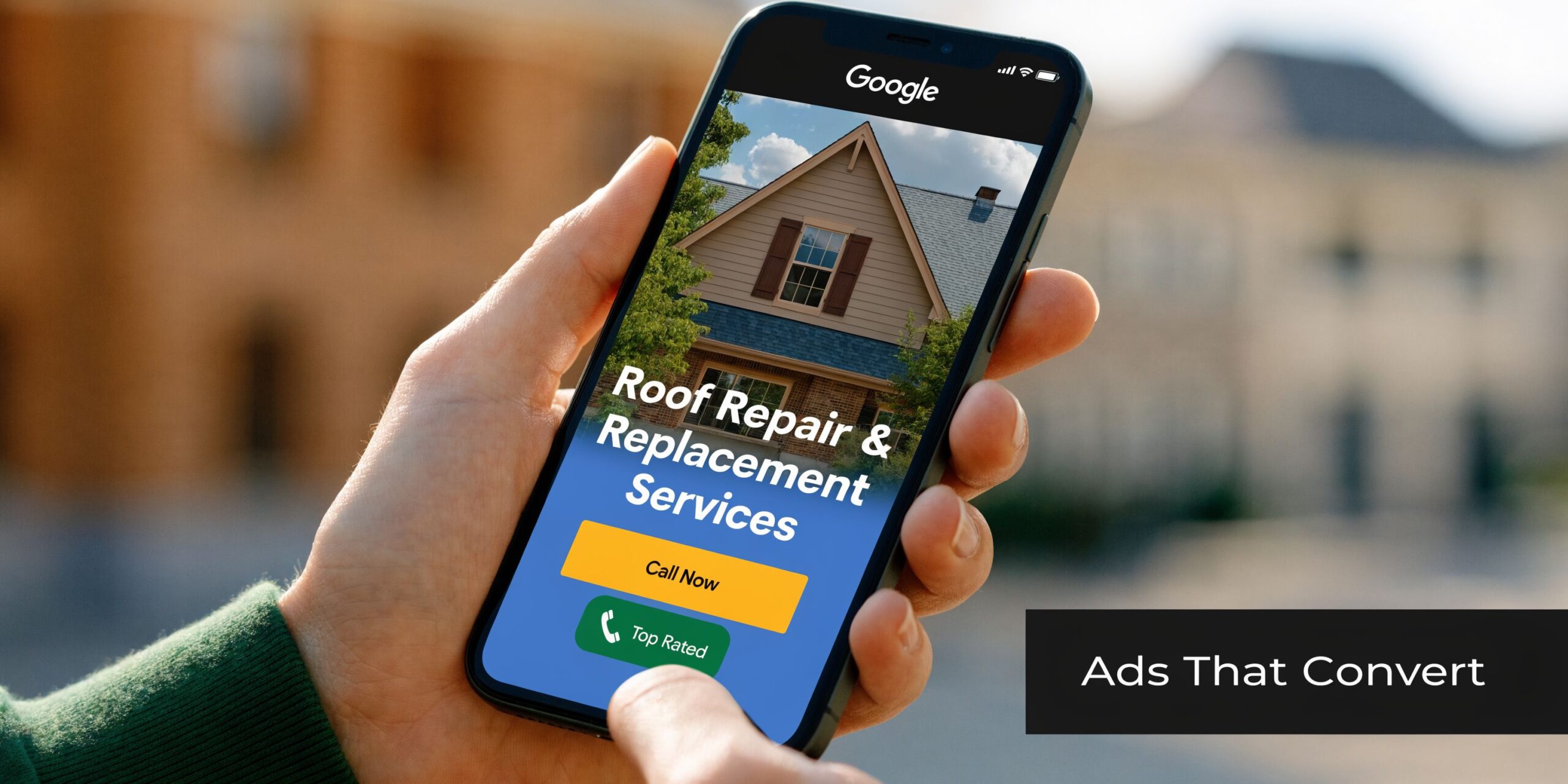
Write to the problem first
Good roofing ad copy does three things fast:
- Names the service
- Shows local relevance
- Tells the homeowner what to do next
Bad example:
- Quality Roofing Services
- Residential and Commercial Solutions
- Contact Us Today
Better example:
- Roof Leak Repair in Fort Myers
- Local Roofer for Fast Inspections
- Call Now for a Roofing Estimate
The better version works because it answers the buyer’s first questions immediately.
A simple ad formula that works
Use this structure for responsive search ads:
| Ad element | What to include |
|---|---|
| Headlines | Service, city, speed, trust, CTA |
| Descriptions | Problem + solution + proof + next step |
| Final URL | Matching service page, not homepage |
Headline ideas you can adapt:
- Roof Repair in Cape Coral
- Emergency Roofer Available
- Get a Fast Roof Estimate
- Local Roof Replacement Team
- Storm Damage Roofing Help
- Licensed and Insured Roofer
- Serving Fort Myers Homeowners
- Call for Roof Leak Inspection
Description examples:
- Leaking roof or storm damage? Get fast help from a local roofing team. Call now or request an estimate online.
- Need roof replacement or repair in your area? Speak with a local roofer and book an inspection today.
- Residential and commercial roofing services with local service area coverage. Call now to get started.
Use extensions like you mean it
Extensions aren’t optional in roofing. They help your ad take up more space and give the homeowner more reasons to trust and click.
According to Roof Predict’s article on roofing ad extensions, optimized extensions can boost CTR by up to 28% and can occupy 50% to 60% of the screen space. The same source says a Colorado roofer improved CTR from 2.1% to 3.8% in 30 days by optimizing extensions. It also notes practical benchmarks such as ROAS of 4:1+ and impression share above 60% for SMB campaigns.
Use these extension types:
Sitelinks
- Get a Free Estimate
- Roof Repair Services
- Roof Replacement Options
- Insurance Claims Help
- View Recent Projects
Callouts
- Licensed & Insured
- Local Roofing Team
- Emergency Service
- Insurance Claim Support
- Fast Estimate Scheduling
Structured snippets
- Services: Roof Repair, Roof Replacement, Roof Inspection, Storm Damage Repair
Location extensions
- Connect your Google Business Profile so your ad supports local trust on the search page
Homeowners often decide from the ad itself whether you look credible. Extensions help answer that before the click.
Call extensions versus call-only thinking
If your office answers the phone well and quickly, call extensions are a must. They’re perfect for repair and emergency searches.
Call-only style thinking works best when the search is urgent and mobile-heavy. But don’t force every campaign into a phone-first setup. For replacement jobs, some people want to read, compare, and fill out a form after hours.
That’s why I like this split:
- Emergency and leak campaigns: push calls hard
- Replacement and commercial campaigns: support both calls and form fills
- After-hours traffic: make the landing page form dead simple
Here’s a useful walkthrough if you want to study ad layout and mobile behavior before rewriting your own ads:
A before and after rewrite
Weak ad:
- Roofing Company Near You
- Affordable Roofing Services
- Call for More Information
Stronger ad:
- Roof Repair in Naples
- Fast Help for Leaks and Storm Damage
- Local Roofer. Call for an Inspection
Weak ad:
- New Roof Installation
- Professional Team
- Learn More
Stronger ad:
- Roof Replacement Estimates
- Serving Cape Coral Homeowners
- Call Today or Request a Quote
What most roofers should test first
Don’t test ten things at once. Start with these:
- Local city headline versus generic headline
- Problem-first language versus company-first language
- Call-focused CTA versus estimate-focused CTA
- Insurance claim messaging for storm campaigns
- Emergency wording for urgent search terms
The point isn’t to sound clever. The point is to sound useful.
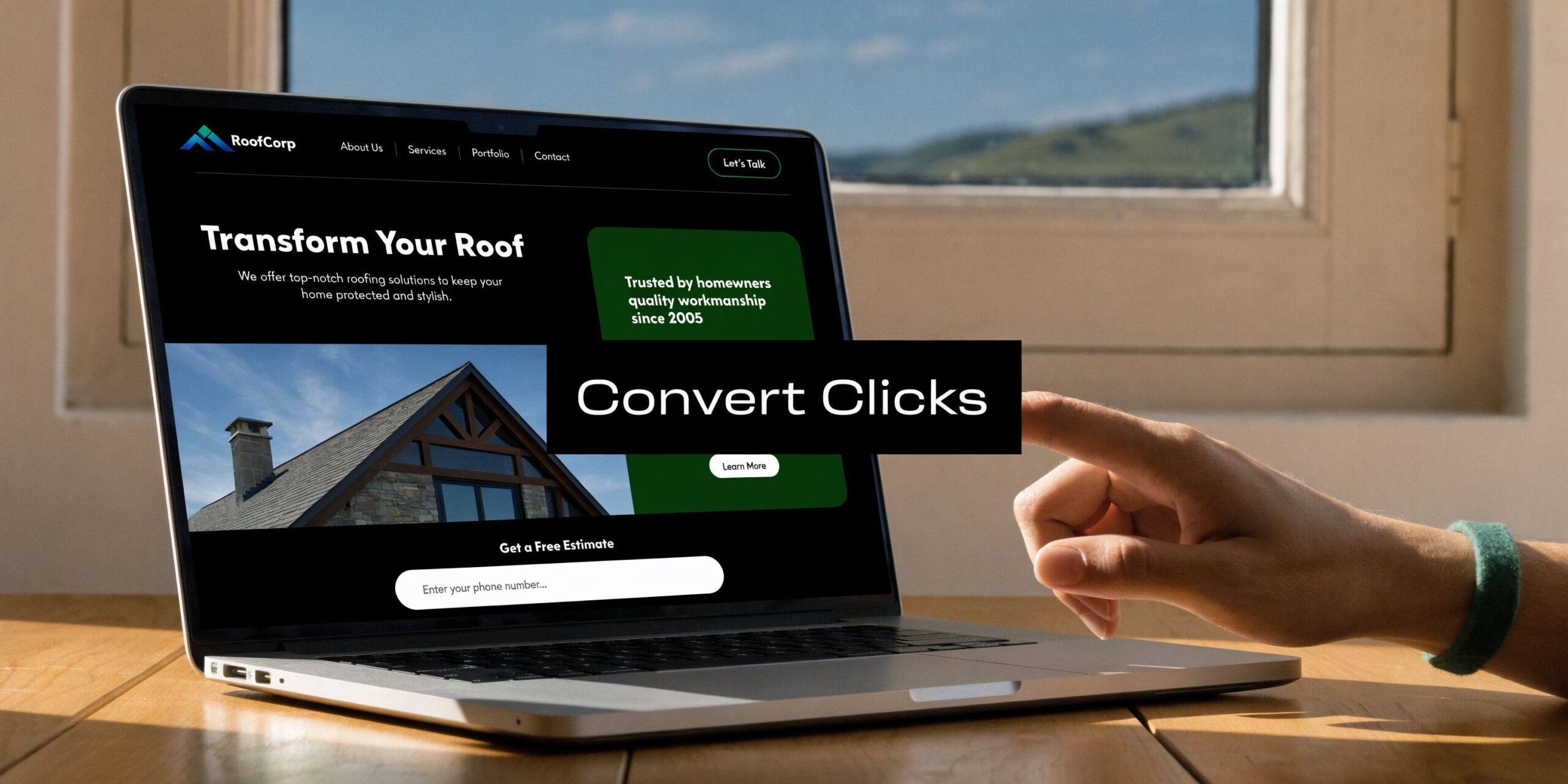
Designing a Landing Page That Converts Clicks to Customers
A roofing click is expensive. Sending that click to a weak page is one of the dumbest ways to lose money.
I’ll be blunt. If you’re paying for traffic and dumping it on your homepage, you’re probably making Google rich and yourself frustrated.
What a roofing landing page has to do
A good roofing landing page should answer four questions fast:
- Am I in the right place for my problem?
- Do these people work in my area?
- Can I trust them enough to contact them?
- Is it easy to call or request an estimate?
If the page fails any one of those, conversion rate drops.
The must-have page elements
Here’s the checklist I’d use for almost any roofer running paid search:
Clear headline
- Match the ad. If the ad says roof leak repair, the page should open with roof leak repair.
Visible phone number
- Put it at the top. Make it click-to-call on mobile.
Short contact form
- Name, phone, address, and brief job detail is enough for most paid traffic.
Service area proof
- Mention the cities or regions you serve.
Trust signals
- Reviews, certifications, licenses, insurance details, and recognizable badges.
Real project photos
- Use your jobs, your crew, your trucks. Stock photos weaken trust.
Simple CTA
- Request an estimate, schedule an inspection, or call now. Pick one primary action.
Matching page copy
- Repair ads go to repair pages. Replacement ads go to replacement pages.
A high-converting layout
You don’t need fancy design. You need clarity.
A simple structure works:
| Page section | What it should do |
|---|---|
| Hero area | State service, city, CTA, phone number |
| Trust strip | Reviews, credentials, insurance, service area |
| Problem section | Speak to leak, storm damage, aging roof, or replacement need |
| Proof section | Photos, testimonials, completed work examples |
| Contact section | Form and phone CTA repeated |
| FAQ or reassurance | Address timing, inspection process, or next steps |
The landing page should feel like a direct continuation of the ad. If the ad promises one thing and the page talks about everything, people leave.
What to remove
Most roofing landing pages have too much junk.
Cut these first:
- Full site navigation if it distracts from the lead action
- Long company history paragraphs near the top
- Too many service links on a single paid page
- Generic stock photos
- Huge blocks of text
- Multiple conflicting CTAs
A homeowner with an urgent roofing issue doesn’t want a tour of your website. They want confidence and an easy next step.
Residential and commercial should not share the same page
This mistake is everywhere.
Residential buyers want homeowner-focused proof. Commercial buyers want different language, different project examples, and a different level of detail. Keep those pages separate.
The same goes for repair versus replacement. The closer the page matches the search, the better your odds.
Use real examples before redesigning
If you want a practical reference point for structure and layout choices, review these examples of high-converting landing pages at https://polarismarketingsolutions.com/examples-of-high-converting-landing-pages/.
Then compare them against your current page and ask:
- Is the headline specific?
- Is the phone number obvious?
- Is the form short?
- Does the page show local trust quickly?
- Does the page match the exact search intent?
Most roofers don’t need a prettier page. They need a tighter one.
Tracking ROI and Optimizing for Profitability
If you’re not tracking calls and forms correctly, you’re not managing advertising. You’re gambling with nicer software.
Owners either take control here or stay stuck in the cycle of “we’re getting clicks but I don’t know what’s working.”
The benchmark you should know first comes from Searchlight Digital’s Q1 2026 roofing CPL analysis. It found the average non-branded roofing Google Ads CPL was $124, with a median of $125. The 25th percentile came in at $80, while the 75th percentile reached $256. That spread tells you everything. Roofing accounts can live in a healthy range or a painful one, and setup plus optimization make the difference.
Track the conversions that matter
For roofing, that usually means:
- Phone calls from ads
- Phone calls from landing pages
- Estimate request forms
Set those up first. If those aren’t accurate, don’t trust anything else in the account.
A practical tracking stack often includes:
- Google Ads conversion tracking
- Google Tag Manager for cleaner event setup
- Call tracking software if you need cleaner attribution across ads and landing pages
- CRM tagging so you can tie leads back to jobs, not just forms
Know your numbers each week
You don’t need to stare at dashboards all day. You do need a weekly review rhythm.
Watch these metrics:
| KPI | Why it matters | What to do if it looks bad |
|---|---|---|
| Cost per lead | Tells you whether acquisition is profitable | Cut waste, tighten keywords, fix landing page match |
| Conversion rate | Shows whether traffic is becoming leads | Rewrite ads, improve page relevance, simplify CTA |
| Click-through rate | Signals ad relevance | Test headlines, improve local language, use extensions |
| Search terms | Reveals wasted spend | Add negatives, split out winners, remove junk |
| Location performance | Shows geographic waste | Exclude bad areas, separate city campaigns |
| Device performance | Shows where leads are really coming from | Adjust mobile experience and call handling |
Use the benchmark the right way
Don’t treat $124 CPL as a guarantee. Treat it like a reference point.
If your non-branded campaign is performing near that average, you may be in decent shape. If you’re approaching the high end of that range, something is off. Usually it’s one of these:
- Keyword targeting is too loose
- Too many irrelevant locations are included
- Ad copy is too generic
- The landing page doesn’t match search intent
- The office isn’t handling leads well
- Tracking is broken and hiding the truth
If you’re closer to the lower end, you likely have a tighter account and better filtering.
Manual CPC or automated bidding
This depends on account maturity.
A practical way to handle it:
- Use Manual CPC early if you need control and your account doesn’t have enough clean conversion data yet.
- Move toward Maximize Conversions once tracking is reliable and the campaign has enough lead volume to train on.
That’s also consistent with the workflow described in earlier benchmark material about roofing account optimization. Google’s automation can work, but only when you feed it clean conversion signals. Bad tracking teaches the algorithm bad habits.
Don’t hand bidding control to Google before you’ve taught Google what a real lead looks like.
Build a weekly optimization routine
Here’s the routine I’d put in place for any roofer:
Check lead quality
- Listen to calls or review form details.
- Flag junk, wrong-area, and low-intent leads.
Review search terms
- Add negatives fast.
- Promote strong search queries into tighter ad groups when needed.
Compare service categories
- Repairs, replacements, emergency, and commercial should be judged separately.
Review geography
- Look for spend from outside your target area.
- Add exclusions where needed.
Inspect ad copy performance
- Pause weak combinations.
- Keep testing headlines tied to service and city.
Audit landing page behavior
- Check whether calls and forms are easy on mobile.
- Look for mismatches between ad and page.
Adjust budgets based on profit potential
- Don’t split budget evenly out of habit.
- Put more into the campaigns bringing in closable work.
Don’t obsess over cheap metrics
Roofers get distracted by impressions, clicks, and sometimes CPM data when they should be looking at cost per qualified lead and closed-job value.
That said, understanding visibility metrics can still help when diagnosing top-of-funnel issues. If you want a plain-English explainer on ad cost per impression, it’s useful background. Just don’t confuse visibility cost with business performance.
Make seasonal changes on purpose
Roofing demand shifts. Storm periods, rainy stretches, and slower seasons all change what people search and how urgently they search it.
What matters is operational alignment:
- Increase focus on emergency and storm-related campaigns when local conditions support it
- Review service-area exclusions more often during busy periods
- Make sure after-hours call handling is covered when urgency rises
- Refresh ad copy to match what homeowners are dealing with right now
Don’t wait until the phones slow down to react.
Judge the campaign like an owner
At the end of the month, ask better questions:
- Which campaign produced calls from real homeowners in our service area?
- Which leads turned into inspections?
- Which inspections turned into jobs?
- Which service line gave us the best return?
- Where did we waste money?
If you can’t answer those, your account needs better tracking and reporting.
For smaller companies that don’t have time to manage that process in-house, services like https://polarismarketingsolutions.com/ppc-management-small-business/ can handle campaign management, tracking, and ongoing optimization. That’s one option. The bigger point is that somebody needs clear ownership of the numbers.
Good roofing PPC isn’t about getting busy. It’s about getting paid.
If you want a second set of eyes on your roofing ads, Polaris Marketing Solutions can review your account, landing pages, and local search presence, then show you where budget is leaking and where qualified lead volume can improve.