
If you run a business in Fort Myers, Cape Coral, Naples, or Estero, you have probably had this experience. You search for the service you offer, see competitors above you in Google, and wonder what they have that you do not.
Sometimes the answer is better content. Sometimes it is a better Google Business Profile. Often, one big part of the gap is website authority.
That is where Domain Authority, often shortened to DA, enters the conversation. It sounds technical. It is not. For a small business owner, it is a way to estimate how much trust and credibility your website has built across the web compared with other sites competing for the same search results.
If you have been trying to understand what is domain authority in SEO, the useful question is not “What is the perfect score?” The useful question is, “How do I build enough authority to outrank the businesses taking calls that should be coming to me?”
Your Website's Reputation Score
A local business builds its reputation in public.
In downtown Fort Myers, that reputation comes from customers talking about you, local organizations knowing your name, other businesses recommending you, and trusted places mentioning you. A clean storefront matters, but reputation grows because other people and organizations validate your business.
Your website works the same way.
Domain Authority is a practical way to think about your site’s reputation online. It reflects whether the rest of the web appears to trust your business enough to mention it, link to it, and treat it like a credible source.

A roofer in Cape Coral can have a great website and still struggle to rank if no respected local websites point to it. A Naples law firm can publish strong service pages and still lose ground if local directories, business associations, and industry sites mention competitors more often.
That is why DA matters to small businesses. It turns an abstract SEO idea into something you can compare and improve.
Why business owners get tripped up
Many owners hear “authority” and assume it is a Google score. It is not. Others think it is just about getting lots of backlinks. That overlooks the core point.
Authority is closer to credible recognition than raw volume.
If you want a plain-English refresher, this guide on What Is Domain Authority in SEO gives a useful overview from a beginner’s perspective. The more important step is applying that idea locally, where citations, partnerships, and trusted mentions move the needle faster than broad national tactics.
For Southwest Florida companies, one of the most practical starting points is local business consistency. Accurate listings across directories help search engines connect your business name, address, and phone number with a local footprint. That is why many businesses begin with structured citation work such as https://polarismarketingsolutions.com/local-citation-building-services/.
Practical takeaway: If people in your market do not know your business, referrals stay low. If trusted websites in your market do not recognize your business, search visibility stays low too.
Decoding the Domain Authority Score
Domain Authority works like a reputation score for your website.
If you run a law firm in Naples or an HVAC company in Fort Myers, that score helps explain why one business can publish decent service pages and still struggle to appear above a competitor. The difference is often not the page alone. It is the strength of the domain behind it.
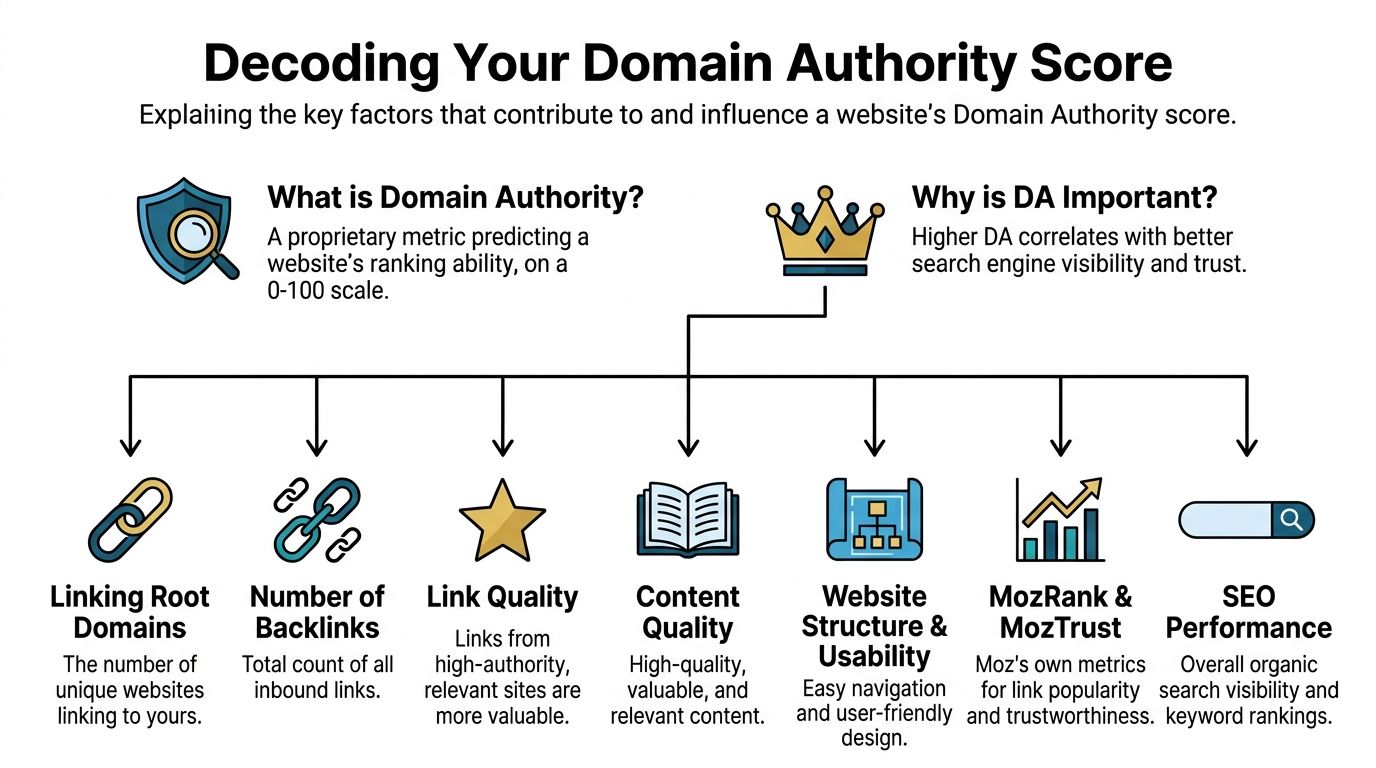
Moz developed Domain Authority, usually shortened to DA, as a third-party SEO metric that estimates how competitive a domain may be in search results. It uses a 1 to 100 scale and weighs link-related signals heavily, especially the quality and breadth of websites pointing to yours, as noted earlier.
The practical point is simpler than the model behind it. DA gives you a fast way to compare your site with the other businesses already winning local searches.
A business owner does not need to memorize the formula. You need to know what the score is reacting to.
What feeds the score
DA rises when your site earns recognition from other credible websites. That recognition usually shows up as backlinks, but not all backlinks carry the same value.
Three patterns matter most:
- Variety of referring domains. A link from ten different relevant sites usually helps more than ten links from one source.
- Quality of the sites linking to you. A chamber of commerce, trade association, local news outlet, supplier, or respected directory sends a stronger trust signal than a low-quality site built only to sell links.
- Overall link profile health. A natural mix of relevant mentions looks stronger than a backlink profile filled with random, off-topic, or spammy links.
Here is how that plays out locally. A Fort Myers roofer that earns mentions from local directories, manufacturer partner pages, community sponsorships, and regional publications is building a pattern of real-world credibility. A competitor that buys cheap links from unrelated websites may increase its link count, but that rarely creates the kind of authority that helps rankings hold.
Why the scale feels harder as you grow
DA is logarithmic. In plain English, early gains are easier than later gains.
A site moving from the lower end of the scale to a more established range can improve with steady local link earning and stronger brand mentions. A business that already has a solid score needs much more authority to gain the same visible increase.
That catches many owners off guard. They expect effort and results to move in a straight line.
They usually do not.
A newer Naples contractor might see progress after joining the right associations, cleaning up citations, earning a few local features, and building useful service pages that attract mentions. An established regional competitor may need far more high-trust links to move the needle by the same amount. That is why DA works better as a comparison tool than as a trophy number.
Key idea: The higher your score gets, the more proof your website needs before SEO tools view it as meaningfully stronger than competing domains.
What the ranges usually suggest
DA ranges are best read as rough competitive tiers, not grades.
| DA range | What it usually suggests |
|---|---|
| 1 to 20 | Newer sites or sites with very little link authority |
| 20 to 40 | Established businesses with some SEO traction |
| 40 to 60 | Stronger domains with consistent authority building |
| 60 to 80 | Highly trusted, competitive domains |
| 80 to 100 | Major publishers, brands, and dominant websites |
For Southwest Florida businesses, the useful question is not whether your company can reach an elite national score. The useful question is whether your site is strong enough to beat the firms competing for the same Fort Myers or Naples searches.
That is where DA becomes practical. If the top-ranking local firms sit in a certain range, you now have a target. Not a vanity target. A market-based target tied to leads, visibility, and revenue.
What DA is good for
DA is most useful for decisions, not bragging rights.
It helps answer questions such as:
- How strong is our domain compared with local competitors?
- Are our link-building efforts improving our ability to compete?
- Do our service pages have enough domain support to challenge the sites already ranking?
Used that way, DA becomes a roadmap. A contractor in Southwest Florida does not need the authority of a national brand. They need enough trusted local and industry recognition to outrank the businesses taking calls from the searches they want.
Comparing DA to Other SEO Power Metrics
A Southwest Florida business owner can open two SEO reports for the same website and see three different authority scores. One report says your domain is average. Another says your backlink profile is strong. A third raises concerns about trust. That does not always mean someone is wrong. It usually means the tools are measuring different parts of the same picture.
Authority metrics work like different inspections on the same property. One looks at the whole building, one checks the strength of the foundation, and one asks whether the materials are reliable. If you know what each score is built to measure, you can make better decisions about where to spend time and budget.
Quick Guide to SEO Authority Metrics
| Metric | Creator | What It Measures | Best Use Case for a Business Owner |
|---|---|---|---|
| DA | Moz | Relative ranking potential of an entire domain, based largely on backlink profile strength | Compare your website against local competitors in Google search |
| DR | Ahrefs | Backlink strength flowing to a domain | Judge whether a potential link source carries meaningful SEO value |
| TF | Majestic | Link trust and quality orientation | Check whether a site’s backlink profile looks credible or risky |
| PageRank | Google (historical) | An older link-based measure of page importance | Helpful as background context, not as a modern reporting metric |
Where DA fits best
DA is the easiest of these scores to use for competitive planning because it gives you a domain-level view. For a roofer in Fort Myers or a law firm in Naples, that helps answer a practical question: how strong does our website look compared with the businesses already taking the clicks?
That makes DA useful in local SEO strategy meetings. If several competitors ranking for your priority searches have stronger domain-level authority, you have a clue about why their service pages are harder to beat. If your DA is in the same general range, the gap may be somewhere else, such as page quality, local relevance, or Google Business Profile strength.
DA is broad. That is its strength.
What DR adds
DR is narrower. It focuses more directly on backlink strength.
That makes it helpful when you are judging link opportunities. If your HVAC company is considering a Chamber of Commerce listing, a local news feature, a trade association profile, or a paid placement on a random directory, DR can help you compare how much raw link value those sites may pass.
Used well, DR helps you avoid a common small business mistake. A site can promise a backlink package that sounds impressive, yet the links come from weak websites with little real authority. A stronger DR on a relevant site does not guarantee results, but it gives you a better filter for deciding which opportunities deserve attention.
Where Trust Flow helps
Trust Flow answers a different question. Is the linking profile behind a site clean and believable?
That matters because some websites look powerful at first glance. They may have a large number of links or inflated-looking authority signals, yet the links come from unrelated, low-quality, or spam-heavy sources. Trust Flow helps you spot that problem before you pay for a sponsorship, directory listing, or outreach placement that does little for rankings.
For local businesses, this is a budget protection metric. If a marketing vendor recommends a site for link building, TF gives you another way to ask whether that recommendation is based on quality or just volume.
Tip: If an agency shows only one authority number, ask what that number leaves out. Good SEO decisions come from context, not a single score.
Why PageRank still shows up in conversations
PageRank is mostly part of SEO history now. Google built it as an early way to evaluate page importance through links, and the term still lingers because many marketers use it as shorthand for link authority.
For a business owner, the practical takeaway is simple. If someone mentions PageRank in a current local SEO pitch, they are usually referring to the old concept behind modern authority metrics, not a score you should be tracking in your monthly report.
Here is the simplest way to keep the metrics straight:
- DA helps you compare your overall website strength against Fort Myers and Naples competitors.
- DR helps you judge whether a backlink source is likely to pass meaningful authority.
- TF helps you screen for link quality and risk.
- PageRank gives historical context for why backlinks matter in the first place.
If your goal is more calls, better visibility, and stronger rankings in Southwest Florida, DA is usually the planning metric, while DR and TF help you choose better authority-building moves.
Three Domain Authority Myths That Cost Businesses Money
Bad assumptions about DA lead businesses into bad spending decisions. The pattern often looks like this: a company hears one partial truth, turns it into a rule, and then builds strategy around the wrong target.
Myth one, DA is a Google ranking factor
It is not.
DA is a predictive metric developed by Moz, not a score Google uses directly in its algorithm. Moz built it to forecast ranking potential by modeling patterns found in search results. That makes it useful. It does not make it a direct ranking factor.
Why this myth gets expensive is clear. Businesses start chasing the score itself instead of improving the underlying signals behind it.
A smarter approach is to treat DA as a thermometer, not the weather. If the score rises because you earned stronger local links, cleaned up weak citations, and built a healthier web presence, that is useful. If you focus only on forcing the number up, you can end up paying for low-value links that do little for leads.
Myth two, the goal is a DA of 100
That is not a local SEO strategy. That is a fantasy benchmark.
The relevant comparison is not your site versus Wikipedia or a national publisher. The meaningful comparison is your site versus the businesses ranking above you for the searches that drive calls, form fills, and consultations in Southwest Florida.
For a Bonita Springs med spa, the right question is whether you have enough authority to beat the med spas and dermatology practices appearing in your target results. For a Cape Coral paving company, the question is whether your authority profile is stronger than the other local contractors winning map pack and organic visibility.
Better target: Beat the sites taking your customers, not the biggest websites on the internet.
Myth three, any high-authority link is a good link
Relevance still matters.
A link from a strong website can help. But if that site has nothing to do with your market, your service category, or your geographic footprint, its value can be limited. Worse, if you build a backlink profile from random placements that do not make business sense, your site can start to look unnatural.
Here is a better way to judge link opportunities:
- Local relevance matters. A Naples chamber listing or community sponsorship often makes more sense for a local firm than a generic placement on a distant site.
- Industry relevance matters. A contractor association, legal association, medical directory, or supplier partner page fits the way businesses build trust.
- Editorial sense matters. If the link would look strange to a customer reading the page, it is probably not a strong SEO choice either.
A Fort Myers electrician does not need links from everywhere. That business needs links and mentions from places that reinforce local trust, trade relevance, and brand legitimacy.
When owners understand these three myths, budgets get cleaner quickly. Less money goes to vanity metrics. More effort goes to assets that support rankings and actual demand generation.
A Local Business Guide to Building Real Authority
A Southwest Florida business does not build authority by chasing a score. It builds authority by giving Google, customers, and other websites repeated proof that the company is legitimate, active, and trusted in its market.
For a contractor in Fort Myers or a professional firm in Naples, that usually starts with a simple question. If someone researched your business across the web today, would they find a clear, consistent reputation, or a scattered footprint with weak signals and few credible mentions?
That is the practical way to approach Domain Authority. Treat it like a reflection of reputation, not a shortcut. As noted earlier, the score gets harder to raise as you climb, so the goal is steady progress that helps you compete locally, not chasing arbitrary milestones.
Start with citations that confirm you are real
Citations are the foundation.
Your business should appear consistently across major directories and relevant local listings, including Google Business Profile, Yelp, Angi, and category-specific platforms tied to your trade or profession. These listings help search engines confirm who you are, where you operate, and whether your business information can be trusted.
Consistency matters more than many owners realize. If your name, address, and phone number are slightly different from one site to another, that creates friction. If those details match everywhere, your online presence looks organized and credible.
If you need help cleaning that up, Polaris offers a local link building service for Southwest Florida businesses that supports citation accuracy and local authority growth.
Earn links through normal business activity
The best local links often come from things your business should be doing anyway.
A Cape Coral roofer sponsors a youth baseball team and gets listed on the league website. A Naples attorney writes a short article for a professional association. A Fort Myers dentist joins a community health event and earns a mention on the organizer's site. An Estero HVAC company gets listed on a builder or property manager partner page.
Those examples work for one reason. They make sense offline first.
That is a useful filter. If a relationship, event, or partnership would make your business more visible in your market, there is a good chance it can support SEO online too.
Build pages worth referencing
Authority grows faster when your website gives people something useful to cite.
A home services company can publish a storm prep checklist for Southwest Florida homeowners, a detailed service area page for Fort Myers or Naples, a financing explainer, or a repair-versus-replace guide based on real customer questions. A professional firm can publish a clear FAQ page, a guide to its process, or a locally relevant article tied to regulations, planning issues, or common client concerns.
Many local businesses stall here. They ask for links before they create anything worth linking to.
A helpful page does two jobs at once. It improves conversions because prospects get better answers, and it improves authority because local organizations, partners, and even journalists have a reason to reference it.
Use reviews as support for authority
Reviews do not function like backlinks, but they strengthen the trust around your brand.
A company with steady review activity, detailed feedback, and consistent mentions of services and locations looks more established online than a company with a thin or outdated profile. That stronger reputation can make your directory listings more useful, your business profiles more persuasive, and your brand more credible when people compare options.
Keep the process simple:
- ask soon after the service is completed
- send the request by text or email while the experience is still fresh
- direct customers to the profile that matters most
- train staff to ask in a natural, repeatable way
Small habits create compounding trust.
Get visible in local media and local organizations
Many Southwest Florida businesses overlook this because it feels like public relations instead of SEO. In practice, the two often support each other.
A contractor can offer hurricane prep advice to a local publication before storm season. A physician can comment on a community health issue. A financial planner can contribute to a chamber newsletter. A law firm can support nonprofit events that publish sponsor pages and recap posts.
Each mention helps build a pattern. Your business appears in places real people recognize, on websites that reflect local relevance, and in contexts that strengthen your reputation in Fort Myers, Naples, and nearby service areas.
Here is a helpful video if you want a broader view of link-building and authority-building in practice.
Local playbook: If a tactic increases trust and visibility in your actual market, it usually supports authority better than generic link building campaigns.
Keep bad shortcuts out of the plan
Cheap link packages, bulk directory submissions, and unrelated placements often look productive in a report. They rarely help a Southwest Florida business win more of the searches that matter.
A better authority plan is straightforward.
| Priority | What to do |
|---|---|
| Foundational | Fix citation inconsistencies and strengthen core directory profiles |
| Local trust | Earn links from chambers, sponsorships, community sites, and local partnerships |
| Industry trust | Build references from associations, vendors, suppliers, and trade organizations |
| Content support | Publish pages that answer local questions and deserve citations |
| Reputation support | Generate reviews and keep business profiles complete and active |
For a local contractor or professional service firm, real authority works like business reputation at scale. It is built through consistent proof, relevant mentions, and useful content that helps customers choose you over the competitor down the road.
How to Measure Your Authority and Track Progress
Authority is easier to manage when you stop treating it like a mystery and start measuring it against the businesses you compete with.
The simplest starting point is your own score. Moz offers free ways to check Domain Authority, including tools such as Link Explorer, and many marketers use the MozBar browser extension to get a quick read while browsing. You can also compare that against competitor domains one by one.

Run a simple local comparison
Pick one keyword that matters to revenue.
Examples:
- HVAC repair Fort Myers
- personal injury lawyer Naples
- roof replacement Cape Coral
- family dentist Estero
Search the term in Google and note the top organic competitors. Then check each domain’s authority score using the same tool so the comparison is apples to apples.
This gives you a working benchmark. If your site is materially weaker than the sites consistently ranking above you, your strategy likely needs more authority-building support alongside content and on-page SEO.
What to track each month
Do not stare at one number in isolation. Track a small set of indicators together.
Your DA trend
Look for directional movement over time, not daily swings.Referring domains
New quality linking domains often tell you more than raw backlink counts.Local ranking movement
Watch service keywords tied to actual lead generation.Profile quality
Check whether important directories, industry listings, and local partner pages are complete and current.Lead indicators
Calls, form fills, and booked appointments matter more than authority alone.
If you need ideas for tools that support this process, this guide can help: https://polarismarketingsolutions.com/best-tools-for-competitor-analysis/
Set a target that makes business sense
A realistic DA goal depends on your competitive environment.
If you are a newer site, the first win may be moving out of the lowest range and building enough trust to compete with established local players. If you are already established, the goal may be widening the authority gap between you and smaller competitors.
The main mistake is choosing a target with no local context. “I want a DA of 70” is not a strategy. “I want to exceed the authority of the top three roofing competitors in Fort Myers while improving rankings for roof repair and replacement pages” is a strategy.
Measurement rule: Track authority to improve decisions, not to decorate reports.
Expect movement in both directions
Your score can go up, hold steady, or decline. That does not always mean your SEO is broken.
Because DA is comparative, your score can shift when the broader web changes or when stronger sites gain more links. That is another reason to focus on competitive context. If your business is gaining visibility, rankings, and leads while the score moves only modestly, the strategy may still be working well.
Use authority as one part of the dashboard. It is a useful signal. It is not the whole business.
Let Polaris Build Your Authority in Southwest Florida
A lot of SEO advice sounds good in theory and falls apart in execution. Local authority building only works when someone turns it into disciplined monthly action.
That means cleaning up citations, improving Google Business Profile signals, earning relevant local links, building location-aware content, and managing reviews in a way that supports trust across your online presence. Those are operational tasks, not just concepts.
Polaris Marketing Solutions applies that kind of work for businesses in Fort Myers, Cape Coral, Estero, Bonita Springs, and Naples. The agency’s local SEO services include the pieces that support authority over time, including citation building, local visibility work, reporting, and competitor analysis. The owner’s background running a cleaning company also matters here because small business owners do not need theory alone. They need marketing tied to clear ROI and lead generation.
For a contractor, healthcare practice, law firm, or other professional service business, the value of authority is simple. A stronger online reputation helps your site compete for the searches that lead to calls and appointments. It also makes the rest of your SEO work more effective because strong service pages perform better when the domain behind them has more trust.
If your current rankings feel stuck, the first useful step is often a competitive review. That reveals where your authority profile stands, where competitors are stronger, and which local opportunities you can realistically win.
Your Domain Authority Questions Answered
How long does it take to improve my Domain Authority
Not overnight.
Authority grows as your site earns better links, stronger citations, and more trusted mentions over time. For some local businesses, early gains happen faster because lower scores are easier to move than already strong ones. The bigger point is consistency. Sporadic SEO rarely builds lasting authority.
Can my DA score go down
Yes.
It can drop if you lose good backlinks, if your link profile weakens, or if competing websites strengthen their own profiles faster than you do. Because DA is comparative, a decline does not always mean your site got worse in isolation.
Can a site have high DA and still not rank well
Yes.
A strong domain still needs relevant pages, solid on-page SEO, useful content, and alignment with the search term. Authority helps your site compete, but it does not replace relevance or user intent.
Should I focus on DA or leads
Leads.
DA matters because it supports visibility. Visibility matters because it supports revenue. If a tactic improves the score but does not improve your ability to win qualified traffic in Southwest Florida, it is probably the wrong priority.
If you want a clear picture of where your website stands, Polaris Marketing Solutions offers a complimentary online analysis and competitor report. It is a practical way to see how your authority compares with local competitors and where to focus next.