
It’s a question we hear all the time from business owners in Southwest Florida: "Why are my competitors all over the Google Map Pack while my business is buried?" If you're feeling invisible in local search results, you're not alone. But the good news is, climbing to the top isn't about luck—it's about a smart, repeatable strategy.
For service businesses in Fort Myers, Cape Coral, or Bonita Springs, landing in that coveted "Map Pack" is what makes the phone ring. It’s not about having the most expensive website; it's about proving three things to Google: your relevance, your proximity, and your prominence.
This guide is our playbook, built from years of getting real-world results for local businesses just like yours. We’re cutting through the noise to give you tangible actions that work, starting with the absolute foundation of local SEO: your Google Business Profile.
Understanding The Ranking Process
Success on Google Maps boils down to a clear process. It's a cycle where you master how Google sees your business through your profile, the keywords you target, and the way customers interact with your listing.
This simple diagram breaks down the core components you need to get right.
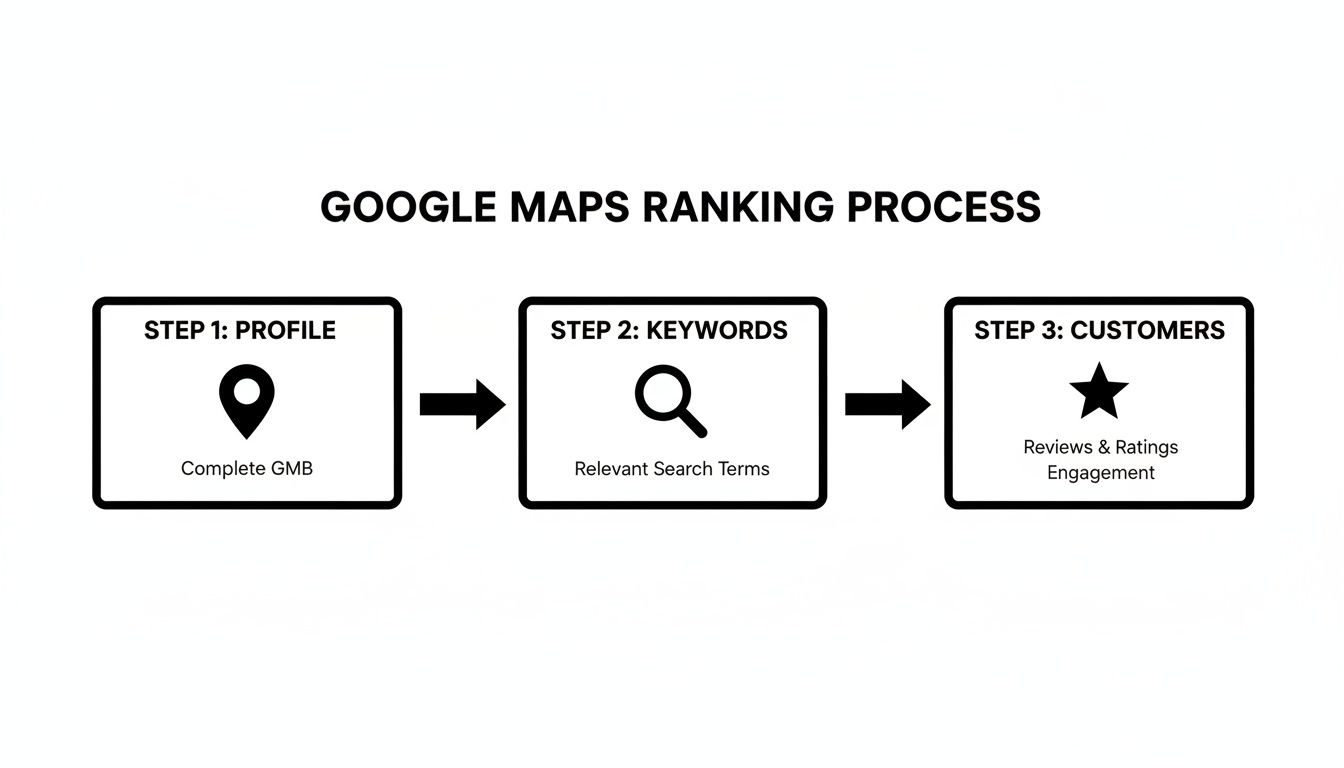
Think of it as an ecosystem. A fully optimized profile attracts the right customers, and their interactions—reviews, clicks, messages—send powerful signals back to Google, reinforcing your authority for the keywords that matter. For example, a plumber who optimizes their profile for "emergency plumbing" will attract users searching for that term. When those users call, get directions, and leave positive reviews mentioning "fast emergency service," it tells Google this plumber is highly relevant for that specific, high-value keyword.
The Three Pillars Of Local Search Success
To climb the ranks, your strategy needs to be built on a solid foundation. These are the non-negotiables.
- Google Business Profile (GBP) Perfection: This is your digital storefront. An incomplete, inaccurate, or neglected profile is the #1 reason businesses fail to rank. It's that simple.
- Customer-Centric Keywords: You have to get inside your customers' heads. Are they searching for "AC repair Fort Myers" or "air conditioning service near me"? The answer shapes your entire content and optimization strategy.
- Trust Through Engagement: Positive reviews, quick responses, and a steady stream of new photos tell Google that you're an active, trusted business worthy of a top spot.
Many business owners come to us thinking they have a website problem, but what they really have is a Google Business Profile problem. A messy profile with the wrong category, no defined service areas, and outdated photos will sabotage your rankings before you even get started.
Quick Wins to Improve Your Google Maps Rank Today
Ready to take action? Here are the most impactful things you can do right now to start improving your visibility in local Fort Myers search results.
| Action Item | Why It Works | Example for a Fort Myers Roofer |
|---|---|---|
| Fill Out 100% of Your GBP | Google rewards completeness. An unfinished profile signals a lack of effort and authority. | Add business hours, all payment methods, accessibility info, and a detailed business description that includes phrases like "roof repair in Fort Myers" and "serving Lee County." |
| Add 10 New Photos | Fresh, geotagged images show your business is active and provides visual proof of your work. | Upload pictures of a recent roof replacement in the Gateway area, with captions like "New tile roof in Fort Myers, FL." Make sure the photo's file name is fort-myers-tile-roof-replacement.jpg before uploading. |
| Respond to Your Last 5 Reviews | Responding shows you're engaged and value customer feedback, a key trust signal for Google and users. | Positive Review Response: "Thank you, Sarah! We're so glad you're happy with your new roof." Negative Review Response: "Hi Mark, we're sorry to hear this. Please call our office so we can make this right." |
| Post a Google Business Update | Updates function like mini-ads, keeping your profile fresh and allowing you to target specific keywords. | Create a post: "Hurricane season is here! Get a free roof inspection in Fort Myers. Call us today!" with a link to your site. Include a high-quality photo of your team. |
These small steps can create immediate momentum. The key is consistency.
To truly master local search in Fort Myers, you need to build on these fundamentals. For a complete overview of the core principles, this guide on How to Rank in Google Maps: A Guide to Local SEO Dominance is an excellent resource. It covers the theory that we'll be turning into practical, local steps for your business right here.
Optimizing Your Google Business Profile for Local Searches
Your Google Business Profile (GBP) is the single most important piece of the puzzle for ranking in Google Maps. Forget all the complex, shiny objects for a moment. Most service businesses in Southwest Florida that struggle with local visibility have one thing in common: a neglected or incomplete profile.
Getting this right isn't just a suggestion; it's the absolute foundation of your local search presence. A fully optimized GBP is how you signal to Google exactly who you are, what you do, and where you do it. This information is what puts you in front of a potential customer in Fort Myers when they search for your services. A great profile doesn't just rank—it convinces searchers to pick up the phone and call you.
Choosing Your Business Categories
One of the first—and most critical—decisions you'll make on your profile is choosing your business categories. Think of it like the sign above your shop door. If you’re a plumber, you wouldn't hang a sign that says "General Contractor." It sounds obvious, but so many businesses get this wrong.
Your primary category has the most weight. You need to choose the most specific and accurate description of your core service. For example, if your company does lawn care but specializes in tree trimming, "Tree Service" is a far better primary choice than the broader "Landscaper." It immediately tells Google your specialty.
But don't stop with just one. Google lets you add multiple secondary categories, and you should use every relevant one you can. This is where you fill in the gaps and capture your full range of work. An actionable example for a landscaping company would be:
- Primary Category: Landscaper
- Secondary Categories: Lawn Care Service, Irrigation System Contractor, Landscape Designer, Sod Supplier
By adding those extra categories, you're suddenly in the running for searches like "irrigation repair near me" in Cape Coral or "sod delivery in Estero." This is free advertising space to tell Google every single thing you offer.
Crafting a Compelling Business Description
You have 750 characters for your business description. Don't waste them on corporate fluff. This is your direct sales pitch to a local customer who is actively looking for help.
Your GBP profile is often the first interaction a customer has with your business. An optimized profile with complete service areas, accurate categories, and a steady stream of fresh photos and reviews tells Google and your customers that you're an active, trustworthy choice in the local market.
Get straight to the point. Think about what a homeowner in Southwest Florida actually needs to know. Mention your key services and name the specific towns you work in.
A weak example: "We are a full-service AC company dedicated to customer satisfaction. We offer quality service."
A much better example: "Your trusted choice for fast AC repair in Fort Myers and Lehigh Acres. We specialize in residential air conditioning service, installation, and maintenance across Southwest Florida. Our NATE-certified technicians are ready to restore your comfort. Family-owned and operated in Lee County for over 15 years."
See the difference? The second one is packed with location terms and service keywords. It feels local, trustworthy, and is far more powerful for both customers and search engines. For a deeper dive into this, check out our complete guide on how to optimize a Google Business Profile.
Service Areas, Photos, and Profile Activity
If you're a service-area business (SAB) that travels to your customers, defining your service area properly is absolutely essential. Don't just list "Fort Myers." Get specific. Add "Cape Coral," "Bonita Springs," "Estero," and even smaller communities like "Gateway" or "San Carlos Park." This tells Google precisely where you operate and gives you a fighting chance to show up in the map pack for searches from those zones.
Finally, you have to keep your profile alive. A profile that hasn't been touched in months sends a signal to Google that your business might be out of date or, worse, closed.
- Add Photos & Videos: Regularly upload high-quality, geotagged photos of your team on the job, your service vans, and your finished work. Start with at least 10-15 photos and then add a few new ones every week or two. For example, a pool service company should upload a picture of a clean pool in Cape Coral with the caption, "Another sparkling pool in Cape Coral, FL. Weekly service available!"
- Use Google Posts: Share updates about your business. This could be a special offer, a recently completed project, or a new service you're offering. Using a tool like a Google Business Scheduler can help you manage these updates efficiently and maintain a consistent presence.
- Answer Q&As: Jump into the Q&A section and answer common questions yourself. This lets you control the information and give potential customers the answers they need right away. An electrician could pre-emptively ask and answer: "Q: Do you install EV chargers? A: Yes, we are certified EV charger installers for all major brands, including Tesla. Contact us for a free quote in Fort Myers!"
Consistently working on these elements transforms your GBP from a simple listing into a powerful, automated lead-generation tool.
Using Reviews to Build Trust and Get Found on the Map
When it comes to local search, online reviews are your most valuable asset. They’re the single best form of social proof, telling both Google and potential customers in Fort Myers that your business is active, reliable, and trusted by the community. A steady stream of positive feedback is how you rank in Google Maps.
Think of it this way: every 5-star review is a direct endorsement. It’s a customer telling Google, "This business did a great job," which is a signal the algorithm can't afford to ignore. If your reviews are old or non-existent, your profile starts to look abandoned, and Google will always favor competitors who are actively proving their worth today.
How to Actually Get More Reviews
The secret to getting more reviews isn't complicated: you have to make it incredibly easy for happy customers. Most people are perfectly willing to leave feedback, but they won't jump through hoops to do it. You need to remove every bit of friction from the process.
Forget about aggressive pop-ups or complex email campaigns. The most effective approach is a simple, personal request sent right after you’ve finished the job.
A post-service text message is a game-changer for any Southwest Florida business. It's direct, it feels personal, and it catches the customer while the positive experience is still fresh in their mind.
Here’s what that looks like for a Fort Myers Pressure Washer:
Hey [Customer Name], this is [Your Name] from [Company Name]. Thanks again for trusting us to clean your driveway today! If you have a moment, would you mind sharing your experience on Google? It really helps our small business. Here's the link: [Your Direct Google Review Link]
This approach is friendly, not pushy, and gives them the exact link they need. This one small action can make a huge difference in your review volume. For a deeper dive, check out our guide on how to get more online reviews for your business.
The Overlooked Power of Responding to Every Review
Getting reviews is only half the job. Responding to them—both the good and the bad—is just as important for building your authority. When you reply, you're not just talking to that one customer; you're showing every future prospect (and Google) that you are engaged and stand behind your service.
A prompt, professional response to a negative review can often turn a bad situation around. More importantly, it shows other potential customers that you take accountability. And when you thank a customer for a positive review, you reinforce their good feelings and add a human touch that builds loyalty. A great response to a positive review might be: "Thank you, Jane! We're thrilled you love your new hurricane shutters. It was a pleasure working on your Bonita Springs home." This reinforces the service and location.
The data doesn't lie. Businesses that maintain a 4.5+ star rating on Google Maps see their 'near me' rankings climb by an average of 28%. Reviews are a massive piece of Google's ranking puzzle, and freshness is a key ingredient. Stale reviews from a few years ago just don't carry the same weight as recent feedback, which can give you a serious edge in today's AI-driven search results. You can find more insights about how review freshness impacts map rankings on clicksgeek.com.
Driving Other Important User Signals
While reviews are king, Google also keeps a close eye on how users interact with your profile in other ways. These "behavioral signals" tell the algorithm that people find your listing useful, which directly helps you rank higher in Google Maps.
The main user signals you want to encourage are:
- Click-to-Call Rate: How many users tap the "Call" button.
- Direction Requests: The number of people asking for directions (critical for storefronts).
- Photo Views: How often people look through your photos and videos.
- Website Clicks: The number of users who click from your GBP to your website.
You can actively push people toward these actions. Add high-quality photos of your team working on a job in Estero or a quick video testimonial from a happy client in Cape Coral. This makes your profile more engaging and encourages users to stick around.
One of the fastest wins is to activate the messaging feature on your Google Business Profile. It gives customers another easy way to get in touch and shows Google you’re accessible and responsive—both are huge trust signals.
Another powerful but underused tool is the Q&A feature. Don't wait for customers to ask questions; seed this section yourself. Think of the top 5-10 questions you always get from new customers and post them with clear, helpful answers.
Example Q&A for a Bonita Springs Electrician:
- Q: Do you offer free estimates for panel upgrades?
- A: Yes, we provide free, no-obligation estimates for all electrical panel upgrades in Bonita Springs and the surrounding areas. Give us a call to schedule yours!
This proactive strategy turns your profile into a go-to resource, making it easier for customers to choose you and building incredible authority with Google over time.
Building Local Authority with Citations and Backlinks

While your Google Business Profile is the centerpiece of your local SEO, it can't do the job alone. Google is constantly scanning the wider web, looking for other sources that validate what you've put on your profile. This is where citations—mentions of your business's Name, Address, and Phone number (NAP)—play a huge role.
Think of it as Google checking your references. When it finds your exact NAP listed consistently across dozens of trusted websites, it builds confidence that your business is real, active, and located where you say it is. This trust is a massive ranking factor for Google Maps. Any inconsistency, however, plants a seed of doubt and will absolutely hurt your visibility.
Why NAP Consistency Is Non-Negotiable
NAP consistency is the bedrock of local SEO. It’s a simple concept that so many businesses get wrong. Even a tiny error, like listing "St." in one directory and "Street" in another, can create confusion for search engines and dilute your authority. For any business in Fort Myers, this means your info needs to be identical everywhere. For example, if your official business name is "Coastal Breeze AC, LLC", it cannot appear as "Coastal Breeze Air Conditioning" on Yelp and "Coastal Breeze A/C" on Angi.
The goal is to build a clean, unified digital footprint that sends an unmistakable signal to Google. It often starts with an audit to find and clean up old or incorrect listings—a surprisingly common problem that holds businesses back.
I once worked with a driveway sealing company that was invisible on Maps. The problem wasn't their website; it was the nine duplicate listings we found with old phone numbers and wrong addresses. Cleaning up those messy citations and getting their NAP consistent was the key to getting them into the map pack.
Your Go-To Citation Sources in Southwest Florida
Not all citations carry the same weight. You need to focus on high-quality, relevant directories, starting with the big data aggregators before moving on to industry and location-specific sites. For service businesses here in the Fort Myers area, these are the platforms you can't afford to ignore:
- Major Directories: Yelp, Bing Places, Apple Maps, Nextdoor
- Industry-Specific Sites: Angi, Houzz, HomeAdvisor (for home services)
- Local Portals: The Fort Myers Chamber of Commerce, Cape Coral Chamber of Commerce
Auditing and correcting your listings on these core sites is a critical first step. For a more exhaustive and professional strategy, you can explore specialized local citation building services.
This methodical work directly influences your "prominence," a key pillar of Google's local algorithm. Prominence is all about how well-known your business is, and it's fueled by signals like citations and profile activity. Remember, while 86% of customers use Maps to find local businesses, the actions you take are what get you seen. You can get more details about how Google determines local ranking on their support page.
Earning Local Backlinks That Actually Move the Needle
Once your citations are in order, the next level of building authority is earning local backlinks. These aren't just directory listings. They are real, earned links to your website from other local businesses, organizations, and news outlets. A link from a trusted local source is a powerful vote of confidence for Google.
This strategy requires you to get away from the keyboard and actually engage with your community. Most of your competitors aren't doing this, which gives you a huge advantage.
Here Are a Few Ideas to Get You Started:
- Sponsor a Local Event: Put your name on a 5K in Fort Myers, a festival in Cape Coral, or a local youth sports team. You'll almost always get a valuable link from the event's website or sponsors page. For example, sponsoring the "Cape Coral Festival of the Arts" could earn you a link from a high-authority
.orgwebsite. - Partner with a Non-Competing Business: Team up with a complementary business for a promotion. A pool cleaning service, for example, could work with a landscaper on a "Complete Backyard Makeover" guide, with both businesses linking to each other.
- Get Featured on a Local Blog: Reach out to local bloggers or news sites like the Florida Weekly. Offer your expertise for a story, like a local roofer sharing tips on "Hurricane-Proofing Your Roof." This provides value to their readers and earns you a powerful, contextually relevant backlink.
These local links prove your business is an active, trusted part of the Southwest Florida community. It’s this kind of real-world authority that helps secure those top spots on Google Maps.
Advanced Strategies for Hyperlocal Dominance in 2026
So, you've nailed the basics. Your Google Business Profile is dialed in, and you’ve got a steady stream of reviews coming in. That’s fantastic, but it’s really just the ticket to the game. If you’re serious about separating your business from the pack and truly owning your market here in Southwest Florida, it’s time to move on to the advanced playbook.
These are the strategies we use for clients who are ready to invest in long-term, dominant visibility.
The whole game changes when you start thinking hyper-local. It’s not enough for Google to see that you're in Fort Myers. You need to prove you're an integral part of the specific communities you serve, from Cape Coral to Bonita Springs. This means building a trail of digital proof that establishes your expertise on a granular, neighborhood-by-neighborhood level.
Create Hyperlocal Service Pages
Let’s be honest, that generic "Our Services" page on your website isn’t cutting it anymore. If you want to rank in Google Maps when a real customer is searching, you have to meet them where they are. That means creating dedicated pages for each core service you offer in each key town you work in.
Think about how people actually search. A homeowner in Gateway isn’t just typing “roofer” into Google. They’re searching for “roof repair in Gateway” or “tile roofing company near me” while sitting in their living room. By creating individual pages optimized for these real-world searches, you give Google exactly what it’s looking for: the most relevant possible answer to a user's problem.
Here’s a real-world example for a Fort Myers paving company:
Instead of one catch-all service page, we’d build out a series of powerful, specific landing pages:
- Asphalt Paving in Bonita Springs
- Driveway Sealing in Estero
- Parking Lot Striping in North Fort Myers
- Paver Installation in Cape Coral
Each of these pages needs to be more than just a headline. It should have unique content talking about the work, photos from actual jobs in that town, and maybe a testimonial from a client right there in that community. For instance, the "Paver Installation in Cape Coral" page should feature pictures of a paver driveway project near the Cape Coral canals and a review from that homeowner. This sends an undeniable signal to Google that you are the authority for that service in that specific location.
Implement Local Business Schema
On-site SEO is more than just scattering keywords around. One of the most powerful, and often overlooked, technical signals you can send is Local Business schema markup. This is a chunk of code that gets added to your website’s backend, and it acts as a direct translator for search engines.
It essentially spoon-feeds Google all your critical business information in a language it understands perfectly. It removes any and all guesswork about your:
- Official Business Name
- Address and Service Area
- Phone Number
- Hours of Operation
- Reviews and Aggregate Rating
For example, a plumber could use schema to tell Google their exact service radius, the types of plumbing they specialize in (e.g., "emergency repairs," "drain cleaning"), and their average customer rating. Getting this code on your site gives you a huge leg up on competitors. It helps Google definitively connect the dots between your website and your Google Business Profile, which strengthens your authority and makes it far more likely you’ll show up in those all-important local map searches.
While it sounds super technical, implementing schema is a foundational move for any business that's serious about local search. Think of it as giving Google a perfectly organized filing cabinet of your business info instead of a messy pile of papers it has to sort through.
Use Geogrid Tracking to Pinpoint Weaknesses
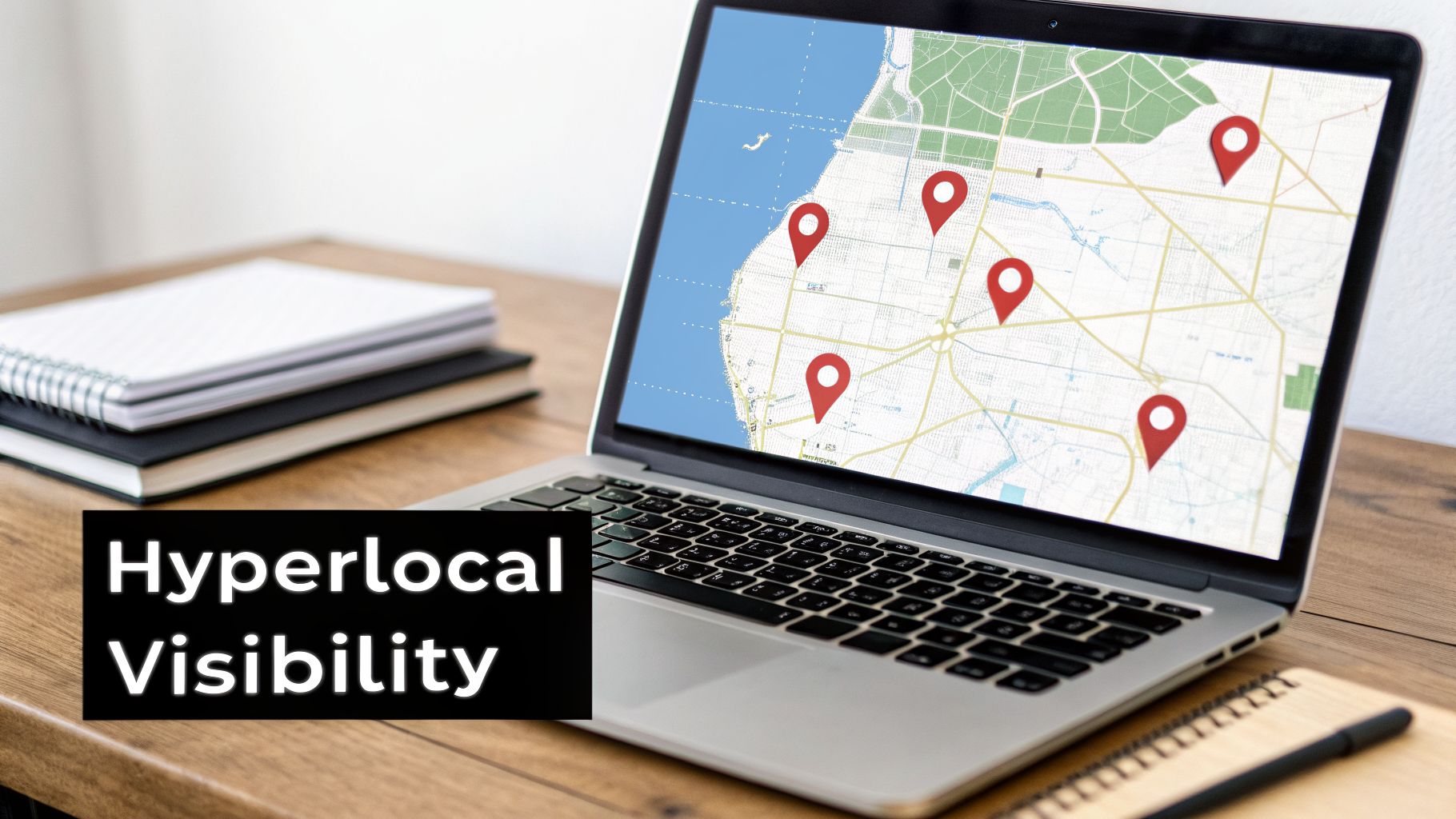
How do you really know if your optimization efforts are working across your entire service area? This is where geogrid tracking tools become your best friend. These tools produce a visual "heat map" of your Google Maps rankings, showing you precisely where you’re strong and, more importantly, where you’re invisible.
For any service-area business, whether you're a plumber or a personal injury lawyer, Google’s results are heavily biased by the searcher’s physical location. This means you might be ranking #1 when someone searches from right down the street, but you fall off the map completely just a few miles away. For businesses that land in the top three Google Maps spots, this visibility can lead to a potential 10X increase in sales compared to ranking just a few positions lower. Geogrid trackers expose this reality. They run searches from hundreds of different points across a city, creating a color-coded map—green where you’re on top, and red where you're a ghost. You can see how these map checkers work at mapranking.com.
This data isn't just interesting; it's incredibly actionable. If your geogrid report shows your paving company is #1 in North Fort Myers but #15 in Cape Coral, you know exactly where to point your efforts. Now you can build out that specific "Paver Installation in Cape Coral" landing page we talked about, get a few new reviews from Cape Coral clients, and fix the weak spots in your digital armor. It’s about ensuring you show up where your customers actually live and work.
Common Questions About Google Maps Rankings
When we sit down with service business owners across Southwest Florida, from Fort Myers to Naples, the same questions about Google Maps always come up. There's a ton of misinformation out there, so let's cut through the noise and give you some straight answers.
These are the real-world concerns we hear every day, and here's the practical advice we give our clients to get them ranking.
How Long Does It Take to See Results on Google Maps?
This is always the first question, and the honest answer is, it depends. You might see some small, encouraging bumps within a few weeks just from getting the basics right, like completely filling out your Google Business Profile. But locking down a stable, top-three spot is a marathon, not a sprint.
For most businesses trying to compete in a hot market like Fort Myers, you’re typically looking at three to six months of consistent work before you see significant, lasting results.
A few things will speed up or slow down your timeline:
- How Tough Your Market Is: Trying to rank a pressure washing company is a different ballgame than ranking for a niche medical service. More competition means more time.
- Your Starting Line: A brand-new profile is starting from scratch. It takes longer to build trust and authority than it does to tune up an older, established profile.
- How Fast You Move: The pace at which you’re earning new reviews, uploading fresh photos, and building local signals directly tells Google how active and relevant you are. For example, a business getting 5-10 new reviews a month will rank faster than one getting 5-10 a year.
The big takeaway? Ranking in the Map Pack isn’t a one-and-done task. It's an ongoing effort to prove you’re the best answer for a local customer.
Do I Need a Physical Address to Rank in Google Maps?
This one trips up a lot of service-area businesses (SABs)—think plumbers, contractors, and mobile detailers. You do need a real physical address to get your profile verified by Google. But you absolutely can, and should, hide that address from the public.
When you set up your Google Business Profile, you’ll have a crucial choice to make: designate yourself as a service-area business. This is non-negotiable. It tells Google not to put a pin on your home or un-staffed office.
Instead, you’ll define your service areas by listing the actual cities and zip codes you cover, like "Cape Coral," "Bonita Springs," and "Estero."
For a service business, your rank isn't tied to your hidden address. Google judges you based on your authority and activity within the service areas you claim. Getting this right is fundamental to showing up where your customers are actually looking.
Can I Outrank a Competitor with More Reviews?
You absolutely can. While having a lot of reviews helps, it’s not the most important piece of the puzzle. Google cares a lot more about review recency and quality.
Think about it this way: a business with 50 total reviews, but 10 of them came in last month with detailed comments and responses from the owner, looks much more active and trustworthy to Google. They will often beat a competitor who has 200 reviews, but they’re all from two years ago. An actionable goal is to aim for 5 new reviews every month.
Your goal should be a steady, consistent stream of new, positive reviews. That constant activity is a massive signal to Google that you’re in business, doing great work, and satisfying customers right now. It's a powerful way to climb the ranks on Google Maps.
How Does My Website Affect My Google Maps Rank?
In Google’s world, your website and your Google Business Profile are two sides of the same coin. They are deeply connected. A professional, mobile-friendly website with content that matches your services and locations gives a massive boost to everything you’re doing on your profile.
For example, if you want to rank for "AC repair in Lehigh Acres," having a dedicated page on your website with that exact title is a game-changer. That page should talk all about your AC services and specifically mention the work you do for clients in the Lehigh Acres area. When Google sees that your website has a page titled "AC Repair Lehigh Acres" and your GBP lists "Lehigh Acres" as a service area and has reviews from customers there, it connects the dots and boosts your ranking for that search.
This connection is a two-way street. The authority of your website feeds into the "prominence" factor of the local search algorithm, which helps your Google Business Profile rank higher. On the flip side, a slow, outdated, or insecure website will absolutely hold your Maps ranking back.
Ready to stop guessing and start ranking? The team at Polaris Marketing Solutions builds custom strategies that help Fort Myers businesses like yours dominate local search in 2026. We handle everything from GBP optimization to hyperlocal content, so you can focus on running your business. Get your free online analysis and competitor report today!