
Plumbing websites don't have to be pretty to win business, they have to convert urgent visitors fast. A LocaliQ-based analysis reported that plumbing websites averaged a 15.61% conversion rate, the highest among home services categories in the study, which is a strong signal that website design for plumbers is a revenue tool, not a branding accessory (Home service conversion stats). When someone's dealing with a leak, a clog, or a broken water heater, the site has one job, earn enough trust and clarity to get the call or form fill before the competitor does.
That's why the best plumbing sites feel less like brochures and more like guided paths. They put the phone number where a thumb can hit it, they show the service area in plain language, and they use real proof instead of decorative fluff. In a category where homeowners are comparing providers quickly, the site itself becomes the first sales conversation.
Why Plumbing Websites Convert at Higher Rates
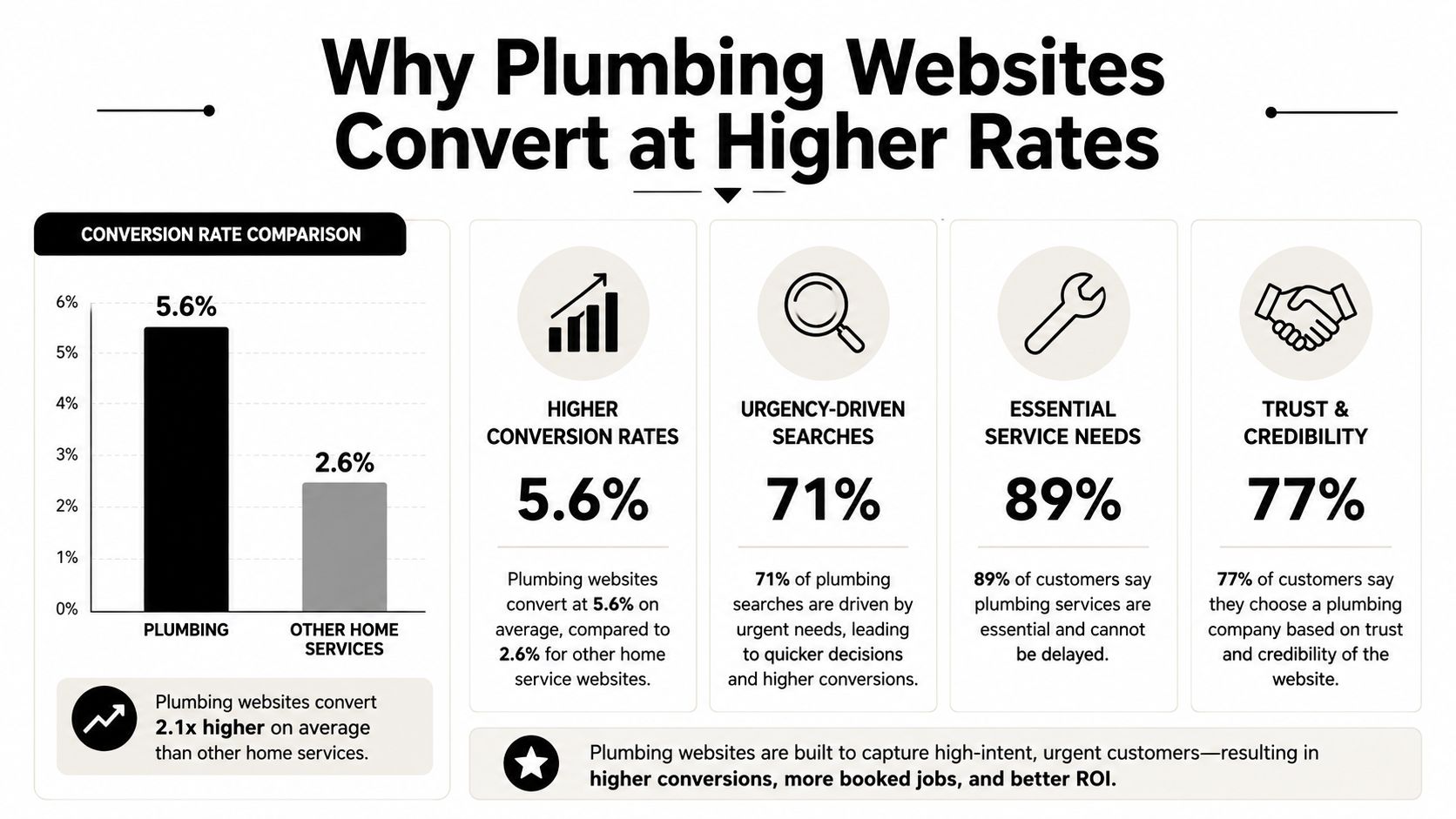
Plumbing is one of the few home service categories where the visitor often arrives under pressure. That changes the job of the website. It has to remove doubt quickly enough for a homeowner to call or fill out a form, and that is part of why plumbing sites can outperform other home service categories on conversion benchmarks.
The number that matters is the 15.61% average conversion rate reported for plumbing websites in the LocaliQ-based analysis, higher than pest and rodent control at 15.52% and air conditioning sales at 15.11% (Home service conversion stats). On paper, those gaps look narrow. In practice, they show that plumbing visitors are often ready to act if the page gives them a clear next step. Every choice, from phone placement to page speed, affects lead flow.
Trust beats decoration
Industry research cited by Thrive Agency says 95% of consumers compare service providers based on web design and website performance, and at least 70% of U.S. consumers prefer local businesses with well-managed websites or digital platforms (Plumber web design and consumer perception). For a plumber, that means the site usually serves as the first credibility check before the phone ever rings. A polished layout wins by signaling that the business is organized, reachable, and real.
That is the core shift in plumbing marketing. The website used to act like an online flyer. Now it works as a trust mechanism that helps a homeowner decide whether your crew should come into the house. If the design feels dated, slow, or vague, people assume the service will feel the same.
Practical rule: In plumbing, clarity outperforms cleverness. Put service, location, and contact options where the eye lands first, then use design to reinforce reliability instead of trying to impress people with visual tricks.
For teams trying to tighten that conversion path, a solid resource on how to boost conversions gives a broader CRO framework that matches the same principle. The site should behave like a dispatcher, not a brochure.
Gathering Operational Assets for Authentic Content
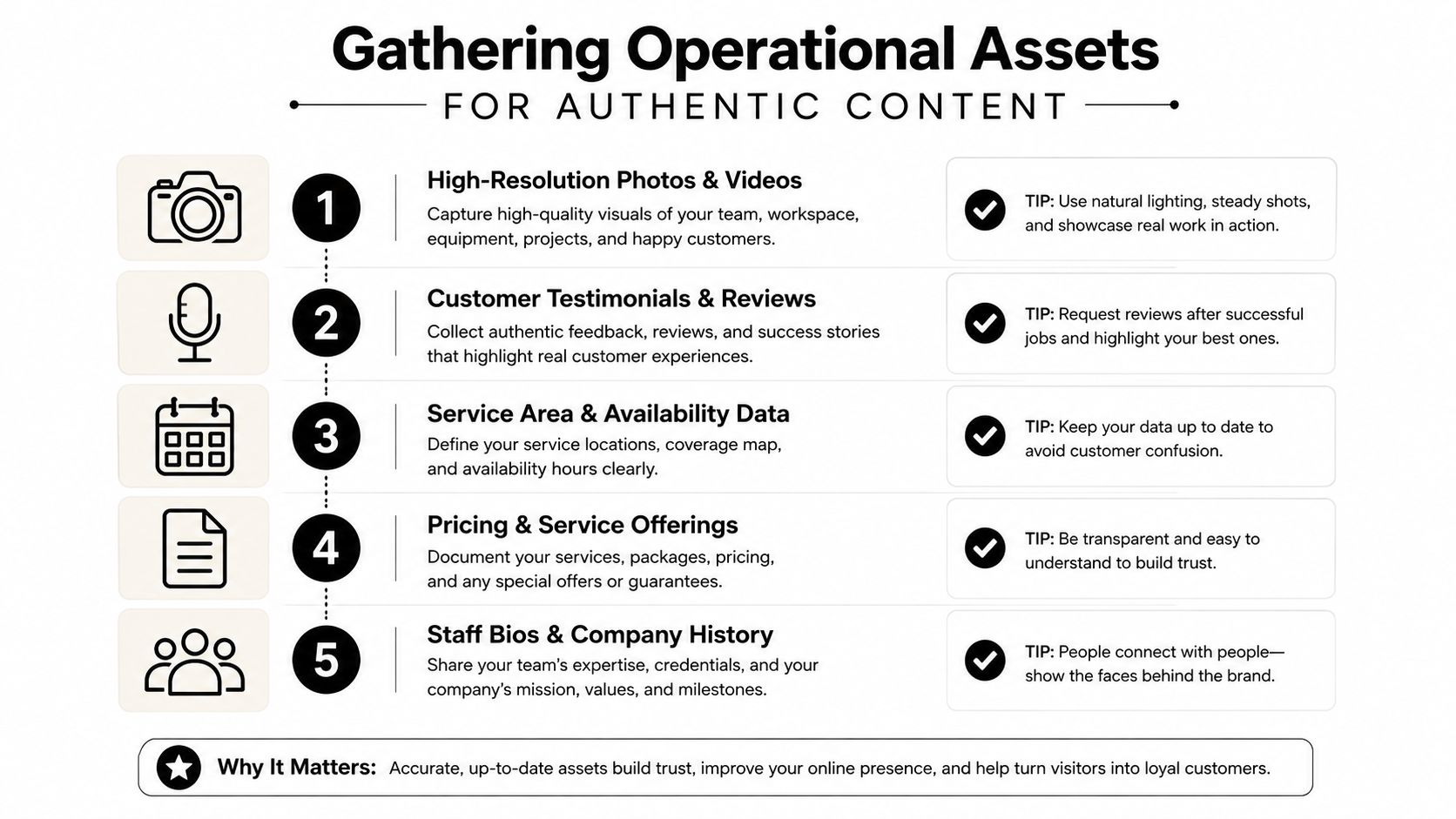
Strong plumbing sites start with real business material, not a template and a stock photo pack. Before design begins, gather the details that let a homepage and service pages sound like your actual company. The better the inputs, the less generic the finished site feels.
Start with the facts customers ask about first
The most useful asset is a complete service list written in customer language. Not internal jargon, not trade shorthand. If your crew handles blocked drains, burst pipes, hot water units, gas fitting, and leak detection, those phrases should be written the way homeowners would search and speak them. That makes it easier to build pages that feel natural and stay relevant.
Next, gather every city, neighborhood, and zip code you serve, along with the exact boundaries of your response area. That supports stronger local pages and avoids the vague “we serve the metro area” language that does very little for search or trust. The same applies to your license numbers, insurance carrier details, and business hours, all of which should be ready before the copy is drafted (Plumber website preparation checklist).
Build a photo library that proves you're real
Stock photography is one of the fastest ways to make a plumbing site feel interchangeable. Replace it with a simple asset library built from real job photos, team photos, trucks, and completed work. Start collecting those images before launch so the homepage, service pages, and about page can reuse them without looking repetitive.
Use this simple collection process:
- Capture the problem and the fix. Before-and-after shots make the work tangible, especially on jobs where the finished result is otherwise invisible.
- Photograph the crew in context. Team photos in uniform, at the truck, or on-site help a homeowner see there's a real operation behind the site.
- Save customer quotes with names. Best Google or Yelp reviews become stronger when they're tied to a visible person and a real review source.
Real photos don't just improve aesthetics. They reduce the “Is this company legitimate?” question that sits behind nearly every residential plumbing inquiry.
The same asset list should include your pricing approach, even if you only use directional language, and a short company history that explains who does the work. If you hand those pieces to the designer early, the finished site feels specific from the first scroll instead of assembled after the fact.
Designing a Mobile-First Lead Path
Most plumbing traffic starts on a phone, and the page design has to match that behavior. Emergency visitors are not browsing for inspiration. They want the shortest path from problem to action, with no extra taps, no tiny text, and no waiting on a slow form.
Build the top of the page around contact, not decoration
A plumber's header should make calling easy the moment the page loads. Put a tap-to-call number in the header, keep it visible as the page moves, and place the primary CTA above the fold so a stressed visitor does not need to search for it. If the number is small, buried, or visually weaker than the logo, the site is asking the customer to do too much work.
For mobile quote requests, keep the form to 3 fields on mobile, name, phone, and problem. That setup cuts friction without making the inquiry vague, which suits emergency-intent users well. A sticky mobile call bar does the same thing in a different way, it keeps the next step one thumb-tap away after the user starts scanning service details (Mobile-first plumber site guidance).
Speed matters because urgency shortens patience
A plumbing site should keep page speed under 3 seconds on 4G, ideally under 2 seconds (Mobile-first plumber site guidance). That matters because slow pages lose impatient visitors fast, especially when someone is dealing with an active leak or a failed hot water system. Compressed images, cleaner code, and reliable hosting are not technical vanity projects, they protect conversions.
If the homepage loads slowly, the best CTA in the world will not save it.
A useful build sequence is to set the service plus city in the H1, place the phone number and CTA above the fold, then test every phone link, booking button, and form on mobile before launch (Mobile-first plumber site guidance). That sequence keeps the site aligned with what a real customer does first, look, confirm, and contact.
For teams that want a fuller build process, this web design service framework from Polaris Marketing Solutions shows how service businesses can connect design, hosting, and lead capture in one workflow. The platform matters less than the reduction in friction from the first tap onward.
Local SEO Architecture and Service Area Pages
A plumbing homepage can't carry the full ranking load on its own. Search engines need a site structure that separates services, service areas, and supporting proof so the right page can match the right search intent. That usually means one unique page per service area and per core service, not one broad page that tries to cover everything.
Build the site like a map, not a flyer
The strongest structure starts with a homepage that introduces the business, then branches into dedicated service pages for blocked drains, hot water, gas fitting, leaks, and bursts. From there, add unique suburb or city pages for each major service area, and make sure each one includes local details instead of recycled copy. Thin location pages fail because they swap in a new place name while keeping the same text, which helps neither users nor search engines, as noted in the plumber local SEO guide.
The technical setup matters just as much. Use unique title tags that include the service and city, keep one H1 per page, and maintain a clear H2 and H3 structure. Add schema markup for LocalBusiness, Service, Review, and FAQ, keep the site on HTTPS with no mixed content, and make sure the sitemap and robots.txt stay clean.
Here's the core architecture I use on local plumbing builds:
| Page type | Purpose | What it must contain |
|---|---|---|
| Homepage | Primary brand and contact entry | Service summary, service area, CTA, trust signals |
| Core service page | Rank for one service intent | Problem, process, proof, next step |
| City or suburb page | Capture local intent | Local details, unique copy, review cues |
| About page | Establish legitimacy | License, insurance, team, company history |
| Contact page | Convert the lead | Phone, form, booking route, hours |
Relevance beats repetition
The business case is straightforward. Local intent is tied to trust signals such as accurate Google Business Profile data, visible reviews, and clear license or insurance details on the site. That means each page should answer a real question for a local searcher, not just repeat the same sales copy in different ZIP codes.
The internal structure matters just as much as the content. Separate pages for distinct services and suburbs give search engines cleaner signals, and the supporting photos, review ratings, and call to action make those pages more useful to a homeowner who is comparing options fast. For a practical reference point on local visibility work, Polaris Marketing Solutions shows how local SEO support can sit beside the website itself without blurring the two jobs.
Trust Signals That Reduce Risk
Generic badges rarely change behavior on a plumbing site. Homeowners usually want a more specific answer, can they trust this company to show up, do clean work, and charge fairly? The strongest trust signals answer that question with evidence, not decoration.
Use proof that lowers perceived risk
The strongest signal is real-job photography. A site filled with actual installs, drain clearances, water heater replacements, and team shots tells a much better story than icons or stock images ever will. Visual proof works because plumbing work is often hidden, behind walls, under sinks, or in basements, so the site has to show that the work really happened.
Pricing transparency is the other big lever. Recent guidance recommends flat-rate language or directional pricing such as “from” pricing for common services, because customers want a rough sense of cost before they call (Trust signals for plumber sites). You do not need to publish every number. You do need to avoid making every page feel like a gated quote request that hides everything until a form is submitted.
Make the proof specific, not generic
Reviews matter most when they are placed near the service they support. Embed them with the reviewer's name and city where possible, and keep the wording close to the actual job type. A water heater page should not rely on a random review about a drain clean, and a suburb page should show local relevance in the proof itself.
Use this rule of thumb when choosing trust assets:
- Real photos over stock. Customers can tell the difference, and the site feels more grounded.
- Service-specific pages over one generic services page. A focused page feels more believable and easier to scan.
- Pricing cues over hidden costs. Even directional pricing reduces uncertainty.
- Public review links over anonymous testimonials. Attribution matters more than polished prose.
A plumbing site does not need more reassurance. It needs the right reassurance in the right place.
If you want a broader brand lens for choosing how that proof looks and feels, best branding agencies is a useful comparative resource. The takeaway for plumbing firms is simple, trust signals should reduce hesitation, not clutter the page.
For reputation-specific tactics, Polaris Marketing Solutions is a practical fit when the site needs to connect reviews, search visibility, and conversion into one system. That matters because the website and the review profile usually work together in the same buying decision.
Technical Performance and Maintenance Routines
A plumbing site can look great on launch day and still lose leads six months later if it isn't maintained. Technical health affects speed, security, and the confidence a visitor feels when filling out a form. It also protects the investment you made in the design itself.
Keep the foundation clean and current
Start with the essentials, HTTPS, reliable hosting, and regular platform updates. If the site runs on WordPress, Webflow, or another CMS, updates should happen on a schedule instead of waiting for something to break. Broken plugins, expired certificates, and outdated code tend to show up as slow pages or failed forms, which is the wrong kind of surprise for a lead-gen site.
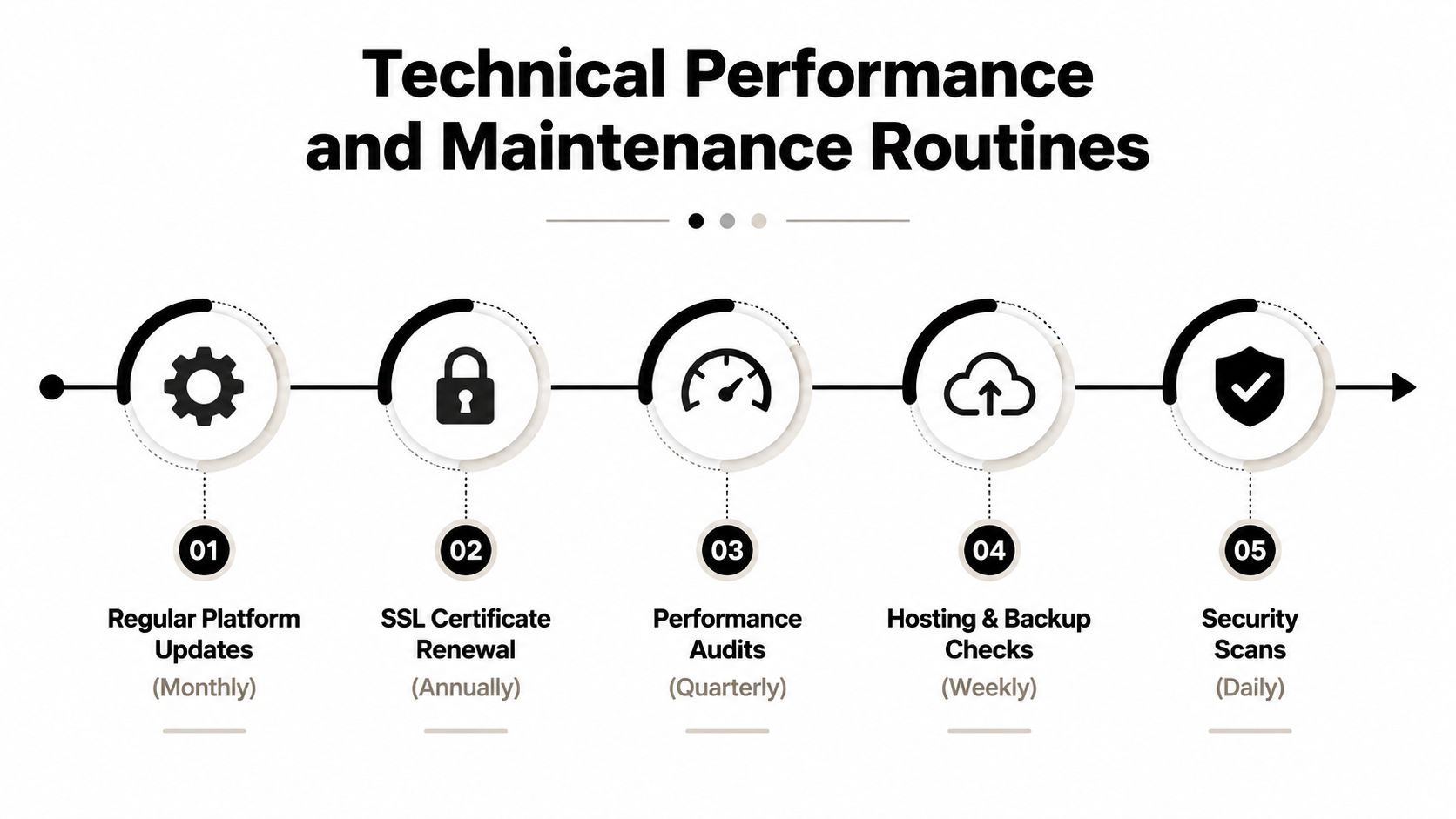
A basic maintenance rhythm should include weekly hosting and backup checks, daily security scans, quarterly performance audits, and monthly platform updates. SSL certificate renewal should be reviewed annually so the site stays secure and browser warnings never interfere with trust (Website maintenance routines). Those tasks are routine, but they're also the difference between a site that consistently performs and one that slowly degrades.
Monitor the conversion path, not just the traffic
The most useful analytics question is not “How many visits did we get?” It's “Where are people dropping off before they call?” Check phone-link clicks, form submissions, and booking button taps, then compare those events before and after content updates. If a service page attracts visitors but doesn't create inquiries, the problem may be the CTA, the proof, or the page order.
Use this maintenance sequence as a working checklist:
- Security scans daily. Catch issues before they affect forms or trust.
- Hosting and backup checks weekly. Make sure recovery is possible if something fails.
- Performance audits quarterly. Look for image bloat, slow scripts, or layout shifts.
- Platform updates monthly. Keep the CMS and plugins stable.
- SSL review annually. Prevent browser warnings and preserve confidence.
For a practical reference on improving site responsiveness, ARPHost offers a useful performance-oriented perspective. The point is to treat the plumbing website like a live asset, not a one-time project.
Polaris Marketing Solutions builds and maintains lead-focused websites for service businesses that need more than a nice-looking homepage. If you want a plumbing site that's structured for mobile calls, local visibility, and real inquiries, visit Polaris Marketing Solutions to see how a conversion-first build can fit your market and your workflow.