

You're probably in a familiar spot. A competitor keeps showing up in the map pack, your calls have flattened, and your site still looks “fine” to everyone who isn't watching search closely. In Tampa, that usually means the problem isn't that SEO “doesn't work,” it's that the work hasn't been tied tightly enough to the buyer's real decision, the one that ends in a phone call, a form fill, or a visit.
That's why search engine optimization services Tampa is really a buying conversation about outcomes. The right engagement should make your business easier to find in the right neighborhood, easier to trust on first glance, and easier to contact without friction. If it can't do that, rankings are just decoration.
What Tampa Businesses Buy When They Buy SEO
A Tampa contractor or clinic owner usually doesn't wake up wanting “SEO.” They wake up after a week where a rival owns the map pack, their own listing slipped, or their website stopped showing up for the searches that used to bring calls. At that moment, the question is simple, what gets the phone to ring?

Ranking and revenue are not the same thing
A business can gain visibility and still miss leads if the site doesn't explain the offer clearly, the Google Business Profile is weak, or the call path is clumsy. In Tampa, that distinction matters because local search is heavily intent-driven. A strong local search program focuses on the pages, profile signals, and conversion paths that turn a search into a contact, which is why a good summary of what local SEO services actually include should talk about more than rankings.
50% of local mobile searches pull up an address or phone number within moments. That is the buying moment most agencies should be building toward, because it points to someone who is ready to contact a business, not just compare options. Tampa local SEO guidance
That's why SEO is usually sold as a retainer, not a one-time project. The work compounds across technical fixes, local signals, content, and authority, and the payoff usually arrives over months, not days. In Tampa service markets, a serious plan should be judged by whether it builds a pipeline of qualified inquiries, not by whether it creates a pretty report.
Practical rule: If an agency talks only about “page one,” ask what they do to track calls, forms, and direction clicks.
The Six Core Components of an SEO Engagement
A Tampa SEO engagement is a working system, not a single deliverable. Each part supports the next, and weak execution in one area usually shows up somewhere else, often in missed calls or form fills rather than in a ranking report. A serious proposal should make clear which six parts it covers and how they connect to the buyer journey.
Technical foundation comes first
Start with crawlability, indexability, speed, and site structure. A good operator runs a crawl audit, checks for broken links, thin metadata, duplicate paths, and pages that search engines may misread, then fixes the parts that stop important pages from being found or understood. Tools like Screaming Frog, DeepCrawl, and Sitebulb are standard because they expose the issues hiding under the hood. For a multi-location Tampa service brand, the site either becomes easy to crawl or stays confusing.
On-page work turns pages into answers
On-page optimization makes each page clearly relevant to one search intent. A Tampa roofing page should speak to roofing, the service area, trust signals, and the reasons a buyer would call now. If the page tries to rank for everything, it usually ranks for nothing useful. For a practical reference point on this work, a structured approach to technical and on-page SEO should include titles, headers, internal linking, and content that matches the query.
Local and Google Business Profile work capture nearby intent
This is the part many Tampa businesses feel first in the phone line. Your Google Business Profile, categories, service areas, photos, Q&A, and review strategy all shape whether nearby buyers see you as a live option. Local intent in Tampa drives action-oriented queries, which makes profile optimization foundational rather than optional. The same applies when a buyer compares two providers on a map pack and decides who gets the call.
Citations and NAP consistency reinforce trust
Citation cleanup means your name, address, and phone number match across directories and platforms. That sounds basic, but sloppy listings still break trust and muddy entity signals. For a Hyde Park clinic or a Brandon home-services business, consistent NAP data helps search engines connect the business to a real place and a real service footprint.
Link building builds authority, but only if it's relevant
Local links work better than random links. Tampa-area associations, local sponsorships, chamber mentions, neighborhood publications, and practical PR placements usually carry more value than a generic link from a site with no regional connection. A backlink with local context often does more for trust than a link that looks strong on paper but has no relevance to the market.
Content gives the algorithm and the buyer a reason to choose you
Content is where neighborhood pages, service pages, FAQs, and proof points live. South Tampa and Wesley Chapel are not interchangeable in the buyer's mind, so they should not be interchangeable on the site. Good content clarifies where you work, what you solve, and why the buyer should call this business instead of the one down the road. It also gives the site enough substance to support the rest of the engagement instead of forcing every page to carry the same message.
A Tampa contractor who cannot explain which neighborhoods the retainer covers is probably looking at a one-size-fits-all proposal. The same warning applies if the plan treats every service area like downtown Tampa and never says which pages, profiles, and links are meant to drive calls in specific parts of the metro.
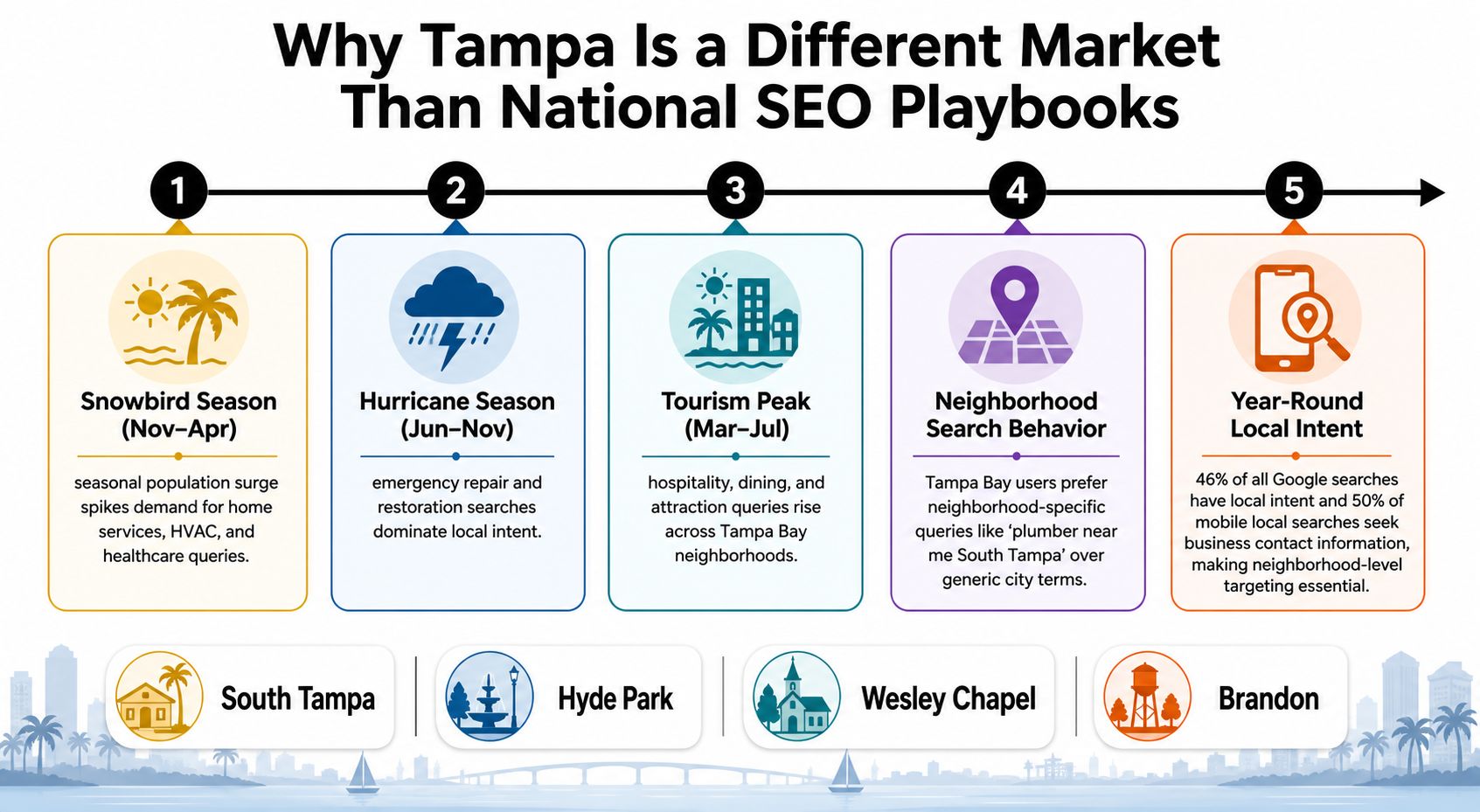
Why Tampa Is a Different Market Than National SEO Playbooks
National SEO playbooks often assume one broad audience and one clean keyword set. Tampa doesn't work that way. The metro is spread out, service-area patterns are messy, and neighborhood language often matters more than citywide phrasing.
Tampa buyers search with place in mind
A person searching “plumber near me South Tampa” is expressing a different intent than someone typing “plumber near me Tampa.” The first query is tighter, more local, and usually more ready to convert. If the site doesn't reflect those sub-market distinctions, it leaves money on the table. The same logic applies to healthcare, legal, and home-service businesses that serve distinct parts of the metro.
Seasonality changes what people need
Tampa search demand isn't static. Snowbird season, hurricane season, and tourism all shift what buyers need and when they need it. That means the SEO plan can't be copied and pasted from a national template. The content and service focus should flex with the calendar and the concerns buyers bring into search.
The AI shift makes clarity even more valuable
A second change is that buyers are increasingly encountering AI summaries, answer surfaces, and chat-style recommendations before they ever land on a website. That means your service area, offer, and proof need to be legible to both people and systems. A generic site with vague service language is harder to recommend, harder to trust, and easier to skip.
A practical way to think about Tampa SEO is this, searchers are choosing between nearby providers, not browsing a neutral directory. That's why digital marketing for local businesses has to connect service pages, maps visibility, and local proof instead of treating them as separate channels. If your agency is still pitching broad “organic growth” without neighborhood intent, it's probably underselling the market.
Tampa doesn't reward generic location pages. It rewards pages that sound like they were written by someone who actually knows how the metro is searched.
The First 90 Days of a Tampa SEO Campaign
A good Tampa campaign should show its work early. The first three months are about making the site readable, tightening local relevance, and improving the pages that can turn searches into phone calls. If an agency starts by pushing blog posts or links before the site structure is clean, the order is backward.
Weeks one through three should uncover the bottlenecks
The opening crawl should surface broken links, indexation problems, weak metadata, duplicate pages, and gaps in internal linking. That audit is the base layer because pages cannot rank well if search engines cannot crawl them cleanly. Mobile usability and speed belong in the same pass, since Tampa searchers are often on phones in real-world conditions, in the car, in the field, or between service stops.
Weeks three through six should sharpen the local entity signals
Schema markup such as LocalBusiness, Service, and FAQPage starts to matter here. It helps search engines map the business to the service and geography it serves. The same phase should include Google Business Profile optimization and citation cleanup so the site, profile, and directory listings all point to the same business identity.
That is also where Tampa-specific page language starts to matter more than generic on-page advice. A Tampa roofing page should include neighborhood references, service-area modifiers, and case studies from local jobs so it matches how Bay Area searchers phrase their queries. For a practical reference point on this work, structured local SEO guidance should line up titles, headers, internal linking, and content with the local query, not just the service name.
Weeks six through twelve should improve the money pages
The pages that already attract or deserve high-intent traffic should be rewritten first. That usually means the main service page, the highest-value location pages, and the neighborhood pages with the clearest commercial potential. One practical benchmark from Tampa-focused guidance is to keep pages fast, mobile-friendly, and crawlable, with a target of LCP at 2.5 seconds or faster on mobile connections and low CLS to avoid layout shifts.
A useful milestone in this window is a clean internal map of what got shipped. That should include technical fixes completed, profile changes made, pages rewritten, and the first batch of local landing pages published. If you cannot answer, “What changed last month, and what does that change influence?”, the campaign is still too vague.
How Tampa SEO Services Are Priced
Pricing usually confuses buyers because proposals often bundle different scopes under the same label. A one-location service business with a narrow territory does not need the same retainer as a multi-location practice in a crowded category. Keyword competition, service-area breadth, and how much local cleanup is still outstanding drive the price more than the package name.
| Tampa SEO Retainer Tiers at a Glance | |||
|---|---|---|---|
| Tier | Monthly Range | Typical Scope | Best Fit |
| Foundation | $1,800 to $3,500/month | Core technical work, local optimization, basic content, reporting | One location, moderate competition |
| Growth | $3,500 to $8,000/month | Broader content, stronger link work, deeper local coverage, more reporting | Multi-service brands, wider service areas |
| Authority | $8,000 to $25,000+/month | Heavy content, advanced authority building, more aggressive local expansion | Competitive categories, multi-location groups |
A neutral industry source also states that a business should budget roughly $30,000 to $80,000 for the first 12 months if it wants reliable first-page visibility on 5 to 8 commercial keywords. Tampa SEO pricing guidance
Match the tier to the business model
A small Tampa landscaper serving one or two zones can often start in Foundation if the niche is not brutally crowded. A healthcare group or law firm with multiple service lines usually needs Growth or Authority because the page footprint, authority work, and local signaling have to cover more ground. If the proposal does not explain that relationship, it is probably priced by habit instead of strategy.
In Tampa's competitive home-services market, retainers under $2,000/month rarely include citation cleanup or call tracking, so those fixes get deferred until the client sees flat lead volume. That delay matters because the business still pays for the missing work later, only after the campaign has already spent time without the right measurement in place.
A lower retainer can make sense only if the scope is narrow and the business already has clean citations, solid location pages, and tracking that shows which calls came from search.
Rankings Without Revenue Are a Vanity Metric
If a Tampa contractor gets more map visibility but the office still sounds the same on Monday morning, the campaign is missing the point. Higher positions only matter when they produce qualified calls, booked estimates, and form fills that turn into work. If those outcomes do not move, the report is describing motion, not growth.

Conversion systems have to sit beside rankings
A strong Tampa engagement should use call tracking, form attribution, and clear service-area definitions so the business knows which visibility is creating qualified inquiries. If a clinic serves specific neighborhoods, or a contractor only wants certain zip codes, the reporting has to reflect that reality. Otherwise, traffic can look good while the sales team is filtering out the wrong leads.
If the agency cannot separate branded calls from organic discovery calls, owners end up guessing about what SEO changed. That is a common gap in local reporting, and it makes it hard to compare SEO against paid search, referrals, or field sales. A clear attribution setup gives the owner a baseline before anyone starts celebrating movement.
The report should tell a story, not just list positions
Monthly reporting should connect rankings to traffic, clicks to calls, and pages to inquiries. It should also show what changed on the site so the owner understands why the movement happened. Monthly reports that only show position changes leave owners unable to explain ROI to their teams or partners.
A lot of agencies get shallow, because rankings are easy to show and business impact is harder to measure. Good reporting should answer a simple question. Which pages produced calls, which service areas produced leads, and which queries brought in the wrong traffic? If the answer is unclear, the campaign may be winning visibility and losing revenue at the same time.
One practical reason the market is moving this way is that local searches are buyer-ready by nature, and a site that only chases visibility leaves the revenue layer unmeasured. Tampa buyers are also showing more signals that fit GEO and AEO patterns, which means they are asking for fast answers, direct service details, and proof that the business can handle the job. That makes lead attribution a buying signal, not a buzzword. If the agency cannot explain how a ranking turns into a call, it is not a complete SEO engagement.
How to Evaluate a Tampa SEO Agency Before You Sign
A sales call should leave you with a working plan, not a pitch deck full of broad promises. In Tampa, the difference between a serious operator and a templated shop usually shows up in the first question: what will you do in the first 90 days, and how will you prove it helped? If the answer stays generic, keep looking. If the agency cannot name three South Tampa neighborhoods they would target first for a landscaping client, the plan is probably templated.
Ask for the work, not the slogan
Ask which pages they would optimize first, which neighborhoods they would prioritize, and how they would clean up citations and profile data. Then ask how they would measure lead quality, not just lead volume. A Tampa agency that understands the market should be able to walk through those details without stalling or drifting into buzzwords.
You also want to hear how they separate phone calls from form fills, and which ones turn into real jobs. If they only talk about rankings, they are skipping the part the owner pays for. For service businesses, the right work is usually the mix that improves map visibility, service-page relevance, and conversion paths that lead to calls.
Watch for red flags
The warning signs are usually easy to spot. No mention of Google Business Profile, no explanation of local content, no talk of call tracking, and no sample reporting that ties visibility to revenue. If the proposal is heavy on links or blog posts but light on maps, citations, and conversion systems, the strategy is incomplete.
Pay attention to how they talk about service pages too. If an agency cannot explain how it would structure pages for searchers who want immediate help, or how it would support Technical and on-page SEO services with page-level fixes, the campaign is likely built to show activity rather than drive inquiries. That matters more in Tampa because many buyers are comparing two or three providers, then calling the one that feels easiest to trust.
Look for proof that matches the market
A credible operator should be able to show named Tampa or Tampa Bay examples, not just anonymous screenshots. They should also be able to show what shipped in the first 90 days, because that is where you see whether the process is real. Transparent reporting samples matter too, since they show whether the agency is measuring business outcomes or only traffic movements.
Ask what they changed on the site, what they changed in the profile, and what happened to calls afterward. Ask how they handled service area language, review generation, and page intent. You are looking for signs that they understand the buyer journey, not just the ranking report.
A practical note here, one option in the market is Polaris Marketing Solutions, which offers SEO services, strategy development, and complimentary online analysis with competitor reporting. That kind of offer is only useful if it comes with clear deliverables and a direct explanation of what gets fixed first.
Your 30-Day Tampa SEO Action Plan
The fastest way to make progress is to start with the assets that already exist. You don't need to rewrite the whole site before you learn where the leaks are. You do need a baseline, a clean profile, and a clear look at what competitors are doing better.
Week one, establish the baseline
Pull current rankings, traffic, call volume, and form submissions. Review the top landing pages, the Google Business Profile, and the most visible citations. That gives you a before picture, which matters because without it, every future improvement is guesswork.
Week two, clean the local signals
Fix the most obvious citation inconsistencies, tighten the business profile, and make sure the top service categories are correct. Then check the site's contact information, service area language, and map visibility. These are the quickest signals to align when a Tampa business needs more local clarity.
Week three, study the competition
Request a competitor report or build one internally. Look at which pages they rank with, how they frame their service areas, and what proof they use to make the click feel safe. That analysis usually reveals whether the gap is technical, content-based, or local trust related.
Week four, decide what you'll keep in-house
Some tasks are easy to handle internally, like basic citation checks and profile updates. Others, like crawl remediation, schema implementation, and service-page strategy, usually belong with a specialist. The goal is to leave the month with a working plan, not a pile of unprioritized tasks.
If you want a practical next step, Polaris Marketing Solutions can review your current visibility, identify competitor gaps, and outline the local SEO work that would move calls in Tampa. Visit Polaris Marketing Solutions to request a complimentary analysis and compare your current position against the market.