
A Fort Myers contractor writes the same kind of ad everyone else writes. “Fast service. Fair pricing. Free estimate.” A Cape Coral cleaner posts “We're local and reliable.” A Naples roofer updates a service page with a list of materials, warranties, and phone numbers.
Then the leads come in unevenly, reviews feel disconnected from the website copy, and every marketing channel sounds like it belongs to a different company.
That's where people start asking a smart question: what is brand storytelling, really? Not the buzzword version. The practical version that helps a small local business sound memorable without hiring a film crew or building a giant marketing department.
For a Southwest Florida business, brand storytelling is less about dramatic speeches and more about making your message feel human. It gives shape to what you already do every day. The emergency AC call on a humid afternoon. The relieved homeowner after a roof leak stops. The repeat customer who says, “I finally found someone who shows up when they say they will.”
Introduction to Brand Storytelling
A home services owner in Fort Myers usually doesn't have a content problem. They have a sameness problem.
Their website says they're professional. Their competitors say the same. Their Google Business Profile says they care about quality. So do ten other companies nearby. Their Facebook page lists services, service areas, and phone numbers. Useful, yes. Memorable, no.
Brand storytelling is the practice of turning your business message into a clear narrative people can follow and remember. Instead of only saying what you sell, you show the customer's problem, the tension around it, the change that happened, and why your business was the right guide.
That last word matters: guide.
A local HVAC company isn't the hero of the story. The sweating family in a house with no cooling is. A paving company isn't the hero. The property manager trying to avoid complaints and liability is. The business helps the customer move from stress to relief.
What small businesses often get wrong
Many owners hear “storytelling” and assume it means writing a long founder bio or posting sentimental content. That's too narrow.
Storytelling can be:
- A service page that starts with the customer's situation instead of your credentials
- A Google Business Profile post that shows a real problem solved in a local neighborhood
- A short before-and-after video from a cleaning job
- An origin story that explains why your company works the way it does
Practical rule: If your marketing only lists features, people compare you on price. If your marketing tells a believable story, people remember why you felt trustworthy.
In crowded Southwest Florida markets, that difference matters. People don't just buy service. They buy confidence.
Understanding Brand Storytelling Concepts
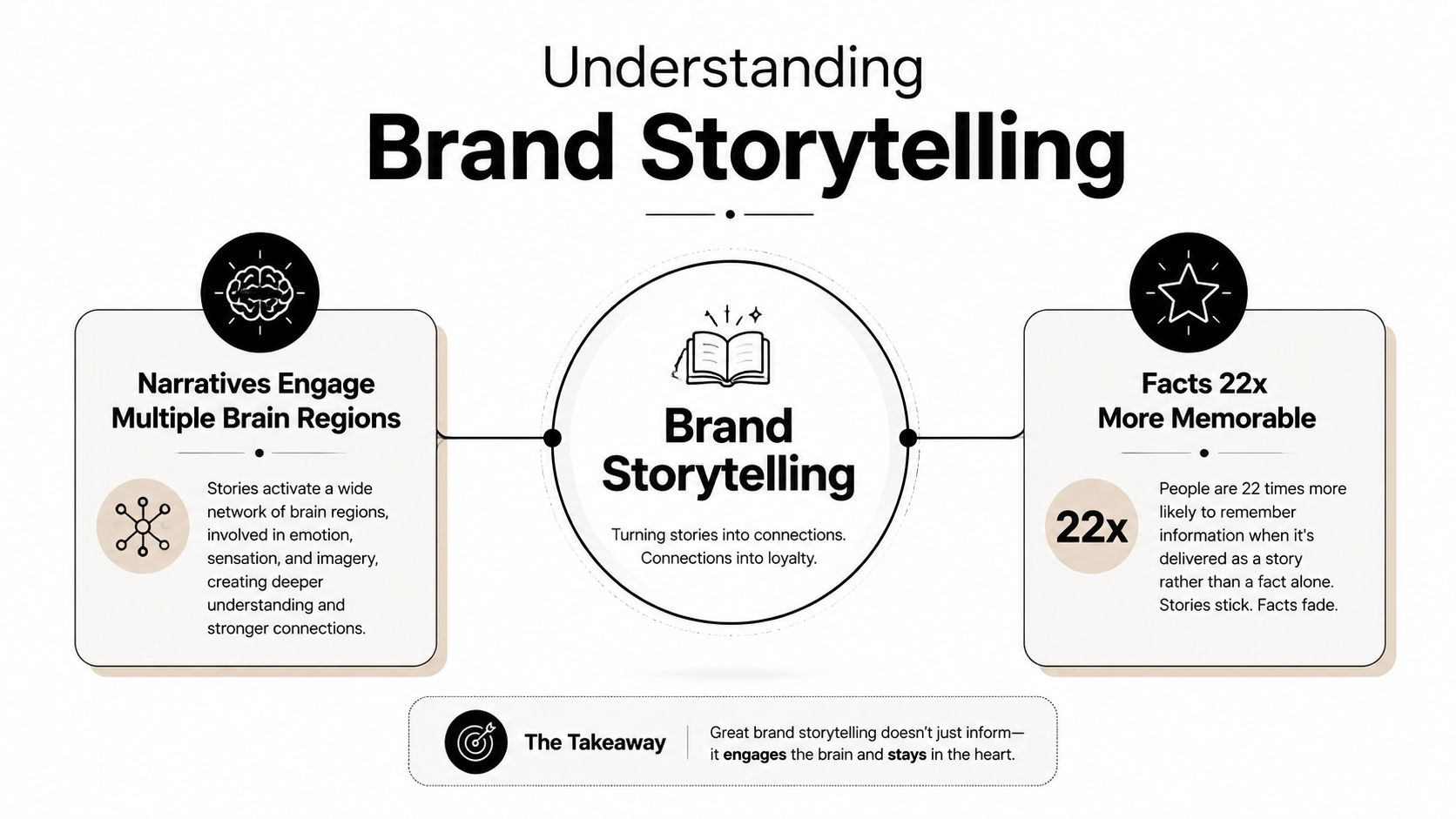
Brand storytelling means organizing your message so people can understand it, feel it, and remember it.
Research summarized by Marketing LTB on storytelling statistics notes that brand storytelling is a core driver of information retention, making facts 22 times more memorable than bare data alone, boosting recall from 5% to 65%. That's the simplest reason stories matter. People don't store isolated claims the same way they store a narrative with a problem, a turning point, and an outcome.
Story versus information dump
Think about the difference between these two examples from a cleaning company.
Version one
“We offer deep cleaning, move-out cleaning, eco-friendly products, flexible scheduling, and trained staff.”
Version two
“A family in North Fort Myers needed a move-out clean after a rushed relocation. They were juggling boxes, school pickup, and a landlord walkthrough. Our team handled the final clean in one visit, documented the rooms, and left the property ready for inspection.”
Both versions communicate service. Only one gives the brain something to hold onto.
The customer is the main character
Many owners frequently misunderstand. They think storytelling means talking more about themselves. Usually it means talking about the customer with more structure.
A good brand story answers questions like these:
| Focus | Weak version | Strong version |
|---|---|---|
| Main character | “We started this business to serve the area” | “Homeowners need a contractor who responds fast and explains the work clearly” |
| Conflict | “We offer many services” | “The customer has a leak, a deadline, or a safety concern” |
| Outcome | “Call us today” | “The customer gets relief, clarity, and a better result” |
Here's the mental model I teach small business owners: a story is a bridge. On one side is the customer's current situation. On the other side is the better situation they want. Your business helps them cross.
A feature tells. A story moves.
That's why brand storytelling works across websites, review responses, social posts, ads, and sales calls. It gives all of them the same emotional logic.
Benefits of Brand Storytelling for SMBs
Small businesses don't need storytelling because it sounds modern. They need it because local buyers judge trust quickly.
A homeowner in Bonita Springs looking for a roofer usually isn't reading your website like a textbook. They're scanning for signs that you understand their problem, work in situations like theirs, and can be trusted in their neighborhood. Storytelling helps you show all three at once.
Why storytelling helps local businesses compete
The biggest advantage is clarity. Storytelling helps a small business explain not just what it does, but why that work matters in real life.
A Fort Myers pressure washing company can say, “We clean driveways.” Fine. But a stronger story is, “After weeks of summer rain, a homeowner wanted to freshen the front of the property before family visited. We restored the driveway, entry path, and front walk so the house looked cared for again.” That framing gives the service context.
Another advantage is consistency across touchpoints. Many businesses have one voice on the website, another on social media, and a third in review replies. Storytelling gives all of them a shared thread.
Spin Sucks on brand storytelling gaps points out that most brand storytelling content ignores the gap between narrative intent and customer journey execution, especially for resource-constrained small businesses in local markets. That hits home for Southwest Florida owners. They don't lack ideas. They lack a simple way to connect those ideas to actual customer steps.
What this looks like in a local workflow
Use storytelling at the moments customers already see:
- Google Business Profile updates with a short problem-to-solution post
- Service pages anchored in local situations, not generic claims
- Review requests that ask customers to mention the challenge they had before hiring you
- About pages that explain why your standards exist
If you're refining your local message, these small business branding tips for local companies can help you line up your story with your visual and verbal branding.
The best local story usually isn't dramatic. It's specific.
A story tied to a screened lanai in Cape Coral, a condo turnover in Naples, or a storm prep call in Estero feels more believable than broad language about “excellence.”
Storytelling Frameworks You Can Use
Frameworks help when you know your business well but freeze when it's time to write. They turn storytelling from an abstract idea into a repeatable process.
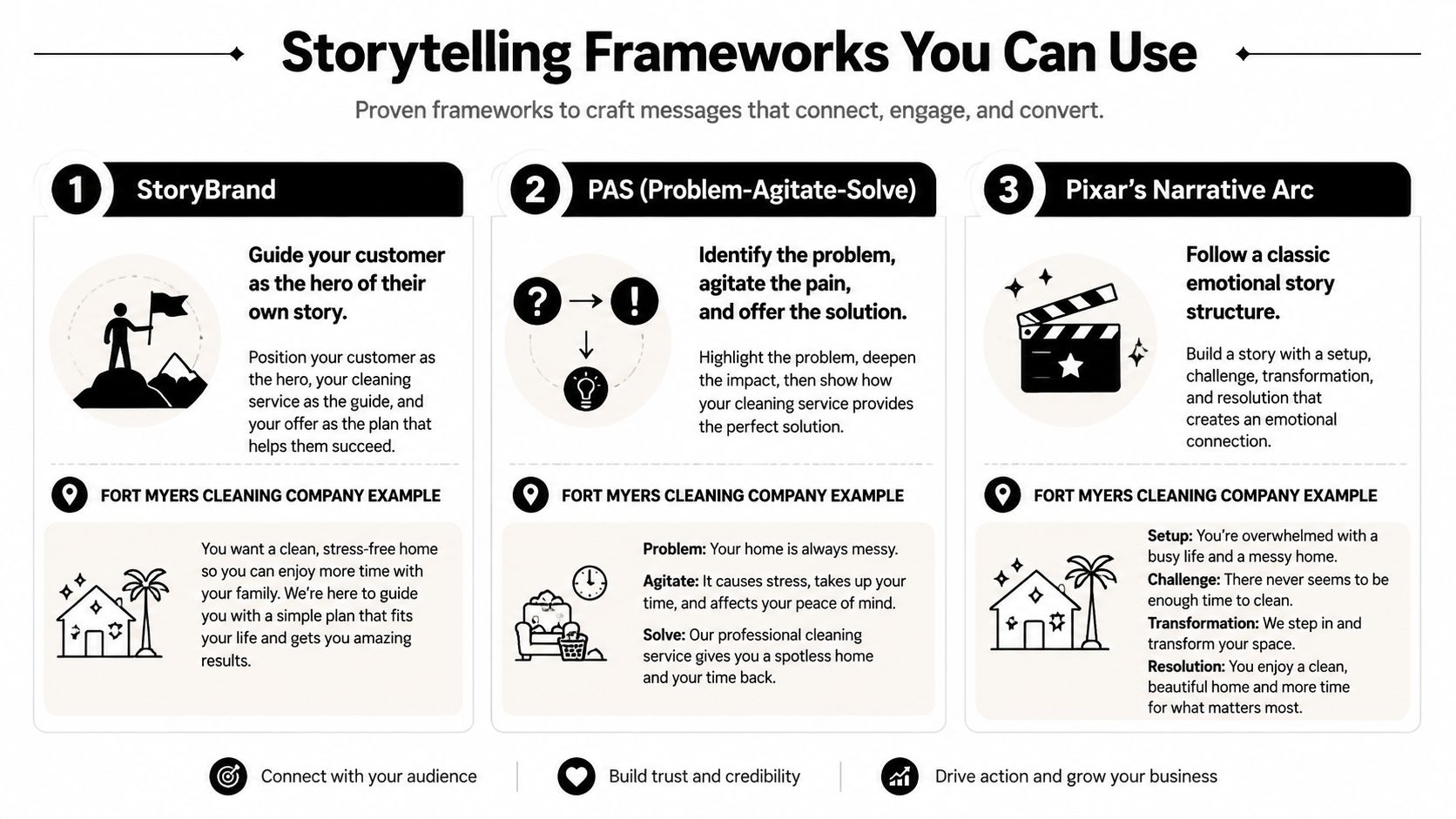
One of the strongest options is the StoryBrand model. Hamilton Sherwind's guide to brand storytelling describes the StoryBrand Framework's six-part architecture: Context, Character, Conflict, Turning Point, Resolution, and Proof, which drives conversion by aligning narrative arcs with the Hero's Journey.
StoryBrand for service pages
A Fort Myers cleaning company could build one page like this:
Context
Busy households want a clean, calm home without spending weekends catching up.Character
The customer is a parent, property manager, or retiree who wants order and peace of mind.Conflict
The house keeps slipping behind, or turnover deadlines are tight.Turning Point
The company steps in with a dependable process and clear communication.Resolution
The home is guest-ready, move-in ready, or easier to live in.Proof
Real reviews, photos, and specific examples support the promise.
PAS for short-form copy
PAS stands for Problem, Agitate, Solve. It works well for ads, landing pages, and email intros.
A roofer might write:
Problem
Your ceiling stain isn't “just cosmetic.”Agitate
Every storm gives water more time to spread behind the drywall.Solve
We inspect the source, explain the repair clearly, and help you stop the issue before it grows.
This is also where studying an effective story framework for writers can sharpen your sense of pacing, even if you're writing website copy instead of fiction.
A quick explainer can make frameworks easier to visualize:
Pixar-style arc for social content
Pixar's style is simple and memorable: once this was normal, then something changed, then action happened, then life improved.
For a cleaning company:
- A rental looked fine at a glance.
- Then the owner noticed guest complaints about overlooked details.
- The team reset kitchens, bathrooms, and high-touch surfaces.
- The next guest walked into a cleaner, more polished space.
Frameworks don't restrict your voice. They keep your message from wandering.
Pick one framework per asset. That alone can make writing faster and cleaner.
Quick Implementation Tips and Metrics to Track
Owners often delay storytelling because they think it requires a campaign. It doesn't. Start with small assets you already publish.
One of the more useful recent ideas comes from Andi Cross on brand storytelling, which notes that brands measuring shares, saves, and unprompted mentions outperform those tracking impressions, signaling genuine narrative resonance. For a small business, that's a practical shift. Stop treating visibility alone as the win. Pay attention to whether people cared enough to keep or repeat the story.
Five tactics you can use this week
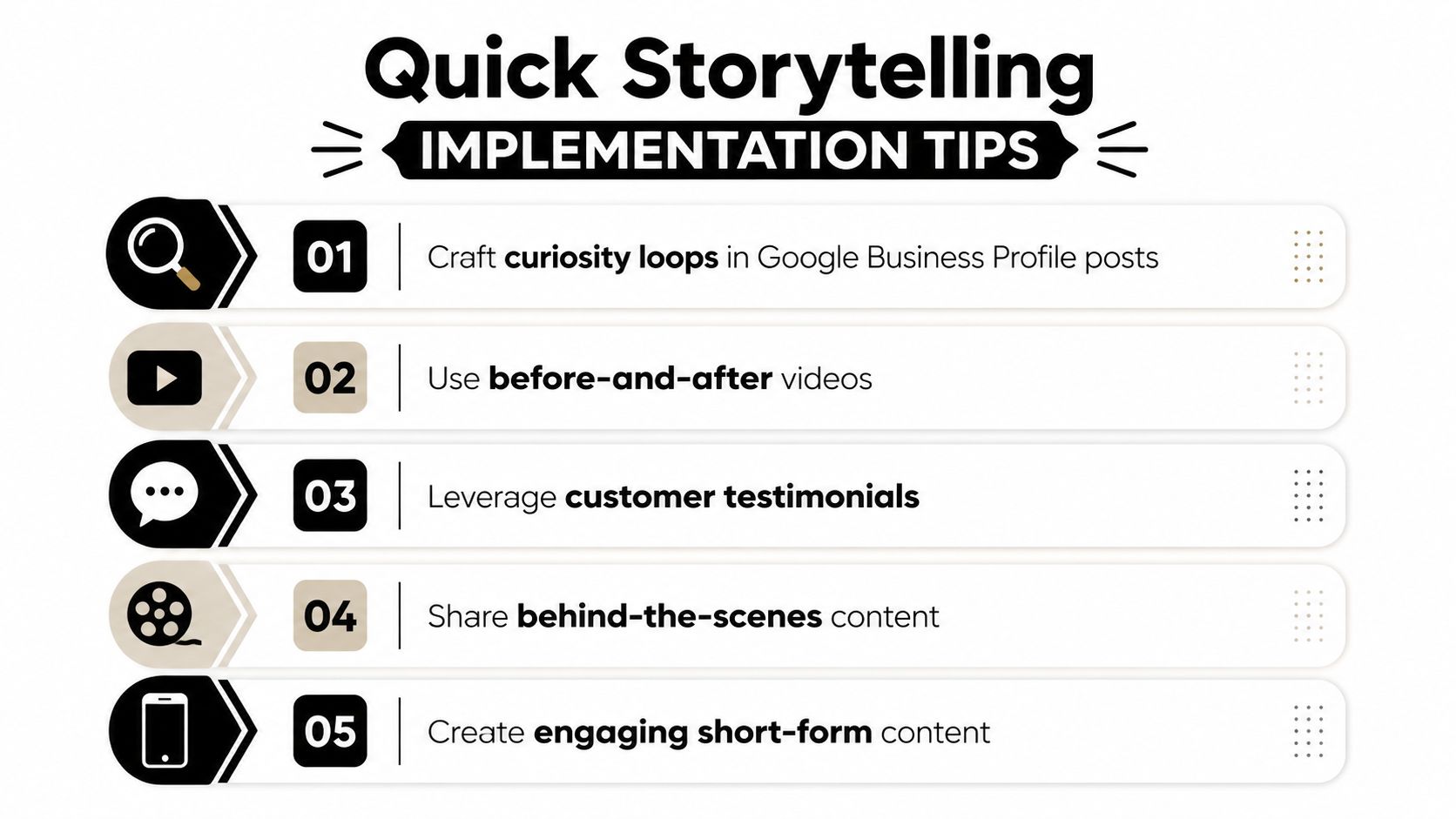
Google Business Profile curiosity posts
Don't post “Another great job completed.” Try: “This Fort Myers homeowner called after noticing one room felt warmer every afternoon. The cause wasn't where they expected.” That open thread gives people a reason to click.Before-and-after video clips
A short phone video from a tile cleaning, driveway wash, or office cleanup works because it shows movement. Start with the problem. End with the visible change.Review prompts with story cues
Ask customers, “What was going on before you called us?” and “What made you feel confident after the job?” Those prompts produce stronger testimonials than “Please leave us a review.”Behind-the-scenes proof
Show your lead tech loading equipment, checking a work order, or walking a property before starting. This makes reliability visible.Short-form recurring series
Create a weekly post like “This week's fix,” “Move-out Monday,” or “Rainy season prep.” Repetition turns scattered posts into a recognizable story stream.
Metrics that matter more for lean budgets
Use a simple tracking sheet with these columns:
| Asset | Story angle | Best signal |
|---|---|---|
| GBP post | Problem and reveal | Clicks and customer replies |
| Instagram Story | Before and after | Saves and shares |
| Testimonial post | Customer transformation | Unprompted mentions in calls or messages |
| Service page rewrite | Customer-first framing | Time on page and contact intent |
If you want your storytelling to connect with a broader publishing plan, these content marketing strategies for small business offer a helpful next layer.
Field note: If a customer repeats your wording back to you on a phone call, your story is working.
That's a stronger signal than a vague spike in impressions.
Content Ideas and Micro Examples
The easiest way to learn brand storytelling is to see small examples, not big theory. AskAttest's storytelling examples article emphasizes that actionable examples like origin stories, customer testimonials, and mission-led narratives are mandatory in brand storytelling to build emotional connection and recall.

Seven simple content formats
Origin story post
A Fort Myers owner explains why they started the company after seeing neighbors struggle to get callbacks.Customer rescue story
A Naples homeowner had guests arriving and needed a last-minute clean. Show the problem, the rush, and the finished result.Day-in-the-life reel
Follow a technician from loading the truck to finishing the final walkthrough in North Fort Myers.Mission-led post
A local company explains why it prioritizes clear arrival windows and photo documentation.One-review breakdown
Turn a strong customer review into a post with context around what happened before the service.Seasonal prep story
Show how a business helps clients get ready for summer humidity or storm season.Neighborhood spotlight
Tie a service story to Cape Coral, Estero, or Bonita Springs so the content feels grounded.
For consistency, map these into a monthly plan using a content calendar for small business marketing.
A micro-example
A roofer posts three slides to Facebook Stories. Slide one shows a ceiling spot with the caption, “Homeowner thought this was old damage.” Slide two shows the inspection. Slide three shows the repair area and the line, “Leak found before the next storm rolled in.” That's storytelling. Short, local, believable.
Conclusion and Next Steps
Brand storytelling isn't fluff. It's a practical way to make a small business easier to remember, easier to trust, and easier to choose.
If you've been asking what is brand storytelling, the working answer is simple: it's the method of turning your customer's problem, your process, and your proof into a message people can follow. For a Southwest Florida business, that can start with one service page, one testimonial post, or one Google Business Profile update.
A useful next step is to do three things this week:
- Audit your current pages and posts for missing story elements.
- Choose one framework that fits your business style.
- Publish one asset built around a real customer situation.
Small businesses don't need more noise. They need a clearer story.
If you want help turning your website, local SEO, PPC, and content into a cohesive story that attracts qualified local leads, Polaris Marketing Solutions offers practical support for Southwest Florida businesses, including a complimentary online analysis and competitor report.