
72% of patients check online reviews before selecting a dentist 1, which means your reputation isn't a finish-line issue, it's a gatekeeper at the very start of the patient journey. In practice, that changes the job from “manage complaints” to engineer trust, response speed, and review volume with the same discipline you'd use for recalls, scheduling, or treatment acceptance.
The clinics that treat reputation as a system usually win on two fronts at once. They show up more convincingly in local search, and they convert more profile visitors into calls because their public feedback looks active, recent, and credible. The clinics that treat it as an afterthought tend to discover the same problem too late, when a few unresolved reviews start shaping how strangers judge the whole practice.
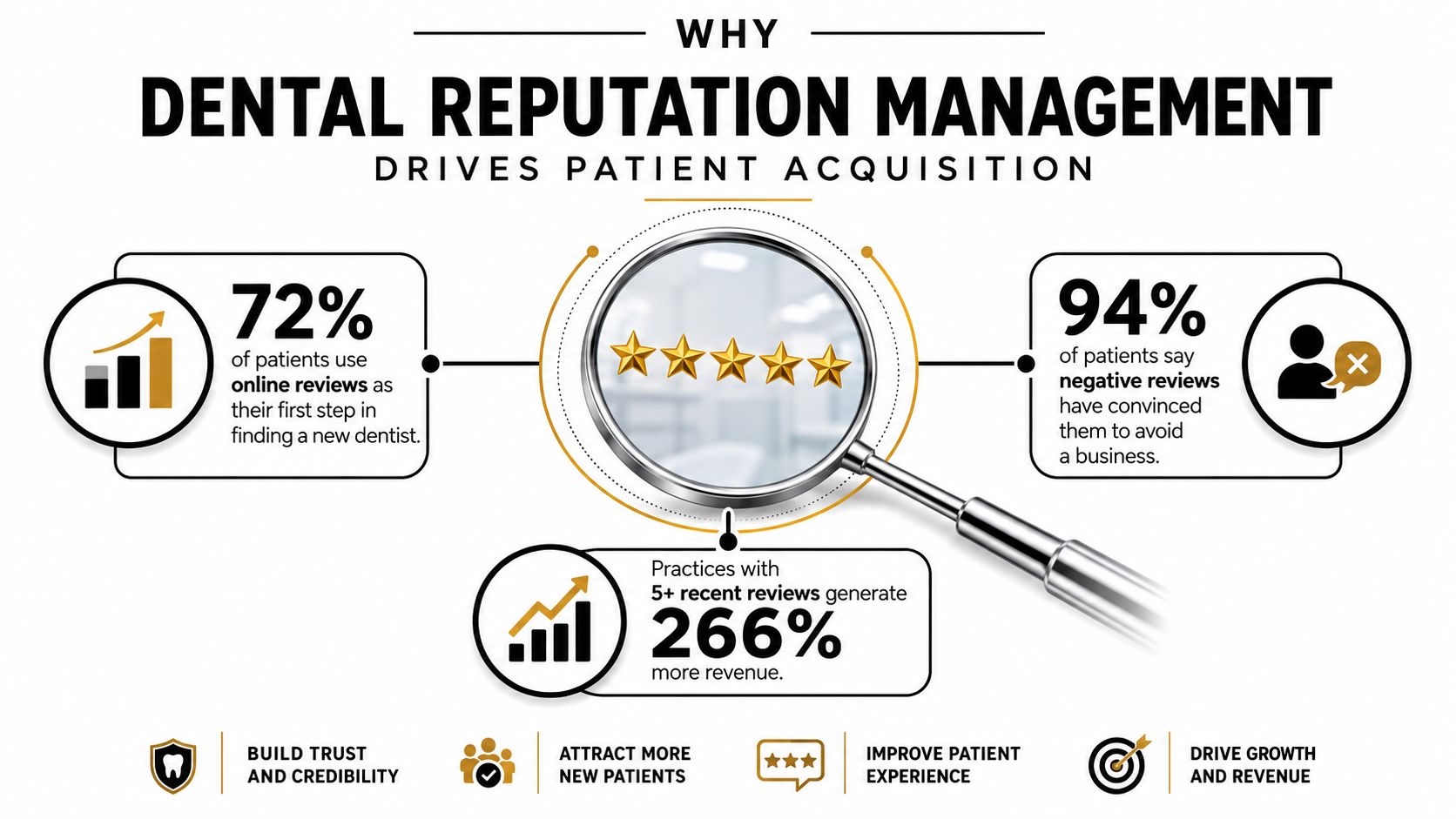
Why Dental Reputation Management Drives Patient Acquisition
A dentist's online reputation is a conversion asset, not a vanity metric. BrightLocal data cited in the source shows that moving from a 4.2-star average to a 4.8-star average can increase new patient inquiries by 25% to 30%, and practices with 50+ Google reviews convert 35% more profile visitors into calls than practices with fewer than 20 reviews 1. That is why reputation work belongs in the acquisition budget, because the effect shows up in inquiries and calls, not just in brand sentiment.
Reviews shape the first filter patients use
Most patients do not compare every dental website in town. They scan reviews, star ratings, and response patterns, then narrow the field fast. Reputation management works best when it is tied to Google Business Profile optimization, review generation, and response discipline, not just damage control after a complaint.
A practice with strong review density also looks more trustworthy in local search because the profile feels active. An empty or stale profile tells a different story, even if the clinical care is excellent. Patients rarely separate those signals.
Practical rule: if your team wants more new patient calls, do not ask only for “more marketing.” Ask whether the practice is collecting enough fresh proof to make a stranger comfortable enough to click.
What the numbers mean for the clinic
The ratings gap between 4.2 and 4.8 stars matters because patients use that visible difference as a shorthand for reliability. The review-count gap matters for the same reason, since volume suggests consistency rather than a one-off spike of praise.
That is why reputation management cannot live only with the office manager or only with marketing. It touches front desk behavior, patient experience, review requests, and the way the practice presents itself on Google. When those pieces are aligned, reputation becomes part of patient acquisition infrastructure instead of a cleanup task.
For clinics that want a practical starting point, how to get more online reviews is a useful baseline, but the operational work only holds when the team responds well to both praise and complaints.
Building a Closed-Loop Review Generation System
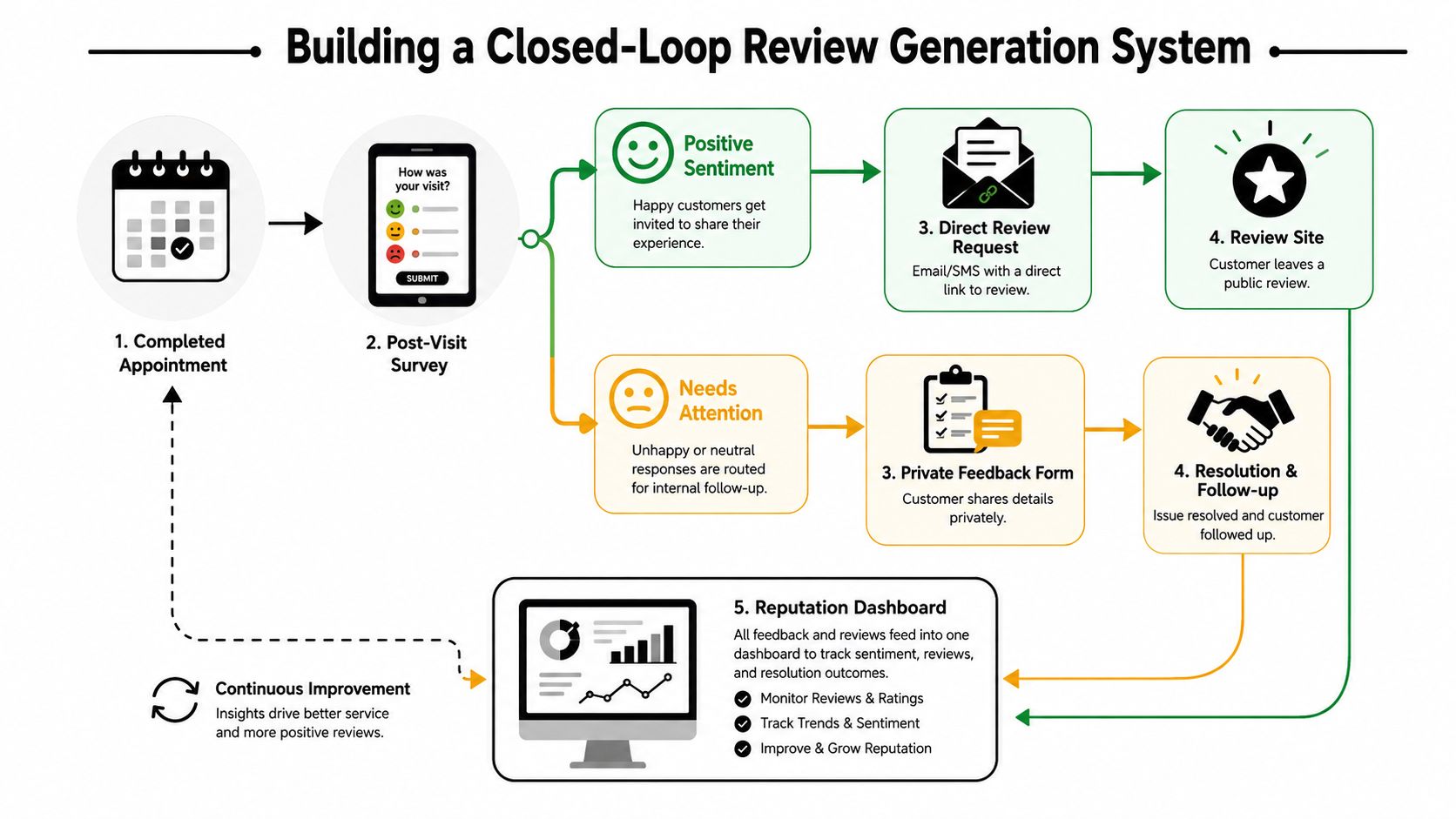
A dental practice gets better results when review requests are part of a system, not a memory test for the front desk. A closed-loop system captures sentiment right after the visit, routes unhappy feedback away from public platforms, and keeps the review stream active every day 3. That matters because a one-time push fades quickly, while an always-on workflow keeps producing useful signals.
Start with the moment the visit ends
The best time to ask is right after a good appointment, while the experience is still fresh. That ask can happen at checkout, in a post-visit SMS, or through an email follow-up sent soon after the visit. Speed matters, because delayed requests lose emotional momentum.
Use a simple staff line at the front desk:
“We'd really appreciate it if you'd share your experience online. It helps other patients feel confident choosing us.”
If a patient seems frustrated, do not push for a public review. Send that person to private feedback first so the team can address the issue before it appears on Google or another review site.
Build the workflow in layers
A practical setup usually includes:
- In-office ask, because staff can catch delighted patients at the best moment.
- SMS follow-up, because it is fast and easy to act on.
- Email follow-up, sent a little later for patients who did not respond right away.
- Physical QR code backup, because some patients still prefer scanning at checkout.
For practices that want a deeper framework on request timing and setup, this guide to getting more online reviews is a useful companion. A reputation management guide also recommends a 30/60/90-day rollout and notes that automated post-visit requests can produce about 20–30 reviews per month, while a stabilized system may target 10–15 new reviews monthly 4. The exact number depends on patient flow, but the operating idea stays the same. Automate the ask and keep the pipeline steady.
Keep the system from breaking
Manual follow-up creates avoidable failures. Staff forget, patients slip through the cracks, and unhappy feedback lands in public without warning. A closed loop fixes that by pairing private feedback with continuous monitoring of Google and secondary review sites.
Treat response management as a dashboard, where you can see activity and trends at a glance. Track the total review count, average rating, review velocity, response rate, response time, and rating trend across platforms 3. Those measures show whether the system is working or just making the practice busier.
For a visual reference, see A flowchart showing a closed-loop review generation system for businesses to manage customer feedback and reputation.
Crafting HIPAA-Safe Review Responses That Build Trust
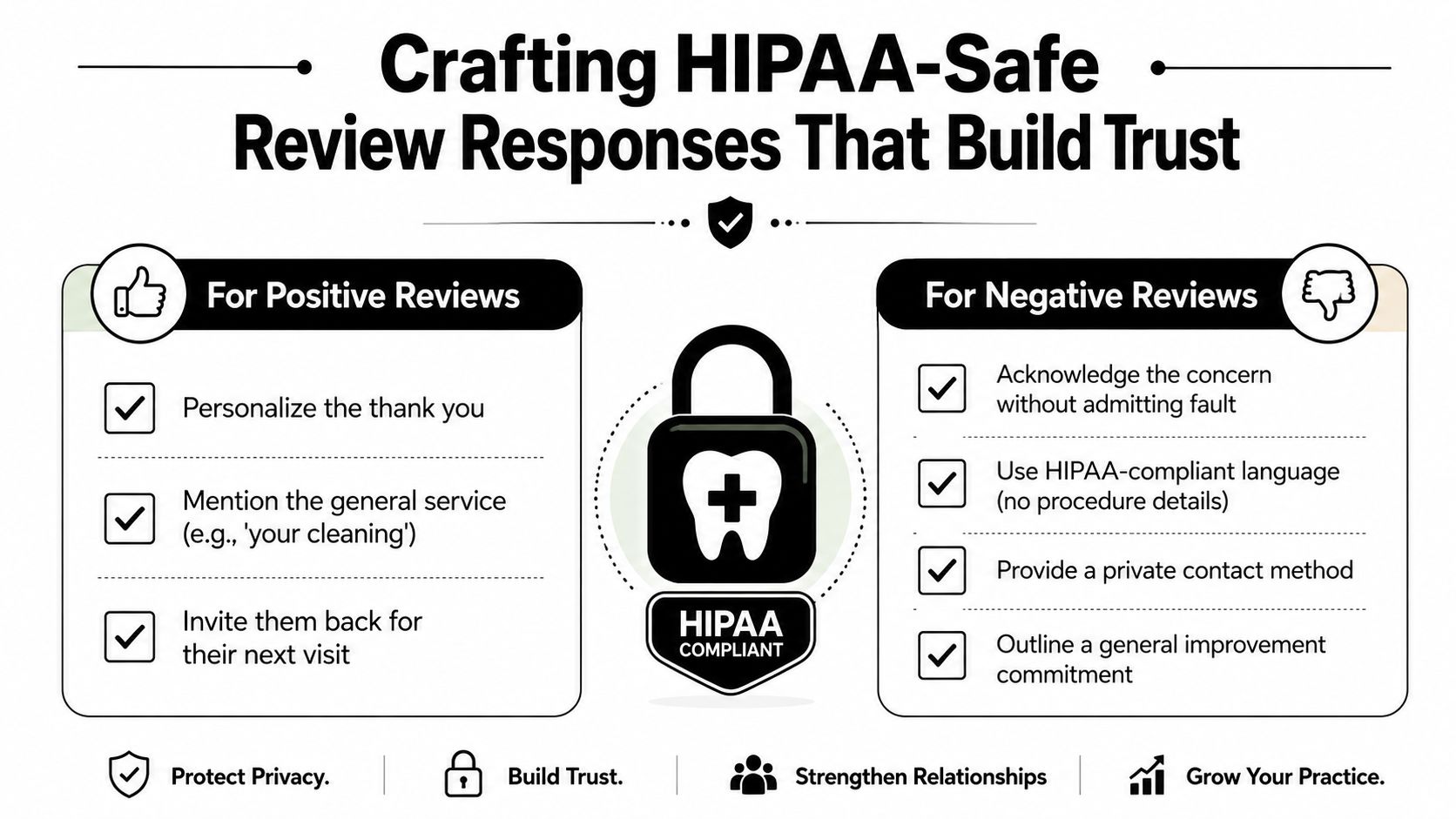
The American Dental Association is clear on the privacy side of review management. Dentists should keep replies generic, avoid confirming that a reviewer was a patient, never reference a specific incident, and take complaints offline 5. That's the part many teams miss, because a warm response can still create privacy risk if it gets too specific.
Use templates the front desk can trust
For positive reviews, keep it simple:
- “Thank you for your kind words. We're glad you had a positive experience with our team.”
- “We appreciate you taking the time to share your feedback. We look forward to seeing you at your next visit.”
- “Thanks for your support. Our team works hard to make every visit comfortable and efficient.”
These replies acknowledge the review without exposing protected details. They also sound human, which matters because canned language can feel dismissive even when it's compliant.
For negative reviews, the structure should be different:
- Acknowledge the concern without admitting facts you can't safely discuss.
- Avoid procedure details and don't mention appointment specifics.
- Invite offline follow-up with a direct office phone number or email.
- Keep the tone calm and professional.
A safe version might read like this:
“We're sorry to hear that your experience didn't meet expectations. We take feedback seriously and would appreciate the chance to speak with you privately so we can look into this further.”
That response doesn't confirm patient status, doesn't argue, and doesn't expose internal details.
Know what not to say
Bad responses usually fail in one of three ways. They reveal too much, they sound defensive, or they turn the thread into a debate. A line like, “We reviewed your Tuesday cleaning and the doctor disagrees,” is a privacy problem. So is a long rebuttal that tries to correct every detail in public.
The right goal isn't to win the comment thread. It's to protect privacy, show professionalism, and move the conversation offline.
For an additional practical reference, the article how to respond to reviews in 2026 is useful because it frames response discipline as a repeatable workflow, not a one-off apology.
If your team needs a tighter response framework, this guide for responding to negative reviews can help standardize tone before the next complaint lands.
Integrating Reputation Management with Local SEO and Google Business Profile
Reputation signals and local search work together. Review volume, rating quality, and response behavior all shape how trustworthy a Google Business Profile appears, and that trust influences whether a practice earns attention in map results and local pack listings. If the profile looks neglected, the practice starts at a disadvantage before a patient even reaches the website.
Treat the profile like a living storefront
The Google Business Profile should be treated like an active storefront, not a static listing. It needs accurate categories, current hours, recent photos, services that match what the practice offers, and regular review responses. The same applies to directory listings across the web.
NAP consistency, name, address, and phone, has to stay aligned everywhere. If one directory shows an old suite number or an outdated phone line, patients lose confidence and search engines receive weaker location signals. That is why citation building and cleanup belong inside reputation management, not just as SEO maintenance work.
Make review signals support the broader local strategy
Recent review activity carries more weight than a burst of old praise. Response rate also matters because it shows the practice is paying attention. Together, those signals reinforce the visibility work already happening in local SEO and GBP optimization.
A strong local strategy usually combines:
- Profile optimization, so the listing stays complete and current.
- Location-specific content, so the site matches the search intent of local patients.
- Citation consistency, so directories do not conflict with each other.
- Ongoing review management, so public proof keeps accumulating.
For a practical setup checklist, this Google My Business optimization guide is a useful companion when your team needs to tighten the technical side without overcomplicating the process.
Reputation management and local SEO work as one system. Cleaner profile data, better review behavior, and consistent business information all push in the same direction, which strengthens the whole setup.
Training Your Team to Become Reputation Champions
Staff training decides whether reputation management becomes a habit or an abandoned project. The front desk sees the ask, the clinical team shapes the experience that creates the ask, and the office manager keeps the process from slipping. If one link drops, the system becomes inconsistent fast.
Give people a script, not a slogan
A good review request sounds natural and short. Train the team to say:
- At checkout: “If you felt well cared for today, we'd love it if you shared your experience online.”
- After a positive visit: “Your feedback helps other patients know what to expect, and it means a lot to our team.”
- When a patient hesitates: “No pressure at all. If you'd rather, we can send the link so it's easy later.”
That last line matters because some patients won't respond in person but will act later if the process is simple.
Role-play the hard moments
The best training sessions include objections. Someone should practice what to say when a patient says they never leave reviews, doesn't want to use Google, or had a mixed experience. Staff don't need a perfect comeback. They need a calm transition.
Practical rule: don't train staff to “convince.” Train them to invite, then make it easy.
I also advise practices to separate the review ask from any pressure tied to treatment or billing. If the request feels transactional, it can backfire. The ask should sound like an invitation to help other patients, not a favor the team is trying to extract.
Build accountability without punishing people
A simple weekly review helps. The manager can look at who asked, who responded, and where the bottlenecks showed up. That's enough to spot inconsistency without turning the process into a scoreboard that stresses the staff.
One of the best signals of a healthy culture is this, team members understand that reputation work is part of patient care. They don't see it as marketing fluff. They see it as the digital extension of how they treated the patient in the room.
Recovering from a Reputation Crisis
A reputation crisis usually starts smaller than people expect. One bad review gets posted, then another patient adds a complaint about the same issue, and suddenly the pattern is public. The practice that recovers fastest doesn't panic, it contains, investigates, responds, and then fixes the underlying process.
A realistic recovery sequence
The first move is to pause any reactive posting and draft a holding response. That stops the team from firing off inconsistent replies while emotions are still high. Next, leadership should investigate privately, gather facts, and compare them against the complaints that appeared online.
If a review looks fraudulent and there's no patient record, flag it with evidence. If the complaint suggests a serious legal or privacy issue, bring counsel in early. A public argument won't help, and in some cases it creates more exposure than the original complaint.
The public response should stay professional and brief:
“We're sorry to hear about your experience. We take concerns seriously and would welcome the chance to speak with you privately to understand more.”
That keeps the tone respectful and protects details that shouldn't be discussed publicly.
Rebuild the signal, not just the mood
Once the issue is addressed, the practice needs fresh positive feedback to restore balance. That means reactivating the review request pipeline, checking whether staff scripts need to change, and watching the trend across platforms instead of obsessing over one thread. The goal is a better pattern over time, not a one-day cleanup.
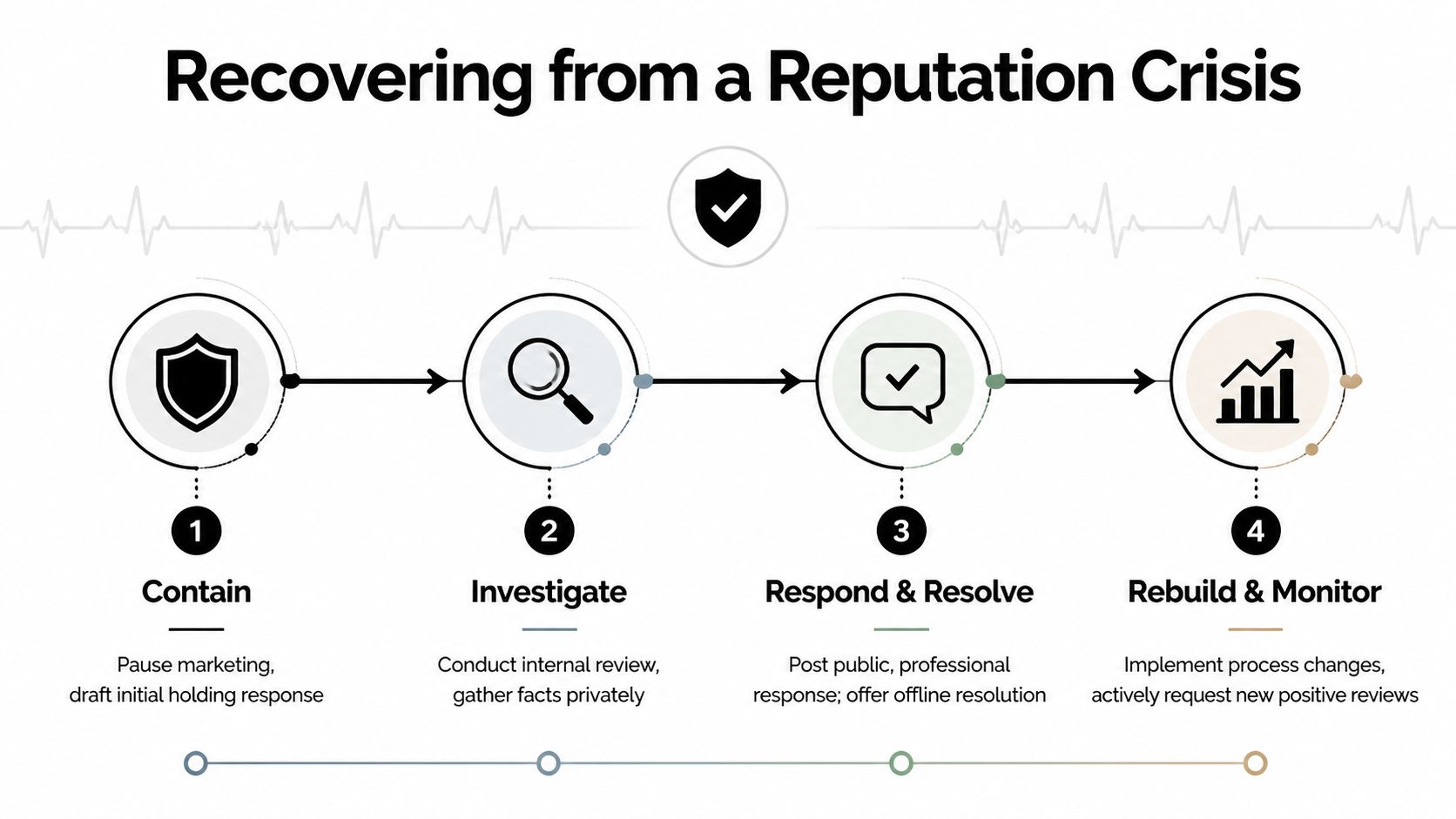
A useful way to think about crisis recovery is this. The review itself is the symptom, the workflow failure is the cause, and the patient-experience fix is what prevents the next round. If the practice only posts apologies, the problem stays alive.
Measuring Success with the Right KPIs
The cleanest reputation dashboards are boring in the best way. They track what matters, update often, and show the owner whether the system is building trust or just creating noise. The numbers that deserve attention are total review count, average rating, review velocity, response rate, response time, and rating trend across platforms.
What to watch and why it matters
Total review count shows whether the practice is building enough public proof to help new patients feel confident. Average rating shows whether the experience is staying steady. Review velocity shows whether the request process is still active, and whether staff are asking at the right moments. Response rate and response time show whether the team is keeping up with what patients are saying and whether concerns are being handled while they are still small.
A strong measurement routine also works better when it includes patient feedback beyond public reviews. A guide to patient satisfaction metrics helps connect review trends to the broader signals that often surface before a reputation problem becomes visible online.
A practical dashboard should also show the right context for each KPI, so the owner can spot patterns without sorting through a long report. Use a simple view that separates volume, sentiment, speed, and consistency by office or provider. That makes it easier to see whether a dip came from a staffing issue, a workflow gap, or a local service problem.
Use the dashboard for staffing and workflow decisions
If response time starts slipping, staffing or workflow is breaking. If rating trend falls on one location, that office probably has a local process issue. If review velocity slows, the request system may be too manual. The same dashboard can also show whether the front desk needs a different script, whether recall visits are being asked for reviews at the right point, and whether a practice manager needs to step in sooner on unhappy feedback. That is the value of the data, it helps the team decide where to adjust schedules, training, and follow-up instead of filling a report for its own sake.
The KPI set stays useful because it turns reputation into an operational signal the owner can act on quickly. As noted earlier in 3, the point is to measure the parts of the process the practice can actually control.