
Some weeks the schedule looks solid. Then a few cancellations hit, referrals slow down, and the front desk starts trying to patch open slots with reminder calls and waitlists. That's a familiar spot for many practices in Fort Myers, Cape Coral, Estero, and Bonita Springs.
Google Ads can help, but only if you treat it like a patient acquisition system, not a visibility experiment. Medical practices usually don't need more random traffic. They need calls, appointment requests, and booked visits from people searching with a real reason to act.
Why Google Ads Is a Patient Magnet for Local Practices
When someone searches “urgent care Fort Myers,” “dermatologist near me,” or “pediatrician Cape Coral same day,” they're not browsing casually. They're looking for care. That's why Google Ads works differently for medical practices than it does for many other businesses.
Healthgrades reports that the average click-through rate for health-related Google Ads is 6.11%, and well-run campaigns can see conversion rates around 4% to 5%, compared with an average closer to 2% across other industries according to Healthgrades healthcare marketing benchmarks. The practical takeaway is simple. Searchers in healthcare tend to have strong intent.
What that means in Fort Myers
A local practice doesn't need to win every search in Southwest Florida. It needs to show up when the right patient is actively looking for the exact service it offers.
For example, a family medicine office in Fort Myers may get better results from ads tied to:
- Immediate needs like same-day sick visits
- Location-based searches such as “primary care doctor Fort Myers”
- Service queries like annual physicals, sports physicals, or chronic care follow-up
- High-convenience actions including call now and online appointment requests
A lot of owners still think of ads as a branding expense. That mindset leads to loose targeting, broad keywords, and weak measurement. In healthcare, Google Ads usually performs best as a direct-response channel.
Practical rule: If your campaign isn't built to generate calls, forms, or booked visits, you're probably paying for attention instead of patient acquisition.
Why search beats passive visibility
A billboard may remind people you exist. A search ad reaches people who are already raising their hand.
That matters in a market like Fort Myers, where patients often compare providers quickly and choose based on proximity, availability, service fit, and trust signals. If your ad answers the search clearly and your landing page makes the next step easy, you can turn demand that already exists into scheduled appointments.
This is also why Google Ads shouldn't sit in a silo. It works best when the offer is specific, the page matches the search, and the practice has a clean intake path. If someone clicks for “vein treatment Fort Myers” and lands on a generic homepage, the campaign loses momentum immediately.
Google Ads for medical practices works because it captures active demand. That's the upside. The catch is that healthcare has tighter rules than most industries, and getting those rules wrong can stop the campaign before it starts.
Navigating Healthcare Compliance and Ad Policies
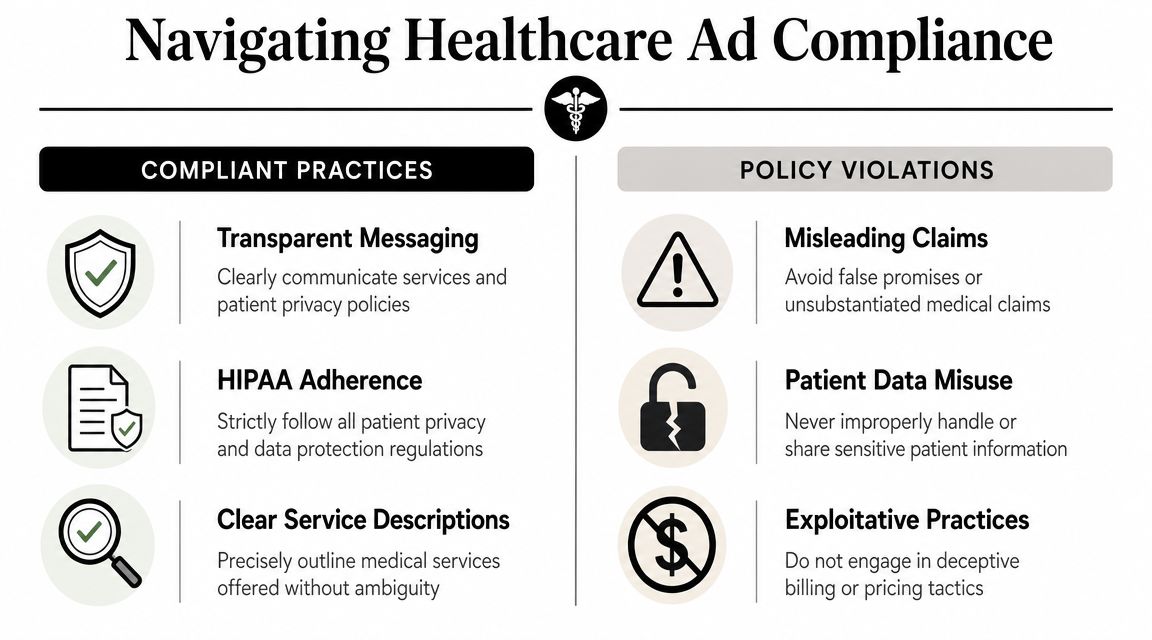
Healthcare advertising on Google has one fundamental rule. Compliance comes first. If the account, ad copy, or landing page doesn't meet policy standards, performance doesn't matter because the ads may not run properly in the first place.
Google requires certification for many medical ads in the U.S. and prohibits unverified claims. Effective campaigns rely on compliant tactics like tight 10-mile radius targeting and city-specific keywords because granular audience targeting is restricted, as noted in Google Ads guidance for doctors.
What compliant targeting looks like
Most practice owners start by thinking about audiences. In healthcare, that's often the wrong starting point.
A safer and more effective approach is to build around:
- Geography such as Fort Myers, Estero, Bonita Springs, or Cape Coral
- Service intent like “Botox Fort Myers” or “urgent care near me”
- Language segmentation if your market includes distinct English and Spanish search behavior
- Landing page relevance so the ad promise matches the page content
That means you can target “Botox in Bonita Springs” as a location-and-service search theme. You should not build ads that imply personal knowledge about the searcher's medical condition or use messaging that feels invasive.
If the ad sounds like the practice knows something private about the user, it's too aggressive for healthcare.
What gets practices in trouble
Most policy issues come from one of three mistakes.
- Unverified claims like guaranteed outcomes, miracle language, or promises that go beyond what you can support
- Loose targeting that tries to mimic consumer e-commerce tactics in a regulated category
- Poor landing page governance where forms, tracking tools, or messaging create privacy or policy risk
Operational discipline is essential. Practice administrators should also understand the broader privacy side of marketing workflows, not just ad approval. A useful primer is this guide to HIPAA compliance for practice administrators, especially if your team manages intake forms, call workflows, or marketing vendors.
Building a compliant local campaign
For a Fort Myers med spa, orthopedic clinic, or primary care office, a safer build usually looks like this:
Pick a narrow service line
Don't launch one campaign for everything. Start with one service that has clear commercial intent.Use location-led keyword themes
Think “dermatologist Fort Myers,” “family doctor Estero,” or “walk-in clinic Cape Coral.”Write factual ad copy
Focus on services offered, locations served, scheduling options, and patient-friendly next steps.Send clicks to a matching page
The page should describe the service clearly, identify the office location, and make contact easy.Coordinate with organic local visibility
Paid ads work better when your location pages, reviews, and Google Business Profile are also strong. A sound local SEO strategy for medical practices then supports paid search instead of competing with it.
Compliance doesn't make campaigns weaker. It forces them to be sharper. The practices that do well on Google Ads usually don't win by getting fancy. They win by being precise, local, and credible.
Choosing Your Campaign Type and Targeting Keywords
Most first campaigns fail because they're too broad. The account tries to cover every service, every nearby city, and every keyword variation at once. Google will spend that budget. It just won't spend it efficiently.
The better move is to choose the right campaign type for the job, then build tightly around patient intent.
Which campaign type fits your practice
Not every campaign type deserves equal trust on day one. For most practices, Search is still the cleanest starting point because it gives you the most control over keywords, messaging, and landing pages.
| Campaign Type | Best For | Example Use Case |
|---|---|---|
| Search | High-intent patient acquisition | A Fort Myers dermatologist advertising acne treatment or skin checks |
| Performance Max | Broader reach when tracking is mature | A multi-location practice with strong conversion tracking and multiple service lines |
| Local | Driving calls, map actions, and in-person visibility | An urgent care clinic trying to increase nearby searches and direct calls |
Search is usually the safest first choice for Google Ads for medical practices. Performance Max can work, but it tends to require stronger tracking and tighter oversight. Local campaign formats can help support nearby discovery, especially if the office depends on map visibility and fast calls.
If you're weighing channels more broadly, this comparison of Google Ads vs Facebook Ads for local lead generation helps explain why search usually wins for immediate medical intent.
How to structure the account
A reliable setup separates campaigns by service line, uses small ad groups with closely related keywords, and sends each ad group to a dedicated landing page. An industry benchmark cited by ROI Amplified's guide to Google Ads for clinics reports a 6.96% average conversion rate for well-structured healthcare ads, which implies about one conversion per 14 to 15 clicks.
That structure matters more than most owners realize.
A Fort Myers practice offering dermatology, injectables, and skin cancer screening should not lump all of that into one campaign. Break it apart:
- Campaign 1 for medical dermatology
- Campaign 2 for cosmetic injectables
- Campaign 3 for skin cancer checks
Then narrow further inside each campaign.
Example keyword grouping for Southwest Florida
Here's a simple model for a dermatology office serving Fort Myers and nearby areas.
Medical dermatology campaign
Ad groups could include:
- Acne treatment Fort Myers
- Eczema doctor Fort Myers
- Skin rash dermatologist Cape Coral
Each ad group gets its own ad copy and its own page.
Cosmetic services campaign
Ad groups could include:
- Botox Fort Myers
- Lip filler Estero
- Cosmetic dermatologist Bonita Springs
Many accounts go wrong when the owner opts for one page called “Services,” one campaign called “General,” and one broad keyword list. While that setup appears simpler, it performs worse because the search intent, ad message, and page content don't line up tightly.
A search for “lip filler Estero” shouldn't land on a page about all cosmetic services in three counties.
What works and what doesn't
A quick side-by-side view makes this clearer.
| Approach | What Happens |
|---|---|
| One large campaign for all services | Budget drifts toward broad searches and weak-fit clicks |
| Small service-line campaigns | You can control bids, copy, and landing pages by profitability |
| Generic keywords like “doctor near me” | Traffic may increase, but relevance often drops |
| Specific local keywords | The searcher's need is clearer and the ad can answer it directly |
A practical keyword filter
Before adding a keyword, ask three questions:
- Is the patient likely looking for an appointment, not information?
- Can we write a specific ad for this search?
- Do we have a page that directly matches it?
If the answer to any of those is no, the keyword probably doesn't belong in the launch set.
A pediatric practice in Fort Myers, for instance, may do better starting with “pediatrician Fort Myers,” “same day pediatric appointment Fort Myers,” and “sports physical Cape Coral” than with broad symptom searches. A med spa may focus on branded service intent and city modifiers. An orthopedic office may split “knee pain specialist Fort Myers” from “shoulder specialist Cape Coral” rather than mixing them.
That's how you keep relevance high and waste low. Once the structure is right, the next job is making the ad and landing page credible enough to convert the click.
Crafting Ads and Landing Pages That Build Trust
A lot of medical ads fail before the click. The message is generic, the offer is vague, and the ad sounds like every other practice in town.
Then the landing page finishes the job by sending the visitor to a homepage with a slider, stock text, and no obvious next step.

A weak version
Here's the kind of ad many practices run:
Headline: Quality Medical Care Near You
Description: Trusted doctors. Professional staff. Contact us today.
There's nothing technically wrong with it. It's just too soft. It doesn't tell the searcher whether this is the right practice, right service, or right location.
The landing page version is usually just as thin. General welcome message. Full site navigation. Long blocks of copy. Buried phone number.
A stronger version
Now compare that with a more focused ad for a Fort Myers dermatology office:
Headline: Acne Treatment in Fort Myers
Headline: Board-Certified Dermatology Care
Headline: Request an Appointment Today
Description: Medical and cosmetic dermatology in Fort Myers. Clear service details, easy scheduling, and a local care team.
That ad doesn't promise outcomes it can't verify. It does something better. It reduces uncertainty.
What the landing page should include
When the visitor clicks, the page should feel like a continuation of the ad, not a detour. At minimum, include:
- A matching headline that repeats the service and location
- A clear call to action such as Call Now or Request Appointment
- A short explanation of the service in plain language
- Provider credibility including doctor bios, certifications, or practice background
- Practical trust elements like insurance information, office photos, map, and review snippets if properly approved for use
- Mobile-first layout because many healthcare searches happen on phones
A good page helps the patient answer four fast questions: Am I in the right place? Do they offer what I need? Can I trust them? What do I do next?
What patients respond to: Specificity, clarity, and low friction beat clever branding every time.
Example from a Southwest Florida search
Suppose someone in Estero searches for “Botox near me.” A high-performing page for that click would usually include:
- Botox clearly named in the headline
- Fort Myers or Estero service area mentioned near the top
- A short form that asks only for essential contact information
- A tap-to-call button for mobile users
- A section answering common first-visit questions
- A visible privacy policy and contact details
What it shouldn't do is force the visitor to hunt through a main menu, read about unrelated services, or submit a long intake request before making contact.
Practices that need examples of clean conversion-focused design can study high-converting landing page examples to see how message match and call-to-action placement work in practice.
The ad earns attention. The landing page earns trust. If those two pieces don't connect, even good targeting won't produce enough appointments to justify the spend.
Budgeting for Profit and Targeting Southwest Florida
The first budget question isn't “How much should we spend?” It's “What can we spend and still make this profitable?”
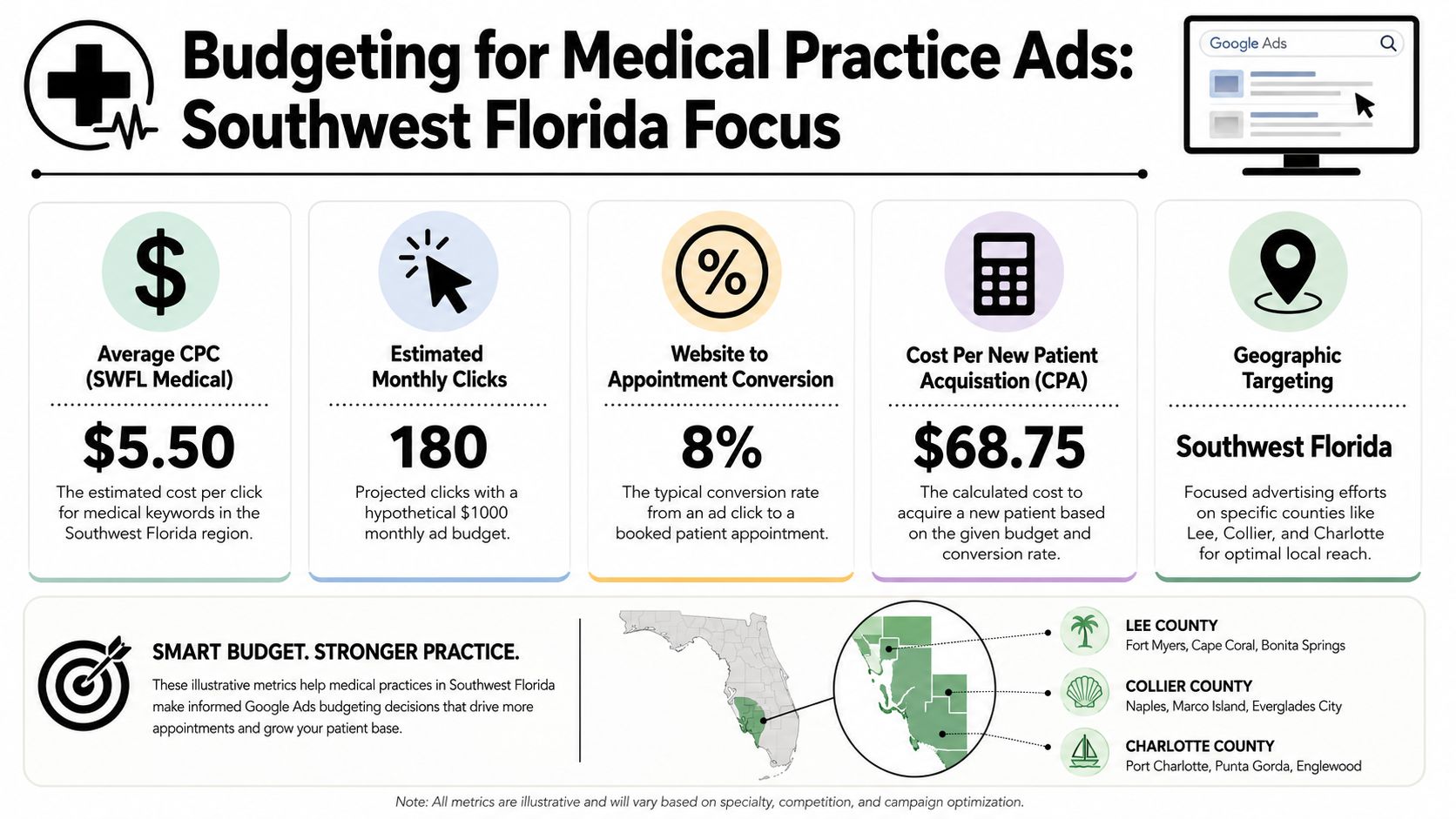
That answer changes by specialty. Average healthcare search ad costs vary widely. Primary care may run about $3 to $8 per click, while plastic surgery may run $15 to $50+, and LASIK can exceed $80 in some markets, according to specialty benchmark analysis for medical Google Ads. That's why budgeting by service-line profitability matters.
Start with margin, not media spend
If you're a Fort Myers primary care office, a booked appointment may justify a different ad cost than it would for a cosmetic dermatology service in Estero. The campaign should reflect that difference.
One healthcare marketing article notes that “dentist near me” can cost around $7 per click and explains that at a 2% conversion rate, about 50 clicks are needed to generate one patient action, which is why cost per conversion matters more than cost per click in practice, according to this analysis of Google Ads economics for medical practices.
That's the budgeting lens to use. Don't ask whether a click is expensive in isolation. Ask whether the full path from click to booked patient still works financially.
A practical Southwest Florida example
Take an Estero practice targeting patients in Fort Myers and Bonita Springs. Instead of covering all of Lee and Collier counties, tighten the campaign to the immediate service area where patients are most likely to book and show up.
A practical way to build the budget:
Choose one service line first
Start with something commercially important, not every service at once.Estimate click costs by specialty pressure
A general primary care campaign has a different risk profile than cosmetic services.Define the actual conversion point
For most practices, that's not a click. It's a call, form, or booked appointment.Keep the radius realistic
If the office mostly draws from Fort Myers, Estero, and Bonita Springs, don't pay for searches from far outside the normal drive area.Watch no-show and intake friction
Ad economics break down quickly if the front desk is slow to respond or if the booking path is clunky.
Here's a useful walkthrough on campaign planning before you go deeper into budget decisions:
What wastes budget in Fort Myers campaigns
In local healthcare accounts, wasted spend usually comes from a short list:
- Overbroad geography that reaches people unlikely to drive to the office
- Mixed service lines where lower-value searches consume budget meant for higher-value procedures
- Homepage traffic instead of dedicated landing pages
- Weak follow-up after the call or form comes in
A dermatology practice in Estero, for example, may be better off running separate campaigns for medical dermatology and cosmetic services, then limiting geography based on where each service draws patients from. The profitable map for Botox may not be the same as the profitable map for general skin exams.
The best budgets are built backward from profit, then constrained by geography and service relevance. That's how a local practice stays competitive without letting Google turn the account into an expensive guessing game.
Measuring What Matters and Optimizing for Appointments
Clicks are easy to see, which is why practices obsess over them. Clicks are also one of the least useful success metrics if they don't turn into appointments.
A medical campaign can generate form fills, phone calls, text inquiries, and booked visits. If the account only tracks one of those, the reporting will mislead you. That leads to bad bid decisions, wrong keyword cuts, and spend shifted away from what's working.
Count calls, not just forms
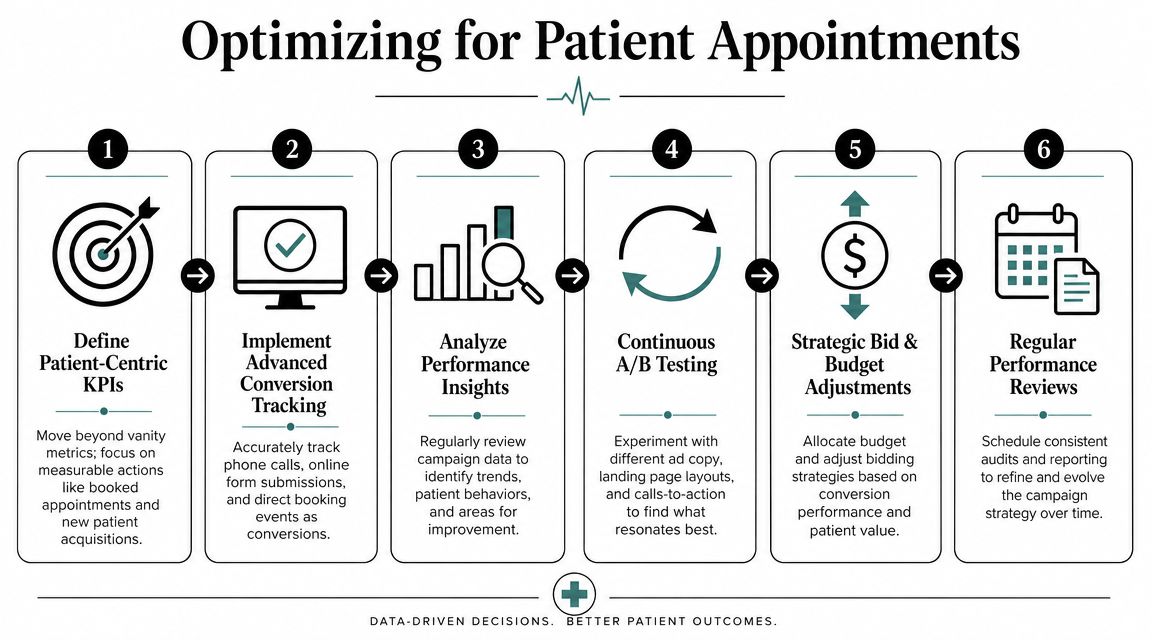
A major pitfall in medical PPC is tracking only online form submissions. Best practice is to pass the Google Click ID, or GCLID, into your CRM so ad clicks can be tied to booked appointments, then import those offline conversions back into Google Ads for optimization, as explained in this medical practice Google Ads setup guide.
That setup matters because many high-value patients don't fill out forms. They call.
A Fort Myers urgent care, pediatric office, or specialty clinic may get a large share of conversions by phone. If those calls aren't tracked properly, the account can look unprofitable even when it's producing real appointments.
What a useful tracking setup includes
A practical measurement stack usually covers:
- Phone call tracking for calls from ads and calls from landing pages
- Form submission tracking tied to completed appointment requests
- CRM capture of lead source so staff can confirm which inquiries became booked visits
- Offline conversion import so Google learns which clicks produced actual patients
- Search term review to cut irrelevant traffic and expand useful intent patterns
The account should optimize toward booked appointments, not toward the easiest conversion action to measure.
How optimization actually improves ROI
Once tracking is clean, campaign decisions become clearer.
If one ad group drives lots of clicks but few booked visits, reduce its priority or rewrite it. If another keyword generates fewer leads but better-quality appointments, protect it. If a city-targeted campaign produces calls but weak follow-through, review the landing page and intake process before blaming the keyword.
A simple monthly review should answer questions like:
| Question | Why It Matters |
|---|---|
| Which keywords led to booked appointments? | Protects profitable intent |
| Which search terms wasted spend? | Builds negative keyword lists |
| Which locations produced real patients? | Tightens geographic targeting |
| Which landing pages turned calls into bookings? | Shows where trust and clarity are strongest |
Don't let the front desk break the funnel
This part gets ignored too often. Marketing can generate the lead, but the practice still has to convert it.
If calls go unanswered, forms sit too long, or the scheduling process feels confusing, paid search ROI drops fast. In healthcare, speed and clarity at the intake stage affect the campaign just as much as keyword strategy does.
That's why serious Google Ads for medical practices isn't only about ad management. It's about closing the loop between search, click, inquiry, appointment, and visit. Without that loop, you're not optimizing. You're guessing.
If your practice in Fort Myers or the surrounding Southwest Florida area wants a clearer path from ad spend to booked appointments, Polaris Marketing Solutions can help you build a Google Ads strategy around local intent, clean tracking, and ROI you can measure.