
You log into Google Ads before the workday starts. The budget is spending. Clicks are coming in. Calls feel inconsistent. Some leads are junk. Some days look promising, then the next week falls apart. If you're a roofer in Cape Coral, a lawyer in Naples, or a dentist in Bonita Springs, that feeling is common. The account looks busy, but it doesn't feel profitable.
Most local businesses don't lose money on Google Ads because Google Ads "doesn't work." They lose money because the bidding strategy is wrong for the stage of the campaign. They pick an aggressive automated option too early, trust bad conversion tracking, or optimize for cheap clicks instead of real appointments and phone calls.
That matters even more in Southwest Florida. Storm damage, emergency services, seasonal swings, and local competition make lead quality more important than vanity metrics. A roofing contractor doesn't need more website visitors. They need estimate requests from homeowners in the right zip codes. A law firm doesn't need broad traffic. They need qualified consultations. A dental office needs booked appointments, not people poking around a services page.
Reviews affect that performance too. If you're paying for clicks and your Google Business Profile looks weak, your ads have a harder job. Before pushing budget harder, it helps to maximize your online reviews so searchers see real social proof when they compare you with the shop down the road.
If you're trying to make sense of paid search as a local company, this overview of PPC for small businesses is also useful background. But the core issue inside the ad account is usually the same. The engine is set wrong.
Your Guide to Winning on Google Ads in Southwest Florida
In Fort Myers, Naples, and Cape Coral, business owners usually come in with one complaint. They're spending enough to feel it, but not getting enough certainty back. That's almost always a bidding problem mixed with a tracking problem.
Why bidding is the engine
Your Google Ads bidding strategy tells Google what to chase. More clicks. More impressions. More conversions. More conversion value. If you choose the wrong goal, Google will still work. It will just work toward the wrong outcome.
A simple example. A local roofer launches search ads after a storm. If the campaign uses Maximize Clicks, Google will try to bring in as many clicks as possible within budget. That may include renters, job seekers, people outside the service area, and homeowners looking for free advice. The campaign can look active while the sales team gets weak leads.
Change the same campaign to focus on conversions after the account has usable data, and the system starts looking for people more likely to call, submit a quote form, or request an inspection. That's a very different result from the same keywords and a similar budget.
Practical rule: If your campaign goal and your business goal don't match, the platform will spend money faster than it produces profit.
What local businesses need most
Most Southwest Florida service businesses don't need a fancy bidding setup. They need a sensible one.
That usually means:
- Start with a strategy that matches your data level. New campaigns need a different approach than mature accounts.
- Track real lead actions. Calls, estimate requests, booked consultations, and appointment forms matter more than page views.
- Stop chasing cheap traffic. Cheap clicks can be expensive if your office staff can't close them.
For local service companies, the best bidding strategy is rarely the one that sounds smartest. It's the one that fits the account you have right now.
Manual Control vs Automated Power
A Fort Myers roofer often asks the same question after a few expensive weeks in Google Ads: should we control bids ourselves, or let Google do it?
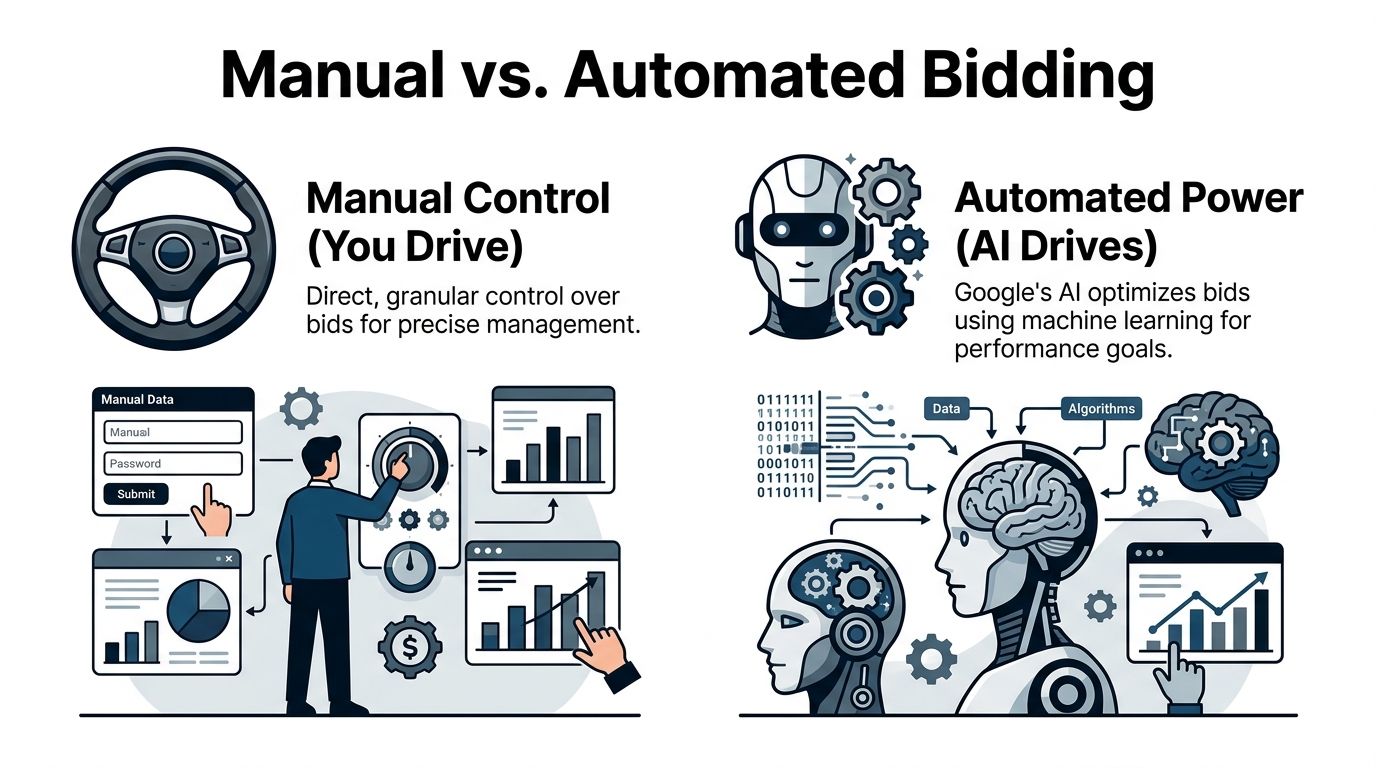
The answer depends less on preference and more on account condition. In Southwest Florida local service campaigns, manual bidding works best when the account is new, tracking is still being verified, or lead quality needs close supervision. Automated bidding works best when the campaign has accurate conversion data and a clear goal tied to booked jobs, consultations, or estimate requests.
When manual bidding still makes sense
Manual CPC is useful when control matters more than speed.
That usually applies in three situations. First, a brand-new campaign with little or no conversion history. Second, a local service account that needs search term cleanup before scaling. Third, a business with a small budget where a few bad clicks per day can do real damage.
For example, if a Cape Coral law firm is testing new practice-area campaigns, manual bidding can help isolate what is generating qualified calls. If a Naples dentist keeps getting clicks for insurance questions, free care, or jobs, manual bidding makes those problems easier to spot before Google starts chasing the wrong patterns at scale.
The downside is simple. Manual bidding takes attention. Someone has to review search terms, adjust bids, watch device and location performance, and make judgment calls regularly. If that work does not happen, "control" becomes neglect.
Why automation usually wins
Automated bidding is stronger once the account is feeding Google clean signals.
Smart Bidding can adjust in real time based on factors a human cannot manage fast enough during every auction. That matters for local service advertisers in Southwest Florida, where search demand can shift quickly by season, storm activity, competition, and service area. A roofing company in Fort Myers after heavy weather and a family law firm in Naples during a quieter month should not be managed with the same level of bid rigidity.
In mature accounts, automation usually beats manual bidding because it can respond faster and stay focused on the selected goal. That only helps if the goal is set up correctly. If the campaign counts weak actions as conversions, automation will still optimize aggressively. It just optimizes toward the wrong outcome.
The trade-off in plain English
| Approach | Best use | Main upside | Main downside |
|---|---|---|---|
| Manual bidding | New campaigns, low-data accounts, close testing periods | More control over spend and keyword-level decisions | Slower to manage, harder to scale, depends heavily on regular oversight |
| Automated bidding | Campaigns with accurate tracking and enough conversion history | Faster bid adjustments and better efficiency once trained | Can waste budget quickly if tracking, targeting, or conversion goals are flawed |
For most local service businesses here, the default path is straightforward. Start tighter. Use manual control or a limited automated approach while the account is being cleaned up. Move to Smart Bidding after conversion tracking is trustworthy and the campaign is producing enough real lead data to guide it.
Automation is not a shortcut. It is a multiplier. Clean account, better results. Messy account, faster waste.
A Breakdown of Every Google Ads Bidding Strategy
The fastest way to understand bidding is to sort each option by the business result it's built to chase. That matters because a roofer, personal injury lawyer, and ecommerce store shouldn't all use the same approach just because it's available in the drop-down.

For visibility and local presence
Target Impression Share
This strategy aims to show your ad in prominent positions for as many eligible searches as possible.
Best for: Branded protection, local visibility, and markets where being seen matters almost as much as being clicked.
Pro: It can help a dentist or law firm stay highly visible in searches for the business name or a narrow branded service.
Con: It doesn't optimize for lead quality. A campaign can look dominant in impressions while producing weak business results.
For many local businesses, this is a supporting strategy, not the main engine.
For traffic and early data gathering
Maximize Clicks
This tells Google to get as many clicks as possible within your budget.
Best for: New campaigns that need traffic and early search-term data, especially when conversion tracking isn't ready.
Pro: Fast way to learn what users search for and how they respond to your ads.
Con: It can buy a lot of curiosity instead of buying intent.
A practical example is a new plumbing or roofing campaign with no conversion history. Maximize Clicks can help gather early search behavior. But if you leave it there too long, you're paying for activity instead of outcomes.
For lead generation
Maximize Conversions
This strategy tells Google to pursue as many conversions as possible within the budget.
Best for: Local service businesses that care about quote requests, calls, booking forms, and consultation requests.
Pro: Strong default choice once conversion tracking is working and the account has enough history.
Con: If your conversions are set up badly, Google will optimize for the wrong actions.
This is often the first serious automated strategy for contractors, legal offices, and healthcare providers because it moves the campaign toward actual lead actions.
Target CPA
Target CPA is for advertisers who want to control average acquisition cost more tightly. As explained in Semrush's guide to Google Ads bid strategy types, Target CPA bidding specifically optimizes for conversions at or below a user-defined average cost per action, adjusting bids dynamically for each auction to secure the most cost-effective conversions within budget; for example, setting a $50 Target CPA will cause Google to bid higher for users predicted to convert near that cost while lowering bids for unlikely converters, ensuring the overall average remains at $50 even if individual conversions vary slightly above or below.
That makes Target CPA useful when a local business has a clear idea of what a lead should cost and enough clean history to support that goal.
Set Target CPA too aggressively, and the campaign can choke off volume. Set it based on real account performance, not wishful thinking.
For revenue and variable deal value
If one conversion is worth much more than another, revenue-focused bidding matters more than lead count.
Maximize Conversion Value
This strategy goes after the highest total conversion value your budget can produce.
Best for: Ecommerce accounts or service businesses that pass meaningful value differences back into Google Ads.
Pro: Better than pure lead-count bidding when some jobs, services, or products are much more valuable.
Con: Useless if every conversion is tracked the same way with no value logic behind it.
Here's a quick walkthrough that helps if you want to see the settings in action:
Target ROAS
This strategy tells Google to optimize toward a return goal based on conversion value. According to WordStream's explanation of Target ROAS bidding, Target ROAS automatically adjusts bids based on the predicted value of each conversion to generate the highest possible return on ad spend, requiring historical conversion value data to function effectively; for example, if a business sets a 400% Target ROAS, Google will bid aggressively for product categories with high estimated revenue while reducing bids on lower-value items to maintain that ratio across the campaign.
For a typical Southwest Florida roofer or attorney, Target ROAS usually isn't the first move because lead value isn't always cleanly passed into the system. For ecommerce, it can be the right end goal.
One specialty option worth knowing
CPV for YouTube Ads
If you run video campaigns, CPV matters. According to DataFeedWatch's overview of automated bidding strategies, Cost-Per-View bidding is reserved for YouTube Ads, and you pay for views or interactions rather than standard search clicks.
That makes CPV useful for awareness video campaigns, but it's not a search bidding strategy for local lead generation.
The Essential Prerequisites for Smart Bidding Success
A Fort Myers roofer can spend real money on Smart Bidding, get plenty of clicks, and still have a slow phone. The usual problem is not the bidding strategy itself. The account is feeding Google weak conversion signals, thin data, or a budget that cannot support the goal.
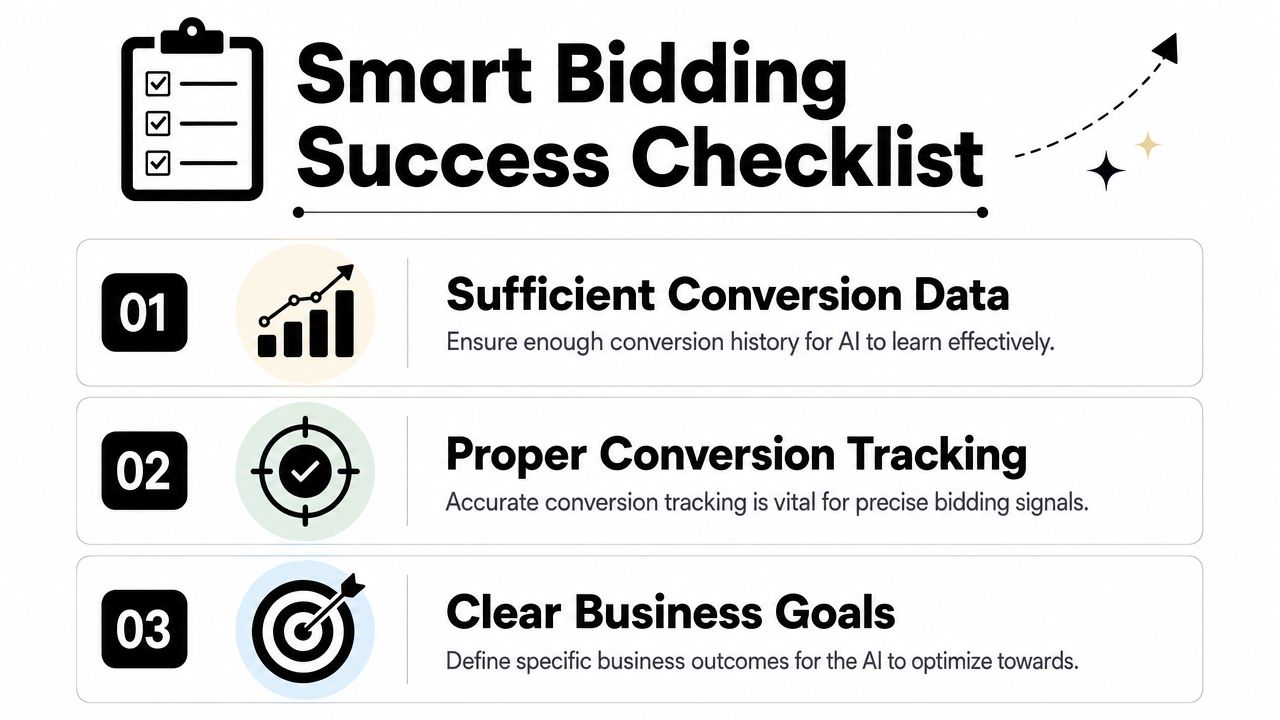
Conversion tracking has to reflect actual lead quality
Google can only optimize toward the actions you mark as important. If a plumbing company counts every page view, button click, and short call as a conversion, the system will go find more of those low-value actions. That does not help the office book jobs.
A better setup is tied to what the business sells. Roofers should usually prioritize estimate requests and qualified phone calls. Personal injury firms should focus on consultation forms and calls that last long enough to show real intent. Dentists should track appointment requests, not casual browsing on a service page.
Bad inputs create bad bidding decisions. In local service campaigns across Southwest Florida, that usually shows up as cheap leads, poor close rates, and a frustrated owner who thinks Google Ads does not work.
Smart Bidding needs enough conversion history to learn
Small accounts run into this issue all the time. The business wants to jump straight into Target CPA because it sounds more efficient, but the campaign has not produced enough real conversions for Google to make stable decisions.
According to Defined Digital Academy's guidance on Google Ads bidding strategies, advertisers should treat 30 conversions per month as a baseline before shifting from Maximise Conversions or Maximise Conversion Value into stricter target-based bidding such as Target CPA or Target ROAS.
That is a practical benchmark, not a guarantee. Some local campaigns in Naples or Cape Coral can work with less volume if the account is tightly built and the conversion action is clean. But in general, low-volume campaigns need simpler bidding rules. The less data Google has, the more cautious you should be about forcing a target.
Budget and campaign structure have to give the system room to work
A tight budget can limit Smart Bidding before it ever gets traction. If a campaign only gets a handful of clicks per day, the algorithm has very little room to test, learn, and adjust. That is especially true in higher-cost categories like legal, cosmetic dentistry, and emergency roofing.
Campaign structure matters just as much. If one campaign mixes branded traffic, broad non-brand searches, and multiple service lines, the bidding model is learning from a messy set of signals. A cleaner setup usually works better. Separate brand from non-brand. Break out core services when budgets allow. Keep match types and search intent reasonably aligned.
For many Southwest Florida service businesses, the safer default is simple. Start with clean conversion tracking, focused campaigns, and enough budget to generate consistent traffic. Then let automation optimize inside a controlled environment instead of asking it to fix a messy account.
Good Smart Bidding results usually come from plain setup discipline. Track the right actions, wait for enough data, and keep the campaign structure tight.
How to Choose the Right Bidding Strategy for Your Business
Most small businesses don't need a complicated framework. They need a decision path they can use today. If you answer a few questions, the right Google Ads bidding strategy usually becomes obvious.
Start with what you're measuring
Ask yourself the first question.
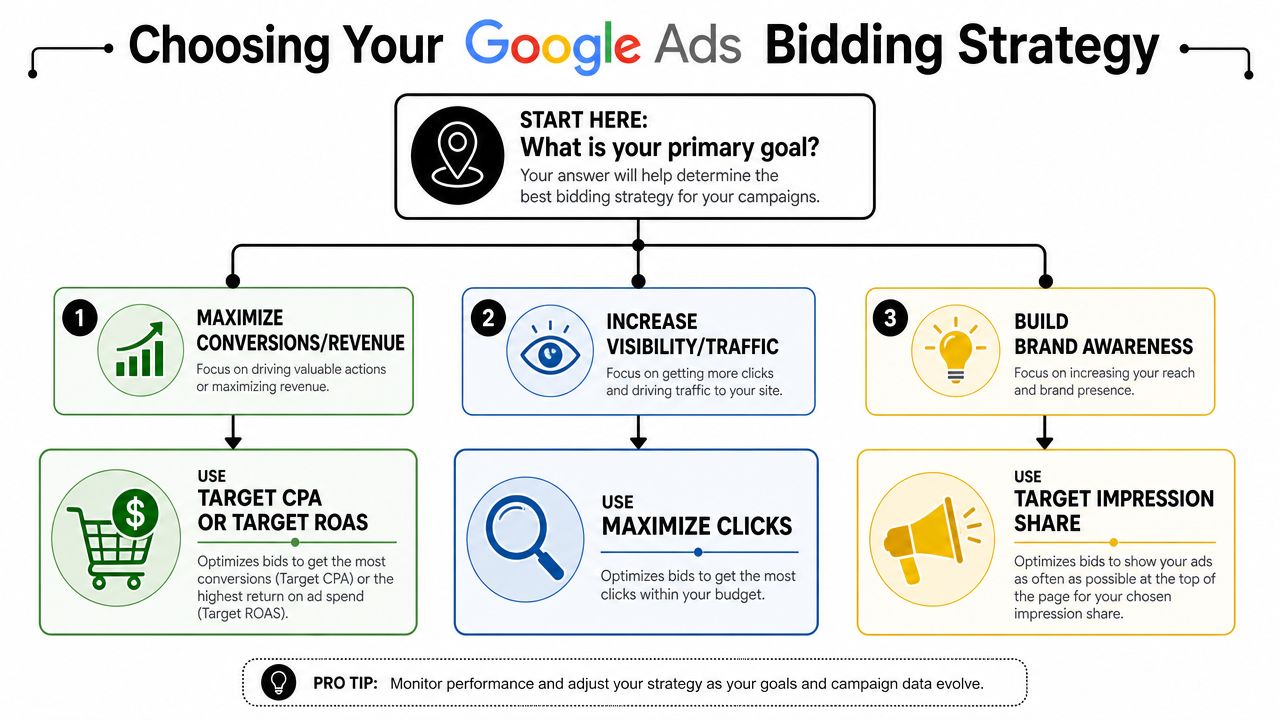
Do you have conversion tracking set up correctly?
If the answer is no, don't jump into Smart Bidding that depends on strong conversion signals. Use Maximize Clicks or a controlled manual approach while you fix call tracking, form tracking, and lead quality rules. Until the account knows what a real lead looks like, advanced bidding won't save it.
If the answer is yes, move to the next question.
Then look at conversion volume
Are you producing more than 30 conversions per month?
If not, a practical default is Maximize Conversions for lead generation or Maximize Conversion Value for revenue-driven campaigns. That gives Google a clear direction without forcing a hard target too early.
If yes, you can start using goal-based bidding with more confidence.
The timeline matters too. According to Two Minute Reports' explanation of Smart Bidding learning periods and target-setting, the learning phase for strategies like Target CPA and Target ROAS typically lasts 1 to 2 weeks, and advertisers should monitor performance for at least 4 weeks after a bidding change before making major adjustments. The same source recommends setting initial targets from recent account performance, then adjusting 10 to 15% at a time, while avoiding changes larger than ±30% in one move.
Choose based on how your conversions are valued
Use this simplified decision tree:
No working conversion tracking
- Use Maximize Clicks while you build data and clean up measurement.
Tracking is working, but lead volume is still limited
- Use Maximize Conversions if all leads are roughly similar in value.
- Use Maximize Conversion Value if some jobs or sales are worth more than others.
Tracking is working and the campaign has strong volume
- Use Target CPA when you want a stable average cost per lead.
- Use Target ROAS when conversion values differ and revenue is the main KPI.
The best bidding choice isn't the most advanced one. It's the one your account can support right now.
For most Southwest Florida service businesses, the default path is simple. Start basic. Build clean data. Move to stronger automation only when the account has earned it.
Example Scenarios for Local Southwest Florida Industries
A contractor in Cape Coral gets three leads in a week from Google Ads. One is a real roof replacement estimate. One is a repair on a mobile home the company does not service. One is a homeowner asking if the business works in Sarasota. The bidding strategy matters, but the right answer depends on the business model, the service mix, and how cleanly conversions are tracked.
Here is the practical framework I use for Southwest Florida service businesses. Start with the lead type you want, then pick the bidding strategy that gives Google enough room to find more of those searches without sending the budget into junk traffic.
Roofing company in Cape Coral
For most roofers, the goal is straightforward. Get estimate requests and phone calls from homeowners in the service area who need a roof replacement, storm repair, or inspection.
In a newer account, Maximize Conversions is usually the better default once call tracking and form tracking are working. It pushes the campaign toward actions that matter instead of cheap clicks from people looking for DIY tips, jobs, or out-of-area help. If the account is still messy and conversion tracking is unreliable, keep expectations modest and fix the setup before asking Google to optimize aggressively.
As noted earlier, many accounts start with simpler bidding and move into stronger automation as conversion history builds. That trend matches what I see in local service accounts. A roofer rarely needs fancy bidding first. They need clean lead signals, tight geography, and separate campaigns for different job types.
That campaign split matters more in roofing than a lot of owners expect. Storm damage searches behave differently from full replacement searches. Inspection leads often sit higher in the funnel. If all of that traffic sits in one campaign, Google can chase the easiest conversion and ignore the jobs with better revenue. This guide to Google Ads for roofing covers that trade-off in more detail.
Personal injury lawyer in Naples
A personal injury firm should not optimize for volume alone. A flood of low-intent form fills can wreck the budget fast in legal search.
Maximize Conversions is often the best starting point if the firm has strong intake tracking and enough qualified lead volume. The catch is lead quality. If the campaign counts every call the same way, Google may optimize for short, weak inquiries instead of signed-case opportunities. The better setup is to make primary conversions stricter, such as qualified calls or completed case evaluation forms, then bid toward those.
Attribution also matters more for law firms than for many home service advertisers. A prospect may click an ad, leave, come back later on another device, then call after reading reviews. This guide to multi-touch attribution is useful if the firm wants a clearer view of which touchpoints helped produce the lead.
A mature legal account can move to Target CPA later if the average cost per qualified consultation is stable enough to set a realistic target. Until then, forcing a tight CPA goal too early usually chokes volume.
Dental practice in Bonita Springs
Dental accounts usually need two different outcomes from Google Ads. One campaign should protect visibility for branded and high-intent local searches. Another should produce appointment requests for services like implants, emergency dentistry, or new patient exams.
That is why a mixed bidding setup often makes sense. Target Impression Share can fit a branded campaign where the office wants strong presence on its own name or a core local term. Maximize Conversions often fits service-line campaigns better, especially when the office wants more booked appointments and phone calls.
The main trade-off is budget control. If a dentist puts branding, emergency care, and high-value elective services into one campaign, the bidding strategy has to solve conflicting goals. Separate campaigns give each service type its own budget, message, and bid logic. For Bonita Springs practices, that usually produces cleaner data and fewer wasted clicks from broad informational searches.
Your Setup Checklist and Key Optimization Tips
A lot of wasted ad spend happens after the strategy change, not before it. Someone flips the bid setting, gets nervous after a few days, starts tweaking targets, piles on bid adjustments, and resets the learning process over and over.
A clean way to change bidding strategy
Use this checklist before you touch campaign settings:
- Confirm your primary conversions. Make sure calls, lead forms, booked appointments, or quote requests are the actions being optimized.
- Check recent performance first. Use recent campaign data as the baseline for any target you set.
- Change one major thing at a time. Don't swap bidding, rewrite ads, and rebuild landing pages all in the same week.
- Document the date of the change. You need a clean before-and-after window.
- Leave the campaign alone long enough to learn. Don't judge the result too early.
If you're trying to understand which touchpoints contributed before a lead converted, this guide to multi-touch attribution gives useful context. That's especially helpful for law firms, medical practices, and service businesses where people often click, leave, come back, and call later.
The mistakes that keep burning budget
One of the biggest mistakes is mixing manual habits into Smart Bidding campaigns. According to Zato Marketing's explanation of bid adjustments under Smart Bidding, nearly 90% of advertisers incorrectly apply location, demographic, and schedule bid adjustments to Smart Bidding campaigns, even though Google ignores those non-device adjustments for Target CPA and Target ROAS. Only device-level bid adjustments are respected.
That means a lot of business owners and agencies are spending time on settings that do nothing.
If you're using Target CPA or Target ROAS, stop fiddling with location, age, and ad schedule bid modifiers as if they still control the auction. In most cases, they don't.
Another common mistake is impatience. Smart Bidding needs stability after a change. If you switch targets every couple of days, you're training the system to never settle.
For day-to-day management, these habits keep campaigns healthier:
- Watch lead quality, not just lead count. A cheap bad lead is still expensive.
- Review search terms regularly. Bidding doesn't fix irrelevant query matching by itself.
- Compare by device. Device-level behavior still matters, and device adjustments are the exception Smart Bidding respects.
- Keep budgets realistic. If campaigns are constantly constrained, performance signals get harder to interpret.
- Use a disciplined reporting process. For businesses that need outside help with that, this overview of PPC management for small businesses covers what structured campaign oversight should include.
The right bidding strategy won't rescue a sloppy account. But a clean account with the right bidding setup can stop a lot of waste fast.
If your Google Ads account is generating clicks but not enough qualified leads, Polaris Marketing Solutions can help you sort out the bidding, tracking, and local campaign structure so your budget works harder in Fort Myers, Cape Coral, Naples, and the rest of Southwest Florida.