

You got a quote from a local agency for your ecommerce site, and it probably landed somewhere between “painful” and “not happening.” So now you're looking at India because everyone says the work is good, the talent pool is deep, and the cost can make a stalled project viable again.
That instinct is reasonable.
But outsourcing ecommerce web design in India isn't automatically a smart move just because the proposal is cheaper. If the agency can't communicate clearly, can't manage a smooth checkout, or disappears once the final invoice is paid, the lower price won't matter. You'll spend more fixing the mess than you would've spent choosing better the first time.
For a US small business owner, the key question isn't “Is India cheaper?” It's “Can I hire an Indian team that protects my margin, respects my deadlines, and builds a store that converts?” That's the standard. Everything else is noise.
Why US Businesses Look to India for Ecommerce Design
A common situation looks like this. A US retailer wants to replace a dated Shopify theme, improve mobile shopping, and clean up checkout. They talk to a local agency, get a proposal that bundles strategy, design, development, revisions, and support, then freeze when they see the price. A week later, they're browsing Clutch, LinkedIn, and referrals looking for Indian agencies.
That search usually starts with cost. It shouldn't end there.
India has become attractive because it isn't just a labor arbitrage play anymore. It's a serious digital commerce market with agencies building for fast-moving, competitive online businesses every day. The Indian ecommerce market is projected to cross $200 billion by the end of 2026, according to GoKwik's ecommerce growth analysis. That kind of scale creates pressure. Agencies working inside that environment learn speed, mobile UX, payments, and conversion-focused execution.
What this means for a US business owner
You're not hiring from a fringe market. You're hiring from a market where ecommerce is active, competitive, and operationally demanding.
That matters for three reasons:
- Broader execution experience: Agencies in India often work across Shopify, WooCommerce, Magento, and custom builds, not just brochure websites.
- More flexibility on scope: You can often find teams willing to handle design-only, design plus development, or full launch support.
- Better fit for growing brands: If your business isn't enterprise-sized but still needs custom work, Indian agencies often sit in that middle ground comfortably.
Practical rule: Don't outsource because it's cheaper. Outsource because the agency can deliver the same business outcome with better economics.
A simple example: if you sell specialty home goods in the US and need a cleaner mobile product page, stronger category navigation, and less friction at checkout, an Indian agency may be a strong fit. If you need intense brand workshops, in-person stakeholder meetings, and close legal oversight, the fit gets weaker.
India can be the right answer. Cheap alone isn't.
Understanding the Indian Digital Commerce Landscape
If you want to hire well, you need to understand the environment Indian agencies design for. It's different from the US market in ways that directly affect how those teams think about ecommerce UX.
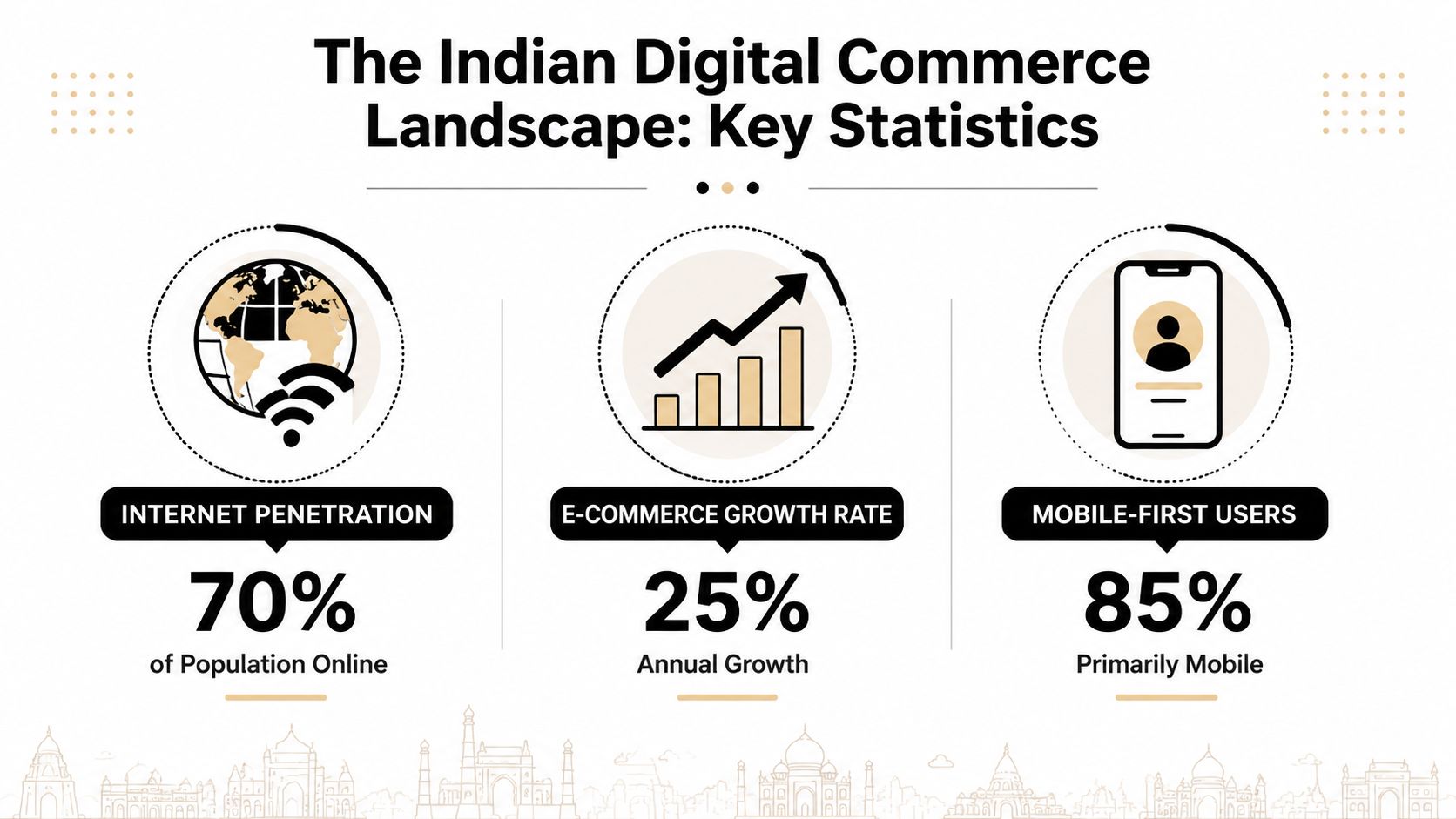
The first difference is mobile. In India, successful ecommerce web design is mobile-first by necessity. Mobile commerce reached $534.18 billion in 2024 and represented 40.4% of total ecommerce sales, while 62% of companies reported increased sales after building a responsive mobile site, according to Source 4. That's why strong Indian agencies obsess over thumb-friendly navigation, compressed media, lean layouts, and fast product discovery.
Here's the visual version of the market many agencies are building inside:
Mobile-first isn't a trend
A lot of US businesses still review homepage mockups on a laptop and approve design direction from there. That's a mistake when hiring for ecommerce web design in India.
Indian teams often build with the assumption that users arrive on smaller screens, weaker connections, and less patience. That changes design decisions:
- Navigation gets simplified: Fewer choices, clearer labels, better filtering.
- Images carry more weight: Users often judge products visually before reading copy.
- Checkout has to feel short: Extra form fields and awkward flows hurt performance fast.
Source 4 also notes that 56% of users look at product images first when landing on a new product page, 78% want ecommerce sites to show more product images, and 69% of regular shoppers rank easy navigation and good user experience as the most important factor. Those aren't design flourishes. They're revenue issues.
Payments and localization shape the build
The second difference is payment behavior. Indian agencies frequently work with payment ecosystems that demand practical integration work, not just “turn on Stripe and go.” Even if your US store won't use Indian payment rails, an agency's experience with payment complexity is useful. It tells you they've likely dealt with edge cases, checkout friction, and gateway-specific UX constraints.
The third difference is localization. Good Indian agencies know that one interface doesn't serve every user equally. They've often had to think about language switching, regional browsing habits, and lower-bandwidth conditions. That mindset is valuable if your US business serves bilingual buyers, older customers, or less technical shoppers.
A useful side read here is this overview of the Asian search engine landscape for e-commerce. It's worth reading because it broadens your view beyond Google-only assumptions and reminds you that regional behavior changes design and discovery strategy.
After you've seen the market context, this short video is a good reset before you start comparing vendors:
What to look for in portfolios
Don't ask an Indian agency whether they “do mobile-first.” Every agency says yes. Check for proof instead.
| What to inspect | What good looks like | What should worry you |
|---|---|---|
| Product pages | Clear image hierarchy, sticky add-to-cart, readable pricing | Tiny text, cluttered layouts, image galleries that lag |
| Category pages | Useful filters, quick scanning, obvious sort options | Endless scrolling with poor product grouping |
| Checkout | Few steps, minimal distractions, clean error states | Long forms, account creation pressure, confusing shipping logic |
If an agency's portfolio looks polished on desktop but awkward on mobile, move on.
Decoding Costs and Timelines for Indian Web Design
Most outsourcing mistakes happen before design starts. They happen in the proposal stage, when the client assumes a price includes more than it does.
That's especially risky with Indian ecommerce projects because “website design” can mean very different things. One proposal may include UX, UI, development, QA, speed optimization, and launch support. Another may be little more than a themed setup with some banner swaps.
What drives cost
The biggest cost drivers are usually platform choice, design depth, product catalog complexity, custom functionality, and integration work. For a US buyer, the smartest move is to force every proposal into the same structure so you can compare apples to apples.
Ask for line items around:
- Design scope: Homepage only, full store templates, or a complete UX system.
- Development scope: Theme customization, app setup, custom code, or API work.
- Checkout complexity: Taxes, shipping rules, payment methods, and edge cases.
- Post-launch support: Bug fixes, training, warranty period, and maintenance.
One budgeting issue gets overlooked constantly. A 2024 study found that 68% of small businesses faced launch failures because they didn't anticipate costs tied to GST-compliant checkout flows and UPI payment integrations, as noted in Source 6. Even if you're a US business not launching for India, the lesson still applies: compliance and payment requirements create hidden scope, and hidden scope turns “affordable” into expensive.
How to estimate timelines without getting fooled
A serious agency should break the work into phases. If they can't, they probably don't manage projects well.
A realistic proposal should separate at least these stages:
- Discovery and requirements
- UX planning and wireframes
- Visual design
- Development
- Testing
- Launch and handoff
If an agency promises an advanced ecommerce site “very quickly” without clarifying revision rounds, content dependencies, app setup, and QA, that's a warning sign. Fast projects usually mean one of two things: they're reusing a template heavily, or they're underestimating the work.
Budget discipline matters more than the headline quote. A slightly higher proposal with detailed scope is safer than a bargain proposal with vague promises.
A practical way to compare proposals
Before you sign anything, send every shortlisted agency the same checklist. Use plain language.
- “List every deliverable by page or template.”
- “State what is custom-coded versus configured from existing tools.”
- “Confirm how many revision rounds are included.”
- “State what happens after launch if bugs are found.”
- “List any third-party apps, licenses, or recurring tools that I'll pay separately.”
If you want a useful framework for thinking through spend before you collect proposals, this guide on budgeting for an ecommerce website is worth reviewing. It helps you separate build cost from ongoing operating cost, which many small business owners blur together.
The business decision
Don't buy the cheapest plan. Buy the clearest plan.
An actionable example: if one Indian agency gives you a short quote that says “Shopify design and development included,” and another gives you a structured estimate covering product templates, mobile QA, app setup, speed checks, launch support, and post-launch fixes, the second proposal is usually the safer investment even if it costs more. Clarity protects ROI.
Popular Platforms and Tech Stacks in India
Platform choice will shape your cost, control, maintenance load, and long-term flexibility more than most owners realize. Don't let an agency pick the stack just because it's what they happen to like building.
For most US small businesses hiring in India, the primary comparison comes down to Shopify, WooCommerce, and Magento. Each can work. Each can also be the wrong choice.
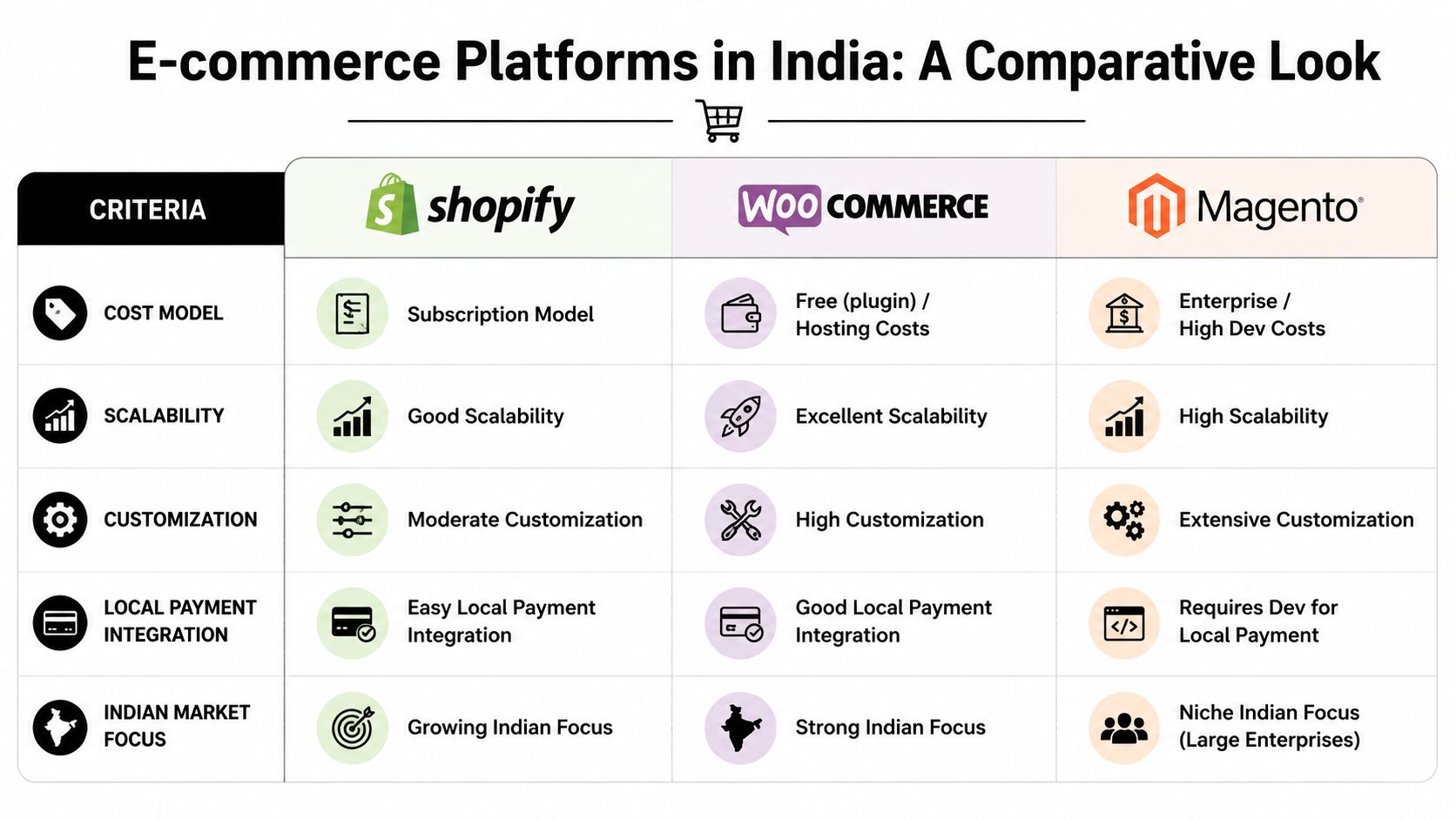
Shopify for speed and simplicity
Shopify is usually the cleanest path if you want predictable management, decent scalability, and less technical overhead. It's strong for businesses that want to launch, sell, and market without babysitting infrastructure.
It's a good fit if you:
- Need speed to launch: Your current store is outdated and costing you sales.
- Prefer lower maintenance: You don't want to manage plugins, hosting, and patching.
- Can live with platform boundaries: You want customization, but not at any cost.
The downside is control. Deep checkout customization, unusual workflows, and certain UX ideas may hit platform limits or require apps that stack recurring costs.
WooCommerce for flexibility and cost control
For ecommerce web design in India, WooCommerce is often the practical favorite. More than 60% of SMB ecommerce startups in India use the WordPress and WooCommerce stack, and agencies use it to cut project costs by 30 to 40% compared to proprietary SaaS platforms, according to Source 3. That's a big reason many Indian agencies lead with it.
This matters for a US business owner because WooCommerce can be the sweet spot when you need customization without enterprise pricing. Product bundles, unusual shipping rules, wholesale logic, custom landing pages, and SEO-heavy content strategies are often easier to shape here.
For a broader comparison before you commit, review these best ecommerce platforms for small business considerations. It's a useful way to pressure-test whether flexibility or simplicity matters more for your business model.
Magento for large and complex stores
Magento makes sense when the catalog is large, the logic is complicated, and the company has budget for real development discipline. It's powerful, but it's rarely the best first choice for a small US business outsourcing from afar.
If an agency pushes Magento immediately, ask why. Sometimes it's the right answer. Often it means they're selling complexity.
Side-by-side decision guide
| Platform | Best for | Main upside | Main risk |
|---|---|---|---|
| Shopify | Small teams that want ease and speed | Cleaner management and faster rollout | Ongoing app costs and platform limits |
| WooCommerce | Businesses wanting control and custom behavior | Strong customization and cost efficiency | More moving parts to manage well |
| Magento | Large stores with advanced needs | Deep flexibility for complex commerce | Higher development and maintenance burden |
Choose the platform that matches your operating capacity, not the one with the most features.
An actionable example: if you sell fewer products, rely on ads, and need a site your staff can update without developer help, Shopify is usually smarter. If your store needs custom product logic, content-driven SEO, and tighter budget control, WooCommerce is often the better fit. If you don't already know why you need Magento, you probably don't need Magento.
The Pros and Cons of Outsourcing Your Web Design
Outsourcing to India can work very well. It can also become a drawn-out headache that burns time and trust. The outcome depends less on country and more on process, expectations, and vendor quality.
Still, there are real advantages and real friction points. Ignore either side and you'll make a bad decision.
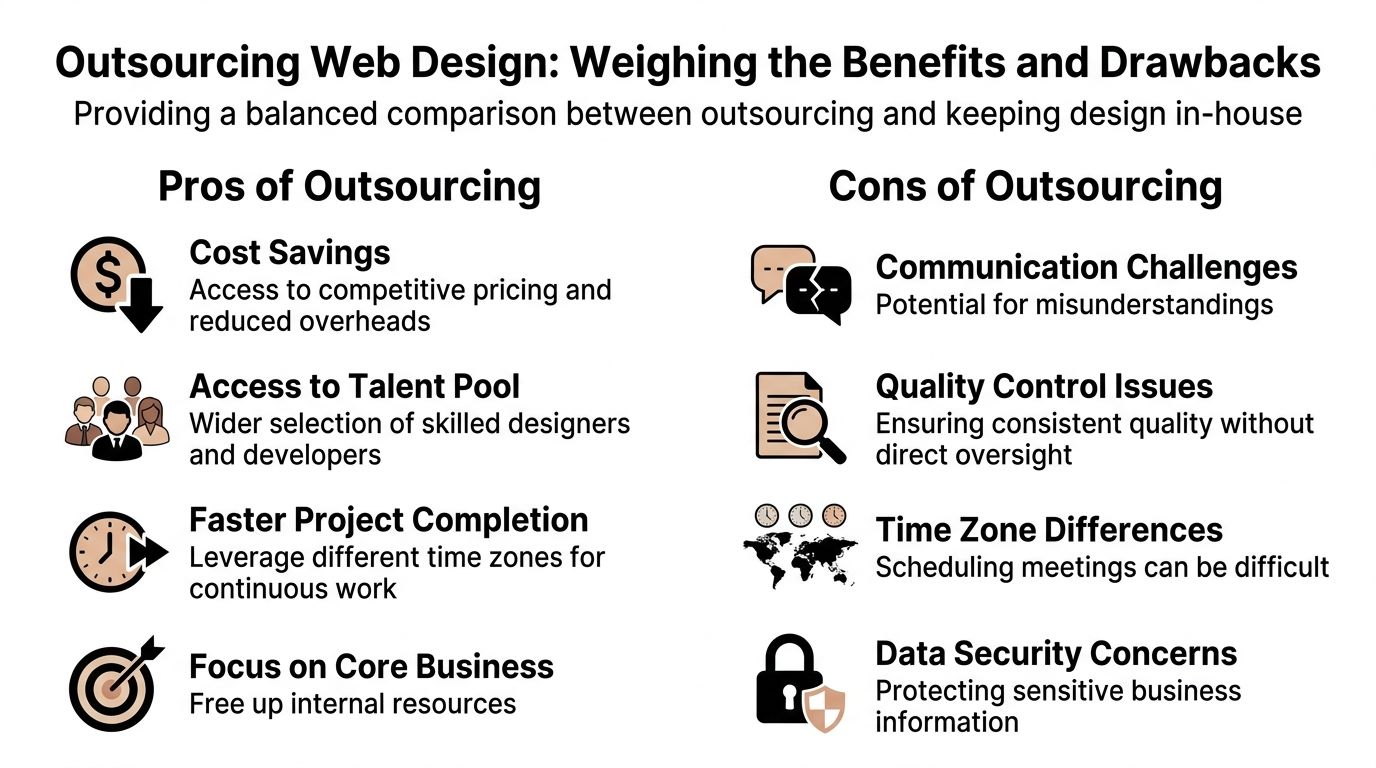
The upside is real
Outsourcing often gives small US businesses access to talent they couldn't afford locally. That doesn't mean “premium for pennies.” It means your budget may buy a more capable team, broader execution, or a fuller project scope than it would in your city.
A few concrete benefits stand out:
- Cost advantage: You may be able to afford strategy, design, development, and QA in one package instead of hiring piecemeal.
- Talent breadth: Indian agencies often have in-house specialists across Shopify, WooCommerce, UI design, and backend integration.
- Follow-the-sun progress: Time zone gaps can be helpful when managed well. You leave feedback in the evening and wake up to updates.
A practical example: a US merchant can review mockups at 5 p.m. Eastern, send comments in Loom or ClickUp, and the Indian team can work while the US office sleeps. Used well, that shortens cycles.
The friction is also real
Communication is where many otherwise capable projects start slipping. Not because the team is unskilled, but because expectations aren't explicit.
Common problems include:
- Indirect communication: Some teams say “yes” before they fully understand the requirement.
- Time zone lag: Simple clarifications can take a full day if there's no agreed response window.
- Quality ambiguity: What you mean by “premium” or “clean” may not match what the agency hears.
- Limited recourse: Enforcing contracts across borders is harder than dealing with a local partner.
“Looks good” is dangerous feedback. Say what you want changed, why it matters, and what outcome you expect.
You also need to think about oversight. If you don't have a project owner on your side, outsourcing magnifies confusion. Somebody has to review work, approve deliverables, and catch drift early.
A useful reference point while evaluating vendor work is this guide to best practices for ecommerce website design. It helps you judge whether you're looking at a design with strong conversion awareness or just a polished mockup.
When outsourcing is a fit
Outsourcing works best when your business has a clear scope, one decision-maker, and a willingness to manage asynchronously. It works worst when the project is fuzzy, approvals come from five people, and nobody writes things down.
Here's the blunt version:
- If you want a partner to execute against a defined brief, India can be a strong option.
- If you want a highly consultative, high-touch local relationship with frequent live collaboration, local may be better.
Neither is morally superior. One is just a better match for how your business operates.
How to Hire and Manage the Right Indian Agency
Most owners don't fail because they chose India. They fail because they hired loosely. They bought a promise instead of a process.
If you want a good outcome, treat agency selection like vendor due diligence, not online shopping.
Start with a brief that removes ambiguity
Don't ask for “an ecommerce redesign.” That's lazy, and it invites bad proposals.
Your brief should include:
- Business model: What you sell, average order complexity, and who buys.
- Platform preference: Shopify, WooCommerce, Magento, or “recommend based on requirements.”
- Must-have features: Subscriptions, bundles, wholesale pricing, product filters, account areas, or custom shipping logic.
- Success criteria: Better mobile UX, easier product discovery, cleaner checkout, improved manageability for your team.
- Operational limits: Internal deadline, content readiness, budget guardrails, and who approves work.
An actionable example: instead of saying “I want a better product page,” say, “I need a mobile product page that prioritizes images, keeps price and add-to-cart visible, supports variant selection cleanly, and doesn't bury shipping information.”
That level of specificity saves money.
Vet the portfolio like a buyer, not a designer
Most portfolios are designed to impress, not inform. You need to inspect them differently.
Open their live sites on your phone. Add products to cart. Check category filters. Trigger validation errors in checkout. Try it on weak Wi-Fi. If possible, test on an older phone, not just your newest device.
One issue deserves special scrutiny: checkout. Unsatisfactory checkout design contributes to roughly $260 billion in abandoned purchases globally, which makes it a critical part of any agency review. Since the source URL for that fact is reserved earlier, treat it here as a practical warning rather than a linked stat. If an agency's checkout examples feel long, cluttered, or confusing, that's not a minor flaw. It's a conversion risk.
Ask questions that expose how they work
Most owners ask, “How much experience do you have?” That question is too easy.
Ask harder ones:
- How do you handle feedback from US clients across time zones?
- Who owns strategy versus production on your side?
- What project management tool do you use day to day?
- How do you test mobile UX before launch?
- What happens if milestones slip?
- What access do I retain to hosting, domain, apps, code, and design files?
- What support is included after launch?
The right agency will answer directly. The wrong agency will hide behind generalities like “we ensure quality” or “we follow best practices.”
Non-negotiable: You should always own your platform accounts, admin access, source files, and third-party subscriptions.
Watch for red flags early
Bad agencies often reveal themselves before a contract is signed.
Here are some common warning signs:
- They avoid specifics: No page list, no revision terms, no acceptance criteria.
- They agree with everything: It sounds pleasant, but it usually means weak discovery.
- They show only static screenshots: You need live examples and working flows.
- They underplay content: Good ecommerce projects depend on product data, images, policy pages, and messaging.
- They promise too much support informally: If it's not in the contract, it doesn't exist.
If you need a framework for comparing agencies more systematically, this resource on how to choose a web design agency is useful because it pushes beyond surface-level portfolio review.
Set communication rules before work starts
At this stage, US clients either gain control or lose it.
You need an operating rhythm. Not vibes. Not “we'll stay in touch.”
Set these rules in writing:
| Area | What to define |
|---|---|
| Primary channel | Slack, ClickUp, Basecamp, email, or another tool |
| Meeting cadence | Weekly live call, plus async updates in between |
| Response expectations | How quickly each side should answer questions |
| Feedback format | Loom video, annotated Figma comments, written task lists |
| Approval process | Who signs off on wireframes, design, development, and launch |
A strong setup for a US small business is simple: one weekly call, one shared task board, Loom for design feedback, and written approvals at each stage. That cuts misunderstanding fast.
Protect yourself contractually
Cross-border legal recourse is harder. Accept that and reduce risk upfront.
Your contract should define:
- Deliverables
- Milestones
- Payment schedule
- Revision limits
- Intellectual property ownership
- Confidentiality
- Support window
- Termination terms
Don't pay too much upfront. Tie payments to tangible outputs. Wireframes approved. Design approved. Development complete. Launch complete. Support period finished.
Manage the relationship like a professional client
The best agencies do better work for organized clients. That's the truth.
Be decisive. Consolidate feedback internally before sending it. Don't rewrite scope midstream without acknowledging it's a change request. If you want speed, give prompt approvals. If you want quality, give precise comments.
A simple example: don't send six separate emails from different team members saying “move this button,” “make it pop,” and “I don't like the vibe.” Send one consolidated note with screenshots, priorities, and rationale.
That's how you turn outsourcing from a gamble into an operating advantage.
Your Final Hiring Checklist and Key Takeaways
If you're serious about ecommerce web design in India, reduce the decision to a checklist. That keeps you from getting distracted by pretty mockups, friendly sales calls, or low bids.
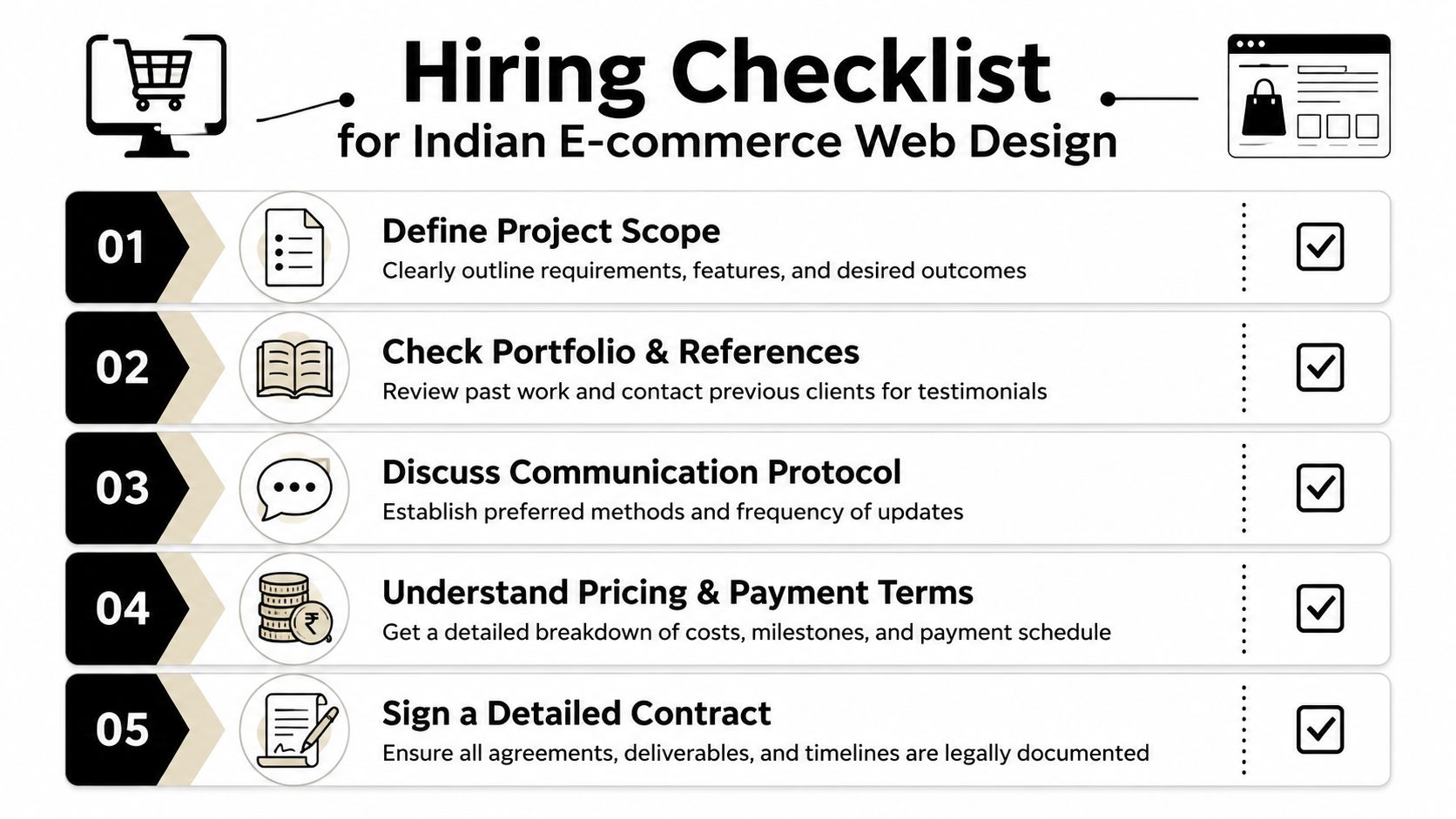
The shortlist test
Before you hire any agency, confirm these points:
- They understand mobile commerce: Their live work feels strong on a phone, not just in desktop mockups.
- They can explain platform choice clearly: They tell you why Shopify, WooCommerce, or Magento fits your business.
- Their proposal is detailed: You can see deliverables, revisions, timeline stages, and post-launch terms.
- They've worked with international clients: They already have a process for asynchronous communication and structured approvals.
- They don't dodge checkout questions: They can show smooth, conversion-aware cart and checkout experiences.
The remote management test
After you've narrowed the list, use these practical filters:
- Ask for one live walkthrough of a relevant project. Don't settle for screenshots.
- Request a sample communication workflow. If they can't show how they manage tasks, expect confusion later.
- Check how they handle ownership. You should control accounts, assets, and access.
- Review the contract for gaps. Especially around revisions, delays, and support.
- Look for clarity, not charm. A calm, organized agency beats an enthusiastic but vague one every time.
A good outsourcing partner makes your business simpler to run. A bad one creates a second job for you.
The biggest takeaway is this: India can be an excellent place to outsource ecommerce design if you hire with discipline. You're not buying geography. You're buying execution, communication, and accountability.
For some US businesses, an Indian agency will be the right fit and the smartest financial decision. For others, especially owners who want closer collaboration, local alignment, and easier oversight, a US-based partner may still be the better move. The win isn't choosing the cheapest path. The win is choosing the path that gives you the best odds of launching well and growing profitably.
If you'd rather work with a US-based team that understands small-business budgets, prioritizes clear ROI, and can guide your ecommerce build without the friction of cross-border management, Polaris Marketing Solutions is worth a look. They help businesses plan, build, and market websites with a practical focus on visibility, conversions, and sustainable growth.