
If you're running a business in Fort Myers, there's a good chance you've looked at Google Ads after hours and thought, "How hard can this be?" Then a week goes by, the clicks come in, the budget drains faster than expected, and the phone still isn't ringing the way it should.
That pattern is common with local service businesses, medical practices, law firms, and multi-location companies across Southwest Florida. The problem usually isn't that paid search doesn't work. The problem is that a campaign without strong structure, clean tracking, local intent filtering, and good landing pages can spend money very efficiently while producing weak business results.
A good PPC advertising firm doesn't just launch ads. It helps you decide where your money should go, what traffic is worth paying for, and what should be blocked before it wastes budget. In a market like SWFL, that local judgment matters. Search behavior shifts with seasonality, snowbird traffic, storm prep, emergency service demand, and neighborhood-level competition.
Why a PPC Firm Might Be Your Next Best Hire
A Fort Myers owner often starts PPC the same way. You set up a few keywords, write an ad, pick a daily budget, and hope Google sends the right people. At first, the dashboard looks busy enough to feel productive. Clicks show up. Impressions rise. Then you realize most of that activity isn't turning into booked jobs, consultations, or qualified calls.
That's where a PPC advertising firm can earn its keep. Not by "managing ads" in the abstract, but by protecting scarce budget and turning paid traffic into real opportunities.

What changes when a specialist takes over
When a campaign is built properly, PPC can become one of the fastest ways to generate demand. According to State of PPC 2024 insights summarized by Business2Community, PPC traffic converts 50% better than organic advertising, and PPC ads can boost a business's brand awareness by an average of 80%.
For a contractor in Cape Coral, that can mean showing up when someone searches with immediate intent. For a med spa in Naples, it can mean staying visible even when competitors flood the market in season. For a law office in Fort Myers, it can mean putting budget behind the exact cases that matter most instead of spreading spend across broad terms that look relevant but rarely convert.
Practical rule: If you're paying for clicks, you need someone watching search intent, lead quality, and wasted spend every week. Otherwise, the platform will gladly spend your money for you.
The cost of doing it halfway
The biggest DIY mistake isn't usually bad effort. It's divided attention. You're trying to answer calls, run payroll, manage crews, and follow up with estimates. Paid search needs consistent decisions that most owners don't have time to make during a workday.
A good firm also helps connect paid traffic to the rest of your lead system. If you're trying to attract new customers, PPC works best when ads, forms, call tracking, landing pages, and sales follow-up are treated like one process, not separate tasks.
The following tends to work:
- Tight targeting: Campaigns built around services, locations, and buyer intent.
- Fast cleanup: Negative keywords added early so irrelevant searches stop draining spend.
- Landing page match: The page reflects the ad promise instead of dumping visitors onto a generic homepage.
- Call-focused conversion tracking: Especially important for home services, legal, and healthcare.
What doesn't work is "set it and forget it" management. In Southwest Florida, too much changes too quickly for that.
Finding the Right Local Partner in Southwest Florida
Hiring local doesn't automatically mean better. Some agencies have a Fort Myers address but run generic campaigns that could belong to any market in the country. The right PPC advertising firm should understand local demand patterns, local geography, and how buyers search in SWFL.
Start where local credibility is visible
You don't need a giant agency list. Start with businesses and organizations already rooted in the area.
A practical shortlist often comes from:
- Chamber and networking circles: Agencies that show up consistently in Southwest Florida business groups usually care about reputation because they live in the same market.
- Referrals from noncompeting businesses: Ask your commercial roofer, attorney, med spa owner, or HVAC vendor who they trust for paid search.
- Local search results: Search for PPC and digital marketing services in Fort Myers, Cape Coral, Estero, Bonita Springs, and Naples. Then evaluate how those firms present themselves.
If an agency can't clearly explain its own services, local positioning, and calls to action on its own site, that's a warning sign.
Check whether they understand SWFL buying behavior
Local market knowledge isn't just knowing city names. It shows up in how they talk about demand.
You want a firm that thinks in terms like:
- Seasonal swings: Snowbird months can change search volume and urgency.
- Storm response demand: Hurricane season affects messaging, service prioritization, and budget pacing.
- Travel radius and service area reality: A plumber in Fort Myers shouldn't pay for weak traffic far outside the actual service footprint unless there's a clear reason.
- Neighborhood intent: Naples, Bonita Springs, Cape Coral, and North Fort Myers don't always behave the same way.
Agencies that understand local PPC don't just target cities. They shape campaigns around service areas, emergency intent, and seasonal demand shifts.
Look for evidence, not polished language
Case studies matter, but the way an agency talks about results matters more than glossy design. Look for details about business goals, campaign structure, lead quality, and what changed over time.
Review their site with questions like these:
| What to review | What you want to see |
|---|---|
| Local proof | Clear examples tied to Southwest Florida or similar local markets |
| Industry fit | Work with home services, legal, healthcare, retail, or professional services |
| Reporting style | Focus on leads, calls, booked work, and return, not just clicks |
| Service clarity | A clear explanation of what they manage and what they expect from you |
A helpful comparison point is to look at adjacent paid media specialties too. If you're also weighing paid social support, this roundup of Proven SaaS insights on social agencies can help you see how firms differ in specialization and account structure.
For a local framework on what to screen for, this guide on choosing a digital marketing agency in Fort Myers is useful because it focuses on fit, transparency, and business alignment instead of generic promises.
A short screening method that saves time
Before you book a call, narrow the list fast:
- Read their homepage and PPC page. If it's vague, move on.
- Check whether they mention your type of business. Generalists can work, but relevance matters.
- Look for local language. Real local knowledge sounds specific.
- See how they ask for contact. Firms that understand lead generation usually build their own site to convert.
- Review their Google Business Profile and reviews. You're not looking for perfection. You're looking for consistency and relevance.
That process won't pick the winner by itself, but it will remove a lot of noise.
Key Questions to Ask Before You Sign a Contract
A sales call can sound great even when the actual management is thin. The simplest way to separate a true PPC partner from a vendor is to ask questions that reveal how they think, not just what they sell.
The big shift in paid search is that manual bidding isn't the whole game anymore. Automation handles more of the mechanics. That means campaign performance often depends more on message, offer, landing page quality, and waste control than most proposals admit.
According to industry analysis discussed by PPC.co, creative quality now drives 49% to 70% of ad success, and a modern firm's job includes controlling waste from irrelevant queries and low-quality clicks.
Ask how they protect your budget
Many business owners ask the wrong question. They ask, "How many clicks can you get me?" A better question is, "How do you stop me from paying for the wrong clicks?"
You want direct answers about search-term review, negative keyword management, geographic controls, and how they handle weak traffic.
Ask questions like:
- How do you review search terms and add negative keywords?
- How do you stop ads from showing outside my real service area?
- How do you identify low-quality clicks or suspicious traffic patterns?
- What do you do when a campaign gets traffic but the leads are poor?
If a firm can't explain waste control in plain English, they probably aren't managing it tightly.
Ask how they handle ad creative and landing pages
Many agencies still sell PPC as if keywords alone are the difference-maker. That's outdated. If your ad promise is weak or your landing page creates friction, the campaign struggles no matter how well the bids are tuned.
Good questions include:
- Who writes the ad copy?
- How do you test offers, headlines, and calls to action?
- Will you review or recommend landing page changes?
- What happens if the ads get clicks but the page doesn't convert?
If they don't ask to see the page where traffic will land, that's a red flag. They're managing the front door without looking inside the building.
Ask about communication rhythm and accountability
You don't need daily calls. You do need a clear operating rhythm.
A firm should be able to tell you:
- what gets reviewed weekly
- what gets summarized monthly
- when strategy gets revisited
- who owns account decisions
- what happens when lead quality drops
Here is a simple vetting table to bring into calls.
Essential Vetting Questions for a PPC Firm
| Category | Question to Ask |
|---|---|
| Budget protection | How do you prevent wasted spend from irrelevant searches? |
| Local targeting | How do you control service areas for Fort Myers, Cape Coral, Estero, Naples, and nearby markets? |
| Lead quality | How do you tell the difference between a cheap lead and a good lead? |
| Creative | Who owns ad copy, offers, and testing? |
| Landing pages | Will you audit the page experience before launching campaigns? |
| Reporting | What metrics will you show me every month? |
| Transparency | Will I have access to my ad account and conversion data? |
| Testing | What do you test first in a new account? |
| Scaling | How do you decide when to increase spend? |
| Communication | Who do I contact when performance changes quickly? |
Listen for trade-offs, not perfect answers
A seasoned PPC advertising firm usually sounds less flashy and more precise. They'll talk about constraints, testing, lead quality issues, tracking gaps, and what needs to be fixed before scaling. That's a good sign.
Be careful with firms that jump straight to volume promises without asking about margins, close rate, service radius, or seasonality. In local PPC, more leads aren't always better. Better leads are better.
Understanding PPC Pricing Models and SWFL Benchmarks
Most confusion around PPC pricing comes from one simple issue. Owners mix up management fee and ad spend.
Consider the scenario of hiring a general contractor. Their fee constitutes one expense, while materials like lumber, tile, and fixtures represent distinct costs. Similarly, with a PPC advertising firm, the management fee pays for strategy, setup, optimization, reporting, and communication. The ad spend is the money paid to Google or another platform to buy traffic.
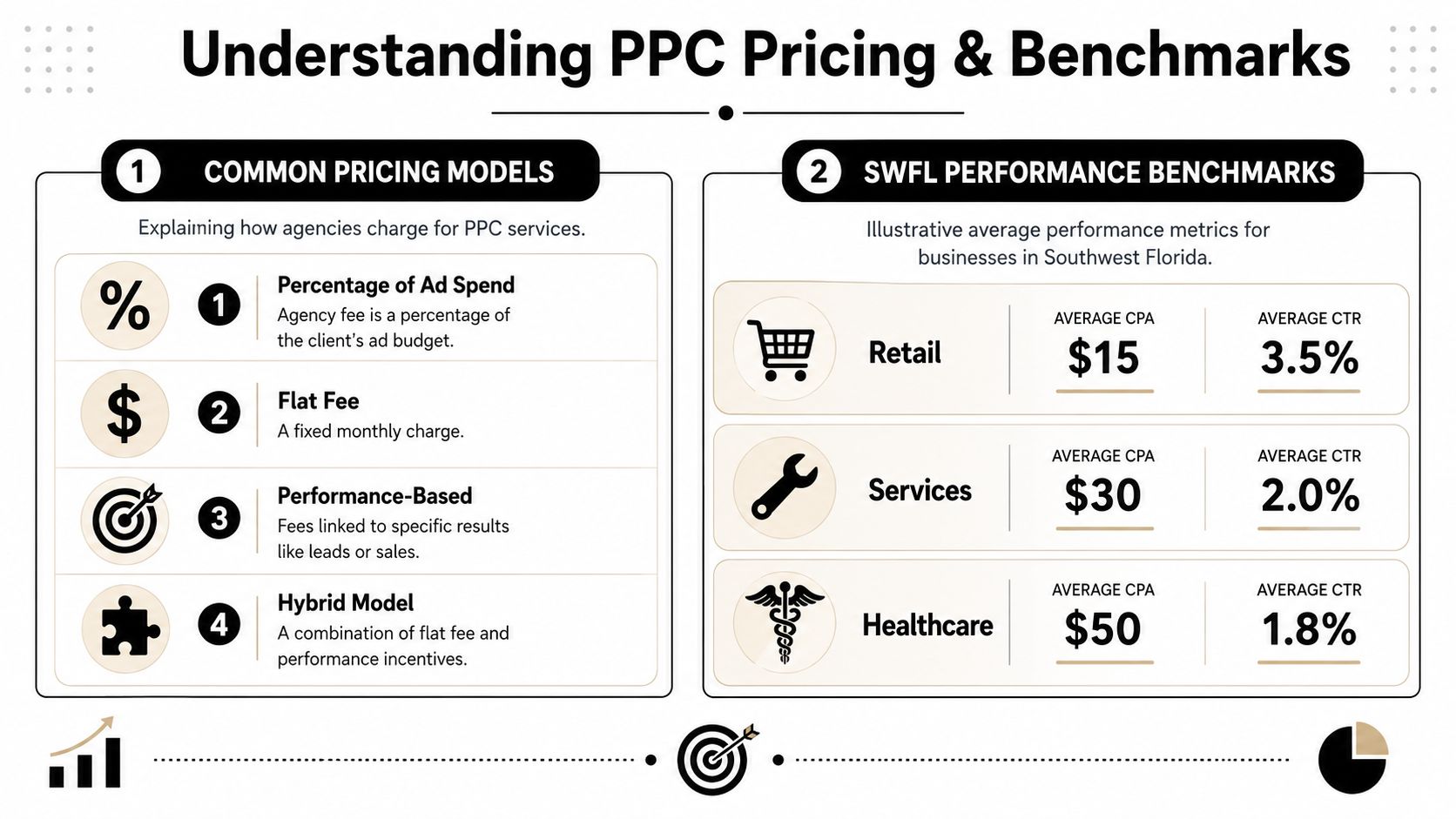
The pricing models you'll run into
Most firms use one of these structures:
- Percentage of ad spend: The fee rises as your budget rises.
- Flat monthly fee: A set management cost each month.
- Performance-based model: Compensation is tied to defined outcomes.
- Hybrid model: A base fee plus another layer tied to spend or results.
None of these is automatically right or wrong. The right model depends on campaign complexity, reporting needs, landing page support, and how much hands-on management your account requires.
A small local service account with tight geography is different from a multi-location healthcare or legal campaign. The pricing should reflect that.
What realistic spend looks like
One benchmark helps business owners reset expectations. According to WebFX PPC cost data, small to mid-sized businesses working with PPC advertising firms typically spend between $9,000 and $10,000 per month on average for their campaigns, including both agency fees and ad spend.
That doesn't mean every Fort Myers business needs to spend at that level. It does mean serious PPC management usually involves a meaningful budget. If your market is competitive and your average customer value is strong, underfunding the campaign can create a bad read on the channel.
For owners exploring the basics first, this overview of PPC for small businesses helps clarify what spend, scope, and expectations should look like before you sign anything.
This walkthrough is also useful if you want a visual explanation of common fee structures and how agencies think about performance.
What to compare in a proposal
Don't compare proposals by price alone. Compare what's included.
Use this lens:
| Proposal element | What to check |
|---|---|
| Account setup | Is buildout included or billed separately? |
| Conversion tracking | Are calls, forms, and key actions tracked? |
| Landing page input | Do they advise on page improvements? |
| Reporting | Do they report on business outcomes or just ad metrics? |
| Scope limits | Are there caps on campaigns, ad groups, or meetings? |
A cheap fee can become expensive fast if the account lacks tracking, search-term cleanup, and landing page support.
In SWFL, pricing should reflect local complexity too. Seasonal demand, emergency services, and overlapping service areas create management work. If the proposal ignores that reality, expect generic execution.
Onboarding and Working with Your New PPC Firm
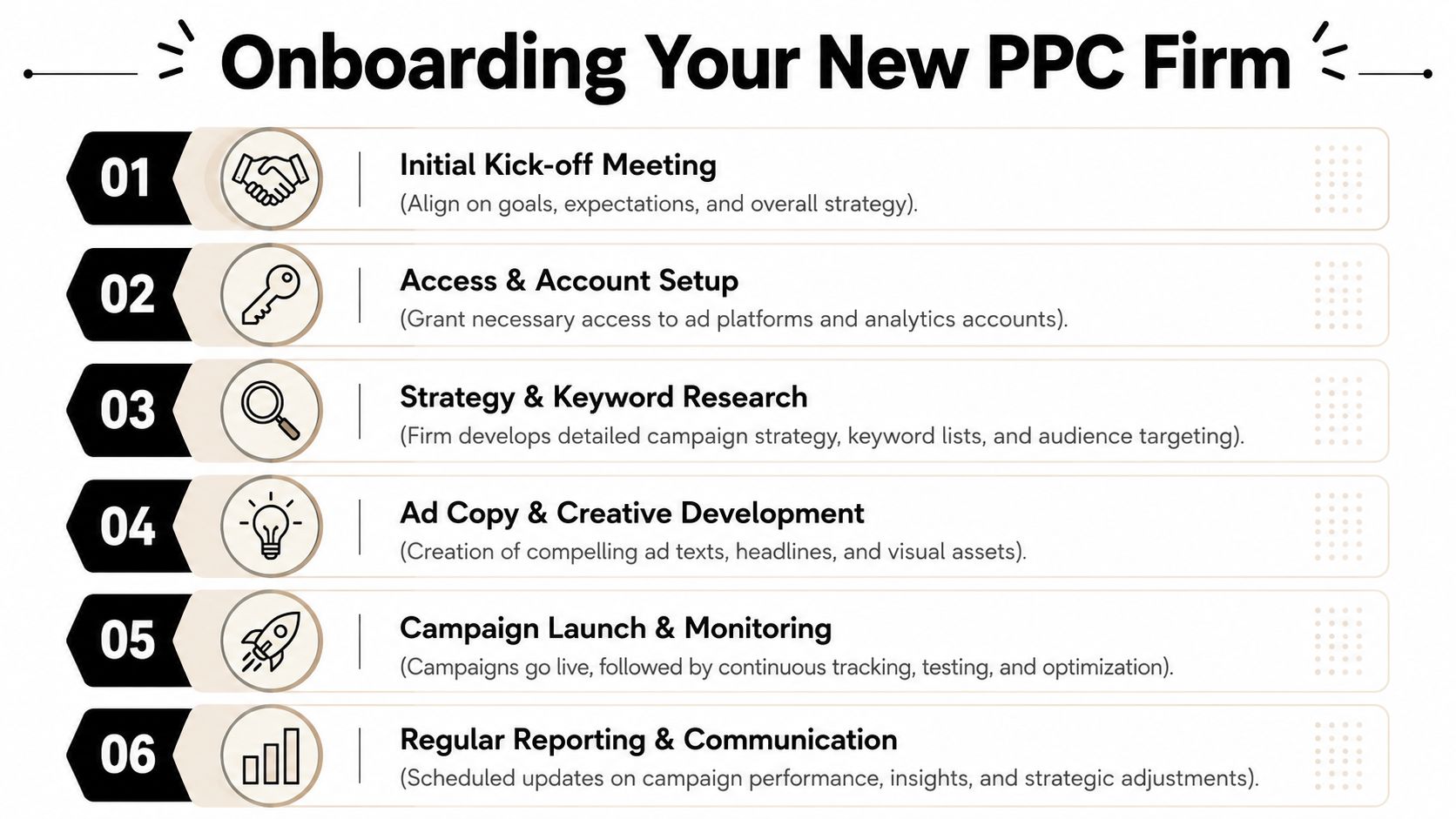
The first few weeks with a new PPC advertising firm tell you a lot. Good onboarding feels organized, practical, and focused on access, goals, and data quality. Bad onboarding feels like you signed a contract and got handed a questionnaire.
A professional process should start with business goals, not ad settings. If a firm doesn't ask about lead quality, close rates, service area limits, and your highest-value services, they're starting too shallow.
What you'll usually need to provide
Most firms can move faster if you gather the basics early.
That usually includes:
- Platform access: Google Ads, Google Analytics, Google Tag Manager, and Google Business Profile if relevant
- Website access: CMS login or developer access for landing page and tracking work
- Brand assets: Logos, photos, approved offers, and service descriptions
- Sales context: Which leads count, which ones don't, and what your team hears on calls
- Geographic boundaries: Cities, ZIPs, or radius limits you want to serve
If your business relies on calls, make sure call tracking is part of the onboarding conversation. If it isn't, ask why.
What the firm's operating rhythm should look like
A disciplined workflow matters more than fancy dashboards. According to Straight North's PPC strategy guidance, a professional PPC firm should define SMART goals, perform competitor research, separate testing and scaling budgets, reserve 10% to 20% of spend for experiments, and review performance weekly and monthly to prevent budget waste.
That sequence is practical because it keeps the account from scaling too early. It also makes room for testing headlines, landing page changes, audiences, and location controls before large chunks of budget go into what only "looks" promising.
What a strong first phase looks like
A healthy onboarding period often follows this pattern:
Kickoff and access collection
Goals get clarified. Tracking gaps get found. Service areas and exclusions get confirmed.Campaign build and validation
The firm maps keywords, writes ads, aligns landing pages, and checks conversions before launch.Early data cleanup
Search terms, device behavior, geography, and lead quality get reviewed fast so waste doesn't linger.
The best early sign isn't volume. It's that the firm notices weak signals quickly and acts on them.
Polaris Marketing Solutions is one local option in Fort Myers that offers PPC alongside website, SEO, and broader digital support. For some businesses, that kind of integrated setup is useful because ad traffic, page experience, and local visibility often affect each other.
Measuring Success and Tracking Key PPC Metrics
A lot of PPC reporting looks busy without being useful. Clicks, impressions, and click-through rate have their place, but they don't tell you whether your marketing is paying for itself.
A Fort Myers business owner usually needs a simpler scoreboard. Did the ads produce qualified calls, form submissions, booked appointments, and revenue opportunities at a cost that makes sense for the business?
The metrics that actually matter
Focus on these:
- Conversion rate: How many ad visitors take the action you want.
- Cost per lead: How much you spent to generate a lead.
- Lead quality: Whether those leads match the jobs or cases you want.
- Return on ad spend: Whether the revenue opportunity justifies the investment.
According to Reboot Online's PPC benchmarks, average PPC conversion rates are about 2.35% in 2024, while strong campaigns can achieve 10% or more. That gap is exactly why conversion rate deserves attention. It tells you whether the strategy is merely active or effective.
A simple way to think about performance
If you spend money on ads and get inquiries, the next question isn't "How many?" It's "How many were worth following up on?"
A practical review sounds like this:
| Metric | What it tells you |
|---|---|
| Conversion rate | Whether traffic and landing page experience are aligned |
| Cost per lead | Whether the campaign is acquiring inquiries efficiently |
| Qualified lead rate | Whether the leads fit your services and sales process |
| ROAS or revenue outcome | Whether PPC is helping the business grow profitably |
For owners who want a clearer way to connect ad activity to business return, this guide on how to measure marketing ROI is a useful companion.
Don't let a firm hide behind traffic metrics if your closeable lead count is flat. Activity is not the same as progress.
What a good agency conversation sounds like
The right monthly review doesn't just summarize platform data. It answers business questions:
- Which campaigns brought qualified leads?
- Which searches wasted money?
- Which locations performed best?
- Which landing pages underperformed?
- What are we changing next?
That's how you judge a PPC advertising firm. Not by whether the dashboard looks impressive, but by whether the account keeps getting sharper, cleaner, and more profitable over time.
If you want a Fort Myers team to review your current campaigns, pressure-test your budget, and show where paid search is helping or leaking money, Polaris Marketing Solutions offers PPC support built for small and mid-sized businesses in Southwest Florida.