

Storm season arrives, the phones light up, and your map is full of roofers who weren't even working in your market last month. An out-of-town storm chaser shows above your company, collects the first call, and turns your established reputation into background noise. You know the neighborhoods, the permitting process, and the local roof systems, but Google can't use what it can't clearly verify.
Local SEO for roofing companies fixes that gap. It connects your Google Business Profile, website, reviews, citations, service areas, and booked-job data into one lead system. The work isn't glamorous, but it's measurable. You can see which profile actions generate calls, which service pages produce inspections, and which review requests help your crews win trust.
Why Roofers Lose Calls to Out-of-Town Competitors
A Fort Myers roofer can spend years building a referral reputation and still lose storm-damage calls to a company based outside the market. The competitor may have fewer local relationships, but its Google Business Profile has fresh photos, a steady review stream, complete services, and strong map visibility. The homeowner searching for “roof repair near me” sees that profile first and calls before checking who has been serving the area longer.
That's the uncomfortable reality of local search. Brand awareness and local visibility aren't the same thing. A billboard can make homeowners recognize your name, but an unbranded search captures someone actively looking for an inspection, repair, or replacement. Google says local results mainly depend on relevance, distance, and prominence, with reviews and links contributing to prominence through the official Google local ranking guidance.
The map pack is a lead channel
One recent roofing industry summary reports that the Map Pack appears in about 93% of local searches, captures 44% of local clicks, and that Google Business Profile signals account for 32% of local pack ranking factors (WebTonic's roofing local SEO summary). Those figures explain why a roofer can have a polished website and still miss the phone call. The map results often appear before the organic listings, and the profile gives the searcher a direct path to call, visit the website, or request directions.
Established contractor SEO programs can generate 38% to 54% of total inbound leads from organic search after 12 months or more of consistent optimization, according to the same industry summary. That isn't an overnight result. It's the outcome of building local relevance until Google has enough evidence to associate your company with the services and neighborhoods you serve.
Owner's rule: If your marketing report celebrates impressions but doesn't show calls, inspections, and booked jobs, it isn't measuring the business.
Reputation needs geographic proof
Your service area must be believable. A profile that claims every town across Southwest Florida looks less relevant than one that clearly serves the communities your crews can reach. Your website should reinforce the same footprint with genuine service-area pages, local project evidence, and consistent business details.
The economics make the choice sharper. Paid search leads average about $228.15, while mature local SEO leads can fall within $10 to $50, according to a roofing benchmark from PipelineON's local SEO analysis. Mature programs can also return roughly $13 for every $1 invested in local SEO, although the asset typically takes 12 to 18 months to compound. If you keep renting every lead through paid channels, your acquisition cost remains tied to the next click. If you build local visibility, the profile and pages can continue working after the initial optimization.
For broader context on how local search strategy differs across markets, this local SEO agency Berlin resource offers a useful comparison. The principle is the same in Fort Myers: show Google exactly where you work, what you do, and why local customers should trust you.
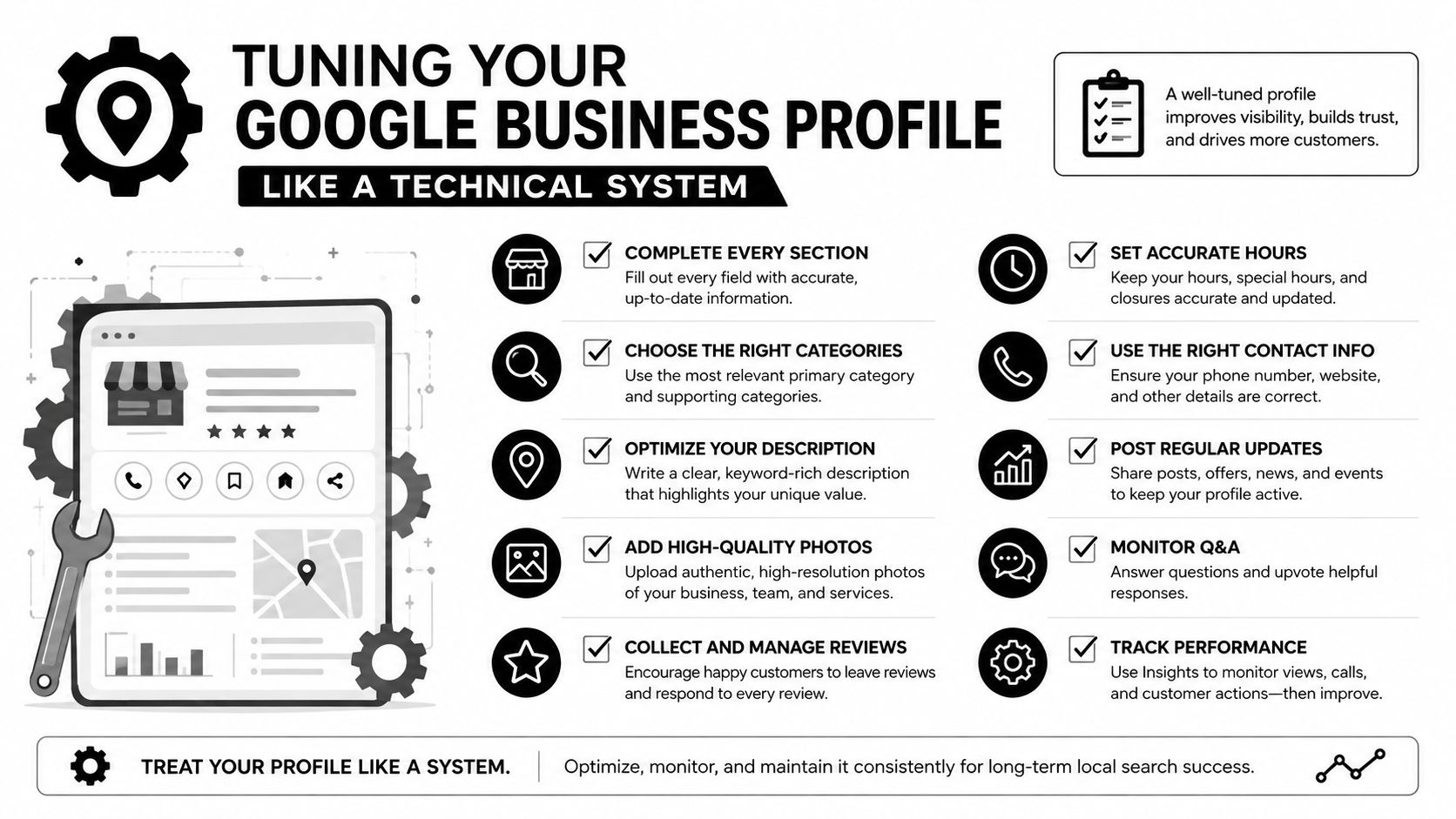
Tuning Your Google Business Profile Like a Technical System
Treat your Google Business Profile as operating infrastructure, not an online business card. Google uses the profile to interpret your services, location, hours, and prominence, so incomplete or inconsistent fields create avoidable friction.
Configure the core fields first
Start with the category that describes the business, not the service that happens to be most profitable this month.
- Choose Roofing Contractor as the primary category. Add secondary categories such as Roof Inspection or Gutter Cleaning only when those services are real, staffed, and supported by website content.
- Set the service area accurately. Use the actual cities or service-area settings your crews cover. Don't add distant communities just to create a larger footprint.
- Match your NAP exactly. The business name, address, phone number, and website URL should match the website footer and other important listings.
- List services individually. Roof repair, roof replacement, emergency roofing, storm-damage inspections, tile roofing, and gutter work should each be clear where applicable.
- Publish accurate hours. If you offer emergency response, make the after-hours process obvious. Don't claim 24/7 availability if nobody answers or dispatches calls at night.
- Use truthful attributes. Add attributes such as woman-owned or LGBTQ+ friendly only when they accurately describe the business.
- Connect tracking carefully. Use a UTM-tagged website link so website sessions from the profile can be separated from other traffic. Keep the phone number consistent across major listings, and use call tracking without creating conflicting public information.
- Complete verification and monitor changes. Check the profile after major edits, ownership changes, address moves, or seasonal hour updates.
Google's local results rely on relevance, distance, and prominence, so the profile must agree with the rest of your digital footprint. A detailed walkthrough of contractor profile setup is available through this Google Business Profile guide for contractors.
Build a maintenance rhythm
A profile becomes useful when your team keeps it current. Publish one GBP post per week, add three to five new project photos weekly, and use real job images instead of stock roofing photographs. Geo-tagged EXIF data can support your internal documentation process, but don't treat hidden metadata as a substitute for visible local proof, accurate captions, and a legitimate service area.
Seed the Q&A section with genuine customer questions. “Do you inspect storm damage?” and “Can you work with tile roofs?” are more useful than keyword-stuffed questions written for search engines. Give direct answers, include the relevant service, and point users to the appropriate page.
End the setup with a review process that produces four to six new reviews per month, with an owner response to each one. That target is a practical operating benchmark, not a guarantee of ranking. The important part is consistency. A profile that receives feedback steadily looks active and gives future customers current evidence of completed work.
Building Service-Area Pages That Earn Rankings
A page titled “Roofing Services in Every City Near You” won't establish a credible service area. Neither will a set of pages that swaps the city name while leaving every sentence unchanged. Google's local system needs relevance, and homeowners need proof that your crew knows the place they're being asked to serve.
Build one substantive page for each priority service area. If you work in Fort Myers, Cape Coral, Estero, Bonita Springs, and Naples, don't automatically create pages for every small community in between. Start where you have completed work, real demand, and a realistic dispatch radius.
Use proof instead of location stuffing
A strong page has a specific job to do. For example, a page titled “Roof Repair in Cape Coral” could open with a unique paragraph about the company's experience handling storm damage and salt-air exposure in local homes. It might reference a completed project, include a real project photo, name a neighborhood when appropriate, and explain why tile, shingle, or metal systems are common in that area.
Use this structure:
- H1: City plus the primary service, such as “Roof Repair in Cape Coral”
- Local proof block: About 150 words describing a real project, neighborhood context, roof type, weather concern, or access issue
- Service descriptions: Explain the work and link naturally to the main roof repair, replacement, inspection, or storm-damage pages
- Before-and-after gallery: Use genuine project images with descriptive alt text
- Embedded map: Show the legitimate business location or relevant service context without pretending the company has an office it doesn't operate
- LocalBusiness schema: Mark up the business details consistently with the profile and website
Your local proof can mention hail exposure where it's relevant, salt air near coastal properties, or the difference between tile and shingle maintenance. Don't invent a project address. If privacy prevents you from publishing the address, describe the neighborhood or project context without making the evidence more specific than it is.
Know what to leave out
Doorway pages create a poor experience when they exist only to capture slightly different city phrases. Avoid spun boilerplate, copied introductions, long lists of micro-towns, and location pages that don't connect to an actual service capability. A smaller group of useful pages is stronger than a large folder of interchangeable URLs.
| Page Element | Earned Rankings Version | Spammy Doorway Version |
|---|---|---|
| H1 | City and one real service | City names stacked with every roofing keyword |
| Local proof | Genuine project, neighborhood, roof type, or weather context | Generic paragraph with the city swapped |
| Services | Useful descriptions with relevant internal links | Keyword list with no supporting detail |
| Images | Real local work with accurate captions | Stock photos reused across every page |
| Map | Legitimate business or service context | Map embeds used to imply nonexistent offices |
| Schema | Accurate LocalBusiness data | Markup that claims locations or services you don't have |
| Coverage | Priority areas with real demand | Dozens of micro-town pages created at once |
A service-area page should help a homeowner decide whether to call. If it doesn't, don't publish it.
Turning Reviews Into a Measurable Ranking Lever
A five-star average looks good, but it doesn't tell you whether your review program is working. Review count was identified as the strongest local ranking factor in an independent local search study, where top-three placement rates rose from 39.3% for profiles with 1 to 5 reviews to 73.0% for profiles with 201 to 500 reviews (Localo's local ranking factor study). The practical lesson is clear: steady accumulation matters more than waiting for an occasional enthusiastic customer.
Volume, freshness, and responses work together
Google says review count and review scores influence prominence, but a roofing company shouldn't chase star count alone. A profile with a strong rating and no recent activity can look less current than a profile that keeps receiving legitimate customer feedback.
| Factor | Signal Type | Why It Moves Rankings |
|---|---|---|
| Review volume | Authority and prominence | A larger body of feedback gives Google more evidence that the business is established |
| Review freshness | Activity and recency | Recent experiences show that customers are still choosing the company |
| Owner responses | Engagement and trust | Responses demonstrate that the business monitors customer experience |
| Service context | Relevance and conversion | Specific references to inspections, repairs, or replacements help prospects understand the company's work |
| Rating quality | Customer confidence | A strong rating supports conversion, but it shouldn't replace consistent acquisition |
Don't script fake customer language or pressure customers to include keywords. Ask for honest feedback about the actual job.
Use a post-job workflow
Your review process should begin when the crew closes the job, not when the owner remembers to ask.
- Trigger the request from dispatch. Sync the completed-job status in Jobber or your field-service system with a review request so the office doesn't rely on memory.
- Send a thank-you SMS within 48 hours. Thank the homeowner for choosing the company, then provide the direct Google review link.
- Follow with a photo-prompt email. Ask whether the homeowner would be comfortable sharing a completed-project photo or describing what changed after the work. Never imply that a review requires a photo.
- Respond according to the rating. A positive review deserves a specific thank-you. A mixed review needs acknowledgment and a path to resolution. A negative review needs a calm response, an offline contact, and no argument about the customer's experience.
- Log the result. Record the crew, job type, completion period, review request date, review outcome, and any follow-up.
The tracking sheet should help you find patterns. If storm-damage inspections generate frequent feedback but gutter work produces little response, improve the close-out conversation for gutter jobs. If one crew receives detailed praise while another receives silence, coach the handoff rather than blaming the customer base.
Practical rule: Ask every customer the same way, at the same point in the job, and measure the workflow instead of waiting for reviews to appear by chance.
Cleaning Up Citations and Local Directory Listings
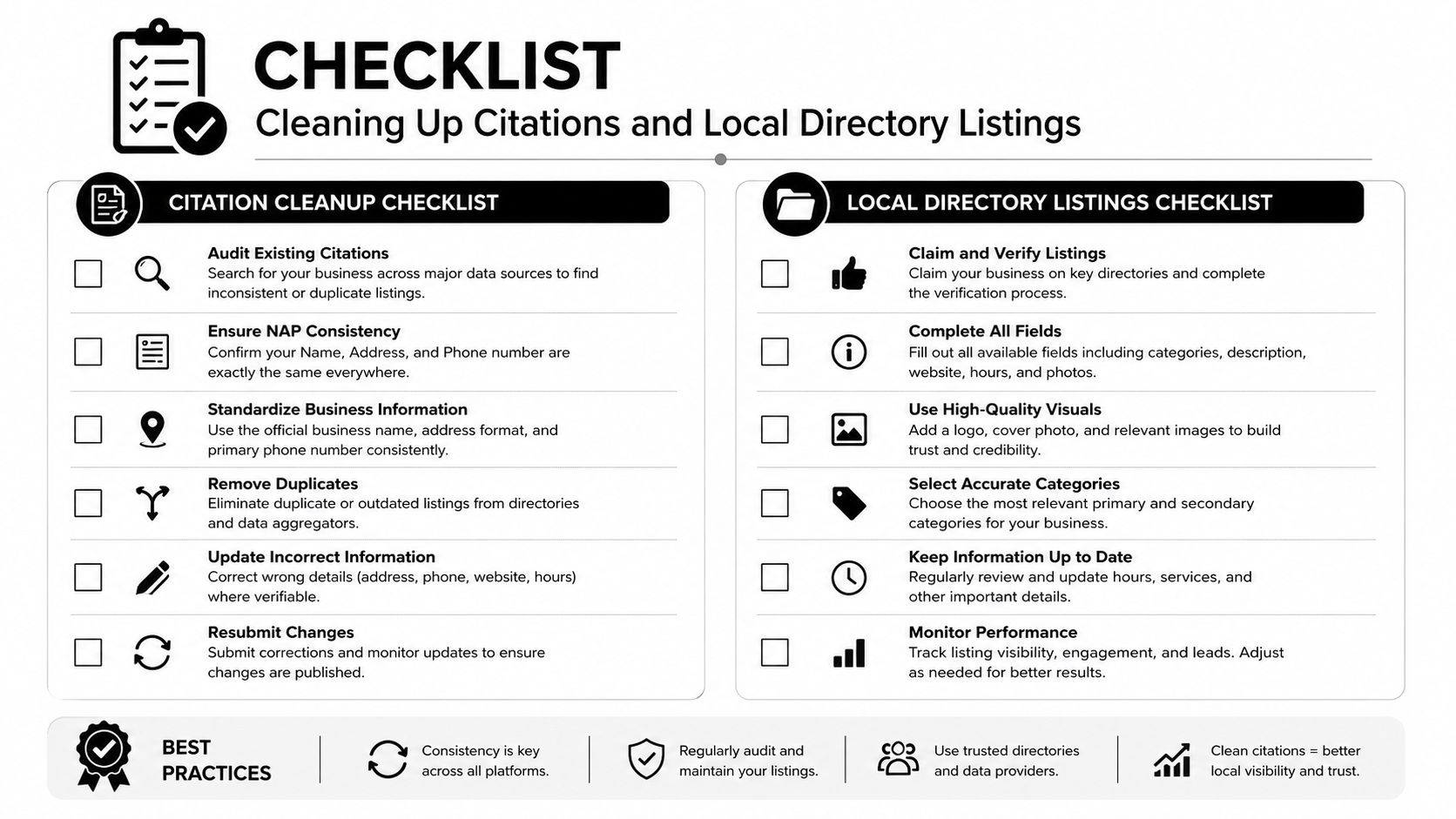
Citation cleanup is plumbing. Find the leaks, repair the pipe, and pressure-test the system before you spend more money promoting the house.
Your core rule is simple: use the exact name, address, phone number, and URL everywhere. An old tracking number, a missing suite detail, or a former business name can create conflicting signals. Google says local prominence is influenced partly by reviews and links, while independent practitioner guidance places citation signals at around 6% of local pack weight, below links at 8% (SEO Handbook's citation and NAP guidance). Citations aren't the entire strategy, but messy listings can undermine the rest.
Audit the listings that matter
Start with the directories customers and search engines are most likely to encounter:
- Trust and map platforms: Better Business Bureau, Apple Maps, Bing Places, Yelp, Nextdoor, and Facebook
- Home-service platforms: Porch, Houzz, Angi, and BuildZoom
- Industry and local sources: Roofing associations, local chambers, supplier directories, and relevant trade listings
The long tail of aggregators can wait. Fix the records that influence customer trust and local discovery before chasing obscure directories.
Run a citation audit in Moz Local or BrightLocal. Export the findings, then classify each listing as correct, incorrect, duplicate, unclaimed, or impossible to verify. Claim the profiles you control, merge legitimate duplicates, and update the primary record before changing secondary listings.
Handle duplicates without creating new problems
Don't delete a live profile just because it contains an error. Confirm ownership, document the correct business details, and follow the platform's merge or suppression process. For stubborn listings, submit a suppression request with evidence, but keep a record of the request and the profile URL.
A new company can also use a relevant directory submission service for early-stage founders when it needs structured distribution, but submission volume isn't a replacement for accuracy. For contractors dealing with scattered or outdated profiles, this citations cleanup service describes the kind of audit-and-correction work that should happen before adding more listings.
After cleanup, check the listings again after major changes. Moving offices, changing phone systems, rebranding, or acquiring another contractor can reopen old inconsistencies.
Local Links, Schema, and a Tight Paid Layer
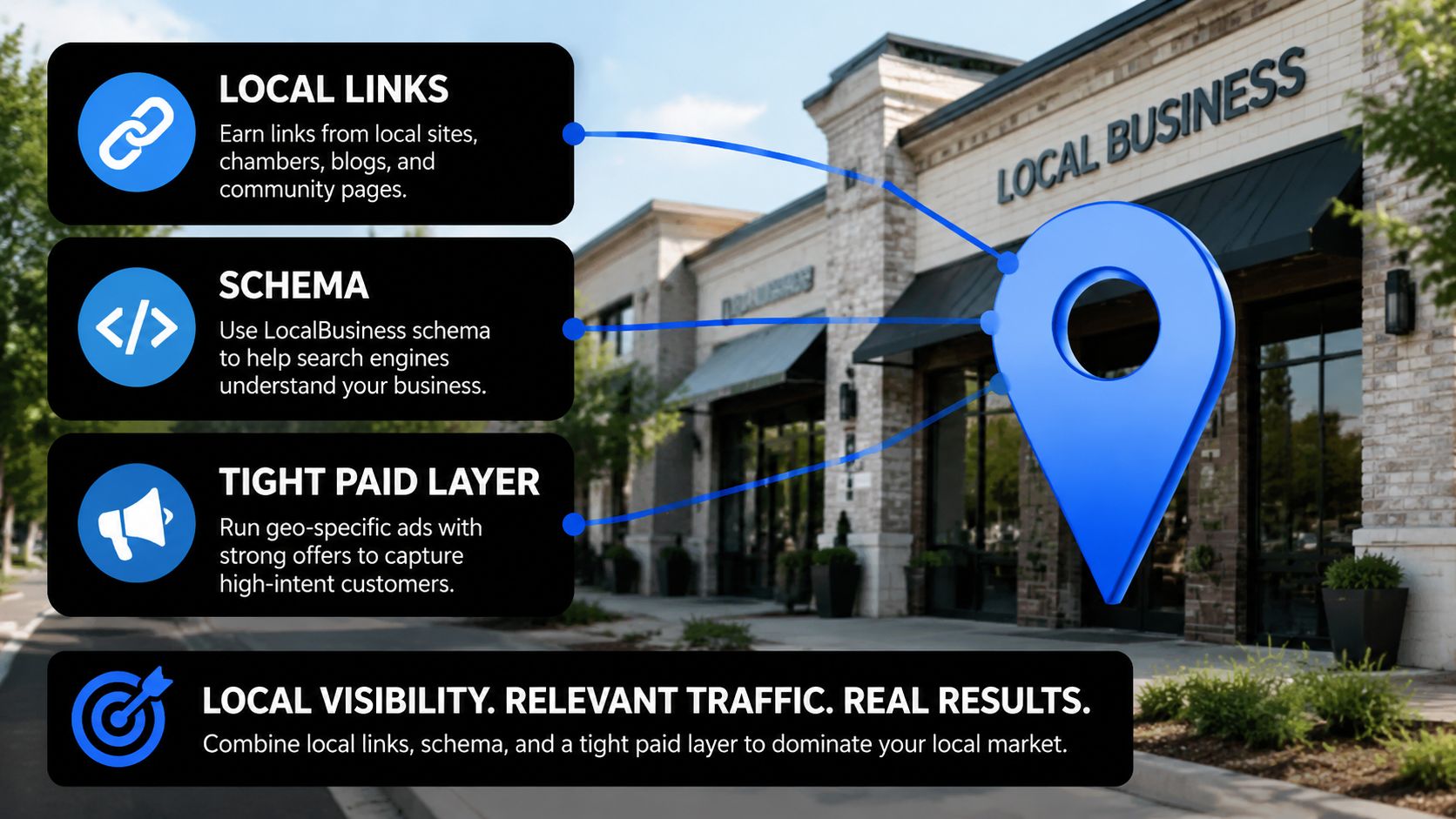
Local SEO becomes more durable when your profile and website earn support from relevant businesses, structured data, and carefully controlled paid campaigns. These layers do different jobs. Links reinforce local authority, schema clarifies entities and services, and paid ads cover urgent demand while organic visibility develops.
Earn links through relationships you already have
Don't buy batches of irrelevant guest posts. Ask the businesses that already understand your work to create useful local references.
- Suppliers and manufacturers: Request inclusion on approved-installer or contractor directories when you meet their requirements.
- Co-branded guides: Create a homeowner guide with a roofing-material supplier, then give both businesses a useful resource to publish.
- Local home shows: Sponsor an event or contribute an educational handout that links to a storm-preparation or roof-maintenance guide.
- Industry groups: Join the regional Home Builders Association or an NRCA chapter and maintain accurate member information.
- Trade press: Pitch a practical story about storm readiness, roof material selection, or local building challenges to supplier publications and relevant trade outlets.
- Supplier roundups: Contribute expertise to a genuine roundup when the article serves homeowners and the link makes sense.
The test is straightforward. Would you still want the relationship if Google gave you no ranking benefit? If the answer is no, skip it.
Add schema that matches the page
Use LocalBusiness markup for the business entity, Service markup on service pages, and FAQPage markup only when the questions and answers appear visibly on the page. Review markup requires particular care. Don't mark up reviews you copied from another platform or reviews that don't meet Google's guidelines.
Validate the implementation with Google's Rich Results Test, then compare the markup against the visible content. Schema can help search engines interpret a page, but it won't rescue thin content, false locations, or an incomplete profile.
Keep paid search narrow
Google Local Services Ads can support the organic system by producing customers who may later leave legitimate reviews. Branded search ads protect your company name when competitors bid on it, while a tightly geo-fenced search campaign can cover urgent queries in areas where organic rankings remain weak.
The paid layer should have clear boundaries. Limit locations, match keywords to actual services, send each ad to the most relevant page, and record the booked job rather than celebrating clicks. For a roofing-specific paid search framework, review this Google Ads resource for roofing companies. Paid advertising should reinforce local SEO, not become an excuse to postpone profile cleanup, service pages, or review operations.
Your 90-Day Local SEO Action Plan and Reporting Loop
Run the first 90 days in three focused sprints. Don't launch ten initiatives at once and then blame SEO when nobody can identify what changed.
Days 1 through 30
Fix the Google Business Profile, confirm categories and service areas, align NAP details, add current project photos, and launch the review request workflow. Set up tracking for profile website clicks and calls before changing the profile so you can compare activity over time.
Days 31 through 60
Publish the priority service-area pages based on real work and genuine coverage. Audit major citations, correct duplicate listings, and connect each page to the relevant service pages. Don't publish a large batch of city pages just to make the website look busy.
Days 61 through 90
Pursue supplier and association links, validate schema, and test a tightly scoped paid campaign where organic coverage is still thin. Use the test to discover which services and locations produce qualified calls, then feed that information back into page titles, profile services, and sales follow-up.
Your monthly report should fit on one page. Include GBP calls, direction requests, website clicks, ranking positions for the top five money keywords, booked jobs attributed by source, and cost per booked job when paid campaigns are running.
| KPI | Day 30 Target | Day 60 Target | Day 90 Target | Source |
|---|---|---|---|---|
| GBP calls | Baseline recorded and tracking verified | Compare activity against baseline | Identify service and location patterns | Google Business Profile |
| Direction requests | Baseline recorded | Review geographic demand | Compare with booked inspections | Google Business Profile |
| Website clicks | UTM tracking active | Separate profile traffic from other sources | Tie visits to forms and calls | GBP and analytics |
| Top five money keywords | Baseline positions recorded | Track movement after page work | Identify winners and gaps | Rank tracker |
| Booked jobs by source | Sales team begins source tagging | Audit attribution quality | Compare organic, GBP, referral, and paid jobs | CRM or dispatch system |
| Cost per booked job | Record paid spend and booked jobs | Remove unprofitable campaigns | Reallocate budget by service and area | Ads platform and CRM |
Use this simple measurement loop: local visibility change, qualified lead change, booked-job change, cost per booked job. If a tactic hasn't moved any of those business numbers within 60 days, kill it, diagnose the data, and move the budget to the next sprint item. Don't keep funding a vanity metric because an agency report makes it look impressive.
Polaris Marketing Solutions helps roofing companies with Google Business Profile optimization, location-specific content, citation building, review management, and geo-targeted SEO across Fort Myers and Southwest Florida. Visit Polaris Marketing Solutions to request a complimentary online analysis and competitor report, then use the findings to decide which local SEO sprint should start this week.