
Businesses ranking in Google's top 10 local positions averaged 81 citations, while the number-one result averaged 86, making local citations online mentions of a business's name, address, and phone number that help search engines confirm who it is and where it operates. They appear across directories, websites, apps, and community pages, so a customer can find the same business information wherever they search.
You might be dealing with this right now. A customer in Fort Myers needs an emergency HVAC repair, finds your company on a directory, and calls an old number that no longer works. The customer doesn't know the listing is outdated. They just call another contractor.
That's the practical reason local citations matter. They create a consistent public record of your business. Search engines use that record to understand your identity, location, and legitimacy, while customers use it to decide whether they can trust and contact you.
What Are Local Citations and Why Should You Care
A local citation is an online mention of your business's name, address, and phone number, commonly called NAP data. The mention may appear in a structured directory listing, such as a profile on Yelp or Yellow Pages, or inside an article, community page, blog post, or association directory.

Think of citations as your company's digital fingerprint. One mention tells a search engine that someone has listed your business. Consistent mentions across multiple credible sources help confirm that those references point to the same real-world company.
For a Fort Myers roofing contractor, citations might include:
- A structured profile on Yelp, Facebook, or Yellow Pages.
- A listing with the Fort Myers Chamber of Commerce.
- A mention in a local article about storm preparation.
- A business profile on an industry directory.
- A community page that names the company, service area, and phone number.
The value isn't limited to search rankings. A person may discover your company through a directory without ever visiting Google Maps. If the address, phone number, or business name is wrong, that customer may never reach you.
Practical rule: Treat every public business listing as customer-facing information, not as a background SEO task.
Why consistency affects trust
Search engines compare information from different sources. If your website lists one phone number, your Google Business Profile lists another, and a directory still shows an old address, those systems have to decide whether every mention refers to the same business.
The BrightLocal expert citation survey found that 90% of local search experts considered accurate citations critical or very important to local search ranking in its 2016 survey. BrightLocal's historical ranking-factor summaries also showed citation influence declining from 16% in 2013 to 15.5% in 2014 and 13.6% in 2015, as Google Business Profile and review signals gained greater attention.
That decline doesn't make citations irrelevant. It shows that local SEO has become broader. Citations remain part of the identity foundation that supports your profile, reviews, website, and location signals.
How Search Engines Use Citations to Rank Local Businesses
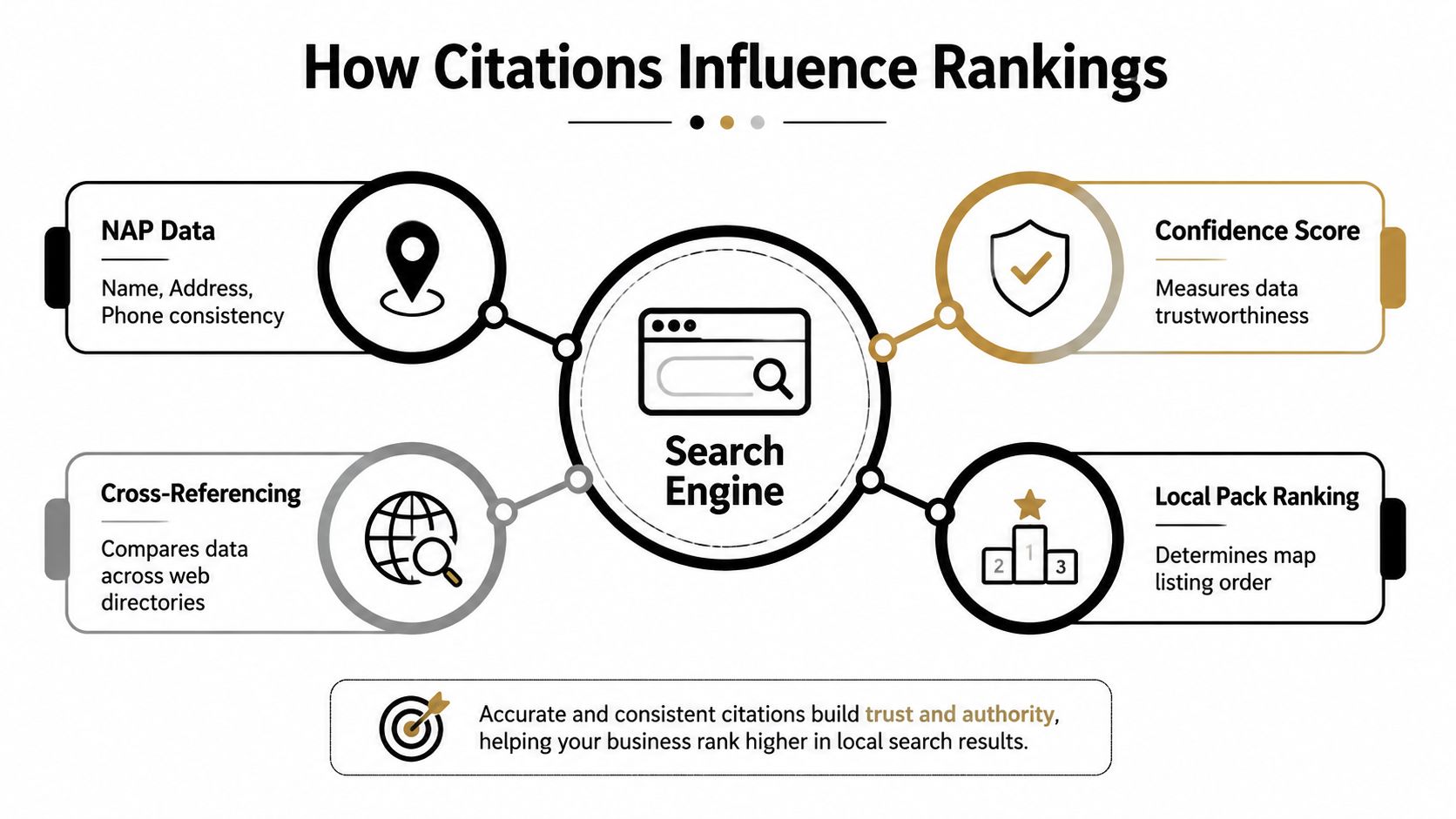
A search engine receives business details from many places, then checks whether those details describe one real company. It does not interpret every listing with human common sense. Instead, it compares the business name, address, phone number, website, category, and related signals across sources.
Suppose an HVAC company appears as “Gulf Coast Air Conditioning” on its website, “Gulf Coast AC” in one directory, and “Gulf Coast Air Conditioning LLC” in another. A person can probably connect the names. A search system must decide whether the shared address, phone number, services, and website confirm that connection.
This matching process is called entity resolution. It means linking different references to the same business. Consistent NAP data, meaning the name, address, and phone number, gives the system clearer evidence. Conflicting details create uncertainty, especially when an old address or phone number remains visible.
The citation signal in practice
Citation information can help a search engine answer practical questions:
- Does this business exist? References on several relevant sources can reinforce that the company is established.
- Where is it located? Matching addresses connect the business with a city, neighborhood, or service area.
- Which phone number is current? Consistent contact details reduce confusion for both customers and search systems.
- What does it do? Categories and surrounding text clarify the company's services.
- Are these listings duplicates? Similar profiles may be merged, ignored, or treated as separate businesses based on the information available.
The result is greater machine confidence in the business identity. That confidence can support eligibility and visibility in local results, including the map pack. It does not guarantee a specific position. Google Business Profile quality, reviews, relevance, distance, website content, and other local signals also affect what appears.
BrightLocal's SEO Citations Study reported that businesses in the top 10 Google Local positions averaged 81 citations. Number-one businesses averaged 86, while businesses in position ten averaged 75, an 11-citation gap. The study also found strong concentration on major platforms: 84% of local businesses had a Facebook listing, 80% had Yelp, 72% had MapQuest, and 71% had Yellow Pages citations.
The useful lesson is not to collect listings without judgment. A visible local business generally has a recognizable, machine-readable identity across important sources. That identity can feed traditional local search and, in 2026, systems that use business data to answer discovery questions through AI.
Structured vs Unstructured Citations Explained
Structured and unstructured citations both mention a business, but they present information differently.
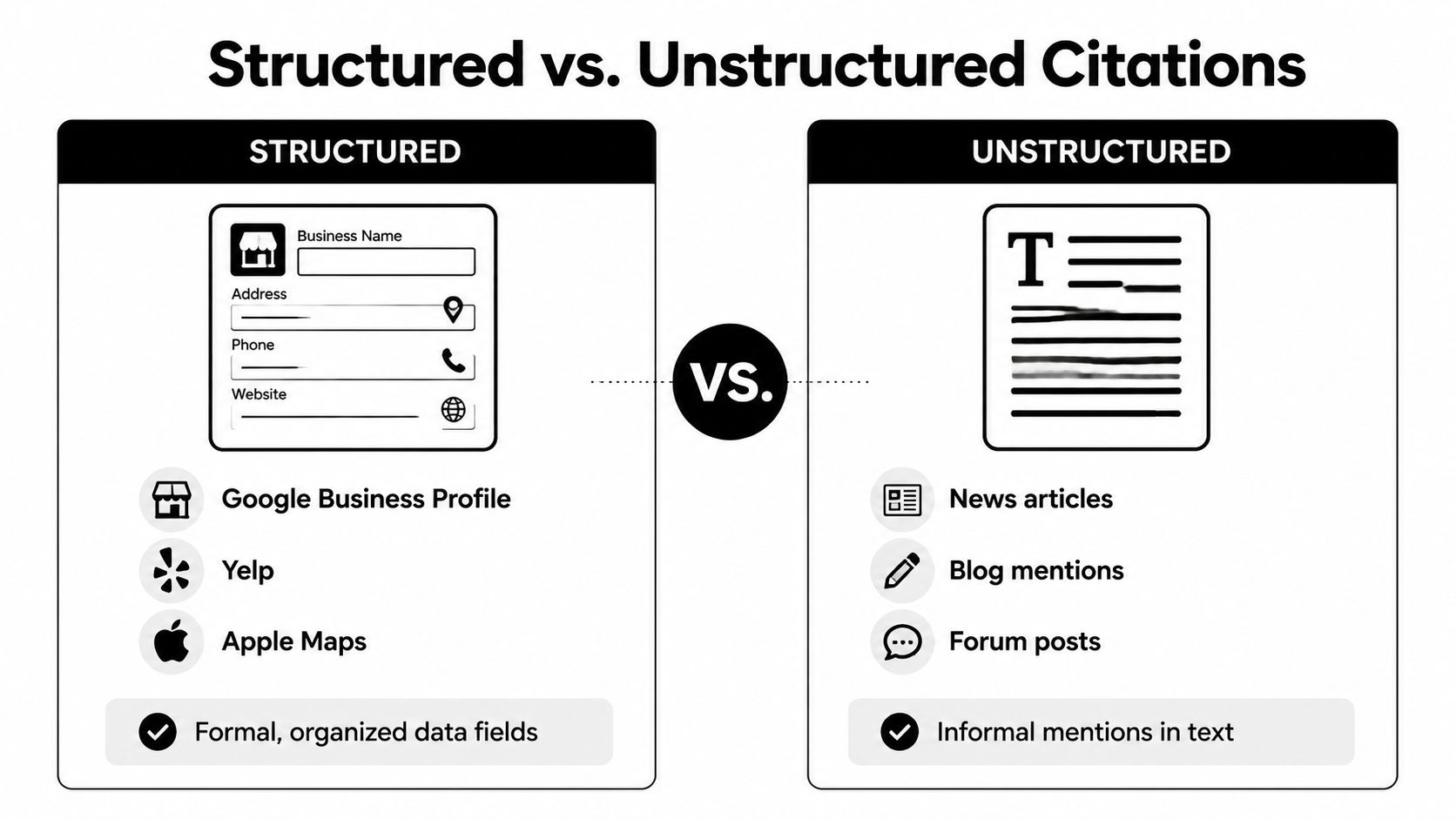
A structured citation places business details in organized fields. A directory may provide separate boxes for the business name, street address, phone number, website, category, hours, and description. Search engines can process these fields relatively directly.
An unstructured citation places business information inside ordinary text. A news story might mention a roofer helping residents after a storm. A chamber page might describe a local attorney and include an address. A community blog might recommend a cleaning company without presenting the information in formal directory fields.
Two citation types side by side
| Citation type | Southwest Florida example | What it contributes |
|---|---|---|
| Structured | A roofing contractor's profile on a business directory | Clearly organized business identity and contact data |
| Unstructured | A Fort Myers community article naming the contractor during storm preparation | Local context, topical relevance, and brand discovery |
A HomeAdvisor listing for a plumbing company is structured because the company's details appear in defined profile fields. A Fort Myers blog post that says “call Gulf Shore Plumbing at its McGregor Boulevard office” is unstructured, even if the article doesn't include every NAP element.
Structured listings are useful for establishing a dependable baseline. Start with platforms customers and search engines commonly use, then add directories connected to your industry or region.
Unstructured mentions can add context that a form-based listing may lack. A local article can connect your business with a service, neighborhood, event, or community issue. That context helps people understand why your company is relevant to a local need.
Choosing the right format
A healthcare practice shouldn't rely only on general directories. It also needs appropriate healthcare platforms and local community references. A law office may benefit from legal directories and bar association pages. A home services company can combine major map and directory profiles with mentions from local organizations, suppliers, and neighborhood publications.
Neither format replaces the other. Structured citations clarify identity, while unstructured citations place that identity in context. Both should use accurate information wherever the page includes your name, address, or phone number.
How to Audit Your Existing Citations
A citation audit starts with discovery, not editing. Before changing listings, create a record of what customers and search engines can currently find.
Follow a practical audit sequence
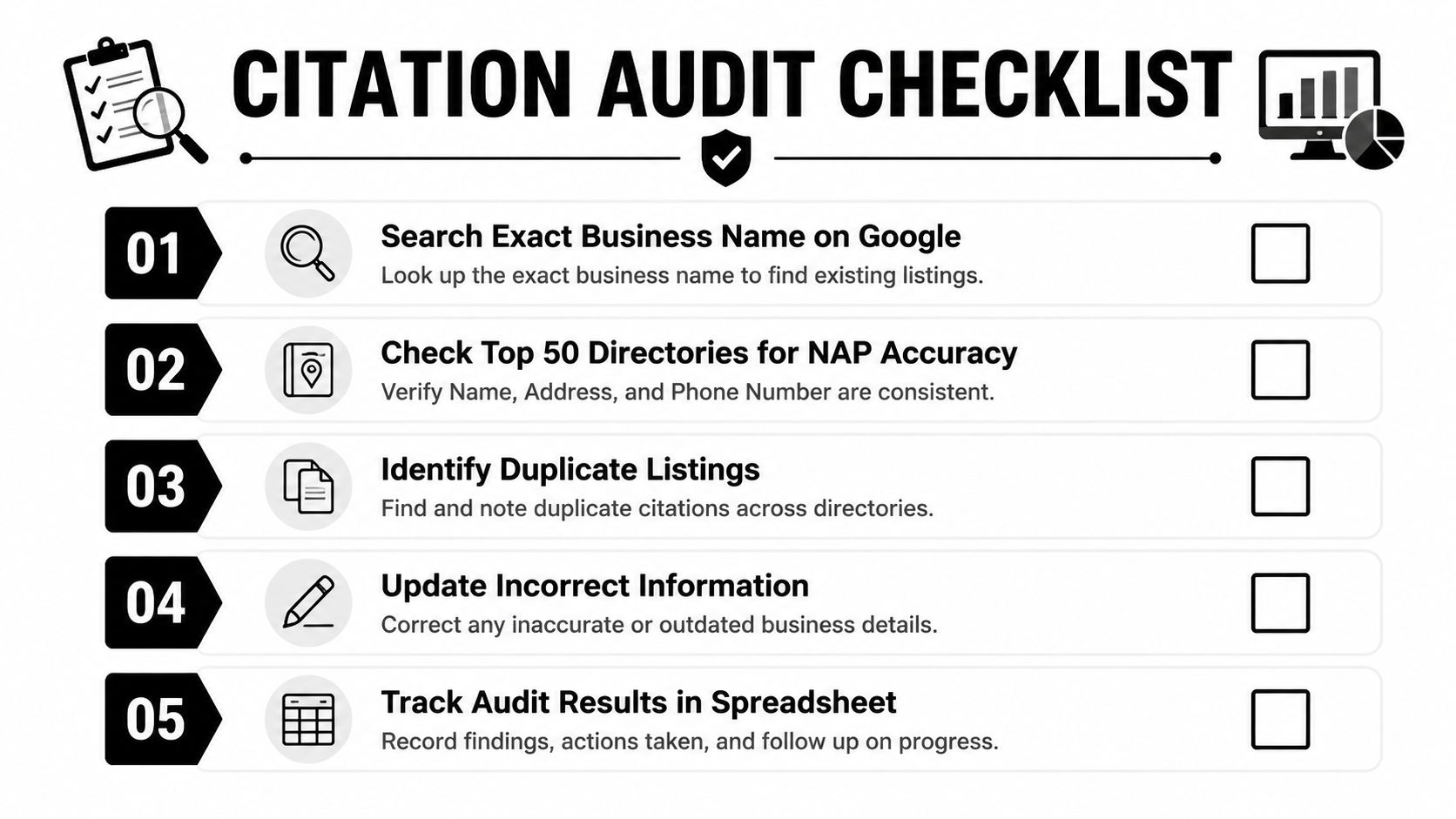
- Search the exact business name. Search Google using your full business name, then record every directory, map profile, article, and social page that appears.
- Check major platforms. Review Google Business Profile, Yelp, Facebook, Bing Places, and Apple Maps. Confirm the name, address, phone number, website, category, hours, and service area where applicable.
- Look for duplicates. Two profiles for the same location can split information and create confusion. Note duplicate, claimed, unclaimed, and closed listings.
- Compare every variation. Copy the NAP information into a spreadsheet rather than relying on memory.
- Correct the source pages. Claim profiles where possible, request edits where necessary, and document the date and action taken.
Standardize the small details
Formatting differences can create avoidable ambiguity. One listing might show “123 Main St., Ste 400”, while another says “123 Main Street, Suite 400.” Choose one canonical format and update the listings to match it.
The same process applies to shortened business names, old phone numbers, suite details, relocated offices, and changed service areas. Don't assume a listing is harmless because customers rarely visit it. Search engines may still use its information during identity matching.
A spreadsheet can include these columns:
- Platform: Directory or website name.
- Listing URL: The profile's direct address.
- NAP version: The exact business information displayed.
- Status: Accurate, inaccurate, duplicate, or unavailable.
- Action: Update, claim, merge, remove, or monitor.
- Date checked: When you reviewed the listing.
Businesses that want help organizing this work can review the citation cleanup service offered by Polaris Marketing Solutions. The important point is to finish with a documented canonical version of your business information and a list of every correction still needed.
Building Citations That Drive Results
A Fort Myers plumber may appear on Google, Apple Maps, a trade directory, and a local association site. If each profile carries the same business identity, search systems can connect those records with confidence. Citation building works best as a priority system, not a race to collect every available listing. Start with platforms customers use, then add sources that fit the business category and location.
Build the core identity layer first
Review the major profiles before pursuing smaller directories:
- Google Business Profile: Confirm the business name, address, phone number, category, hours, service areas, photos, and website.
- Bing Places and Apple Maps: Keep the same core identity across different search ecosystems.
- Facebook and Yelp: Maintain accurate contact details and business descriptions.
- Local sources: Consider the Fort Myers Chamber of Commerce, Southwest Florida associations, and relevant local news sites.
The right platform list depends on the business model. A Fort Myers plumbing company might prioritize HomeAdvisor and Angi. A law firm may need Avvo and FindLaw. A healthcare practice can evaluate Healthgrades and Zocdoc alongside appropriate local organizations.
An actionable guide from Solo AI can help organize research and submissions, especially for businesses managing listings without a dedicated local SEO team.
Match each directory to the customer
A directory earns priority when it helps potential customers identify, compare, or contact the right provider. A paving contractor should seek home improvement and contractor platforms. A healthcare provider should favor healthcare-specific sources. A professional service firm should review industry associations and regional business directories.
| Priority tier | Home services | Professional services | Healthcare |
|---|---|---|---|
| Primary | Google Business Profile, Yelp, Facebook, Apple Maps | Google Business Profile, Yelp, Facebook, Apple Maps | Google Business Profile, Yelp, Facebook, Apple Maps |
| Industry | HomeAdvisor, Angi, trade directories | Avvo, FindLaw, professional associations | Healthgrades, Zocdoc, healthcare directories |
| Local | Fort Myers Chamber of Commerce, regional associations, local news | Fort Myers Chamber of Commerce, regional associations, local news | Local medical groups, community organizations, regional news |
Keep descriptions and contact details consistent across profiles. Each listing becomes another machine-readable reference that can support traditional local search and AI-mediated discovery. Businesses seeking hands-on support can compare local citation building services and directory management options, then choose assistance that fits their workflow.
Citation Quality vs Quantity in 2026
A business owner can collect dozens of listings and still give search systems a confusing identity record. Another business may have fewer citations, yet present the same name, address, phone number, website, and service details wherever customers look. In 2026, that consistency matters because citations act as machine-readable signals for traditional local search and AI-mediated discovery.
Both can matter, but they solve different problems. Citation volume can show that a business has built a broad presence across relevant sources. It does not prove that those listings are accurate, trusted, or useful to local customers.
A few precise, relevant citations can put a business in a healthier position than many neglected profiles. Each additional listing creates another place for an outdated phone number, incorrect address, duplicate profile, or conflicting business name to persist. Search systems and AI tools may then receive mixed signals about which record represents the actual company.
Use this decision order
First, repair contradictions. Compare the website, Google Business Profile, and major directories. Correct differences in the core identity record before creating new listings. More profiles cannot compensate for conflicting information.
Next, choose authoritative, relevant platforms. Prioritize sources connected to the business's market, industry, customers, or professional community. A local association or respected trade directory may help more than a generic site with no meaningful audience.
Then, compare the competition. If competing Fort Myers HVAC companies appear on the same important directories, matching that baseline may make sense. A directory unrelated to the service area or industry may not deserve the time required to maintain it.
Citation strategy should follow customer search behavior, industry relevance, and data accuracy, not an arbitrary listing target.
Unstructured mentions can strengthen the identity record too. A local news article, chamber profile, sponsorship page, or community resource connects the company with a specific place and service. Reliable structured data paired with useful local context gives search systems clearer evidence than a collection of low-value profiles.
Citations in the Age of AI Search and Google Business Profile
A customer asks an AI tool for a nearby service provider. The answer may draw on your website, directory profiles, reviews, and local mentions before presenting your business. Those references form a machine-readable business identity layer. It feeds traditional local results and AI-mediated discovery, where systems compare information from several sources.
A citation does not guarantee a place in an AI answer or local pack. It gives search systems a clearer record of who you are, what you offer, and where you serve. Consistent details make that record easier to interpret, while useful local context can help connect the business with a real community.
Build the complete local presence
Citation work should support the rest of your local presence:
- Google Business Profile: Keep the primary profile accurate, complete, and aligned with the website. Learn more about what a Google Business Profile is.
- Reviews: Monitor customer feedback and respond in ways that clarify the business and its services.
- Structured data: Add appropriate schema markup to help search systems read key business details on the website.
- Local content: Publish useful pages connected to the communities and services you serve.
- Ongoing maintenance: Recheck listings after a move, rebrand, phone change, or service-area update.
Start with a citation audit. Repair conflicting information, claim priority listings, and add relevant local or industry references. You can review the local citation concept overview for a plain-language explanation of the concept. This routine keeps your public business identity dependable as search systems change.
Polaris Marketing Solutions helps Fort Myers and Southwest Florida businesses audit, clean up, build, and manage local citations alongside Google Business Profile optimization and broader local SEO. Visit Polaris Marketing Solutions to request a complimentary online analysis and competitor report, then use the findings to decide which listings need attention first.