
A second location looks great on a growth plan. Then the calls split, the reviews get messy, the website feels duplicated, and the simple SEO playbook that worked for one branch starts leaking time and money across the others. That's the point where local SEO for multiple locations stops being a marketing task and becomes an operating system for the business.
The shift is bigger than most owners expect. Google treats each branch like its own local presence, and that matters because 46% of all Google searches have local intent and 76% of people who search for something nearby on a smartphone visit a related business within 24 hours (BrightEdge). If each location can win its own local search moments, the brand gets more chances to show up where buyers are already ready to act.
Why Your First Location's SEO Strategy Won't Work for Your Second
The first branch often grows on momentum. The owner knows the neighborhood, the Google Business Profile gets attention, and the website has just enough content to support local demand. The second branch changes the math because the search environment is no longer one market. It's two distinct markets with different competitors, different review patterns, and different signals of trust.
A plumbing company expanding from one city to another feels this fast. The original location may rank because the brand name has local history, but the new branch starts from zero unless it earns its own location-level authority. A copy-paste approach usually disappoints, even when the service quality is identical.
Practical rule: treat each branch as a separate local asset, not a clone of the first one.
Local searchers act quickly, and Google rewards the businesses that look present in the area. Analysts at BrightEdge found that businesses in the local map pack receive 126% more traffic and 93% more calls, website clicks, and direction requests than businesses ranked in positions 4 to 10. That gap is why a generic corporate page rarely pulls its weight for every branch.
A better mindset is to build location-by-location relevance. Each branch needs its own page, its own Google Business Profile, and its own local signals. If you want a practical checklist for the setup work, use this Google Business Profile optimization checklist as a working reference while you build the system. A useful companion read on improving local search authority can also help you compare branch-level priorities without drifting into duplicate tactics.
The biggest mistake is assuming centralized branding solves local visibility. It doesn't. Centralization keeps the message consistent, but local SEO wins when consistency is paired with real branch-level proof.
Building Your Foundation with Google Business Profiles

Start with the profile customers see in Maps and the local pack. Google Business Profile signals account for a meaningful share of local pack ranking influence, so this is the first asset worth tightening for every branch, not just the brand as a whole. A multi-location business needs one verified profile for each physical, customer-facing location.
The cleanest way to manage this at scale is through a Location Group inside Google Business Profile. It keeps the account organized, lets you work across branches without losing track of edits, and makes consistency easier to enforce without blending one location into another. Central control saves time, but each change still needs to be made at the location level.
Use this setup checklist for each branch:
- Unique phone number: assign a branch-specific number so calls route correctly and the listing does not blur into another location.
- Exact hours: keep holiday and special hours current, because outdated hours create friction fast.
- Location-specific photos: storefront, team, signage, and interior shots help prove the branch is real and active.
- Distinct description: keep the brand voice consistent, but add local references that fit the market.
- Correct primary category: do not force every branch into the same category if the service mix differs.
- Separate verification workflow: use Google's bulk verification process if the brand has 10+ locations, and use the Business Profile API when ongoing management needs centralized updates.
Bulk verification matters because admin work scales badly. The more branches you have, the more likely one location gets forgotten, outdated, or miscategorized if everything is handled manually. A practical model is a location group for a ten-store home services brand, with each branch carrying its own phone number, storefront photos, and hours, so the listings stay useful instead of generic.
This Google My Business optimization checklist is a useful companion if your team needs a more operational view of profile cleanup and ongoing maintenance.
Google Business Profiles are ongoing local storefronts. They work best when each branch looks like an actual branch, with details that match what customers see on site.
A centralized team can still manage the system well, but the edits need to reflect the reality of each location. That balance keeps a multi-location account scalable without turning it into a generic corporate shell.
Designing Your Website for Local Dominance
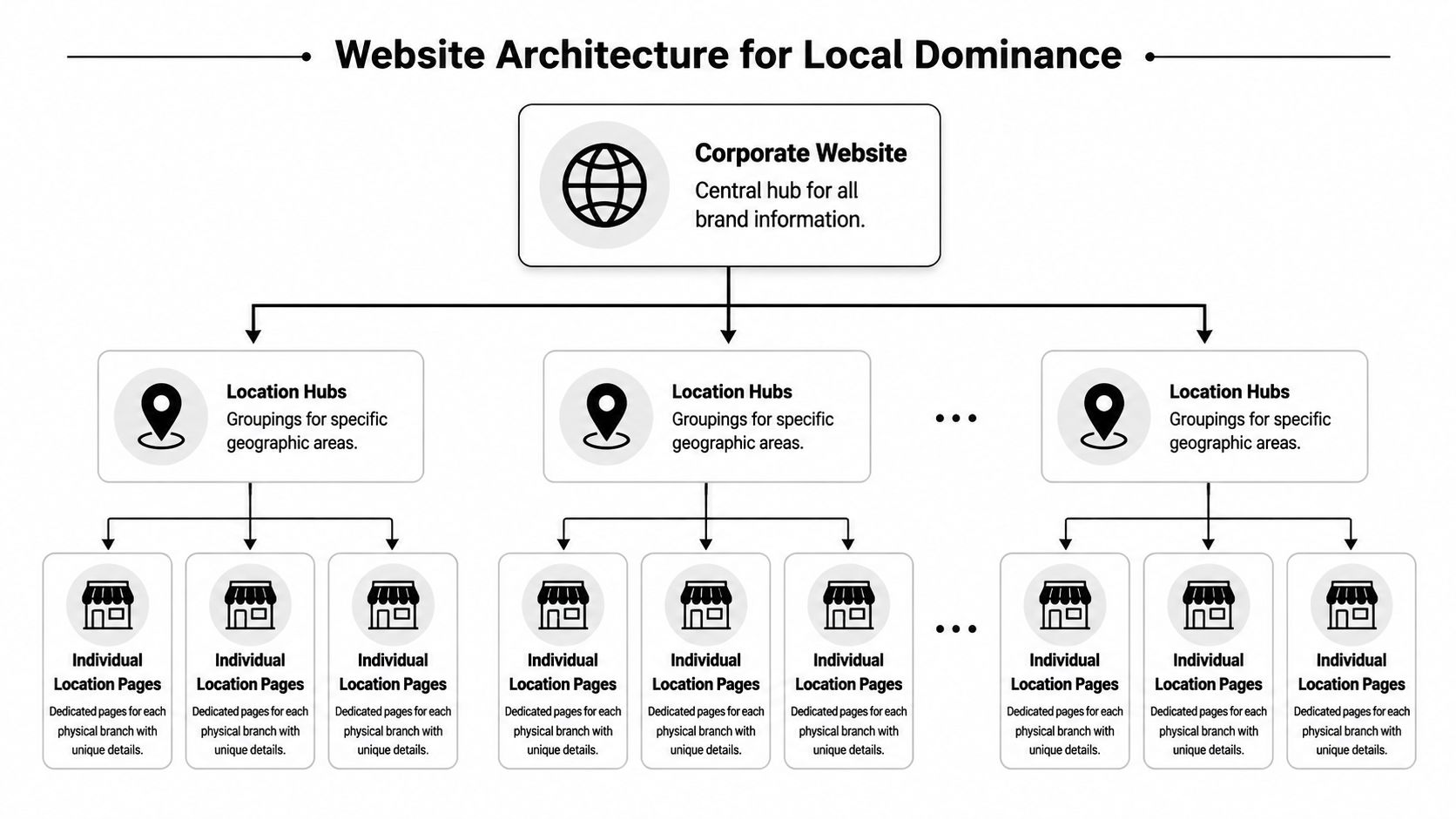
A strong multi-location site needs a structure that tells both users and search engines where each branch belongs. The most scalable setup is a main site > state or region hub > city or location page model, with internal links flowing in a predictable direction. That structure keeps the site organized and makes it easier for search engines to understand which pages support which locations (The Practical SEO).
Think of a regional HVAC company serving several counties. The homepage handles the brand, the regional hub introduces the service area, and each city page handles local proof, local hours, and branch-specific contact details. That keeps the website from collapsing into a pile of near-duplicate pages.
Build the page hierarchy first
The hierarchy matters more than decorative design. A location page shouldn't float alone, and it shouldn't be linked randomly from unrelated pages. Use deliberate pathways, homepage → regional hub → location page, plus links from relevant service pages back to the proper branch pages. Add breadcrumb navigation on every location page so users can move back up the structure without guessing.
Make the location page actually local
A high-performing location page needs more than a city name in the title. It should include a map embed, local reviews, staff photos, branch-specific hours, and services that fit the market. If a branch has a local technician team or a local office manager, include that. If service availability differs by location, say so plainly.
A location page that only swaps out the city name is usually asking for trouble. Search engines and users both notice the lack of local proof.
The other technical layer is uniqueness. A recent multi-location guide recommends a modular content approach with roughly 60% core brand content and 40% local context so the pages stay consistent without looking duplicated (Entrepreneur). That's the right instinct. Keep the service description and brand promise stable, then use local detail, local testimonials, and local operational notes to make each page distinct.
If you need a practical implementation reference for usability and page flow, this user experience optimization guide fits well with the way multi-location pages should be structured.
The goal isn't to create more pages. It's to create pages that prove the branch belongs in that market, then make the path to them obvious.
Managing Citations and Reviews Across All Branches
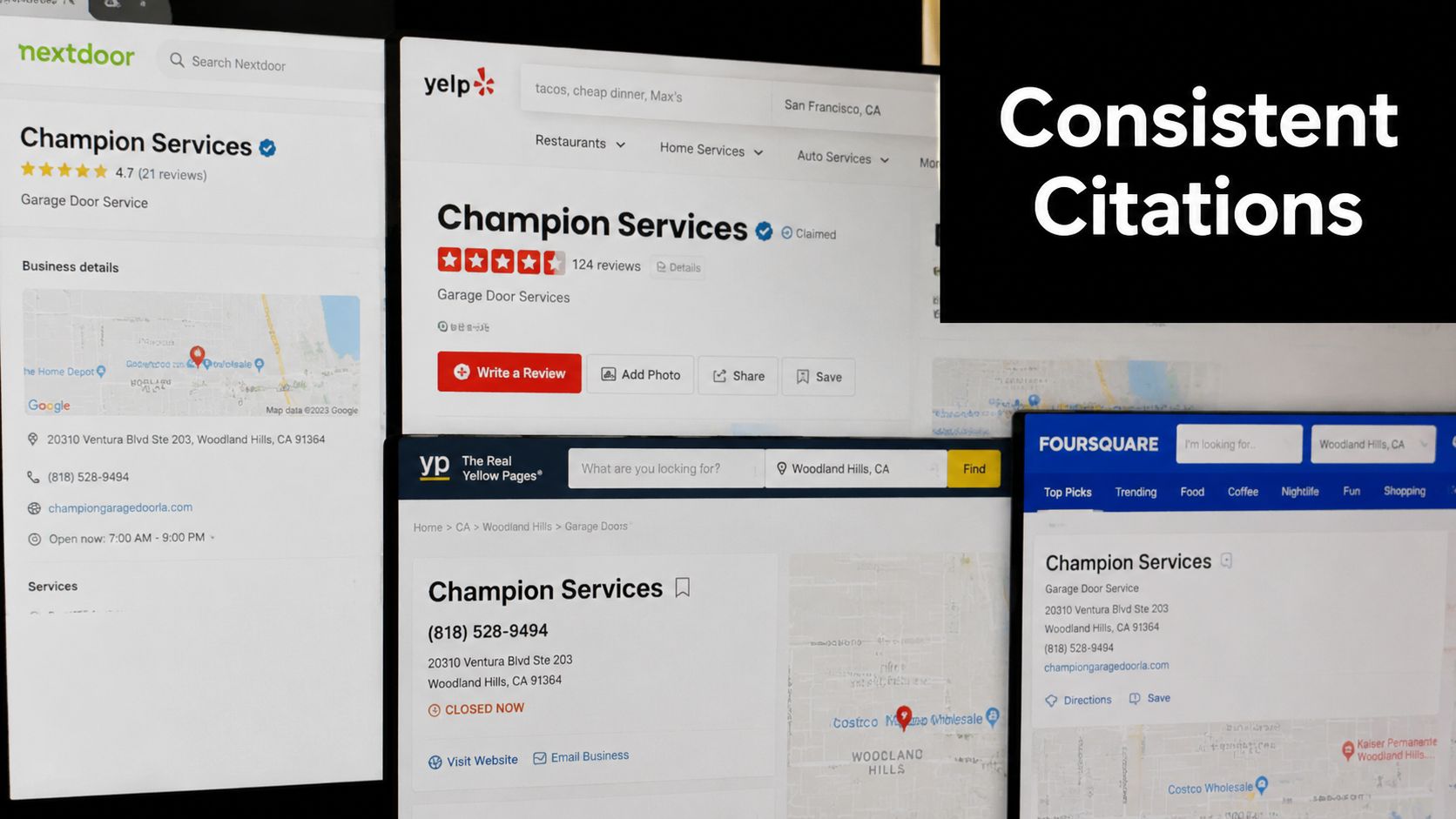
Citations and reviews work best when they are managed as one system. If the name, address, phone number, categories, and hours drift from one directory to another, the branch starts to look unreliable, even when the service quality is strong. Consistency is not glamorous, but it is one of the clearest trust signals you can control across a multi-location footprint.
For a marketing manager, the practical workflow is to audit the core directories, fix the main listings, and keep a change log for every branch. That matters because a moved office, a suite number change, or a phone forwarding mistake can spread through many listings before anyone notices. Tools like BrightLocal, Moz Local, and Yext are commonly used to clean up and distribute listing data at scale. The right choice usually comes down to how many branches you manage and how much control your team wants over each update.
Pair citation consistency with review operations
Reviews should not be handled branch by branch in isolation. If one location keeps getting fresh reviews and another goes quiet, the stronger location often looks more trustworthy to users, while the weaker one starts to fade from consideration. Set up one request workflow for all locations, then route responses through templates that sound human instead of scripted.
A workable review system has three parts:
- Automatic request timing: ask after a completed job, appointment, or purchase while the experience is still fresh.
- Response templates: build a starting draft for praise, complaints, and mixed feedback, then localize the details before posting.
- Page-level reinforcement: feature strong local reviews on the matching location page so the proof supports the branch that earned it.
If your team needs a practical starting point for review operations, this guide to getting more online reviews is a useful companion.
The best review strategy is not volume for its own sake. It is branch-level credibility. A customer reading a review from their own city wants reassurance that the team knows the area, shows up on time, and understands the local service context.
One more point. If a business runs on a franchise model, the local review process still has to stay grounded in the authentic branch experience. The strongest systems make it easy for each location to sound like itself while staying on brand.
Implementing Local Schema and Technical Signals
Schema gives search engines a structured way to read branch data. For multi-location sites, that means each location page should carry its own LocalBusiness JSON-LD with unique values for @id, address, geo, and telephone. Those fields help separate one branch from another and reduce the chance that Google blurs them together.
A practical template looks like this:
{
  "@context": "https://schema.org",
  "@type": "LocalBusiness",
  "@id": "https://www.example.com/locations/city-name/#localbusiness",
  "name": "Business Name City Name",
  "url": "https://www.example.com/locations/city-name/",
  "telephone": "+1-000-000-0000",
  "address": {
    "@type": "PostalAddress",
    "streetAddress": "Street Address",
    "addressLocality": "City",
    "addressRegion": "ST",
    "postalCode": "00000",
    "addressCountry": "US"
  },
  "geo": {
    "@type": "GeoCoordinates",
    "latitude": "00.0000",
    "longitude": "00.0000"
  }
}
Keep the template consistent, but never reuse the same branch data across pages. The point is to make each location page machine-readable and location-specific at the same time. If a branch serves a different service mix, add that in the schema and on the page copy where it's accurate.
Internal links still matter here. Link from related service pages to the right location page, and avoid letting every service page point to every branch. That creates confusion and weakens the relationship between a service intent and a specific location. A clean linking pattern sends the right signals without turning the site into a maze.
Mobile usability is part of technical local SEO too. Local searchers often act quickly on phones, so the page has to load cleanly, display the phone number clearly, and make directions easy to find. If the visitor has to hunt for contact details, the branch loses the lead before the form ever gets filled out.
Tracking Performance and Proving ROI by Location
One blended report won't tell you which branch is carrying its weight. A multi-location business needs separate reporting by location so the team can see which profiles, pages, and markets are producing calls, direction requests, and website clicks. That's the level where local SEO turns from theory into an operating decision.
Start with Google Business Profile links that carry UTM parameters. That lets you separate website traffic from each listing inside analytics instead of guessing which branch drove the visit. Then pair that with GBP Insights so each location's calls, direction requests, and clicks can be reviewed in the same monthly window.
Build the report around branch decisions
The report doesn't need to be complicated. It does need to answer three questions clearly. Which locations are getting attention, which ones are turning that attention into actions, and which branches need support from content, reviews, or citations?
A simple monthly dashboard can track:
- Calls by location: useful for service businesses where the phone drives bookings.
- Direction requests by location: a strong signal that the branch is pulling nearby traffic.
- Website clicks by location: helpful for evaluating landing page performance and engagement.
- New reviews by location: a good indicator of whether local operations are staying active.
Practical insight: if a branch gets traffic but few calls, the problem may be page layout or CTA friction, not ranking.
The right report also keeps management honest. A location that looks weak in one market may be facing heavier competition, weaker local proof, or just a less responsive audience. That's why branch-level reporting matters more than broad company averages.
Polaris Marketing Solutions is a natural fit for small and mid-sized businesses that need a local SEO partner, since its work includes local SEO, location-specific content, citation building, and transparent monthly reporting. The value is in seeing the branches separately, then deciding where the next round of effort should go.
Common Multi-Location SEO Pitfalls and How to Scale Smart
A multi-location SEO program usually stalls for one reason, teams treat every branch the same. That sounds fair, but it wastes budget and slows return. The smarter move is to rank locations by revenue potential, addressable customer base, and local competition (Search Engine Journal).
That order should shape the work. A branch in a crowded city may need more review support and stronger local content. A quieter market with higher ticket value may need tighter profile accuracy and better citations before it needs more pages.
Avoid the common scaling traps
The usual problems show up fast once expansion starts. NAP inconsistency slips in, location pages reuse the same copy, and internal keyword cannibalization begins when several pages compete for the same query. None of that looks dramatic at first, but each issue can hold back performance as the brand adds more branches.
Use this as the filter for every new location:
- Is the market worth prioritizing now? Rank it by commercial potential, not by internal politics.
- Does the branch have real local proof? If it does not, the page will feel thin even with a clean design.
- Can the team maintain the listing and review workflow? If not, start with fewer locations and expand in stages.
For multi-unit brands, a specialized franchise marketing company can help keep standards aligned across branches, but the priority list still has to come from your own market data and margin reality.
The right scale model is disciplined. It does not try to make every branch equal. It puts more effort into the locations most likely to return that effort, then uses templates, internal processes, and local proof to keep growth from turning messy.
If you need a partner that understands both local SEO fundamentals and the realities of small-business growth, visit Polaris Marketing Solutions and ask for a local SEO analysis and competitor report. If your brand has multiple locations in Fort Myers or Southwest Florida, they can help you build a cleaner location system, tighten your Google Business Profiles, and focus effort where it can drive real leads.