
If you run a Fort Myers HVAC, roofing, cleaning, or law firm, you've probably felt this already, a better service call gets lost to a cheaper quote because the buyer can't tell the difference fast enough. That's not just a sales problem, it's a brand positioning strategy problem. When people trust one company more than another, they buy differently, and when they understand a brand's difference clearly, they're less likely to treat every option like a commodity.
That matters because consistent, differentiated brands are associated with 10% to 20% revenue increases on average, and 88% of consumers globally say trust matters in purchase decisions, just behind value for money and quality. In global brand markets, the top 5,000 brands grew from USD 11 trillion in 2020 to over USD 14 trillion in 2025 source. For Southwest Florida service businesses, the lesson is simple, positioning isn't polish, it's the reason your website, Google Business Profile, reviews, and sales process work together instead of fighting each other.
Why Brand Positioning Matters More Than Price in Local Markets
A Fort Myers contractor can do excellent work, answer the phone, and still lose the job to a lower quote. That usually happens when the buyer sees two similar options and has no clear reason to pay more for one of them. In that moment, the company with the clearest positioning wins the conversation before price ever becomes the deciding factor.
Trust beats discounting when the offer feels risky
In local service markets, buyers are often trying to reduce risk, not just buy a product. A homeowner hiring an HVAC company wants the system fixed correctly, on time, and without surprise friction. A business owner choosing a cleaning vendor wants reliable crews and fewer headaches, not another vague promise about “great service.”
That's why positioning is a commercial lever, not a branding accessory. It changes what people notice first, what they believe, and what they're willing to pay for. The right message makes your price feel like part of the value story instead of a separate obstacle.
Practical rule: If the buyer can't repeat your difference in one sentence, they'll compare you on price.
It also helps to think about how your brand shows up in newer discovery surfaces. If you're trying to understand how competitors appear across answer engines, this guide on benchmark competitors in LLMs is a useful lens because visibility now extends beyond classic blue links.
Positioning shapes every downstream marketing decision
Once a brand has a clear position, the website headline gets sharper, the Google Business Profile description gets more focused, and the sales team stops improvising inconsistent promises. Without that foundation, every channel drifts in a different direction. The result is weaker trust and more price pressure.
For SMBs, that's the cost of weak positioning. You end up funding traffic that doesn't convert, leads that don't understand the offer, and sales calls that restart the same explanation every time. Strong positioning makes your marketing spend work harder because it gives people a reason to choose you that isn't based on being the cheapest option in town.
Researching Your Market and Mapping the Competition
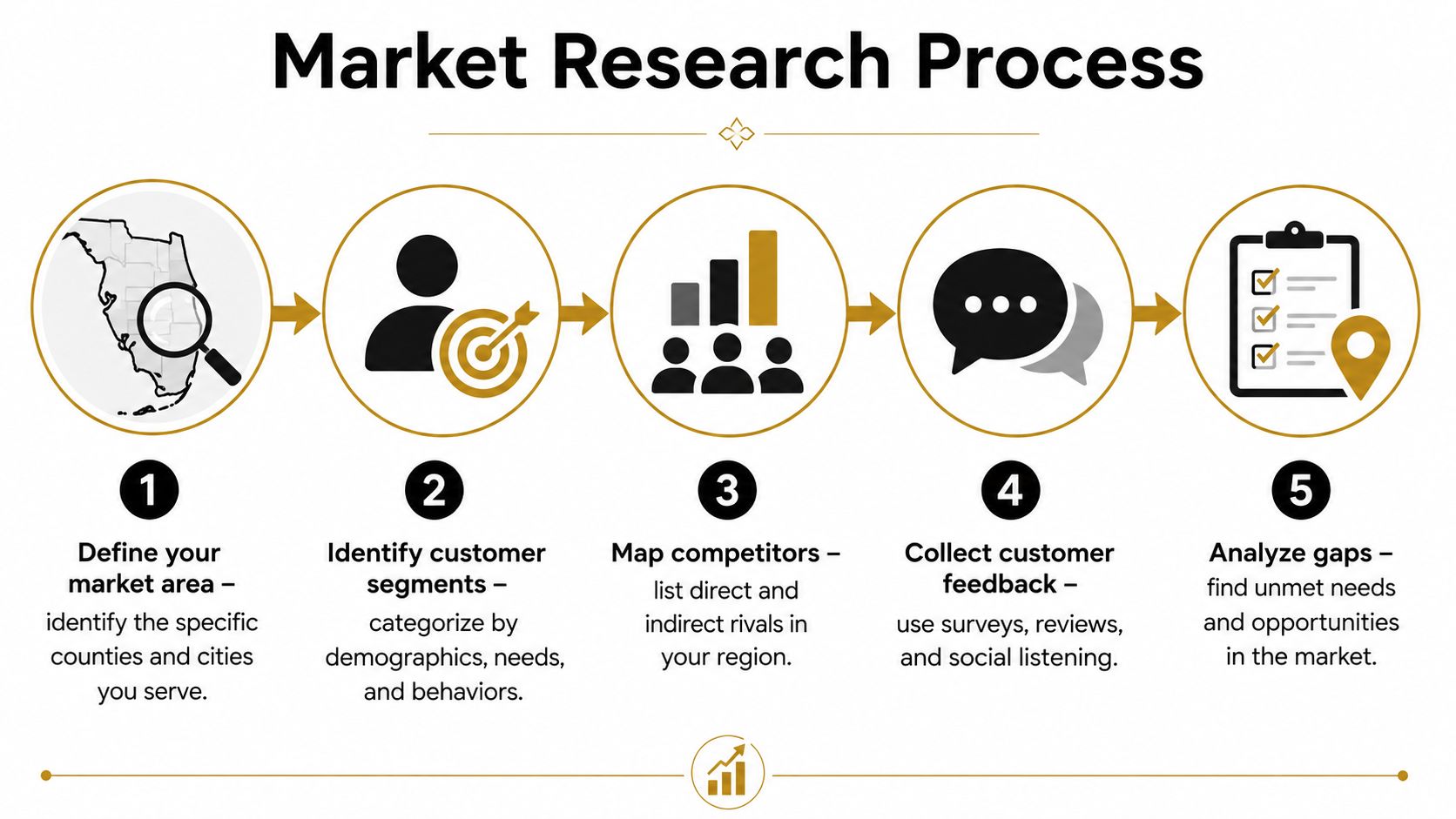
Start with evidence, not slogans. In a Cape Coral dental practice, or a Naples law firm, the right positioning usually shows up in what existing customers already say they value, what competitors promise too often, and where the market sounds crowded but still feels under-served. A sharp position comes from that overlap.
Interview customers until the pattern gets obvious
The cleanest research I've seen starts with interviews, not a survey deck. One practical rule is to keep talking to customers until the same themes keep repeating, which a cited positioning method says usually happens after 15 to 20 conversations source. That threshold matters because early interviews often sound scattered, while later ones reveal the jobs people are hiring you to do.
Listen for the phrases customers use when they describe the problem, the moment they searched, and why they chose one company over another. Those exact words often become the raw material for positioning language, especially in service businesses where trust, speed, and clarity matter more than fancy phrasing.
Keep the customer's wording if it's usable. Owners often over-edit away the exact language that made the insight valuable.
Map competitors on two axes, not just a list
Harvard Business School's positioning-statement framework recommends plotting brands on a two-axis perceptual map, such as price versus quality, to expose whitespace and gaps in the market source. For a Cape Coral dental practice, that might mean mapping three nearby competitors against what patients care about, for example speed of booking, comfort, or insurance clarity. The point is not to draw a pretty chart, it's to see where everyone sounds the same.
A practical way to use that map is to compare what competitors promise publicly with what your interviews reveal customers still worry about. If every rival says “quality care” and “friendly staff,” those phrases are not differentiators, they're table stakes. The opening is usually in a more specific promise tied to a real pain point.
If you need a toolset for this part of the process, the internal guide on competitor analysis tools for small businesses can help organize the research without turning it into a spreadsheet exercise.
Turn the gaps into a decision
Once the interviews and competitor map are in front of you, the choice usually becomes clearer. You are either positioning around a feature, a service outcome, a segment, or a proof point that others aren't using well enough. If you can't identify the gap, that's usually a sign the market is crowded and your current language is too generic.
For service firms, the best positions are often simple and specific. They speak to a need the buyer already has, then prove that the company can solve it better or more reliably than the alternatives.
Writing Your Positioning Statement and Value Proposition
A positioning statement has to do more than sound smart. It needs to force decisions, because vague positioning is usually just a polite way of saying the business hasn't chosen what it wants to be known for. The strongest format keeps four pieces in view, target audience, frame of reference, point of difference, and proof source.
Use a sentence that can actually be tested
A working template looks like this, For [target], [brand] is the [frame] that [point of difference] because [reasons to believe]. That structure is useful because it forces a business to name the audience, the category, the advantage, and the evidence in one sentence. If any part feels fuzzy, the market will feel it too.
Here's how that sounds in practice:
- North Fort Myers roofing company: For homeowners dealing with storm damage, [Brand] is the roofing contractor that responds quickly and helps with insurance-claim paperwork because the team documents damage clearly and keeps communication tight.
- Estero family law firm: For clients who want clearer costs in stressful cases, [Brand] is the family law firm that offers transparent flat-fee pricing because the intake process sets expectations before work begins.
- Bonita Springs home cleaning service: For busy households that want dependable help, [Brand] is the cleaning service that sends background-checked crews because satisfaction follow-up is built into every visit.
The point of these examples is not to sound clever. It's to show how a position becomes stronger when it ties a specific audience to a specific outcome and backs it with proof.
Shrink the statement into a value proposition
A value proposition is the short version people see in a headline or ad. It should keep the benefit, drop the internal detail, and stay specific enough that the right buyer recognizes themselves. In practice, that means turning the statement into a clear promise, like reliable storm response, transparent pricing, or background-checked service teams.
A concise value proposition should answer one question fast, why choose this company instead of the next one? If the answer leans on generic service language, the message still isn't ready. If it points to a real outcome and proof point, it can move into the website header, ad copy, and proposal language.
For teams building the brand side of that message architecture, the internal resource on small business branding tips is a practical companion because it keeps identity work tied to business reality.
Practical rule: If your positioning statement can't survive a skeptical customer reading it aloud, it's too broad.
Use AI tools to speed the drafting, not replace the thinking
Agentic AI can help organize interview notes, compare messaging patterns, and draft first-pass versions of positioning language, but it still needs human judgment. The useful part is speed, not authority. A good overview of how to implement agentic AI can help teams decide where automation supports the process without turning the strategy into generic copy.
Integrating Positioning with Local SEO and AI Search
A positioning statement sitting in a document doesn't change buying behavior. It has to show up where people encounter the brand, especially in local search results, Google Business Profile, review sites, and AI-generated answers. If those surfaces all tell a slightly different story, the market gets confused fast.
Make the Google Business Profile match the promise
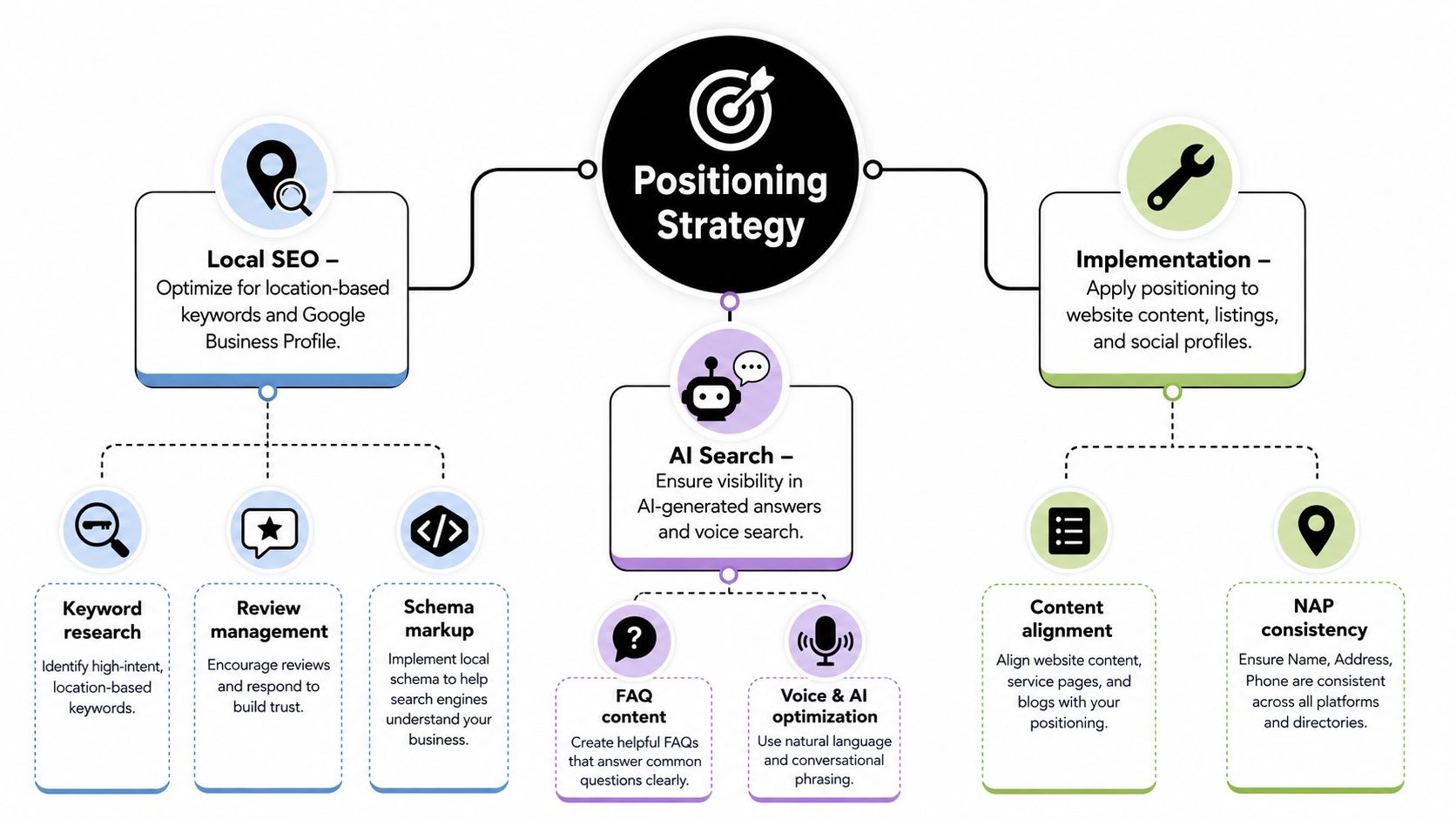
Your GBP category, business description, services, photos, and posts should reinforce the same positioning language you use on the website. If the firm wants to be known for responsiveness, that should appear in the copy, the post schedule, and the way services are described. If the business wants to lead with trust, the proof has to be visible through reviews, not just claimed in a headline.
That's also where local content matters. A Naples legal firm writing about Lee County court procedures or a Fort Myers contractor publishing area-specific service pages gives search engines and buyers more context about who the company serves. It turns positioning into a real local signal instead of a slogan.
Reviews and citations become proof points
In local service categories, reviews often do more than persuade people, they validate the position. If your message says you're reliable, the reviews should sound like customers experienced reliability. If you say your team is responsive, the review profile should reflect that same theme consistently.
That's where answer-engine visibility starts to matter. The more your location pages, review themes, and business listings repeat the same problem, audience, and proof point, the easier it is for both humans and machines to understand what you're known for. For teams thinking about that shift, the guide to monitor your brand across AI engines is a relevant reference point because the discovery layer is no longer only traditional search.
If the topic is new to your team, the internal explanation of answer engine optimization is worth using alongside your local SEO work, especially when you're trying to show up in summaries rather than just rankings.
Align the message everywhere people look
The key is consistency across touchpoints, not volume of content. Your website, listing profiles, review requests, and local service pages should all support the same claim in slightly different ways. That makes the position easier to remember and harder for competitors to copy.
Once that alignment is in place, the brand starts showing up as a coherent answer instead of a loose collection of assets. In the AI search era, that coherence is part of the competitive edge.
Implementing Across Touchpoints and Tracking What Works
Keep the rollout tight. Select a maximum of five key touchpoints, then make sure the same positioning shows up there without extra fluff or side messages. For most Southwest Florida service firms, those touchpoints are the website homepage, Google Business Profile, phone greeting, proposal template, and post-service follow-up email.
Build the launch around consistency
The first pass should audit what customers hear and read at each stage. If the homepage promises fast response, the phone greeting can't sound casual or vague. If the proposal emphasizes transparency, the estimate process should reflect that same clarity.
A simple launch checklist helps keep the work grounded:
- Homepage headline: Match the main benefit and proof point to the positioning statement.
- GBP profile: Align categories, description, and service language with the core promise.
- Phone script: Train staff to echo the same value language in the first 10 seconds.
- Proposal template: Remove generic phrases and insert proof-driven claims.
- Follow-up email: Reinforce the original promise and invite a review that speaks to it.
Measure perception, not just activity
Positioning needs checkpoints before launch, not after the fact. That's how you tell whether the message is changing how people perceive the business instead of just changing what the team says internally. The most useful metrics are the ones that connect visibility, trust, and conversion behavior.
| Positioning KPIs and What They Measure | ||
|---|---|---|
| Metric | What It Measures | Target Direction |
| Branded search volume | Whether more people are looking for the business by name | Up |
| GBP click-through rates | Whether the listing is earning interest from local searchers | Up |
| Review sentiment scores | Whether customers echo the intended proof points | Up |
| Lead-to-customer conversion rates | Whether the message is attracting better-fit leads | Up |
| Customer lifetime value | Whether positioning is helping retain stronger accounts | Up |
These numbers only matter if they're reviewed against the actual positioning promise. If the profile says reliability and the reviews keep mentioning missed calls, the position isn't landing yet. That's the feedback loop most SMBs skip.
Positioning gets real when the team can point to customer language, review themes, and conversion quality in the same monthly report.
The practical advantage of this approach is that it gives owners something concrete to improve. Instead of asking whether branding feels stronger, you can ask whether the market is repeating the same proof points you intended to own.
Winning When You Are Not the Cheapest or Most Unique Option
A lot of positioning advice assumes you have a flashy feature or a dramatic pricing edge. Most local service businesses don't. What they do have is execution reliability, speed, and reduced risk, and those can be powerful if you build the message around the job customers are hiring you to do.
Own the job, not the category cliché
A paving contractor doesn't need to claim it's the only company that paves driveways. An HVAC company doesn't need to pretend it invented comfort. It needs to show why the buyer should trust its process, timing, and follow-through more than the next bidder's.
That's where an uncopyable position starts to form. If a competitor copied the offer exactly, would the customer still choose you? If the answer is yes because your process is clearer, your response is faster, or your results are more predictable, then the position has real weight.
Proof points matter more than adjectives
In crowded Southwest Florida markets, buyers often care about trust, responsiveness, and predictable outcomes more than brand personality. That's why vague claims like “better service” don't hold up well. They don't tell the buyer what will happen differently.
Instead, tie the promise to something observable. Mention documented results, transparent estimates, response commitments, or a process that lowers stress. The more concrete the proof, the less the business has to lean on discounting.
Practical rule: If the claim can't be supported by a review, a process, or a visible asset, it isn't ready to lead with.
This approach works because it respects the buying psychology in local services. People don't always want the cheapest option. They want the option that feels safest and easiest to trust with something important.
Treating Positioning as a Continuous System Not a One-Time Project
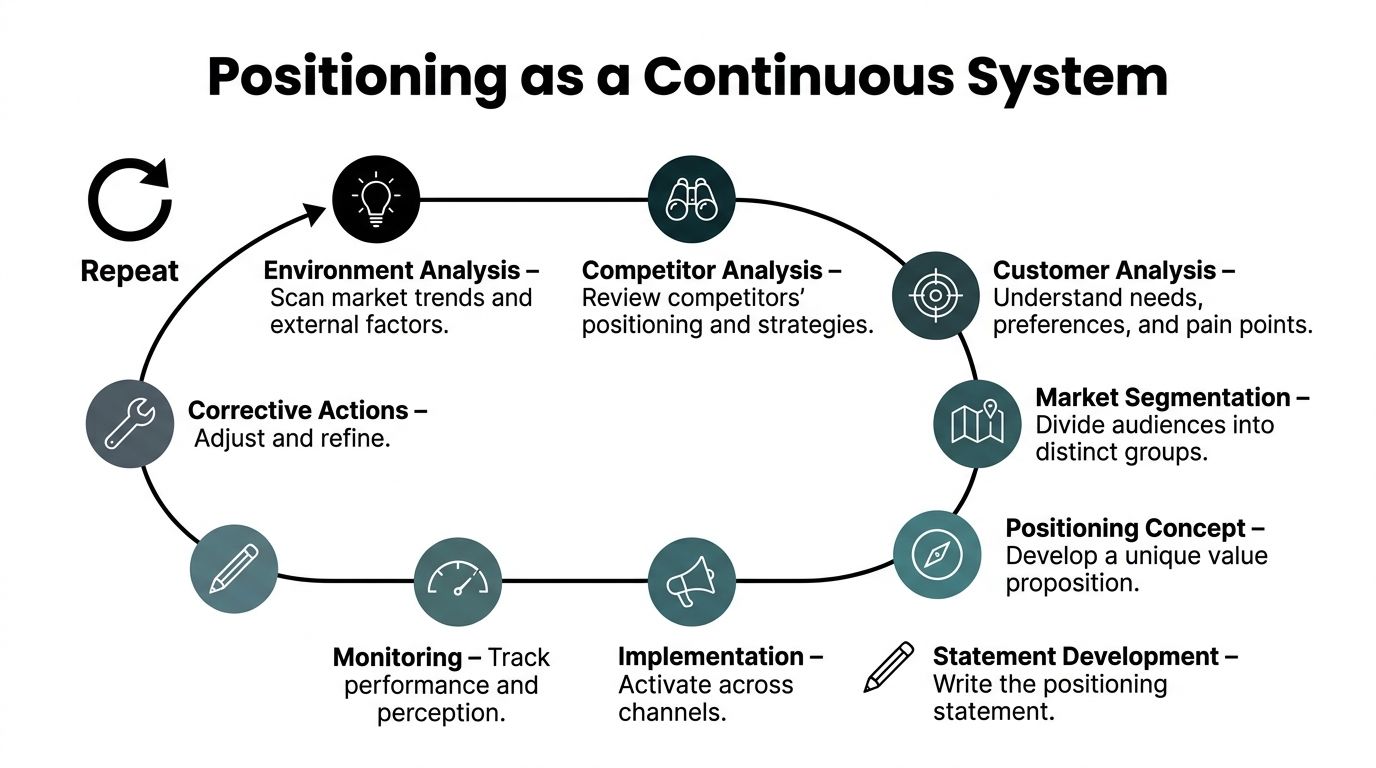
The strongest positioning work follows a nine-stage loop, external and internal analysis, trademark and brand design, selection of differential features, definition of the method, strategic and tactical targets, implementation planning, execution, results evaluation and control, then corrective actions. That sequence matters because it treats positioning as a closed-loop system rather than a one-time message rewrite source.
Review, adjust, repeat
The biggest mistake is launching a statement and never checking whether customers absorb it. Markets shift, competitors copy language, and proof points lose force if they aren't maintained. Quarterly review cycles solve that by reconnecting the original intent to what the audience is really saying back.
For a Fort Myers or Naples SMB, that means checking the homepage, GBP, reviews, and proposals together, not as separate chores. If those touchpoints still match the intended position, keep pushing it. If they've drifted, correct the message before the market drifts further.
Schedule the first 15 customer interviews, draft the positioning statement using the four-part template, and audit your top five touchpoints for consistency before the next campaign goes live. That's the cleanest way to turn brand positioning strategy into a working system instead of a file on someone's desktop.
Polaris Marketing Solutions works with Southwest Florida businesses that need their positioning to show up clearly in local search, reviews, and website messaging. If you want help tightening your message and making it visible across the channels that drive leads, visit Polaris Marketing Solutions and start with a practical review of where your current position is helping, or costing, you business.