

If you're running Google Ads for HVAC in Fort Myers, you already know the pain. The account looks busy, the click reports keep climbing, and the phone still isn't ringing with enough booked jobs to justify the spend. That usually isn't a bidding problem. It's a structure problem, a tracking problem, and, more often than people admit, a budget problem.
In Southwest Florida, HVAC demand is unforgiving. Summer searches spike, emergency calls are expensive, and a broad campaign can burn through cash on the wrong neighborhoods, the wrong queries, and the wrong kind of lead. The contractors who win don't just “run ads.” They separate urgent repair traffic from installation and maintenance, keep a hard line on service area, and measure success by booked work, not by vanity lead volume. If you want a practical place to look for adjacent lead-generation tactics outside search, find HVAC leads with property data can help frame how offline targeting and paid search often work best together.
The common mistake is simple: launch fast, hope the system figures it out, and trust form fills too early. That's how budgets disappear in Cape Coral, Fort Myers, Estero, and Naples while the CRM fills with unqualified inquiries. A tighter account, better search-term hygiene, and honest conversion rules change that equation. For teams that want a broader paid-media operating model, this PPC management overview is useful context for how disciplined account control should look in practice.
Why Most HVAC Google Ads Campaigns Burn Budget
A Fort Myers contractor can get what looks like a solid start in Google Ads and still end up disappointed by Friday. The account gets clicks from people searching for AC repair near me, but it also picks up DIY tinkerers, job seekers, coupon hunters, and people outside the service radius. The result is noisy data, not demand.
The core issue is that most HVAC accounts mix different intents into one bucket. Emergency repair, replacement, and maintenance all behave differently, yet broad campaigns tend to treat them the same. That creates poor bidding decisions because the platform sees blended signals instead of clean patterns.
The fastest way to waste money
Broad location settings are a common leak. If a contractor serves Fort Myers and nearby Southwest Florida neighborhoods but leaves targeting too open, spend drifts into areas that look close on a map but are weak in dispatch economics. The same thing happens when calls and form fills are treated equally, even though a short call or a half-complete form often means nothing.
A cleaner setup starts with discipline, not volume. That means separating service lines, excluding irrelevant searches, and deciding in advance what a real lead looks like. For a lot of contractors, that's the point where the account stops feeling random and starts behaving like a system.
Practical rule: if you can't explain why a click should become a booked job in your actual service area, it probably shouldn't stay in the campaign.
A good way to think about this is by market fit, not by ad count. HVAC isn't a generic lead-buying category. It's a local dispatch business, and the ad account should reflect that reality. Once the structure mirrors the business, wasted spend becomes easier to spot and much easier to cut.
Structuring Campaigns Around Service Intent and Geography
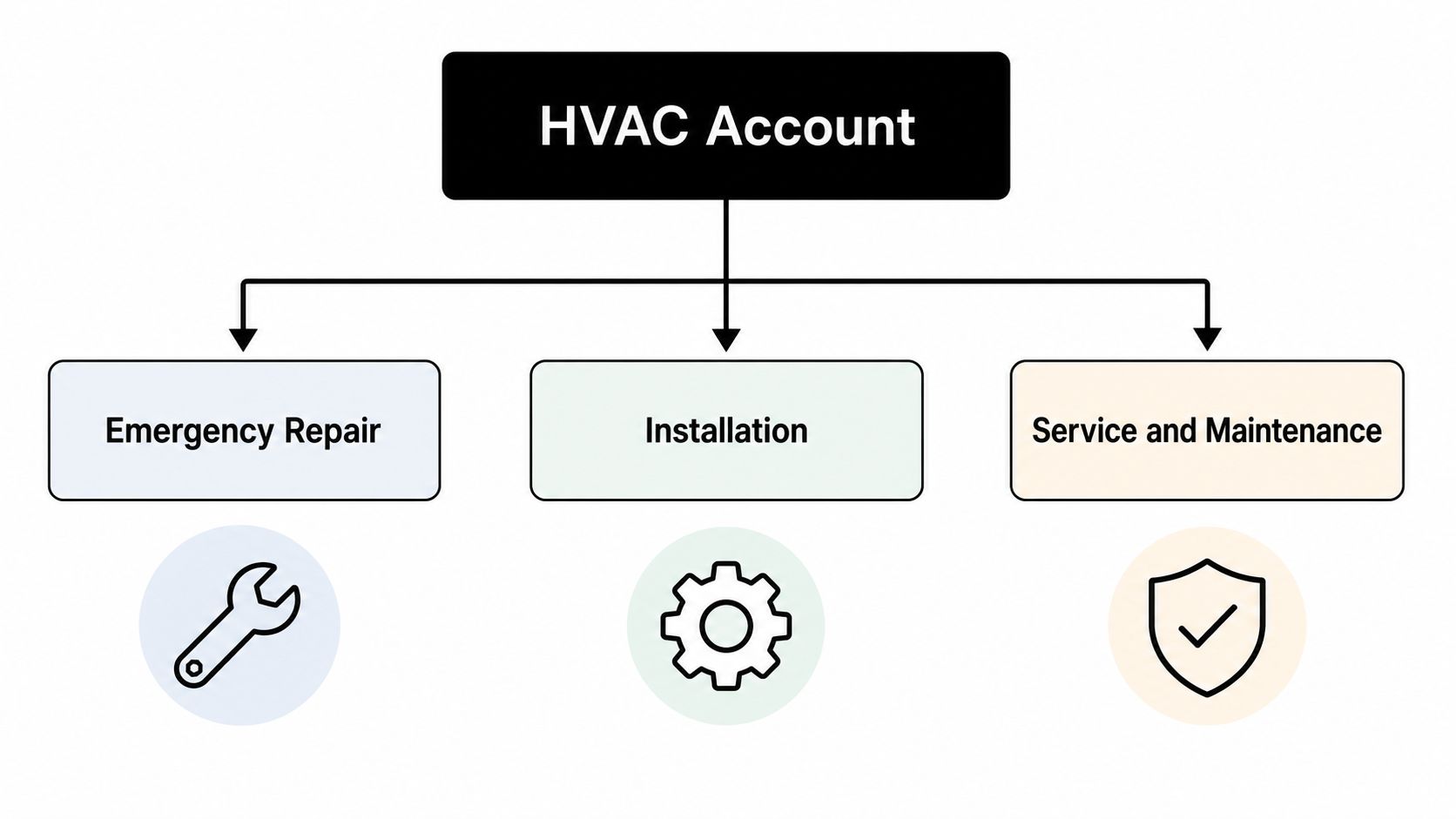
The account should start with three clear campaign families, Emergency Repair, Installation and Replacement, and Service and Maintenance. That isn't just neat organization. It keeps bids, ad copy, and conversion expectations aligned with the kind of customer searching. A homeowner with a broken AC unit at 5 p.m. behaves differently from someone comparing replacement options or asking about seasonal tune-ups.
Build the account the way customers search
Use a naming convention that makes intent obvious. Something like HVAC | Emergency Repair | Fort Myers is more useful than a vague brand campaign because anyone looking at the account can see what the budget is doing. Inside each campaign, keep ad groups narrow, so repair terms don't get mixed with maintenance language and installation questions.
Geo-targeting should be just as deliberate. In Southwest Florida, service area mapping matters because dispatch feasibility and close rates change quickly by location. Radius targeting around actual service locations, distance-based bid adjustments that favor nearby users, and ZIP-code focus for strong neighborhoods such as Estero, Bonita Springs, and Naples keep spend concentrated where jobs are more realistic.
Use geography as a filter, not a vanity setting
A campaign that covers too much ground often looks healthy in click volume and weak in revenue. The fix isn't to chase more reach. It's to bias toward the neighborhoods your techs can serve quickly and profitably. That usually means letting high-value ZIP codes compete harder while quieter areas receive less aggressive bids or no coverage at all.
Nearby searches are usually the easiest to turn into appointments, because response time and trust line up with the buyer's urgency.
Campaign structure should also reflect service urgency. Emergency repair needs faster response, stronger call prompts, and tighter keyword control. Maintenance can tolerate a longer decision cycle, while installation and replacement often need stronger landing pages and more explanatory ad copy.
A simple working structure
- Emergency Repair Campaign: Focus on urgent searches, mobile-first ads, and call-heavy conversion paths.
- Installation and Replacement Campaign: Use service-specific landing pages and stronger qualification questions.
- Maintenance Campaign: Target recurring service language and keep expectations measured.
That structure makes budget planning cleaner and reporting far more useful. When one campaign underperforms, you'll know whether the issue is intent, geography, or the offer itself. If you want a deeper keyword-planning framework, this PPC keyword research guide fits neatly into this setup.
Keyword Research and Bidding Economics for HVAC Services
An HVAC account can look busy and still bleed cash if the keyword mix is wrong. In Fort Myers and the rest of Southwest Florida, that usually shows up as plenty of clicks from people who are shopping, researching, or looking for a job, while the phone stays quiet. The budget gap is real, and it shows up fastest when a contractor tries to cover every service with one blended bid strategy.
The economics are better understood through real benchmarks than through theory. A January 2026 benchmark tracking $14.9 million in Google Ads spend across 816 contractors and 8,077 campaigns found an average CPL of $104 for HVAC and plumbing Google Ads, with a national HVAC average CPC of $9.12 and CPCs ranging from $8 to $25 depending on intent, geography, and seasonality, according to the benchmark report. Another 2026 benchmark reported a 5.8% CTR, 10.2% conversion rate, and $89.06 CPL for HVAC and air conditioning campaigns, as shown in the HVAC PPC benchmarks.
What those numbers mean in practice
High-intent repair terms cost more because every contractor wants them, and the buyers behind those searches are usually ready to act. In a market like Fort Myers, that is where budget gets tight fast. Emergency phrases such as “AC repair near me” often deserve the strongest bids, while installation and maintenance terms should be judged over a longer conversion window.
The service line matters just as much as the keyword. A branded lead can come in well under broader service leads, while replacement work and specialty repairs can sit far above average. I do not treat those leads as interchangeable, because the economics are not interchangeable. The smarter move is to assign each service its own target and let bids follow job value, not just click volume.
| HVAC Google Ads Performance Benchmarks | Value | Context |
|---|---|---|
| Average CPL | $104 | Based on a January 2026 benchmark across HVAC and plumbing campaigns (benchmark report) |
| Average CPC | $9.12 | National HVAC Google Ads average from the same benchmark (benchmark report) |
| CPC Range | $8 to $25 | Varies by keyword intent, geography, and seasonality (benchmark report) |
| CTR | 5.8% | HVAC benchmark from 2026 (HVAC PPC benchmarks) |
| Conversion Rate | 10.2% | HVAC benchmark from 2026 (HVAC PPC benchmarks) |
| CPL | $89.06 | HVAC and air conditioning benchmark from 2026 (HVAC PPC benchmarks) |
Match types still matter
Phrase and exact match still earn their keep because they keep intent under control. Broad match can work in mature accounts, but for most local HVAC contractors it expands the funnel too quickly and sends spend into searches that never become booked jobs. If a query cannot plausibly turn into a service call, it should not consume budget.
Auction pressure is also local. Fort Myers can behave differently from Naples or Cape Coral even when the service offer is identical, so bid levels need to reflect the actual competitive zone, not a generic statewide assumption. That is where a structured keyword plan helps, and a practical keyword research guide for PPC is useful when you are separating repair, replacement, and maintenance demand.
Landing page relevance has to carry that same intent after the click. A page built with the standards outlined in the Exclusive Addons landing page guide gives the keyword a place to land without losing the promise that earned the click. When the page misses that promise, the CPC math gets worse quickly.
Negative Keywords and Geo Exclusions That Protect Your Budget
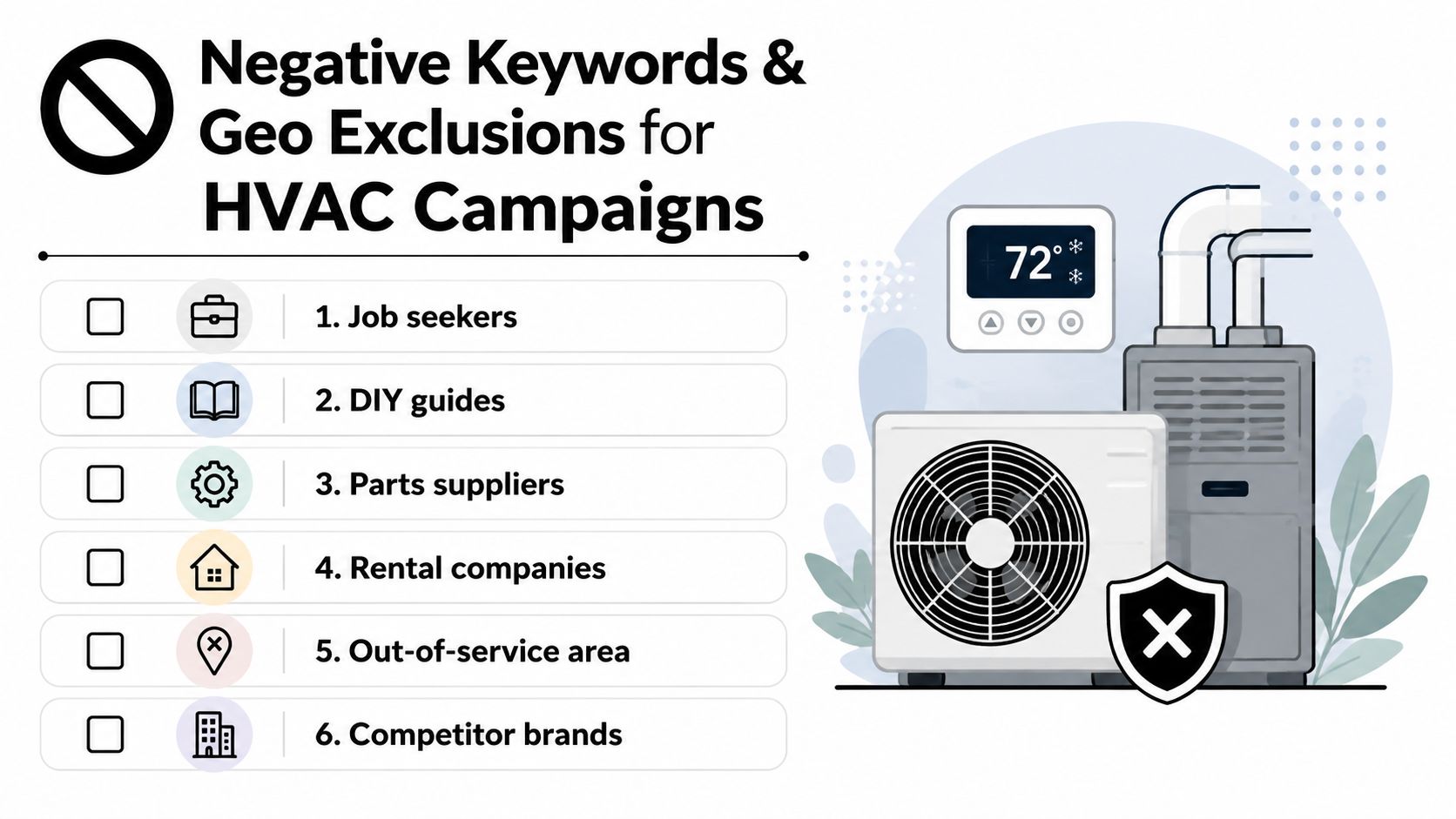
Negative keywords are where a lot of HVAC budgets are saved. A residential account should usually block job-seeker terms like jobs, salary, hiring, and apprentice. It should also exclude DIY phrases such as how to, fix my own, and R-410A DIY, along with parts-related searches like parts, manual, and wholesale.
Build the filter list in layers
Add used-equipment terms if they're showing up. Exclude price shoppers such as cheap and coupon if you aren't competing on that angle. Reputation terms like complaint, scam, and reddit also belong on the list when the goal is booked service, not casual research.
A practical HVAC checklist looks like this:
- Job seekers: Block terms such as “HVAC jobs,” “salary,” and “apprentice.”
- DIY traffic: Exclude phrases like “how to fix my own AC” and related repair tutorials.
- Parts shoppers: Remove searches focused on manuals, wholesale parts, and component sourcing.
- Price-only traffic: Filter “cheap,” “coupon,” and similar bargain language.
- Reputation searches: Exclude “scam,” “complaint,” and “reddit” when they're pulling non-buyers.
- Outside service area: Block ZIP codes your trucks can't profitably reach.
Geo exclusions should be strict
If a ZIP code sits outside the service radius, exclude it. Don't leave it in “just in case.” HVAC is local and time-sensitive, so even a small amount of irrelevant geography can tilt the account toward wasted clicks. In practice, ZIP exclusions are a straightforward way to stop money from drifting into counties or cities you don't serve.
Review search terms weekly. That cadence catches new waste before it compounds. In HVAC, a handful of irrelevant searches can become a real budget leak surprisingly fast because the campaign is often live during high-pressure seasons when every click is expensive.
Practical rule: if a search term would never end with a service appointment, it belongs in the negative list.
Account-level negative lists help keep this under control across campaigns. That way, when you block a term in emergency repair, you aren't forced to repeat the same cleanup in every maintenance or installation campaign. The account gets cleaner, and the reporting gets easier to trust.
Conversion Tracking That Measures Booked Jobs Not Just Clicks
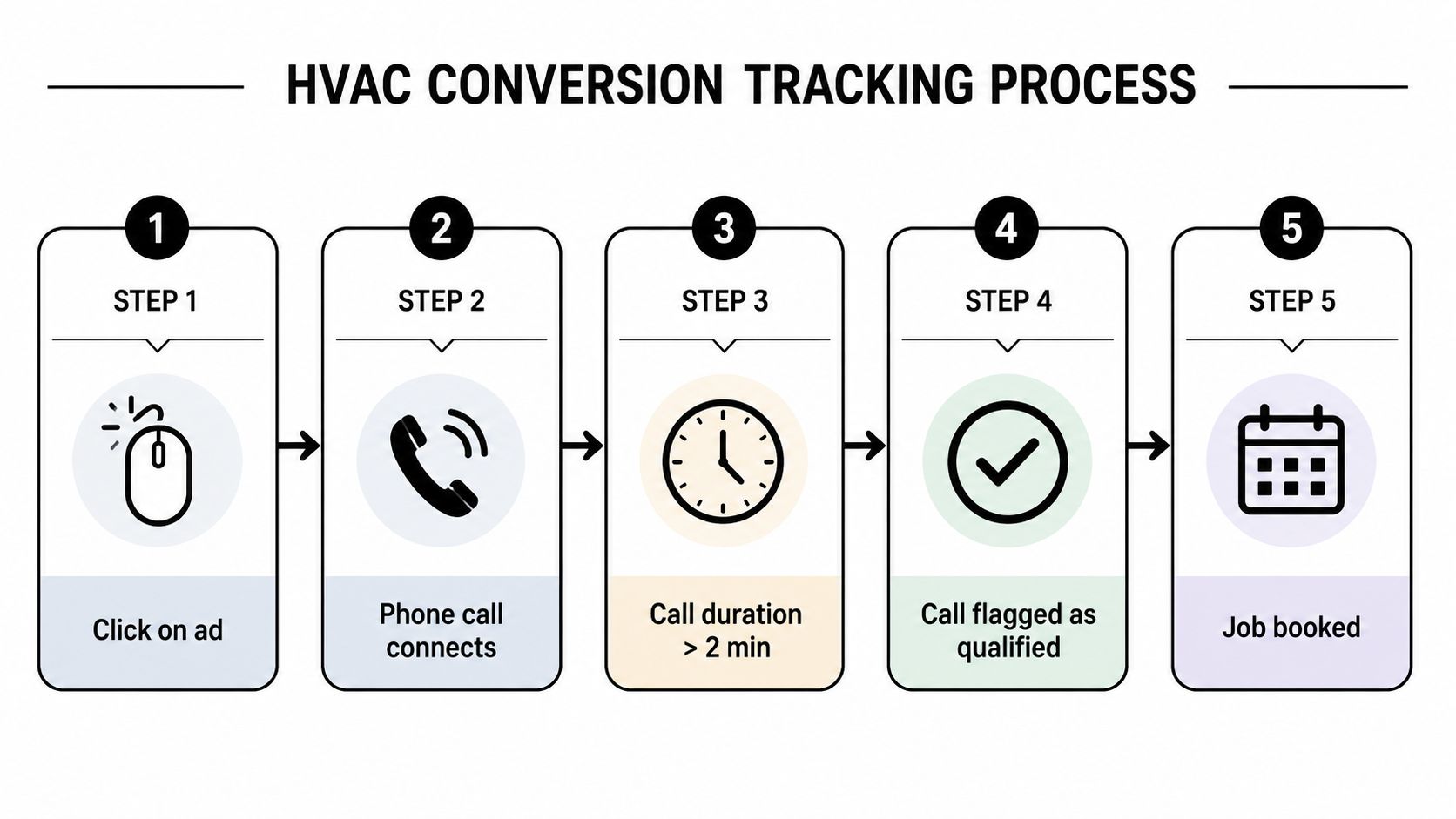
The biggest tracking mistake in HVAC is counting every inquiry as equal. A short call, a junk form fill, and a scheduled estimate don't have the same business value. If you optimize bidding around all three the same way, you'll end up paying for noise.
Start with call quality
Call tracking should not stop at “the phone rang.” A better rule is to count calls only after they pass a 60 to 90 second threshold, because calls shorter than that are often wrong numbers or early hang-ups. That filter matters because it keeps the account from rewarding shallow traffic that looks active but doesn't book work.
Forms need the same discipline. A submitted form is only useful if it moves into a sales conversation or gets scheduled. For that reason, CRM or scheduling integration is the key, because booked appointment data gives Google Ads something closer to revenue than to raw lead volume.
Track what the business actually sells
The cleanest setup usually separates these actions:
- Phone calls that last long enough to be real conversations
- Forms that become booked estimates
- Appointments that turn into completed jobs
If a platform treats all three as the same conversion, the account gets distorted. That distortion is expensive in HVAC because paid search traffic often includes researchers, shoppers, and people comparing service options before they're ready to buy.
The technical work is worth doing before spend ramps up. Conversion tracking should be in place first, then search terms should be reviewed weekly, and only then should bids be judged on real outcomes. A landing page that supports this process, like the examples in these high-converting landing page patterns, helps turn qualified traffic into measurable appointments.
A useful reporting habit
- Separate call, form, and booked-job reporting: Don't let one weak metric mask another.
- Mark short calls as noise: They usually shouldn't steer bidding.
- Push booked jobs back into the platform: That makes optimization more honest.
- Check mobile behavior closely: HVAC urgency often starts on a phone.
If the tracking stack can't show which ads produce actual scheduled work, the optimization process is built on guesswork. That's fine for vanity reporting, not for a trade business that lives or dies by dispatch efficiency.
Budget Frameworks That Give Campaigns Room to Learn
The budget question gets glossed over in too many HVAC guides. People talk about keywords, landing pages, and automation, but they avoid the harder issue, how much spend is enough for a local market to produce meaningful data. Without enough runway, even a decent campaign can look broken.
A few heuristics float around the industry, such as 10x the maximum CPC, at least 3x your average CPC, or a starter budget near $50/day. Those shortcuts are better than nothing, but they aren't a complete answer. The core problem is that underpowered accounts often never generate enough conversion data for bidding systems to stabilize, especially in expensive markets like Southwest Florida.
Think in learning windows, not just daily spend
A campaign needs enough consistent budget to survive the messy early stage. That means emergency repair, installation, and maintenance may each need different runway because their conversion windows and lead values aren't identical. A cheap campaign that never learns is worse than a more expensive one that produces usable booking data.
In Fort Myers, this matters because competition rises quickly when the weather turns. If budget is too thin, the account ends up sampling only scraps of traffic, which creates false conclusions about keyword quality. The campaign might not be bad. It might just be underfunded.
Use a simple decision filter
- Scale when: The campaign produces booked jobs from the right service line and search terms stay clean.
- Hold steady when: Leads are coming in but the sales team hasn't yet confirmed quality.
- Pause and restructure when: Spend is going to irrelevant queries, bad geography, or call noise.
A campaign that gets too little budget often looks “unproven” when it's really just starved.
The smartest starting point is one that can support real testing without drifting into waste. That usually means tighter campaign segmentation, disciplined geo-targeting, and enough spend to let the platform observe a meaningful pattern, not a handful of lucky clicks. If a contractor wants to know whether the strategy is working, the budget has to be big enough to let the answer surface.
Testing Cadence and ROI Measurement for Ongoing Optimization
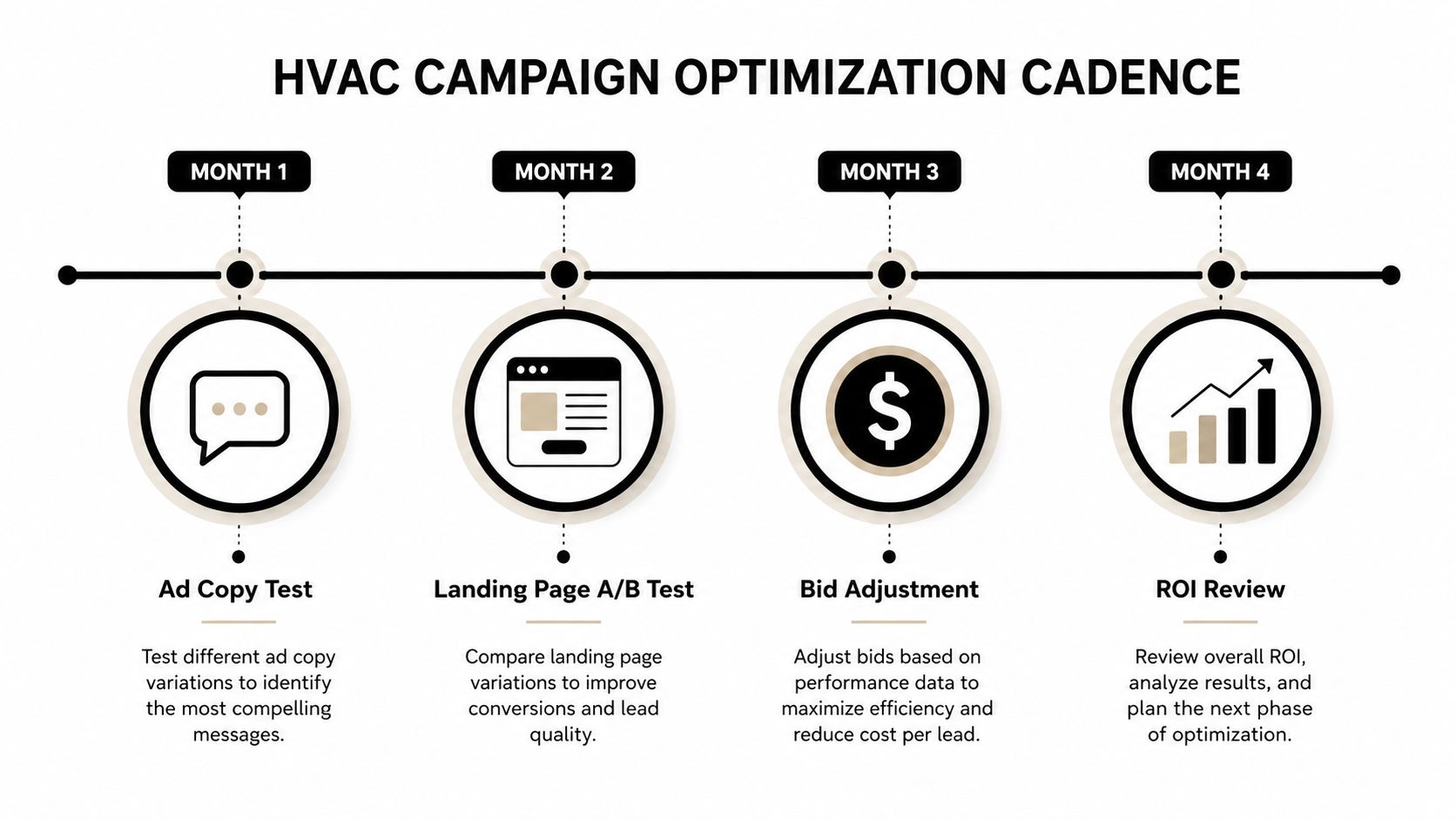
The accounts that hold up over time don't rely on occasional tweaks. They run on a rhythm. Weekly search-term cleanup, monthly performance review, and periodic landing-page testing create a feedback loop that keeps the account from drifting into waste.
Keep the cadence simple
Week to week, search terms should be reviewed for new junk traffic and bid pressure. Month to month, ad copy and landing pages should be checked against booked-job data, not just clicks. Quarter by quarter, the account should be compared against seasonal demand shifts so summer cooling demand doesn't get judged against a slower period in the same way.
That kind of discipline makes ROI clearer. Once booked jobs are tied back to ad groups, the business can calculate true acquisition cost at the service-line level instead of relying on broad averages. That's especially useful when one service line carries stronger margins than another.
Don't test too many things at once
Ad copy and landing pages should be tested separately when possible. If both change at the same time, the data gets muddy and no one can tell what caused the lift or drop. Bid changes should come after enough stability exists to compare real service outcomes.
A practical monthly review often looks like this:
- Search-term report: Remove waste and expand only into relevant intent.
- Call quality report: Confirm which calls were long enough to matter.
- Booked-job review: Check which campaigns produced revenue.
- Geo review: Watch for neighborhoods or ZIP codes that consume spend without returns.
The bigger insight is that HVAC search behavior is seasonal, local, and intent-heavy. That means the account should never be managed like a generic lead-gen funnel. The best systems stay close to the phone, stay strict on search terms, and keep the budget pointed at work that can be dispatched.
If your HVAC account in Fort Myers or anywhere in Southwest Florida is getting clicks but not enough booked jobs, it's time to rebuild the structure around service intent, geography, and real conversion data. Reach out to Polaris Marketing Solutions for a practical review of your current campaign setup, and get a clearer plan for turning search spend into qualified HVAC appointments.