
Monthly retainers for small to mid-sized businesses usually fall between $2,500 and $12,000 per month, and focused services can start around $1,500. If you're getting proposals in Fort Myers that seem wildly different, that range is the first reality check: some quotes are lean because they cover one channel, and some are higher because they include strategy, creative, ad management, tracking, and reporting.
If you're a business owner in Southwest Florida, you're probably looking at two or three agency proposals right now and wondering why one is close to a part-time employee's pay while another looks like a second rent payment. I've been on the operator side of that decision before. When I ran a home services business, I didn't care about marketing jargon. I cared about whether the phone rang, whether the leads were qualified, and whether the spend made sense.
That's still the right way to look at digital marketing agency cost.
A cheap agency can waste money slowly. An expensive agency can waste it faster. The right agency usually lands somewhere in the middle, with a clear scope, a reporting process you can understand, and a plan tied to revenue, not vanity metrics.
How Much Should Your Business Budget for Digital Marketing
When budgeting for digital marketing, Fort Myers business owners usually hit the same wall fast. One proposal looks cheap because it covers one narrow service. Another looks expensive because it includes strategy, ad management, creative, tracking, and reporting. A third gives you a monthly number with no clear explanation of what gets done or what results should follow.
From an operator's standpoint, the budget question is less about finding the lowest fee and more about matching spend to the revenue goal. I used to run a home services company, and the math was simple. If marketing brought in booked jobs at a profitable cost, I kept funding it. If it produced traffic, vague reports, and weak leads, even a modest retainer was too expensive.
What that means for a Fort Myers budget
A Fort Myers roofing company, med spa, law office, or HVAC business should budget based on customer value, sales cycle, and local competition.
A smaller budget usually fits businesses that need to clean up the basics. That often means improving Google Business Profile visibility, fixing local SEO issues, tightening core website pages, and building a review process that supports trust.
A mid-range budget makes more sense when lead volume matters every month. That level often supports paid search management, landing page work, conversion tracking, ongoing SEO, and regular reporting that shows where calls and form leads came from.
Higher budgets tend to fit companies trying to grow across several channels at once. That can include SEO, Google Ads, email, content production, website support, and campaign reporting tied to booked appointments or signed jobs.
Practical rule: Budget around missed revenue, not agency line items. If one missed roofing job, legal case, or med spa patient is worth significant revenue, underfunding marketing gets expensive fast.
That is especially true in Southwest Florida, where seasonality, storm-related demand, population growth, and heavy competition can change lead costs quickly. A budget that works for a slow local service market in another state may be too light for Fort Myers if three competitors are bidding on the same search terms and investing in better landing pages.
A good proposal should explain how spend turns into leads, sales opportunities, and revenue. Reviewing outside guidance on digital marketing ROI strategies can help you check whether an agency is talking about outcomes or just listing tasks.
If the budget needs to stay tight, start with a defined scope and a short decision window. Compare options for affordable marketing for small businesses based on deliverables, tracking, and expected business impact, not just the monthly fee.
Decoding the Four Common Agency Pricing Models
A Fort Myers contractor might get two proposals for the same goal. More booked jobs. One agency sends a $3,000 monthly retainer. Another quotes a $7,500 website project plus hourly PPC help. A third wants a percentage of ad spend. The price difference looks confusing until you see the billing model underneath it.
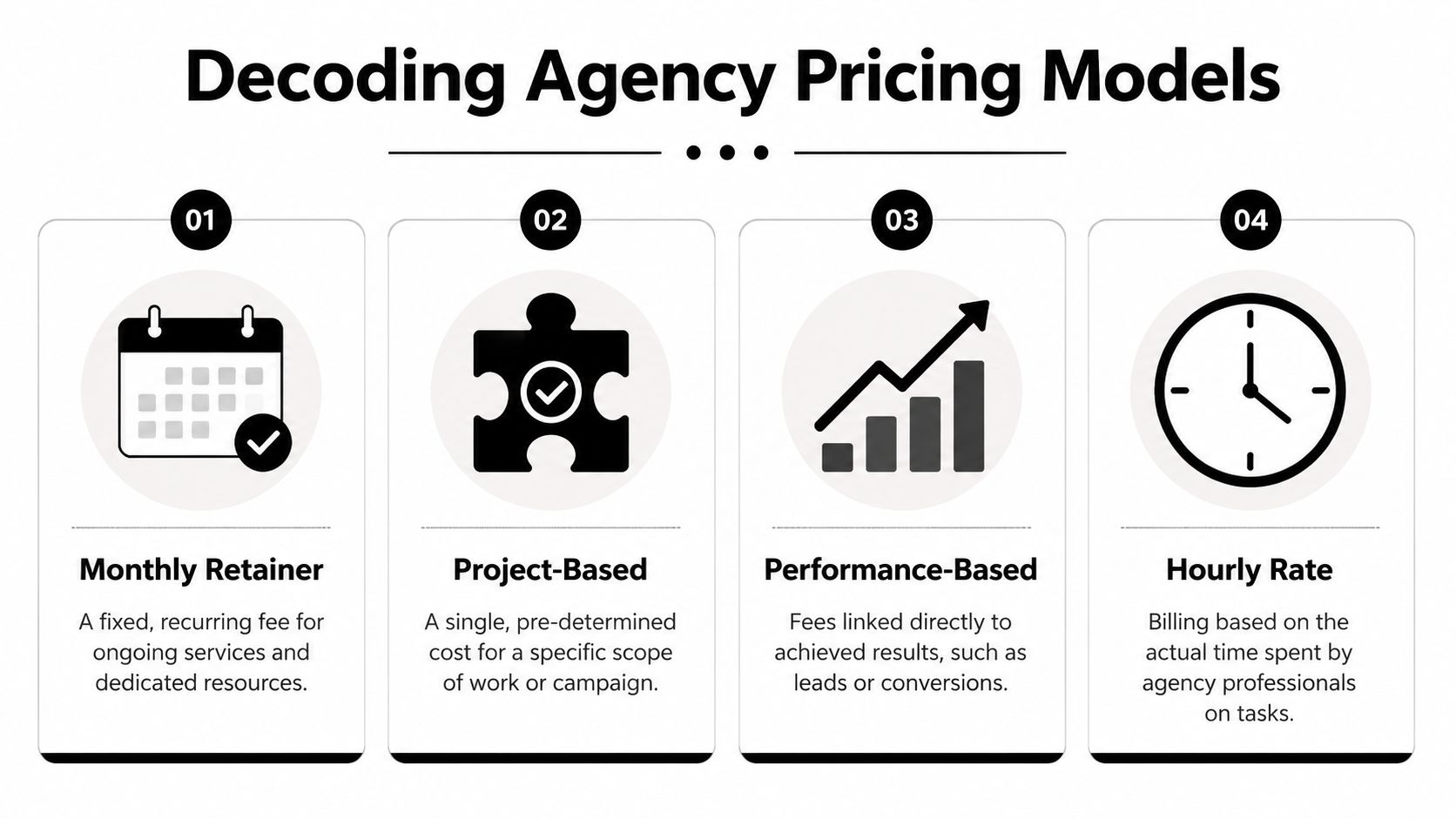
The same agency work can be packaged in very different ways. For local businesses in Southwest Florida, that matters because cash flow, seasonality, and lead volume are rarely steady all year. The right model depends on what problem needs to be solved, how fast results are needed, and how much management attention the owner can realistically give.
Monthly retainer
This is the standard model for ongoing marketing support. You pay a set monthly fee for an agreed scope, usually covering some mix of SEO, Google Ads management, content, reporting, website updates, and strategy.
Best for: businesses that need steady lead flow and regular optimization.
Retainers usually make sense for home services, legal, medical, and other categories where campaigns need constant adjustment. Search terms change. Competitors enter the auction. Landing pages need testing. Reviews and local listings need attention. In Fort Myers, that can shift even faster during peak season or after major weather events.
The risk is loose scope. If the proposal promises "full-service marketing" without clear deliverables, response times, reporting, and ownership of work, the monthly fee can turn into a standing charge with no clear path to revenue.
Project-based pricing
Project pricing fits a defined job with a clear finish line. Common examples include a website rebuild, analytics setup, an SEO audit, call tracking installation, new landing pages, or a brand refresh.
Best for: businesses with one specific gap to fix.
This model gives owners more cost control up front. You know what is being built, what it should cost, and when it should be delivered. I usually recommend projects when the business has a real bottleneck. Bad site speed, weak conversion pages, broken tracking, or a poor Google Business Profile setup.
The trade-off is simple. Projects fix assets. They do not manage growth after launch. A new website can improve close rates, but it will not generate traffic on its own.
Hourly pricing
Hourly work is common for consulting, audits, troubleshooting, account cleanup, and short engagements where the scope is still taking shape.
Best for: businesses that already have an internal team or need senior guidance on a narrow issue.
This can work well if a company wants an expert to review campaign performance, find waste in ad spend, or map out a local SEO plan for Fort Myers, Cape Coral, and nearby service areas. It can also get expensive fast if too much basic execution is billed hour by hour. Owners should ask who is doing the work, what tasks are included, and how many hours similar jobs usually take.
Predictability is the weak point here. If the goal is stable monthly lead generation, hourly billing often feels harder to manage than a fixed scope.
Percentage of ad spend or performance-based pricing
Some agencies charge a percentage of media spend. Others tie part of their fee to leads, booked appointments, or revenue targets. These models can line up incentives, but only when the agreement is precise.
Best for: paid media accounts with strong tracking and clear sales definitions.
A percentage-of-spend model can work if the agency is actively improving conversion rates, lead quality, and cost per acquisition. It becomes a problem when spend goes up faster than results. A performance deal can sound attractive too, but it needs tight definitions. A form fill is not the same as a qualified estimate request. A phone call is not the same as a booked job.
Before signing, match the pricing model to the actual work being promised. A clear breakdown of what a digital marketing agency does makes it easier to see whether the fee structure fits the services, the workload, and the growth target.
Key Factors That Determine Your Final Price
The final price isn't random. Agencies build quotes from labor, skill level, deliverables, channel mix, and business complexity. Two companies can both ask for "SEO and Google Ads" and need completely different levels of work.
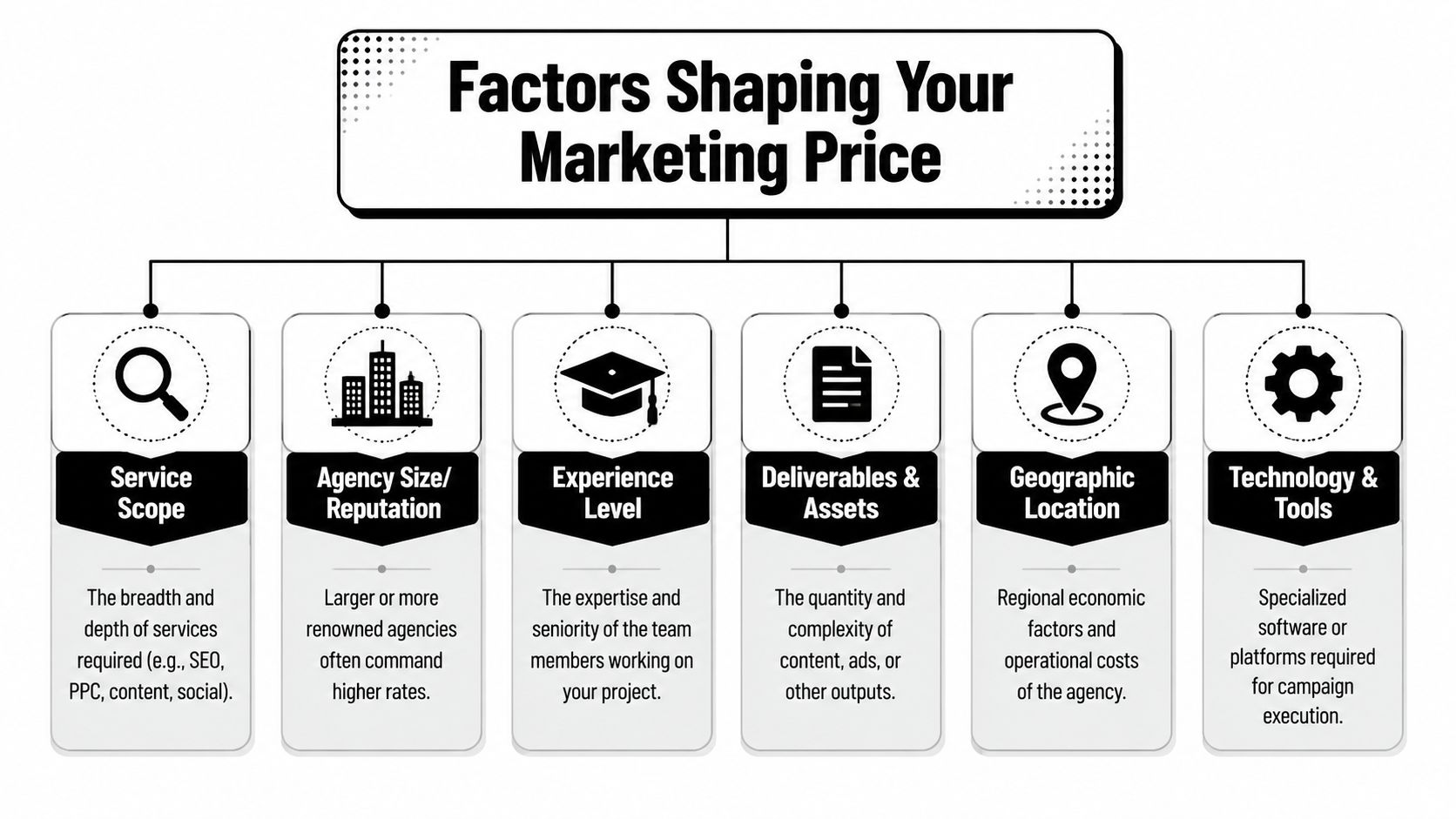
The national average hourly rate for digital marketing services is $82.66, but this can climb to $100 to $149 per hour for specialized roles like SEO or PPC managers. Top-level strategists in premium markets can command over $500 per hour, according to Clutch's digital marketing pricing research. That gap tells you something important. Expertise is one of the main drivers of digital marketing agency cost.
Scope changes everything
A local plumber targeting Fort Myers, Cape Coral, and Estero doesn't need the same setup as a multi-location law firm or a regional e-commerce brand.
A lighter scope might include:
- Google Business Profile work: category refinement, photo updates, review responses, and local posting
- Core website fixes: service page improvements, lead forms, calls to action, mobile cleanup
- Basic SEO support: title tags, location pages, internal linking, and citation consistency
A broader scope usually adds campaign management, landing page testing, blog content, email follow-up, creative production, call tracking, and regular strategic review.
Competition raises the workload
Some industries don't need flashy marketing. They need disciplined execution in a crowded market.
In Southwest Florida, that's common with roofers, pavers, HVAC companies, med spas, attorneys, and restoration contractors. The more businesses fight over the same searches, the more work it takes to stand out. Better copy, faster follow-up, stronger reviews, tighter landing pages, and stronger account management all add labor.
Deliverables matter more than labels
"SEO package" can mean almost anything.
One agency may include technical fixes, page optimization, content updates, internal linking, and reporting. Another may give you a rank tracker and one monthly call. Both can use the same label. Only one reflects meaningful work.
Most price confusion comes from proposals that sell a category instead of a deliverable.
Senior thinking costs more and usually saves money
A junior team can post content and push buttons inside ad platforms. A senior team can spot why a campaign isn't converting, where lead quality is breaking down, and whether your offer is the actual problem.
That doesn't mean every business needs the highest-priced agency. It means you should know whether you're paying for strategic judgment or basic execution.
A practical example: if your Google Ads account has weak conversion tracking, broad match chaos, and landing pages that don't match intent, a cheaper manager can keep spending. A stronger one fixes the system.
Sample Digital Marketing Packages and Costs
Most businesses don't buy "marketing." They buy a mix of tasks meant to solve a problem. More calls. Better rankings. Lower wasted ad spend. More repeat business. That's why package examples help. They turn the broad idea of digital marketing agency cost into something you can compare.
Three practical package templates
These aren't rigid plans. They're planning tools. A Fort Myers cleaning company, dentist, and personal injury attorney could all sit in the same price band but need very different work inside it.
| Package Tier | Best For | Included Services | Estimated Monthly Cost |
|---|---|---|---|
| Local Foundation | Newer local businesses or established companies with weak visibility | Google Business Profile optimization, local SEO basics, service page updates, citation cleanup, review guidance, monthly reporting | $1,500 to $3,000 |
| Business Growth | Service businesses that need steady lead flow | SEO management, Google Ads management, landing page updates, content support, call tracking review, monthly strategy and reporting | $3,000 to $8,000 |
| Integrated Dominance | Businesses pushing aggressively across multiple channels | SEO, PPC, email marketing support, social content coordination, web support, conversion tracking, reporting, strategy oversight | $8,000 to $12,000 |
How to choose the right package
The wrong move is buying the biggest package because it sounds complete. The other wrong move is buying the smallest package when your market is already crowded.
Use this filter instead:
- Choose Local Foundation if people can't reliably find you yet. This is common with newer contractors, practices with weak local SEO, or businesses with inconsistent reviews.
- Choose Business Growth if you already have some visibility but need more qualified leads every month. This is often the sweet spot for established home service companies in Fort Myers.
- Choose Integrated Dominance if you have the staff, close rate, and operational capacity to handle higher lead volume across several channels.
What works and what doesn't
What works is stacking services that support each other. For example, paid search brings immediate traffic, SEO builds long-term visibility, and email helps recover and nurture leads you already paid to attract.
What doesn't work is paying for disconnected activity. Running ads without strong landing pages wastes clicks. Publishing blogs without service page strategy rarely moves local lead generation. Posting on social just to "stay active" usually adds noise, not revenue.
If you're comparing proposals, put them into a table like the one above and force each agency to list exact deliverables. That makes key differences obvious fast.
The Southwest Florida Difference in Marketing Costs
Fort Myers pricing doesn't live in a vacuum. The same monthly budget behaves differently here than it might in a smaller inland market with less seasonal movement and less category pressure.

Seasonality changes strategy
Southwest Florida businesses don't market to a flat demand curve. Search behavior shifts with tourism, snowbird movement, storm recovery, and the rhythm of local service demand.
That affects budgeting in practical ways. Some companies need stronger paid search during peak demand windows. Others need reputation management and local SEO consistency all year so they don't disappear when the market gets noisier.
For example, a med spa in Fort Myers may see search intent rise and fall differently than a roofing company after severe weather. A paver contractor in Naples may lean hard on project galleries and reviews because visual proof closes trust gaps fast.
Home services competition is intense
I pay close attention to this because it's the world I came from. Home services owners usually don't need a lecture on branding. They need booked estimates and crews with enough work.
In this market, the expensive part isn't always the ad spend. It's the quality of execution needed to compete. You need clean intake forms, fast mobile pages, review generation, location-focused landing pages, and someone actively watching the account.
- Roofers and restoration companies often deal with urgency-driven searches and reputation sensitivity.
- HVAC and plumbers need ads and pages built for immediate action, not passive browsing.
- Cleaning, pavers, and outdoor service providers depend heavily on visual trust, local proof, and review volume.
Reputation management carries more weight here
In Southwest Florida, buyers compare businesses fast. They scan reviews, photos, maps, and whether your site looks current. If a storm hits or a busy season kicks up, that comparison happens even faster.
A weak online reputation doesn't just lower conversion rate. It makes every click you buy less valuable.
That local reality is why a bare-minimum package can look affordable but underperform. In Fort Myers, Cape Coral, Estero, Bonita Springs, and Naples, the businesses that win usually don't outspend everybody. They out-execute slower competitors.
Budgeting for Real ROI Not Just Marketing Activity
The smartest way to look at digital marketing agency cost is as an investment decision. Not a line item. Not a monthly annoyance. A decision about how much you're willing to spend to acquire profitable customers.

The benchmark that matters most is efficiency. The average cost per acquisition across all industries is $53.52, and email marketing delivers an average ROI of $36 to $40 for every $1 invested, based on WordStream's digital marketing statistics. Those numbers don't tell you what your business should achieve. They tell you where to start asking harder questions.
Track business outcomes, not task completion
A bad agency reports activities. A useful agency reports whether those activities produced leads, appointments, sales conversations, and closed revenue.
The minimum scorecard should include:
- Lead cost: what you're paying to generate an inquiry or booked call
- Lead quality: whether those leads are in your service area, budget, and customer profile
- Close rate: how many qualified leads your team converts
- Customer value: what a new customer is worth over time, not just on the first transaction
If you want a simple way to pressure-test channel economics, tools like SleekPost for social media ROI can help you think through return before you commit more budget to content or paid social.
A practical Fort Myers example
Here's the kind of situation I see often. A home service company in Fort Myers comes in frustrated because marketing "isn't working." After a short audit, the actual issue isn't lack of spending. It's spread. They have some Google Ads, inconsistent follow-up, weak service pages, and no clean way to connect calls back to campaigns.
The fix usually isn't adding random channels. It's tightening the system.
A more disciplined setup looks like this:
- Clarify the offer: emergency service, maintenance plan, premium install, or estimate request
- Match landing pages to intent: one page per service, clear service area, obvious next step
- Track lead sources: form fills, calls, booked estimates, and closed jobs
- Use email and follow-up: especially for estimates that don't close immediately
One local option businesses evaluate for this kind of work is marketing ROI measurement support, especially when they need better attribution between ads, SEO, calls, and booked jobs.
Here's a useful walk-through on the same idea:
What real ROI budgeting looks like
Set a budget only after answering these questions:
- What is one new customer worth? Not in theory. In your real books.
- How many new customers can your team handle well? Lead volume without capacity creates waste.
- Which channel has the clearest path to revenue first? For many local businesses, that's Google Search plus strong local SEO.
- What must be fixed before scaling? Intake, sales follow-up, landing pages, tracking, reviews
A budget tied to those answers will usually outperform a cheaper budget built around vague deliverables.
Critical Questions to Ask an Agency Before Signing
A Fort Myers contractor can sign a $3,500 per month marketing agreement on Friday and still have no clear answer by Monday to a basic question: who is doing the work, what gets done first, and how will this turn into booked jobs? I have sat on the client side of that conversation. A clean proposal means very little if the scope is vague and the agency avoids straight answers.
Treat the sales call like a hiring interview. You are not buying nice-looking reports. You are hiring a team to use your budget well in a market where seasonality, service area coverage, storm response, snowbird traffic, and local competition all affect lead flow.
Questions that expose the real fit
Start with how they define success.
If the answer stays at traffic, impressions, or rankings, ask one more question: how does that connect to calls, form leads, booked estimates, and closed revenue? A Fort Myers plumbing, HVAC, roofing, or legal campaign should tie activity to business outcomes. If they cannot explain that chain clearly, the account will be hard to manage once the contract starts.
Ask who does the work. This matters more than many owners realize. Some agencies sell with a senior strategist, then hand the account to junior production staff following a checklist. That setup can work for a simple account. It usually breaks down when your cost per lead rises, your Google Ads search terms get sloppy, or your website needs service-page changes fast during peak season.
Then ask what is included each month. Get the answer in writing. "SEO," "PPC management," and "content support" are categories, not deliverables. You need specifics such as campaign builds, landing page edits, call tracking checks, review requests, reporting cadence, and meeting frequency.
Reporting is another pressure test. Ask to see a real report with client details removed. A useful report shows what changed, what the agency learned, what they are doing next, and whether lead quality is improving. Screenshots from ad platforms are not enough.
One more question tells you a lot: what happens in the first 30 days? A capable agency can walk through onboarding in order. Access, tracking review, account audit, offer and service-area review, competitor check, then launch priorities. If they answer with general language, expect a slow start.
Questions that protect your budget
These questions help prevent expensive surprises.
| Question | Why it matters |
|---|---|
| What happens if we need to change scope? | You find out whether the agency can adjust as your priorities shift, or whether every change triggers a new fee |
| Do we own the ad account, tracking setup, landing pages, and creative assets? | You need control if the relationship ends or you bring work in-house later |
| How do you judge lead quality? | Low-cost leads that never book waste budget and staff time |
| What assumptions are built into this proposal? | You can see whether they understand your margins, sales cycle, service area, and close rate |
If an agency cannot explain your budget in plain English, they usually cannot explain poor results clearly either.
What a solid answer sounds like
A good agency talks in priorities and trade-offs. They should be able to say what they would fix first, what can wait, what they plan to test, how long feedback loops usually take, and what your team must handle internally. That last part matters. If your office misses calls, slow follow-up will hurt performance no matter how strong the campaign is.
They should also be willing to tell you that your budget and goals do not match. I trust that answer more than an easy yes. In Southwest Florida, a business trying to cover multiple services across Fort Myers, Cape Coral, Estero, Bonita Springs, and Naples on a starter budget usually needs to narrow the plan first. The right agency will say that before the invoice goes out.
For businesses that want a practical conversation about cost, scope, and what a realistic Fort Myers growth plan looks like, Polaris Marketing Solutions offers integrated digital marketing services for small and mid-sized businesses, including SEO, PPC, website design, and local lead generation support.