

You're probably spending money on postcards, boosting a few posts, and still wondering why the phone isn't ringing the way it used to. In Fort Myers, that feeling usually shows up when another agent's listings keep surfacing online first, while your own website remains in the background. The fix isn't to “do more marketing” in a vague sense, it's to build a digital-first system that helps buyers find you, trust you, and contact you faster.
That shift is already baked into buyer behavior. Digital channels captured 58.6% of total real estate marketing budgets in 2026, with 96% of home buyers starting their search online and 41% reporting they began hunting for homes digitally (Digital Agenc y Network statistics). For an agent in Southwest Florida, that means the job is no longer just to list homes. It's to show up where people are comparing neighborhoods, pricing, photos, and agent credibility before they ever call.
Think of digital marketing for real estate like fishing with a better map. The old approach was casting a wide net and hoping a buyer passed by. The better approach is using local search, website content, ads, video, and CRM follow-up so your lead generation is tied to actual buyer intent. That's the difference between random activity and a working pipeline.
Introduction and Core Concepts of Real Estate Digital Marketing
A Fort Myers agent can feel busy all day and still miss serious prospects. A buyer searches for “homes near McGregor,” clicks a competitor's neighborhood page, watches a video tour, saves the listing, then books a showing. If your marketing doesn't connect those steps, the lead can look like it came from nowhere, which is why so many agents underestimate what's already working.
What digital marketing really does for an agent
The core idea is simple. Digital marketing helps you attract attention online, turn that attention into a lead, and then keep the lead warm long enough to become a client. In real estate, that usually means a mix of website content, local SEO, social media, ads, email, and CRM follow-up.
A practical stack for a small or mid-sized firm usually includes three to five channels, such as a Google Business Profile, social video, email, and paid ads, rather than trying to “be everywhere” at once (practical channel mix). That matters in Fort Myers because the market is local enough to reward focus, but broad enough that buyers still compare multiple neighborhoods before they decide.
Practical rule: if a channel can't be tracked back to a call, booking, or showing request, it's just noise.
The bigger shift is that buyers don't start with you, they start with search. They want proof, not promises. They want neighborhood context, property photos, and a reason to trust the person behind the listing. That's why digital marketing is less about “promotion” and more about building a visible path from search to conversation.
Why the digital-first model changes the game
The phrase digital-first means your online presence is the main front door to your business, not a side project. In a place like Fort Myers, that front door needs to answer a buyer's real questions fast. What area fits their budget? Which neighborhood has the right feel? Who knows Southwest Florida?
That's why the best campaigns don't start with a hard sell. They start with a useful answer. If someone lands on your website from a neighborhood search and sees a clear next step, the experience feels like local guidance rather than advertising. If they don't, they leave and likely end up on another agent's page.
Digital marketing works best when every part of the system supports the next one. Search brings the visitor, the website captures interest, the content builds trust, and the CRM keeps the conversation alive. That's the structure that turns browsers into buyers.
Local SEO Strategies for Southwest Florida Agents
Local SEO is where many Fort Myers agents gain their first real advantage. You don't need to outrank national portals for generic terms. You need to win the searches that signal local intent, the ones tied to neighborhoods, property types, and nearby landmarks that matter in Southwest Florida.
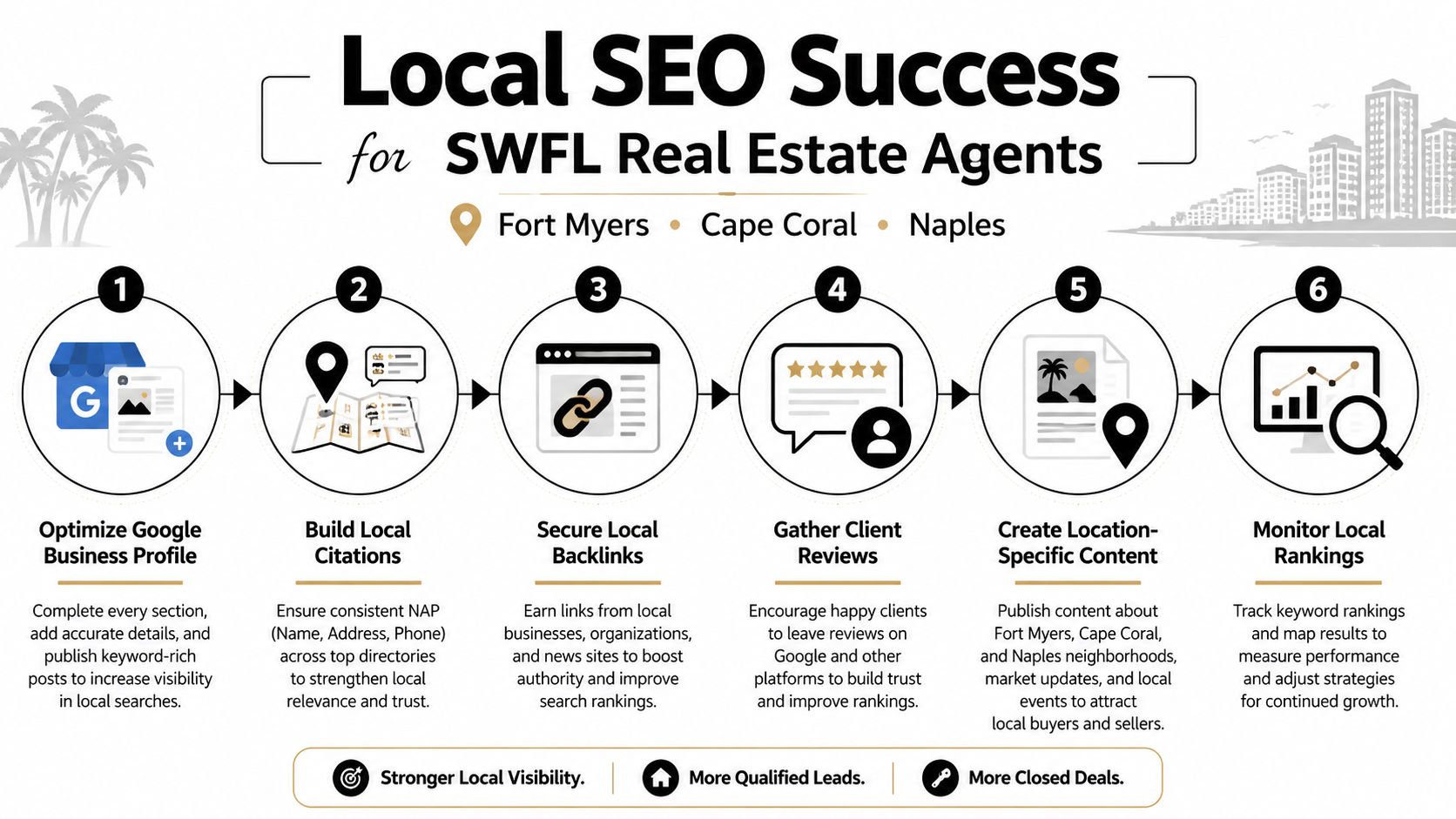
Start with your Google Business Profile. Keep the business name, service area, hours, categories, photos, and contact details consistent. Then add keyword-rich posts that sound local and useful, not stuffed with buzzwords. A post about “waterfront homes in Cape Coral with quick access to marinas” is much better than a vague announcement about being a local expert.
Build pages around places people actually search
The strongest local pages are usually built around neighborhoods, not just cities. In Fort Myers, that might mean separate pages for riverfront areas, gated communities, or specific pockets that buyers already recognize. The goal is to become the most helpful local resource for the exact search someone typed.
A recent guide notes that top agents create hyper-local pages for the 3–5 best neighborhoods to capture highly intentional buyers (micro-market strategy). That's useful because broad area pages get crowded fast, while neighborhood pages can speak directly to the buyer's intent. If you're working Fort Myers, Cape Coral, or Naples, that might mean one page for each high-value pocket where buyers keep comparing homes.
People don't search for “Southwest Florida real estate” when they're ready to move. They search for the exact area they want to live in.
Use the same thinking in citations and reviews. Your listings, directory profiles, and social accounts should all use the same business details. Reviews should be asked for naturally after a successful closing or showing experience, and they should mention the local market when possible. That helps reinforce relevance for both search engines and human readers.
For a deeper checklist on local visibility, this local SEO guide for real estate agents is a useful companion when you're tightening your Southwest Florida presence.
A simple local SEO checklist you can actually run
- Google Business Profile posts: publish short, local updates tied to neighborhoods, open houses, or market changes.
- Neighborhood pages: create dedicated pages for the locations buyers ask about most.
- Directory consistency: make sure your name, address, and phone number match across major listings and local directories.
- Review requests: ask every satisfied client for a review that mentions the city or area they worked in.
- Local content: publish guides about schools, commute patterns, lifestyle, and property types tied to each neighborhood.
- Rank monitoring: check which search terms bring people in, then improve the pages that already get impressions.
The underserved opportunity here is micro-market specialization. Many agents publish broad “Fort Myers” pages and stop there. The better move is to build a few strong local assets around the pockets where serious buyers are already concentrated.
Website and IDX Best Practices for Lead Generation
Your website is your storefront, and for many buyers it's the first place they decide whether to keep you in mind. A cluttered homepage, confusing menu, or slow listing search sends people away fast. A clear site, on the other hand, acts like a good showing assistant. It gets people to the right room without making them work for it.
Put search behavior ahead of design preferences
The most effective real estate websites don't try to impress visitors with clever layouts first. They help them search. That means your main navigation should make property search obvious, your homepage should explain what markets you serve, and your calls to action should be visible without forcing people to hunt for them.
IDX works best when it feels like part of the site, not an add-on. The listing search should be easy to filter by neighborhood, price band, home type, and features that matter locally. If a Fort Myers buyer wants waterfront homes or a Naples seller wants to see what's moving nearby, those paths need to be simple and fast.
A lead-generation website should also ask visitors to take the next step before they disappear. That might be a saved search, a valuation request, a showing inquiry, or a contact form tied to a specific community page. If the site gives people too many choices, they often choose none.
For a detailed breakdown of website structure and user flow, this lead generation website guide is a useful reference point.
Prioritize mobile, speed, and clear next actions
Most browsing happens on phones, so your site has to work like a pocket-sized sales assistant. Buttons need to be large enough to tap, galleries need to load cleanly, and property details need to be easy to scan without pinching the screen. If a page looks good on desktop but feels awkward on mobile, it won't convert well.
Keep the homepage focused on three things. Where you work. What visitors can search. What they should do next. That usually means a short market statement, a visible search bar or listing entry point, and one or two strong calls to action.
Good real estate websites don't ask visitors to admire the site. They guide them to the next useful step.
Use analytics to watch which pages hold attention and which pages lose it. If your neighborhood page gets visits but no contact requests, the content may need a stronger CTA or better property relevance. If your listing pages get traffic but little interaction, the photo order or search filters may need adjustment.
The goal is not a fancy digital brochure. It's a site that acts like a dependable assistant, showing people the right listings and making it easy to reach you when they're ready.
Paid Advertising and Social Media Campaigns
Paid ads are what you use when you need visibility before organic traffic has fully matured. For real estate, they're useful because buyers and sellers often arrive with a specific intent, and good targeting lets you meet that intent with the right message. Google Ads and social ads do different jobs, so treating them like substitutes usually leads to wasted spend.
Google Ads is strongest when someone already has a search in mind. If a person types a local property query, they're close to taking action. Social media, by contrast, is better for visual promotion, community building, and keeping listings in front of people who may not be searching yet. Both can work, but they work best for different stages of interest.
Use Google Ads for intent, social ads for attention
Google Ads fits search terms tied to a clear local need. That makes it useful for property inquiries, valuation requests, and neighborhood-specific searches. You're not interrupting someone at random, you're responding to a query they already typed.
Social media ads on Facebook and Instagram are stronger for listing presentation. A carousel can show multiple rooms. A short video can highlight a property flow. A single image can drive curiosity if the visual is strong and the copy is localized. These ads also let you segment by geography and interest patterns, which helps when you're promoting a listing in a specific part of Southwest Florida.
For a practical PPC overview for smaller businesses, this pay-per-click guide helps frame how paid search fits into a limited budget.
Keep creative simple and local
Real estate ads work better when they sound like a person who knows the market. Use neighborhood names, property types, and a single action. “See waterfront homes in Cape Coral” is easier to act on than a broad brand message. The job of the ad isn't to explain everything, it's to earn the click.
Your budget should follow your goal. If the goal is immediate inquiries, use search ads and a landing page built for one action. If the goal is awareness for a new listing or a new community angle, use social video and image-based ads that help people remember the property.
You can also refresh creative without changing the core offer. Swap the lead photo, change the opening line, or rotate the first carousel card so the ad feels new. That keeps the campaign from going stale while you preserve the audience and message.
For a useful visual comparison of the two channels, the following asset keeps the platform differences easy to explain to a client or teammate.
Content and Video Marketing for Neighborhood Engagement
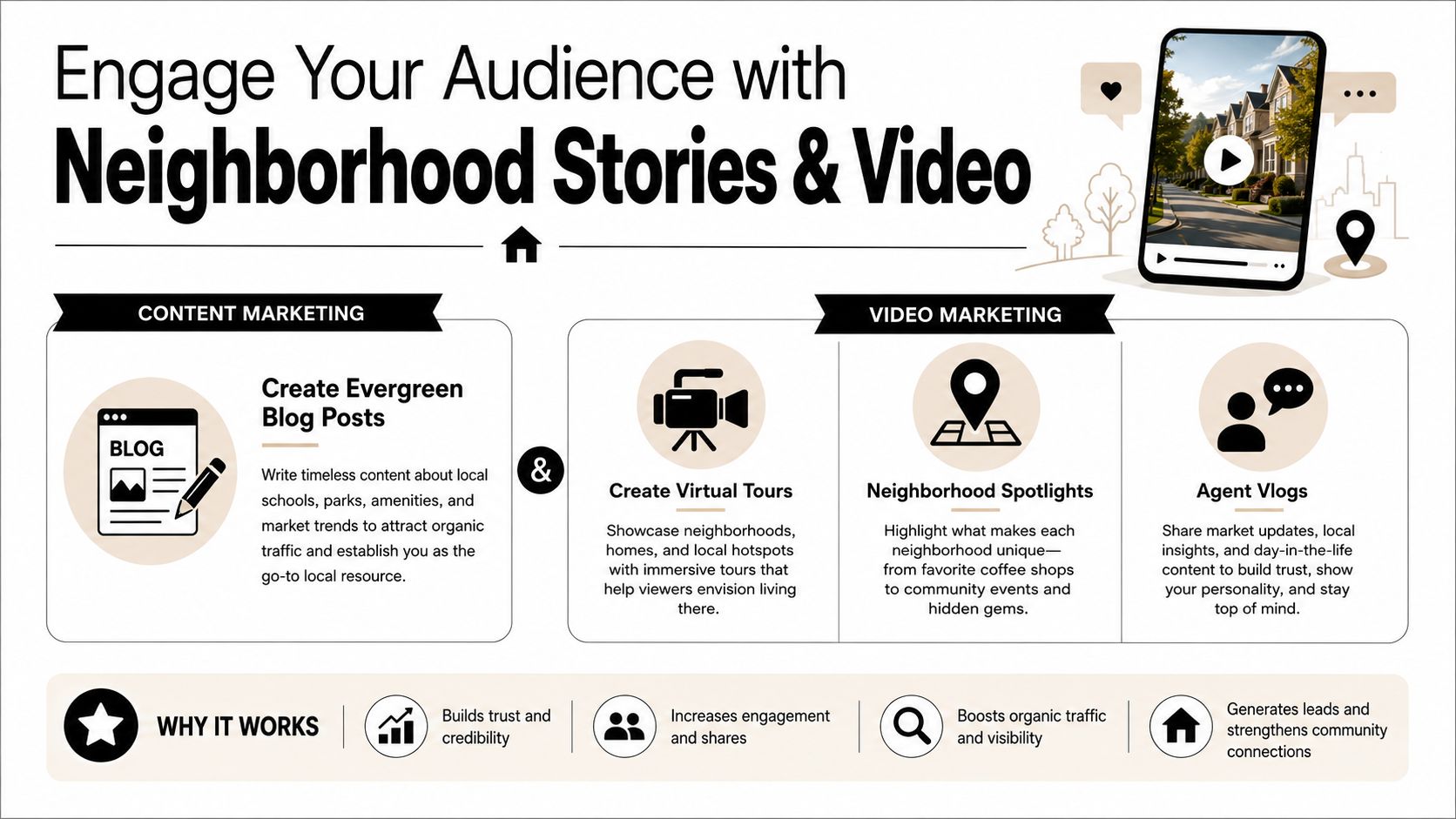
Neighborhood content gives buyers a reason to trust you before they ever fill out a form. A strong blog post can answer a local question. A short video can make a street, park, or waterfront area feel familiar. Put those together and your brand starts to feel less like advertising and more like a local guide.
Write content that answers the question behind the search
The best blog topics are the ones people ask out loud. Schools, parks, commute routes, property styles, seasonal market changes, and “what's it like to live here” questions all work well because they match how buyers think. If you write about the neighborhood like a guide, not a salesperson, readers stay longer.
A useful structure is simple. Start with the neighborhood, name the buyer concern, then show how the area fits that need. A Bonita Springs article can cover lifestyle, nearby amenities, and who the area tends to suit. A Fort Myers post can compare different sections of the city in plain language so the reader feels oriented, not overloaded.
Content rule: if a buyer would ask the question at a showing, it's probably a good topic for a blog or video.
The same logic works for video. A virtual tour shouldn't just walk through rooms. It should explain flow, location context, and the small details that matter to a buyer who's trying to imagine day-to-day life. Drone footage works well for showing the setting, while a market update reel can make the agent feel current and useful.
If you want a deeper library of formats and editing ideas, Seedance's real estate video marketing guide is a practical resource for planning short-form and tour-based content.
Give every piece one job
A strong direct-response rule for real-estate marketing is that every piece should include a clear CTA and a numeric goal before launch for tracking performance (CTA and goal rule). That means a neighborhood blog might aim to drive report downloads, while a video tour might aim to get viewers onto the listing page. The content should not try to do five things at once.
Use the CTA to match the content. A school guide can end with a neighborhood consultation offer. A market update can point readers to a local report. A property walkthrough can direct viewers to a showing request or saved-search signup. The cleaner the next step, the easier it is to measure whether the content worked.
Content also helps you build consistency. Buyers may not be ready today, but a useful article or video keeps you in their consideration set. That's especially valuable in Southwest Florida, where timing can stretch across several conversations and multiple listings.
CRM and Lead Nurture Workflows for Faster Conversions
A lead is most valuable when it's still fresh. That sounds obvious, but many agents lose the edge because inquiry handling is slow, inconsistent, or tied to someone remembering to check email. A CRM changes that by making response, sorting, and follow-up part of the system instead of part of someone's memory.
Build a response path that starts immediately
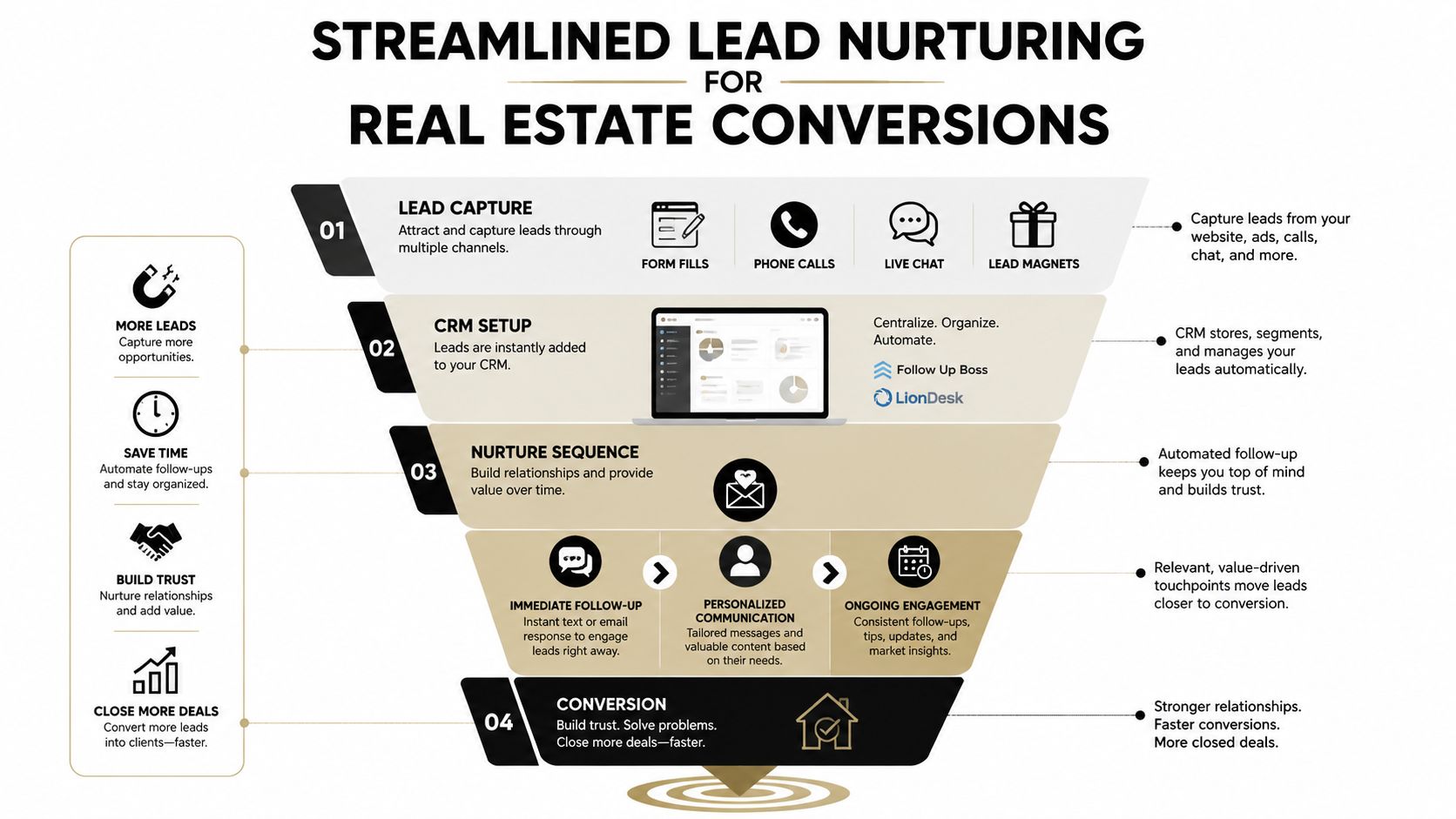
Every form fill, chat, and call should land in one place. Tools like Follow Up Boss or LionDesk are commonly used for that kind of organization, because they help centralize contact history and follow-up tasks. The point is not the brand name, it's making sure no inquiry sits in a blind spot.
A simple workflow looks like this. First, the lead enters the CRM. Second, the system sends a quick text or email. Third, the agent or team follows up with a relevant property or neighborhood message. Fourth, the lead gets added to alerts or a nurture sequence tied to the search behavior they showed.
Leads contacted within five minutes convert at 7–10 times the rate of leads contacted after 30 minutes (rapid response benchmark). That makes speed a business rule, not a convenience. If your office can't answer every inquiry instantly, automated acknowledgments become the next best move.
Use behavior, not guesswork, to score leads
A good CRM doesn't just store names. It tells you who's warming up. Listing views, saved homes, search alerts, photo-gallery completion, time on page, map exploration, and virtual-tour engagement all matter because they show real interest before a showing request ever appears.
That's where a tool such as Automated customer service chat can help cover the first response window, especially when inquiries arrive after hours or during busy showing blocks. Used properly, chat can collect the basics, route the lead, and keep the conversation moving until a person takes over.
Fast follow-up doesn't feel pushy when the reply is useful. It feels professional.
Here's the logic in plain language. Someone who opens multiple listing pages and saves a home is giving you a stronger signal than someone who just landed on the homepage. A CRM should treat those actions differently, so the follow-up message matches the level of intent. That's how you avoid sending the same generic note to everyone.
For a visual breakdown of the funnel, this workflow graphic makes the process easier to explain to agents or assistants.
Measuring KPIs and Cost-Effective Tactics for Small Firms
Small firms don't need more metrics. They need the right ones, and they need enough attribution to make the numbers believable. If you can't tell which channel brought the site visit, the booking, or the call, you end up rewarding the wrong campaigns and cutting the ones that were effective.
Start with attribution before you start comparing channels
A technically comprehensive real estate attribution stack should combine UTM parameters, dedicated landing pages, unique phone numbers per channel, and CRM source logging. That mix matters because otherwise traffic gets mislabeled as direct and you lose visibility into what's working. A three-source model that blends first-touch digital, last-touch site visit, and self-reported office attribution can reach roughly 70% attribution accuracy, instead of near-zero visibility (attribution framework).
That level of clarity changes how a Fort Myers brokerage spends. If a neighborhood page drives booked visits but a boosted post only produces casual clicks, the page should get more support. If one ad set generates form fills that never convert, the message may need to change or the audience may be too broad.
Focus on the KPIs that actually guide decisions
| KPI | Description | Target Benchmark |
|---|---|---|
| Attribution coverage | How often the lead source is known | Close to the strongest possible source mapping your stack can support |
| Lead response speed | Time from inquiry to first contact | Within five minutes when possible |
| Booking rate | Leads that turn into showings or consultations | Improve steadily from your own baseline |
| Site-visit quality | Traffic that reaches neighborhood, listing, or contact pages | Rising share of engaged sessions |
| CRM source accuracy | Whether the lead source is logged correctly | Consistent, auditable entries |
| Local engagement | Calls, messages, and inquiries tied to a specific area | Higher on neighborhood-specific content |
The simplest way to use that table is to pick two or three KPIs you can inspect every week. Don't try to manage everything at once. If response speed is weak, fix that first. If source tracking is muddy, clean the tracking before you judge ad performance.
Keep costs under control with targeted local tactics
Cost-effective marketing often comes from specificity, not from doing less. Hyperlocal pages, neighborhood email lists, niche social groups, and focused direct mail can outperform broad messaging when the market is already concentrated in a few pockets. That's especially useful in Southwest Florida, where a few neighborhoods can hold a lot of buyer attention.
A second practical angle is seller-focused micro-market work. Many agents only build buyer content, but sellers often want to know how a small pocket of demand compares with the broader area. That's where neighborhood pages and direct local outreach can be useful, because they turn a generic listing pitch into a targeted market story.
Polaris Marketing Solutions also offers a complimentary online analysis and competitor report, which can be useful when a small brokerage needs a clearer picture of what's already ranking, what's missing, and where the easiest gains might be. For teams watching every dollar, that kind of audit can help narrow the next move instead of guessing.
Conclusion and Next Steps
Digital marketing for real estate works when it's built like a system, not a collection of random posts. In Fort Myers and the rest of Southwest Florida, the winners are usually the agents who keep their local SEO tight, make their websites easy to search, use ads with a clear local purpose, publish neighborhood content, respond quickly, and measure what led to the booking.
A practical next-step checklist looks like this. Audit your Google Business Profile. Build or refresh your top neighborhood pages. Tighten your IDX search flow. Set up faster CRM follow-up. Review your attribution so you can trust the numbers. That sequence gives you a stronger base without wasting spend on activity that can't be tracked.
Start with the channel that has the biggest gap, not the one that feels most exciting. Then keep refining the parts that already bring in the best local traffic. If you want a cleaner read on where your Fort Myers marketing stands, request a competitor review and site audit, then use that as your launch point.
A CTA for Polaris Marketing Solutions.