
If you're like most local business owners, your sales process probably looks busy from the outside and messy on the inside. Leads come in from Google, referrals, Facebook, and your website. Someone answers the phone, someone else sends an estimate, and half the time the same questions get answered from scratch.
That usually isn't a lead problem. It's a content problem.
A roofer gets asked about shingle options. An HVAC company keeps explaining repair versus replacement. A family law attorney repeats the same intake points before every consult. Those explanations should not live only in your team's heads. They should live in useful, repeatable assets your staff can send, reference, and use to move a prospect toward a decision.
What Is Sales Enablement Content Really
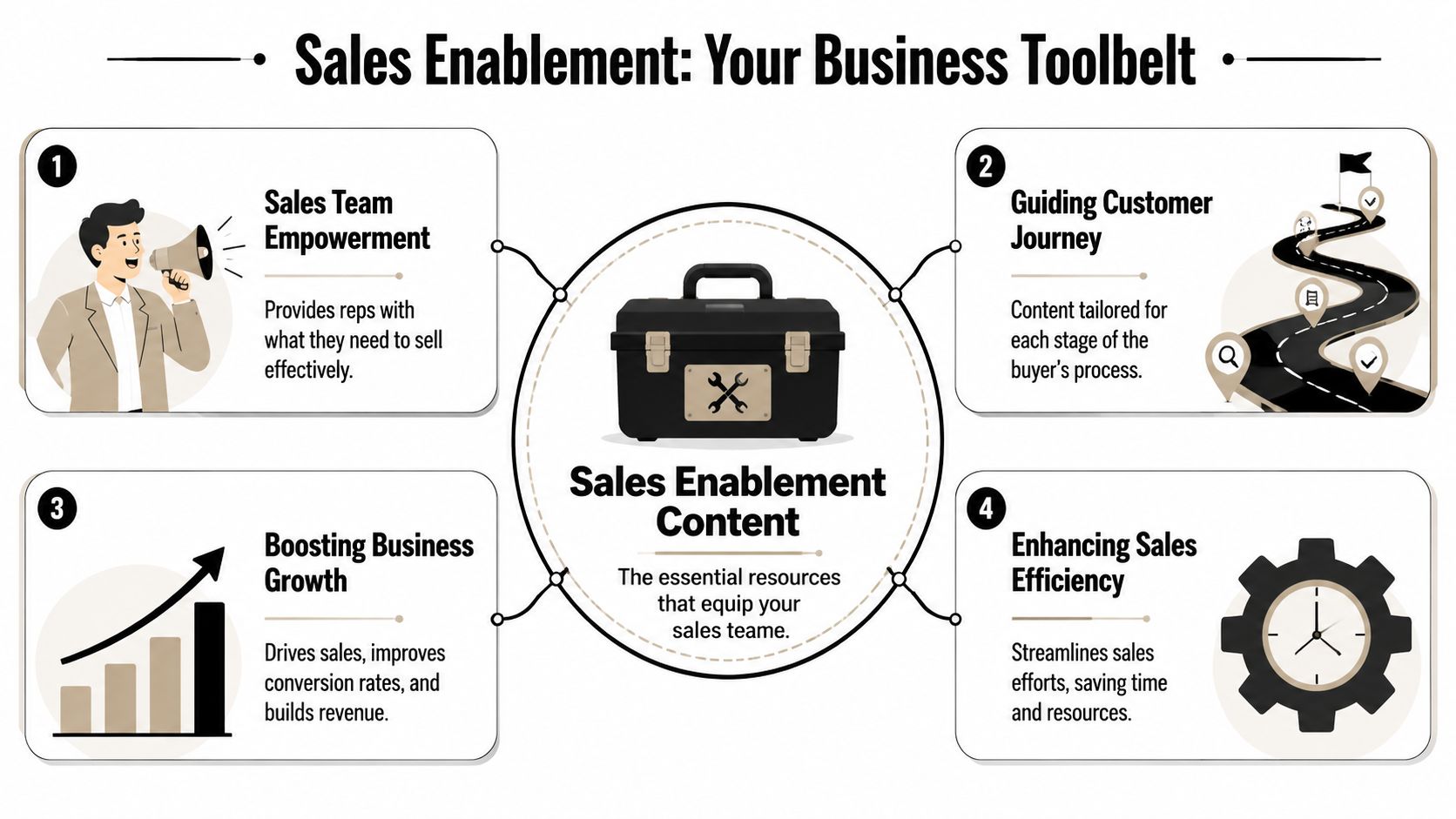
Think of sales enablement content like a technician's tool belt. A service pro doesn't show up to every job with one tool and hope it somehow handles inspection, repair, and cleanup. They carry the right tool for the right moment.
Sales enablement content works the same way. It's the set of materials your team uses to answer questions, build trust, handle objections, and help a buyer choose you. That can include FAQs, case studies, checklists, one-pagers, sales decks, explainer videos, customer testimonials, and comparison sheets.
It is not the same as general marketing content
A brand ad says, "We're trusted and professional."
Sales enablement content says, "This explains what happens during our roof inspection, what damage insurance may care about, and the questions to ask before signing any contract."
That difference matters. General marketing gets attention. Sales enablement content helps close business.
For a local SMB, the line is simple:
- Marketing content brings people in
- Sales enablement content helps your team convert them
- Customer content helps them feel confident after they buy
A blog post about "how Florida storms affect roofing systems" can attract local search traffic. A one-page storm damage checklist your estimator sends before an inspection helps win the job. Same topic. Different job.
Why it matters more now
Modern buyers do a lot of homework before they ever call. Gartner-reported research shows buyers complete 57% of the buyer's journey before their first meaningful interaction with a seller, according to Highspot's discussion of sales enablement content strategy. For a local business, that means your website, PDFs, reviews, videos, and email follow-ups often do the early persuasion before your office manager or salesperson says a word.
Practical rule: If your team keeps answering the same question more than twice a week, that answer should become a reusable content asset.
Many small businesses often encounter a significant challenge. They think content means posting on social media or writing broad blog posts. That's part of the picture, but it won't solve the sales bottleneck if prospects still hesitate at estimate time.
What useful sales enablement content looks like in the field
A small content library doesn't need to be fancy. It needs to be usable.
Start with assets like these:
- A short FAQ sheet that answers pricing, scheduling, warranty, service area, and financing questions
- A simple case study showing the problem, the work completed, and the result
- A comparison guide that explains repair versus replacement, or one service tier versus another
- A follow-up email template your team can send after estimates or consultations
- A customer proof packet with testimonials, certifications, before-and-after photos, and process details
Bad sales enablement content is bloated, outdated, and impossible to find.
Good sales enablement content is clear, specific, and easy for your team to send in under a minute.
Content Types Mapped to the Buyer Journey
Most local businesses create content in random bursts. Someone writes a blog. Someone else makes a flyer. A salesperson has a PDF on their laptop that nobody else can find. That approach creates clutter, not momentum.
A better way is to match content to where the buyer is mentally. In local services, that usually falls into three practical stages: awareness, consideration, and decision.
Awareness content
At this stage, the customer knows something is wrong or wants to improve something, but they aren't ready to buy today. They're trying to understand the problem.
For a roofer, that prospect might search after spotting a ceiling stain or missing shingles.
Useful awareness content includes:
- Checklists such as "Signs your roof may need inspection after a storm"
- Educational blog posts that explain common problems in plain language
- Short videos showing what a typical inspection includes
This kind of content works because it lowers confusion. It helps the customer name the issue before they compare vendors. If you need ideas for building those top-of-funnel assets, this guide to content marketing strategies for small business is a practical next read.
Consideration content
Now the customer understands the problem and is weighing options. They want proof, clarity, and less risk.
For a roofer, the relevant questions are whether a patch will work, whether insurance may be involved, and what materials make sense for their home.
These assets are most beneficial in:
- Case studies showing a similar home, issue, and solution
- FAQs that answer objections about timeline, disruption, cleanup, and warranties
- Comparison sheets such as asphalt shingle versus metal roofing
Buyers in this stage aren't asking for more slogans. They're asking for fewer unknowns.
Decision content
At decision stage, the customer is choosing who to hire. Speed, confidence, and professionalism matter.
Your content should help your team remove final friction. Strong decision-stage assets include:
- One-pagers summarizing scope, service promise, and next steps
- Estimate follow-up emails with links to reviews, photos, and financing info
- Testimonials and proof packets that reinforce trust right before the sale
A local business often wins here by being clearer, not louder.
Sales Content for Every Stage of the Local Buyer Journey
| Buyer Stage | Customer Question | Content Type | Example for a Roofer |
|---|---|---|---|
| Awareness | "Do I actually have a roofing problem?" | Checklist | Storm damage checklist with photos of common warning signs |
| Awareness | "What should I look for before calling?" | Blog post | Plain-English article on leaks, flashing issues, and missing shingles |
| Consideration | "What are my options?" | Comparison sheet | Repair versus replacement guide for older roofs |
| Consideration | "Have you handled this before?" | Case study | Before-and-after project summary for a similar home |
| Decision | "Why should I trust you?" | Testimonial packet | Review highlights, certifications, and process overview |
| Decision | "What's the next step?" | One-pager or email template | Estimate recap with scheduling and warranty details |
A simple filter for choosing what to make
Before creating any asset, ask three questions:
- What question does this answer
- Who on the team will use it
- At what point in the sale will they send it
If you can't answer those, the content probably belongs in general marketing, not sales enablement.
Actionable Examples for Local Service Businesses
The easiest way to understand sales enablement content is to look at how it solves everyday sales friction. For local businesses, the best assets are usually not elaborate. They are short, scannable, and tied to a real objection.
Expert guidance highlighted by Spekit's review of sales enablement content types recommends battle cards, FAQs, checklists, and case studies packaged for quick consumption and tracked for rep adoption. That fits local SMBs perfectly because your team doesn't need a giant content portal. They need the right answer at the right time.

HVAC contractor handling repair versus replacement
An HVAC company often runs into the same stall point. The homeowner asks, "Should I repair this unit or replace it?" If the technician answers off the cuff, the conversation can drift. One tech emphasizes efficiency. Another talks about age. A third focuses on parts availability.
A better move is a simple repair versus replacement decision sheet.
That sheet can include:
- System age ranges in plain terms
- Common warning signs like uneven cooling or repeated service calls
- Decision factors such as comfort, reliability, and expected future maintenance
- Next-step options for inspection, quote, or financing discussion
The tech can walk through it in person, then text or email it afterward. That keeps the conversation consistent and gives the homeowner something concrete to review with a spouse.
Local attorney building trust before the consultation
Professional services businesses often lose momentum before the first meeting. A law firm may get a qualified inquiry, but the prospect hesitates because the process feels unclear.
In that case, a pre-consultation FAQ packet does a lot of heavy lifting.
It can answer questions like:
- What should I bring
- What happens during the first consultation
- How communication works
- What kinds of matters the firm handles
- What the next step looks like after the meeting
This isn't about replacing legal advice. It's about reducing anxiety. The prospect shows up more informed, the attorney spends less time on repetitive orientation, and the intake process feels more polished.
A good FAQ doesn't just save staff time. It makes the buyer feel like your business has done this many times before.
Paving company closing with a visual case study
A paving contractor usually sells trust through visible proof. Homeowners and commercial property managers want to see workmanship, not just hear promises.
A short visual case study can do that job well.
Keep it simple:
- The property type such as driveway, HOA road, or parking lot
- The issue like cracking, drainage trouble, or worn surface
- The work completed including prep, repair, sealcoating, or full replacement
- The photos before, during, and after
- The owner's concern addressed such as appearance, longevity, or access disruption
A salesperson can attach that case study to an estimate follow-up email. That's much stronger than sending "just checking in" two days later.
What works and what usually doesn't
What works for local SMBs:
- Short assets your staff can use fast
- Plain language instead of industry jargon
- Visual proof when the service is tangible
- Repeatable answers to common objections
What usually doesn't:
- Ten-page PDFs nobody reads on a phone
- Generic brochures with no local relevance
- Files buried in personal inboxes
- Content with no clear use case
If the asset doesn't help someone answer a buyer question faster, it probably won't get used.
A Simple Framework for Creating and Managing Content
Most small businesses don't need special software to start. They need a repeatable routine. If your team can use Google Drive, a spreadsheet, and email templates, you can build a workable sales enablement system.
The key is organization. Guidance from SiftHub on sales enablement content strategy recommends organizing content by the buyer journey and auditing it for gaps. That approach reduces search friction and helps match each asset to real sales stages like discovery and validation.
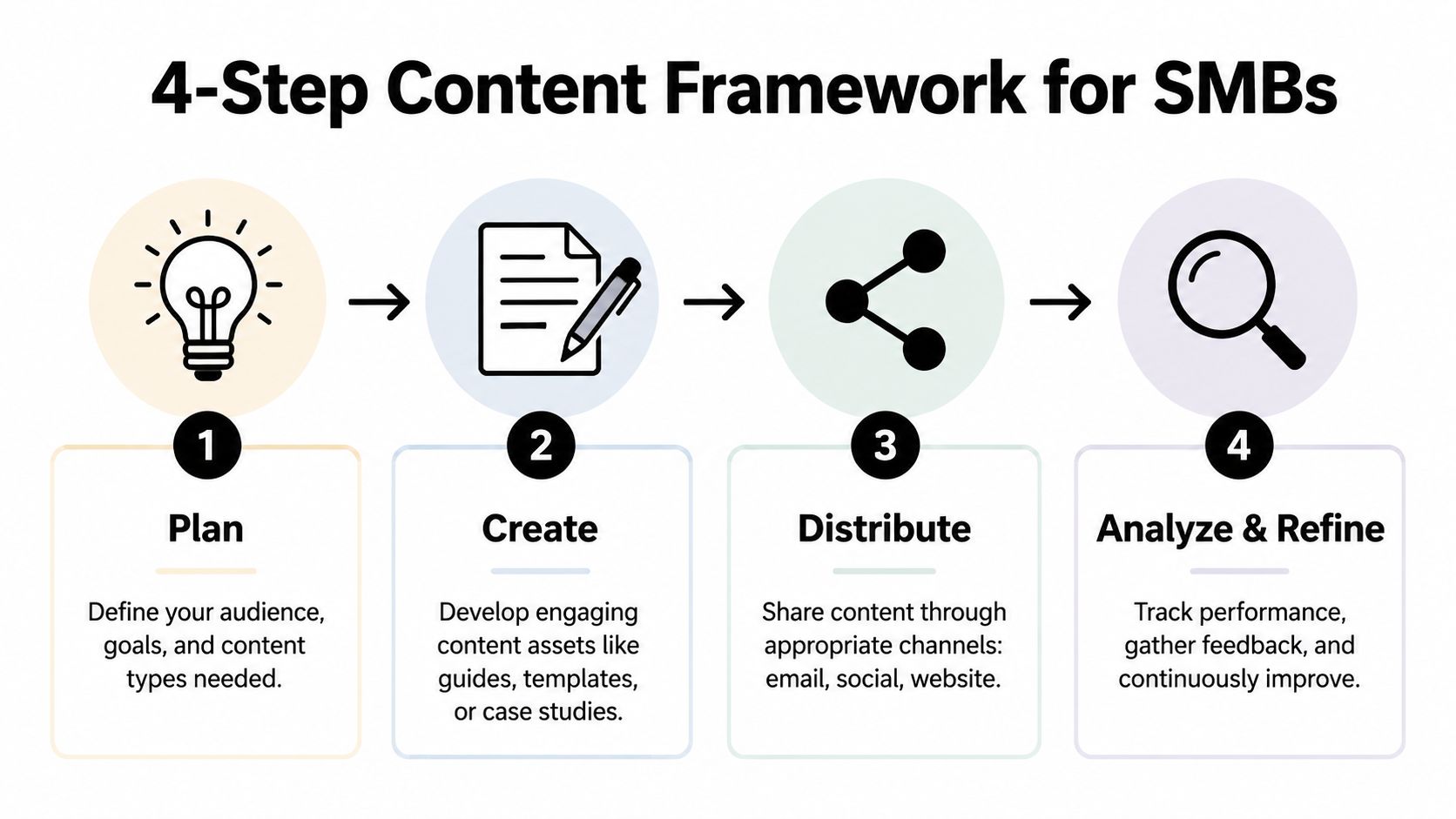
Listen first
Don't start by brainstorming content in a vacuum. Start with the questions your team already hears.
Ask your office manager, estimator, technician, intake coordinator, or attorney:
- What question comes up constantly
- Where do prospects hesitate
- What do you explain over and over
- What makes a lead go quiet after a quote
Those answers become your first content list.
A home service business might hear "How long will this take?" "Will insurance cover this?" "What's included in the quote?" A CPA firm might hear "What records should I bring?" or "Do you work with small businesses in my industry?"
Create small assets, not masterpieces
Your first round of content should be quick to produce and easy to update.
Start with:
- A one-page FAQ
- A simple case study
- A comparison sheet
- Two or three follow-up email templates
A shared Google Drive folder works fine at this stage. Name files clearly. Something like "Decision Stage – Roof Replacement FAQ" is much better than "final-v3-new.pdf."
If you want help choosing practical content tools for small business, that resource gives a useful overview of creation options without assuming you have a full in-house team.
Distribute where your team already works
A content library is worthless if nobody remembers to use it.
Tie each asset to a real moment:
- After first call send the FAQ
- After inspection send the checklist or comparison guide
- With the estimate send testimonials and case study
- After no response send a follow-up email template with a relevant proof asset
Put links inside your CRM if you use one. If not, create a simple "when to send what" sheet for the team.
A basic publishing rhythm also helps. This guide on how to create a content calendar can help you turn scattered content ideas into a manageable schedule.
Field-tested advice: If reps have to hunt for a file, they'll stop using it. Put the asset where the action happens.
Measure and clean up
You don't need elaborate dashboards to improve. Start with simple signals.
Track things like:
- Which assets get sent most often
- Which ones get mentioned positively by prospects
- Which documents are outdated
- Which questions still slow down the sale
Review the library regularly. Remove duplicate files. Update old language. Replace anything that no longer matches your service offering.
It's like maintaining a work truck. If tools are scattered, broken, or missing, every job takes longer.
Boost Sales and SEO with Aligned Content
A roofer gives an estimate on Tuesday. By Friday, the homeowner is on Google searching, "roof repair vs replacement after hail" and "how long does roof insurance approval take." If your site answers those exact questions, your sales content is still working after the rep leaves the driveway.
That is the payoff of aligned content for a local business. The same piece can help a prospect say yes and help your site show up for the next person asking the same question.
For contractors, law firms, med spas, and other local service businesses, this matters because the sales cycle and the search cycle overlap. Prospects talk to your team, compare options, check reviews, and search for reassurance before they decide. If marketing writes in one direction and sales speaks in another, you lose ground in both places.
One asset should earn its keep twice
A useful FAQ is not just a sales document sitting in a folder. It can become a service page section, a blog post, an estimate follow-up email, or a prompt for your Google Business Profile Q&A.
The same applies to proof assets. A case study about a kitchen remodel in one neighborhood can support a location page. A "repair or replace" guide can support organic search for plumbers, HVAC companies, electricians, and even professional service firms where prospects are weighing two paths before committing.
That overlap is where local SMBs can beat larger competitors. Big brands often publish polished content that sounds generic. A local company has access to real objections, real job photos, real timelines, and real neighborhood context. That makes the content more persuasive and more searchable.
Sales questions usually make better SEO topics than brainstorming sessions
Many local websites miss easy wins because the content was written from the owner's point of view instead of the buyer's. Homeowners do not search for "premium exterior solutions." They search for "how much siding repair costs in Naples" or "will tree roots damage my sewer line."
Use the questions your team hears every week. If prospects keep asking about permit timelines, financing, cleanup, disruptions, warranties, insurance, or service-area availability, those topics belong on the site. They support conversions and local search visibility at the same time. If you want a practical starting point for building that traffic, this guide on increasing website traffic organically lays out the process clearly.
Execution still matters. Good content does not help much if reps forget to send it or cannot find the right piece fast enough. This article on optimizing sales team performance is useful for tightening that side of the process.
The ROI is straightforward
Aligned content lowers repetitive sales effort. It also gives your site more pages and sections built around real buyer intent.
That means fewer calls spent answering the same basic questions, better-qualified leads from search, and more confidence at the point of decision. For a local business owner, that is the goal. Content should not just fill a website. It should help the next lead find you, and help the current lead choose you.
Frequently Asked Questions About Sales Content
A lot of local owners ask this when they realize the same questions keep coming up in estimates, follow-up calls, and quote reviews. If your office manager, estimator, or technician keeps explaining the same thing by phone, you already know what content to create.
Can I start with almost no budget
Yes. Start with a shared folder, one simple document template, and a short weekly check-in.
For a plumber, that might mean a one-page answer on sewer line replacement vs. repair, a financing explainer, and a short video on what happens during the first visit. For a law firm, it could be a fee FAQ, a timeline sheet, and an intake follow-up email. The point is to reduce repeated explanation, not produce polished marketing pieces on day one.
What should I create first
Create the pieces tied to delays, objections, or ghosting.
For many local service businesses, the first three assets are enough to make a visible difference: an FAQ, a short case study from a nearby job, and an estimate follow-up email that answers the top concern before the prospect asks. If your team explains permits, cleanup, scheduling windows, insurance, warranties, or service-area limits every week, document those topics first.
How do I get staff to actually use the content
Build it around real sales moments. "After estimate sent." "When customer asks about price." "When homeowner needs spouse approval."
That works better than dumping files into a folder called "marketing." Clear names matter. Short formats matter. Reps and office staff will use content they can find in 10 seconds and send in one click. If a piece never gets used, the problem is usually one of three things: wrong topic, hard to locate, or too long.
How often should I update content
Update it when your pricing approach changes, your service area shifts, your offers change, or buyers start asking new questions.
Review the basics every quarter. Local businesses feel these changes fast. A roofer adding financing, a med spa changing packages, or an HVAC company expanding into a new town all need content updates right away. Old sales content creates confusion, and confusion slows decisions.
Does this really affect revenue
Yes. It affects how consistently your team handles sales conversations.
The gain usually shows up in practical ways first. Fewer repetitive calls. Faster follow-up. Better-informed prospects. Higher close rates on the jobs you want. For a local business, that can mean fewer wasted estimate appointments and more booked work from people who already trust your process before they call.
Is this only for bigger companies
Small businesses often get results faster because the owner can spot problems quickly and fix them without layers of approval.
One clear comparison sheet, one strong testimonial from a nearby customer, or one email that answers "why does this cost more than the other quote?" can change the tone of the sale almost immediately. In a local market, that kind of clarity also helps your site match the questions people type into Google.
If you want help turning your team's real sales questions into content that drives leads, improves local SEO, and supports conversions, Polaris Marketing Solutions can help you build a practical system that fits your business and your market.