
You've probably done the basics already. Your Google Business Profile is filled out, your website lists your services, and you may even be asking for reviews. But when someone in Fort Myers searches for a roofer, cleaning company, attorney, or HVAC contractor, competitors still show up above you in the map results.
That usually means one thing. Google still needs stronger proof that your business belongs in the local market you serve.
That proof often comes from local backlinks. Not random SEO links. Not junk directory blasts. Not paid placements on irrelevant blogs. Real mentions and links from businesses, organizations, publications, and websites connected to your area.
For service businesses in Southwest Florida, link building for local SEO works best when it stays grounded in real relationships, useful local content, and clean business information across the web. That's the playbook.
Why Local Links Are Your Most Powerful Asset
A local link works like a referral from someone your town already knows.
If a neighbor recommends a plumber, that carries more weight than a stranger from another state saying, “This company seems good.” Google treats links in a similar way. A backlink from a Fort Myers business association, Bonita Springs nonprofit, neighborhood blog, or local news site tells Google your business is tied to that place and trusted there.
That's why link building for local SEO isn't the same as chasing broad national authority. In local search, relevance and geography matter together.
Why one local link can beat a pile of generic ones
A contractor in Cape Coral doesn't need a backlink profile that looks like a national software company. They need signals that connect the business to Cape Coral, Fort Myers, Estero, Bonita Springs, or Naples.
A few examples make that clear:
- Chamber listing with a live website link matters because it confirms local membership and place-based trust.
- Local event sponsor page matters because it ties your business to an actual community activity.
- Neighborhood blogger mention matters because it puts your name in front of a nearby audience and reinforces local relevance.
- Industry supplier testimonial page helps when the supplier serves the same regional market and links back to you.
None of those links are flashy. That's exactly why they work.
Practical rule: If the site would still matter to your business even if Google didn't exist, it's usually a stronger local link prospect than a random SEO placement.
There's also a direct business reason to care. Link building for local SEO is a critical driver of conversion, as 28% of local searches result in a purchase. That's the part many owners miss. Local links don't just help rankings. They help your business appear when buyers are ready to call, book, or visit.
What Google is trying to verify
Google wants to reduce risk for searchers. When someone types “family lawyer near me” or “AC repair Fort Myers,” Google has to decide which businesses are credible nearby options.
Local backlinks help answer questions like these:
| What Google needs to know | What a local link signals |
|---|---|
| Is this business real? | The company appears on legitimate community and industry sites |
| Is this business tied to this area? | The referring domain is connected to the same city or region |
| Is this business trusted locally? | Local organizations, media, and partners mention it naturally |
A business with strong local links often looks more established than a competitor with a prettier website but no local authority.
What this means for a small business owner
If you run a home service business or professional firm, stop thinking about links as abstract SEO points. Think about them as digital proof of local reputation.
The best local links usually come from:
- organizations you already support
- vendors and partners you already know
- local pages that already talk about your area
- content you publish that helps nearby customers make decisions
That's why local link building rewards businesses that are involved in the market they serve.
Secure Your Foundational Links Today
Before you chase press mentions or create neighborhood studies, fix the basics. A weak foundation makes every later link less effective.
A proven local link-building process starts with citation cleanup and then moves into competitor link-intersect research. That order matters because a proven local link-building methodology begins with cleaning citation inconsistencies, followed by a systematic competitor link-intercept process to identify domains linking to competitors but not you, which is effective as 85% of SEO experts confirm link building's critical role in brand authority.

Start with a citation cleanup
If your business name, address, phone number, or website URL appears differently across the web, Google gets mixed signals. That can weaken local trust.
Run through this checklist first:
Check your core business details
Make sure your legal business name, public-facing name, phone number, address, and website URL match exactly.Review your Google Business Profile
Use it as the master version. Other listings should follow it closely.Audit your major listings
Look at business directories, review sites, chamber listings, trade associations, and local directories.Fix old information
Old suite numbers, tracking phone lines, outdated URLs, and previous branding create confusion.Strengthen your citation base
If you need help cleaning and standardizing listings, a service like local citation building services can save a lot of manual work.
Build your first wave of easy local links
Once your details are consistent, go after links you can secure without a massive outreach campaign.
Focus on sources like these:
- Local chambers and associations such as city business groups, trade organizations, and merchant associations
- Industry directories that are relevant to your service, not just any directory that accepts submissions
- Supplier and vendor pages where testimonials, installer lists, or preferred partner pages exist
- Community directories tied to your county, neighborhood, school, or local events
- Professional profiles for attorneys, healthcare providers, consultants, and licensed trades
Don't submit to every directory you can find. Submit to the ones a real customer or partner might use.
A bad local SEO habit is treating directory count like a scoreboard. Relevance beats volume.
Use link intersect to stop guessing
Link intersect sounds technical, but it's simple. You compare your website against a few local competitors and look for sites that link to them but not to you.
Here's the practical version:
- Pick 3 to 5 local competitors
- Enter them into Ahrefs or Semrush
- Pull a list of referring domains they share
- Remove spammy sites and irrelevant blogs
- Highlight the domains that make local sense
You'll start seeing patterns. Maybe several competitors are listed on the same local home improvement guide, chamber page, event sponsor page, or neighborhood resource directory.
That gives you an outreach list built from what already works in your market.
A first-week action list
If you want a short list of immediate tasks, do these:
- Standardize your NAP details
- Claim or update your chamber and association profiles
- Ask two vendors for testimonial opportunities
- Find three competitor backlinks worth replicating
- Check whether local bloggers or publications already mention your category
- Review curated top guest blogging platforms if you want selective industry placements beyond local sites
Guest posting can help, but it shouldn't be your first move. For a local business, local trust pages usually produce stronger signals than generic outreach at the start.
Build Links Through Community Engagement
The strongest local links often come from things your business is already doing offline.
A roofing company sponsors a youth sports league. A law firm gives a free workshop for a neighborhood business group. A cleaning company helps a nonprofit prepare for an annual fundraiser. Those activities can turn into lasting backlinks when the organization publishes sponsor pages, event recaps, partner directories, or volunteer acknowledgments.
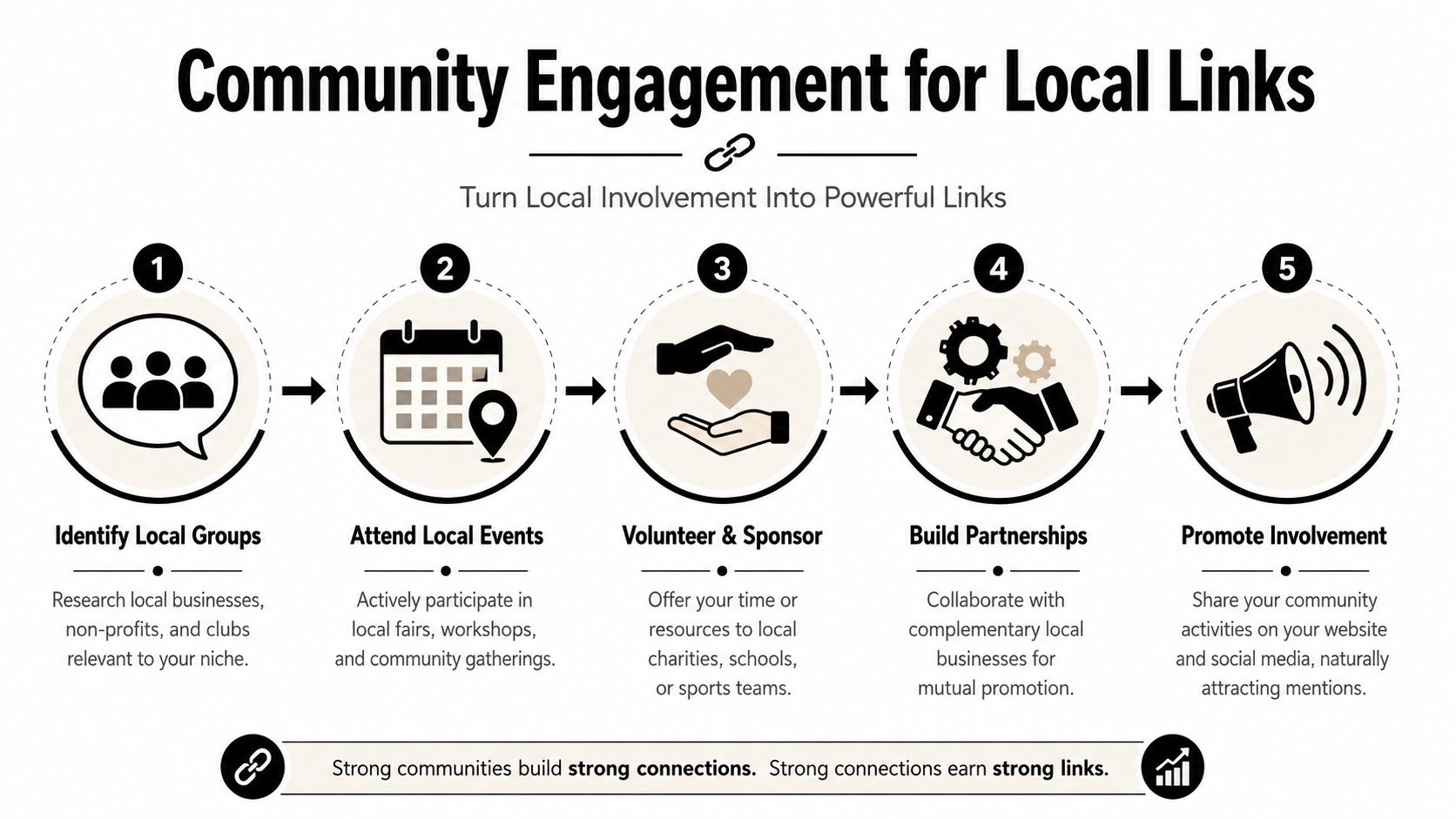
One reason this works so well is that many businesses still ignore it. Despite the proven efficacy of local links, 58% of companies globally fail to optimize for local search, creating a real opening for businesses that invest in community-based local SEO.
What good community link building looks like
A Cape Coral roofer doesn't need to manufacture SEO tactics. They can build links by participating in the community in ways customers already respect.
Consider examples like these:
- sponsoring a school fundraiser and being listed on the event page
- partnering with a painter, electrician, or solar company on a local homeowner resource page
- speaking at a chamber breakfast and getting included in the event recap
- donating services to a nonprofit and earning a thank-you mention on its website
- supporting neighborhood safety or storm prep content that local groups share
These links are hard for competitors to copy because they come from actual involvement.
A simple outreach email that gets used
You don't need a polished PR pitch. You need a clear request that makes the organizer's job easier.
Hi [Name],
We're happy to support [organization or event name]. If you're listing sponsors or partners on the website, please include our business name and website link so attendees can find us easily.Business name: [Your Business]
Website: [Your URL]
Short description: [One sentence]
Logo: [Attach or link]Thanks for all the work you're doing for the community.
That email works because it's short, specific, and useful.
Turn partnerships into recurring links
The best local partnerships aren't one-off favors. They create ongoing visibility.
A practical setup for service businesses looks like this:
| Partner type | Example collaboration | Possible link placement |
|---|---|---|
| Complementary trade | HVAC company and insulation contractor create a homeowner checklist | Recommended partners page |
| Professional service partner | Estate attorney and financial planner co-host a seminar | Event page or recap post |
| Community group | Cleaning company supports a charity drive | Sponsor page or donor acknowledgment |
If you want a broader framework for building these relationships, community engagement strategies can help you organize efforts around partnerships that produce both referrals and search visibility.
A short explainer on local authority through real-world outreach can also help frame the process:
What doesn't work as well
Some community SEO efforts look local but don't move the needle much.
Watch out for:
- Logo-only sponsorships on pages with no crawlable text or no live links
- Irrelevant donations made only for placement on a weak website
- Reciprocal partner pages that list dozens of random businesses with no user value
- Thin event pages that disappear immediately after the event ends
A good local link should make sense to a real visitor. If the page exists only to trade SEO value, skip it.
Create Content That Naturally Attracts Local Links
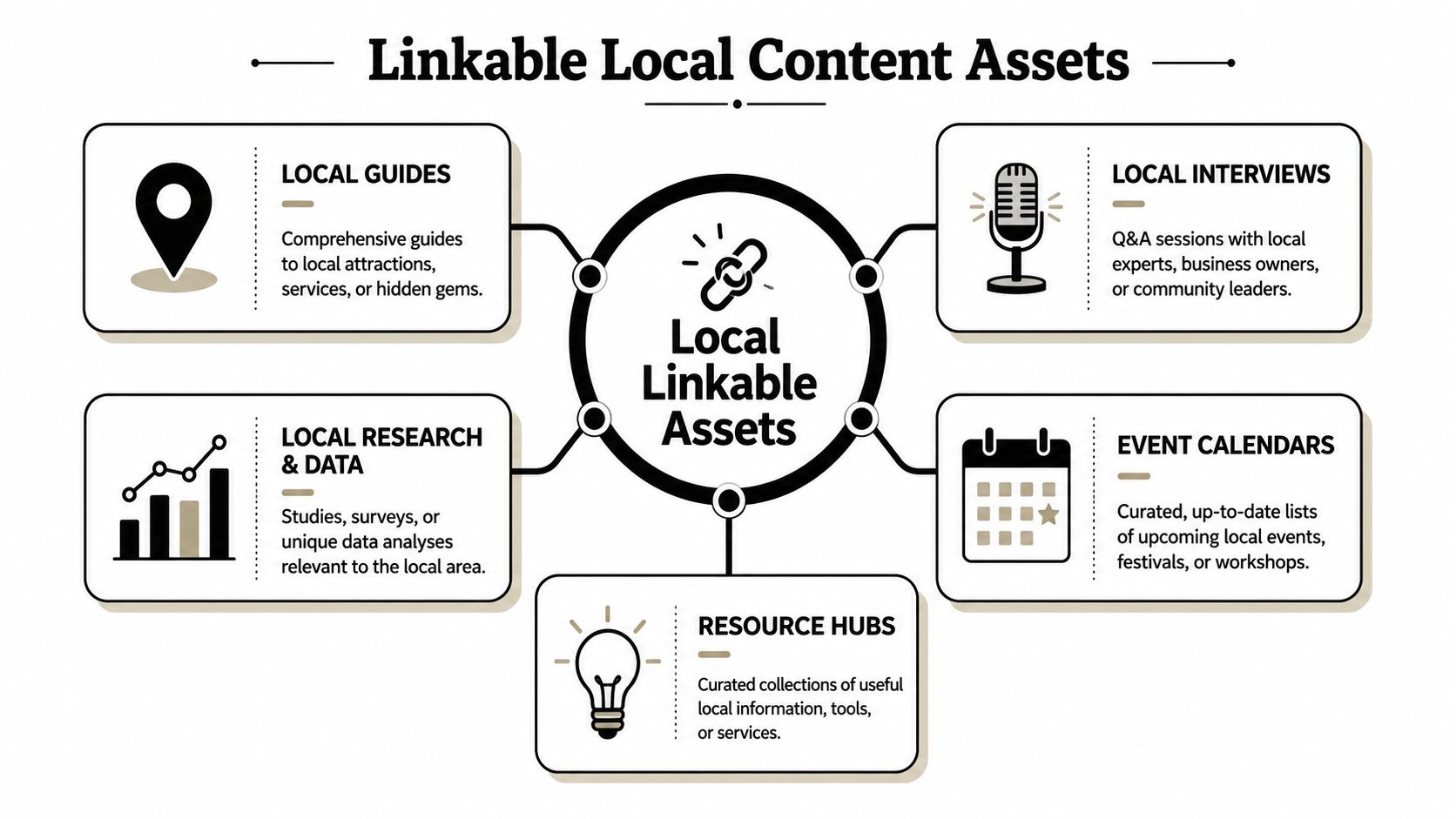
Directories are easy to copy. Sponsor pages are useful, but limited. The businesses that separate themselves create local resources other people want to cite.
That's the difference between asking for links and earning them.
For service-area businesses, the best opportunity is hyper-local content that solves a local question better than anyone else. This works especially well in places like Fort Myers and the surrounding Southwest Florida market, where seasonality, weather, housing stock, insurance concerns, and neighborhood differences all affect buying decisions.
Stop publishing generic service pages
A page titled “Best Roofing Company in Fort Myers” won't attract many natural links. It's promotional and interchangeable.
A page that compares roof maintenance concerns by neighborhood, storm exposure pattern, or common housing type gives local bloggers, property managers, and community writers something worth referencing.
That's why unique, hyper-local research data such as a Fort Myers HVAC Cost Index naturally attracts links from journalists and bloggers more effectively than standard directory links. Most small businesses never create this kind of asset, which is exactly why it stands out.
Hyper-local content ideas that can earn links
Think like a local publisher, not a salesperson.
Here are examples that fit home services and professional firms:
HVAC company
A neighborhood-by-neighborhood guide to AC strain during peak heat, with maintenance advice tied to local housing types.Paving contractor
A Southwest Florida driveway material guide focused on drainage, heat, and curb appeal.Cleaning company
A seasonal checklist for homeowners returning to vacant properties or preparing rentals for occupancy.Estate planning attorney
A plain-English guide to local planning considerations for retirees and seasonal residents.Physical therapy practice
A local resource on injury risks tied to popular sports, golf, pickleball, boating, or active retirement communities.
What makes a linkable asset actually linkable
A strong local asset usually has three qualities:
It's specific to a place
“Florida roofing tips” is broad. “Roof replacement concerns in coastal Southwest Florida neighborhoods” is tighter.It includes usable information
Summaries, comparisons, maps, checklists, public data interpretation, or interviews give others something to cite.It helps another publisher serve their audience
Reporters, bloggers, HOA sites, and community groups link when your page helps them explain something.
Don't ask, “What should we blog about?” Ask, “What page would a local editor actually reference?”
Turn one asset into multiple link opportunities
One good asset can support several outreach angles.
For example:
- A local storm-prep checklist can be pitched to neighborhood associations.
- A service cost guide can be shared with real estate bloggers.
- A seasonal maintenance resource can support press outreach and newsletter mentions.
- A local data story can become part of a campaign to boost rankings with press releases when there's a timely community angle.
If you need help planning content that serves both customers and search visibility, these content marketing strategies for small business are a useful reference point.
A simple content filter before you publish
Use this quick test:
- Would a local journalist quote it?
- Would a neighborhood Facebook admin share it?
- Would a real estate agent, HOA, or business group link to it?
- Would it still be useful if your company name were removed from the page header?
If the answer is no across the board, it's probably just another blog post. Not a linkable asset.
Track Your Results and Avoid Costly Penalties
Local link building only pays off if you track the right outcomes and stay away from shortcuts that can create problems later.
The biggest mistake I see is focusing on vanity metrics while ignoring business impact. A local company doesn't need a pretty backlink chart. It needs stronger location-page visibility, more qualified visits, better map pack presence, and more calls or form submissions from the areas it serves.
What to watch each month
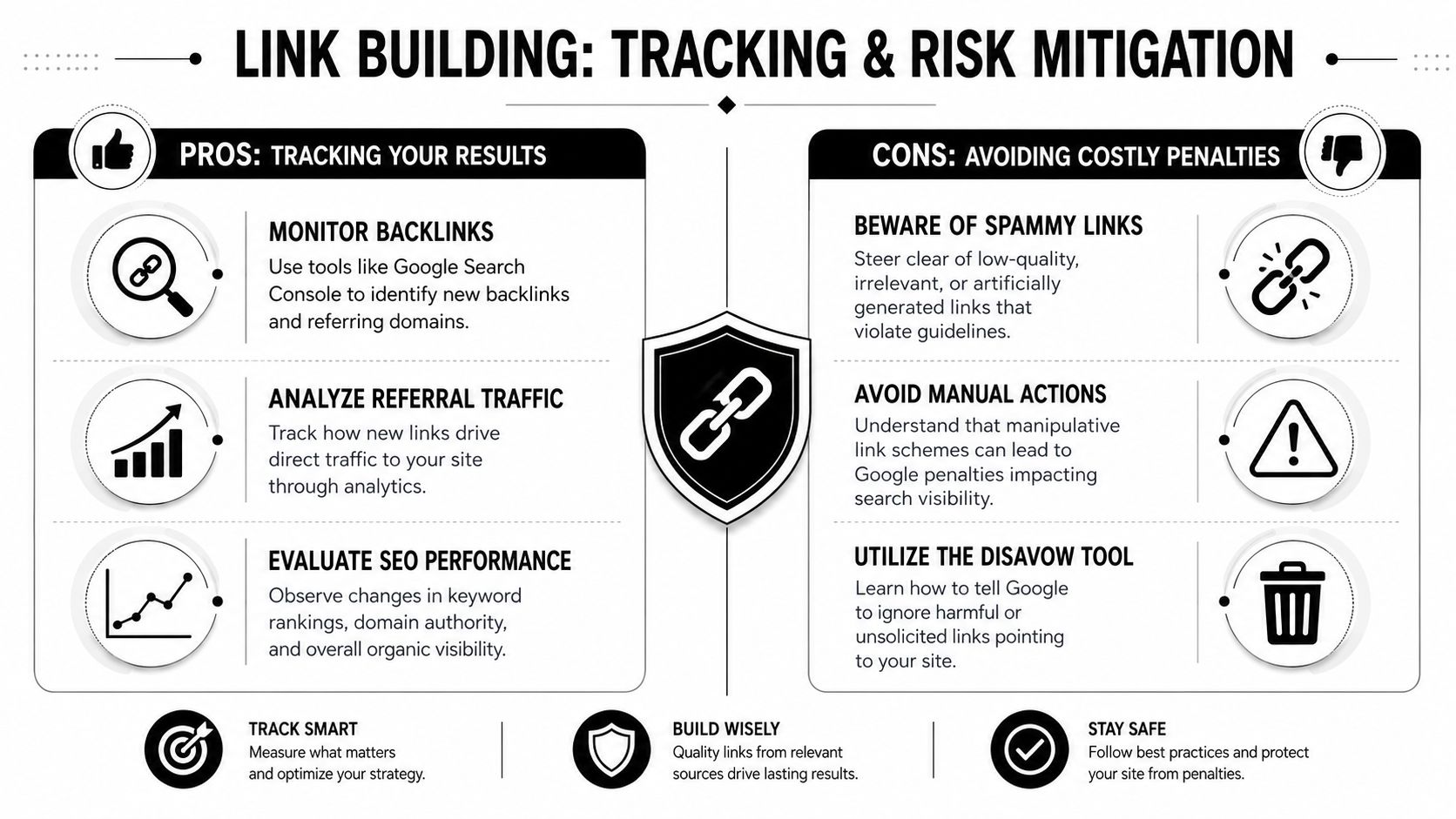
Google Search Console is a practical starting point. Check which pages are earning links, which queries are improving, and whether your location-specific pages are gaining more impressions and clicks.
Then compare that with your business-facing metrics:
- Google Business Profile activity such as calls, direction requests, and website clicks
- Organic traffic to city or service-area pages
- Lead quality from organic forms and calls
- Referral traffic from local partner sites, organizations, and media mentions
A local link from a community site may not send huge traffic. But if it improves trust and local search visibility, it still matters.
A clean way to judge whether a link was worth it
Use this table when reviewing new opportunities:
| Good sign | Warning sign |
|---|---|
| The site serves your city, region, or industry | The site exists only to sell links |
| The page has real content and real users | The page is stuffed with unrelated outbound links |
| The mention makes sense in context | The placement feels forced or keyword-heavy |
| You'd be comfortable showing it to a customer | You'd rather hide it from a customer |
The safest local links come from useful pages on legitimate sites. If you have to talk yourself into a placement, it's usually a bad sign.
What to avoid
This part is straightforward. Common pitfalls in local link building include reciprocal linking and buying links, which violate Google's spam guidelines. Marketers achieve positive results only when they avoid these tactics and instead use strategies like creating original local data studies according to Rio SEO's local link building guidance.
That means you should avoid:
- buying batches of “local SEO backlinks”
- trading links with every business that asks
- stuffing exact-match keywords into anchor text
- paying for placements on irrelevant blogs
- submitting to low-quality directories with no audience
If you've already built questionable links in the past, document them, monitor Search Console, and clean up what you can. Going forward, build slower and cleaner.
Keep the business goal in view
A good local SEO campaign should make your market position stronger. You should see better visibility in the places you serve, more branded and non-branded discovery, and more leads from nearby buyers.
That's the standard. Not just “we got a link.”
Your Local Link Building Questions Answered
How much should a small business spend on local link building
There isn't one fixed budget that fits every business. The right amount depends on your market, your competition, and how much work you can do in-house.
If you handle outreach yourself, your main investment is time. That usually means cleaning citations, building partner relationships, writing testimonials, and creating one or two solid local assets. If you hire help, pay for work that includes strategy, outreach, and content support. Don't pay for mystery link packages.
How long does it take to see results
Local link building usually works gradually. Some links help almost immediately with trust and discovery, especially if they come from high-visibility local pages. Others support rankings over time as Google recrawls and reevaluates your authority.
If your foundation is messy, results take longer. If your listings are clean, your site is solid, and your Google Business Profile is active, link gains usually compound better.
Can I do this myself
Yes, if you're willing to stay organized and patient.
DIY works best when you can personally utilize existing relationships. Owners often do well with:
- chamber listings
- vendor testimonials
- sponsor and partner outreach
- unlinked brand mention requests
- community resource content
DIY gets harder when you need a repeatable process across several service areas or when competitors already have a strong local footprint.
When should I bring in an agency
Bring in help when one of these is true:
- You're too busy to do consistent outreach
- You need content assets built properly
- You don't know which links are safe
- Your competitors have stronger local visibility and you can't see why
- You want reporting tied to leads, not just SEO activity
The best agency support doesn't replace your local knowledge. It turns that knowledge into a system.
What should I do first this week
Keep it simple:
- Audit your business listings.
- Make a list of five local organizations or partners that should link to you.
- Review three competitors' backlinks with Ahrefs or Semrush.
- Choose one hyper-local content idea your business could publish.
- Send two outreach emails.
That's enough to start moving.
If you want help building a local SEO plan that's practical, affordable, and grounded in real lead generation, Polaris Marketing Solutions works with Southwest Florida businesses that need more visibility in markets like Fort Myers, Cape Coral, Estero, Bonita Springs, and Naples. Their approach is shaped by real small-business operating experience, so the focus stays on what drives calls, form fills, and revenue, not busywork.