
You've probably been there. A competitor in Fort Myers keeps showing up above you in search, their phone rings, and your website sits there like an online brochure that nobody finds. Then a marketing person throws out terms like Domain Authority, backlinks, technical SEO, and digital PR, and none of it sounds connected to the actual problem, which is simple: you want more qualified local leads.
That's where Domain Authority becomes useful. Not as a vanity score, and not as something to obsess over daily, but as a practical way to judge whether your site has enough authority to compete in your market. If you run a roofing company, law firm, med spa, HVAC business, or cleaning company in Southwest Florida, learning how to improve domain authority can help you close the gap between your site and the businesses that already dominate the search results.
What Domain Authority Really Means for Your Business
A Fort Myers business can have a clean website, solid services, and good reviews, then still lose ground in search because competing sites carry more authority. That is the practical value of Domain Authority. It helps you judge how hard it will be to compete over the next 90 days, especially in crowded local categories like roofing, legal, med spa, HVAC, and home services.
Domain Authority, or DA, is a proprietary Moz metric scored from 1 to 100, as explained in Launch Codex's overview of what a good Domain Authority score means. Google does not use DA as a ranking factor, but the score is still useful because it reflects patterns that do affect rankings, especially backlink quality, domain strength, and overall site trust.
For a local business, DA works as a competitive benchmark. If your strongest local competitors have built better links, stronger service pages, and more trust across the web, they usually have an easier time ranking new pages and holding those positions. A lower DA does not block you from ranking in Fort Myers or Southwest Florida, but it does mean you need a tighter strategy and better execution.

How to use DA without getting distracted by it
DA is useful when you compare it against the businesses you are trying to outrank. It is less useful when you treat it like a goal by itself.
A site with a higher score can still underperform if its pages are weak, its calls to action are poor, or its local intent is off. A site with a modest score can still produce leads if it has focused service pages, strong Google Business Profile signals, and the right local links. That trade-off matters for small businesses with limited budgets. In many cases, you do not need to beat the biggest regional brand. You need enough authority to compete in your service area and enough relevance to convert the traffic you get.
This is also why I do not recommend chasing DA with random link packages or broad content that has nothing to do with your market. The better approach is to strengthen the pages that make money, clean up technical weaknesses, and earn links that fit your geography and services. If you need that groundwork first, start with a review of your technical and on-page SEO structure.
Practical rule: If a competitor in your market offers similar services and has a much stronger backlink profile, that gap usually shows up in search visibility.
What drives significant improvement
For local businesses, authority grows from a few inputs that work together. Strong backlinks matter most, but they work better when the site is organized well and the pages deserve to rank.
That means:
- Getting links from relevant local and industry websites
- Building pages that match real search intent in Fort Myers and nearby service areas
- Using internal links so authority reaches service pages, city pages, and high-converting content
- Supporting link building with content people can cite, reference, or share
That is the connection between DA and lead generation. Higher authority gives your best pages a better shot at ranking. Better rankings put you in front of more local buyers.
If you want a broader framework that ties authority building to local visibility, these local SEO strategies for service companies are useful because they connect backlinks, citations, content, and service-area relevance. For a Fort Myers business, that is the primary objective over the next 90 days. Build enough authority to give your money pages a fair chance to compete.
Build a Solid Foundation with Technical SEO
A lot of businesses want to jump straight into link building. That's a mistake. If your site is hard to crawl, slow on mobile, or full of dead pages, you're leaking authority before it has a chance to help.
Think of technical SEO like the slab under a house. Nobody compliments it, but if it's cracked, the rest of the structure suffers.
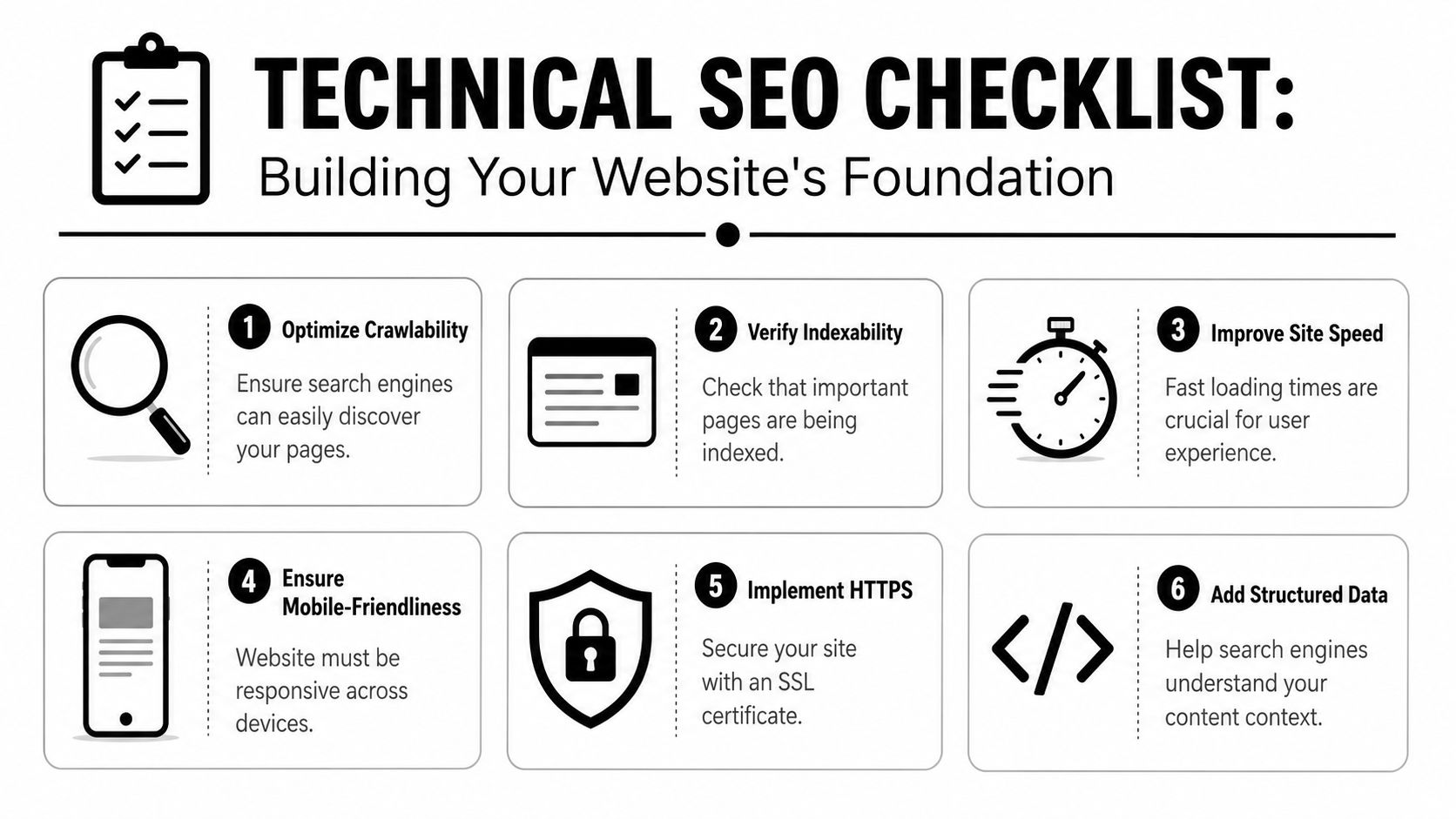
Start with crawlability and indexability
Search engines can't rank pages they can't properly access. One of the biggest problems on small business sites is navigation built in ways that look fine to users but create crawl issues behind the scenes.
Technical SEO guidance from Forbes notes that JavaScript-only navigation should be replaced with proper HTML <a href> tags, pages should use one descriptive H1 with a clean H2 and H3 structure, and 301 redirects should be set up for all 404 URLs with referring domains to preserve authority flow. The same piece also notes that toxic backlinks can depress DA by 15 to 25% within months, while crawlability fixes and internal linking can make pages discoverable very quickly after repair, according to Forbes Tech Council's technical SEO tips.
Here's a practical local example. Say your Fort Myers plumbing company redesigned its site last year and changed service page URLs. If local directories, chamber listings, or old blog mentions still point to the old URLs and those pages now return 404 errors, you're wasting link equity. A simple 301 redirect often fixes that.
Use free tools before you spend money
You don't need an enterprise SEO stack to find the obvious issues. Start with the basics:
- Google PageSpeed Insights: Check mobile speed and usability problems
- Google Search Console: Review indexing issues, sitemap coverage, and crawl errors
- GTmetrix: Get another view of page load behavior
- Your browser on a phone: Test whether your main pages are easy to use on mobile
You should also make sure the site uses HTTPS, submit an XML sitemap in Google Search Console, and test performance with tools like PageSpeed Insights or GTmetrix, as recommended in Name.com's domain authority guidance.
If you need a more complete checklist for page structure, internal linking, headings, and crawlability, this guide to technical on-page SEO is a useful reference.
A quick walkthrough can help you visualize what to look for before making changes.
The three fixes that usually matter most
Not every technical issue deserves equal attention. For local businesses, I'd put the first round of work into these:
| Priority | What to fix | Why it matters |
|---|---|---|
| First | Broken pages with backlinks | Preserves authority you already earned |
| Second | Mobile speed and page usability | Keeps visitors from bouncing and helps search engines trust the experience |
| Third | Weak internal linking | Moves authority from strong pages to service and location pages |
Fix the pages that already have links before you chase new ones. That's usually the fastest technical win.
Don't ignore internal linking
Internal links don't create authority from scratch, but they distribute the equity you've already earned. If one blog post got picked up by a local publication and now has the strongest backlink profile on your domain, use that page to link naturally to your service pages, city pages, and related guides.
A Fort Myers law firm might have a blog post about hurricane claims that attracts attention each season. That page shouldn't sit isolated. It should connect to insurance dispute pages, consultation pages, and nearby topic clusters so authority flows where it can help rankings and leads.
Create Content That Earns Authority and Links
A Fort Myers business can publish blog posts for six months and see almost nothing from them. Then one well-built local guide gets picked up by a neighborhood blog, a trade site, or a reporter, and that single page does more for authority than a stack of short posts ever did.
That is the standard to aim for.
Content that helps domain authority has to earn citations. It needs to be useful enough, specific enough, or original enough that another site has a reason to reference it. For local businesses in Southwest Florida, that usually means building content around real local questions, real service decisions, and real seasonal issues your customers deal with.
What earns links in Southwest Florida
Generic posts rarely become reference material. Local resource content can.
Here are the kinds of assets that tend to attract attention for businesses in Fort Myers, Cape Coral, Estero, and nearby markets:
- Roofing company: A hurricane season preparation guide that covers roof types, insurance documentation, inspection timing, and what homeowners should do before and after a storm.
- Estate planning attorney: A Florida-focused guide explaining homestead rules, probate timing, and common mistakes families make after relocating to Lee County.
- HVAC company: A homeowner resource on AC performance, humidity control, duct issues, and maintenance schedules during long cooling seasons.
- Real estate team: A relocation guide that compares neighborhoods, commute patterns, flood zones, HOA expectations, and school-area considerations across Southwest Florida.
These assets work because they answer bigger questions than a standard service page can handle. They give local publishers, partners, and community sites something worth citing.
Build around one flagship asset each quarter
For most small businesses, the best use of the next 90 days is simple. Publish one strong authority piece, then support it with smaller articles that answer narrower questions and point back to the main resource.
That approach is more practical than trying to churn out constant blog content.
A good quarterly structure looks like this:
- Pick one topic tied to buyer questions and local demand.
- Create a detailed main resource page.
- Publish two to four supporting posts around subtopics.
- Link those pieces to the main asset and to relevant service pages.
- Give that asset a promotion plan, not just a publish date.
If you want help connecting content creation to promotion and authority growth, our local link building services for Fort Myers businesses are built around that exact process.
Add something other sites can actually cite
Useful content is a baseline. Citable content gets links.
For a local business, “original” usually does not mean running a national study. It means publishing information that comes from your direct experience in the market:
- Questions your team gets every week from homeowners or buyers
- Patterns you see in estimates, inspections, repairs, or consultations
- A local checklist people can use before they call a vendor
- A plain-language FAQ that clears up confusion better than the current search results
Experience matters significantly. A Fort Myers plumber who documents the most common pipe failures after heavy rain has something specific. A local attorney who explains the mistakes families make after a death in Florida has something specific. Specific content gets referenced because it is harder to replace.
If you work in housing, property, or relocation, this article on mastering digital presence for real estate agents shows how topic depth supports authority over time. The same principle applies to other local industries. Own the subject well enough that your site becomes a resource, not just a brochure.
What to stop publishing
A lot of local businesses fill their blog with safe topics that never attract links:
- “Why choose us”
- “Benefits of our service”
- “What is [service]”
- Slight rewrites of pages that already rank everywhere else
Those pages may still help conversions if they sit close to a service page. They usually do very little for authority.
The trade-off is time. Every hour spent on thin, low-value articles is an hour you could spend building one page with actual earning power. If your goal over the next 90 days is stronger authority in Fort Myers search results, publish fewer pieces and make each one more useful, more local, and easier to cite.
Master Local Link Building and Outreach
A Fort Myers business can publish a strong hurricane guide, a useful FAQ, or a local resource page and still see no authority gains if nobody relevant links to it. Link building is the distribution step. It turns a good asset into something other sites reference.
For most local businesses in Southwest Florida, the goal over the next 90 days is not volume. It is getting a small number of relevant links from real local and industry sites that make sense for your market.
Start with links you can realistically earn
The best local links usually fall into four groups:
- Local business organizations such as chambers, business associations, and credible community directories
- Industry sites connected to your service category, trade, or profession
- Local partners that serve the same customer in a different way
- Community and event websites tied to sponsorships, education, or local involvement
Relevance carries more weight than random authority. A Florida roofing company gets more value from a link on a respected construction or property site than from an unrelated blog with stronger metrics. The same logic applies across local industries. A Fort Myers estate planning attorney should care more about links from legal, financial, and senior resource sites than generic marketing blogs.
That focus keeps your outreach list tight. It also keeps you from wasting time on links that look good in a report but do little for rankings or local credibility.
Use a repeatable outreach process
Outreach works when each request matches a real asset to a real audience. Sending people to your homepage rarely gets traction. Sending them a page that helps their readers does.
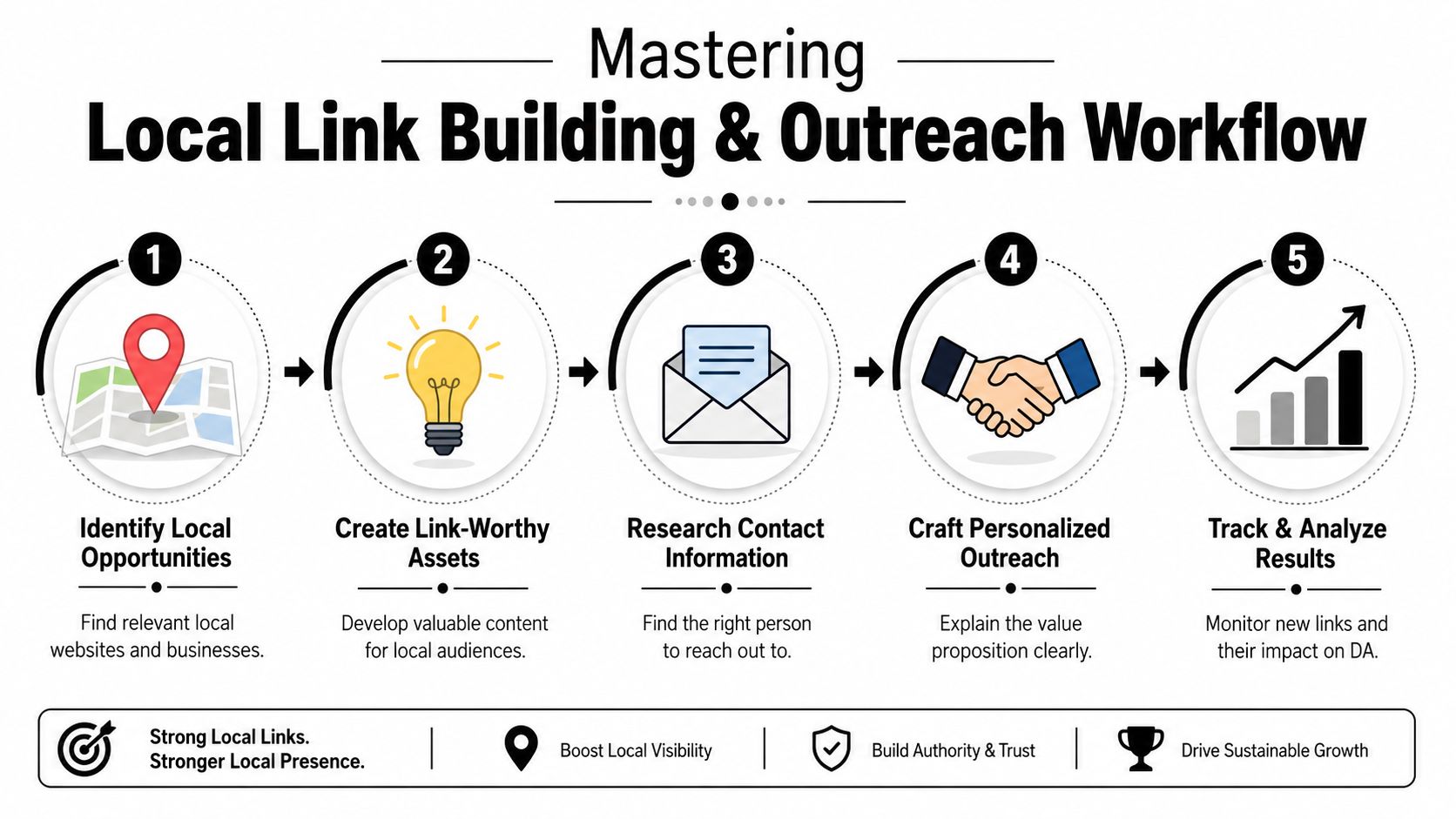
Use a simple workflow:
Build a short target list
Start with local organizations, trade associations, niche publications, schools, nonprofits, and adjacent businesses in Fort Myers, Cape Coral, Naples, and the rest of Southwest Florida.Match each site to one useful page
Pitch the storm prep guide, insurance checklist, relocation resource, permit explainer, or neighborhood-specific FAQ. Match the asset to the site.Find the right contact
Look for the editor, marketing lead, owner, membership coordinator, or community manager. Generic inboxes can work, but direct contacts usually work better.Write a short email with a clear reason
Explain why the page is relevant to their audience. Keep it specific. A vague compliment and a link drop usually gets ignored.Track every follow-up
Use a spreadsheet or CRM. Record who you contacted, what you pitched, when you followed up, and whether the link went live.
If you want a clearer model for campaign structure, this overview of a local link building service shows the types of targets, assets, and outreach steps local businesses usually need.
Use guest contributions and link replacement selectively
Guest articles still work when the site is relevant and the topic is useful. WordStream recommends targeted outreach and guest blogging on industry-specific publications in its guide to domain authority improvement tactics. For a local business, that usually means writing something practical for a site your customers or referral partners already trust.
A Cape Coral pool builder could co-author an article with an outdoor design professional or outdoor lighting company about planning a backyard project in Southwest Florida. A Fort Myers HVAC company could contribute a seasonal maintenance piece to a local property management blog. Those partnerships produce links, referral traffic, and stronger local relationships. That is a better outcome than chasing generic guest post opportunities on sites nobody in your market reads.
Broken link building can also work, but it is more manual. Look for local resource pages, neighborhood associations, HOA blogs, tourism sites, or trade articles linking to dead pages. If you already have a better live resource on the same topic, suggest it as a replacement. This works best when the fit is obvious.
One rule matters across every tactic. The person adding the link should be able to explain in one sentence why your page helps their audience.
What to avoid
Skip tactics that create a weak backlink profile or waste budget:
- Buying low-quality link packages
- Paying for irrelevant directory listings
- Swapping links with unrelated businesses
- Sending mass outreach with no local context
- Sponsoring pages only for a backlink when there is no audience fit
These shortcuts usually show up fast. They can pad your link count, but they rarely improve the kind of authority that helps a Fort Myers business rank better and win trust.
Measure What Matters to Track Your Progress
If you only watch your DA score, you'll get frustrated. It moves slowly, it fluctuates, and by itself it doesn't tell you what changed.
A smarter approach is to track the inputs that usually lead to stronger authority.
Watch the trend, not the daily score
BrightEdge recommends tracking your Authority Score trend in Domain Overview and comparing it against competitors in your niche, while also pulling a full backlink profile from tools like Ahrefs, SEMrush, or Moz Link Explorer to audit link health, according to BrightEdge's domain authority glossary.
That gives you context. If your score is flat but you're adding better referring domains than you had six months ago, progress is happening. If your score drops and you also lost several quality referring domains, that tells a clearer story than the score alone.
The metrics that matter most for local businesses
Use a simple monthly dashboard built around these questions:
| Metric | What you're looking for | Why it matters |
|---|---|---|
| Referring domains | Are more unique sites linking to you? | Unique domains usually matter more than raw link count |
| Link quality | Are links coming from relevant businesses, publications, and local organizations? | Better links tend to carry more authority |
| Top linked pages | Which pages earn links naturally? | Shows what content to expand or promote |
| Service page rankings | Are your core money pages climbing? | Rankings on service pages affect leads more than blog vanity metrics |
| Organic conversions | Are calls, forms, or bookings improving? | Authority only matters if it supports business growth |
Make competitor review part of the process
For local SEO, competitor review is where the strategy gets practical. Pick a few businesses that are your competitors in Fort Myers, Cape Coral, Naples, or Estero. Compare their authority trends, backlink sources, and top linked pages. Don't compare yourself to giant national publishers. That's not useful.
You'll often notice patterns fast. Maybe a competitor gets links from trade associations you've never joined. Maybe local media cite their guides because they publish stronger educational content. Maybe their strongest links point to resources, not service pages.
If you're trying to tie SEO progress back to revenue, this guide on how to measure marketing ROI is useful because it helps connect rankings and authority work to actual business outcomes rather than vanity reporting.
If authority growth isn't helping your important pages rank better or convert better, adjust the strategy. Don't just celebrate a score.
Your 90-Day DA Improvement Plan for Fort Myers
You launch a new service page, wait a few weeks, and nothing happens. Rankings barely move. Calls stay flat. In Fort Myers, that usually means your site needs a tighter authority plan, not more random SEO tasks.
A good 90-day push gives you enough time to fix weak spots, publish something worth citing, and start getting links that fit your market in Southwest Florida.
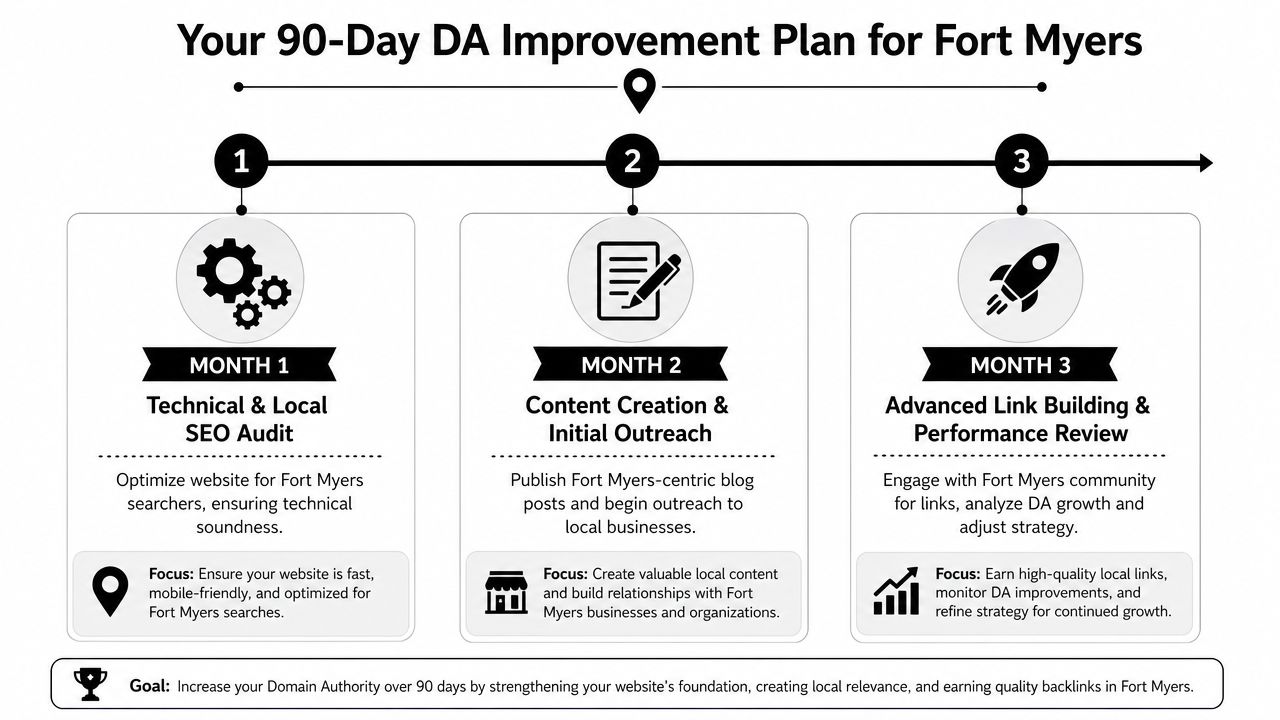
Month 1 fix the leaks
Start with the parts of the site that support lead generation. For most local businesses, that means the homepage, core service pages, and location pages tied to Fort Myers, Cape Coral, Estero, or nearby service areas.
Use month one to tighten the basics:
- Audit broken pages: Find 404 pages with backlinks and redirect them to the closest relevant page.
- Review mobile performance: Test your key service pages on phones, not just desktop.
- Submit and verify your sitemap: Confirm Google Search Console is seeing the pages you want indexed.
- Improve page hierarchy: Clean up H1, H2, and H3 usage so your main pages are easier to understand.
- Strengthen internal links: Add relevant links from blog posts and high-traffic pages to your money pages.
This work is not glamorous, but it protects the authority you already have. If key pages load poorly, waste link equity, or create friction on mobile, new backlinks do less for you.
Month 2 publish one asset worth promoting
Month two is about giving people a reason to mention your site.
Publish one local resource that is useful enough to earn links, references, or shares from nearby businesses and organizations. A generic blog post will not do that. A strong local asset can.
A few examples:
- A Fort Myers roofer publishes a hurricane and storm prep guide for homeowners
- A Naples estate attorney creates a plain-English Florida probate and homestead guide
- A Cape Coral HVAC company builds a resource on AC maintenance and humidity control during long cooling seasons
- A med spa publishes a detailed FAQ on treatment expectations, recovery, and candidacy
Support that main piece with two or three related articles. That gives you internal linking opportunities and helps the main asset carry more topical weight.
The goal is simple. Create a page that deserves outreach.
Month 3 run local outreach every week
Now you put that asset in front of the right people. Keep the list focused and local. A small set of relevant prospects usually outperforms a bloated list of weak targets.
Build a list of local organizations, businesses, publishers, and community groups in Lee and Collier County that would find the resource useful. Then reach out with a specific reason. Offer a guest contribution, suggest the resource for a community page, replace an outdated reference, or propose a collaboration tied to a local event or audience need.
Good outreach targets include:
- Chambers and trade associations
- Nonprofits with resource pages
- Nearby businesses that serve the same audience without competing directly
- Local bloggers and neighborhood publications
- Regional news and event sites
- Sponsorship or community partner pages
The trade-off is straightforward. A handful of relevant local links often helps more than a pile of low-quality directory placements. Go after links that make sense for your business, your geography, and your customers.
What success should look like after 90 days
Do not expect a dramatic jump overnight. Expect traction you can build on.
By the end of 90 days, you should have:
- Cleaner high-value pages
- Fewer technical problems that waste authority
- One strong local content asset live
- Better internal links to service and location pages
- A steady outreach process
- A clearer view of which pages and link sources are helping rankings and leads
That is the practical way to improve domain authority for a local business in Fort Myers. The score matters less than the outcome. You want stronger service page visibility, better local trust signals, and more qualified leads from the work.
If you want help turning this into a practical campaign, Polaris Marketing Solutions works with Fort Myers and Southwest Florida businesses that need stronger local visibility, better authority signals, and clearer SEO ROI. If your site feels stuck, a focused audit and competitor review can show you where authority is leaking, what content you should build next, and which local link opportunities are worth pursuing.