
You launch a new website for your business, connect the contact form, add Google Analytics, install a chat widget, link a scheduling tool, and call it done. Then someone asks where your privacy policy is, whether your terms cover bookings, and what happens to customer data after a form submission. That's the moment most owners realize the legal pages weren't optional admin work. They were part of the build.
For service businesses, the issue usually isn't whether you meant to collect data. You already do. A quote request form collects names, phone numbers, addresses, and service details. A booking tool may collect appointment preferences. A payment processor handles billing information. Even a basic analytics setup can involve tracking behavior on the site. If your legal pages don't match that reality, you've created a gap between what your website does and what your business says it does.
The good news is that privacy policy terms of service work is manageable when you treat it as an operations task, not just a legal template exercise. One page explains data handling. The other sets the rules of use. Together, they help you communicate clearly, reduce avoidable risk, and make your website look like it was built by a serious business.
Your Website Needs Legal Pages Here Is Why
A lot of small business owners put legal pages off because they feel disconnected from day-to-day work. You're focused on calls, leads, jobs, invoices, and reviews. A privacy policy and terms of service can feel like paperwork that belongs at the very end.
That's a mistake.
These pages do two different jobs that matter right away. Your Privacy Policy tells visitors what information you collect, why you collect it, who receives it, and what rights users may have over that data. Your Terms of Service set the rules for using your site, submitting forms, booking services, relying on website content, and interacting with your business online.
The modern line between the two became much sharper after major privacy laws changed expectations. The EU's GDPR took effect on 25 May 2018, and the California Consumer Privacy Act became enforceable on 1 January 2020, which pushed privacy policies from optional website disclosures into legally significant notices about data collection and use, while terms of service remained the contract governing site or app use, as explained in this overview of privacy policy and terms distinctions.
What customers actually see
Visitors don't read every clause. But they do notice whether your site feels trustworthy.
A footer with clear legal links signals that you've thought through basics like:
- Data handling: What happens after someone submits a form.
- Business boundaries: What your website promises, and what it doesn't.
- Professional standards: Whether your online presence looks complete and credible.
Practical rule: If your website has a form, analytics, chat, scheduling, payments, or SMS follow-up, your legal pages should reflect each of those tools in plain English.
What goes wrong without them
The common failure isn't total absence. It's mismatch. A business copies a generic policy, but the site uses Calendly, Stripe, Meta Pixel, Google Analytics, and a chatbot that aren't named or described. Or the terms say nothing about quote accuracy, cancellations, acceptable use, or ownership of site content.
That creates avoidable friction. Customers get unclear answers. Staff don't know what to send when someone asks about data deletion or consent. And if you ever need to rely on your terms, weak wording and weak acceptance become a real problem.
Privacy Policy vs Terms of Service The Core Differences
Think of it this way. A privacy policy explains what you do with information people share in your business “house.” Terms of service are the house rules.
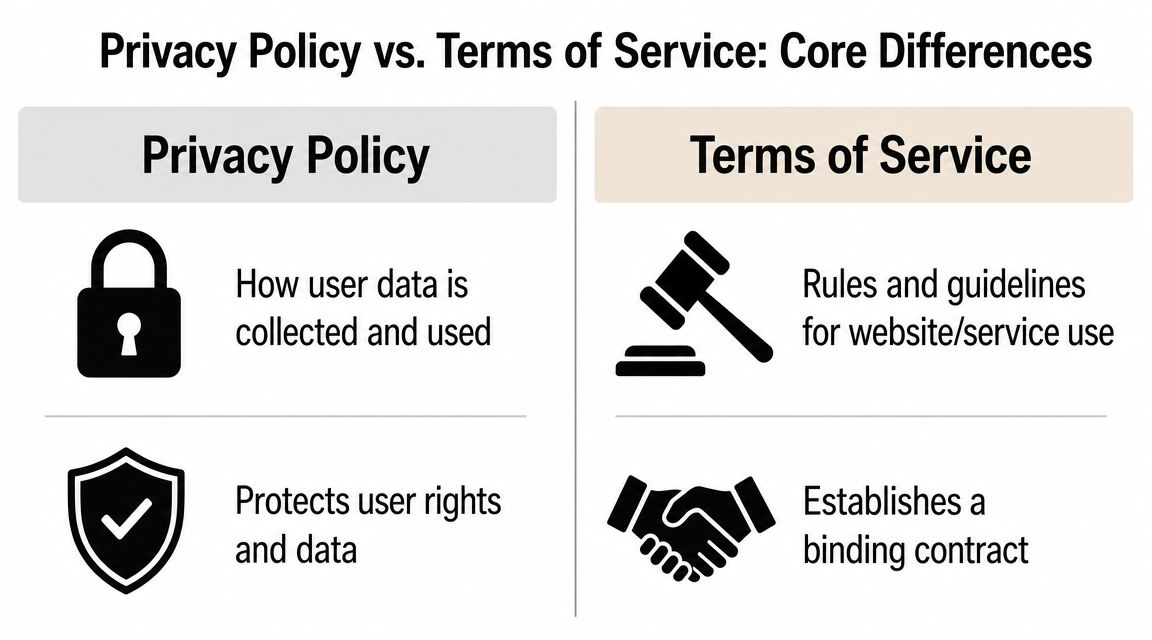
They're related, but they are not interchangeable. When owners search for privacy policy terms of service, they often assume one strong legal page can cover both jobs. In practice, that usually leads to a muddy document that does neither job well.
The privacy policy handles data
The operational difference is straightforward. A privacy policy governs personal-data collection, use, sharing, retention, and user rights, while terms of service govern the contractual rules of service use. Privacy policies commonly address rights such as access, correction, deletion, portability, and consent withdrawal, and they often reserve the right to retain data where needed for legal obligations, dispute resolution, or enforcement of agreements, as outlined in this privacy compliance guide.
For a local service business, that means your privacy policy should answer questions like:
- What do you collect: Name, phone number, email, address, service request details.
- Why do you collect it: To respond to inquiries, schedule visits, process payments, provide support.
- Who gets it: Scheduling software, payment processors, analytics providers, CRM tools, SMS platforms.
- What rights exist: How a user can ask for access, correction, deletion, or withdrawal of consent where applicable.
Here's a simple example. If a customer fills out a roof inspection form, your privacy policy should explain that you collect contact details and property information to review the request and schedule follow-up. If that request routes into a CRM or booking platform, the policy should say so.
The terms of service handle the relationship
Your terms of service are the rules of engagement. They answer different questions:
- Who may use the site
- What conduct is prohibited
- Who owns the content, logo, and website materials
- Whether website information is informational only
- How disputes are handled
- How liability is limited
If your site includes an online estimate form, your terms can clarify that estimates generated online are preliminary and subject to review. If your site allows account creation, customer uploads, or reviews, the terms can define what users may not post.
A quick visual recap helps:
| Document | Main job | Core question |
|---|---|---|
| Privacy Policy | Explain data practices | What information do you collect and what do you do with it? |
| Terms of Service | Set legal rules for site use | What are the rules and limits for using this website or service? |
For a short explainer in video form, this overview is useful:
If your privacy policy answers “data,” your terms should answer “boundaries.”
Key Clauses Your Privacy Policy Must Include
A usable privacy policy isn't written for a lawyer reading in a quiet office. It's written for a customer who wants a clear answer about what happens after they click submit.
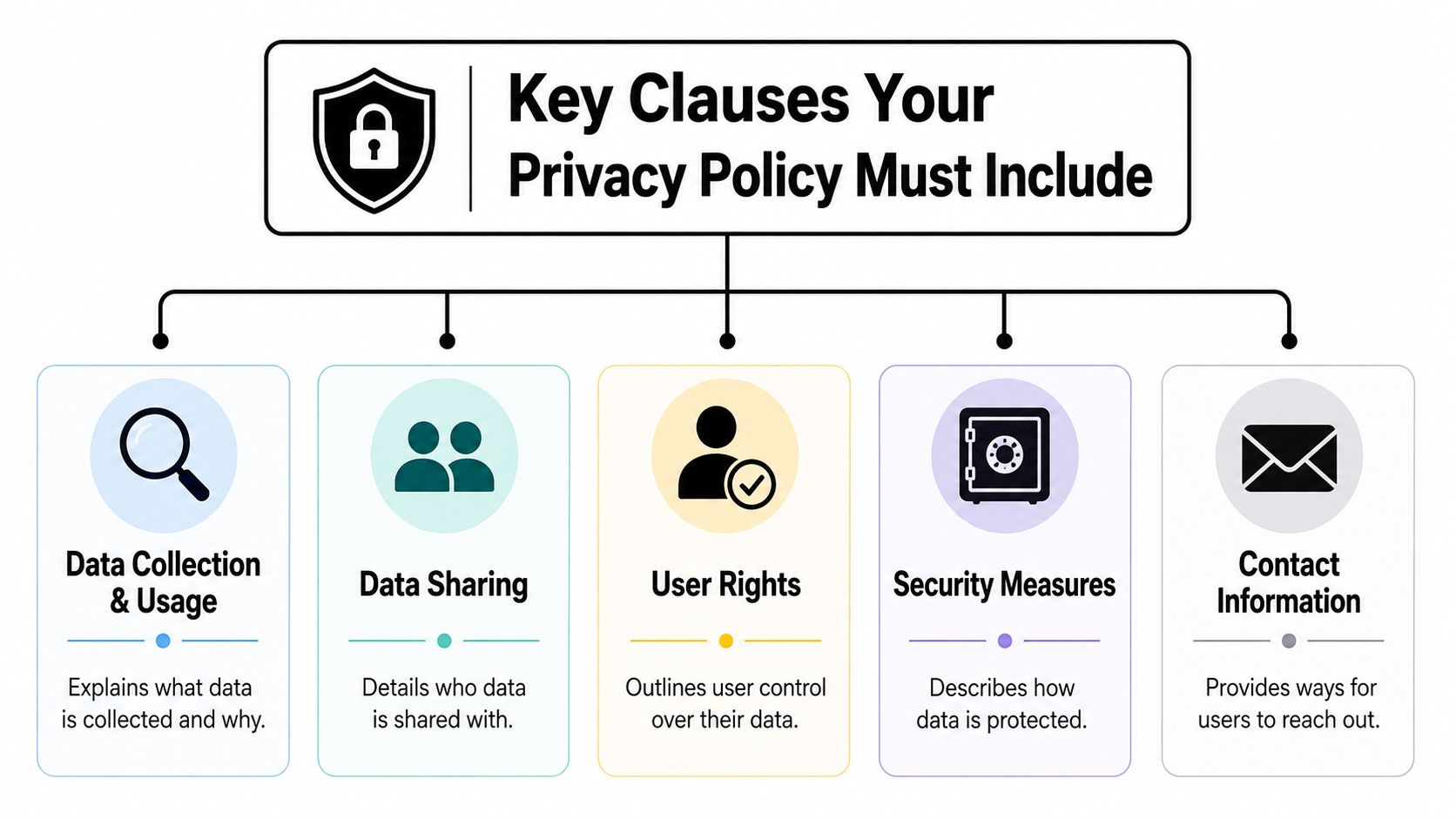
Information you collect
Start with the obvious. Tell people what you collect directly and what may be collected automatically.
For a cleaning company, HVAC contractor, or law office, that often includes:
- Contact details: Name, email, phone number, mailing or service address.
- Request details: Service type, preferred date, notes about the project.
- Website activity: Basic analytics, cookie-related data, device or browser information if your tools capture it.
Example language in plain English: you collect a homeowner's address to prepare a service quote and schedule a visit.
How you use the information
This clause should connect each type of data to a business purpose. Don't just say “for business operations.” Be specific enough that a customer can follow the logic.
A better approach looks like this:
- Responding to inquiries: Use phone and email details to reply to quote requests.
- Scheduling work: Use address and appointment details inside a booking tool.
- Processing transactions: Use billing information through a payment processor.
- Improving the site: Use analytics to understand which pages people visit before submitting a form.
If your site runs on WordPress, a practical resource on WordPress and GDPR can help you think through plugin-related data collection, consent tools, and site-level disclosures before you finalize the text.
Data sharing and third parties
Many small businesses often become too vague in their policy statements. “We may share data with trusted partners” isn't enough to be useful.
List the categories of vendors that receive data. For example:
- Scheduling platforms: A customer's name, phone number, and preferred appointment time may go to your scheduler.
- Payment processors: Billing details go to the processor handling transactions.
- Analytics providers: Site usage information may be processed by analytics tools.
- Chat or SMS providers: Messages and contact details may pass through communication platforms.
If you're not sure whether Google Analytics is collecting what you think it is, review your setup before writing the clause. A simple operational check like this guide on how to give access to Google Analytics can help the right team member inspect the configuration instead of guessing.
User rights and requests
This clause tells people what they can ask for and how they should ask. Depending on where your users are located and what rules apply, policies commonly cover rights such as access, correction, deletion, portability, and withdrawal of consent.
Make the request path simple:
- Use a dedicated email address or contact method
- Identify what information the requester should provide
- Explain that some information may still be retained when needed for legal obligations, dispute resolution, or enforcing agreements
The best privacy policies read like a map. A customer can see what data enters, where it goes, and how to ask questions about it.
Security and contact details
You don't need to publish a technical manual. You do need to explain, at a reasonable level, that you use measures to protect information and that no internet transmission is guaranteed to be fully secure.
Finish with direct contact information for privacy questions. If someone wants to ask about deletion, correction, or consent, they shouldn't have to hunt through your site.
Structuring Your Terms of Service Agreement
Your terms of service protect the business side of the relationship. They matter most when something goes wrong, which is why generic wording often fails at exactly the worst moment.

Clauses that do real work
A strong terms page usually includes a few clauses that carry most of the practical weight.
| Clause | Why it matters | Small business example |
|---|---|---|
| Acceptance of terms | Shows users are agreeing to the rules | A customer creates an account or checks a box before submitting a booking |
| Permitted and prohibited use | Limits misuse of the site | No scraping, spam submissions, or abusive messages through forms |
| Intellectual property | Protects your branding and content | Your logo, service descriptions, photos, and copy remain your property |
| Disclaimers | Clarifies what the site does not guarantee | A blog article or FAQ isn't personalized legal, medical, or technical advice |
| Limitation of liability | Reduces exposure if the site causes an issue | A booking glitch or website typo doesn't create unlimited liability |
If you want a plain-language primer on protecting business creations, this overview of intellectual property protection is useful background before you draft your ownership clause.
A practical example of liability limits
Say your paving company's site has an instant quote form. A user enters square footage, and the form returns a number that turns out to be incomplete because the property details were entered wrong or the calculator missed a condition. Without terms, that online estimate can become a source of conflict.
Your terms should clarify that:
- website content is provided for general informational purposes
- online estimates are preliminary
- final pricing depends on inspection, scope, location, materials, and approved work
- the business isn't responsible for losses tied to reliance on preliminary website content beyond what the agreement allows
That doesn't give you permission to be careless. It gives you a defined boundary.
Don't forget content and conduct
Service businesses often overlook user conduct clauses because they assume only software platforms need them. But if your site has forms, comments, portals, uploads, chat, or review submissions, you need rules around misuse.
A short clause can prohibit unlawful use, attempts to interfere with the site, impersonation, and submission of false or harmful material. Another can reserve your right to suspend or block access when necessary.
Your terms of service shouldn't sound aggressive. They should sound clear, calm, and enforceable.
Compliance Checkpoints for US Businesses
For U.S. businesses, compliance is no longer just about posting a privacy page in the footer and moving on. The harder part is making sure the page matches your actual tools, vendors, and consent flow.
A major blind spot is how privacy policies and terms work together once a site uses analytics, chat widgets, payment processors, or SMS tools. Many articles explain that policies disclose collection and sharing, but they don't answer the operational question users care about most: which vendor receives the data and under what legal basis. The same gap matters because users often struggle to understand disclosures, and state laws now provide rights such as access, deletion, correction, and opt-out of targeted advertising, sale, and certain profiling, including Florida's newer sensitive-data and voice/facial-recognition opt-outs, as discussed in this analysis of practical privacy-policy gaps.
Audit the tools, not just the text
If you run a local business site, use this simple audit process.
List every data entry point
Contact forms, booking forms, live chat, newsletter signup, call tracking, payment pages, SMS opt-in forms, and embedded maps.Match each entry point to a vendor
Form builder, CRM, scheduler, payment processor, analytics tool, chat software, ad platform.Ask what data moves
Name, phone, email, address, notes, device data, cookies, appointment details, payment details.Check the legal page against reality
If your privacy policy doesn't mention those categories of sharing or rights pathways, it needs work.
A practical small business checklist
Use this when reviewing your own site:
- Contact form: Does the policy explain what information the form collects and where submissions are stored?
- Analytics: Does the policy explain that site usage data may be processed by analytics vendors?
- Chat widget: Does it disclose that conversations and contact details may be handled by a third-party provider?
- Scheduler: Does it explain that appointment information goes through a scheduling platform?
- Payments: Does it identify that payment information is processed by a payment provider rather than directly by you?
- SMS or mobile workflows: Does the policy state how consent works and whether mobile information is shared for marketing purposes?
This work is detailed, but it's not glamorous legal theater. It's documentation. If you need help organizing drafts, vendor lists, and policy revisions before attorney review, some businesses use support like Paralegal Assistants to clean up the administrative side of compliance.
Where owners usually get tripped up
Most problems start with assumptions:
- “Our web designer handled that.”
- “The plugin probably covers it.”
- “We only collect basic info.”
- “We don't sell data, so we're fine.”
Those assumptions usually fall apart when someone asks for details. A practical starting point is a focused review of whether your website needs a privacy policy, then comparing that answer against your actual stack of tools and vendors.
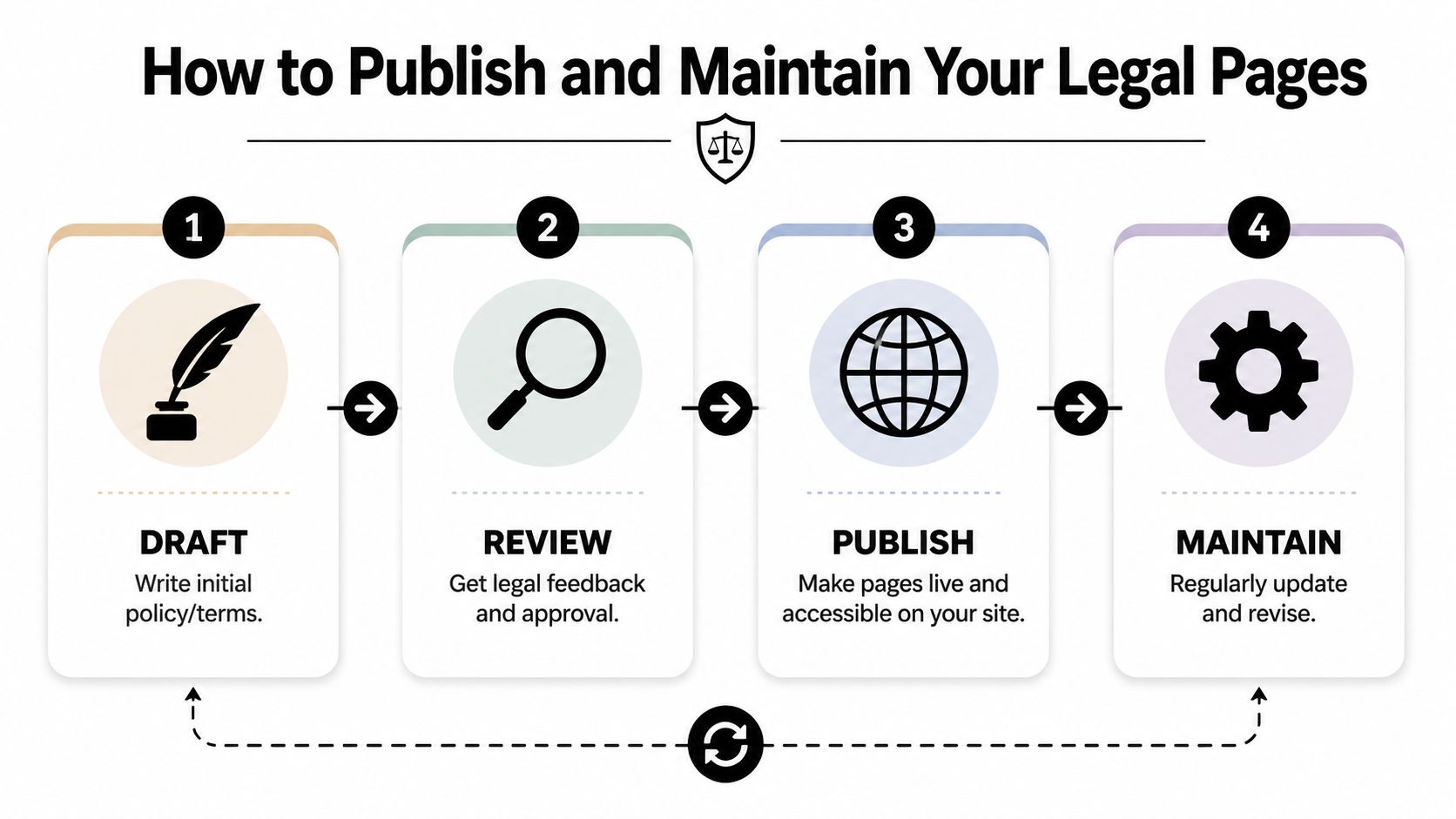
How to Publish and Maintain Your Legal Pages
Good legal pages don't help much if nobody can find them, nobody agrees to them properly, or nobody tracks changes after launch.
Publish them where people expect to find them
At a minimum, place links to your Privacy Policy and Terms of Service in the website footer so they're available across the site. If you collect leads through forms, it also makes sense to reference the privacy policy near the form itself. If you run checkout, membership, or account creation, your terms should be presented in that flow too.
There's a practical difference between passive availability and active acceptance:
- Browsewrap style notice: A user can access the policy through site links. This is common for privacy disclosures.
- Clickwrap acceptance: A user checks a box or clicks agreement language during signup, booking, or checkout. This is stronger for terms you may need to enforce later.
For service businesses, clickwrap is usually the better move when users create accounts, submit service requests with contractual consequences, or pay online.
Treat updates like controlled changes
The biggest risk isn't merely whether you have legal pages. It's how you change and enforce them. The FTC has warned that unannounced or retroactively changing a privacy policy or terms of service can be unfair or deceptive, so versioning, notice, and consent tracking should be treated as audit-critical controls rather than basic editing tasks, as noted in this compliance-focused discussion of policy changes.
That has practical consequences.
Maintenance rule: If the website adds a new vendor, new tracking, new SMS workflow, or new booking process, review the legal pages before or at launch, not months later.
A workable maintenance routine
You don't need a complicated governance program. You do need discipline.
- Keep dated versions: Save each published version with its effective date.
- Log material changes: Note what changed, such as adding a chat widget or updating deletion request handling.
- Notify users when needed: If a change affects rights, processing, or terms of use in a meaningful way, provide notice through the right channel.
- Track acceptance where relevant: For terms tied to account creation, booking, or checkout, keep a record of the version accepted.
If you're starting from scratch, reviewing a live example of a website privacy policy structure can help you think through layout, footer placement, and readability before your own final draft goes live.
Privacy and Terms FAQs for Small Businesses
Can I copy a competitor's policy?
You can look at competitor pages to see what topics they cover. You shouldn't copy their text and pretend it fits your business. Their tool stack, retention practices, payment setup, SMS flow, and consent process may be completely different from yours.
A copied policy is one of the fastest ways to publish something inaccurate.
Do I really need a lawyer?
Not every small business needs a custom legal memo before publishing basic pages. But most businesses benefit from legal review if they have online payments, account creation, regulated services, user-generated content, multi-state operations, or a more complex vendor stack.
A practical approach is to draft from real operations first. Map your forms, analytics, chat, scheduling, and payment tools. Then have a qualified reviewer tighten the language and risk points.
Are online generators good enough?
Generators can be a useful starting point. They are not a substitute for knowing how your site works.
The danger is false confidence. A template may ask broad questions, but it won't know that your intake form sends data to one system, your scheduler sends confirmations through another, and your chat tool stores transcripts elsewhere. That's why template language often sounds complete while staying operationally thin.
What's the real issue with outdated templates?
Privacy rights are becoming more granular. Recent privacy policies increasingly state that mobile information will not be shared for marketing or promotional purposes, and some now disclose separate rights to limit sensitive-data use or opt out of collection tied to voice or facial recognition features, reflecting a shift toward more specific rights and consent expectations, as described in this recent privacy-policy example analysis.
That means a static template can go stale fast if your business adds cookies, SMS, targeted advertising, or channel-specific consent language.
Do I need both a privacy policy and terms of service?
If your website collects personal information, a privacy policy handles the data side. If your website offers services, bookings, content, customer accounts, or any interaction where rules matter, terms of service help define boundaries and protect the business.
For most real-world service websites, the answer is yes. Not because it sounds formal, but because the site is already doing two different things. It's collecting data and creating customer interactions.
If your website uses forms, analytics, chat, booking tools, or online payments, your legal pages should match those workflows exactly. Polaris Marketing Solutions helps small businesses build websites that don't just look professional, but also reflect how the site operates so your privacy policy and terms aren't an afterthought.