

Submitting your website to online directories probably sounds like an ancient SEO tactic, right? Something left over from the dial-up days. But for local businesses, especially here in places like Fort Myers or Cape Coral, writing them off is a huge mistake. The truth is, directory submissions are still a powerhouse for local SEO. The game has just changed—it's no longer about volume, but precision.
Why Directory Submissions Are Still a Big Deal for Local SEO

Let’s get one thing straight: the idea that directories are "dead" is a dangerous myth. For any business trying to win local customers, they are absolutely critical.
Think of it this way. Instead of blanketing the entire county with cheap flyers, you’re now walking up to your ideal customers and handing them a business card right when they need you. That's what a high-quality directory listing does. It acts as a trusted, third-party stamp of approval for your business. For example, when a tourist in Naples searches "best seafood restaurant near me" on their phone, a well-maintained Yelp profile with great reviews is far more likely to win their business than a restaurant that doesn't show up at all.
The Game Changed from Quantity to Quality
Back in the early 2000s, SEO was a wild west. Marketers would scramble to get their sites listed on every directory they could find, from massive catalogs like the old Open Directory Project (which had over 4 million listings) to tiny niche hubs. And it worked! By 2005, it wasn't uncommon for sites with a hundred or more directory links to see ranking jumps of 30-50 positions.
But Google got a whole lot smarter. Today, a few strategic listings on authoritative directories are worth more than hundreds of links from spammy, irrelevant ones.
A smart directory strategy builds trust with search engines and creates a rock-solid foundation for your local SEO. It’s all about being seen in the right places, not all the places.
Building the Foundational Signals Google Loves
For local businesses, this refined approach is everything. Google relies on these directory listings—also called citations—to verify that your business is real, active, and located where you say it is. To really get a handle on this, a foundational understanding of directories and how they work is key.
When your business information is consistent and accurate across the web, you unlock some powerful benefits:
- You Climb the Local Map Pack: Every correct listing on a major site like Yelp or an industry-specific portal tells Google your business is legit. This is a huge factor in ranking higher in local map results. For instance, a Fort Myers plumber with 20 consistent, high-quality citations is more likely to appear in the top 3 map results than a competitor with 50 inconsistent or low-quality listings.
- Your Brand Gets Seen More: You need to be where your customers are looking. Whether that’s an industry blog, a review site, or your local Chamber of Commerce, each listing puts your brand in front of a ready-to-buy audience.
- You Get High-Quality Traffic: Someone searching on a "best pavers in Naples" list is a hot lead. They’re much further down the buying path than a random searcher, and that kind of referral traffic is gold.
Ultimately, a focused directory submission plan proves to both customers and search engines that you’re a credible, established authority in your local market.
Building Your High-Impact Local Directory Hit List

So, where do you even begin with directory submissions? It’s easy to get lost in an endless sea of options, but the key isn't quantity—it's quality. Forget the old-school advice about submitting to hundreds of spammy sites.
Your goal is to build a laser-focused "hit list" of directories that will actually drive results. We’re going to focus on the listings that matter, leaving the rest behind.
Start with the Heavy Hitters
Before you do anything else, you need to get your information right with the major data aggregators and high-authority platforms. These are the giants of the directory world, and their data feeds hundreds—sometimes thousands—of smaller sites, apps, and GPS systems.
Getting your business listed correctly here is non-negotiable. We're talking about platforms like:
- Apple Maps
- Yelp
- Bing Places for Business
- Foursquare
Think of these as the foundation of your entire local SEO strategy. Once these are solid, you can move on to the more specialized directories. For example, getting your restaurant listed correctly on Foursquare ensures its data is accurate not just there, but also on apps like Uber, which uses Foursquare's data for location services.
Uncover Niche and Industry-Specific Directories
Next, it's time to hunt for directories that cater specifically to your trade. These are incredibly powerful because they send crystal-clear relevance signals to Google. A listing on an authoritative industry site confirms to search engines that you are a specialist in your field.
For instance, a Naples-based law firm would make sure they have a stellar profile on Avvo. A custom home builder would prioritize getting listed with the National Association of Home Builders.
Finding these gems is easier than you think. Just use some targeted Google searches:
"plumbing" + "business directory"inurl:directory "landscaping services""attorney directory" + "florida"
These search strings help you bypass the general-purpose clutter and find the portals where your ideal customers are already looking.
Find Hyperlocal Gems in Your Service Area
Finally, you need to drill down to the hyperlocal level. These are the listings that prove you’re a real, active part of your local community, whether that’s Fort Myers, Bonita Springs, or Cape Coral.
Your local Chamber of Commerce, neighborhood business associations, and city-specific directories are SEO gold. They provide powerful, geographically-relevant signals that are hard for competitors to replicate.
To find these opportunities, just get specific with your searches:
"fort myers" + "business directory""cape coral" business listings"bonita springs chamber of commerce"
These listings don't just give your SEO a boost; they can be a fantastic source of direct customer referrals. If you want to go deeper on this strategy, our professional local citation building services can give you a serious competitive edge.
One last pro tip? Ethically spy on your top local competitors. See where they’re listed, and make sure you’re there, too. This simple competitive analysis often uncovers high-value directories you might have missed. For example, searching for your top competitor's business name and phone number in quotes (e.g., "Competitor Name" "(239) 555-1234") can reveal all the directories where they have citations. Combine these three approaches, and you'll build a powerful, targeted list that makes every submission count.
How to Create a Flawless Business Profile
Hold on. Before you start firing off submissions to every directory you can find, there’s a foundational step that will save you a world of frustration down the road. In local SEO, consistency isn't just a good practice—it's the whole game. Even a seemingly tiny difference in your business information can send mixed signals to Google and chip away at the very trust you’re trying to build.
This is where creating a "master profile" comes in. Think of it as your single source of truth—one definitive document that houses all your core business information, ensuring every single submission is a perfect, identical match.
Nail Down Your NAPW Consistency
The absolute core of your master profile is your NAP (Name, Address, Phone Number). Over the years, this has rightly evolved into NAPW to include your Website. Search engines like Google crawl hundreds of sites, cross-referencing this exact data to confirm that your business is legitimate and located where you say it is.
One small mistake here can have an outsized impact. If one directory lists your address as "123 Main St." and another has it as "123 Main Street," Google’s algorithm might interpret them as two separate entities. This splits your SEO value and creates a confusing experience for customers trying to find you.
The goal is to make your business's digital footprint so consistent that search engines have zero doubt about who you are, what you do, and where you're located. This is the bedrock of a strong local presence.
To get this right from the start, I always have my clients build out a simple spreadsheet. This document becomes the one and only place you copy-paste from for every submission. No exceptions.
To help you get started, here’s a simple template you can use to collect and standardize your own information. Fill this out once, and then use it for every single directory you submit to.
Business Information Master Template
| Data Point | Your Business Information (Example for a Fort Myers Contractor) |
|---|---|
| Business Name | Fort Myers Elite Contracting LLC |
| Street Address | 1234 Contractor Ave, Suite 56 |
| City | Fort Myers |
| State | FL |
| ZIP Code | 33901 |
| Phone Number | (239) 555-0123 |
| Website URL | https://www.fortmyerselitecontracting.com |
| Business Category | General Contractor |
| Hours of Operation | Mon-Fri: 8:00 AM – 5:00 PM, Sat: 9:00 AM – 1:00 PM, Sun: Closed |
Having this locked in and ready to go is half the battle. Our comprehensive Google My Business optimization checklist dives even deeper into refining these critical details for maximum impact.
Prepare Your Business Descriptions Ahead of Time
Here's another rookie mistake: writing a new business description on the fly for every directory. Not only is it a massive time sink, but it’s a surefire way to create brand inconsistencies. Different platforms have different character limits, so the smart move is to prepare three versions in advance.
- The Short Snippet (approx. 250 characters): This is your elevator pitch. It needs to quickly state who you are, what you do, and the main area you serve. Think of it as what you'd put in a Twitter bio or a tightly constrained directory field. Example: "Fort Myers Elite Contracting LLC offers premier home remodeling and general contracting services in SWFL. Family-owned with 20+ years of experience. Licensed & insured."
- The Medium Summary (approx. 750 characters): Here’s where you can breathe a little. Expand on your core services, highlight what makes you different (like "family-owned" or "24/7 emergency service"), and list your primary service areas, such as Fort Myers and Naples. Example: "Fort Myers Elite Contracting is your trusted partner for high-quality home renovations and general contracting. We specialize in kitchen and bathroom remodeling, room additions, and custom lanai enclosures. As a family-owned business, we pride ourselves on exceptional craftsmanship and customer service. Serving Fort Myers, Cape Coral, and Bonita Springs."
- The Full Story (1,000+ characters): This is your chance to go all in. Talk about your company’s history, your unique value proposition, the full range of services you offer, and the kind of experience customers can expect.
Having these descriptions pre-written and saved in your master document ensures your messaging stays consistent while still fitting the requirements of each platform. To keep your GMB profile itself perfectly managed, a dedicated Google Business Scheduler can be a huge help. A little bit of prep work now makes the entire submission process smoother and far more effective in the long run.
Getting Your Hands Dirty: The Manual Submission Process
You’ve got your list of high-impact directories and your master business profile is locked and loaded. Now comes the part where the rubber meets the road. I won't lie—manual submission can feel like a grind, but doing it with a clear system is what separates the pros from the amateurs. This is where all that prep work pays off and turns into real, high-quality listings that Google loves.
Every directory has its own unique form, but they all ask for the same core information you’ve already prepped. Your main job is to carefully copy and paste from that master file, making sure every single detail is perfect. This methodical approach is your best defense against the tiny errors that can seriously water down your local SEO power.
Think of it like this: the heavy lifting is already done. Your standardized business info, consistent descriptions, and master file are the foundation. The submission part is just the final assembly.
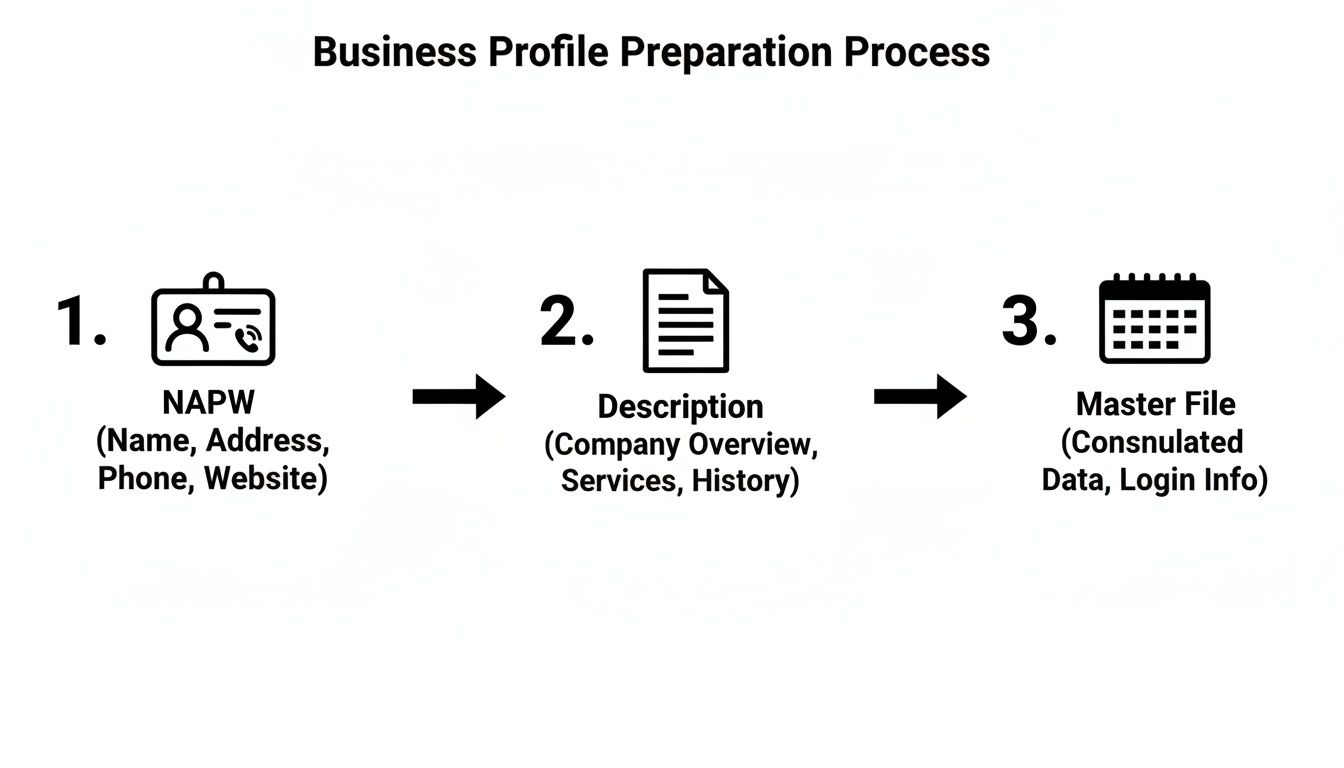
This really drives home the point that successful directory submission happens before you even open a single form. Execution is all about what you did to prepare.
Navigating the Submission Forms
As you start filling things out, you'll hit a few common forks in the road. One of the biggest is choosing the right business category. My advice? Get as specific as you possibly can. If you're a roofer, don't just settle for "Home Services." Dig deeper for "Roofing Contractor" or, even better, "Metal Roofing Specialist" if that option exists. Granularity matters.
Most directories will also give you space to upload a logo and photos. Don't skip this. Always use high-resolution images that look professional. Your logo is your brand's handshake, and photos of your crew, your completed projects, and smiling customers build immediate trust and make your profile pop.
Pro-Tip: I always recommend setting up a dedicated email address just for directory submissions (something like listings@yourbusiness.com). It keeps all the verification emails and account notifications in one place, preventing your main inbox from becoming a chaotic mess. It's a small step that makes managing everything so much cleaner.
Once you hit "submit," you're not quite done. The next step is verification. Most listings won't go live until you prove you're the real owner, which usually happens in one of three ways:
- Email Verification: This is the most common. You’ll get an email with a confirmation link you have to click. Simple enough.
- Phone Verification: Some of the bigger players, like Google Business Profile, might call your business number with an automated message or text you a PIN to enter online.
- Mail Verification: It’s less common now, but some directories will still send a postcard to your physical address with a verification code.
Stay on top of your new "listings" email inbox. You don't want to do all this work just to have a listing sit in limbo because you missed the verification step.
Doing It Yourself vs. Paying for a Service
A question I get all the time is whether it’s worth paying for a service like BrightLocal or Yext. Honestly, it depends. If you're working with a tight budget, the manual approach is incredibly powerful and costs nothing but your time. By focusing on the top 20-30 most relevant directories, you can get fantastic results without spending a penny.
Paid services are all about speed and scale. They can push your business data out to dozens or even hundreds of directories at once, which is a massive time-saver. The trade-off is that it comes with a recurring monthly or annual fee. The right choice really comes down to your budget and how much time you can personally dedicate to this task.
Just remember, quality is everything. That became crystal clear after Google's Penguin update on April 24, 2012, which completely changed the game. The algorithm went after sites with spammy, low-quality links, and initial reports showed it hit over 3.1 million sites. Many saw their traffic tank by 50-90% overnight. Since then, the only sustainable strategy has been to focus on high-authority, relevant directories. You can read more about how SEO benchmarks shifted after this crucial update on activemarketing.com.
Tracking Your Listings and Measuring Real-World Results
Getting your business listed in directories is just the starting line. The real win comes from knowing what’s actually working. Simply firing off submissions without a way to track them is like trying to navigate without a map—you're moving, but you have no idea if you're headed in the right direction.
You don't need fancy software for this. Honestly, a simple spreadsheet is one of the most powerful tools in your arsenal. Just create columns for the directory name, the date you submitted, the verification status, and the final URL of your live listing. This keeps everything organized, ensures nothing falls through the cracks, and gives you a clear record of your work.
The biggest mistake we see businesses make is stopping right after they hit "submit." The true value is found when you connect that directory activity to real-world outcomes like referral traffic, phone calls, and, most importantly, better local search rankings.
Once you have a system for tracking, you can start measuring the impact. This is how you prove that your time and effort are paying off.
Connecting Submissions to Your Business Goals
Your directory work isn’t just about collecting links; it’s about generating leads and driving revenue. You can see the results for yourself using two free and incredibly powerful tools: Google Analytics and Google Search Console.
Inside Google Analytics, head over to the Acquisition > Traffic Acquisition report and set the filter to "referral" traffic. This is where you'll see which directories are sending actual visitors to your website. If you spot a high-quality site like your local Chamber of Commerce sending you engaged users, that’s a fantastic sign your strategy is on the right track.
Monitoring Your Local SEO Performance
At the same time, you should be keeping a close eye on Google Search Console. The Performance report is your best friend here. It lets you track your rankings for those crucial local keywords, like "HVAC repair in Naples" or "Fort Myers paving company." As your high-quality directory listings start going live and getting picked up by Google, you should see a gradual, steady improvement in your average position for these terms.
This isn't just theory—it delivers tangible results. For example, a Naples-based HVAC company we worked with saw a 15% jump in appointment calls coming directly from their Google Business Profile. This happened within just 60 days of us securing them listings on three top-tier home service directories. They could directly tie the increase in visibility and calls to that focused citation work. You can learn more about how to measure marketing ROI in our detailed guide.
To really get a handle on your efforts, focus on these key metrics:
- Referral Traffic: How many visitors are coming to your site directly from your directory listings?
- Local Keyword Rankings: Where are you showing up in Google for your most important location-based searches?
- Google Business Profile Insights: Watch for increases in calls, website clicks, and requests for directions.
- Lead and Conversion Tracking: At the end of the day, are more people filling out your contact form or calling your business?
When you consistently track this data, the task of submitting your website to directories is no longer a simple checklist item. It becomes a measurable, high-impact part of your overall marketing strategy.
Common Questions About Website Directory Submissions
Even with the best game plan, a few questions always come up during the directory submission process. It's completely normal. Let's tackle some of the most common ones we hear from business owners to give you the clarity and confidence to get it done right.
How Many Directories Should I Actually Submit To?
This is the first question on everyone's mind, and the answer might surprise you: it's all about quality, not quantity. For most local businesses, the sweet spot is getting listed in the top 20-30 directories that matter most for your industry and location.
Your initial focus should always be on the heavy hitters—think Google Business Profile and Yelp. After that, pivot to industry-specific sites and local powerhouses like your Chamber of Commerce. A slow and steady approach of adding just two or three high-quality listings per month is far more powerful for your SEO than blasting your info out to hundreds of junk sites at once. That shotgun approach just looks like spam to Google.
Are Paid Directory Submission Services Worth the Money?
Honestly, it all comes down to a trade-off: your time versus your budget.
Paid services like Yext or BrightLocal offer a massive leg-up in speed and efficiency. They can push your business data to dozens of directories simultaneously. More importantly, they often lock your listings to stop others from making unauthorized changes, which is a huge win for keeping your information consistent as you grow.
If you're a small business on a tight budget, manually submitting to your top 20-30 directories is an incredibly effective and completely free strategy. The real goal is consistency, whether you get there by hand or with a paid service.
If you have more time than money, the DIY route works great and delivers real results. But if your time is better spent running your business, a paid service can be a smart investment.
What Do I Do If I Find Incorrect or Duplicate Listings?
Finding bad data out there isn't a disaster—it's an opportunity. Cleaning up your digital footprint is one of the best ways to send positive trust signals to Google. Don't panic, and whatever you do, don't just create a new, correct listing. That only adds to the mess.
Instead, here’s the process to follow:
- Claim the Listing First: Look for a button that says "Claim this business" or "Suggest an edit" on the incorrect or duplicate profile. Follow their steps to prove you're the owner.
- Correct the Information: Once you have the keys, go in and carefully update the name, address, phone, and website using your master file.
- Merge or Delete the Duplicates: If you find more than one listing for your business on the same site, claim all of them if you can. Most platforms have a tool to "merge" the profiles or delete the extra ones. If you can't find it, a direct email to their support team is your next best step. For example, if you find two Yelp pages for your cafe, you would claim both, then contact Yelp support through their help center and request that they merge "Yelp Profile A" into "Yelp Profile B" (the one with more reviews).
Ready to stop guessing and start getting real results from your local SEO? The expert team at Polaris Marketing Solutions can build a powerful directory strategy that drives visibility and brings qualified customers right to your door. Get your free, no-obligation analysis today and see exactly how you stack up against the competition. Visit us at https://polarismarketingsolutions.com.