
Before you even think about calling a digital marketing agency, you need to get crystal clear on one thing: what do you actually want to achieve? This is the first, most critical step. Forget vague ideas like "more leads" and start thinking in terms of specific business outcomes that will guide your entire search.
Defining Your Business Goals Before Starting the Search
Walking into an agency meeting without clear goals is like setting off on a road trip with no destination in mind. You'll spend a lot of time and money, sure, but you'll have no idea if you're actually getting anywhere. The biggest mistake we see businesses make is asking for help with fuzzy objectives like "improving our online presence."
That kind of thinking just leads to frustration down the road. An agency might boost your social media followers, and technically, they've "improved your online presence." But if your real goal was getting more phone calls for your plumbing business in Fort Myers, a bunch of new Instagram fans won't do a thing for your bottom line.
Clarity is everything.
From Vague Hopes to SMART Goals
To get the right agency on board, you need to give them a specific target to hit. This is where the SMART framework—Specific, Measurable, Achievable, Relevant, and Time-bound—is so valuable. It’s how you turn a wish into a real, actionable plan.
Let’s translate this with an actionable example for a local Fort Myers business:
- Vague Goal: "I need more customers for my roofing company."
- SMART Goal: "Increase qualified leads for roof repair services from Cape Coral by 20% over the next six months by ranking in the top three of Google Maps for 'roof repair Cape Coral'."
See the difference? Now an agency has a clear mission. They know the exact service, the target location, the desired outcome, and the timeline. This process, as the visual below shows, is all about moving from abstract ideas to concrete, revenue-focused targets.
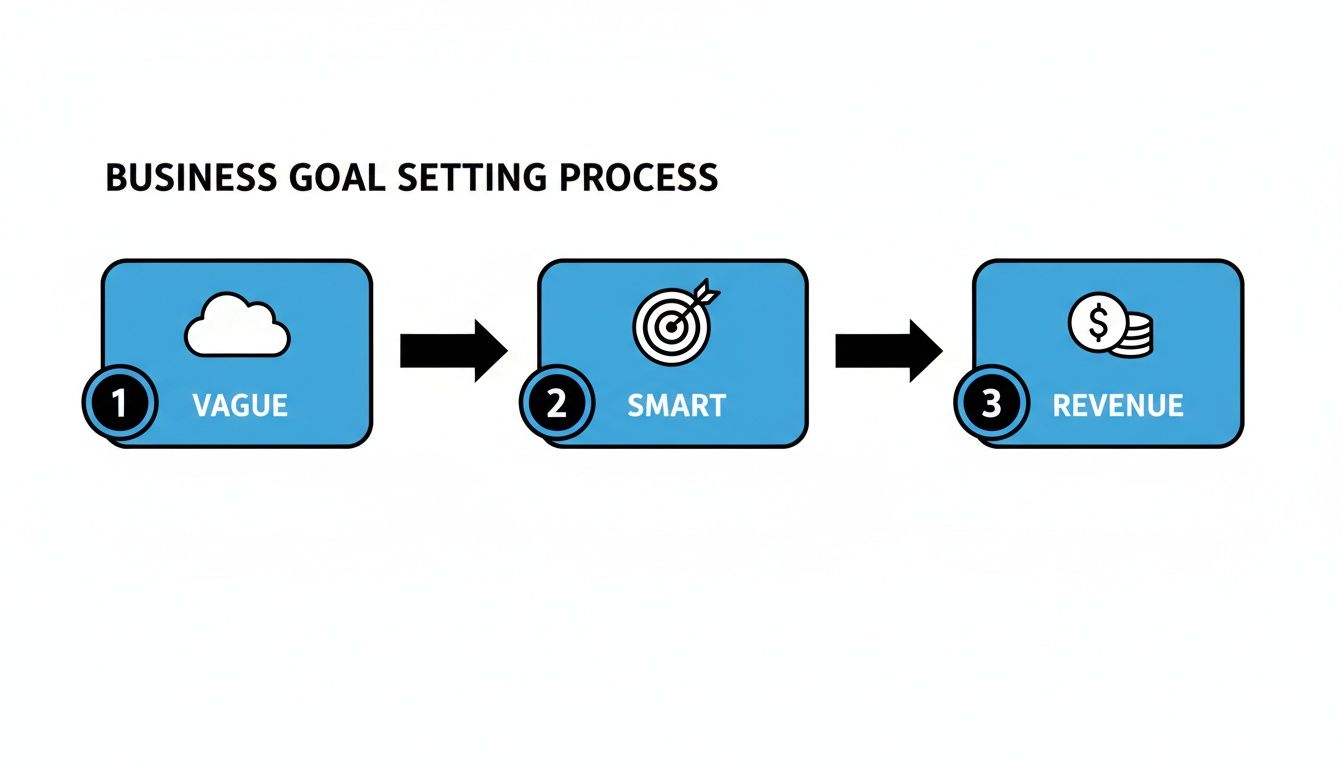
The big takeaway is that specific, measurable goals are tied directly to business results, giving you a real benchmark for success.
Why Specific Goals Matter for Your Search
When you show up with well-defined goals, the whole conversation changes. It's no longer a sales pitch; it becomes a strategic discussion. You can now judge potential agencies based on their ability to solve your specific problem, not just on their general list of services.
A well-defined goal is your North Star. It guides every decision, from the services you prioritize to the questions you ask, ensuring you partner with an agency that can deliver the results that directly impact your revenue.
For example, a boutique on Sanibel Island looking to triple its online sales during tourist season needs an expert in e-commerce and PPC advertising, not a generic SEO firm. Knowing that upfront helps you immediately filter out agencies that aren't the right fit. It's also smart to get a handle on what's working right now by reviewing these Top Digital Marketing Tips for Small Businesses.
Ultimately, doing this foundational work ensures you aren't just hiring a vendor. You're investing in a partner who is completely aligned with your growth. You can learn more about how to put these plans together by exploring different digital marketing strategies for small businesses.
Evaluating an Agency’s Fort Myers Market Expertise
When you’re picking a digital marketing partner, national awards don't mean much if they don't get the unique rhythm of Southwest Florida. A big-shot agency from New York or LA won’t know that "season" here means a flood of snowbirds, which completely changes how people search and where they shop from November to April. This isn’t a bonus feature; it’s a must-have.
A great local partner just gets it. They know the difference between marketing to year-round families in Cape Coral and vacationers on Fort Myers Beach. They understand which community events are worth sponsoring and which local publications people actually read. That on-the-ground intel is what makes a marketing campaign connect.

Audit Their Own Digital Footprint
Want to see if an agency has local chops? Start by looking at how they market themselves. It's the easiest sniff test there is. A quick Google search is incredibly revealing.
Actionable Example: Open an incognito browser window and search for "Fort Myers SEO agency" or "digital marketing Cape Coral." If an agency promising to get you on page one is stuck on page five themselves, that’s a huge red flag. How can they rank your roofing company if they can’t even rank their own site?
Next, dig into their Google Business Profile (GBP). For any local business, a well-managed GBP is ground zero for local SEO.
Here’s an actionable checklist:
- Recent Posts: Look for posts from the last 7-14 days. Are they actively sharing updates, offers, and company news?
- Legit Reviews: Do they have a consistent stream of positive reviews from other local businesses? And just as important, do they take the time to respond professionally to both good and bad reviews?
- Complete Profile: Is every section filled out? Check for detailed services, plenty of real photos (not just stock images), and a helpful Q&A section with answers provided by the agency.
If an agency’s own local presence is neglected, you can bet yours will be too. Their digital storefront should be a prime example of their best work.
Scrutinize Their Local Case Studies and Testimonials
Think of case studies as an agency's resume. Seeing a flashy national brand in their portfolio is fine, but it’s way more valuable to see success stories from businesses like yours, right here in SWFL.
Don't just glance at the logos—get into the weeds. If you own a dental practice in Bonita Springs, you want to see their work with other local medical offices or professional services. The marketing challenges for a local plumber are a world away from a national e-commerce brand.
Look for proof, not promises. The best indicator of future success is past performance in your specific market and industry. An agency that has already helped a Naples-based law firm increase its client intake has a proven playbook you can benefit from.
As you review their past work, ask pointed questions:
- "What specific problem were you solving for that client?" Look for challenges that sound familiar to your own business struggles, such as "low local search visibility" or "high cost-per-lead on Google Ads."
- "Can you detail the exact strategies you used?" Vague fluff like "improved SEO" doesn't cut it. Did they build local links, write content targeting specific neighborhoods, or run a Google Ads campaign in Estero? Get specifics.
- "What were the real, measurable results?" They need to show you the numbers. We’re talking a 40% increase in qualified leads or hitting the #1 ranking for a valuable local keyword.
Do the same thing with their testimonials. Are the reviews from local business owners you recognize? Generic praise is one thing, but a detailed review from another Fort Myers business owner who saw a tangible ROI is gold. It shows they’re making a real impact where it matters most—in our local economy.
Agency Local Proof Scorecard
Before you make a decision, use this scorecard to rate potential agencies objectively. It helps you move past the sales pitch and focus on tangible proof of their local expertise.
| Evaluation Criteria | Agency A Score (1-5) | Agency B Score (1-5) | Notes/Examples |
|---|---|---|---|
| Ranks for Local Keywords | 4 | 2 | e.g., Agency A is #3 for "Fort Myers SEO agency" |
| Optimized Google Business Profile | 5 | 3 | A has weekly posts; B's last post was 2 months ago |
| Recent, Positive Local Reviews | 5 | 4 | A's reviews are from SWFL businesses; B has national clients |
| Relevant Local Case Studies | 4 | 2 | A showed a case study for a local plumber (my industry) |
| Measurable Results (KPIs) | 5 | 3 | A showed a 50% lead increase; B showed traffic % |
| Local Team/Physical Address | 5 | 1 | A has an office in Fort Myers; B is fully remote |
| TOTAL SCORE | 28 | 15 |
Tally up the scores. This simple exercise can quickly reveal which agency truly has the on-the-ground experience to help your business win in Southwest Florida.
Comparing Agency Services and Partnership Models
Picking a digital marketing agency isn't like ordering from a menu. You’re not just choosing a list of services; you're choosing a partner. The way an agency structures its relationships tells you everything you need to know about the experience you're about to have. It’s the key to finding a true partner in growth, not just another vendor sending you invoices.
You’ll generally run into two models: project-based work and retainer partnerships. Each has its place, but choosing the wrong one for your goals can lead to a lot of frustration and wasted money.
The Full-Service Agency vs. The Niche Specialist
One of the first forks in the road is deciding between an agency that does a bit of everything and one that’s laser-focused on a single skill.
A full-service agency is essentially your outsourced marketing department. They handle it all—from building your website and mastering local SEO to running social media and managing your pay-per-click ads. The big win here is cohesion; every piece of your marketing works together under one unified strategy.
Actionable Example: A new real estate agency in Fort Myers needs a brand launch. A full-service partner is perfect for this, as they can build the website, optimize the Google Business Profile for local searches, and run lead-gen ads simultaneously, ensuring the message and branding are consistent everywhere.
On the flip side, a niche specialist does one thing, and they do it exceptionally well. You might hire one firm just for their expertise in TikTok advertising or another for highly technical SEO. This is the right move when you already have a solid in-house team but need to plug a specific, high-level skill gap.
Actionable Example: Your Fort Myers cafe has a killer organic social media game but is losing money on Google Ads. A PPC-only specialist could be a smart, cost-effective hire to come in, fix the campaigns, and lower your cost-per-lead without disrupting your other successful marketing efforts.
Retainer Partnerships for Long-Term Growth
A retainer model is a long-term agreement where you pay a fixed monthly fee for ongoing work. This is the gold standard for services like SEO and content marketing, where results don’t happen overnight. It’s like having an expert on your team, constantly looking out for your business.
This steady relationship allows the agency to get to know your business inside and out, pivot when the market shifts, and build real momentum. A retainer fosters a proactive, strategic partnership.
A retainer transforms an agency from a service provider into a strategic partner. They become invested in your long-term success because their success is tied directly to yours, leading to more thoughtful, data-driven decisions that build sustainable growth.
The data backs this up. Retainer-based agencies have the lowest annual client churn rate at just 18%, with the average partnership lasting nearly five years. That stability speaks volumes about the value businesses see in sustained collaboration. You can dig into more of the numbers on agency client retention rates at focus-digital.co.
Project-Based Work for Specific Needs
In contrast, project-based work is transactional. You hire an agency for a single, defined task with a clear start and end. It’s the perfect fit for one-off needs, like a website redesign, a new logo, or a short-term ad campaign for a seasonal promotion on Sanibel Island.
Actionable Example: A local restaurant needs a new website before tourist season starts. They hire an agency for a one-time project with a fixed cost and a 60-day timeline. The agency builds the site, hands over the keys, and the engagement is done.
While it's great for plugging an immediate hole, this model isn't built for growth. The agency that builds your website won't be there three months later to make sure it's actually ranking on Google. For a business trying to steadily grow its market share in Southwest Florida, a disconnected, project-by-project approach rarely gets the job done.
Asking the Right Questions in Your First Meeting
That first meeting with a potential marketing agency is more than a sales pitch. It’s your best shot at interviewing a future strategic partner before you commit. Going beyond a simple, "What are your prices?" is absolutely critical. This is where you get to peek under the hood and see how they really think, strategize, and operate.
Think of the right questions as a flashlight. They cut through the polished presentations and illuminate an agency’s true capabilities, helping you figure out if you’re talking to a genuine growth partner or just another vendor.
Probing into Strategy and Process
Any agency can show you a pretty portfolio. What you really need to understand is the thinking that produced those results. This means digging into their strategic process, not just admiring the finished product.
Here are a few actionable questions to ask:
- "Can you walk me through a recent successful campaign for a business like mine, from the initial strategy session to the final report?" This question forces them to ditch the canned case study and show you the real, step-by-step journey. Listen for details about their initial audit, goal-setting, campaign execution, and how they measured success.
- "For my business goal of X, how would you decide which channels—SEO, PPC, social—will actually deliver the best ROI?" Their answer will tell you if they offer a data-driven, tailored plan or just push a one-size-fits-all package. A great answer might be, "Given your goal of immediate leads for emergency AC repair, we'd start with Google Ads, as SEO will take months to show results."
- "What’s your process for competitor analysis, and what tools do you rely on to find opportunities?" This gets to the heart of their strategic depth. For a local Fort Myers business, knowing what your direct competitors are doing is gold, and a sharp agency will have a robust method for digging that up. If you want to get a head start, you can check out some of the best tools for competitor analysis.
Uncovering Operational Agility and Tech Integration
In today's market, speed wins. A brilliant strategy is worthless if it takes an eternity to execute. You need to know how quickly an agency can turn an approved idea into a live campaign that starts putting money back in your pocket.
Recent data shows that while 46% of marketers use AI to speed things up, a shocking 41% still need three to four weeks just to get a campaign out the door. A delay like that could mean missing a key seasonal promotion here in Fort Myers. Getting a real sense of an agency's operational speed is vital. You can read more about digital advertising trends and efficiency at smartly.io.
To test their agility, get specific with your questions:
- "What’s your average turnaround time from strategy approval to campaign launch?" If the answer is more than a week or two, that’s a red flag.
- "How do you balance AI-powered tools with human oversight? For example, do you use AI for keyword research but have a human strategist review and approve the final list?" This helps you see if they're using modern tech responsibly, without letting robots kill the strategy and creativity.
- "Describe your internal workflow for creating and getting approval on new ad creative or a blog post." This peels back the curtain on their project management and shows you what communication will really look like. A good process might involve a shared project board like Asana or a clear email approval chain.
An agency’s operational cadence is a direct reflection of how they value your time and budget. A team that can launch campaigns swiftly is better equipped to adapt to market changes, capitalize on trends, and ultimately drive a faster return on your investment.
Clarifying Communication and Reporting
Finally, you have to get crystal clear on how the day-to-day partnership will actually function. Misaligned expectations on communication and reporting are one of the top reasons agency relationships fall apart. Don't leave this to chance.
Get absolute clarity by asking these actionable questions:
- "Who will be my main point of contact, and how much direct experience do they have with accounts like mine?" You need to make sure you won't be handed off to a junior account manager the second the ink is dry on the contract.
- "What does your standard monthly performance report look like? Can you show me a sample?" Look for a report that ties marketing activity directly to business outcomes—leads, sales, revenue—not just vanity metrics like clicks and impressions. A good report shows, "We spent $500 on ads, which generated 20 leads, resulting in 5 new customers and $5,000 in revenue."
- "How do you attribute marketing efforts to actual revenue?" This is the million-dollar question. A sophisticated agency will have a solid answer that involves tracking pixels, CRM integrations, or call tracking. For example, "We use call tracking numbers on your website and in your ads to know exactly which campaigns are making the phone ring."
By asking these targeted, practical questions, you turn that initial meeting from a sales pitch into a genuine interview. It’s the only way to make a true apples-to-apples comparison and find an agency that isn't just skilled, but is the right operational and cultural fit for your business.
Understanding Contracts, Pricing, and How to Measure ROI
Okay, let's talk about the part where the promises get put on paper: the contract. This document is where everything from payment terms to performance goals becomes legally binding. Getting this right isn't just about spending money; it's about making a smart investment with a clear path to getting a return.

As you start getting proposals, you'll notice a few common ways agencies structure their fees. The best model for you really just depends on your goals and what services you actually need.
Decoding Agency Pricing Models
Most agencies have a few go-to pricing structures. The most common is a monthly retainer, especially for ongoing work like SEO or social media management. This fixed fee makes budgeting predictable and helps build a real partnership over time.
Another one you'll see a lot is percentage-of-spend. This is the standard for pay-per-click advertising. The agency’s fee is simply a set percentage—usually 10-20%—of whatever you spend on ads each month. Then there's project-based pricing, which is a flat fee for a one-and-done job, like building a new website.
Actionable Example: Let's say you're a home services company in Fort Myers looking to get competitive with local SEO and Google Ads. An agency might propose a hybrid approach: a monthly retainer of $2,500 for the SEO work, plus a 15% management fee on a $3,000 monthly ad spend ($450). Your total monthly investment would be $2,950. If you want to get a better handle on the ad side of things, understanding the details of PPC management for a small business is a great place to start.
Key Contract Details You Cannot Overlook
Before you sign anything, you need to go over the fine print. I mean really go over it. These are the clauses that can either protect you or cause major headaches down the road.
- Term Length: Most agencies will want an initial commitment, often 6 to 12 months. This is fair, especially for something like SEO that takes time to deliver results. Just be wary of any contract that tries to lock you in for longer than 12 months without a clear performance-based way out.
- Cancellation Policy: What happens if it’s just not working out? A good contract will have a clause like, "After the initial 6-month term, this agreement may be terminated by either party with 30 days' written notice." If an agency makes it feel like you need a team of lawyers to leave, that’s a red flag.
- Asset Ownership: This one is a deal-breaker. You must have 100% ownership of all your digital assets. The contract should explicitly state that you are the owner of your website domain, your Google Analytics account, your social media pages, and especially your Google Ads account. If an agency wants to own them, you need to walk away. Period.
Your contract should protect your business just as much as it protects the agency. Clear terms on ownership, termination, and scope of work are the foundation of a healthy, transparent partnership.
Measuring What Truly Matters
So, how do you know if this investment is actually paying off? The answer is tracking the right Key Performance Indicators (KPIs) and getting reporting that makes sense. "Impressions" and "clicks" are nice, but they don't pay the bills. You need to measure the things that directly impact your bottom line.
A good agency will work with you to define KPIs that match your specific business goals.
- Actionable Example (Service Business): An HVAC company in Naples has a goal to generate more repair service calls. The main KPI is Cost Per Qualified Lead (CPL). They track how much ad spend it takes to generate one phone call that lasts longer than 60 seconds (indicating a real inquiry).
- Actionable Example (E-commerce): A boutique on Sanibel wants to sell more online. The most important metric is Return On Ad Spend (ROAS). If they spend $1,000 on Facebook ads and it generates $4,000 in sales, their ROAS is 4x.
- Actionable Example (Brand Awareness): A new law firm wants to become well-known in Fort Myers. They could track the growth in branded search volume (how many people are searching for their firm's name each month) and the increase in organic website traffic over time.
A solid agency will provide transparent and useful marketing agency reporting that actually proves their worth. A great report doesn't just throw charts at you; it tells a story, connecting the work they did last month to the revenue you're seeing today.
Common Questions About Choosing a Marketing Agency
When you start the journey of hiring a marketing partner, a lot of questions pop up. As a Fort Myers business owner, you don't have time for vague answers—you need straight talk to make a decision you can feel good about. Let's tackle the most common questions we hear from local businesses just like yours.
How Much Should a Fort Myers Business Budget for Digital Marketing?
This is usually the first thing people ask, and the honest answer is, it really depends. A good rule of thumb is to set aside 7-12% of your total revenue for all your marketing efforts. For most small to mid-sized companies here in Southwest Florida, that often works out to a monthly budget of anywhere from $1,500 to $5,000+.
But that number isn't set in stone. Your industry and your specific goals are the real drivers. For example, if you're in a super competitive field like legal services, the cost-per-click on Google Ads for a term like "car accident lawyer Fort Myers" can be over $100, requiring a larger budget than a local coffee shop would need.
A solid agency won't just throw a number at you. They should offer a complimentary analysis of your current standing and give you a realistic quote tied directly to the services you need, like local SEO or PPC management.
The number itself isn't what's important—it's the value you get for it. Your focus should be on finding a partner who can clearly show you how your investment will translate into a real return (ROI), not just hand you a list of tasks they plan to check off.
What Are the Biggest Red Flags to Watch For?
Knowing what to run away from is just as crucial as knowing what to look for. Keep your eyes peeled for these warning signs as you talk to different agencies.
- "Guaranteed" #1 Rankings: If an agency email says, "We guarantee you the #1 spot on Google for $499," delete it immediately. Nobody can ethically make that promise. Google’s algorithm is a complex beast that’s always changing.
- Zero Transparency: Is the agency cagey about their process, strategy, or how they'll report results? If you ask what SEO work they did last month and the answer is "we worked on optimizations," that's a huge red flag. A good partner will say, "We built 5 local citations, wrote a blog post about 'hurricane-proof windows', and optimized 3 service pages."
- High-Pressure Sales or Insane Contracts: Be wary of aggressive sales tactics or anyone trying to lock you into a super-long contract (think over 12 months) without a clear, performance-based way to get out if things go south.
- No Real Proof: If they can’t show you relevant case studies or give you client references from your industry or right here in the Fort Myers area, it’s a good sign they don't have the specific experience you need to win.
Should I Hire a Local Fort Myers Agency or a Big National Firm?
For most businesses in Southwest Florida, going with a local agency is almost always the smarter move. A Fort Myers agency just gets the market here. They understand our unique seasonal population shifts, the local economy, and the specific search terms your customers are typing into Google in Cape Coral, Naples, and Estero.
Actionable Example: A local agency knows that search traffic for "boat rentals Fort Myers" skyrockets from January to March. They can proactively shift your ad budget to capitalize on this, while a national firm might not catch that nuance until it's too late.
A local team has boots-on-the-ground knowledge of community events, local publications, and what your direct competitors are up to—things a national firm in a different time zone can't possibly replicate. While a big name might sound impressive, they often use a cookie-cutter approach for all their clients. A local partner gives you better access, quicker responses, and has a genuine stake in seeing another local business do well.
What Is the Difference Between SEO, SEM, and PPC?
You'll hear these acronyms thrown around a lot, and while they're related, they mean very different things. Here’s a simple breakdown:
- SEO (Search Engine Optimization): This is the long game. It’s all about organically improving your website’s content, structure, and authority so you rank higher in search results without paying for ads. Example: Writing a blog post titled "The 5 Best Fishing Spots in Cape Coral" to attract local anglers looking for information.
- PPC (Pay-Per-Click): This is the fast track. It’s paid advertising, like Google Ads, where you pay a fee every single time someone clicks on your ad. It's a great way to get immediate visibility at the very top of the search results page. Example: Running an ad that appears at the top of Google whenever someone searches "emergency plumber Fort Myers."
- SEM (Search Engine Marketing): This is the big picture. It’s an umbrella term that covers both SEO and PPC. Think of SEM as your complete strategy for getting traffic and visibility from search engines, using a mix of paid and organic tactics.
A well-rounded agency will sit down with you and figure out the right blend of these strategies to hit your goals without blowing your budget.
Ready to partner with a local Fort Myers agency that understands your business and delivers measurable results? Polaris Marketing Solutions offers a complimentary online analysis and competitor report to show you exactly where you stand and how we can help you grow. Get your free analysis today!