Growing your cleaning business isn't about working harder; it's about working smarter. The real key to scaling is locking down your strategy before you start chasing every job in town. It comes down to pinpointing your ideal client, scoping out the local competition to find where they’re dropping the ball, and creating a unique offer that makes you the only logical choice.
This groundwork is what separates the businesses that hit a ceiling from the ones that truly take off.
Building the Foundation for Smart Growth
Before you pour a single dollar into ads or even think about hiring your first cleaner, you have to build a solid foundation. This is more than just getting your LLC paperwork filed. It's about making the tough, strategic choices that will steer every decision you make from here on out.
Skip this part, and you'll end up with chaotic, unprofitable growth. You’ll be the cleaner who says "yes" to every job, stretching your team and equipment thin without ever building a real reputation for anything specific.
The good news? The cleaning industry is wide open for business owners who plan. The global market has ballooned to $320.95 billion and is expected to grow by 6.6% every year through 2030. More importantly, the $13 billion residential cleaning market in the U.S. is completely fragmented. No single company owns more than a 5% market share. That’s a massive opportunity for a focused, local business like yours to step in and dominate a niche.
Pinpoint Your Ideal Client
You can't be everything to everyone. Trying to serve a massive medical facility and a tiny downtown apartment with the same crew, equipment, and pricing is a surefire way to fail. You have to get specific. Defining your ideal client sharpens your marketing, streamlines your pricing, and makes your service delivery incredibly efficient.
So, who are you going after?
- High-End Residential Homes? Maybe you're targeting dual-income families in affluent suburbs who care about eco-friendly products and want someone they can trust. Your marketing would be all about quality, security, and premium, non-toxic supplies.
- Commercial Office Spaces? You could focus on small businesses with offices under 5,000 sq ft that need a reliable crew after hours. Your entire pitch would revolve around professionalism, consistency, and showing up when you say you will.
- A Specific Niche? Don't overlook the power of specializing. Think post-construction cleanups for contractors, vacation rental turnovers for Airbnb hosts, or move-out cleans for real estate agents. Each one has unique needs you can become the go-to expert for.
Analyze Your Local Competitors
Once you know who you want to serve, it’s time to see who’s already out there. A quick Google search for "cleaning services in [Your City]" is just the beginning. Don't just glance at their websites—dig in and look for the cracks.
You're looking for answers to a few key questions:
- What services are they pushing? Are they generalists, or do they specialize? Maybe nobody in your area is really marketing their tile and grout cleaning services. That's an opening.
- How do they price their work? Is everyone charging by the hour, or are they using flat-rate pricing? Knowing this helps you position your own rates competitively without starting a race to the bottom.
- What are their reviews really saying? Go read their Google Business Profile reviews. If you see five different people complaining about missed spots under the furniture, you’ve just found a major pain point you can build your reputation on solving.
Pro Tip: Open up a simple spreadsheet and track 3-5 of your top local competitors. List their name, website, main service, pricing model (if you can tell), and a summary of what their reviews say. This quick analysis will make the gaps in your market glaringly obvious.
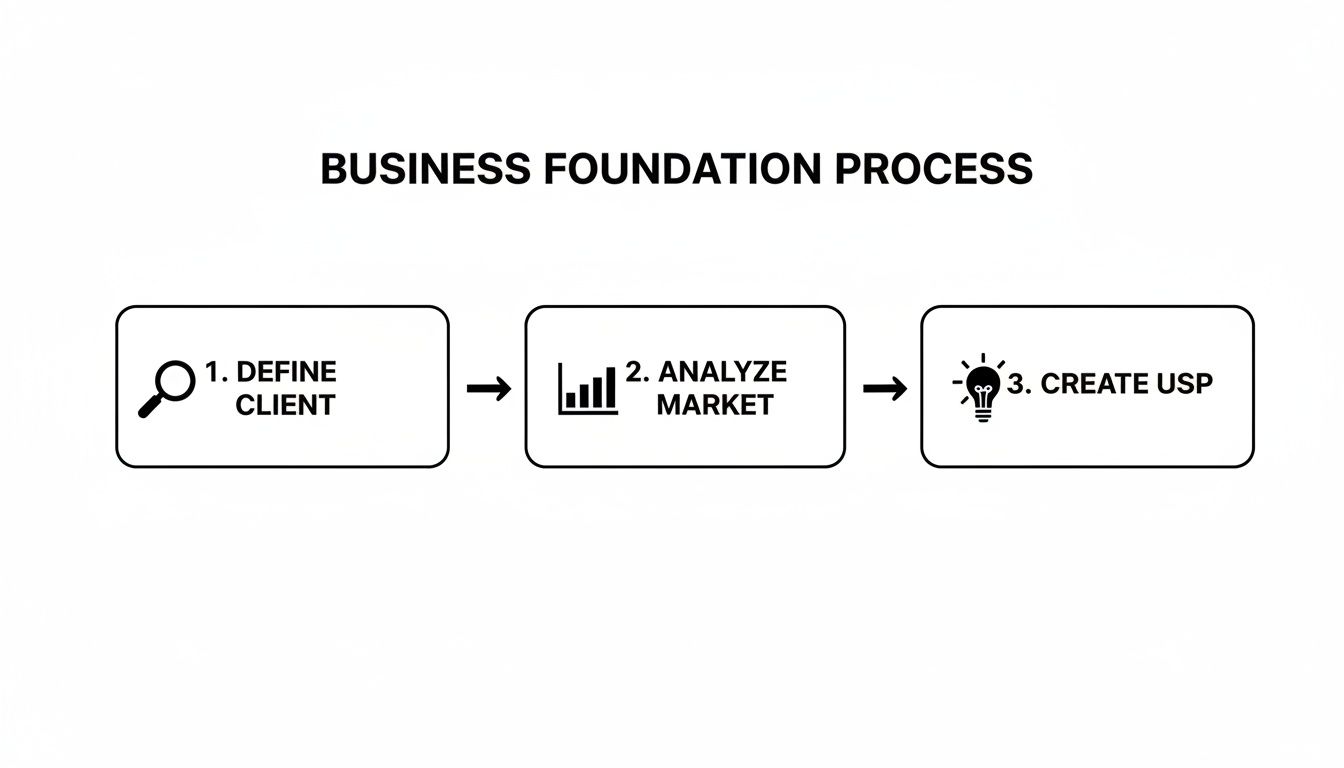
See how each step builds on the last? This is how you create a focused, powerful business strategy before you even print your first flyer.
Craft Your Unique Selling Proposition
Your Unique Selling Proposition (USP) is the heart of your brand. It’s the simple, clear answer to the question, "Why should I hire you over everyone else?" And no, "We Clean Best" doesn't count. It has to be a specific, compelling promise that resonates with the ideal client you just identified.
Here are a few examples of what a strong USP looks like in the real world:
- For Commercial Clients: "The 24/7 cleaning partner for medical offices. We guarantee a 2-hour emergency response for any unexpected cleanup needs."
- For Residential Clients: "The safest clean for families with kids and pets. We use exclusively plant-based, non-toxic products, every time."
- For a Niche Service: "We specialize in post-renovation cleanups. Our HEPA-filter vacuums and dust-settling techniques make your new space truly move-in ready."
This USP needs to be everywhere: on your website homepage, your van wrap, your team’s shirts, and in your social media bio. It’s the core message that will attract the right customers and set you up for smart, sustainable growth. If you're looking for more ways to get the word out, explore these digital marketing strategies for small businesses.
Initial Growth Checklist for Your Cleaning Business
Before you start scaling, it's crucial to have these foundational elements locked in. This checklist summarizes the non-negotiable first steps that position your business for long-term success, not just short-term jobs.
| Growth Area | Key Action | Example for a Local Cleaner |
|---|---|---|
| Client Definition | Narrow your focus to a specific customer segment. | "We exclusively serve dental and medical offices under 10,000 sq ft." |
| Market Analysis | Identify a weakness in your top 3 competitors. | "Competitors have bad reviews for communication; we'll offer a client portal." |
| Unique Offer (USP) | Create a promise no one else is making. | "The only local cleaner offering HIPAA-compliant cleaning protocols." |
| Brand Identity | Develop a professional name, logo, and colors. | "Apex Medical Cleaning" with a clean, trustworthy blue and white logo. |
| Online Presence | Set up a simple website and a Google Business Profile. | A one-page site listing services and a fully optimized GBP with photos. |
| Legal & Insurance | Register your business and get liability insurance. | Form an LLC and secure a $1 million general liability policy. |
Getting these basics right isn't just busywork—it's the strategic framework that ensures every dollar and every hour you invest in growth actually pays off.
Winning High-Value Clients in Your Local Market
A steady stream of high-value leads is the engine that keeps a cleaning business running. Just throwing money at random ads is like trying to water a single flower with a firehose—it’s messy, expensive, and just plain inefficient. The real secret is to zero in on the marketing channels that give you the best, most measurable return for a local service business like yours.
This means getting really good at the digital tools your local customers are already using every day to find cleaning services. At the same time, you can’t ignore the old-school, offline strategies that build a referral network that sends you business around the clock. Let's break down the tactics that will actually keep your schedule packed with profitable jobs.
Dominate Local Search with Google Business Profile
Think about it. When someone in your town decides they need their house cleaned, what’s the first thing they do? They grab their phone and search "house cleaning near me." If you want that call, you have to be at the very top of those results. The single most powerful (and free) tool to get you there is your Google Business Profile (GBP).
Your GBP is basically your digital storefront. It's shocking how many business owners set up a profile and then just forget about it, which is a huge mistake. An optimized and active profile tells Google you’re a legitimate, trusted, and busy local business worth showing to searchers.
Here’s how you turn that profile into a lead-generating machine:
- Fill Out Every Single Section: Seriously, don't skip a thing. List all your services, define your exact service areas (down to the zip codes), and write a detailed business description that highlights what makes you different.
- Geotag Your Photos: Before you upload those before-and-after shots, use a free online tool to add GPS data to the image file. A photo of a sparkling kitchen that's geotagged in "Naples, FL" is rock-solid proof to Google that you actually do work there.
- Make Reviews a Priority: Reviews are the lifeblood of local SEO. You need a constant flow of new 5-star reviews. As soon as you finish a job, send a quick text or email with a direct link to your GBP review page. Make it dead simple for happy clients to sing your praises.
A well-managed Google Business Profile isn’t just an online listing; it’s a powerful trust signal. According to recent studies, 92% of consumers trust recommendations from friends and family above all other advertising, and a stream of positive reviews functions as that trusted digital word-of-mouth.
For a deeper dive into optimizing your online presence, our complete guide on local SEO for contractors offers strategies you can apply immediately.
Get Immediate Leads with Paid Advertising
SEO is a long game. But sometimes, you just need to fill a few gaps in your schedule now. This is where smart, targeted paid advertising comes in, putting your business right in front of people who are ready to hire.
Google Local Services Ads (LSAs) are an absolute game-changer. These are the "Google Guaranteed" listings you see at the very top of search results. The best part? You only pay when a customer actually calls or messages you through the ad. It’s one of the most efficient ways to get qualified leads. To earn that Google Guaranteed badge, you have to pass a background check, which gives potential clients instant peace of mind.
Facebook Ads work a little differently but can be just as powerful. While people on Google are actively searching, Facebook lets you get in front of potential customers based on their demographics and major life events.
- Example Campaign: Create a short video ad showcasing a move-out clean. Target users in your service area who have recently shown interest in "moving" or interacted with real estate content. Your ad copy could be as simple as, "Moving is stressful enough. Let us handle the final clean. Get a free quote today!"
Build a Powerful Referral Network
Finally, don't forget that some of the best marketing you'll ever do happens offline. Building real relationships with other local businesses who serve the same clients you do is a low-cost, high-reward strategy. These partners can become a consistent source of top-tier referrals.
So, who should you be connecting with?
- Real Estate Agents: They are constantly working with clients who need move-in, move-out, or pre-listing cleanings.
- Property Managers: They oversee multiple units and are always in need of reliable cleaners for tenant turnovers and common area upkeep.
- Home Contractors: Plumbers, electricians, and painters often leave a mess. Partnering with them for post-project cleanups is a win-win for everyone.
Don't just drop off a stack of business cards and hope for the best. Build a genuine relationship. Take an agent out for coffee to explain your process. Offer a small referral fee or a special discount for their clients to give them a reason to send business your way. A simple, professional outreach email is the perfect way to get the conversation started and plant the seeds for a profitable partnership.
Creating Systems That Enable Scaling
Real growth isn't about jamming more jobs onto your calendar. It’s about building a business that can handle more work profitably without everything falling apart. Packing your schedule means nothing if your quality nose-dives, your team is burned out, and your margins get thinner.
The secret to avoiding this common trap is building simple, repeatable systems. These are the scaffolding of your company, ensuring consistency and efficiency as you expand. They cover everything from how you bid a job to how your crew cleans a master bathroom, creating a predictable, top-notch experience for every client. This is how you stop being a frantic owner and start becoming a strategic leader.
Smart Pricing Models For Profitability
Pricing can feel like throwing darts in the dark, but a structured approach takes the anxiety out of it and guarantees you’re making money on every single job. There’s no single “best” way to price; the right strategy really depends on the kind of cleaning you’re doing.
Let's break down the three most common models:
- Flat-Rate Pricing: You give one fixed price for the whole job. This is gold for recurring residential cleans or standardized services like a move-out clean. Clients absolutely love the predictability, and it incentivizes your team to be efficient.
- Hourly Rate: Charging by the hour is your safety net for unpredictable jobs. Think deep decluttering projects or the first-time clean of a seriously neglected property. It protects you from underbidding work that’s full of unknowns.
- Per-Square-Foot Pricing: This is the industry standard for most commercial contracts and big post-construction cleanups. It gives you a scalable and easy-to-justify metric when you're bidding on larger, more complex projects.
For instance, you might charge a flat rate of $180 for a bi-weekly clean of a standard 3-bed, 2-bath home. But for a one-time, post-construction cleanup of a new 2,500 sq ft office, you’d be better off pricing it at $0.15 per square foot, which comes out to $375.
Documenting Your Standard Operating Procedures
How do you make sure the kitchen in Client A’s house sparkles just as brightly as the one across town at Client B’s, even when different teams are on the job? The answer is Standard Operating Procedures (SOPs). These are just simple, written instructions for every core task in your business.
Don't overthink it—SOPs aren’t dense corporate manuals. They can be simple checklists or even short videos shot on your phone. Their only job is to kill the guesswork and make sure every single clean meets your quality standard.
Your SOPs are your company’s playbook. They turn your brand promise into a consistent reality, making your service reliable and your customers incredibly loyal. This is the bedrock of scalable service.
Get started by creating SOPs for your most critical functions:
- 10-Point Residential Cleaning Checklist: A room-by-room guide detailing exactly what gets cleaned, from wiping down baseboards to polishing chrome faucets.
- Client Communication Protocol: A simple script for how your team greets clients, confirms appointments, and handles follow-up calls after a service.
- Supply Restocking Process: A checklist cleaners use at the end of each day to make sure their kits are fully stocked and ready for the next morning.
Hiring A Team That Embodies Your Brand
You can’t scale alone. But here’s the thing: hiring the right people is less about finding experienced cleaners and more about finding reliable people with a great attitude and an eye for detail. You can teach someone how to clean; you can’t teach work ethic.
Your interview process needs to be designed to find these core traits. Get past the generic, "Tell me about your cleaning experience," and ask questions that actually reveal character.
Sample Interview Questions:
- "Can you tell me about a time you noticed a small detail that others might have missed? What did you do about it?" (This tests for attention to detail.)
- "Imagine a client is unhappy with a clean you just finished. Walk me through how you would handle that situation." (This assesses customer service skills and accountability.)
- "This job is physical and requires staying on schedule. What keeps you motivated to stay productive all day?" (This helps gauge their internal drive and work ethic.)
A solid hiring process lets you build a team of pros who will represent your brand the way you would, giving you the confidence to book more jobs.
Investing In Technology To Slash Admin Time
As you grow, the paperwork and admin tasks pile up fast, stealing time you should be spending on strategy. This is where technology becomes your best friend. In fact, 40% of cleaning pros name labor shortages and efficiency as their top challenges, and 60% are turning to technology for the answer.
By 2026, a staggering 80% of large cleaning contractors will use digital platforms for accountability, and 62% are already investing in smart tech to optimize schedules and cut costs. You can read the full research about cleaning industry trends to see where the industry is headed.
The right software can put your most tedious tasks on autopilot.
- Scheduling Software (like Jobber or Housecall Pro): These tools automate booking, dispatching, and sending client reminders. They drastically cut down on no-shows and frustrating scheduling mix-ups.
- Customer Relationship Management (CRM): Even a basic CRM helps you track client history, special requests, and past communications, letting you deliver a much more personal and polished service.
As you get busier, it's easy for things to fall through the cracks. Investing in the right technology isn't a cost—it's a direct investment in efficiency and your ability to scale.
Technology Investment ROI for Cleaning Businesses
Investing in the right software can feel like a big leap, but the payoff in saved time and increased profitability is almost always worth it. Here's a quick look at common tech solutions and the return you can expect.
| Technology | Primary Benefit | Potential ROI Metric |
|---|---|---|
| Scheduling Software | Automates booking, dispatching, and reminders | Reduction in no-shows by 25%; 5+ hours/week saved on admin |
| CRM Software | Centralizes client data and communication history | 15% increase in repeat business; higher client satisfaction scores |
| Quoting/Estimating Tool | Standardizes pricing and generates professional proposals | 20% faster quote generation; improved proposal win rate |
| Team Management App | Tracks time, location, and job progress in real-time | Improved payroll accuracy; 10% reduction in idle time |
Ultimately, these tools turn manual, time-consuming tasks into streamlined, automated processes, freeing you up to focus on what really matters: growing your business.
As your business grows, consider bringing in outside help like virtual assistants for cleaning services to handle scheduling and client calls. This frees you up to work on the business, not just in it. These systems are what turn daily chaos into a smooth, scalable operation.
Keep Clients Coming Back and Boost Your Bottom Line
Here’s a hard truth: it can cost five times more to land a new customer than to keep an existing one. That simple fact is why the fastest way to grow your cleaning business is to get laser-focused on keeping the clients you already have happy.
A loyal customer base gives you predictable, recurring revenue. Even better, it turns your happy clients into your most powerful marketing asset—people who rave about your service and send referrals your way. This isn't just about doing a good job; it's about having a deliberate system for building trust, proving your value, and making every client feel like your only client.
When you nail client loyalty, you stop chasing one-off jobs and start building a sustainable, profitable business that practically grows itself.
Build a Wall of 5-Star Reviews
Your online reputation, especially on your Google Business Profile, is your digital handshake. A steady stream of 5-star reviews is the ultimate social proof. It helps you dominate local search and wins over prospects before they even pick up the phone.
The secret? Don't just hope for reviews—build a simple system to ask for them.
- Ask at the Right Time: The perfect moment to ask is right after a fantastic clean when the client is admiring your work and feeling great about their sparkling home.
- Make It Insanely Easy: Send a text or email with a direct link straight to your Google review page. The fewer clicks it takes, the more likely they are to do it.
- Keep it Personal: A quick message like, "Hi [Client Name], we loved making your home sparkle today! Would you mind sharing your experience on Google? It really helps our small business. Here's the link:" feels genuine and gets results.
Turn Good Service into Unforgettable Service
It’s the small, thoughtful touches that separate an average cleaning company from a brand people love. It’s all about being proactive, professional, and personal. These little efforts build deep trust and show clients you care about more than just the transaction.
Think about implementing these small but mighty habits:
- Automated Reminders: Use your scheduling software to send a friendly text or email reminder 24-48 hours before an appointment. It cuts down on no-shows and makes you look incredibly organized.
- The Personal Follow-Up: A day after the service, especially for a new client, a quick call can work wonders. Just ask, "Hi [Client Name], this is [Your Name] from [Company Name]. I just wanted to personally check in and see how you liked the cleaning yesterday."
- Remember the Little Things: Use a CRM to jot down notes about client preferences—maybe they love a specific scent, or you need to be mindful of their shy cat. Mentioning these details in the future shows you’re paying attention.
When you deliver standout customer service, you turn a simple transaction into a real relationship. Clients who feel seen and valued won't be tempted to leave you for a competitor who’s a few bucks cheaper.
Increase What Every Customer is Worth with Smart Upsells
Once you've earned a client's trust, you can easily increase your revenue per visit with smart, helpful upsells. This isn't about being a pushy salesperson. It's about spotting other problems you can solve for them.
By offering relevant add-on services, you boost their Customer Lifetime Value (CLV) and become their one-stop shop for everything clean. Your recurring clients are the perfect people to offer these to.
Here’s how that sounds in the real world:
- For Window Cleaning: After a regular house cleaning, you might say, "I noticed your windows get so much great sunlight! We're actually running a special on interior and exterior window cleaning this month. It would make the whole house feel even brighter. Would you like me to send over a quick quote?"
- For Carpet Cleaning: During a clean, you could note, "While we were vacuuming, we saw the usual high-traffic wear on your living room carpet. We offer a deep carpet shampooing service that can lift those stubborn spots and help your carpet last longer. Would you be interested in adding that to your next appointment?"
Another huge opportunity? Offering eco-friendly cleaning. This is more than a trend; it's a major reason why clients choose one company over another. In fact, 83% of customers are now actively looking for businesses that offer eco-friendly services. Companies using plant-based, sustainable products often see a spike in loyalty, as 66% of consumers prefer brands that go green.
And if you're looking for other ways to get your brand name out there, check out our guide on how to elevate your brand with a leading social media marketing agency in Fort Myers FL.
Using Data to Make Smarter Growth Decisions
If you aren’t measuring your results, you’re just guessing with your money and time. Growing a cleaning business isn't about feeling busy; it's about making smart, profitable decisions, and that all starts with tracking the right data. It’s easy to get fixated on top-line revenue, but moving past that simple figure is what lets you see the real health of your company.
The most successful owners I know live and breathe their numbers. They don't just know how much they made last month; they know which marketing channel brought in the most profitable jobs and which services have the best margins. This is how you confidently decide where to put your resources for the biggest impact.
Key Metrics That Drive Growth
To really get a grip on your business, you need to zero in on a few key performance indicators (KPIs). These are the numbers that tell the story behind your revenue—the vital signs that show you what’s working and what needs your immediate attention.
Start by tracking these three essentials:
- Customer Acquisition Cost (CAC): This is the total amount you spend on marketing to get one new client. For example, if you spend $300 on Google Ads in a month and get 10 new clients, your CAC for that channel is a clean $30.
- Customer Lifetime Value (CLV): This number estimates the total revenue you can expect from a single client over the entire time they’re with you. If a recurring client pays you $200 a month and sticks around for three years, their CLV is a whopping $7,200.
- Job Profit Margin: This is how much you actually pocket on each job after you’ve paid for labor, supplies, and other direct costs. Knowing this helps you instantly spot which services are your true money-makers.
A healthy business model is simple to see in the numbers. Your CLV should be at least three times higher than your CAC. If you spend $30 to acquire a client, they should be worth at least $90 to your business over time. It’s a simple rule of thumb that keeps your growth profitable.
Setting Up a Simple Tracking Dashboard
You don’t need a complicated software suite to get started. Honestly, a simple spreadsheet can work wonders as a basic dashboard to keep an eye on your most important data points. The goal is to see, at a glance, where your business is coming from and how efficiently you're turning leads into paying customers.
Your dashboard should track a few key things:
- Lead Source: Make it a habit to ask every new client, "How did you hear about us?" Jot down whether they found you on Google, Facebook, a local flyer, or through a referral. This is gold.
- Website Conversion Rate: Use a free tool like Google Analytics to see what percentage of your website visitors actually fill out your contact form or pick up the phone. A low conversion rate might mean your website's design or message isn't connecting.
- Client Churn Rate: This is the percentage of customers who stop using your service over a certain period. A high churn rate is a major red flag—it’s a clear signal that you have a problem with service quality or customer satisfaction that needs fixing ASAP.
Using tools like call detail reporting can also turn raw call data into something you can actually use, showing you exactly which marketing efforts are making the phone ring. These insights tell you whether to pour more fuel on your SEO fire or double down on those referral partnerships.
When you track these numbers, you’re not just crunching data—you’re giving yourself the power to make strategic decisions that fuel real, sustainable growth.
Your Top Questions About Growing a Cleaning Business, Answered
Once your cleaning business starts to take off, a whole new set of questions and challenges pops up. Suddenly, it’s not just about cleaning anymore—it’s about building a team, managing client expectations, and protecting everything you’ve built. Here are the answers to the questions I hear most often from owners who are ready to scale.

When Is the Right Time to Hire My First Employee?
The golden rule is to hire just before you're desperate. If you wait until you're drowning in work and turning down good jobs, you'll rush the process and likely make a bad hire. That just creates more problems.
The clearest sign it’s time to hire is when you’re consistently booked for 80% or more of your target workweek. This sweet spot means you have enough steady income to cover a new salary but still have room to grow into with the help of your new team member.
Think of it this way: if your goal is to be on-site cleaning 30 hours a week, and you’ve been hitting 24-25 hours every week for the last month, it’s time to post that job ad. You can start small by bringing on a part-timer for 15 hours a week to take over your most straightforward, recurring cleans.
How Should I Handle a Difficult or Unhappy Client?
Dealing with a complaint the right way can actually build more loyalty than a perfect clean ever could. The trick is to listen first, act fast, and focus on the fix—not on who was right or wrong.
Keep it simple with this three-step approach:
- Listen and Apologize: The first thing out of your mouth should be, "I'm so sorry to hear you're not happy with the service." It immediately validates their feelings and shows you care.
- Get the Details: You need to know exactly what went wrong. Ask a direct question like, "Could you tell me specifically what we missed or what we need to make right?"
- Offer a Clear Fix: Propose a concrete solution. The industry standard is a "re-clean" of the specific areas in question, offered free of charge and scheduled within 24-48 hours.
Your response to a complaint is more memorable than the mistake itself. A swift, professional resolution shows you stand behind your work and builds a level of trust that a perfect clean never could.
What Insurance Do I Need for a Growing Team?
The moment you hire your first employee, your insurance needs change—big time. Your basic general liability policy just won't cut it anymore. You need specific coverage to protect your business from employee-related risks.
There are two policies that are non-negotiable:
- Workers' Compensation Insurance: This is legally required in most states once you have employees. It covers medical bills and lost wages if a team member gets hurt on the job.
- Bonding (Surety Bond): This protects your clients from employee theft. Being "bonded and insured" is a huge selling point that gives customers peace of mind and instantly makes you look more professional than the solo operators.
For example, if a new hire slips on a wet kitchen floor and hurts their back, workers' comp covers their medical care. If that same employee is later accused of stealing jewelry from a client's home, your bond covers the client's loss, protecting your business's reputation and saving you from a financial nightmare. This is a critical step in learning how to grow your cleaning business assets safely.
Ready to stop guessing and start growing with a marketing plan that actually works? The team at Polaris Marketing Solutions uses practical, small-business insight to build digital strategies that deliver real ROI. Get your complimentary online analysis and see exactly how you stack up against the competition. Learn more about our services.