
Your phone isn't ringing as consistently as it should. You've probably tried a few things already. Maybe Google Ads during the summer rush, maybe a website refresh, maybe some Facebook posts when business slowed down. But if those pieces aren't tied together, you don't really have an hvac marketing plan. You have activity.
A real hvac marketing plan works like an operating system for lead generation. It tells you what you're trying to grow, who you want more of, where your budget goes, how leads get attributed, and which channels turn into booked jobs. That matters in HVAC because the customer journey is messy. People search Google, check maps, compare reviews, call from a mobile listing, click a remarketing ad later, then finally book after talking to your office.
Most guides stop at tactics. That's where contractors waste money. The useful version is measurable, local, and built around booked calls, closed jobs, and repeat business.
Build Your Foundation with Goals, Audience, and a Unique Message
Most contractors start in the wrong place. They start with channels. They ask whether they should run Google Ads, improve SEO, or post more on social media. Start earlier than that. Strategy comes first.
A sound HVAC plan is built as a measurable system with 2 to 3 clear business objectives, customer segments, a defined value proposition, a budget, and KPI tracking. Growth-focused firms often put 10% to 20% of revenue into marketing, while a 5% budget is often only enough to maintain current visibility, according to Home Service Scorecard's HVAC marketing plan guidance.
Set business goals that affect revenue
“Get more leads” is too vague to run a business on. The better goal is tied to job type, margin, geography, or retention.
For example, an HVAC owner might choose goals like:
- Increase installation work: Prioritize replacement and install leads in neighborhoods with older housing stock.
- Add maintenance members: Push service agreement signups from tune-up calls and past-customer follow-up.
- Improve territory mix: Grow calls in the zip codes where your trucks already run profitably.
Those choices shape everything downstream. If your goal is more install revenue, your messaging, landing pages, financing offers, and follow-up process should all support larger-ticket jobs. If your goal is more maintenance members, retention campaigns matter more than broad awareness.
Practical rule: If a goal can't be traced to a booked call, sold job, or retained customer, it's not strong enough for your hvac marketing plan.
Pick the audience that makes the plan easier
Not every lead is worth chasing. Some areas are price-shopping heavy. Some customers want same-day service and will pay for reliability. Some neighborhoods are full of aging systems and replacement opportunities.
A lot of contractors serve “everyone” and then wonder why their message sounds flat. Instead, define your best-fit customer by property type, problem urgency, and geography. If you need a sharper way to think about that, this complete guide to ICP for growth is useful because it helps translate a broad market into a specific ideal customer profile.
A practical HVAC version might look like this:
- Homeowner segment: Owner-occupied homes in higher-value neighborhoods, older systems, likely to finance replacements
- Emergency segment: Households searching after-hours for no-cool or no-heat service
- Commercial light-service segment: Small offices, retail, or property managers needing dependable recurring service
Once you know who you want, your ads stop sounding generic. So does your website.
Build a message customers can repeat
Your unique selling proposition should answer a basic question fast. Why should someone call you instead of the other three companies on the screen?
Good HVAC messaging usually isn't clever. It's specific and believable.
Examples:
- 24/7 emergency service with real dispatch support
- Technicians trained on high-efficiency replacement systems
- Strong warranty positioning
- Maintenance-first service for lower breakdown risk
- Financing available for replacement jobs
The key is choosing one or two points you can support operationally. If your office misses evening calls, don't build your whole brand around rapid response. If your install team is excellent, lead with quality and long-term value.
For contractors working on tightening their market position, these small business branding tips from Polaris Marketing Solutions are a useful reminder that brand isn't just colors and logos. In HVAC, brand shows up in promise clarity, review quality, technician presentation, and consistency across every touchpoint.
Dominate Local Search with Google Business Profile and Reviews
For most HVAC companies, local search is the front door. Before someone sees your website, they usually see your Google Business Profile, map placement, star rating, and recent reviews. That's where first impressions happen.
If your profile is incomplete, stale, or filled with weak photos, you'll lose calls before your team even gets a chance.
Treat your Google Business Profile like a sales asset
A strong profile does more than “exist.” It helps a homeowner decide that your company looks credible enough to contact.
Use this checklist:
- Primary category accuracy: Choose the main category that best reflects your core service.
- Service detail completion: Add service descriptions that match what people hire you for.
- Real jobsite photography: Use vans, technicians, installs, equipment, and before-and-after work.
- Service area clarity: Keep your territory aligned with where you want jobs.
- Hours and emergency availability: If you offer after-hours response, make that visible.
- Consistent contact information: Make sure the business name, phone, and address details match your other listings.
- Regular updates: Add fresh photos and posts so the profile doesn't look abandoned.
A neglected profile tells homeowners one of two things. Either you're behind the times, or you're too busy to care. Neither helps convert a searcher into a call.
If you want a deeper operational checklist for this process, this Google My Business optimization checklist is a practical reference for tightening the details most contractors overlook.
Reviews do two jobs at once
Reviews influence both ranking visibility and conversion. But the mistake contractors make is treating review collection like an occasional office task.
It needs to be part of closeout.
Ask right after a successful job, while the homeowner still remembers the technician's name, the fix, and the relief of having the system running again. Don't wait several days. By then, life has moved on.
A simple text works well:
Thanks for choosing us today. If the service went well, would you mind leaving a quick Google review? It helps other local homeowners know what to expect.
A short email follow-up can work too:
We appreciate the opportunity to help with your HVAC service. If you have a minute, we'd be grateful for a review sharing your experience with our team.
Keep it short. Don't write a speech. Don't send a giant branded newsletter asking for a favor.
Build a repeatable review system
The easiest way to get more reviews is to remove friction from the process. That means:
- Trigger the request after completed jobs.
- Send the customer directly to the review destination.
- Train technicians and office staff to mention it naturally.
- Respond to every review, good or bad, with a professional tone.
Negative reviews matter too. A calm, accountable response often builds more trust than silence. Future customers are reading your response as much as the complaint.
A profile with strong recent reviews usually outperforms one with old social proof and weak engagement, because customers care about what your company looks like now.
Support Google with citation consistency
Your local visibility also depends on whether your business details are consistent across major directories and platforms. If your business name is written one way on Google, another on Yelp, and a third on a local directory, you create trust issues for both users and search engines.
Focus on core citations first:
- Yelp
- Apple Maps
- Bing
- Relevant contractor and local business directories
If you want a contractor-specific walkthrough on tightening local search visibility, mastering contractor SEO through Google Business Profile work is worth reviewing. It aligns well with what moves the needle for service businesses in local markets.
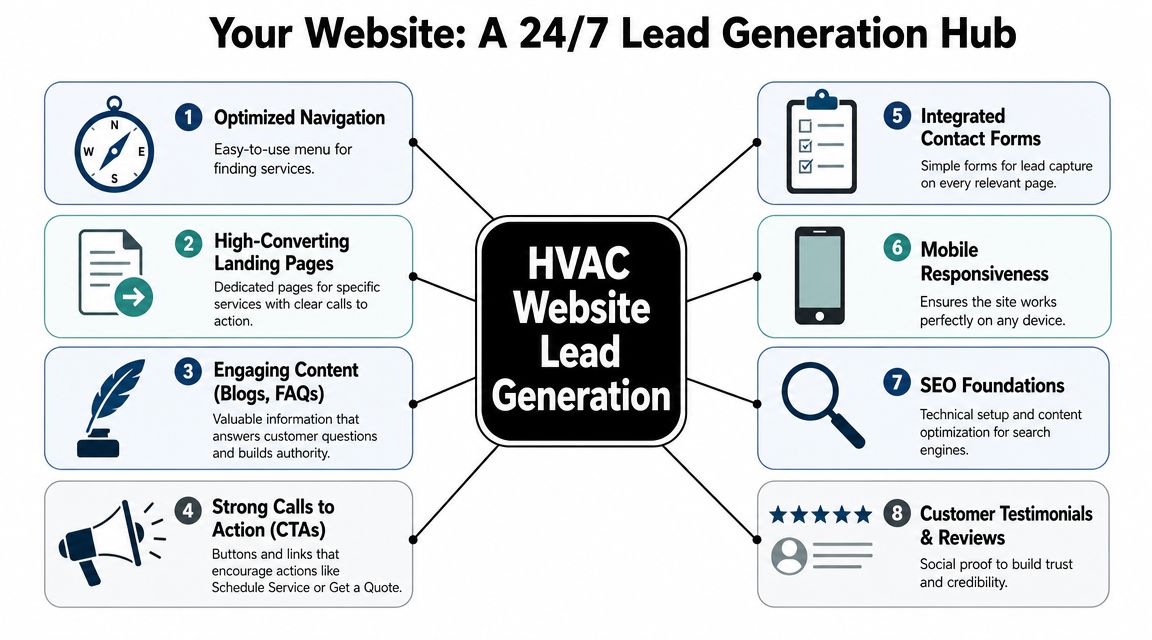
Turn Your Website into a 24/7 Lead Generation Hub
A lot of HVAC websites look fine and still underperform. They have a homepage, a list of services, a phone number in the header, and a few stock photos of smiling families. That isn't enough.
Your website has one job. Turn search intent into contact. If it can't do that, it's an expense, not an asset.
Service pages win the searches that matter
Homeowners don't usually search for a contractor's brand name first. They search for the problem or service. AC repair. Furnace installation. Heat pump replacement. Emergency HVAC service.
That's why dedicated service pages matter. A page built around one service and one location gives Google a clear reason to rank it and gives the customer a clear reason to stay. Your homepage can't do both jobs well.
Create separate pages for core services such as:
- AC repair
- AC installation
- Furnace repair
- Furnace installation
- Heat pump services
- Indoor air quality
- Maintenance plans
- Emergency HVAC service
Then build location relevance into the site where appropriate. Not with thin duplicate pages, but with pages that reflect actual service areas, customer concerns, and local trust signals.
Problem-based content captures buyers before they call
A strong site doesn't just target money keywords. It also answers the questions people search before they're ready to book.
Think about the calls your office gets every week. Those are content topics.
Examples:
- Why is my AC leaking water
- Why is my furnace making a loud noise
- Should I repair or replace my HVAC system
- How often should I service my air conditioner
- Why is one room hotter than the rest of the house
That kind of content does two things. It helps you show up earlier in the buying cycle, and it builds trust before the sales conversation starts.
Conversion has to be obvious
Contractors lose leads on websites for one simple reason. The next step isn't clear enough.
Every key page should make contact easy:
- Visible phone number
- Short quote or service request form
- Emergency call option if offered
- Trust signals like reviews and technician photos
- Financing mention on replacement pages
- Service area confirmation
A homepage that says “welcome to our company” doesn't help much. A page that says what you do, where you do it, and how to get help now converts better.
If you're evaluating whether your current site is built to produce leads, this explanation of what makes a lead generation website is a useful lens. It separates brochure sites from sites that support sales.
Drive Immediate Demand with PPC and Social Media
It's 2:15 on a July afternoon. Three AC units go down across town, homeowners grab their phones, and the company that shows up first with a clear offer usually gets the call.
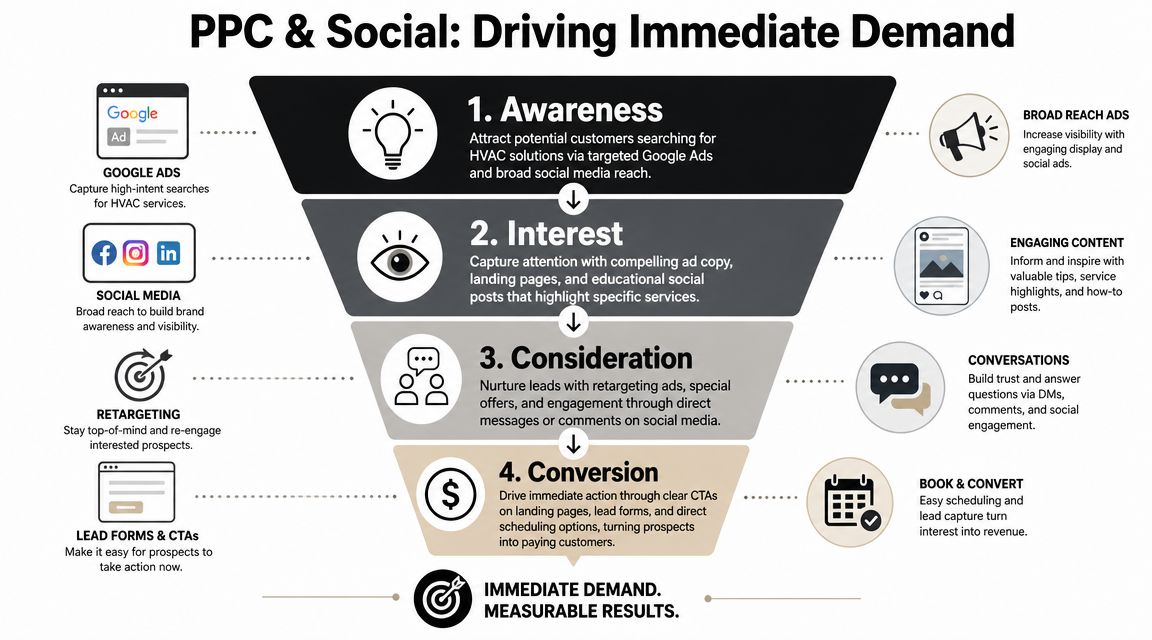
That is the job of paid media. SEO, reviews, and your website build long-term demand. PPC helps you capture high-intent searches right now, while social media supports the trust check homeowners make before they contact you.
Google Ads captures urgent intent
Google Ads works best for searches with immediate buying intent. “AC repair near me,” “furnace not turning on,” “emergency HVAC service,” and “air conditioner replacement” are very different from research-driven searches. Treating them the same usually wrecks ROI.
The biggest mistake I see is lumping every service into one campaign and sending all traffic to the homepage. That setup makes attribution muddy and wastes budget fast. If you want to know what books calls, break campaigns out by service line, geography, and urgency.
A tighter PPC structure usually includes:
- Separate campaigns by job type: Emergency repair, standard service, maintenance, and replacement should each have their own budget and messaging.
- Landing pages that match the search: Repair searches should go to repair pages. Replacement searches should go to replacement pages with financing and estimate options.
- Tight location settings: Only pay for clicks in areas you can serve profitably and on time.
- Call-first conversion paths: Mobile searchers often want to call, not fill out a long form.
- Negative keywords and search term review: Cut waste from DIY, jobs, parts, and irrelevant service searches.
Speed matters as much as targeting.
Paid campaigns break down when lead handling is slow. If nobody answers, if calls roll to voicemail, or if form leads sit untouched for 20 minutes, your ad account can look fine while revenue stays flat. That gap is why serious HVAC operators connect ads to call tracking, after-hours routing, text confirmations, and follow-up workflows. If you're evaluating that operational side, this HeyBRB guide to workflow automation gives a useful overview.
Social media supports the sale before and after the click
Social media rarely produces the same volume of urgent leads as Google Ads for HVAC. It still matters because homeowners check it when they're deciding whether your company looks active, credible, and local.
That changes what you should post.
Skip generic holiday graphics and stock-image promos if they don't reflect your brand. Use content that lowers hesitation and helps a homeowner feel comfortable inviting your team into the house:
- Technician spotlights: Put faces to the company.
- Real job photos: Show installs, service calls, ductwork fixes, and clean mechanical rooms.
- Short homeowner tips: Filter changes, thermostat checks, drain line issues, seasonal prep.
- Review highlights: Share real customer feedback with permission.
- Community posts: Sponsorships, school support, local events, neighborhood involvement.
A dead social profile creates doubt. A modest but current one reinforces trust.
Use paid social carefully
Facebook and Instagram can work, but usually for a different offer. They fit maintenance plans, seasonal tune-ups, financing promotions, replacement estimates, and remarketing better than emergency service. Someone with no AC is more likely to search Google than browse social feeds and suddenly decide to book a repair.
That trade-off matters for budget allocation. Search ads often deserve first claim on demand-generation dollars because intent is stronger. Paid social becomes more useful after search is covered and you have a clear offer, a defined audience, and a way to track booked jobs back to campaign spend.
For contractors that want one provider covering website, SEO, PPC, and local visibility work, Polaris Marketing Solutions is one option in the Florida market. It offers those services as part of integrated digital campaigns for small and mid-sized businesses.
This video is a useful companion if you're comparing how paid channels fit into HVAC lead flow.
Budget for Profitability and Track Your Key Metrics
A lot of HVAC owners hit the same wall. The phone rings, some jobs get booked, money goes into marketing every month, and nobody can say which dollars produced profitable work. That is how decent revenue masks weak marketing.
Budgeting fixes that only when tracking is set up to answer one question. Which channels are producing booked jobs at an acceptable cost?
A common rule of thumb is to spend a percentage of revenue on marketing. Housecall Pro's HVAC marketing plan guide notes a range of 5% to 10% and outlines a channel mix many contractors use. That gives you a starting point, not a target you follow blindly.
A company trying to grow market share usually needs to spend closer to the high end. A company with strong repeat business and a full install pipeline may stay lower and protect margin. The right number depends on capacity, average ticket, close rate, and how much of your work comes from existing customers versus new demand.
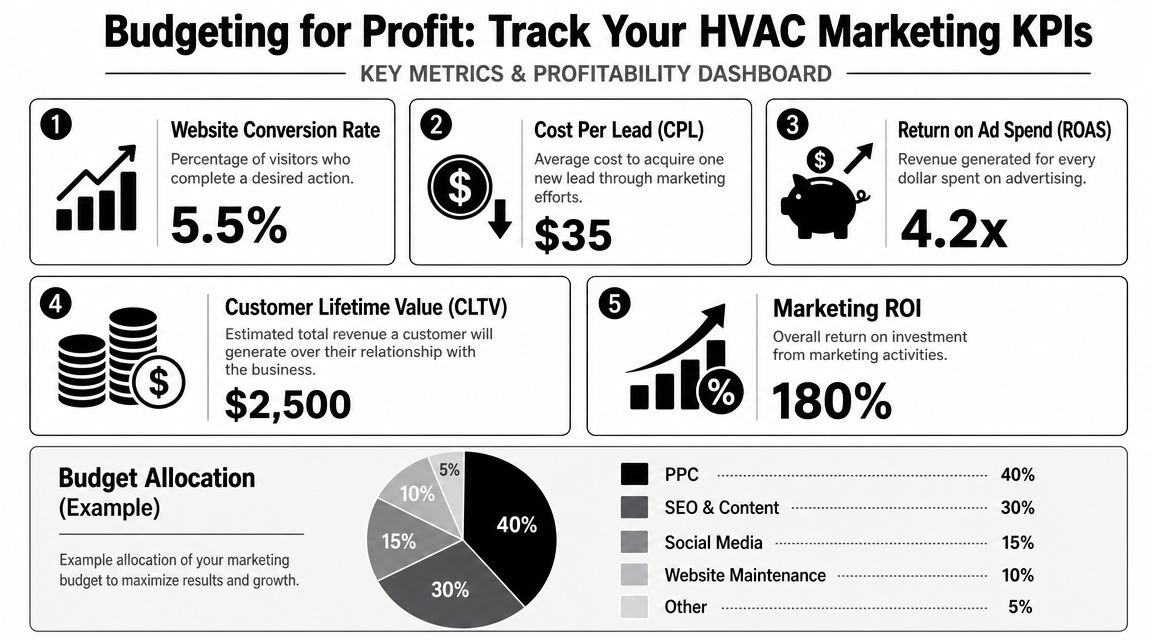
For a $500,000 HVAC business, an 8% marketing budget puts annual spend at $40,000. That is enough to build a real system if you split it with intent instead of scattering it across random tactics.
A sample budget for a $500k HVAC business
Use the budget below as a working model.
| Channel | Allocation | Annual Spend | Primary Goal |
|---|---|---|---|
| Digital ads | 30% | $12,000 | Immediate lead generation |
| SEO and website work | 25% | $10,000 | Long-term local visibility and conversions |
| Email and SMS retention | 20% | $8,000 | Repeat business and maintenance renewals |
| Print and local sponsorships | 15% | $6,000 | Local brand awareness |
| Seasonal promotions and events | 10% | $4,000 | Short-term demand during key periods |
The trade-off is simple. Paid search can create demand fast, but lead costs often rise in peak season. SEO and website work usually takes longer to pay back, but it lowers dependency on ads over time. Retention marketing rarely gets enough attention, even though it often produces some of the cheapest revenue in the system because you are selling to people who already know your company.
If the office cannot answer calls well or the schedule is already packed, cutting ad spend can be smarter than forcing more leads into a bottleneck. More volume does not fix a weak sales process.
Track the numbers that affect booked jobs
Busy contractors do not need a fancy dashboard. They need a scoreboard the owner, office manager, and marketing partner can review in a few minutes every week.
Track these numbers first:
- Qualified leads: Calls and form submissions that match your service area and job types
- Booked calls or appointments: The clearest measure of whether lead handling is working
- Cost per lead: Useful, but only if the leads are qualified
- Cost per acquired customer: Better than cost per lead because it shows what you paid to win real business
- Return on ad spend: Best used for paid campaigns tied to actual sold revenue
- Lifetime value compared to acquisition cost: Important for maintenance plans and replacement-driven businesses
- Call attribution: A large share of HVAC leads still come in by phone, so call tracking matters
Plenty of reports look good and still fail the business. Clicks, impressions, and traffic spikes do not help if they never turn into booked calls, approved estimates, or membership renewals.
Attribution is where many HVAC marketing plans fall apart. If every lead gets credited to the last click, you will undervalue channels that assist the sale. A customer may find you through Google Business Profile, leave, read reviews later, come back through a branded search, then call from the website. If your tracking only credits the final visit, you will make bad budget decisions.
Use unique call tracking numbers by channel, tagged forms, CRM source fields, and a monthly review of booked jobs against spend. That is how you stop guessing.
If you cannot tie spend to booked jobs and revenue, your budget is not a plan. It is overhead.
Your 90-Day Action Plan, Calendar, and Advanced Tactics
A workable hvac marketing plan has to survive real shop conditions. The phone rings, a tech calls out, install runs long, and nobody has time to manage six new marketing projects at once. That is why the first 90 days should be staged around revenue impact, tracking, and operational follow-through.
Start with the pieces that affect booked jobs fastest. Then tighten measurement. Then add the tactics that raise close rate, repeat business, and average ticket.
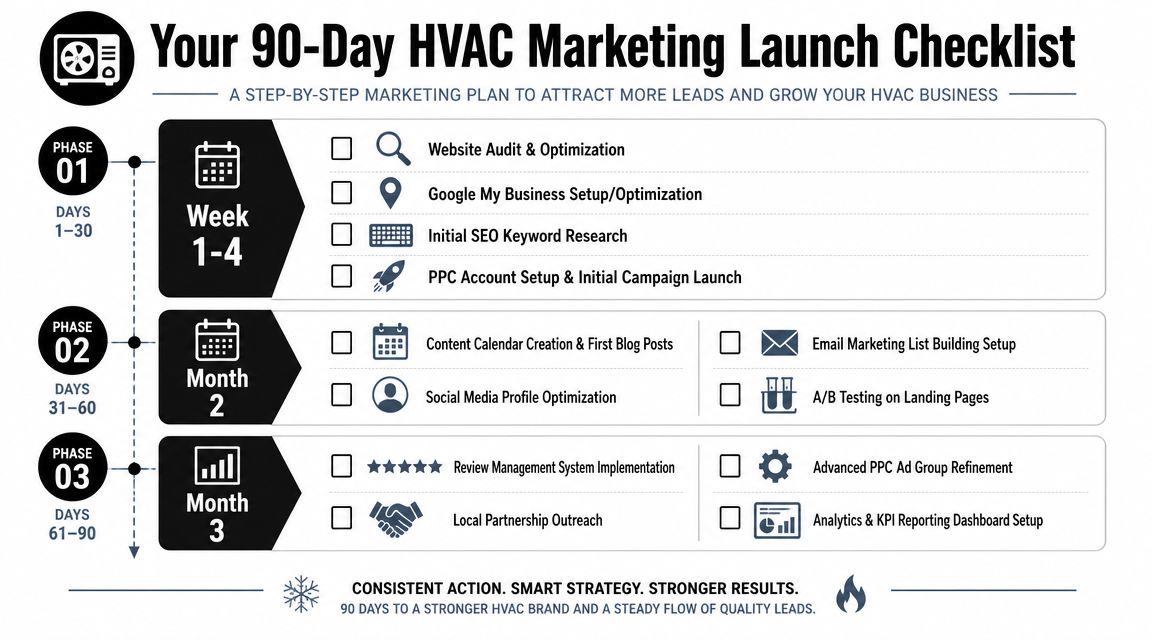
Days 1 through 30
The first month is for fixing the obvious leaks. If traffic is coming in but the site is slow, the phone number is hard to find, or no one can tell which calls came from Google Ads versus Google Business Profile, more promotion just wastes budget.
Focus here first:
Audit your website
Check mobile load speed, service pages, form friction, click-to-call visibility, financing visibility, and whether each core service has its own page.Clean up your Google Business Profile
Update categories, hours, service areas, photos, descriptions, and core business details.Set up call and form tracking
Use channel-specific call tracking numbers, tagged forms, and clear source fields inside your CRM.Pick your primary goal for the quarter
More repair calls, more maintenance agreements, or more replacement estimates. Pick one main target and one secondary target.Launch one focused paid campaign
Go after a high-intent service first, such as AC repair or furnace repair, instead of spreading budget across every service line.Build a review request process
Decide who asks, when they ask, and how the request gets sent after a completed job.
Month one is about control. Contractors who skip this step usually end up buying leads they cannot track and paying for clicks that never turn into booked work.
Days 31 through 60
Month two is where separate marketing pieces start working as one system.
Build the paths that support how customers buy. A homeowner might see your Google profile on Monday, visit your site that night, leave without calling, come back through a branded search two days later, and finally book after reading reviews. If your website, retargeting, follow-up, and office response are disconnected, that lead costs more than it should.
Priority work for this phase:
- Service-specific landing pages for repair, replacement, maintenance, and indoor air quality
- Basic content assets built from real customer questions your office hears every week
- Retargeting campaigns for site visitors who did not call or fill out a form
- Email or SMS follow-up for tune-ups, maintenance reminders, and unsold estimates
- Review monitoring and response to protect conversion rate and spot service issues
- Fresh proof on core pages including testimonials, project photos, and financing mentions where relevant
This is also the right time to audit call handling. I have seen campaigns blamed for poor lead quality when the actual problem was slower answer times, weak scripting, or missed calls after hours. Marketing can create demand. Your office still has to catch it.
Days 61 through 90
Month three is for optimization, budget shifts, and a few higher-return tactics.
At this point, there should be enough data to see patterns. Some keywords bring calls but not booked jobs. Some service pages convert well on mobile and some do not. Some campaigns drive estimate requests that never close because the offer is weak or financing is absent from the page and the follow-up.
Use this phase to:
- Cut weak paid search terms
- Shift spend toward channels producing booked jobs
- Tighten message match between ads and landing pages
- Coach CSRs on consistency and booking discipline
- Add financing language to replacement journeys where it fits
- Build referral relationships with adjacent local businesses
- Map promotions to the upcoming season instead of running generic offers
As noted earlier, HVAC benchmarks show that lead costs can get expensive fast, and close-rate gains often come from better sales process, financing visibility, and stronger follow-up, not just more traffic. Month three should reflect that reality. The goal is to lower customer acquisition cost and raise revenue per lead.
A practical seasonal calendar
A strong calendar matches buyer intent, not your internal wish list.
Spring
Spring is for tune-ups, maintenance plan pushes, and identifying aging systems before the first real heat wave hits.
Good offers and campaigns include:
- AC tune-up reminders
- Maintenance agreement enrollments
- Pre-season system inspections
- Replacement consultations for older units
Summer
Summer is the highest-pressure season in many markets. Visibility, speed to answer, and scheduling capacity matter more than polished branding.
Use messaging built around:
- Emergency AC repair
- Same-day or fast scheduling
- No-cool service
- Financing options for replacements
Fall
Fall gives you room to fill the board before winter breakdown season.
Run campaigns tied to:
- Heating tune-ups
- Furnace safety inspections
- Maintenance renewals
- Indoor air quality services
Winter
Winter is often the best time to improve the assets you own while demand patterns are less chaotic.
Focus on:
- Website updates
- Review process cleanup
- Referral partner outreach
- Customer list segmentation
- Content and landing pages for the next peak season
Advanced tactics that usually outperform random promotion
The best next move usually is not another channel. It is a better return from the traffic and customer list you already have.
Financing promotion on replacement pages
Replacement buyers often hesitate on payment, not need. Put financing information on install pages, replacement pages, estimate follow-up emails, and ad copy where appropriate. If a homeowner has to hunt for that information, close rates suffer.
Past-customer reactivation
Past customers are cheaper to market to and easier to convert than cold audiences. Short campaigns around maintenance, aging systems, filter changes, and seasonal service reminders often produce solid returns because trust is already there.
Referral partnerships
Local partnerships can produce better-fit leads than broad awareness campaigns, especially for replacement and repeat property work.
Good partners include:
- Realtors
- Property managers
- General contractors
- Plumbers and electricians
- HOA or community contacts
Better attribution
Attribution has to go beyond last-click reporting. A homeowner might discover you in map results, return later through a branded search, then call after reading reviews on your site. If you only credit the final click, budget decisions get distorted.
Track performance against business outcomes:
- Booked jobs
- Maintenance signups
- New customers acquired
- Lead source by call path
- Close rate by campaign type
- Revenue by channel
What to look for if you hire outside help
Ask direct questions. You are not buying activity. You are buying a process for getting more profitable jobs.
- How do you track calls, forms, and booked jobs by source
- How do you separate lead quality from lead volume
- How often do you reallocate spend
- What do you change when a campaign misses target
- How do ads, reviews, SEO, and the website work together
- Who owns the data, tracking, and reporting setup
Vague answers usually lead to vague results.
The standard for a working hvac marketing plan
A real plan ties local visibility, paid demand, conversion, follow-up, and attribution into one operating system. It gives you a budget split, a launch sequence, and a way to measure which dollars are producing booked jobs and revenue.
That is the difference between marketing that stays busy and marketing that helps the business grow.
If you want help turning your hvac marketing plan into something measurable and manageable, Polaris Marketing Solutions works with businesses that need practical support across local SEO, PPC, websites, and lead generation systems without losing sight of ROI.