
You're probably seeing the same pattern a lot of Orlando business owners see. The work is solid, customers are happy, and referrals still come in, but Google isn't sending enough new business. A prospect searches for a roofer in Winter Park, a med spa near Lake Nona, or an electrician in College Park, and your company is nowhere useful in Maps, nowhere in the local pack, and buried under competitors that aren't necessarily better.
That gap is what local SEO fixes. In Orlando, it isn't a vanity channel. It's the layer that connects a ready-to-buy customer with the nearest trustworthy option at the exact moment they need help. If you run a service business in a market this crowded, visibility has to be built on purpose.
Why Your Orlando Business Is Invisible Without Local SEO
A lot of businesses assume they have a marketing problem when they really have a local discovery problem. The website exists. The logo looks polished. Maybe there's even some ad spend running. But when someone searches for your service in Milk District, Winter Garden, Dr. Phillips, or near the attractions corridor, Google doesn't have enough local relevance signals to trust you.
That matters because local search behavior is tied closely to action. A 2026 data compilation reported that 46% of all Google searches have local intent, and 76% of people who search for something nearby visit a business within 24 hours according to Digital Applied's local SEO statistics roundup. For an Orlando HVAC company, urgent care clinic, cleaning service, or personal injury law firm, that means the missed opportunity usually isn't abstract traffic. It's missed calls, missed quote requests, and missed appointments.
Why generic marketing falls short in Orlando
Orlando is fragmented in a way many smaller Florida markets aren't. Search behavior changes by neighborhood, commuter pattern, tourist flow, and even whether the searcher wants immediate service or planned service. A “family dentist Orlando” search doesn't always mean the same thing as “dentist Baldwin Park” or “emergency dentist near Lake Nona.”
Local SEO gives you a practical way to claim territory. Instead of competing everywhere at once, you build relevance where your customers look.
Practical rule: If your business depends on geography, your marketing has to be measured by geography too.
That's why it helps to measure ROI for local business marketing in terms of calls, quote requests, direction requests, and booked jobs, not just pageviews. If you're trying to diagnose a visibility issue before making changes, this guide on why your business is not showing up on Google is a useful starting point.
What usually isn't working
Three patterns show up over and over:
- Weak Google Business Profile signals because the profile is incomplete, lightly managed, or using the wrong categories.
- Thin local relevance on the website because the site targets “Orlando” broadly and ignores neighborhoods and service-area pages.
- Low off-site trust because reviews, citations, and local mentions are inconsistent or stale.
The upside is that these are fixable. Local SEO Orlando campaigns work best when they focus on controllable assets first, then build trust outward from there.
Build Your Google Business Profile Fortress
A homeowner in Winter Park searches “AC repair near me” at 7:10 p.m. Three profiles show up first. One has recent photos, clear emergency hours, service details, and strong review language. Another has outdated hours, no recent activity, and a vague description. The click usually goes to the profile that looks current and credible before the website even enters the decision.
That is why Google Business Profile deserves real attention. For many Orlando service businesses, it drives calls, direction requests, and quote starts faster than any other local asset.
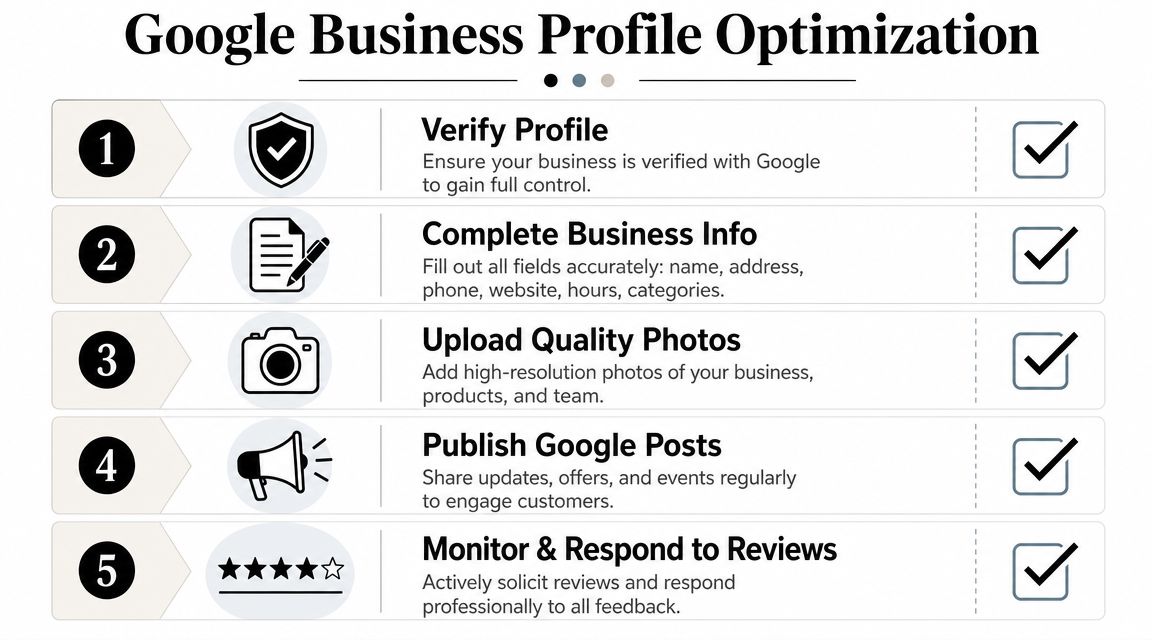
Fill every field with a ranking and conversion job in mind
A half-built profile creates two problems. Google has less context about what you do, and prospects have less confidence that you are the right fit.
Start with the basics, then tighten the parts that affect visibility in Orlando's more competitive categories.
Verify the profile
No verification means limited control. Fix that first.Choose the primary category based on your main revenue service
This choice carries more weight than business owners think. An HVAC company that makes most of its money on repairs should not default to a broad contractor label. A personal injury firm should not dilute relevance with a generic legal category if a better match exists.Use secondary categories carefully
Add real adjacent services, not every option that sounds related. I see this mistake often with med spas, dentists, and home service companies trying to rank for services they barely offer. That usually creates weaker relevance, not broader reach.Complete services, hours, attributes, and service areas
If you serve Dr. Phillips, Oviedo, Winter Garden, and Lake Nona, list them. If you offer weekend appointments, same-day service, financing, wheelchair access, or bilingual staff, include that too. These details help both rankings and conversion.
If the listing still needs cleanup, this step by step Google Business Profile setup guide covers the setup process clearly.
Write a description that sounds like a real Orlando business
The business description should answer three questions fast. What do you do, where do you do it, and why should someone trust you?
For a roofing company, strong copy would mention roof replacement, storm damage repair, leak diagnostics, insurance claim support, and the areas it serves around Greater Orlando. For a med spa in Lake Nona, the description should focus on actual treatments, appointment experience, and what makes the office convenient for the right patient.
Weak descriptions usually fail in one of two ways. They read like keyword stuffing, or they stay so generic that any competitor could have written them.
Here's a useful visual walkthrough before you start editing the profile:
Activity matters more in Orlando than many owners expect
An active profile sends a stronger trust signal than a stale one. That matters in tourism, hospitality, legal, dental, and home services, where searchers compare several options fast.
Use a simple operating rhythm:
- Upload current photos from jobsites, the office, the team, vehicles, equipment, signage, and completed work
- Publish posts for seasonal offers, storm prep, holiday hours, special events, or new service availability
- Add and answer Q&A based on real pre-sale questions about parking, insurance, appointment types, response times, service radius, and financing
- Review your hours before holidays and storm events because bad hour data costs calls
For Orlando tourism businesses, photos should reduce uncertainty. Show pickup points, vehicle types, tour scenes, check-in areas, and what guests can expect. For home service companies, neighborhood-specific project photos often outperform generic stock images because they prove local experience.
Quick wins for competitive niches
Some categories need more than basic completion because the map pack is crowded.
For HVAC, roofing, plumbing, and electrical, add service-specific photos tied to actual job types and keep emergency availability accurate. A lot of Orlando homeowners search under pressure, especially after summer breakdowns and storm-related damage.
For med spas, dentists, and clinics, build out treatment and appointment detail cleanly. Prospects want to know what is offered, what the office feels like, and how easy it is to book.
For tourism and hospitality, the profile has to answer visitor questions before they bounce back to results. Parking, reservation policies, hours, family-friendliness, and location context near attractions all help.
There is also a future-proofing angle here. Google's AI Overviews pull from business information that is clear, consistent, and easy to interpret. A complete profile with precise services, updated details, and strong review language gives Google better material to reference. That does not replace your website, but it improves the odds that your business appears accurately when AI-generated summaries become part of the search journey.
A neglected profile loses ground gradually. A managed one can produce leads without waiting months for broader SEO gains.
Find Keywords Orlando Customers Actually Use
Most Orlando businesses start keyword research too high up the ladder. They chase “plumber Orlando,” “dentist Orlando,” or “marketing agency Orlando,” then wonder why they're stuck behind larger brands, directories, and old domains.
The better move is to map how people really search when they're close to a decision.
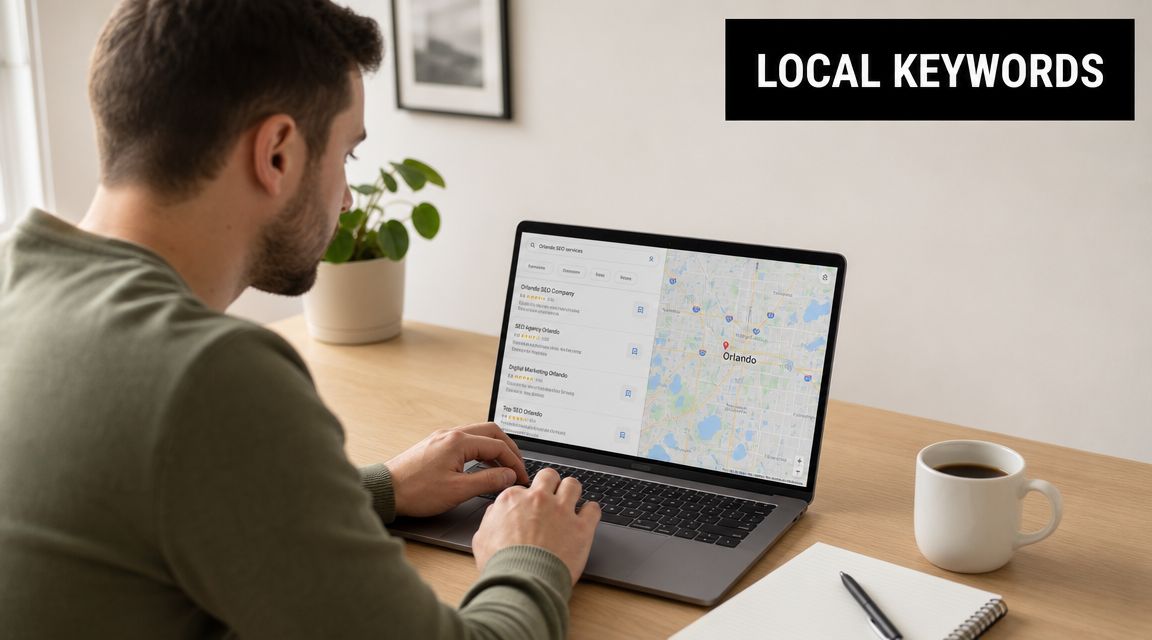
Start with the service, then narrow by place and intent
The core phrase is only the first layer. Add modifiers that reflect urgency, problem type, neighborhood, and buyer context.
An Orlando roofer might build keyword sets like these:
| Search type | Example phrase | Why it matters |
|---|---|---|
| Broad local | roofer Orlando | Competitive, but useful as a benchmark |
| Service-specific | roof leak repair Orlando | Better intent |
| Neighborhood | roofer Winter Park | More targeted and often more practical |
| Problem-based | emergency roof tarp College Park | High urgency |
| Decision-stage | best roofer near Baldwin Park | Close to contact |
A local cafe would do the same:
- coffee shop Lake Eola
- breakfast cafe Thornton Park
- cuban coffee near Downtown Orlando
- best brunch near Milk District
That's how you move from visibility to lead quality.
Don't over-target broad head terms
This is one of the most common mistakes in local campaigns. SEOProfy's local SEO guide notes that a frequent mistake is over-targeting broad head terms, and that local keywords often have lower keyword difficulty, making “Orlando + service + neighborhood” pages more efficient and faster to rank than citywide head-term pages.
That tracks with what works on the ground. In Orlando, broad city terms are crowded. Neighborhood terms are often where smaller service businesses can gain traction first.
The phone usually rings from specific intent, not from generic ambition.
Build keyword sets around real Orlando geography
If your team serves the whole metro, don't stop at “Orlando.” Build phrases around the actual places your ideal customers live and search.
Useful modifiers include:
- Neighborhoods: College Park, Baldwin Park, Thornton Park, Milk District, SoDo, Doctor Phillips
- Nearby cities: Winter Park, Maitland, Ocoee, Winter Garden, Altamonte Springs, Kissimmee
- Landmarks and districts: Lake Eola, UCF area, International Drive, Medical City
For home services, I'd usually group terms by dispatch patterns. If crews naturally route from East Orlando into Lake Nona and Avalon Park, those are logical clusters. If you work mostly northwest, Winter Garden and Ocoee may deserve their own content path.
Use customer language, not internal jargon
A lawyer may say “personal injury representation.” A prospect may search “car accident lawyer near me.”
A dentist may say “restorative dentistry.” A patient may search “broken tooth repair Orlando.”
Simple ways to uncover better wording:
- Check Google autocomplete: Start typing service phrases and note what Google suggests.
- Review competitor page titles: Not to copy them, but to spot service phrasing and neighborhood coverage.
- Mine reviews and call notes: The words customers use are often your best keyword source.
- Look at your own GBP questions: Those are often search terms in disguise.
For tourism and hospitality, question keywords matter even more. Visitors often search with uncertainty. They ask things locals don't:
- best breakfast near Universal area
- family activities near International Drive
- shuttle service from hotel to airport Orlando
That's where strong keyword research beats generic SEO advice. Local SEO Orlando works better when the language matches how Orlando residents and visitors search.
Craft On-Page Content and Location Pages That Rank
Once you know the terms customers use, your site needs a structure that gives each term a proper home. Many local campaigns often stall at this stage. The business has a decent homepage, maybe a service menu, and then one weak “areas we serve” page trying to rank for everything from Winter Garden to Lake Nona.
That setup usually underperforms because it blurs relevance.
Think in page roles, not just pages
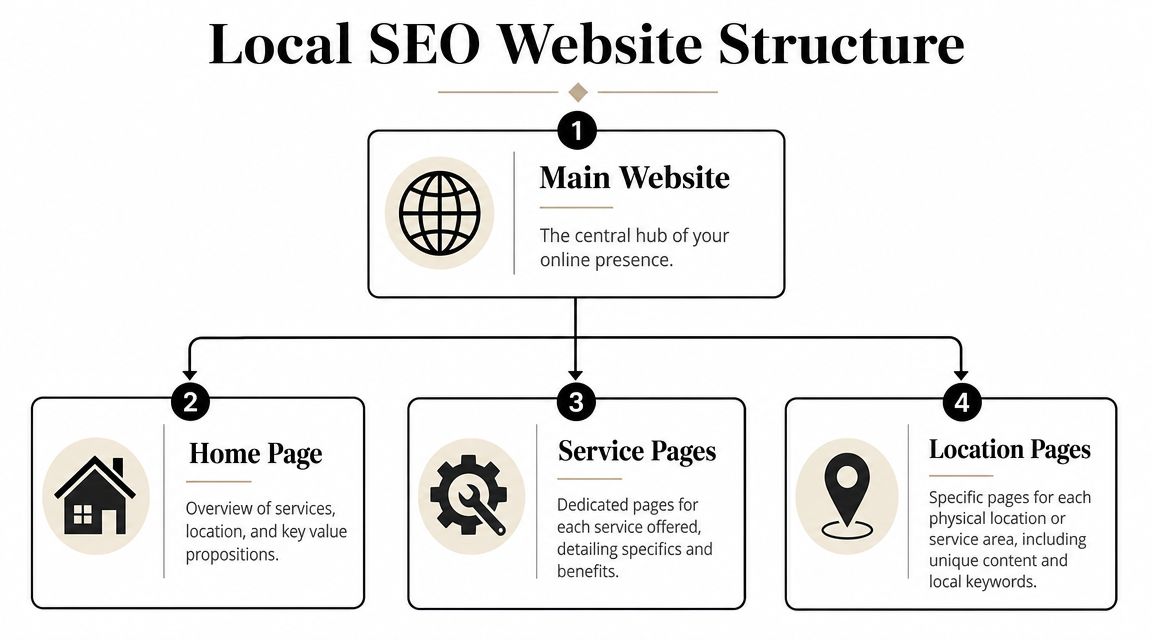
A strong local site usually has four distinct layers:
| Page type | Job |
|---|---|
| Home page | Establish primary service and core market |
| Service pages | Explain each revenue-driving service clearly |
| Location pages | Prove relevance in each target area |
| Supporting content | Answer questions and support service pages |
Each page should have a defined purpose. If one page tries to do everything, it usually ranks for nothing meaningful.
Why one generic locations page is usually a mistake
Coursera's local SEO guide recommends individual geo-pages over a generic “Locations” page because they better match long-tail queries like “best vet in Doctor Phillips” and reduce keyword cannibalization across service areas.
That matters in Orlando because market intent changes by area. A page for “AC repair in Winter Garden” can speak to suburban homeowners, seasonal maintenance, and residential neighborhoods. A page for “commercial HVAC in Downtown Orlando” should sound completely different.
If every city page says the same thing with a swapped place name, don't expect strong rankings or strong conversions.
What a useful Orlando location page should include
A location page has to feel local and useful. Thin boilerplate pages create a footprint with little substance.
For a strong page, include:
- A unique title tag and H1 tied to the service and place
- A localized intro that references the area naturally
- Relevant service details for that market
- Trust elements like reviews, project photos, or FAQs
- Internal links to related services and nearby locations
- A real call to action tied to calls, estimates, or bookings
Example for a plumbing company:
- /plumber-winter-park/
- /drain-cleaning-college-park/
- /water-heater-repair-maitland/
Example for a tourism business:
- /private-tours-international-drive/
- /airport-shuttle-lake-buena-vista/
- /family-attractions-guide-orlando-resort-area/
On-page details that still matter
Local relevance isn't only about page creation. It also comes from small execution details.
Use your local terms in:
- Title tags
- Primary headers
- Meta descriptions
- Image alt text where appropriate
- Internal anchor text
- Body copy that reads naturally
Don't force the city or neighborhood into every sentence. Google can spot awkward repetition, and so can prospects.
For local SEO Orlando campaigns, I'd rather see ten well-built pages targeting real service-area demand than fifty spun location pages no one trusts. Quality wins here because the page has to convert after it ranks.
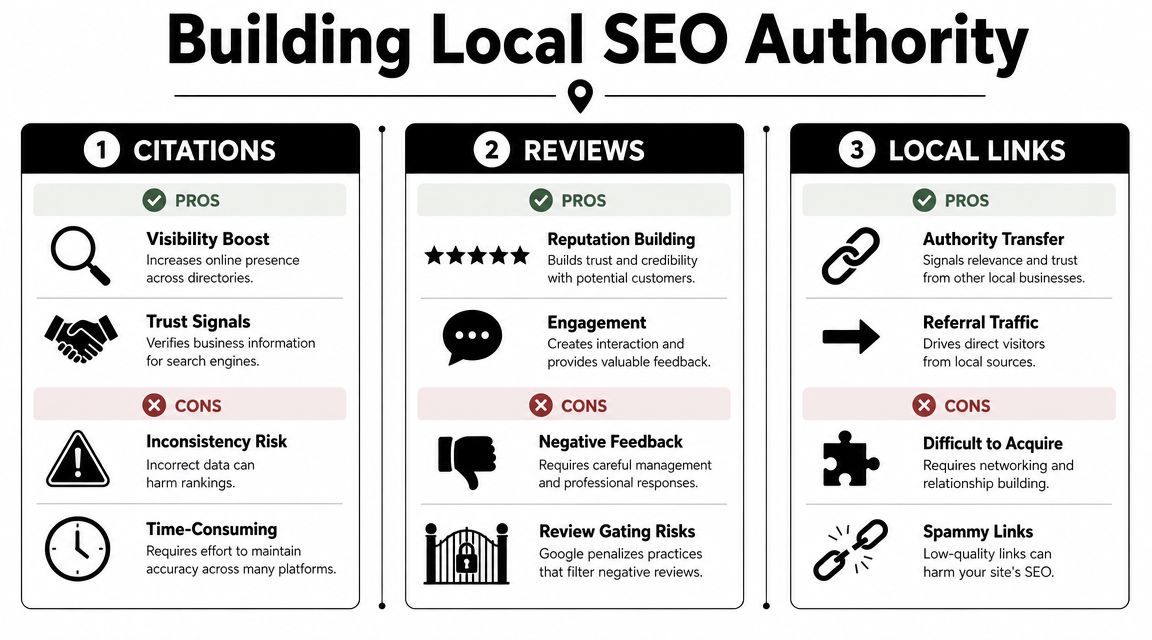
Build Authority with Citations Reviews and Local Links
Once your profile and site are in good shape, Google still needs confirmation from the rest of the web. That's where citations, reviews, and local links come in. I group them under one idea: digital trust.
A business can say it serves Orlando professionally. Off-site signals are what back that claim up.
Citations are boring until they're wrong
A citation is any listing that repeats your business name, address, and phone number. This sounds simple. It isn't, especially for businesses that have moved offices, changed suite numbers, switched tracking lines, or rebranded.
The problem isn't usually missing citations first. It's citation drift. One old listing still has the previous address. Another has a shortened business name. Another points to a dead phone number. Those conflicts weaken location trust.
Good local SEO work includes:
- Auditing old listings
- Fixing NAP consistency everywhere
- Removing or updating duplicates
- Keeping website, GBP, and directories aligned
If you need a done-for-you option, local citation building services are one way to handle that cleanup systematically.
Here's a practical starter list.
| Directory Name | Website | Notes |
|---|---|---|
| Google Business Profile | business.google.com | Core listing for Maps and branded local visibility |
| Yelp | yelp.com | Still influences customer discovery in many service categories |
| Bing Places | bingplaces.com | Worth maintaining for search consistency |
| Apple Business Connect | businessconnect.apple.com | Important for Apple Maps users |
| facebook.com | Common trust and reference signal | |
| Better Business Bureau | bbb.org | Helpful in trust-sensitive industries |
| Florida Chamber or local chamber directories | chamber-specific websites | Useful for geographic relevance where available |
| Industry-specific directories | category-specific websites | Strong fit for legal, medical, home services, and hospitality |
Reviews change both ranking strength and conversion strength
An Orlando-focused guide from W3era emphasizes that consistent, weekly review generation is a core metric for success, and that results often take 3 to 6 months of consistent effort to stabilize. That timeline matters because reviews aren't a one-time blast. They work better as an operating habit.
A few review practices that hold up:
- Ask right after the win: Right after the install is complete, the leak is fixed, or the case milestone is reached.
- Use a direct link: Don't make customers hunt for your review profile.
- Train the front office: The request process should be part of checkout, follow-up, or closeout.
- Respond to every review: Short, professional responses are enough.
Simple review request template:
Hi [First Name], thanks again for choosing us for your [service]. If you have a minute, we'd appreciate a Google review. Your feedback helps other Orlando customers find a business they can trust.
That works because it's clear and low friction. Don't over-script it.
Local links still matter, but junk links don't
Local links are harder to earn than citations. They're also more valuable when they come from real community relevance.
For Orlando businesses, good local link opportunities often come from:
- Sponsoring neighborhood events
- Partnering with nearby businesses
- Joining chambers or trade groups
- Getting featured by local bloggers or publications
- Supporting schools, nonprofits, or community drives
Examples:
- A Winter Park contractor sponsors a school event and gets listed on the event site.
- A Thornton Park salon collaborates with a nearby boutique on a shared promotion.
- A restaurant appears in a local foodie guide focused on a specific district.
What doesn't work well is buying random low-quality backlinks from irrelevant sites. Those links rarely help and can create cleanup work later.
The trust stack that tends to work
For small service businesses, this sequence is practical:
- Fix citations
- Build a weekly review habit
- Pursue a handful of relevant local links
- Reinforce trust with better location pages and GBP updates
That stack is what gives local SEO Orlando campaigns durability. Rankings built on trust signals tend to hold up better than rankings built on shortcuts.
Track Your Results and Optimize for AI Search
Local SEO only pays off if you track the actions that lead to revenue. Rankings matter, but they're not the end goal. Calls, booked jobs, consultation requests, and direction requests are what tell you whether the campaign is working.
For Orlando businesses, the cleanest measurement setup usually includes:
- Google Business Profile insights
- Call tracking that preserves listing consistency
- Form submission tracking
- Map pack position checks for core service terms
- Mobile usability checks
- A shortlist of neighborhood keywords monitored over time
What to watch each month
Don't flood the report with vanity metrics. Focus on indicators that connect to customer intent.
A practical monthly review should answer:
- Are more people calling from branded and non-branded local searches?
- Which neighborhood pages are attracting qualified visits?
- Are review requests being sent consistently?
- Did visibility improve for the service areas that matter most?
- Are mobile users hitting friction on contact pages?
The goal is simple. Tie local visibility to lead flow, then adjust where conversion is weak.
AI search is changing local visibility
Most Orlando SEO content still stops at rankings, reviews, and citations. That's no longer enough. According to South Street Marketing's Orlando local SEO article, Google's AI Overviews were rolled out in 2024, and businesses now need content that answers specific local questions concisely to gain visibility within those AI-generated answers.
That changes how content should be written.
A few practical ways to adapt:
- Add FAQ blocks to service and location pages
- Answer specific local questions directly in short paragraphs
- Use clean headings that mirror search intent
- Include concise summaries near the top of important pages
- Write for zero-click discovery, where a user may call after reading the answer layer
Examples:
- “Do you offer same-day AC repair in Winter Park?”
- “What areas around Lake Nona do you serve?”
- “How far in advance should I book airport transportation from International Drive?”
Short, direct answers are becoming part of local search strategy, not just content formatting.
If you want local SEO Orlando to hold up over the next few years, build for both search results and answer surfaces. The businesses that adapt first will be easier to discover even when users click less.
If your business needs a clearer local search plan, Polaris Marketing Solutions offers services relevant to SMBs that need help with Google Business Profile optimization, location-focused SEO, citations, and lead generation. For companies that want practical execution instead of generic advice, that kind of support can help turn local visibility into actual calls and customers.