
You finish a long blog post or record a 20-minute video, then stare at the publish button and wonder if that one asset was worth the hours you just spent. That's the moment where content repurposing strategies stop being a nice-to-have and start becoming the difference between one piece of work and a week of usable marketing. In practice, a single strong asset can become a blog excerpt, a video clip, a social post, an email, a graphic, and a sales follow-up, which is why many teams now treat repurposing as the operating model, not the backup plan. For a quick tool example, TransClipper repurpose clips fits the kind of clip extraction that saves time when the source file is already strong.
Southwest Florida SMBs feel this pressure hard. A Fort Myers roofer, HVAC contractor, dentist, or law firm can't afford to publish once and disappear for three weeks, especially when every channel rewards consistency and platform-native packaging. The smartest teams start with one useful asset, then reshape it for the places local buyers already spend time, such as Google Business Profile, Instagram, LinkedIn, email, and short video. The shift is simple, but the payoff is real, because the same idea now works across multiple touchpoints without forcing you to invent a new campaign each time.
1. Blog-to-Social Media Content Atomization
A strong blog post is rarely just one piece of content. It's a stack of usable atoms, statistics, short tips, step-by-step instructions, quotes, and takeaways, and those atoms can be distributed across Facebook, Instagram, LinkedIn, TikTok, and Google Business Profile with different hooks and calls to action. The key is to stop thinking of the blog as the finished product and start treating it as the source file for a local awareness system. That's how a Fort Myers home-service brand gets more than one week of visibility out of one article.
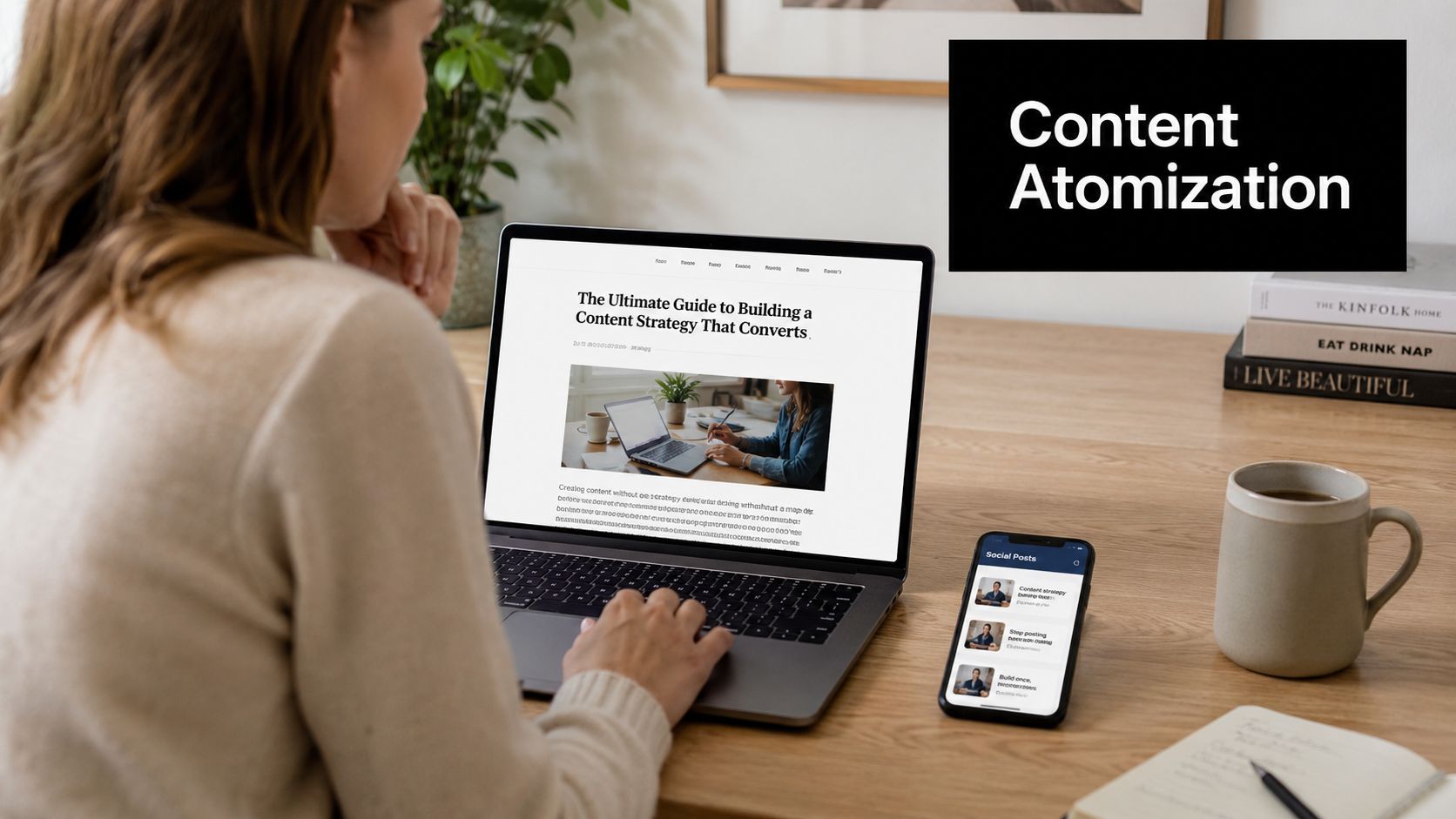
A practical Fort Myers example: an HVAC contractor publishes a 1,500-word article on summer AC maintenance, then turns it into Instagram Stories, a LinkedIn highlight, Facebook carousel posts, TikTok shorts, and a Google Business Profile update over four weeks. That approach works because it matches how local buyers browse, they skim on social, save on mobile, and click through when the topic feels relevant to their immediate problem. For more social formatting ideas, see this Southwest Florida social media planning resource.
Practical rule: space repurposed posts out over several days, not hours. When the same idea appears too fast on every channel, people tune it out.
A Fort Myers team should also adapt the CTA to the platform. “Save this post” works on Instagram, “Comment with your question” fits LinkedIn better, and “Learn more” is often enough for a Google Business Profile update. Native formatting matters too, because a text-heavy link dump feels lazy on every platform except maybe a blog archive. The local result isn't just more posts, it's more opportunities to be seen by homeowners who are already searching for help nearby.
2. Video Repurposing Across Multiple Platforms and Formats
Video is one of the easiest assets to stretch because the source material already contains hooks, transitions, and proof points. A single webinar, testimonial, or how-to video can become short clips, a transcript blog post, captioned reels, email copy, and platform-specific uploads. That's especially useful for Southwest Florida service businesses that already explain the same repair, inspection, or consultation process over and over in sales calls.
A Cape Coral roofing contractor can film one 20-minute explainer on roof damage, then break it into TikTok clips, Instagram Reels, a full YouTube upload with timestamps, a transcript-optimized blog post, LinkedIn updates, email content, and Facebook carousels. The local advantage is that one recorded answer now meets the buyer at multiple stages, from casual scrolling to serious comparison shopping. For local video distribution structure, this local business social video guide is a useful companion.
Make the source video easier to clip
The best repurposed video starts before editing begins. Record in a quiet room, use decent lighting, and keep a tripod in place so the footage doesn't feel shaky or rushed. It also helps to script natural breakpoints, because a long ramble is harder to turn into clean short-form clips later.
ON24's workflow is a good practical model, extract the key ideas, verify the statistics before reuse, organize the flow, rewrite into concise bullet points, convert numbers into charts, and then assemble the final asset. The same source also recommends turning a webinar transcript into both an infographic for a sales deck and a captioned short video for social media, which is exactly the kind of multi-format reuse a Fort Myers contractor can apply after a live training or customer education session. See the full process in ON24's repurposing guidance.
Clip first for the first three seconds, not the first thirty. If the hook isn't sharp, the clip dies before the viewer reaches the useful part.
Short clips should end with a clear next step, ideally one that sends people to your Google Business Profile, website, or booking page. That keeps the content from becoming entertainment only, which is a common failure point for businesses that repurpose video without a conversion plan.
3. Customer Testimonial-to-Case Study Expansion
A short testimonial is good proof. A case study is better proof because it shows the problem, the process, and the result in context. That matters in home services, healthcare, and legal work, where trust is built by details, not by vague praise. A Fort Myers business can use one satisfied client review as the starting point for something much more persuasive.
A North Fort Myers cleaning company can take a 4-star review, interview the customer for 30 minutes, and turn that into a full case study with the client's challenge, the service plan, implementation details, and before-and-after photos. That asset can live on the website, in email, and in sales materials, which gives the owner a way to answer objections before a prospect even calls. The strongest version includes permission, a clear timeframe, and visible proof from the job itself.
What makes the expansion credible
The biggest mistake is trying to generalize the story. If the customer gives permission to use the business name and the actual outcome, the proof feels real. If not, the case study usually loses credibility because readers know the business is hiding something.
A good case study format usually includes the following elements:
- The starting problem: what the customer needed fixed or improved.
- The service delivered: what the team did, in plain language.
- The timeline: when the work happened and when the result showed up.
- The proof: photos, screenshots, or timestamps.
- The lesson: what future customers should learn from the example.
A Bonita Springs legal firm can use that format across multiple practice areas, then segment the case studies by service line and refresh them yearly. That creates sales collateral that still feels current instead of stale. For a local SMB, the payoff is simple, a testimonial stops being a nice review and becomes a structured sales asset that helps move cautious buyers toward a decision.
4. Webinar-to-Content Library Deconstruction
Webinars are one of the most underused repurposing assets because teams often treat them like one-time live events. In reality, a recorded webinar can become a full content library, with clips, a blog post, a gated PDF, a transcript, social graphics, and a follow-up email sequence. The best repurposing teams don't ask whether a webinar was “successful enough,” they ask how many formats it can support after the live session ends.
An Estero healthcare provider running a 60-minute webinar on chronic pain can split the recording into a YouTube video, topic-based short clips, a transcript blog post, a gated PDF for lead capture, and a drip sequence for follow-up. That structure gives the provider different entry points for different audience types, including the person who wants a quick answer, the one who wants a deeper read, and the one who needs time before booking.
The source asset also matters. Record with good audio, because poor sound ruins repurposed clips faster than weak visuals do. Use slide design with graphics so screen-share monotony doesn't carry into every derivative piece. If the webinar platform auto-generates transcripts, that's a major time saver, but the transcript still needs human review before it becomes a public blog post or downloadable resource.
A useful sequencing rule is to delay distribution for 60 to 90 days after the live event if the topic is still relevant. That gives the content a second life, and it helps reach people who missed the original session. For a Naples roofing contractor, a later release can feel fresh to homeowners who weren't in the first audience but still need the same advice before storm season or a repair estimate.
Repurposing webinars well isn't about making the event look bigger than it was. It's about turning one live moment into a library that keeps working after the cameras stop.
5. Quote-to-Quote Graphic Expansion and Social Campaign
A strong quote can carry a surprising amount of weight if the design and distribution are handled correctly. Instead of posting a single static graphic once, turn the quote into a multi-platform campaign with several visual versions, specific captions, and a clear CTA. This works especially well for Fort Myers SMBs that want to stay visible without constantly producing brand-new ideas.
A quote from a blog post about Google Business Profile or customer trust can become an Instagram post, a LinkedIn graphic, a Facebook version, a Pinterest tile, an email header, and even a short animated TikTok version. The graphic itself should stay readable at thumbnail size, use branded colors, and carry one simple CTA such as “Book Now” or “Learn More.” A Cape Coral dental practice can use this approach to keep a service-page message in circulation without asking the team to film another video that week.
The trade-off is that graphics can look polished but still underperform if the underlying quote is weak. A flashy design around a bland statement won't move anyone. A sharp quote with a specific local angle, on the other hand, can create steady awareness because it's quick to absorb and easy to reshare.
Practical rule: don't design for the feed only. Design for the scroll speed of a distracted homeowner checking their phone between errands.
Seasonal updates help too. A Fort Myers service business that refreshes the same visual with new examples or a new offer avoids fatigue and keeps the message relevant. If the content is tied to local demand, such as roof checks before storm season or a seasonal HVAC reminder, the graphic campaign becomes more than a brand post, it becomes a timely prompt that can move a local lead closer to action.
6. Podcast-to-Blog Article and Content Syndication
A podcast episode should do more than sit in an app and collect plays. One strong recording can become a blog post, transcript, show notes, quote graphics, a LinkedIn article, and a syndicated version on a platform like Medium or Substack. That gives the episode more ways to be found, easier ways to skim it, and more material to use in sales calls and email follow-up.
A Fort Myers CPA firm can take one episode on tax season prep and turn it into a blog post with embedded audio clips, a keyword-friendly transcript, show notes, social graphics, and a LinkedIn article. Local business owners then get the same advice in the format they prefer, which matters when one person listens in the truck and another wants to scan the key points at a desk. For the transcript and audio conversion side, ClearAudio conversion tips gives a useful starting point.
The repurposing process works better when the transcript is cleaned up before publishing. Tools like Otter.ai, Rev, and Descript can speed up the draft, but the final version still needs editing so it reads like a real article instead of raw machine output. Timestamps also help because they let readers jump to the part they care about instead of scrolling through a wall of text.
Why syndication can help a local SMB
A single episode should not stay on the original platform alone. When the content is syndicated to a few relevant places, the same core idea can reach different audiences without changing the message. That matters for consultants, attorneys, accountants, and healthcare providers who need authority more than viral reach.
A Naples consulting firm can use podcast repurposing as a steady lead-generation tool, because it creates a repeatable written and spoken archive around the topics clients ask about. A blog version can also support the broader value of business blogging for local visibility, especially when the firm wants one episode to keep working after the publish date. For a business that wants local trust, that consistency matters more than chasing whatever format is hot this month.
7. Email-to-Social Content Series Adaptation
Email often holds some of the best thinking a business has already done. A successful sequence can be adapted into social posts, short videos, and graphics so the core message reaches people who never subscribed in the first place. That's valuable for Southwest Florida SMBs that already do regular email but want the same ideas to work on public channels.
A Bonita Springs HVAC contractor can turn a “Summer AC Preparation Checklist” email series into Facebook posts, Instagram Reels, TikTok videos, and LinkedIn updates. The adaptation works best when the subject line becomes the social hook and the body of the email becomes a short narrative or teaching moment. That way, the social version still feels like the same campaign, just packaged for a different audience.
The smart move is to adapt the best-performing email sequence first. If a subject line already got attention in the inbox, that idea is worth testing on social. The risk is overloading the feed with text that sounds too much like a newsletter, so the language has to fit the platform. LinkedIn needs a more professional tone, while TikTok needs a faster, more visual rhythm.
A Fort Myers legal firm can use this method to push one strong message across both email and social without restarting the creative process. The result is a more consistent narrative, and consistency is what makes a local service business feel recognizable instead of random.
8. User-Generated Content Aggregation and Showcase Campaign
Customer content is one of the easiest forms of repurposing to overlook. Reviews, photos, testimonials, and tagged social posts already exist, and they often carry more trust than brand-made copy. The job is to collect them cleanly, ask for permission, and turn them into a repeatable showcase campaign across the website, Google Business Profile, social, and email.
A Cape Coral roofing company can collect post-project photos, request written permission, and run a “Customer Spotlight” series with weekly review reposts, monthly video testimonials, and a “Customer of the Month” email feature. That creates a steady stream of usable content without adding much production pressure to the internal team. It also makes the business look active in the market because real customers are doing the talking.
Build the submission system first
The easiest way to get UGC is to make submission simple. A QR code on a leave-behind card, a short form, or a texted link can lower friction after the job is complete. Staff should also be trained to ask for photos and feedback while the experience is fresh, because delayed requests usually get ignored.
A few practical habits make the campaign stronger:
- Ask for permission in writing: Don't assume a customer wants their name or photos republished.
- Tag and credit the customer: That increases the chance they'll share the post again.
- Feature the content in more than one place: Use it on the homepage, the GBP profile, and relevant landing pages.
- Respond quickly: Reviews and mentions should be acknowledged within 24 hours whenever possible.
A Naples healthcare practice can use this approach to build a visible trust layer across multiple channels, especially when prospective patients are comparing providers. The value isn't just the content itself, it's the proof that real people are willing to recommend the business publicly.
Content Repurposing: 8-Strategy Comparison
| Strategy | Complexity 🔄 | Resources ⚡ | Outcomes ⭐ / 📊 | Ideal Use Cases | Key Advantages 💡 |
|---|---|---|---|---|---|
| Blog-to-Social Media Content Atomization | 🔄 Medium, platform best-practices required | ⚡ Moderate, content calendar, social assets, minor design/time | ⭐⭐⭐⭐, 8–12 posts per article; higher engagement & reach 📊 | Regular bloggers, local businesses wanting steady social presence | Repurposes long-form into many posts; cost-effective ROI |
| Video Repurposing Across Multiple Platforms and Formats | 🔄 High, editing, aspect ratios, brand consistency | ⚡ High, recording gear, editors, software, time | ⭐⭐⭐⭐⭐, 5–15 clips + transcripts; high shares and watch time 📊 | Webinars, tutorials, testimonials; creators and service pros | Maximizes production value; improves SEO & accessibility |
| Customer Testimonial-to-Case Study Expansion | 🔄 Medium, interviews + approval workflows | ⚡ Moderate, client interviews, writing, design, approvals | ⭐⭐⭐⭐, higher-quality leads; stronger sales proof 📊 | B2B/B2C services with measurable outcomes and sales cycles | Converts testimonials into gated sales assets and credibility |
| Webinar-to-Content Library Deconstruction | 🔄 High, heavy post-production and asset mapping | ⚡ High, editing, transcripts, landing pages, gated PDFs | ⭐⭐⭐⭐⭐, 15–20 clips; long-lived lead-generation library 📊 | Training providers, SaaS, high-consideration offerings | Generates multiple touchpoints and gated leads over 12+ months |
| Quote-to-Quote Graphic Expansion and Social Campaign | 🔄 Low, template-driven design work | ⚡ Low, design tools, small paid amplification budget | ⭐⭐⭐, quick engagement boosts; highly shareable 📊 | Small businesses, low-budget brand-awareness campaigns | Fast, low-cost visual content with high share potential |
| Podcast-to-Blog Article and Content Syndication | 🔄 Medium, transcription + editorial cleanup | ⚡ Moderate, transcription tools, writer/editor, syndication time | ⭐⭐⭐⭐, improved SEO, discoverability, multiple repurposed assets 📊 | Podcasters seeking search visibility and written reach | Turns audio into searchable, syndication-ready written content |
| Email-to-Social Content Series Adaptation | 🔄 Medium, tone adaptation per platform | ⚡ Low–Moderate, copy repurposing, scheduling, visuals | ⭐⭐⭐, audience crossover; higher subscriber uplift when coordinated 📊 | Brands with high-performing email sequences wanting wider reach | Leverages proven copy to create cohesive cross-channel narratives |
| User-Generated Content Aggregation and Showcase Campaign | 🔄 Medium, collection, permissions, moderation | ⚡ Low–Moderate, UGC system, incentives, legal checks | ⭐⭐⭐⭐, authentic social proof; steady fresh content 📊 | Retail, service businesses with repeat customers | Builds trust, reduces in-house content needs, boosts reviews |
Your 30-Day Repurposing Sprint
The fastest way to make content repurposing strategies work is to stop trying to repurpose everything at once. Pick one anchor asset, either your longest blog post, your latest video, or a recent webinar, then run it through three formats that match your strongest channels. A Fort Myers roofing, HVAC, cleaning, dental, or legal business doesn't need a giant system on day one. It needs one repeatable workflow that proves the idea before the next round of production.
Start by auditing the asset for usable atoms, the most quotable point, one customer-friendly explanation, and one proof point. Then turn that source into one social sequence, one video clip or transcript derivative, and one trust-building asset such as a case study, graphic, or email series. Schedule everything on a simple calendar so the pieces roll out over several weeks instead of all at once. That pacing matters because repeated exposure over time is what keeps the content from feeling like a one-day announcement.
Track one metric per channel. For example, watch profile visits on social, clicks from email, and consultation or quote requests from the website. You don't need a dozen dashboards to know whether repurposing is helping, you need enough data to tell which format gets attention from local buyers. If one channel keeps producing stronger engagement, that's where the next batch of repurposed content should go.
Southwest Florida businesses that want a starting point can also use Polaris Marketing Solutions' free online analysis and competitor report to see where their current channels stand and which ones are most likely to compound fastest. That's a practical first step for owners who know they need more output, but don't want to guess which content formats deserve the next 30 days. Build the sprint around one asset, three repurposed formats, and one measurable goal, then let the results tell you what to repeat.
Polaris Marketing Solutions helps Fort Myers and Southwest Florida businesses build content marketing strategy that fits repurposing, local SEO, and multi-channel distribution. If you want a practical starting point, visit Polaris Marketing Solutions to request a free online analysis and competitor report and see which content formats are most likely to help your business grow.