
A lot of professional services firms are already publishing. The problem is that the work feels detached from revenue. A partner will point to a stack of blog posts, a few LinkedIn updates, maybe a newsletter, then ask why the phone still isn't ringing with the right kind of prospect.
That frustration usually isn't a visibility problem. It's a system problem. In professional services, buyers often begin with a generic search, consume several pieces before they ever speak to sales, and use educational content to judge expertise long before they reach out. That means content marketing for professional services has to do more than fill a calendar, it has to shape how a firm is discovered, trusted, and shortlisted. The firms that get this right don't just publish more, they create a clearer path from first search to first meeting.
Why Most Professional Services Firms Publish and Still Hear Nothing
A 12-person firm in Fort Myers can publish a solid article every few weeks and still feel invisible. The problem is usually operational. The firm has no repeatable way to choose topics, capture SME knowledge, match format to buyer stage, and distribute the finished asset so it keeps working after publication.
Professional services buyers educate themselves before they contact anyone. In B2B buying generally, 71% of buyers begin with a generic search query rather than a branded one, and 47% consume three to five pieces of content before engaging a salesperson, according to Tenspeed's content marketing statistics. For legal, healthcare, accounting, consulting, and other trust-heavy firms, that means educational articles and guides are often the first proof point a buyer sees. A second independent signal points the same way. RedactAI's consultant playbook frames content as part of the consulting process itself, because prospects use it to evaluate whether a firm understands their problem before they ever book a call.
The blog itself only becomes useful if it creates more entry points and more reasons to trust the firm. Companies that blog have been reported to get 55% more visitors, 97% more inbound links, and 434% more indexed pages than companies that do not blog, according to this explainer on the benefits of business blogging. Those figures matter because they point to an operational reality. Consistent publishing gives the firm more ways to show up in search and more chances to be judged before a sales conversation starts.
Practical rule: if the content does not help a skeptical buyer make a safer decision, it is decoration, not demand generation.
The payoff is internal as much as external. When content is aligned, partners spend less time on cold, poorly qualified inquiries, consultations start with more context, and the sales cycle usually gets cleaner because prospects arrive with a clearer view of the firm.
Define Your Audience, Positioning, and Topic Pillars
Start with the buyer, not the service list
The fastest way to create weak content is to start from the firm's org chart. A better approach is to build a one-page audience profile from real client interviews, then write down how people describe the problem in their own words. A healthcare practice, for example, may think it sells general care, but the search language often sounds like “same-day help,” “insurance questions,” or “what to do before treatment.”
That language matters because positioning needs to sound like something a buyer would search. The firm doesn't need clever slogans. It needs a clear statement of who it helps, what it helps with, and why its perspective is credible enough to trust.
Turn positioning into a topic map
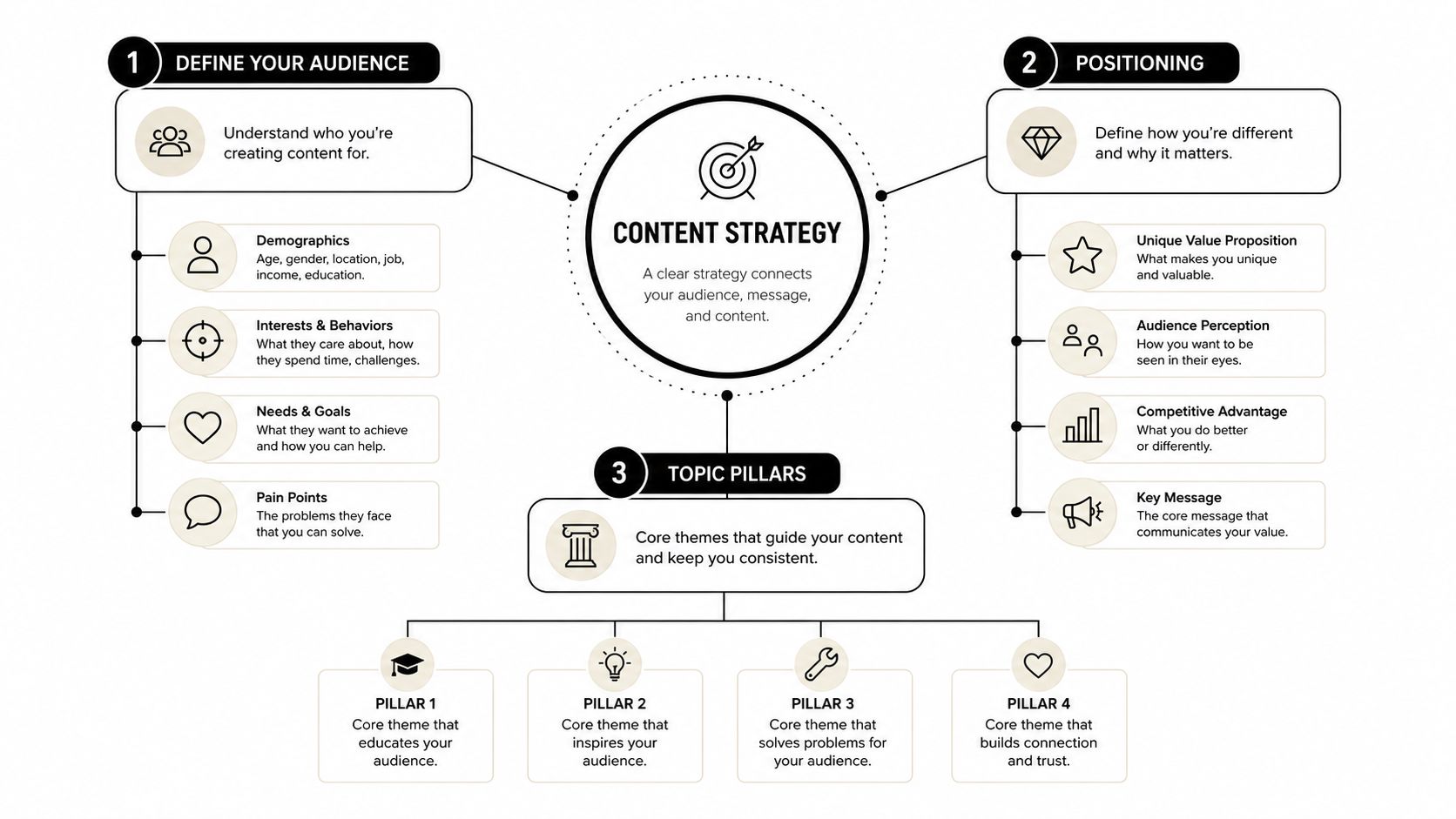
Once the audience statement is clear, move to three to five topic pillars. MarketMuse recommends starting with a business-related topic, mapping user intents, building one pillar page as the cluster center, then creating cluster content that goes deeper into individual intents. A law firm might build around employment law for small businesses, then support it with articles on termination checklists, wage-and-hour audits, and noncompete rules, as MarketMuse outlines.
A simple planning grid keeps the work disciplined:
- Audience statement: who the content is for, in plain language.
- Positioning statement: what the firm owns, and what it refuses to pretend to own.
- Pillar one: the broad service theme buyers already search for.
- Pillar two: the risk or problem cluster that slows decisions.
- Pillar three: the proof, process, or compliance topic that builds confidence.
A pillar isn't a random category. It's the topic family that keeps your expertise recognizable across multiple articles.
This is also where a firm avoids the common trap of mixing thought leadership with generic advice. If a consulting firm says it helps manufacturers improve operations, the pillar map should not drift into unrelated management commentary. It should stay close to the buyer's actual decision process, because that's what makes the content useful and searchable.
Use the grid to brief every article
Each pillar should answer one question and support several sub-intents. That keeps the editorial calendar from turning into a pile of disconnected ideas. It also gives partners a fast way to approve topics, since they can see how each article fits into the larger authority structure rather than judging every draft in isolation.
Match Content Types to the Buying Stage
Different formats do different jobs, and treating them as interchangeable wastes time. A blog post can create discovery, but it rarely resolves uncertainty on its own. A case study can reduce risk, but it will not attract a stranger who does not yet understand the problem.
The practical move is to assign each format to a stage in the journey. In professional services, that usually means one asset for awareness, one for consideration, and one for decision. Megabant's guidance on professional services content best practices points to case studies, credentials, service pages, client testimonials, and consultation offers as the formats that reduce uncertainty and support action.
| Buying Stage | Best Format | Primary Job | Example Asset |
|---|---|---|---|
| Awareness | Pillar guide or blog | Introduce the problem and capture search demand | “Employment law basics for small businesses” |
| Consideration | Whitepaper, webinar, or video | Explain approach, process, and trade-offs | “How our firm handles compliance reviews” |
| Decision | Case study, credentials page, testimonial, consultation offer | Reduce risk and make action easier | “Client outcome summary with consultation invite” |
A Fort Myers law firm could use a pillar guide to attract people searching for a broad issue, then send them to a case study that shows how a similar matter was handled, then route them to a credentials page and consultation offer. That sequence works because each asset answers a different objection at a different moment. The content is doing separate jobs, not repeating the same message in new packaging.
Video deserves a separate mention. It is strong for humanizing expertise and showing tone, which matters in high-trust categories. Newsletters do a different job again. They keep existing contacts warm, surface new content, and make sure one good article does not disappear after the publish date. For firms that do not have enough internal bandwidth to turn every idea into every format, Polaris Marketing Solutions has a practical note on whether to prioritize social or website content when time is tight.
The format also needs to fit the relationship stage. Research on B2B content marketing for professional services found that in-person content is viewed as more useful for expert insight, relationship building, and trust, while online content is more useful for scalability and convenience, according to this study summary. That is why a live workshop still makes sense for a high-value prospect, even when the firm has a solid online library. The trade-off is simple. Live formats take more coordination, but they often create a stronger read on fit and seriousness than a passive asset can.
A practical repurposing loop helps here too. One subject-matter interview can feed a blog, a short video, a newsletter, and a decision-stage asset, which is why a guide to content repurposing is useful when the team is trying to do more with the same source material. The biggest mistake is overproducing awareness content and underproducing decision content. A library full of educational posts can create traffic without creating confidence. A balanced mix does both.
Build a 4-Week Production Cycle and Editorial Calendar
A content program survives on process, not bursts of inspiration. The cleanest model I have seen in firms with busy partners is a 4-week production cycle. It keeps SMEs involved without turning them into a bottleneck, and it gives marketing enough room to shape the piece properly.
Week-by-week ownership
Week 1 is topic selection and SME interview. The marketer brings a brief, the partner or senior staff member brings real examples, and the goal is to pull out the judgment calls that make the firm sound credible instead of generic. Week 2 is draft creation and first review, where the draft should already reflect the firm's actual language, not marketing filler.
Week 3 is revision and design, which is where the article becomes usable in practice. Week 4 is final approval, SEO optimization, publishing, and distribution, which means the team does not stop at “it's live” and pretend the job is finished.
If the SME interview is weak, the whole draft usually turns generic. Fix that first, not the headline.
For capacity planning, a neutral services guide recommends 2 articles per month minimum for small firms and 1 article per week plus monthly long-form for mid-size firms, as described in Rework's services content planning guide. That range is useful because it forces an honest conversation about bandwidth before the calendar gets overfilled.
A simple editorial calendar might include these fields:
- Working title: the exact topic under review.
- Pillar: the parent topic it supports.
- SME owner: the person who provides the substance.
- Status: interview, draft, revision, approved, published.
- Distribution lane: email, LinkedIn, local partner, or internal sales use.
The operational win is case study discipline. Document the situation, challenge, approach, and results after each successful engagement, then publish the case study within a short window after project completion. That timing protects detail and keeps the story fresh enough to be useful, which matters more than waiting for a perfect format.
For firms that never seem to have time to turn one article into multiple assets, a guide to content repurposing is a practical reference point. The same principle applies in a legal or consulting practice, one strong source piece should feed several channels instead of being treated as a one-off.
If your team is also deciding whether social posts belong in the current cycle, Polaris Marketing Solutions has a practical note on whether to prioritize social or website content when time is tight. That trade-off shows up fast in real firms, because social can help with distribution while website content carries more long-term search value.
Internal calendars also need to respect reality. A firm that keeps changing review windows, waiting on partner approvals, or asking marketing to finish it later will break the rhythm. The calendar has to be treated like a client delivery schedule, not a wish list.
SEO, Google Business Profile, and Location Pages for Local Firms
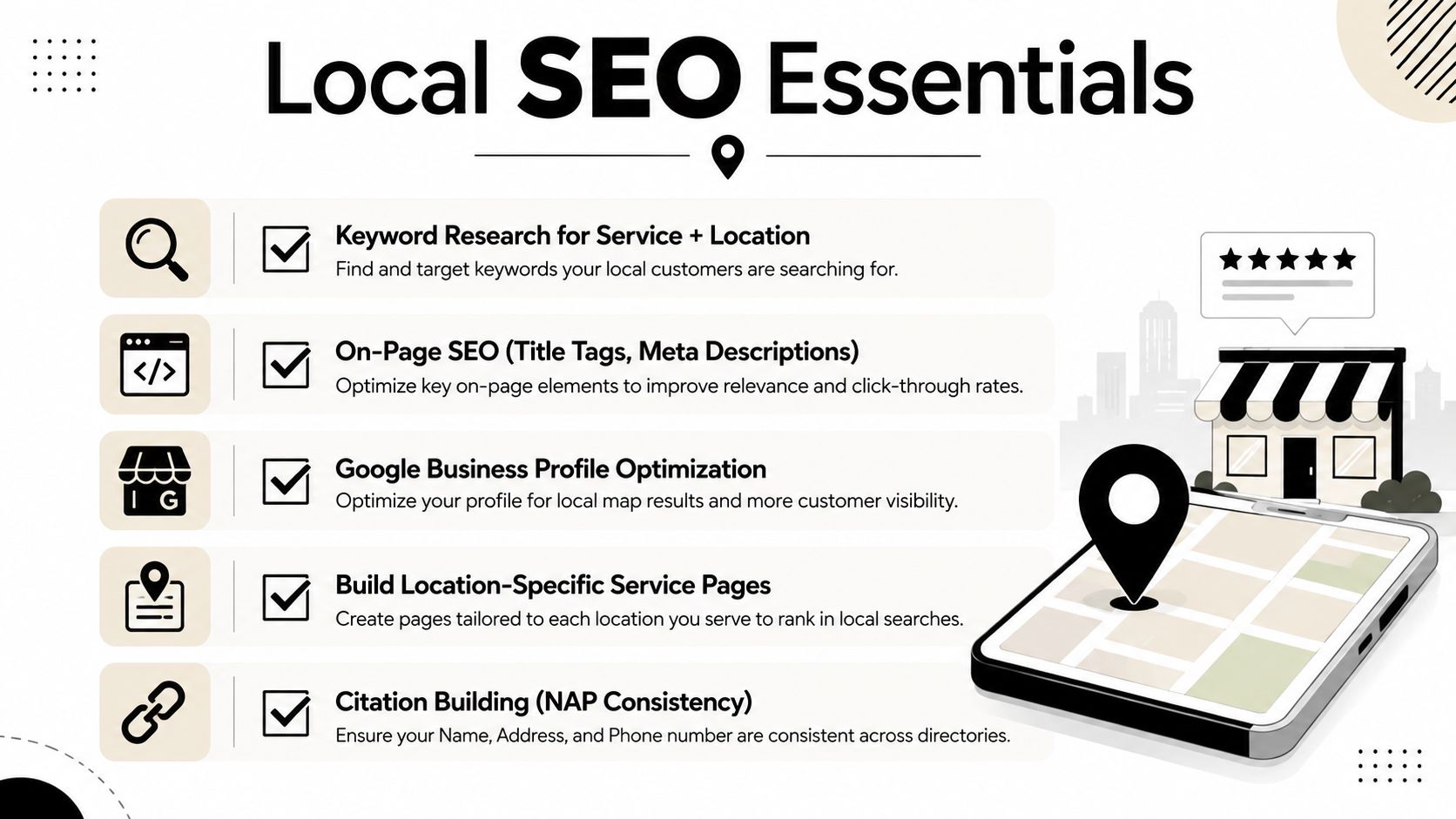
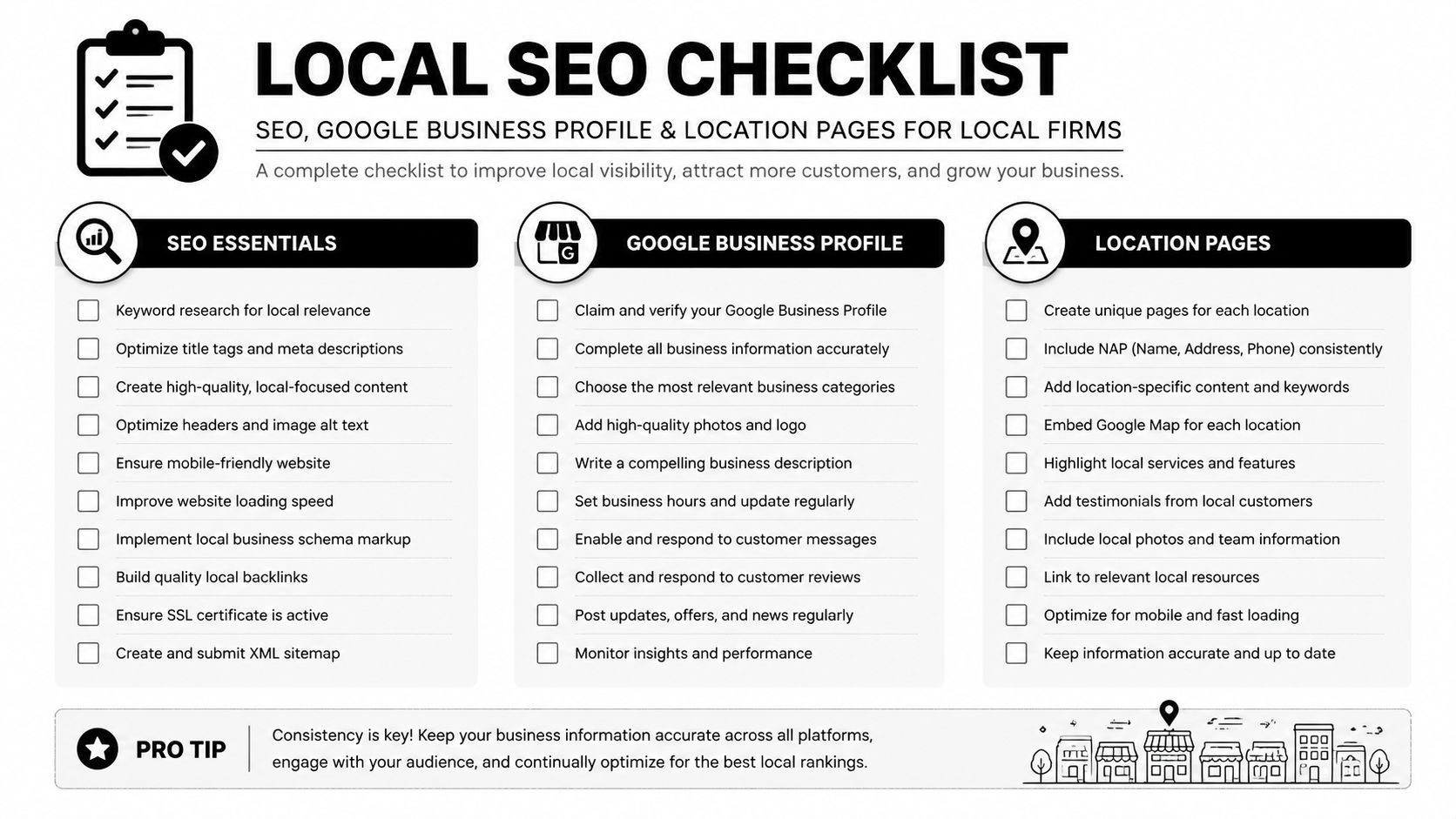
Local professional services firms need more than good writing. They need search visibility in both organic results and map results, because buyers often search by service plus place. That means the content program has to support the website, the Google Business Profile, review signals, citations, and location pages that are specific enough to be credible.
The on-page basics are still the starting point. Every service page should state what the firm does, who it helps, and where it operates without burying the answer under clever copy. A location page for Fort Myers, for example, should combine service detail, local proof, internal links to related articles, and a clear route to contact.
Local signals that deserve a quarterly audit
- Title tags and meta descriptions: make sure the service and location are both clear.
- Google Business Profile: keep services, categories, photos, hours, and posts current.
- Reviews: ask satisfied clients for feedback in a steady, non-pushy way.
- Citations: keep name, address, and phone information consistent.
- Location pages: build pages for core service areas such as Fort Myers, Cape Coral, Estero, and Bonita Springs.
For firms with a local footprint, review management and location-specific content matter because they connect the digital profile to real-world geography. A consulting or legal practice that serves Southwest Florida should not hide behind a single generic service page and assume search will figure it out.
A practical location page outline looks like this. Open with the service, name the market, then add the local problem the buyer is trying to solve. Include one short proof block, one internal link to a relevant pillar article, and one call to action that matches the buyer's stage.
On the timeline side, expectations need to be realistic. One industry guide estimates 6 to 10 weeks for strategy design, 3 to 6 months for the initial rollout, and 12 to 24 months to reach full maturity, while another says early positive indicators often appear in 3 to 6 months but consistent qualified-lead flow typically takes 9 to 12 months. Those estimates are described in this strategy guide, and they line up with what most firms experience when the program is sustained.
I'd also be blunt about tools. Polaris Marketing Solutions is one option for firms that need website design, SEO, local SEO, and content creation tied together in one operating plan, especially when the goal is to support local visibility rather than run disconnected campaigns.
Distribution Rhythm Across Email, LinkedIn, and Local Partnerships
Publishing without distribution is where a lot of solid programs stall. The article gets written, it goes live, and then the team acts surprised when it does not create traction. The fix is to treat distribution as part of production, not as a separate chore at the end.
The practical move is to build one asset into multiple lanes. A pillar guide can become a LinkedIn post series, a short email segment, a talking point for a local workshop, and a clipped video. That approach reduces the pressure to invent a new message every time, while still meeting people where they already pay attention.
Online content handles scale. In-person events still build trust, especially in higher-value service relationships. A ScienceDirect study on content format preferences found that in-person content performed better for relationship building and expert insight, while online content performed better for convenience and reach. That trade-off matters because firms often need both, but for different parts of the buying journey.
A practical monthly cadence looks like this:
- Week 1: publish the pillar piece and send it to the email list.
- Week 2: post a short LinkedIn series that breaks the pillar into smaller angles.
- Week 3: use one excerpt in a partner newsletter or association update.
- Week 4: record a short video or host a local conversation around the topic.
For email execution, browse the email lead gen playbook if the firm needs a clean way to segment educational content and keep nurture flows from getting too noisy. Email works best when it feels like a useful next step rather than a hard pitch, and that usually means tighter audience splits, clearer subject lines, and fewer sends that try to do everything at once.
Local partnerships still matter in Southwest Florida. Chambers, trade groups, industry associations, and referral partners can extend the life of a strong article if they see it as a useful resource for their own audience. That works best when the piece answers a practical question people are already raising in meetings or events, because partners are much more likely to share something that helps them look useful too.
The best distribution programs do not chase novelty. They repeat the same useful idea in formats that fit the channel, then let the message compound across search, email, social, and local relationships. A simple way to keep that work honest is to measure the content paths that lead to meetings and closed work, which you can frame with a clear guide to marketing ROI measurement.
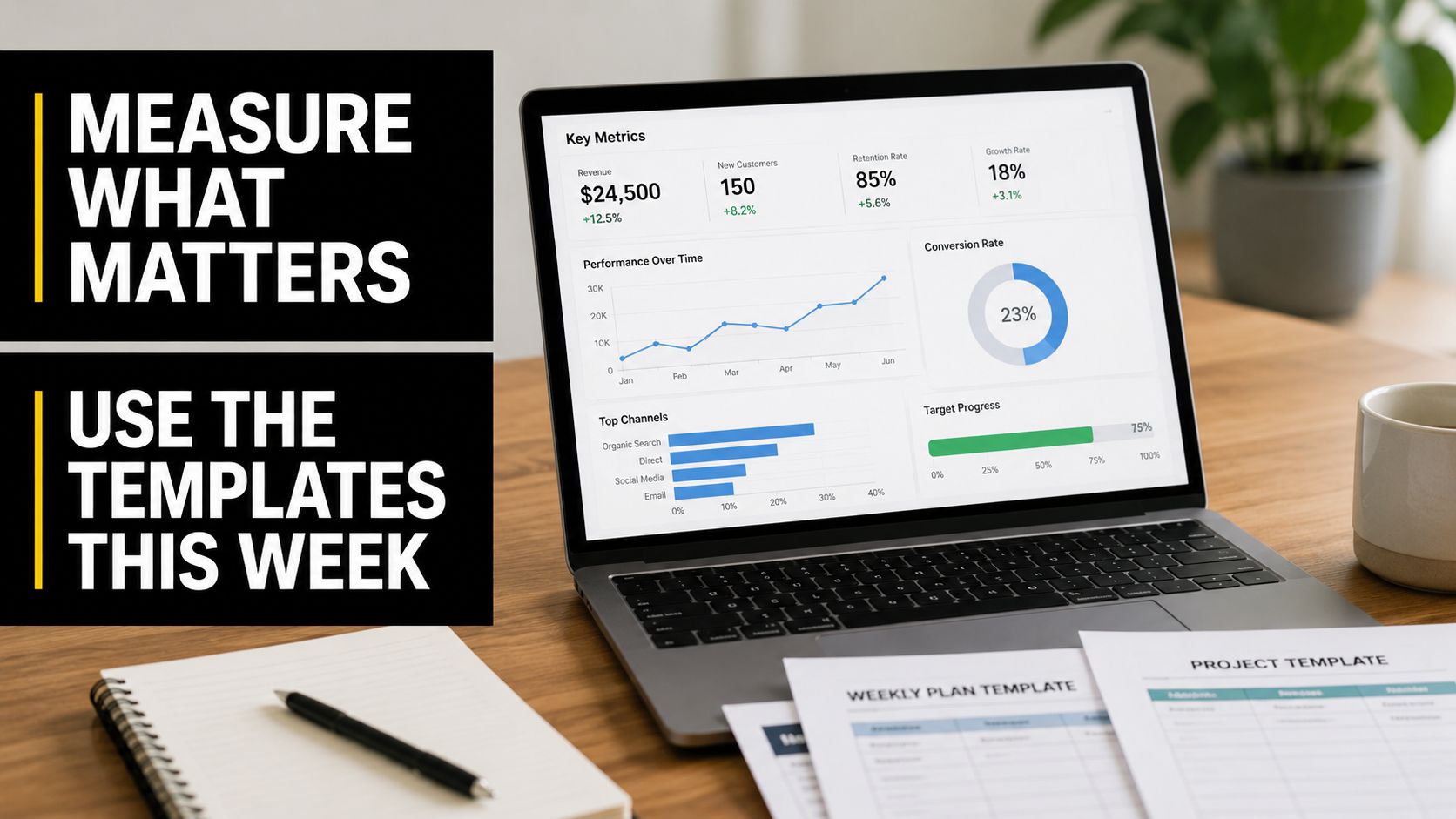
Measure What Matters and Use the Templates This Week
Traffic is a useful diagnostic, but it's a weak success metric for professional services. Long sales cycles blur attribution, and a buyer might read several pieces over weeks before ever filling out a form. That's why the better measurement lens is influenced pipeline, lead-to-meeting conversion, and the content consumption patterns of clients who eventually close.
There's a second measurement mistake to avoid. A lot of firms chase whatever gets clicks, then wonder why the leads don't fit. In a trust-heavy market, the most valuable content is often the piece that lowers sales friction, pre-sells the buyer, and shows up repeatedly in successful client journeys, not the one with the biggest top-of-funnel spike.
A simple KPI dashboard
- Influenced opportunities: where content appeared before or during the sales process.
- Lead-to-meeting conversion: which assets helped turn interest into a conversation.
- Content sequence: which articles, videos, or pages were consumed before contact.
- Decision-stage assist rate: which case studies, testimonials, or service pages showed up most often.
That dashboard can sit next to a 90-day launch checklist and keep the team honest about what the program is doing. It also fits the shift toward AI-driven search, where content needs strong topical authority, pillar structure, and E-E-A-T signals so visibility doesn't come at the expense of qualification.
The cleanest starter move is simple. Pick one pillar, run the 4-week cycle, and watch how it supports the next sales conversation instead of obsessing over vanity traffic. For a more practical framework on attribution, this guide on how to measure marketing ROI is worth keeping nearby.
If your firm needs content that supports local lead generation, Polaris Marketing Solutions can help with the planning, writing, SEO, and distribution pieces that make the system work together. Visit Polaris Marketing Solutions to explore a content plan built for professional services, then turn one pillar topic into a repeatable pipeline asset.