
You're paying a web designer for a site that isn't generating calls, an SEO freelancer for reports you can't interpret, and a social media manager who keeps posting without explaining where the leads come from. Meanwhile, your competitors keep appearing in Google when local customers search for the services you provide.
That's the problem small business marketing packages are supposed to solve. The right package connects discovery, trust, conversion, and follow-up under one strategy, with deliverables tied to business outcomes instead of a disconnected list of activities. The wrong package just gives you more tasks to review each month.
For contractors and professional firms in Southwest Florida, budget fit matters just as much as channel selection. A roofing company competing in a crowded service area needs a different plan from a solo consultant serving a narrow audience. This guide shows how to evaluate the difference.
Why Small Business Owners Are Turning to Marketing Packages
A contractor I worked with had what looked like a full marketing team. His website provider handled updates, an SEO freelancer worked on rankings, a social media manager posted project photos, and a pay-per-click specialist managed Google Ads. Each vendor delivered something. Nobody owned the customer journey.
The website generated form submissions that weren't consistently tracked. The SEO report emphasized keyword positions but didn't connect them to calls. Social posts looked professional, yet they rarely directed prospects to a service page or booking process. Paid campaigns brought traffic to pages that didn't answer basic questions about service areas, availability, or next steps.
That arrangement creates a coordination problem. A marketing package can place complementary services under one strategy and one point of accountability, so the person managing the campaign can see how a prospect moves from search to inquiry and from inquiry to appointment.
A package should follow the buyer
Modern small business marketing packages shouldn't be judged by how many services appear in the proposal. They should be judged by whether each deliverable supports a stage of the buying process.
- Discovery: Local SEO, Google Business Profile optimization, citations, paid search, and location-specific content help people find the business.
- Trust: Reviews, project galleries, service explanations, social proof, and useful content reduce uncertainty.
- Conversion: Website structure, landing pages, calls to action, phone tracking, and forms make it easier to take the next step.
- Follow-up: Email sequences, missed-call workflows, estimates, reminders, and reactivation campaigns help recover opportunities that weren't ready to buy immediately.
This approach also prevents a common mistake, spreading a limited budget evenly across every channel. One industry survey found that small and midsized businesses allocate an average of 46% of their marketing budget to digital channels, while 28% devote more than 70% to digital and 24% keep digital below 10%. The same survey reported average SMB marketing spend of about $400 per month. Those figures explain why practical packages emphasize prioritization and channel mix rather than enterprise-style retainers. (Marketing Dive's analysis of SMB marketing budgets)
A package isn't automatically affordable or effective. Its value depends on whether the scope matches your growth stage, cash flow, geography, and competition. Business owners researching affordable ways to promote listings can apply the same principle. Start with the channels that create measurable visibility and move prospects toward a decision.
Core Components of Effective Marketing Packages
A useful package connects several services, but every service should have a defined job. The website supports conversion. Local optimization creates discovery. Advertising captures urgent demand. Social media and reviews reinforce trust. Email keeps the business present after the first interaction.
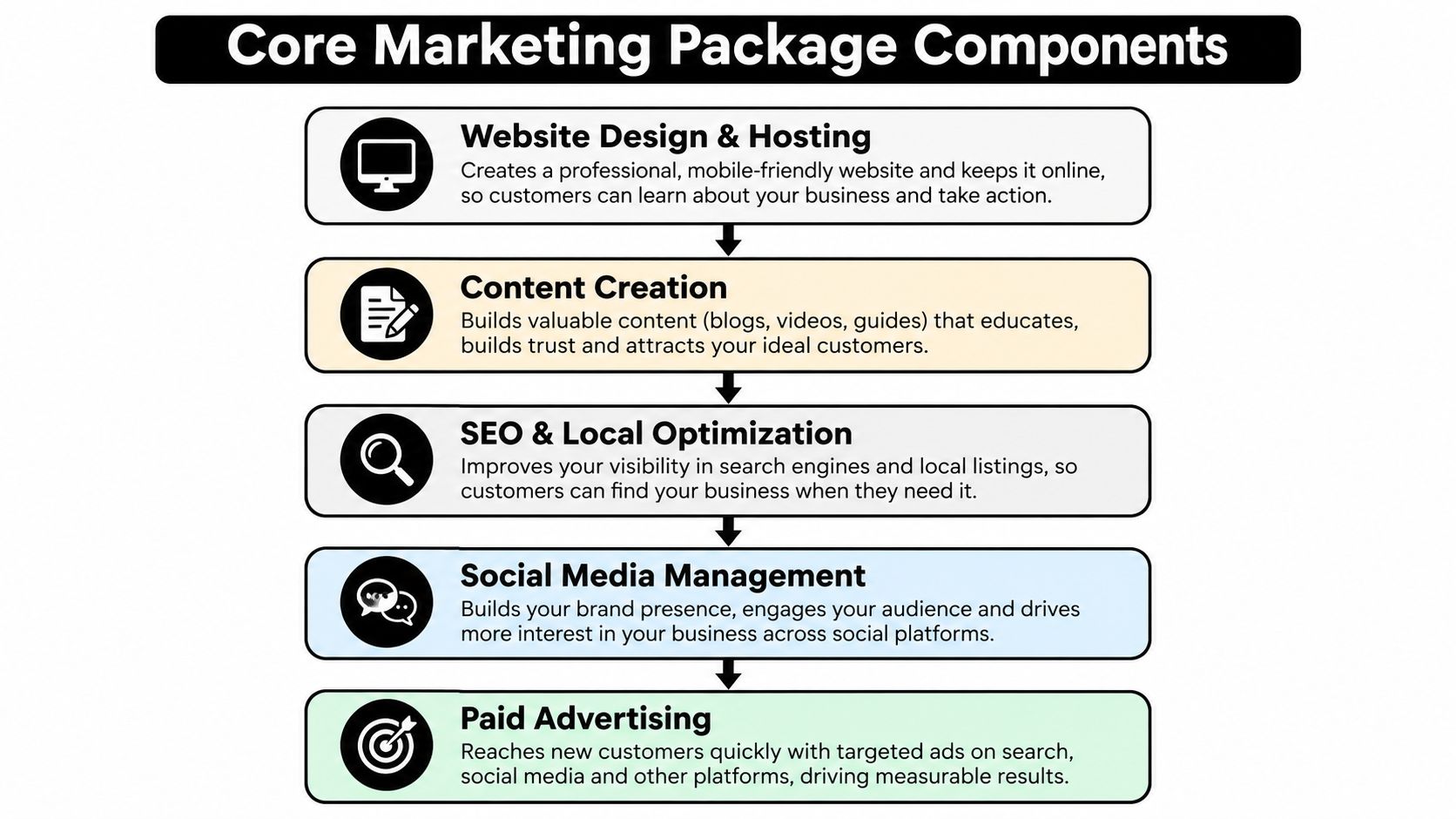
Website design and hosting create the conversion foundation
Your website is where most marketing traffic should land, but many small businesses treat it as a brochure instead of a sales tool. A conversion-focused site should make the service, service area, differentiator, and next step obvious. It should also load reliably, work on mobile devices, and give each important service a relevant page.
Hosting matters because broken pages, slow loading, and outdated plugins can undermine every other channel. A package that includes website support should specify who handles updates, how requests are prioritized, and how form submissions and phone calls are recorded.
Local SEO and Google Business Profile support discovery
Local SEO works best as a coordinated system. It can include service pages with location relevance, citation cleanup, internal linking, technical improvements, and Google Business Profile optimization.
Google Business Profile work should cover accurate categories, complete services, photos, business details, and review responses. Roughly 46% of searches have local intent, about 93% of local searches show a Map Pack result, and 76% of mobile users visit a business within 24 hours after a local search, according to a guide focused on Google Business Profile performance. (Google Business Profile guidance from Posterly)
Paid search captures immediate intent
Pay-per-click advertising can generate visibility before organic rankings mature, but campaign structure determines whether the spend teaches you anything. Separate branded, service, and location campaigns so you can see which searches produce qualified inquiries.
Current Google Ads benchmark summaries report roughly $5.26 CPC, 6.7% CTR, 7.5% conversion rate, and $70.11 cost per lead across industries. WordStream's benchmark set reports $4.22 CPC, 6.1% CTR, and 7.0% conversion rate. These are reference points, not promises. (WordStream PPC benchmarks)
Social media, reviews, and email complete the trust loop
Social media management is useful when it shows evidence of competence, answers customer questions, and supports campaigns. It doesn't work well as a monthly posting quota with no connection to service pages, offers, or inquiries.
Review management deserves its own process. One benchmark summary reports that businesses with 50 or more reviews are 266% more likely to appear in the Local Pack than businesses with fewer than 10 reviews. That makes review requests, response standards, and monitoring practical package deliverables, not decorative extras. (Local SEO benchmark data from BizIQ)
Email marketing handles the prospects and past customers who aren't ready to act today. Welcome, nurture, appointment reminder, and reactivation sequences can extend the value of traffic you've already paid to acquire. Industry sources report average email returns ranging from $36 to $42 for every $1 spent, with some top performers exceeding $50 per dollar. (Email marketing ROI benchmarks from Marketful)
For broader planning ideas, compare package design with these data-backed marketing strategies for small businesses. The practical lesson is simple. Isolated tactics create activity. Connected services create a path from attention to revenue.
Understanding Package Tiers and Pricing Ranges
Package pricing reflects more than the number of deliverables. It reflects the amount of strategy, production, optimization, reporting, and advertising management required to compete in a particular market.
A basic package may be appropriate for a new local business that needs a credible foundation. A growth package makes more sense when the business already has a working offer and needs consistent lead generation. A full-service program is often necessary when several locations, multiple service lines, or highly competitive search terms require ongoing work across channels.
| Package Tier | Monthly Investment | Best For | Core Services Included |
|---|---|---|---|
| Foundation | About $500 and upward | New or early-stage local businesses | Website maintenance, Google Business Profile setup, basic local SEO, listings, review process |
| Lead generation | Variable, with ad spend budgeted separately | Established contractors and professional firms | Local SEO, landing pages, Google Ads, conversion tracking, review management |
| Growth | Variable, based on market and scope | Businesses expanding service areas or lead volume | SEO content, PPC management, website improvements, social media, email automation, reporting |
| Full service | Over $12,000 at the upper end | Competitive legal, medical, roofing, and home-service markets | Strategy, multi-channel execution, technical SEO, content, paid media, creative, lifecycle marketing |
Recent benchmarking places small-business marketing packages from roughly $500 per month at the low end to more than $12,000 for full-service programs. Local-service businesses may need about $1,500 to $4,000 per month in ad spend, while highly competitive sectors may require $4,000 to $10,000 monthly to remain visible. Those figures describe budget conditions, not guaranteed outcomes. (Small-business marketing benchmarks from InnerSpark Creative)
Separate management fees from media spend
Ask whether the quoted package includes advertising spend. A management fee pays for research, campaign construction, creative, optimization, and reporting. Media spend goes to Google, Meta, or another advertising platform.
Combining the two figures can make a proposal look inexpensive while hiding an inadequate campaign budget. Require both amounts in writing, along with the service areas, campaign objectives, landing pages, and conversion actions included.
Match the tier to the market
A low-cost social package may be sufficient for a startup that needs consistent visibility while it builds its customer base. It won't substitute for local SEO and paid search when a roofing or legal firm is competing for urgent, high-value searches.
For an early-stage company, a practical priority is a reliable website, a complete profile, a review process, and one measurable acquisition channel. Once those foundations work, add content, email, or social activity where the customer journey shows a gap. Guidance on an affordable social media strategy for startups can help businesses avoid paying for broad social activity before they know what role it serves.
How to Evaluate Packages for Your Specific Business
Don't compare proposals by counting deliverables. Compare them by asking what each deliverable changes in the customer journey and how the agency will prove that change.
A proposal that promises monthly blogs, social posts, backlinks, and ad management may sound complete. If it doesn't explain which pages receive traffic, which calls are attributed to campaigns, and how leads enter your sales process, you're buying activity without enough visibility into business performance.
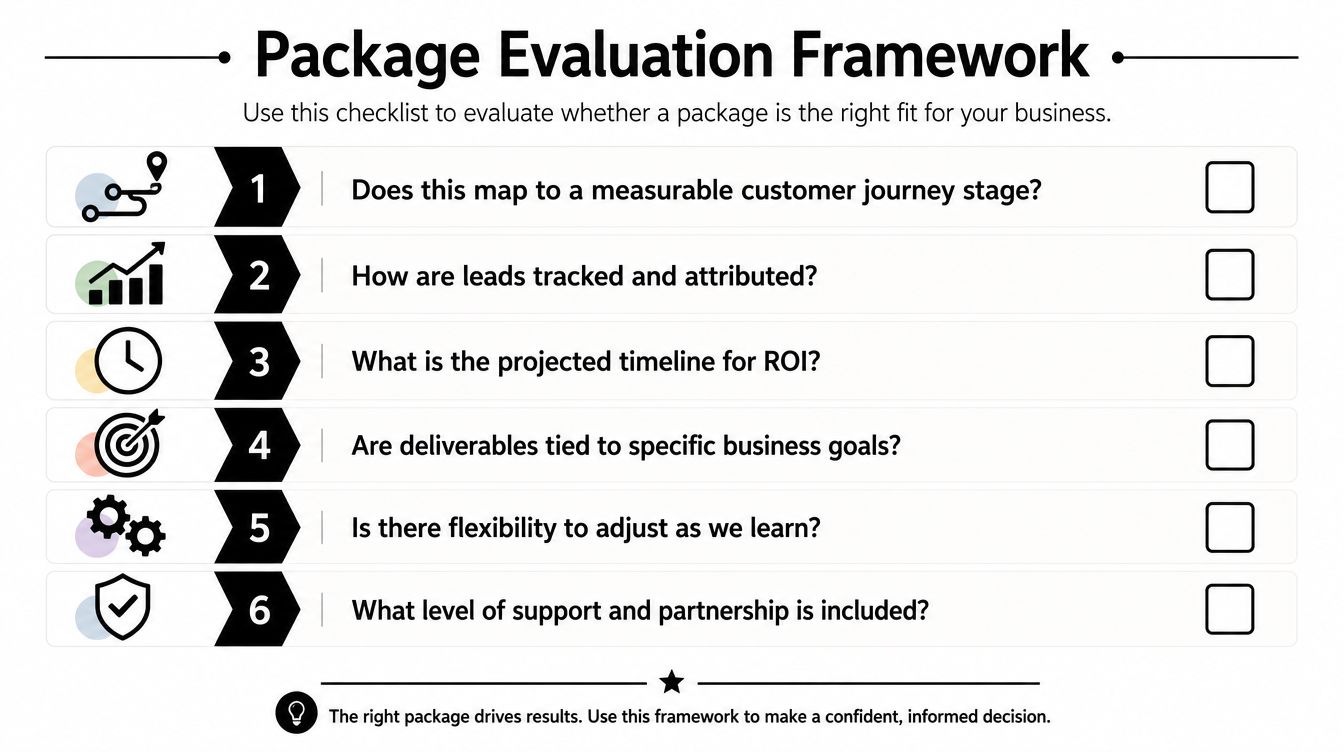
Use five questions before signing
Does each deliverable have a journey stage? A service page should support discovery and conversion. A review workflow should strengthen trust. An email sequence should support follow-up. If a deliverable has no clear role, challenge its inclusion.
How are leads tracked? Ask for call tracking, form attribution, campaign naming, landing-page reporting, and a process for matching inquiries to closed jobs. You don't need complicated enterprise software, but you do need a consistent source record.
What does the report help you decide? A useful report should show leads, qualified leads, cost per lead, conversion rate, revenue where available, and actions for the next period. Rankings and impressions can provide context, but they shouldn't replace outcome reporting.
What happens when a channel underperforms? The agreement should explain testing, budget adjustments, landing-page changes, audience refinement, and when the team recommends reducing or pausing a channel.
Does the investment fit cash flow and timing? SEO may build durable visibility over time, while paid search can capture immediate demand. Your package should balance the need for near-term inquiries with the ability to fund longer-term improvements.
Adjust the evaluation by industry
A home services contractor typically needs strong local SEO, service-area pages, Google Business Profile maintenance, and a disciplined review and missed-call process. A healthcare provider needs reputation management, clear credentials, patient-friendly explanations, and trust signals that reduce hesitation.
A legal firm often depends on high-intent PPC, practice-area landing pages, conversion optimization, and careful lead qualification. Professional firms may need stronger thought leadership and email nurture than a business driven by emergency service searches.
For a broader agency-selection checklist, review how to choose a digital marketing agency. The right provider should explain what it will do, why it matters, how it will be measured, and how the plan can change when the data changes.
Sample Package Structures and ROI Projections
Marketing packages become easier to evaluate when you translate them into operating scenarios. The examples below are planning models, not promised results. Your actual performance depends on competition, offer quality, response speed, service capacity, sales process, and tracking accuracy.
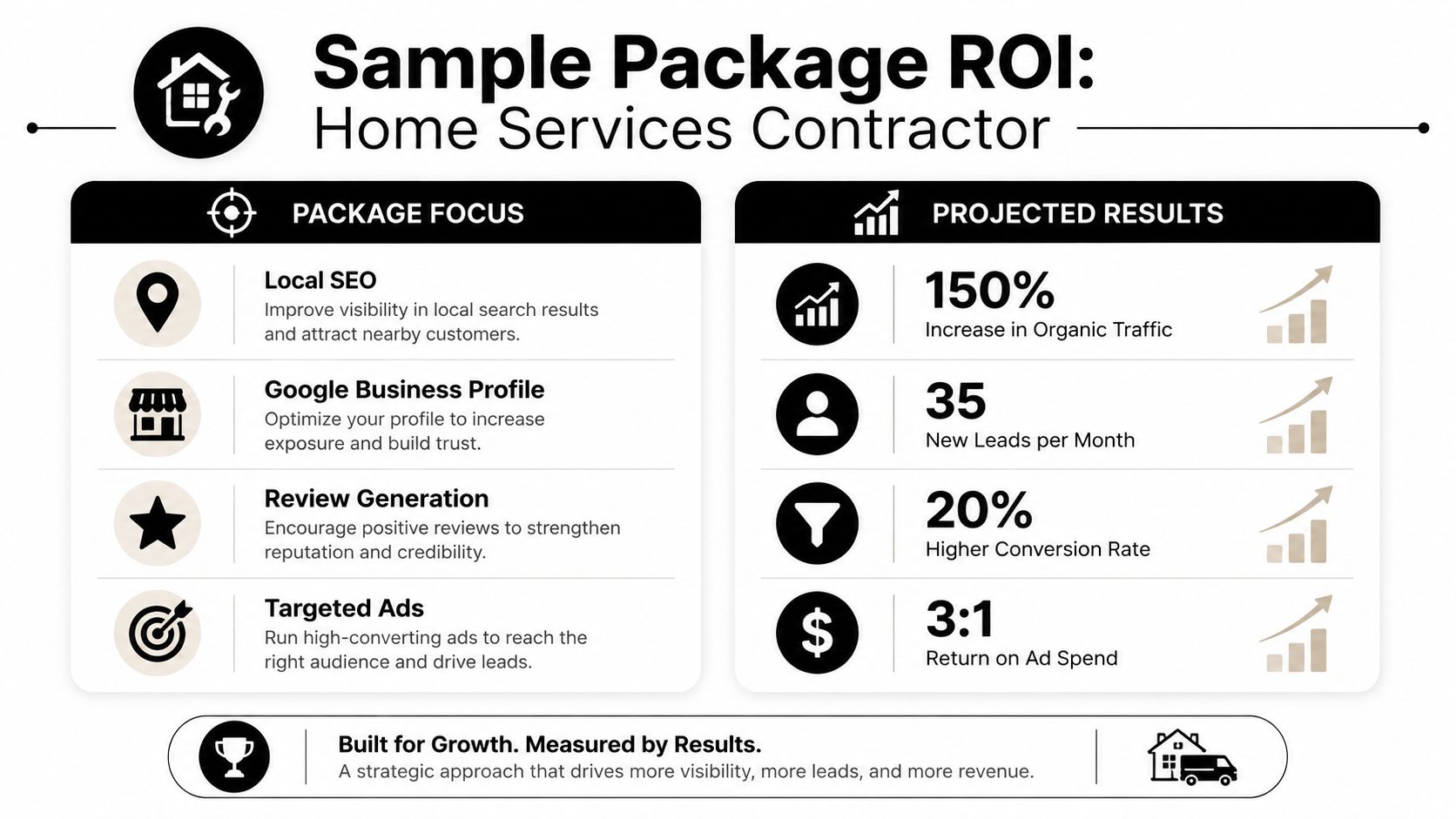
Home services contractor
A cleaning, roofing, paving, or HVAC company might begin with a package centered on local SEO, Google Business Profile optimization, review generation, location-specific service pages, and targeted ads. The measurable path is straightforward:
- Discovery: Customers find the business through local results and service searches.
- Trust: Reviews, photos, credentials, and completed-project content answer credibility concerns.
- Conversion: A focused landing page offers one clear action, such as calling or requesting an estimate.
- Follow-up: Missed calls, estimate reminders, and reactivation emails recover opportunities that otherwise disappear.
The reporting should show calls, forms, booked appointments, qualified leads, and cost per lead by source. Avoid accepting a projected lead volume or acquisition cost unless the agency explains the assumptions behind it.
Practical rule: A lead isn't a result until the business records whether the lead was answered, qualified, booked, and converted.
Professional services firm
A consultant, accounting firm, or business advisory practice may need a different mix. Paid search can capture people actively seeking a service, while conversion-focused web design clarifies expertise and makes consultation requests easy. Email nurture then gives prospects useful reasons to stay engaged when they need time to compare providers.
A simple ROI model starts with the value of a new client, the acceptable acquisition cost, the number of qualified opportunities required, and the close rate from those opportunities. The package should report each stage separately, because a campaign can generate inexpensive leads that rarely become viable clients.
Healthcare or legal practice
For healthcare and legal practices, the package should connect reputation management with high-intent search visibility. That means accurate service information, location relevance, review response standards, clear calls to action, and landing pages that address the questions people ask before contacting a provider.
Paid campaigns should separate branded, service, and location intent. A practice should also monitor lead quality, not just form volume. A consultation request that lacks the right case type, insurance fit, or service need may increase workload without improving revenue.
Use how to measure marketing ROI to build a reporting structure around spend, source, conversion stage, and revenue. The useful projection isn't a dramatic percentage on a slide. It's a defensible model that explains what must happen for the investment to pay back.
The embedded video offers another way to think through measurement and package performance:
Local Success Patterns from Southwest Florida Businesses
Southwest Florida businesses face a practical combination of regional competition, seasonal demand, tourism-driven buying behavior, and service areas that cross city boundaries. A business serving Fort Myers may also need visibility in Cape Coral, Estero, Bonita Springs, or Naples, but it shouldn't create thin pages that swap city names.
The stronger pattern is location-specific usefulness. A contractor can explain which neighborhoods it serves, what conditions affect the work, how quickly it responds, and what customers should prepare before requesting an estimate. A healthcare or professional practice can create pages that answer local concerns without making unsupported promises.

Patterns that separate coordinated operators
Businesses that get more from packages usually do four things consistently:
- They request reviews after completed work. The request is part of the operating workflow, not an occasional campaign.
- They maintain their Google Business Profile. Categories, services, photos, hours, and responses stay aligned with the actual business.
- They publish local proof. Service pages and project content explain real work in real places instead of repeating generic industry copy.
- They follow up quickly. Calls, forms, estimates, and inquiries have a defined owner and next step.
A fragmented business may have each tactic somewhere in its marketing stack, but the customer experiences gaps. The profile says one thing, the website says another, and the sales team doesn't know which campaign produced the inquiry.
Southwest Florida requires operating discipline
Seasonal businesses should plan ahead for demand changes rather than wait for a slow period to begin marketing. Tourism-related services may need messaging that distinguishes visitors from permanent residents. Contractors may need campaigns organized by service urgency and geographic capacity.
The best local packages also respect operational limits. If a company can't answer calls or schedule estimates promptly, increasing ad spend can expose a sales bottleneck rather than solve a visibility problem. A package should therefore include reporting that helps the owner decide whether to invest more, improve conversion, or fix follow-up first.
Businesses comparing digital marketing for local businesses should look for this operational connection. The package must fit how the company serves Fort Myers and surrounding communities, not just how an agency organizes its service menu.
Your Next Steps Toward Smarter Marketing Investment
Start with an audit, not a sales call. Gather your current marketing invoices, advertising spend, website access, Google Business Profile data, call records, form submissions, and customer sources. If you can't identify which activities produced qualified conversations, that gap belongs in the package requirements.
Work through this decision checklist
- Record current investment. Separate agency fees, software, creative, and media spend so you can see the total cost of each channel.
- Identify journey gaps. Decide whether the main problem is discovery, trust, conversion, or follow-up. Don't buy more traffic if the website or response process is failing.
- Review local competitors. Search your core services in the cities you serve. Note which businesses appear, how complete their profiles are, what reviews emphasize, and whether their landing pages make contacting them easy.
- Set a realistic business goal. Define the number and type of jobs, consultations, appointments, or client opportunities you want. Include a reasonable timeline and the sales capacity needed to handle them.
- Request channel-level measurement. Ask how the provider will track calls, forms, booked appointments, qualified leads, and revenue.
- Require a response plan. Find out what happens when a channel underperforms, a campaign produces poor leads, or seasonal demand changes.
The U.S. Small Business Administration recommends allocating 7% to 8% of gross revenue to marketing, while newer or highly competitive businesses may need 12% to 20% to grow faster, according to a budget summary. A company generating $1 million in revenue could therefore plan a $70,000 to $80,000 annual marketing budget, with a higher-growth version at $120,000. (SBA-related marketing budget guidance summarized by Revenue Memo)
Treat those figures as planning context, not a prescription. A professional assessment should examine competitor visibility, current positioning, conversion paths, tracking quality, service capacity, and cash flow before recommending a package. Polaris Marketing Solutions provides complimentary online analysis and competitor reporting for businesses evaluating those decisions.
When the scope matches the market and every deliverable has a measurable role, a package can become a more predictable growth system. When the scope is built around activity alone, even a polished proposal can become another monthly expense that your team struggles to explain.
Polaris Marketing Solutions builds customized marketing packages for small and midsized businesses, combining website design and hosting, local SEO, Google Business Profile optimization, PPC, social media, email, and reporting around the customer journey. Visit Polaris Marketing Solutions to request a complimentary online analysis and competitor report for your Southwest Florida business.