
Most local owners are in the same spot. The phone rings, the inbox is full, jobs are getting quoted, and marketing still feels like something that steals time instead of creating it. In Southwest Florida, I see the same pattern with HVAC contractors in Fort Myers, law firms in Cape Coral, and med spas in Naples, they know they need visibility, but they don't need a content machine, they need content that helps people call, book, or request a quote.
That's where content marketing for local businesses stops being theory and starts acting like a practical growth tool. The businesses that win aren't publishing the most articles, they're building the right pages, answering the right questions, and making it easy for nearby customers to trust them fast. A useful starting point is actionable local marketing tactics, because the best content works when it's tied to the rest of the local marketing stack, not treated like a separate hobby.
Why Local Businesses Need a Content Strategy
A Fort Myers roofing owner once told me he had a “website” but no real leads from it. The site had a homepage, a services page, and a few generic paragraphs about quality and reliability, but nothing that matched the questions people searched before calling. That is the gap content fills, not by adding fluff, but by giving Google and real customers a reason to choose you.
Local search behavior makes that gap expensive. A Local marketing statistics roundup reported that 46% of all Google searches have local intent, and it also said 76% of people who do a local search on smartphone visit a business within 24 hours, while 28% make a purchase after that search. The same roundup noted that 86% of consumers use Google Maps to find local businesses, and that complete Google Business Profile listings are 7x more likely to be visited, so content and listings have to support each other. For service businesses and professional firms, that is the difference between being visible and being ignored.
What changes when content is specific
When a Cape Coral family law firm publishes a plain-English FAQ on custody questions, it gives anxious prospects a place to land before they ever call. When a Bonita Springs HVAC company adds a page on no-cool emergency service, it catches people in a moment of urgency, which is exactly when local intent is strongest. The same logic applies to service-area pages, neighborhood pages, and case studies, because they speak to real situations, not vague brand messaging.
Practical rule: if the page does not help someone decide whether to call you today, it is probably not a priority page.
That is also why content budgets have moved upward. One Content marketing statistics and trends roundup reported that 90% of marketers and business owners use content marketing, only 3% called it unsuccessful, and 41% of global marketing leaders increased content budgets in 2023 while 45% planned to raise them again in 2024. For local firms, that usually means educational blogs, service pages, and location-based content get a bigger share of attention and money.
If you want the plain-English version, content gives a local business more chances to be found, more chances to build trust, and more chances to turn a search into a call. National brands can outspend you, but they cannot easily out-local you.
Building a Local Content Foundation That Works
A local business usually wastes the most time at the start, not the finish. I see teams build too many weak blog posts, then wonder why the phone still feels quiet. A better foundation starts with measurable goals, a quick audit of what already exists, and a short list of assets that can influence calls, quote requests, and bookings.
Start with the pages that earn their keep
For local businesses, the highest-value assets are usually service pages, neighborhood or location pages, FAQ content, and case studies, with a cadence of about 1 to 3 pieces per month often being enough for sustainable execution. That lines up with local-content advice that says businesses should focus on material tied to a local search, a customer question, or a sales conversation. It also fits what I've seen in Southwest Florida, where a few strong pages usually beat a busy blog full of broad advice nobody is searching for. Local content marketing framework
A simple planning workflow keeps the work realistic. Use your existing questions, calls, and quote requests to decide what gets written next, then map each piece to a stage of the journey. Adobe's content guidance on awareness, consideration, and decision helps here, because it forces each asset to do one job instead of trying to do everything at once. Adobe content marketing basics
A local business with limited time should ask one question before drafting anything, “Will this help someone choose us, contact us, or trust us enough to come back?”
Keep the workflow small and measurable
The operational side matters just as much as the content type. A data-led workflow starts with clear goals, then adds GA4, conversion tracking, UTM parameters, CRM lead tracking, and monthly review by channel, entry page, and conversion rate, so decisions are based on outcomes instead of guesses. Data-driven content strategy
If you're building a calendar, keep it simple. One useful reference is this content calendar framework, because a calendar only works when it reflects your actual service mix, staffing, and sales cycle. For most small teams, the goal is not volume, it is repeatable output that supports the phone.
Use long-tail local keywords first
Local content planning gets easier when you stop chasing broad terms first. Target low-competition long-tail keywords around your services, then expand into broader topics once your pages start earning traction. That approach is especially useful in competitive metro areas like Fort Myers, Naples, and Cape Coral, where broad search terms can be crowded and expensive to win with thin content.
For teams that need structure, SemDash's SEO content guide is a practical companion for organizing topics, refining on-page optimization, and keeping the work focused on search intent.
Creating High-Intent Local Content Assets
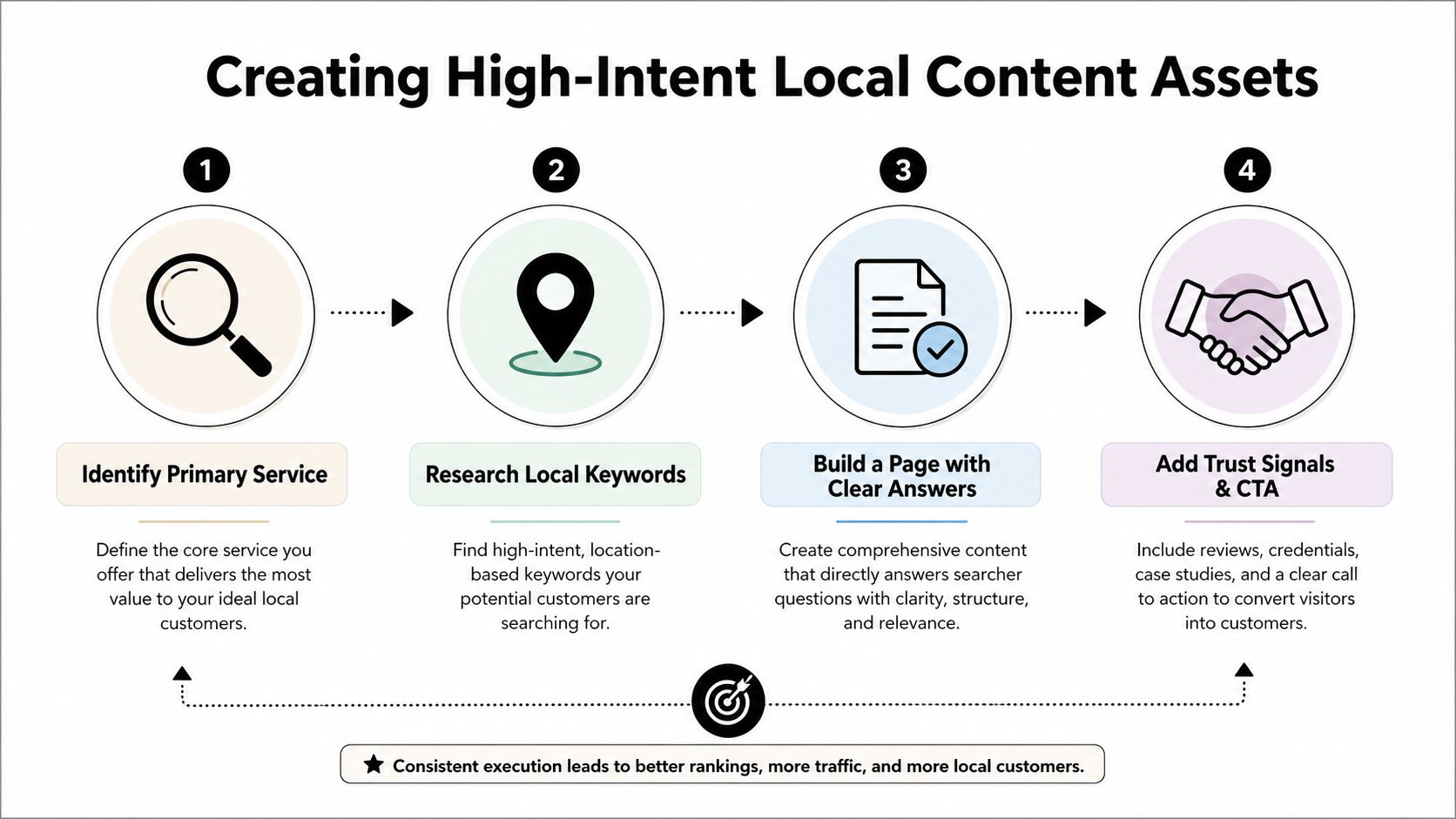
A good service page does not read like a brochure. It answers the questions people ask before they're willing to call, and it removes friction without sounding pushy. The same goes for location pages and FAQs, they're not filler, they're conversion tools when they're written for real intent.
Service pages need clarity, not cleverness
For a home service business, the service page should say what the service is, who it's for, where you work, what problems you solve, and what happens next if someone contacts you. For a Cape Coral plumber, that might mean separate pages for emergency repairs, water heater replacement, and drain cleaning instead of one catch-all page. For a professional firm, it might mean breaking out family law, probate, or business formation so each page can speak to a specific decision.
A good page structure usually includes a short problem statement, a clear list of services, proof that you do the work locally, and a direct call to action. The language should sound human, not like it was written to impress other marketers. People in a rush want the answer first, then the reassurance.
Location pages should feel real
Location pages work when they mention the area, nearby service patterns, and why that geography matters. A roofing company serving Bonita Springs doesn't need a copy-pasted page with only the city name swapped out. It needs specifics, service coverage, common property types, local concerns, and a clear way to request help.
If you cover multiple Southwest Florida areas, keep each page distinct. Mention the neighborhoods, service logistics, or customer situations that really differ by area. That's the difference between a page Google can understand and a page that looks mass-produced.
FAQs should sound like the front desk
FAQ content is one of the most underrated assets in local content marketing because it mirrors the conversation people have before they buy. Write the questions exactly the way customers say them, then answer them plainly. If your team hears the same concern over and over, that question belongs on the site.
A useful FAQ set often includes these kinds of prompts:
- Pricing and timing: Answer the cost anxiety and scheduling concern people usually ask first.
- Service fit: Explain who the service is for and when it's the right choice.
- Process and expectations: Tell people what happens after they call or submit a form.
- Local service area: Make it obvious which towns, neighborhoods, or counties you serve.
The best pages in this category don't try to “rank for everything.” They earn contact because they reduce uncertainty. That's what turns search traffic into booked work.
Optimizing Google Business Profile and Local Listings
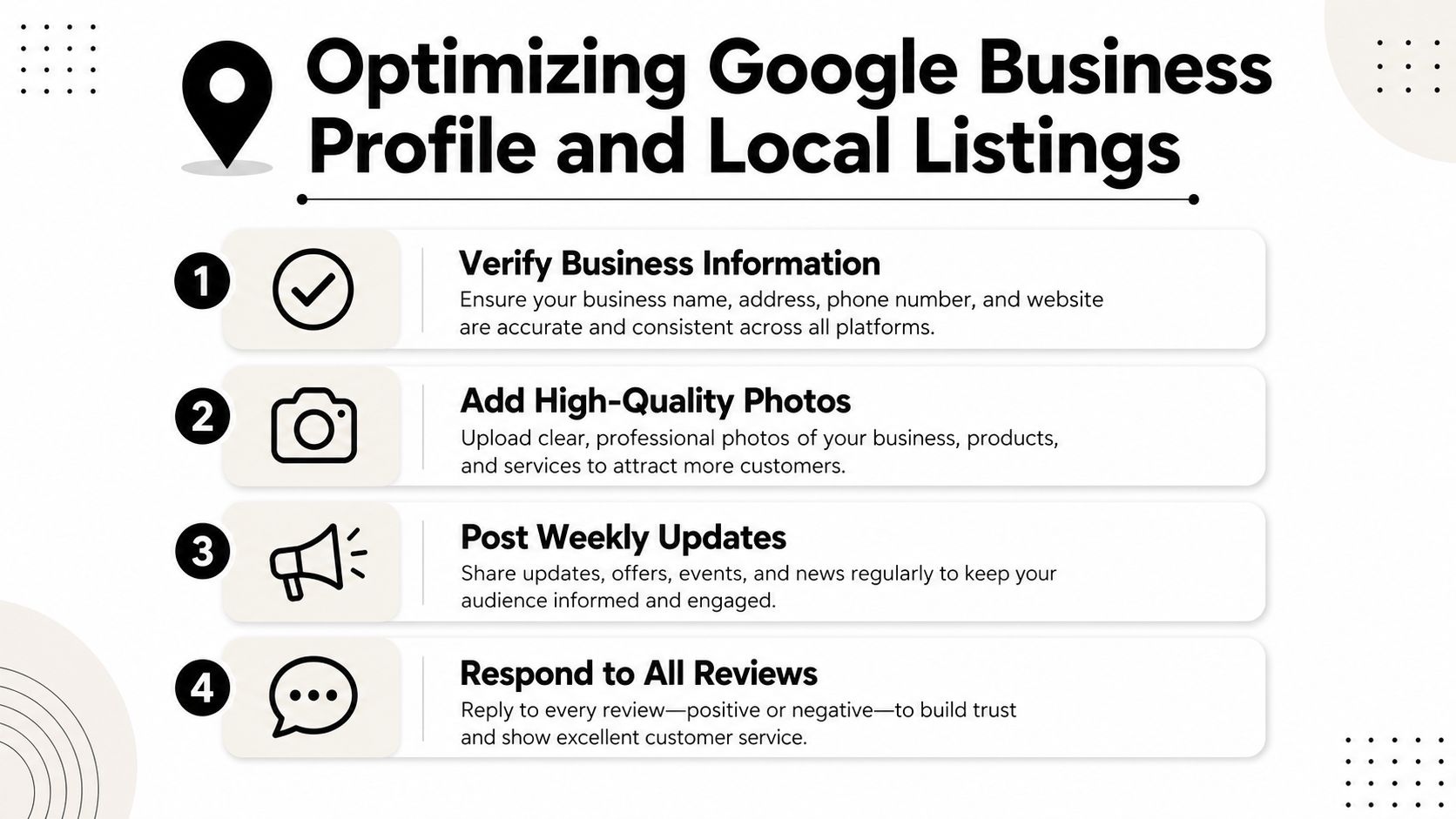
A good article or service page can get attention, but messy public information can still break trust in seconds. I've seen that happen with home service and professional firms in Southwest Florida, where the website, Google listing, and directory profiles all told slightly different stories. One office used one phone number on the site and another on Maps, and callers hesitated before booking. Keep Google Business Profile, directories, and local listings aligned with your address, hours, phone number, email, and website, and fill out GBP fields like photos, a logo, a description, and ownership details where they apply. Neil Patel local content marketing guidance
Treat GBP like a distribution channel
A lot of owners treat Google Business Profile like a static directory entry. It does more than that. Posts, photos, Q&A, and review responses can all reinforce the content you already published, especially when you point people toward a new service page or a useful FAQ.
If your listing is complete, discovery has a better chance of turning into a visit. That is why listing hygiene belongs in the content system, not in a forgotten admin folder. If your article earns the click but the profile looks stale, the customer has one more reason to pause before calling.
Use the profile to keep the conversation moving. If a homeowner sees a service page about drain cleaning, the GBP post can echo the same offer, the same service area, and the same next step. For a practical walkthrough of the setup, how to optimize Google Business Profile covers the details that matter most.
Keep the details aligned
The checklist is simple. The execution is where teams slip.
- Match core business info: Keep the name, address, phone, email, and website consistent everywhere a customer can find you.
- Use fresh photos: Show the team, the vehicles, the storefront, or recent work, because visual proof helps nearby customers trust what they are seeing.
- Post updates regularly: Use GBP posts to highlight new service pages, seasonal offers, or fresh answers to common questions.
- Respond to reviews: Reply to every review in a way that sounds like a real person, not a canned template.
Use local listings to support the site, not replace it
The best setup is content on your site, then GBP and local listings amplifying it. A homeowner in Estero who sees a service page and then finds the same business details in Maps gets a cleaner experience, and that consistency makes the next click easier.
I've also seen firms use Polaris Marketing Solutions for the practical side of this work, especially when they need website content, local SEO, and Google Business Profile support managed together. That matters most when the team is stretched thin and needs the site, the listing, and the booking path to line up. If you need a framework for the wider channel mix, you can find your content distribution plan and build from there.
Distributing Local Content Through Email and Social Channels
The best local page in the world won't do much if nobody sees it. Distribution is where a lot of small businesses either overcomplicate things or do almost nothing. You don't need to post every day, you need a routine that gets helpful content in front of current and potential customers without eating the week.
Email still does heavy lifting
Email is one of the most efficient ways to push local content back into the hands of people who already know your business. A 2024 industry summary reported that email content marketing delivers $36 for every $1 spent, a 3,600% return, which is why email remains a strong channel for local service firms with a modest list and a clear offer. Local marketing statistics roundup
The practical use case is simple. Send a short note when you publish a useful article, a new FAQ, or a seasonal service page. Keep it tight, lead with the problem, and link to the full piece. If someone already filled out a form or bought from you before, that's a warm audience, and warm audiences are more likely to act again.
Social should support the site, not compete with it
Social posts work best when they're repurposed from the content you already made. A blog post becomes a short caption, a service page becomes a before-and-after visual, and a FAQ becomes a quick video or carousel. That's how small teams stay consistent without having to invent new material every day.
For a local business, the goal is not omnipresence. A few well-run channels are enough if they point back to assets that can turn into calls or booked jobs. A Fort Myers roofer can use one service page, turn it into three social posts, and send it to the list once. That's a workable system.
The fastest way to waste content is to publish it once and never move it again.
If you need help organizing the channels, The AI CMO's content distribution plan is useful as a planning reference because it forces you to think about where each asset should go after it's published.
Reviews are content too
Customer reviews shouldn't sit isolated on third-party sites. Pull them into your email campaigns, social graphics, and service pages where they support a real decision. A review from a local homeowner, patient, or client does more to reduce hesitation than generic brand claims ever will.
A simple cadence works better than a complicated one.
- Publish one useful asset. Make it a page or article with clear intent.
- Send one email. Summarize the problem and point to the content.
- Create two or three social assets. Reuse the same core message.
- Add or request a review. Use the momentum while the service is fresh in the customer's mind.
That rhythm is realistic for small teams, and realistic beats ambitious when you're trying to stay consistent for the long run.
Measuring Content Performance That Ties to Revenue
Most local businesses say they want “more traffic,” but traffic alone doesn't pay payroll. The better question is whether content is creating calls, quote requests, bookings, and sales conversations. If it isn't, the content might be interesting, but it isn't doing its job.
Track what the business can use
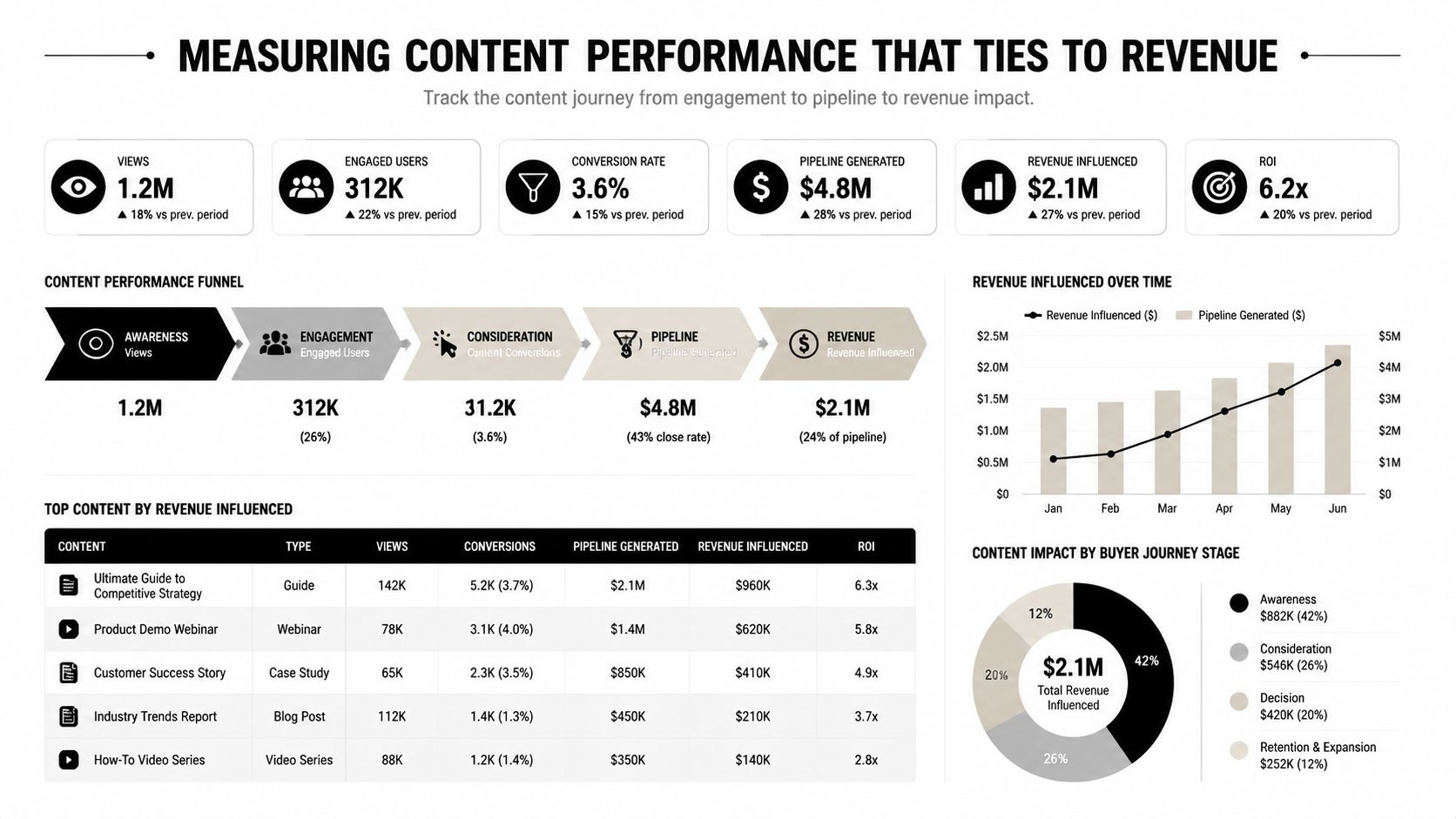
A practical measurement stack starts with GA4, conversion tracking, UTM parameters, and CRM lead tracking so you can tell which pages and channels are contributing to outcomes. The point is to review performance monthly by channel, entry page, and conversion rate, then adjust what you publish based on what buyers do. How to measure marketing ROI
The most useful metrics are usually simple. Call tracking, form submissions, booked appointments, quote requests, and qualified leads tell you far more than social likes or raw page views. For local businesses, those are the numbers that connect content to the pipeline.
Build a reporting habit you can maintain
A good dashboard doesn't need to be fancy. It needs to answer a few questions fast.
- Which pages generate inquiries? Look at service pages, FAQs, and location pages first.
- Which channels bring qualified visitors? Compare email, organic search, GBP, and social.
- Which topics produce bookings? Double down on content tied to real conversions.
- Where do people drop off? Fix the page that gets attention but doesn't get action.
If you want a reference point, a content-performance dashboard should make it obvious which assets influence the pipeline, not just which assets get clicked. The work gets easier when someone in the business can glance at the numbers and say, “That page helps us,” or “That one doesn't.”
Use the data to decide what to keep
The strongest local content programs are selective. If a page gets views but no inquiries, it may need a stronger call to action, better alignment with search intent, or a different topic altogether. If another page keeps producing calls, that's a signal to expand the topic cluster or create a matching location page.
That's the advantage of tracking content properly. It lets you stop arguing about opinions and start making decisions from evidence.
Building a Realistic Content Marketing Budget and Timeline
The right budget is the one your team can sustain. I've watched too many businesses start with an aggressive plan, post hard for six weeks, then disappear because the work was built around optimism instead of operations. A better plan fits your budget, your staffing, and the amount of time you can protect every month.
Choose the model that matches your capacity
If you're very lean, DIY can work, especially when the business already knows its customers well and only needs a few high-intent pages. If you have the ideas but not the bandwidth to write, a freelancer can turn those ideas into usable assets. If you need strategy, content, SEO, and reporting tied together, an agency makes more sense, especially when the business has multiple services or locations.
The decision should come down to three things, not ego.
- Time: Can your team protect hours every month without sacrificing operations?
- Skill: Can someone write clearly enough to help buyers decide?
- Consistency: Can you keep publishing long enough for content to matter?
Set a 90-day pace that won't break the business
A practical launch usually looks like this. Month one, audit the site, identify the highest-intent pages, and clean up the GBP and local listings. Month two, publish the first service or location assets and set up tracking. Month three, distribute the content through email and social, then review which pages are getting calls or form submissions.
The goal in the first 90 days is not perfection. It's momentum with proof. If one page starts to bring inquiries, that's a signal to build around it instead of starting over.
Keep the scope narrow at first
For local businesses, the biggest mistake is trying to publish content for every possible keyword, every channel, and every service at once. The better move is to choose a few high-intent assets, support them with listings and distribution, and make sure they're tied to bookings or calls. Once that loop works, expand.
That's the part most generic content advice misses. Local marketing isn't a volume contest, it's an operations contest. The businesses that win are the ones that stay specific, stay visible, and keep the pipeline in view.
If you want a content plan built around calls, bookings, and local search visibility, Polaris Marketing Solutions can help you map the pages, clean up the listings, and turn the work into something measurable. Visit Polaris Marketing Solutions to get a practical starting point for your local content strategy.