

You have a solid website. Your Psychology Today profile is up. You may even have a few referrals coming in each month. But when someone in your city searches for “anxiety therapist near me” or “couples therapist in Fort Myers,” your practice still doesn't appear where it should.
That gap is what local SEO solves.
For therapists, local visibility isn't a vanity metric. It's how a person who's ready to get help finds a real provider nearby, checks whether the practice feels trustworthy, and decides whether to book. The good news is that effective local SEO for therapists doesn't require enterprise marketing tactics. It requires accurate information, a well-built Google Business Profile, a locally relevant website, and a review strategy that respects HIPAA.
Why Local SEO Is a Lifeline for Your Therapy Practice
Most therapy searches start at a moment of urgency. Someone is anxious, overwhelmed, stuck in conflict, or finally ready to deal with something they've put off for months. They reach for their phone, search locally, and click one of the first results that looks credible and nearby.
That behavior is exactly why local SEO for therapists matters so much. According to Google, 46% of all searches have local intent, and for mental health, local intent is even stronger, with “near me” behavioral health searches growing 35% year over year. When people look for support, they usually want it close to home.
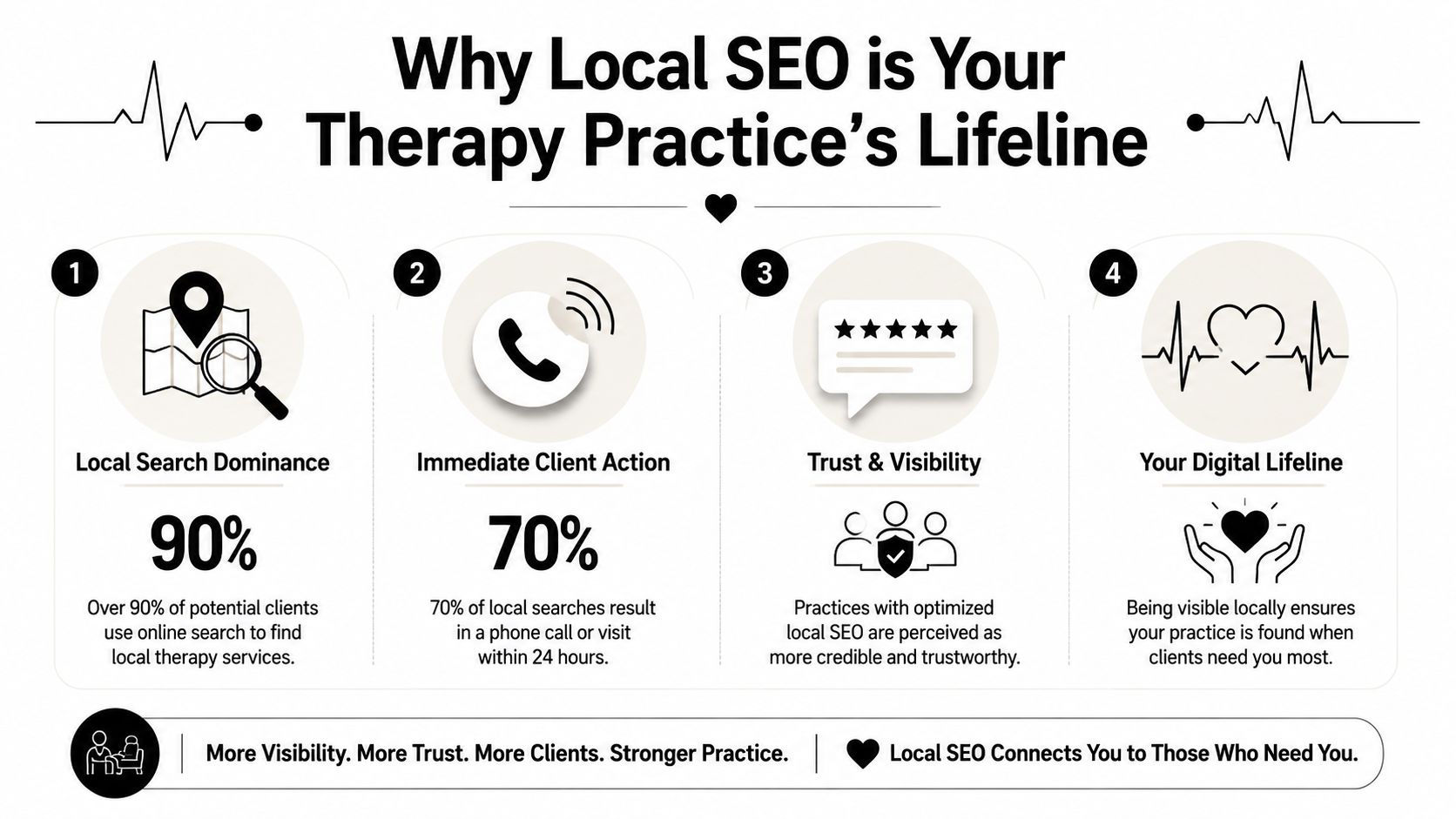
That changes how you should think about marketing your practice. You're not competing with every therapist on the internet. You're competing for visibility in your city, your nearby neighborhoods, and the Google Map results that people see before they ever visit a website.
What local visibility actually does
Local SEO helps your practice show up in the places where high-intent decisions happen:
- Google Maps results: Many people use Google Maps to quickly compare nearby providers.
- Branded search results: If someone hears your name from a physician or friend, your profile needs to confirm you're legitimate.
- Location-based service searches: Terms like “trauma therapy in Naples” or “marriage counseling in Cape Coral” are far stronger than broad searches.
A lot of therapists overinvest in general brand messaging and underinvest in local signals. That's backwards. If Google can't confidently connect your practice to a place, your credentials and clinical specialties won't help you rank.
Practical rule: Start with the assets Google trusts most for local intent. Your Google Business Profile, your website's location signals, and consistent directory listings.
If you want a broader perspective on how local businesses turn search visibility into inquiries, EmailScout's guide to strategies for local lead gen is useful because it frames local search as a lead system, not just a traffic play.
Master Your Google Business Profile
Your Google Business Profile is your digital front desk. For many therapists, it creates the first impression before a prospect ever sees the homepage, reads an about page, or checks insurance details.
If this profile is weak, incomplete, or inconsistent with the rest of your online presence, local SEO stalls.
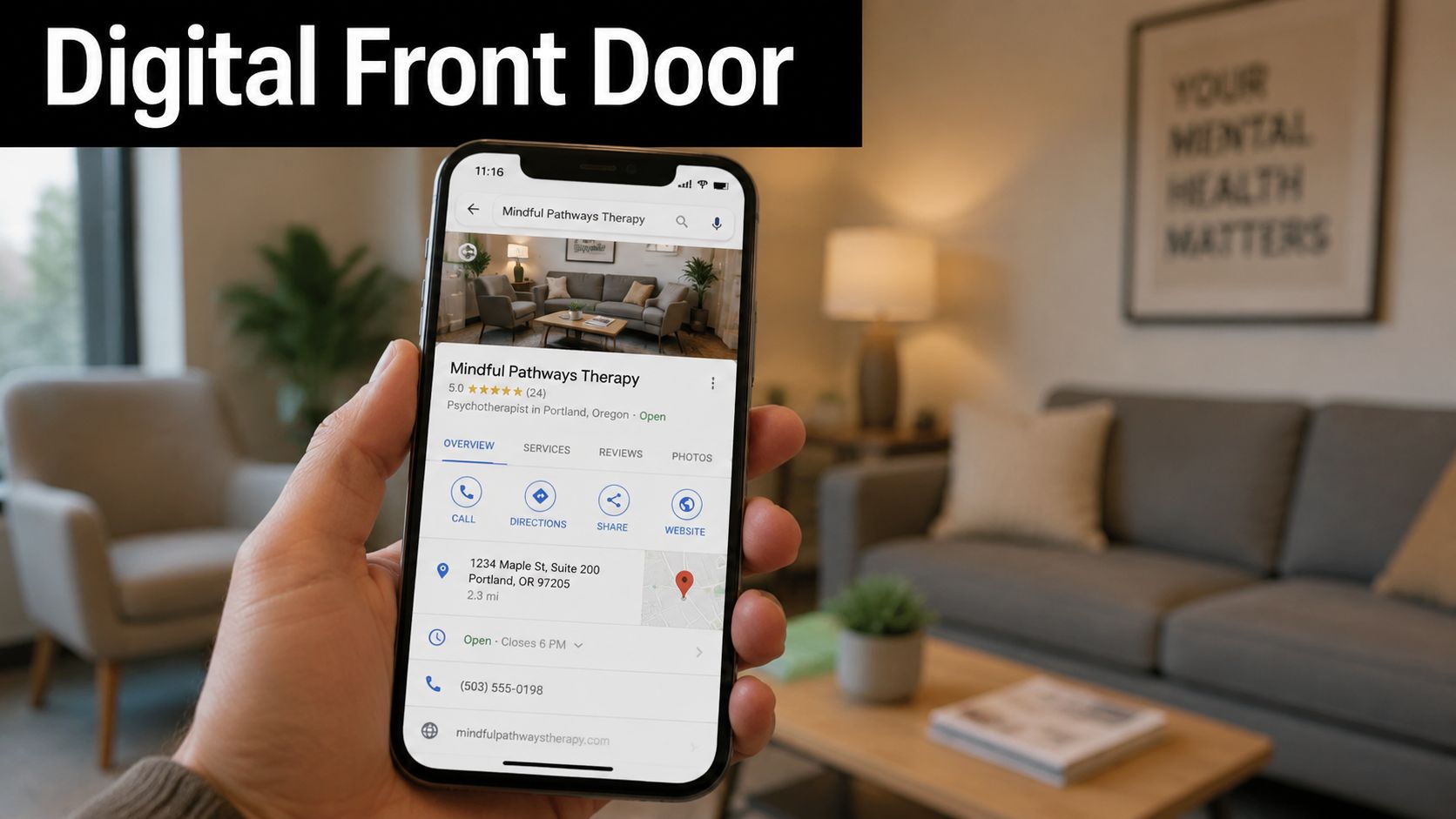
Set up the profile like a therapist, not a generic business
Start by claiming and verifying the listing. Then go field by field. Don't rush it.
The most important category choice is your primary category. Choosing the correct one matters because Google uses it to match your listing to local search intent. The recommendation is to select the most specific option available, such as “Psychotherapist” instead of a broader category like “Mental Health Service”, as noted in this therapist local SEO guide.
That same source also notes that 68% of local businesses lose visibility due to citation errors, which is why your practice name, address, and phone number must match exactly everywhere Google can find them.
What to complete before you do anything else
A therapist's Google Business Profile should include all of the following:
- Primary category: Use the most granular match, such as Psychotherapist.
- Business description: Mention your city, specialties, and who you help in plain language.
- Services: Add focused service names like anxiety counseling, couples therapy, trauma therapy, or EMDR if relevant to your practice.
- Photos: Upload real office photos, exterior entrance photos, and a professional headshot.
- Hours: Keep them accurate, especially if you offer both in-person and telehealth appointments.
- Contact details: Make sure they mirror your website perfectly.
A weak description says, “We help clients improve well-being.”
A stronger one says, “Private therapy practice serving adults and couples in Fort Myers, offering anxiety therapy, trauma-informed counseling, and relationship support.”
Use activity signals that many therapists ignore
Google tends to trust active profiles more than abandoned ones. Therapists don't need to behave like restaurants or retailers, but they do need to show signs of life.
That means:
- Post weekly updates: Share a short educational note, a new blog post, or an office update.
- Upload fresh photos: New office and team photos show that the practice is active.
- Respond to reviews carefully: More on the HIPAA side of that below, but silence isn't ideal.
- Review your Q&A section: Add useful pre-booking information if common questions aren't covered.
For a practical setup workflow, a detailed Google Business Profile optimization checklist can help you audit each field without missing the basics.
A quick walkthrough can also help if you're updating the profile yourself:
A simple example
If you run a private practice in Southwest Florida and want to rank for anxiety-related searches, your profile should not stay vague. It should clearly connect these dots:
| Profile field | Weak version | Better version |
|---|---|---|
| Primary category | Mental Health Service | Psychotherapist |
| Description | Compassionate support for healing | Anxiety and trauma therapy for adults in Fort Myers |
| Photos | Logo only | Office, entrance, therapy room, headshot |
| Services | Counseling | Anxiety therapy, trauma therapy, couples counseling |
That level of specificity helps both Google and the person searching.
Tune Your Website for Local Searches
Once someone clicks through from Google, your website has one job. Confirm that you're relevant, local, credible, and easy to contact.
A therapist website often fails local SEO in a predictable way. The design is clean, the copy is thoughtful, but the pages could belong to a practice in any city. If the site doesn't signal where you work and who you help, Google has less reason to rank it for local intent.
Use local keywords that match real searches
Broad keywords like “therapy” or “mental health support” don't do enough. Local search usually combines service + location.
Examples include:
- Anxiety therapist in Fort Myers
- Couples counseling in Cape Coral
- Trauma therapy near Naples
- Teen therapist in Bonita Springs
Those phrases belong naturally in your page titles, H1 headings, service page copy, and contact page. Don't stuff them everywhere. Place them where they clarify the page's purpose.
A homepage can introduce your practice. A local service page closes the gap between a search query and a booking decision.
Build pages for the places you actually serve
Therapists who serve multiple cities or neighborhoods need dedicated local service pages. Don't make one generic services page and expect it to rank everywhere.
A better structure looks like this:
- /anxiety-therapy-fort-myers/
- /trauma-therapy-naples/
- /couples-counseling-cape-coral/
Each page should be meaningfully different. Mention the specific service, the area served, how to reach the office, and what a prospective client can expect.
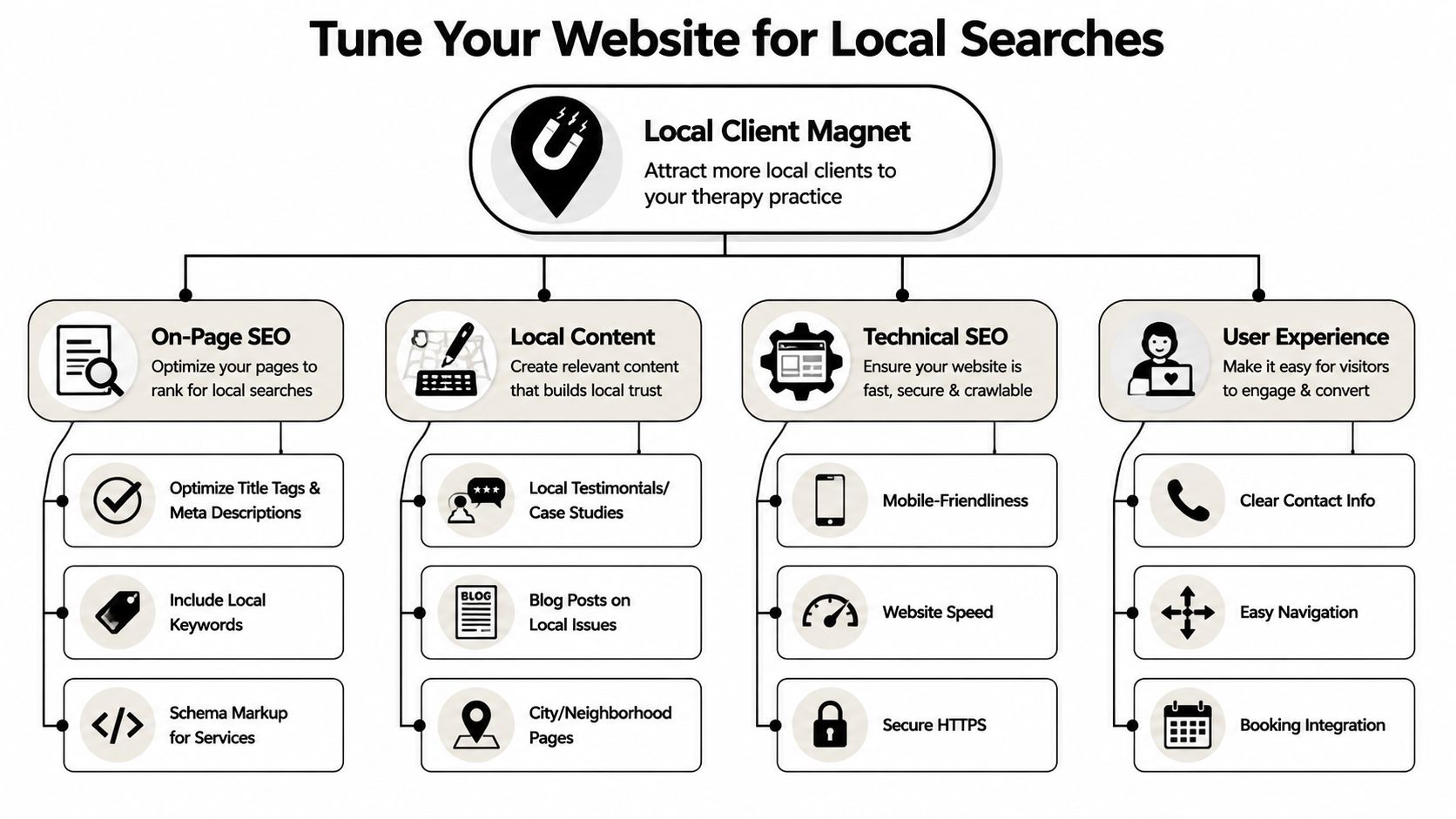
Therapists who create local service pages for each target neighborhood, embed a Google Map on their contact page, and keep the site mobile-friendly see a 50 to 70% increase in qualified local leads, while 82% of local therapy searches happen on mobile. That's why mobile performance and local page structure matter so much.
Tighten the technical basics
Many private practices frequently lose momentum. The content is decent, but the site experience gets in the way.
Focus on these items first:
- Mobile-first layout: The site needs to work comfortably on a phone.
- Fast loading pages: People in distress won't wait for bloated pages.
- HTTPS security: This is basic trust infrastructure for healthcare-related sites.
- Embedded Google Map: Put it on the contact page to reinforce location relevance.
- Schema markup: LocalBusiness or MedicalBusiness schema helps search engines understand your location and services.
If your practice gets traffic from Instagram, provider directories, or email signatures, a lightweight mobile landing setup can also help organize those touchpoints. This guide on creating a powerful link-in-bio hub is useful for thinking through mobile navigation without overcomplicating the user path.
A useful page-by-page checklist
| Page type | What it should include |
|---|---|
| Homepage | City served, primary services, clear booking path |
| Service page | Specific therapy specialty plus local relevance |
| Location page | Unique copy about the area, directions, map |
| Contact page | Exact NAP, embedded map, click-to-call phone number |
The goal isn't more pages for the sake of SEO. The goal is clearer pages that match how clients search.
Build Trust with Local Citations and Links
Citations are simple in theory and tedious in practice. They're mentions of your business name, address, and phone number across the web. Google uses them to verify that your practice is real and that your public information is dependable.
For therapists, citations matter because they reinforce trust. They also influence whether your local profile feels stable enough for Google to rank.
Why citation consistency beats random directory submissions
A lot of practices create listings over time and then forget them. A move to a new suite, a changed phone number, or even a slightly different business name can create conflicting records.
That's not a small issue.
Practices that maintain consistent NAP across 10+ directories have an 82% higher chance of ranking in the local top 3, according to this private practice SEO guide. The same source notes that 73% of top-ranking therapists are listed on at least two therapist-specific directories, while many non-ranking practices overlook those platforms.
Where therapists should actually spend time
Start with the platforms that support both trust and local relevance:
- Google Business Profile: Your central local asset.
- Psychology Today: A major therapy directory with strong intent.
- Healthgrades: Important for healthcare credibility.
- GoodTherapy and TherapyTribe: Niche therapist directories that many practices skip.
- Yelp: Still part of the local ecosystem.
- Local chamber or community directories: Good for geographic trust signals.
If your practice has moved, rebranded, or changed numbers, audit every major profile. Small inconsistencies add up.
Citations and backlinks are not the same thing
Citations mention your practice. Backlinks are actual links from other websites to yours.
Backlinks help when they come from relevant local or professional sources, such as:
- A local physician or wellness center resource page
- A chamber of commerce member directory
- A nonprofit mental health organization
- A school, church, or community support group page
- A guest article on a relevant local publication
What works: A backlink from a respected community organization in your service area.
What doesn't: Buying random links from generic SEO vendors.
For practices that want help cleaning up listings at scale, local citation building services can save a lot of manual work, especially after an office move or merger.
One clean rule to follow
If a directory or local site can't accurately represent your practice, don't list there. A smaller set of accurate, therapist-relevant citations beats a mess of inconsistent profiles every time.
Navigate Online Reviews and Reputation with Confidence
Generic local SEO advice usually becomes ineffective for therapists.
Most SEO articles say, “Respond to every review.” That advice is incomplete at best and risky at worst for mental health professionals. Therapists operate under confidentiality standards that most local businesses never have to think about.
The Hippocratic Review Gap is real
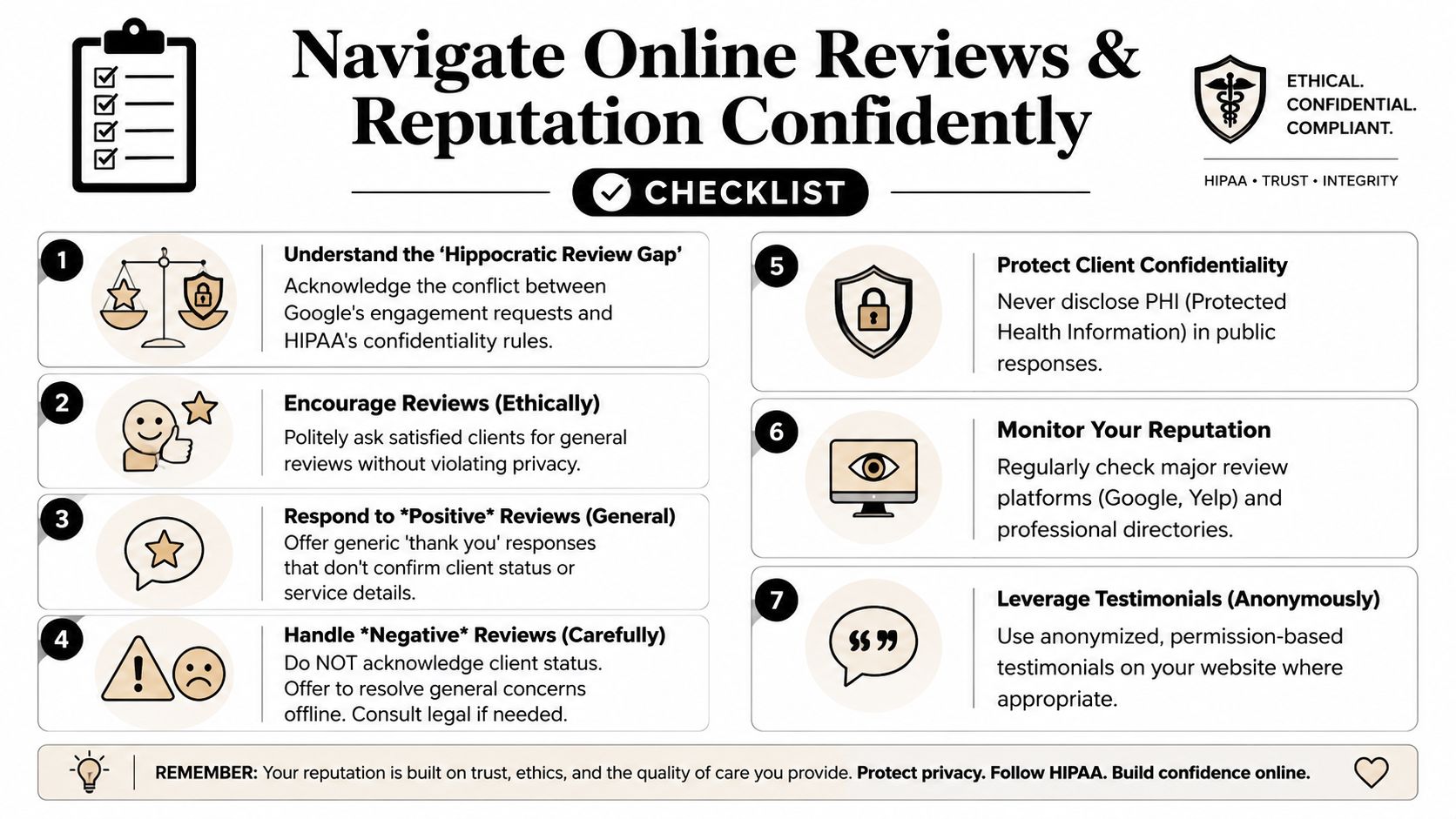
Therapists face a genuine conflict. Google wants engagement signals. HIPAA and therapist confidentiality rules prevent you from publicly confirming or denying a therapeutic relationship.
That tension creates paralysis. Some practices avoid review responses entirely because they're trying to stay safe. The problem is that total silence has a cost. According to this therapist SEO review guide, practitioner engagement with reviews increases ranking prominence by 34%, yet HIPAA laws strictly forbid confirming a therapeutic relationship in public. The safe middle ground is a non-identifying reply such as, “We take all feedback seriously.”
What a safe response looks like
A compliant public response should do three things:
- Acknowledge the feedback.
- Avoid confirming client status.
- Move specifics offline, if appropriate.
Here are examples that stay general:
We take all feedback seriously and strive to provide a safe, respectful environment for everyone.
Thank you for your feedback. We're always reviewing how to improve the experience people have with our practice.
We're sorry to hear about your concern. Please contact our office directly if you'd like to share more.
Those responses aren't warm in the usual small-business sense. That's okay. The job here is professionalism, not personalization.
What not to say
Avoid responses like these:
- “We're sorry your sessions felt this way.” This implies a therapeutic relationship.
- “We remember working with you.” Same problem.
- “As your therapist explained…” Never do this.
- Anything that mentions treatment, scheduling history, insurance, or outcomes.
If a review appears fake, misleading, or malicious, you can flag it through Google while still keeping any public response neutral.
When to ask for reviews
The most effective time to request a Google review is immediately after a positive session or at discharge, when the experience is still fresh. The practical move is to send a direct review link from your Google Business Profile dashboard within 24 hours, using a short follow-up email that thanks the client for their trust and makes the process easy.
That doesn't mean pushing hard or creating pressure. It means removing friction.
A simple internal process works well:
- Prepare the link in advance: Don't make staff hunt for it every time.
- Use a neutral email template: Thank the person and invite feedback without discussing care details.
- Send promptly: Waiting too long lowers follow-through.
- Keep the language broad: You're asking for a general review, not a testimonial about treatment.
Build a review policy before you need one
Most practices wait until they get a difficult review. That's late.
Create a short internal policy covering:
| Situation | Safe action |
|---|---|
| Positive review | Reply with a neutral thank-you that doesn't confirm client status |
| Negative review | Use a non-identifying response and invite offline contact |
| Suspected fake review | Flag it and keep any reply general |
| Staff uncertainty | Escalate to practice leadership or legal counsel before responding |
If reputation management feels messy, that's normal. Healthcare businesses don't get to use the same playbook as restaurants, salons, or law firms. A structured process helps. These online reputation management tips are useful for building consistency without improvising every reply.
Track Your Growth and Refine Your Strategy
Local SEO isn't finished when the profile is optimized and the location pages are live. It works best when you review performance regularly and make small corrections before problems pile up.
The good news is that therapists don't need a huge reporting stack. You only need to watch the signals that connect to consultations and appointments.
Focus on lead indicators, not vanity metrics
Use Google Business Profile insights, Google Analytics 4, and Google Search Console to answer a few practical questions:
- Are more people clicking to your website from local search?
- Are they calling from the profile?
- Which location or service pages attract actual interest?
- Which searches bring qualified visitors?
Effective strategy relies on evidence. If your Fort Myers anxiety page gets traction but your Naples couples page doesn't, that indicates areas to improve copy, internal links, or local relevance.
A simple monthly checkup
Set aside 15 minutes each month and review:
- Google Business Profile activity: Website clicks, calls, and direction requests.
- Top landing pages in GA4: Look for service and location pages that people reach.
- Search Console queries: Identify local phrases generating impressions and clicks.
- Review activity: New reviews, unanswered reviews, and any reputation issues.
- Mobile experience: Test your own site on a phone and try booking like a new client.
Keep the review simple. If a metric doesn't help you get more qualified inquiries, it doesn't deserve much of your attention.
What to do with the data
Don't just monitor. Adjust.
If one page gets impressions but few clicks, rewrite the title and meta description to make the offer clearer. If mobile users bounce from the contact page, shorten the form and make the phone number more visible. If your Google Business Profile gets views but few actions, improve photos, services, and review activity.
The practices that win local SEO usually don't do one dramatic thing. They do the obvious things consistently, and they fix weak points before those weak points become expensive.
If you want help turning all of this into a workable system, Polaris Marketing Solutions helps small and mid-sized businesses improve local visibility, tighten Google Business Profile performance, clean up citations, and turn search traffic into qualified leads. If your therapy practice needs a clearer local SEO path, it's a practical place to start.