
A Fort Myers contractor opens Google Business Profile before heading to a job in Cape Coral, and the hours don't match what's on Yelp or Apple Maps. A Bonita Springs dentist sees two profiles at the same address, one with old photos and one with the right phone number, and both are sending mixed signals to patients. That's the point where listing management services stop sounding like a marketing line and start looking like an operational fix.
For small businesses in Southwest Florida, the problem usually isn't that one profile is wrong. It's that the same business identity has drifted across many platforms, so customers, maps apps, and search engines all see slightly different versions of the truth. If you already have a handle on the local SEO basics, a practical guide to local SEO for business can help frame why listings matter in the broader local-search picture, while a local inventory of citation sites like this directory list shows how wide the footprint can get.
The Moment a Local Business Realizes Its Listings Are Wrong
A Cape Coral roofing company gets a call about a Saturday emergency, but the caller says Google showed closed hours while Yelp showed open. A week later, the owner checks Apple Maps and finds the suite number is still the old one from before the move. Each error looks small on its own. Together, they create hesitation, and hesitation costs calls.
That pattern shows up fast for local service businesses. If a customer sees one phone number on Facebook and a different one on a directory, they may wonder whether the business is still active. If a map pin lands in the wrong plaza, the visit never happens. Listing management services exist to keep the public version of the business consistent enough that customers can trust it.
A Bonita Springs dental practice can run into a different version of the same problem. After a merger, a staffing change, or an old agency handoff, two Google Business Profile listings can sit at the same address. One profile collects reviews, the other sends directions, and the practice loses control over which listing represents the brand. That is a data problem before it is an SEO problem.
Practical rule: if a customer could reasonably ask, “Is this the same business?”, the listings need cleanup.
The fix starts with one source of truth, then a process for pushing that truth to directories, maps, and search platforms without creating more duplicates. A local inventory such as this directory list helps show how many places can carry the business name, address, and phone number. For owners who want a deeper primer on the fundamentals, the guide to local SEO for business explains why listings matter in the broader local-search picture.
What Listing Management Services Do
Listing management is a location-data synchronization problem. You keep one clean record of the business, then distribute it across the web and keep checking that outside platforms haven't drifted away from it. That central record usually includes the business name, address, phone number, hours, categories, website, photos, and other location details that customers rely on.
The data layer matters more than the directory count
The job is reducing schema drift, which is just a plain-language way of saying the same business gets described differently in different places. If the hours on Google don't match Yelp, or the phone number on one platform points to the old office line, search systems can treat the entity with less confidence and customers run into friction when they try to call or visit. Semrush describes this as keeping location data synchronized and monitored, not merely submitted once Semrush listing management guidance.
A complete listing usually carries more than the basics. Business name, full address, location-specific phone number, hours, website URL, services or menu items, photos, categories, accessibility details, payment methods, and booking or ordering links all belong in the managed data set Alchemer's listing management overview. For a Fort Myers HVAC company, that can mean the difference between a customer finding emergency service or leaving after the first confusing listing.
A listing is not just a directory entry. It's a customer-facing record that needs to stay usable everywhere it appears.
That is why a proper service does more than submit a business once and move on. It claims profiles, corrects bad data, watches for duplicates, and keeps the business information aligned as locations, hours, and contact points change. The work often overlaps with local citation building services, because citations are part of the same cleanup process. For businesses that also need richer on-page context, a structured data generator can support the same goal by making the business details easier for search engines to read. The better mental model is ongoing data hygiene for local visibility, because every corrected field reduces confusion for both customers and search systems.
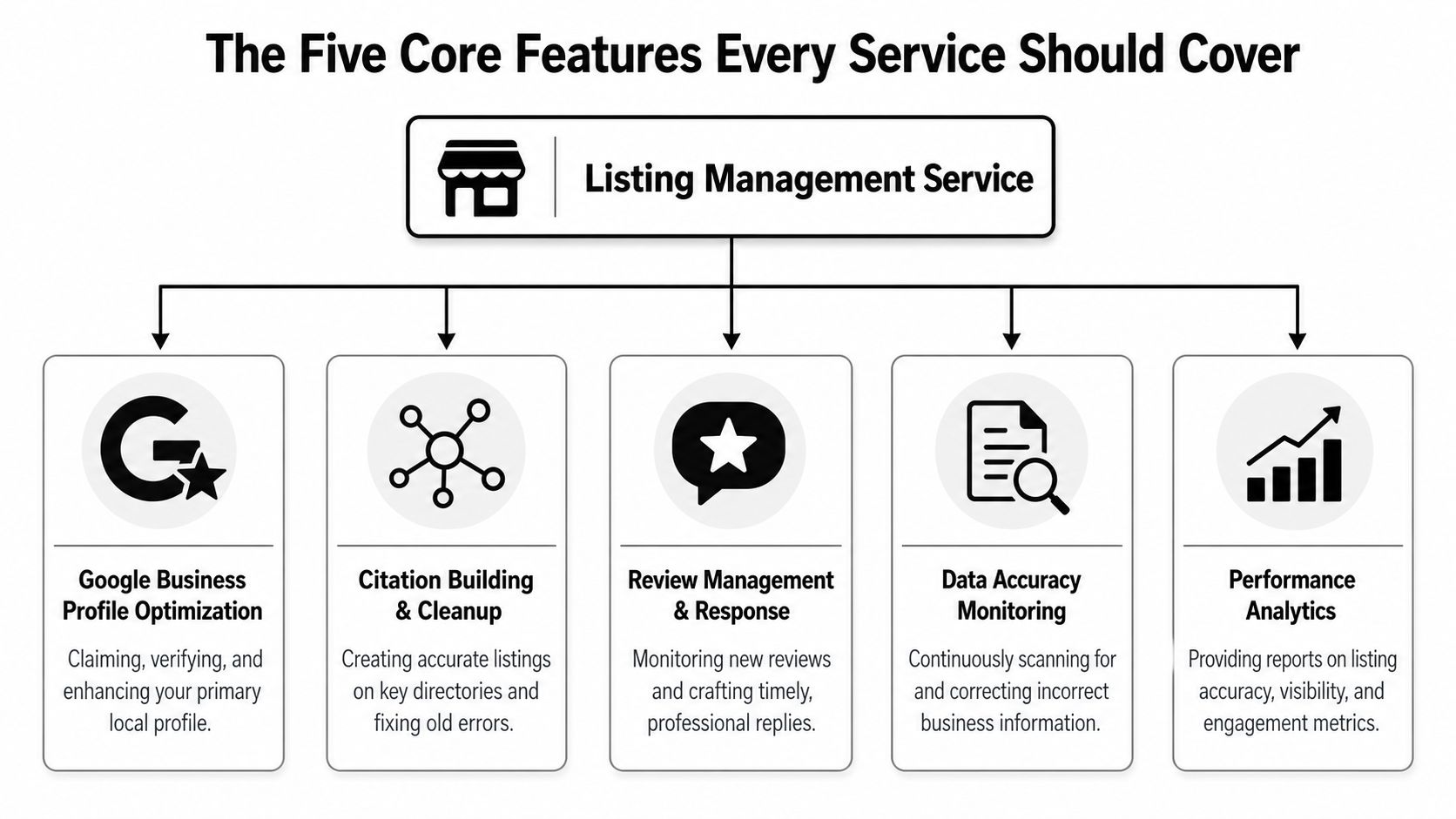
The Five Core Features Every Service Should Cover
The best services don't just touch a profile once and move on. They handle a set of tasks that all support one goal, making sure the business identity stays accurate everywhere customers look. That matters in Fort Myers, where a home-service customer might start on Google, double-check on Apple Maps, and then read Yelp before placing a call.
Google Business Profile work comes first
Google Business Profile is usually the highest-priority asset because it influences search visibility, directions, calls, and profile actions. A local plumber or urgent care clinic in Lee County needs the profile claimed, verified, and updated with the right hours, categories, services, and photos. If a business moved offices or changed holiday hours, that update has to happen here first.
Citations clean up the wider web
Citations are the mentions of the business name, address, and phone number across other sites. Thrive Agency notes that they help search engines validate NAP data and provide accurate information to users Thrive Agency on listings management. A Fort Myers law firm, for example, needs that same phone number and category language across Yelp, Apple Maps, and relevant legal directories so the business doesn't look fragmented.
Review management protects trust
Review monitoring and response workflows matter because listings aren't static folders, they're active customer touchpoints. If a new review lands and nobody responds, the profile can look neglected. If a negative review appears alongside outdated contact details, the whole listing starts to feel unreliable.
Duplicate suppression prevents split signals
Duplicate profiles can siphon reviews, directions, and clicks away from the primary listing. That's especially common after a move, a rebrand, or a new marketing vendor. An HVAC company in Fort Myers that had a location change needs duplicate suppression so customers don't end up on the old pin.
Continuous sync keeps the network aligned
A listing-management platform may need to sync data across more than 100 websites, search engines, applications, voice assistants, GPS systems, and social networks Sentry Insights. That's exactly why manual updates break down, because one correction can have to travel through a very wide network. If you want to standardize the underlying profile data before pushing it outward, a structured data generator can be useful for shaping the information cleanly.
How a Fort Myers Business Puts Listing Management to Work
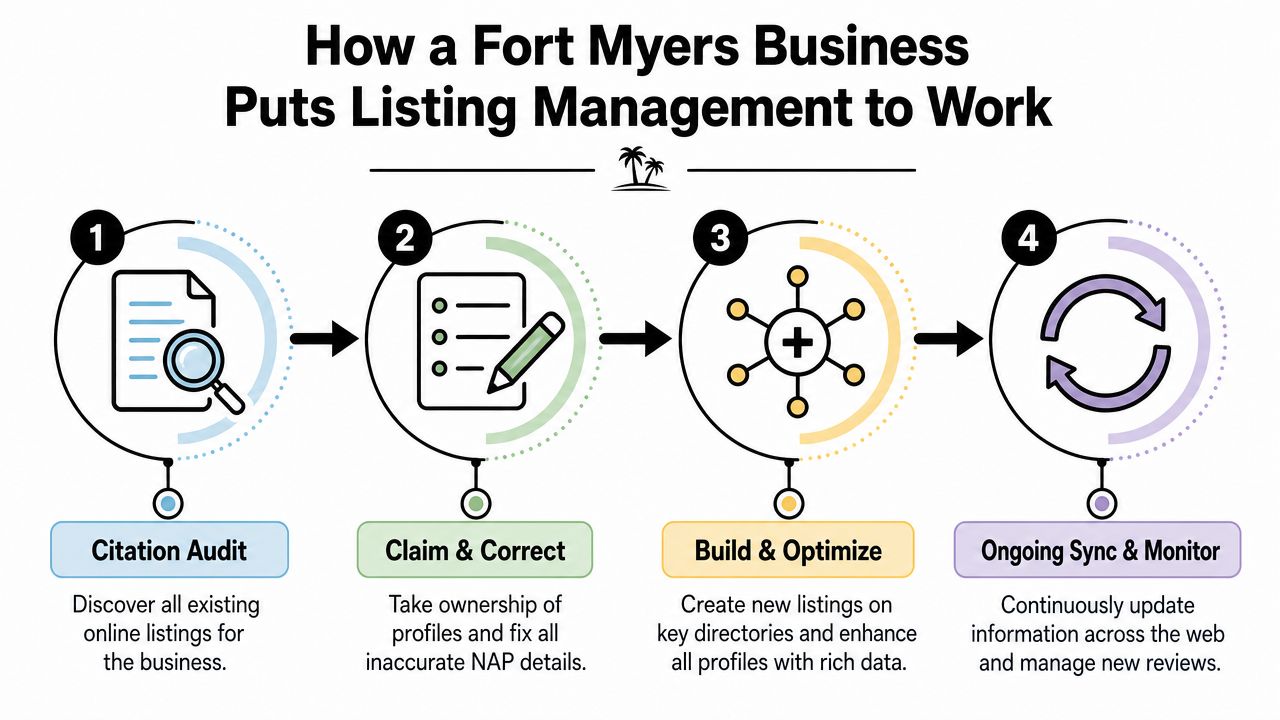
A local business doesn't need a giant rollout to get control back. It needs a sequence that finds the current mess, fixes the critical profiles, and then keeps the system clean without eating the owner's week. For a Fort Myers contractor or medical practice, the process usually fits into four practical moves.
Step one is the citation audit
Start by finding every live listing, old listing, and duplicate profile tied to the business. That includes Google Business Profile, Apple Maps, Yelp, Bing, Facebook, and the industry sites that matter in the owner's market. The deliverable here is a master sheet of every profile, what's correct, what's wrong, and what needs ownership.
Step two is claiming and correcting priority profiles
Next, claim the important profiles and fix the obvious errors first. That means business name, address, phone number, hours, website, and service categories, plus any move-related issues like old suite numbers or outdated holiday hours. A Fort Myers healthcare practice often sees the fastest relief here because the most visible profile problems get removed early.
Step three is standardizing the data network
After the priority profiles are corrected, push the same NAP and category language across the rest of the web. That's the stage where consistency matters more than volume. If a home-service contractor lists “roof repair” on one site and “roofing contractor” on another without a plan, the signal gets muddy.
Step four is the maintenance loop
The ongoing work is where many owners lose control. Reviews need monitoring, hours need updates, photos need refreshing, and duplicates need suppression when they appear. A practical routine is a monthly audit for the owner or office manager, with immediate updates any time the business changes something customers can see.
For owners who want this tied to broader GBP execution, the GBP management service page gives a useful sense of how profile work fits into the larger local-search workflow. The key is keeping the process lean enough that the business can sustain it, because unmanaged listings rarely stay accurate on their own.
Choosing Between DIY Tools, Freelancers, and Agencies
The right setup depends on how many locations you have, how often your business details change, and who on your team can keep the process moving. A Fort Myers owner with one stable location may be able to handle some of it in-house. A growing contractor, clinic, or law firm with multiple staff changes usually needs more structure.
| Model | Typical Monthly Cost | Owner Time Required | Best Fit |
|---|---|---|---|
| DIY Tools | Lower software cost, but variable by platform | High | Very small businesses with one location and a disciplined office manager |
| Freelancer | Moderate and flexible | Medium | Businesses that need help but can oversee quality closely |
| Full-Service Agency | Higher, but more integrated | Low | Multi-location businesses or owners who want listings tied to broader local SEO |
DIY tools can work when the business has simple needs and one person can check data regularly. The risk is that software still depends on someone on the team spotting problems and acting on them. That often works at the start, then breaks when the owner gets busy.
Freelancers vary a lot. A strong freelancer can clean up citations and support GBP updates, but quality depends heavily on their process, tools, and attention to detail. Businesses that need reliable reporting, duplicate handling, and review support usually want more than a one-person workaround.
Full-service agencies make sense when listing management needs to connect with SEO, content, reviews, and conversion tracking. That's also where a broader system matters, because the same team can coordinate profile cleanup with the rest of the local visibility work. If you're comparing formats beyond listings, a tool like create marketing videos with AI is a reminder that many owners are stacking multiple marketing systems, so the core question is whether the workflow stays coordinated.
Practical rule: buy the model that matches your internal follow-through, not the one with the longest feature list.
The Real ROI of Listing Management for Local Businesses
The return shows up first as lost friction removed. When hours, phone numbers, and addresses are wrong, a local business loses calls, directions requests, and appointments before the sales process even starts. That's why listing management should be measured as customer-loss prevention, not as a decorative marketing expense.
The cleanest way to estimate value is simple. Start with baseline calls, estimate how many of those calls turn into booked jobs or visits, and multiply by average job value. If a Fort Myers service business knows that some callers are reaching the wrong profile, the business can compare that leakage against the cost of keeping listings clean.
That logic matters more now because the market is growing fast. A 2025 to 2032 estimate placed the global local listing management software market at USD 5.14 billion in 2025, rising to USD 5.62 billion in 2026 and projected to reach USD 9.81 billion by 2032, with a 9.65% CAGR 360iResearch. Another forecast put the market at USD 3.27 billion in 2024, USD 3.84 billion in 2025, and USD 8.33 billion by 2030, with a 16.83% CAGR from 2025 to 2030 Research and Markets. Different models produce different totals, but both point in the same direction, competition is moving into this operational layer.
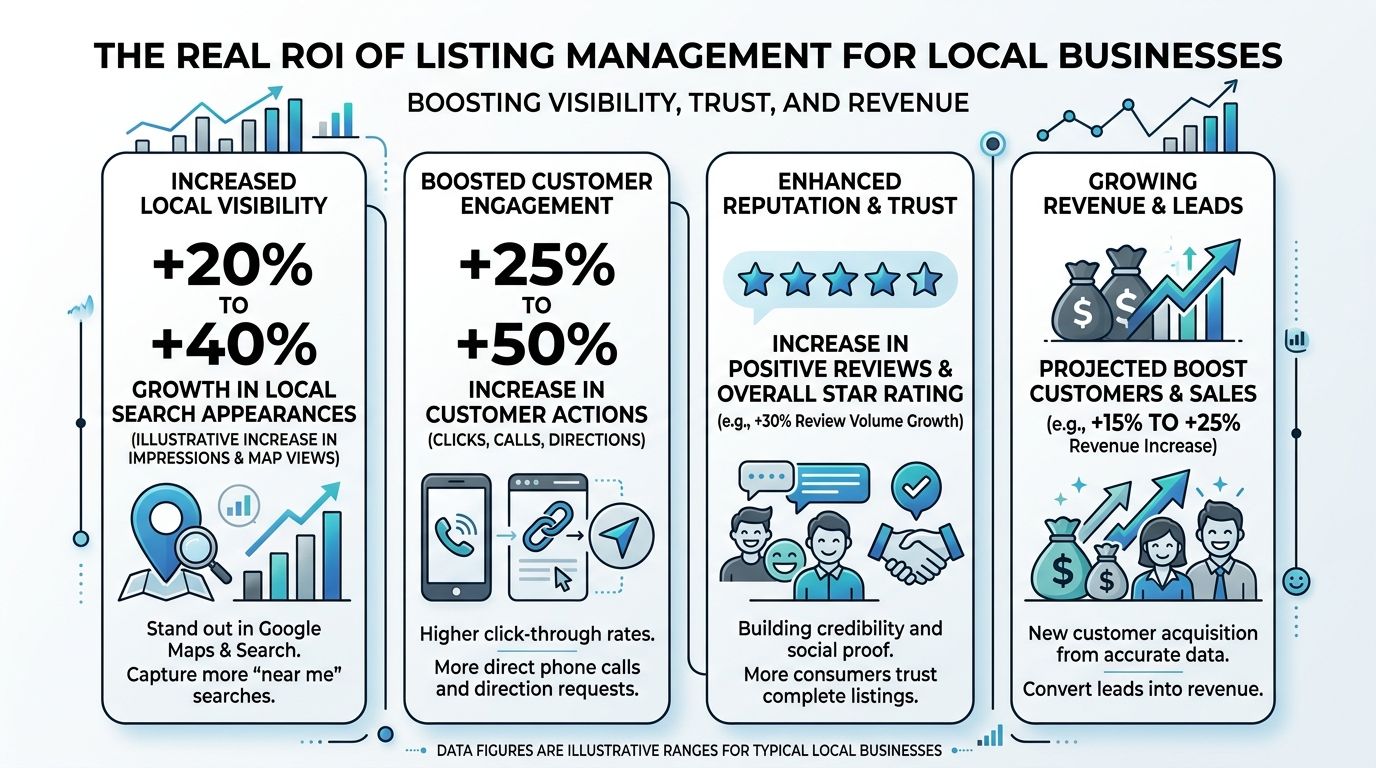
A good service should produce visible operational wins within a reasonable window. That means fewer duplicate profiles, cleaner hours, corrected phone numbers, stronger profile consistency, and better control over customer-facing information. It should also make reporting easier, so the owner can see what changed instead of guessing whether the work happened.
How to Pick the Right Service and What to Do Next
Choose a vendor that understands local relevance, not just directory volume. Ask which directories they cover for your industry and geography, how they handle duplicates, whether they support review response workflows, and what reporting you'll get. If a provider leans on “100+ directories” but can't explain which ones matter to your business, that's a warning sign ARC4 on local listing management.
Red flags are easy to spot once you know what to look for. No Google Business Profile access, no transparent reporting, no duplicate strategy, and no proof that they'll cover the directories your customers use should all slow you down. The same goes for vendors that sell a generic package without asking whether you serve Fort Myers, Cape Coral, Bonita Springs, or a wider Southwest Florida area.
Polaris Marketing Solutions offers Fort Myers businesses a practical starting point through integrated local SEO, Google Business Profile optimization, review management, and citation building. Their complimentary online analysis and competitor report can show how your current listings stack up before you commit to anything. If you want to clean up the data first and stop losing leads to inconsistent profiles, visit Polaris Marketing Solutions and ask for the analysis, then compare the findings against your current calls, directions, and review visibility.