
A law firm can have a polished website, a strong reputation, and still lose calls every day because its Google listing is incomplete, unclaimed, or pointing searchers to the wrong office. That happens a lot in competitive markets like Fort Myers, Cape Coral, Naples, and Estero, where a single missed map pack click can mean a caller never reaches intake.
Google Business Profile is the free Google product introduced in 2014 for managing how a business appears in Search and Maps, and for lawyers it matters because it controls high-visibility data like category, hours, services, and reviews Clio's overview of Google Business Profile for law firms. If your firm wants more qualified local leads, this profile isn't a side task, it's one of the first places Google decides whether you look relevant. For a broader lead-generation framework, this law firm lead generation resource pairs well with the practical steps below.
Introduction to Google Business Profile for Lawyers
A solo attorney in Fort Myers can lose calls because the profile is half-finished, or because Google is highlighting the wrong practice emphasis. A family law firm in Naples can look generic if the category says only “Law Firm” and the description skips the city or the core services. The fix is not complicated, but it does need to be deliberate.
The practical value of google business profile for lawyers is straightforward. It helps the right people find the right office, at the right time, with the right expectation about services, hours, and contact options. Google built the platform for local discovery, and legal firms use it to surface practice-area relevance, trust signals, and review activity in a single public listing. For firms building a broader lead-generation system, this law firm lead generation resource fits well with the steps in this guide.
Practical rule: treat the profile like a front-desk assistant, not a directory entry. Every field should answer a real intake question.
That means claiming the listing, choosing the right category, filling out the description strategically, adding photos, and staying active with reviews and posts. Firms that leave the profile untouched usually look less current than competitors that update it consistently. In Southwest Florida, where searchers often compare several firms before calling, that difference can decide who gets the lead.
For multi-office firms, the bigger question is not whether to be on Google. It is which office should be prioritized, how each location should be described, and how to avoid sending callers to the wrong team. A Naples estate planning office should not read the same way as a Fort Myers personal injury office if the goal is to match search intent and intake capacity. The profile also has to stay aligned with compliance needs, because a polished listing that creates confusion is worse than a plain one that is accurate.
Claim and Verify Your Profile
The first move is to find whether a listing already exists. Many firms already have a Google Maps presence created from user data, old citations, or prior ownership, so the right action is usually to request ownership rather than start fresh. If you create a duplicate, you split trust signals and make future cleanup harder.
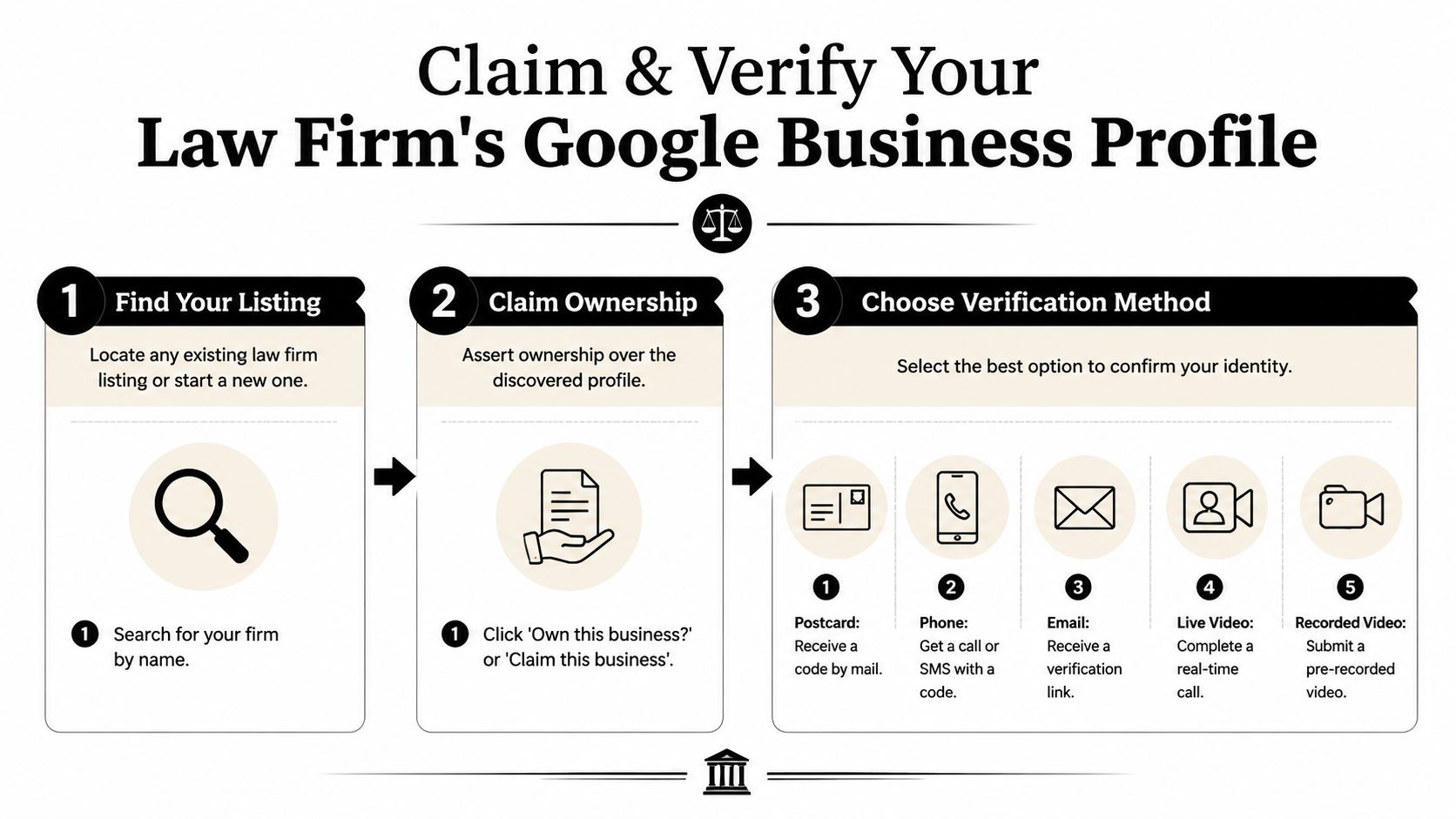
A good claim process is straightforward. Search for the firm name, open the listing, and look for the ownership path if the profile already exists. If it doesn't, create it carefully under the firm name, then verify it using one of Google's supported methods.
Google's verification options can include phone, email, video recording, live video call, and postcard On the Map's attorney guide. A single-office practice with a stable street address may end up using postcard verification, while a multi-location firm may need to verify multiple offices separately. The important part is consistency, not speed.
A few pitfalls come up again and again. Staff members sometimes create new listings because they can't find the old one, then later discover both versions are competing with each other. Another issue is verifying a profile and stopping there, even though the listing still lacks hours, services, or an accurate phone number.
Use this as the clean workflow:
- Find the existing listing and request ownership if it already appears on Maps.
- Verify through Google's available method that fits the office setup.
- Confirm the profile is live before moving on to categories and content.
- Avoid duplicates at every step, especially if the firm has more than one office.
For firms that serve clients from several locations, the verification stage should also include a quick audit of which office should own which listing. That decision becomes important later when practice areas and service areas start overlapping.
Select Categories and Define Services
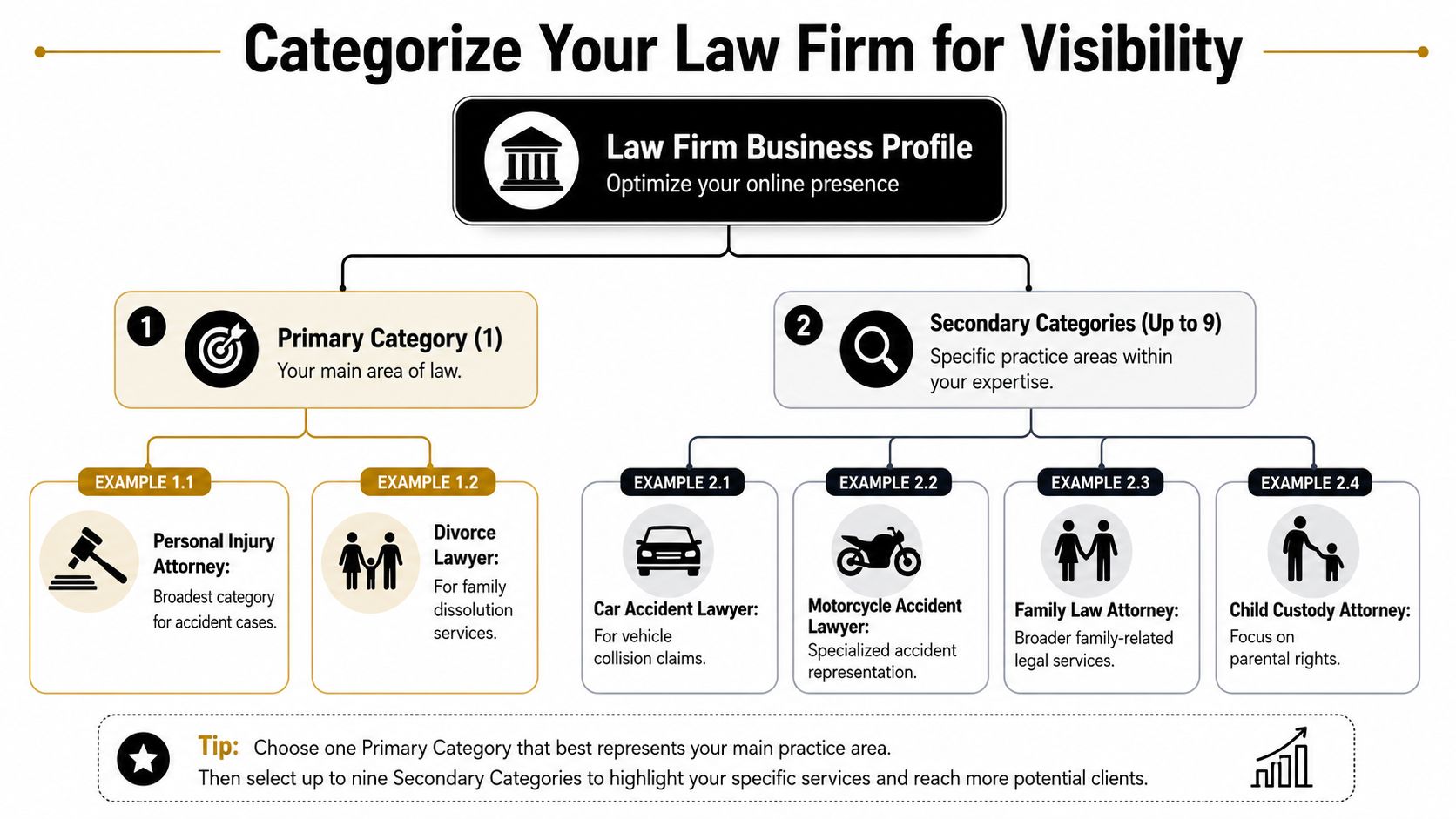
Category selection does more local SEO heavy lifting than many law firms expect. Google allows a primary category plus up to nine secondary categories, so the primary choice should match the firm's main line of work, not its broadest identity Local Falcon's lawyer GBP guide. A personal injury office should usually avoid hiding behind “Law Firm” if a more specific category fits the core practice.
Start with the main practice area
Choose the category that reflects the search terms you want most. Legal guides commonly recommend options such as Personal Injury Attorney and Divorce Lawyer, because they are more specific than a generic law-firm label. That specificity helps Google connect the profile to the searcher who already knows what kind of help they need.
For a Southwest Florida firm, the category choice should match how the office obtains work. If the Naples office handles mostly family law, that office should be categorized around family law. If the Fort Myers location is the injury team, don't dilute that focus with a broad label that hides its strongest signal.
Multi-office firms also need to decide whether each location deserves its own emphasis. A downtown office that handles estate planning and probate may not need the same category mix as a coastal office built around accident claims. The goal is consistency between the office, the category, and the calls the team wants to receive.
Use secondary categories only where they support the core work
Secondary categories should add precision, not clutter. A firm centered on injury work can add related categories for adjacent services, but only if those practice areas are real and backed by staff, content, and intake. Irrelevant add-ons create confusion and can weaken relevance.
The services section should follow the same logic. List the actual offerings, such as car accident representation, trucking claims, divorce, custody, probate, or estate planning, depending on what the office handles. Keep the service list aligned with the category, because the profile works best when the signals match.
For firms with several offices, service definitions should also reflect location-specific capacity. If one office handles family law consultations and another office focuses on litigation, the profile should not blur those lines. That distinction matters in Southwest Florida markets where callers often choose a location based on both proximity and practice area.
Good testing question: if a receptionist answered the phone today, would the first three services on the profile match the first three reasons callers contact the office?
If the answer is no, the profile needs a reset. The goal is not to impress Google with breadth, it is to help Google and searchers understand the firm's strongest local fit.
Craft Descriptions and Add Visuals
The description field gives you 750 characters to explain what the firm does, who it serves, and why someone should call Google's business description guidance. Use that space like intake copy, not marketing fluff. State the practice areas, the geography, and the reason a caller should keep reading in plain language.
A useful structure is simple. Lead with the practice area, add the service area, then close with a consultation invitation. For a Southwest Florida firm, that might mean family law and probate in Fort Myers, Cape Coral, and nearby areas, followed by a clear prompt to schedule a consultation.

Write like a person answering a real inquiry
A strong description sounds specific and credible. It should mention the city or metro area naturally, not in a stuffed list of keywords. It also should not promise outcomes or pad the field with filler that does not help a caller decide.
A firm could say, in substance, that it handles family law and probate, serves Fort Myers and surrounding Southwest Florida communities, and invites prospective clients to call for a consultation. That wording reinforces relevance without sounding forced. Google's guidance is to keep the description useful, relevant, and honest.
Use photos to show the firm is active
Practitioner guidance for law-firm profiles recommends uploading a minimum of 20 photos and posting at least 4 updates per month to signal activity and improve local-pack competitiveness. That does not mean random phone shots. Use professional exterior images, attorney headshots, office interiors, team photos, and community involvement images.
The best photos answer silent trust questions. Can I find this office? Does it look professional? Is there a real team here? Searchers do not ask those aloud, but they notice them immediately.
Keep posts tied to intake value
Posts work best when they do one of three things, explain a common legal issue, highlight a relevant event, or reinforce firm credibility. A family law office might post about consultation availability, a probate reminder, or a community sponsorship. A personal injury office might use a post to explain what to do after a crash.
A simple editorial calendar helps. Use one post for a service-area reminder, one for an FAQ, one for a firm update, and one for a community item each month. That keeps the profile current without turning it into a content dump.
For review workflow and reply standards, use a documented process and tie it to how to get more online reviews. For teams comparing tools and workflows, the practical takeaways in 2026 white label software insights are useful as well.
Manage Reviews and Q and A Effectively
A law firm's reviews shape more than first impressions. They influence whether a searcher trusts the office enough to call, especially when the profile sits beside other firms serving the same area. The best process asks for feedback while the matter is still fresh, then treats responses and public questions as part of ongoing intake work, not a side task.
Ask satisfied clients for a review soon after the matter closes, and make the request part of the wrap-up routine. A timely ask usually works better than a generic email sent long after the client has moved on, and it gives the firm a cleaner path to consistent follow-up. For teams that want a practical system for requests and reminders, how to get more online reviews is a useful reference point.
A simple reminder can sound like this in substance, “Thank you for trusting our team. If you're willing, please share a brief review about your experience so other local families can feel more confident reaching out.” That wording works because it is direct, respectful, and avoids steering the client toward any specific language.
The review process itself needs clear rules.
- Respond quickly: Acknowledge every review, whether it is positive or negative, with a professional tone.
- Avoid confidential detail: Never confirm case facts or disclose private information in a public reply.
- Invite offline resolution when needed: If a negative review raises a real concern, move the discussion away from the public page.
- Monitor Q and A regularly: Public questions can help or hurt conversion depending on who answers them.
Google's Q and A feature is often overlooked, and that creates preventable problems. Seed the profile with accurate answers to common questions about consultations, practice areas, and service areas so the firm controls misinformation before it spreads. That approach matters even more for multi-office firms, where callers may be comparing a downtown office, a suburb, or a specific practice area like family law versus probate. In Southwest Florida, for example, one office may need to answer questions about Fort Myers consultations while another needs clearer responses for Naples or Cape Coral searchers.
For firms that compare reputation tools and workflow options, the 2026 white label software insights from Testimonial are useful because they show how review handling is being packaged for agencies and professional-service teams. The software itself is not the point. The core issue is whether the firm has a repeatable process for requesting, monitoring, and answering reviews without creating compliance risk. If that process is uneven, a dashboard will not solve it.
Answer from the business profile, not from a personal account, so clients can tell the response comes from the firm.
Implement Local SEO and Track Insights
Google Business Profile works best when it sits inside a broader local SEO system. The profile should reinforce the same city, practice-area, and intake signals that appear on the website, location pages, and citations. When those pieces line up, the firm looks more credible to both Google and searchers.
The monthly reporting habit matters here because Google Business Profile Insights shows real engagement such as search terms, phone calls, and direction requests GoConstellation's lawyer guide. A lot of firms glance at those metrics once and never connect them to action. That leaves opportunities on the table.
Build a monthly review routine
Open Insights once a month and compare three things. First, which search terms are bringing people in. Second, which actions they take after viewing the profile. Third, whether the profile looks active enough to justify the traffic it receives. That review should lead to one concrete adjustment, not a vague “looks good” note.
For local SEO support beyond the profile itself, it helps to align the listing with broader search engine optimization strategies that reinforce location relevance and service clarity. A profile with strong categories but weak website alignment usually underperforms. The same is true in reverse.
Use location signals with discipline
Location-specific posts can help a profile stay relevant to nearby searchers. If a firm serves Fort Myers, Cape Coral, Estero, Bonita Springs, and Naples, the profile content should reflect the office that handles the case load, not every city the attorneys can name from memory. That keeps the message sharper and reduces confusion.
Practical rule: match the profile to the office that should receive the call, not to every possible location the firm touches.
Service-area settings matter too. Use them to define where the firm legitimately serves clients, but don't turn the profile into a substitute for an office that doesn't exist. That mistake creates friction and can cause bigger problems than a weak ranking ever would.
Track what searchers actually do
Calls from the profile tell you far more than impressions do. Direction requests matter too, especially for offices that depend on in-person consultations. Website clicks can be useful, but they're usually a lower-intent signal than a direct call from the listing.
If you want a more complete local ranking workflow, this guide to ranking in Google Maps fits well beside the reporting process. The key point is to connect profile changes to behavior. If activity rises but calls don't, the issue may be messaging or friction in the intake path. If calls rise after a content update, repeat that pattern.
Google Posts can support that routine, especially for events, FAQs, and office updates. Use them to keep the profile fresh and to give searchers another reason to choose one firm over another. The best posts feel current, local, and useful.
Ensure Compliance and Next Steps Checklist
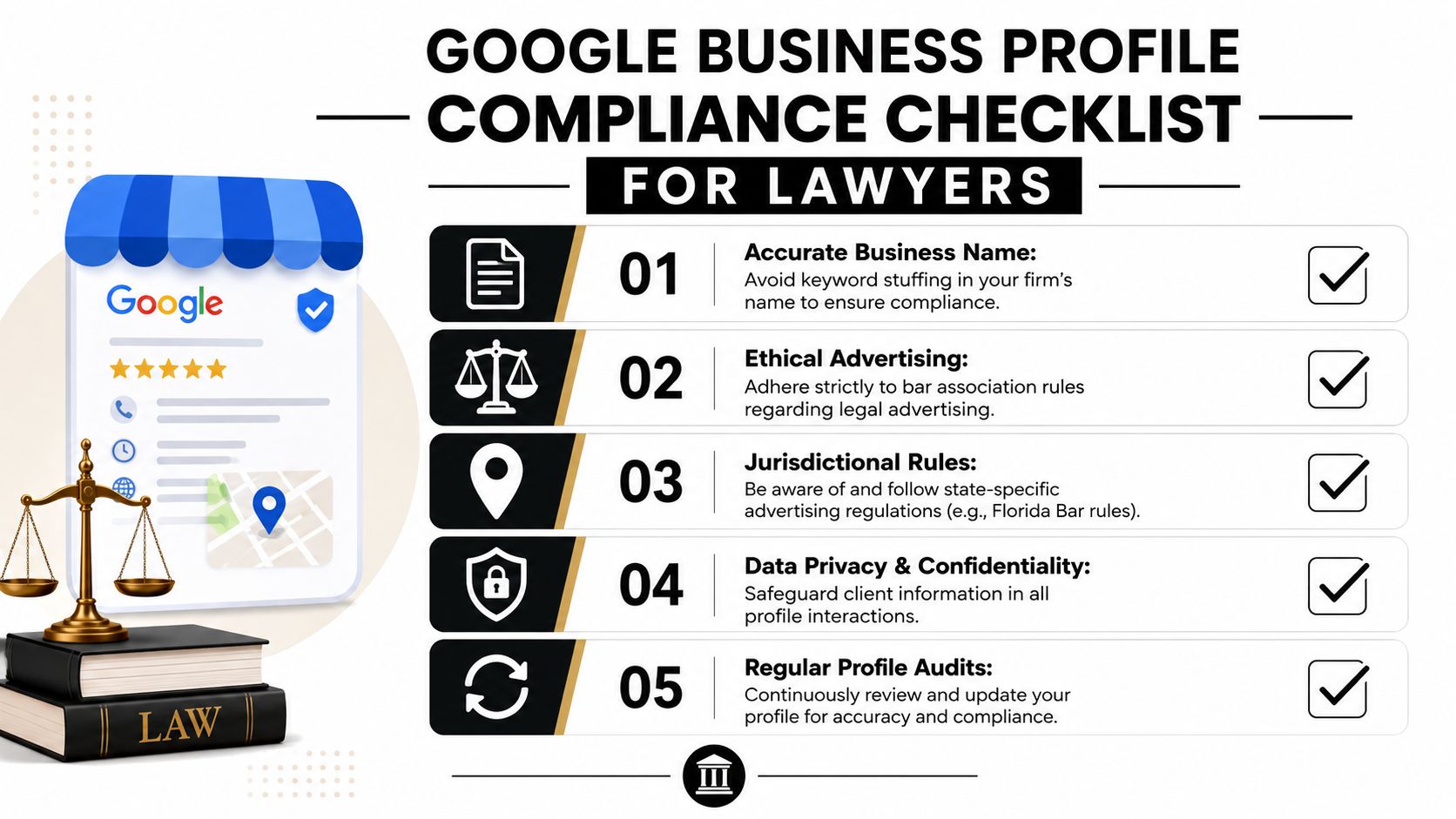
Law firms have to be careful with profile accuracy, not just because of Google rules, but because legal marketing has ethical limits. A business name stuffed with keywords looks aggressive and can create compliance risk. So can vague office claims, mismatched locations, or profile fields that don't reflect the actual practice.
The multi-office question is where many firms get stuck. The best decision rule is to prioritize the office and practice area that should receive the call, then keep NAP, service areas, and category selection consistent across the related pages and listings Justia's multi-office coverage gap. If one office handles family law and another handles injury, each profile should stay tightly focused on its real function.
For firms handling sensitive client data, the summary on avoiding GLBA exposure for your firm is a useful reminder that privacy discipline matters across every digital touchpoint, including reputation and intake workflows. Public profile management should never expose confidential information, even accidentally.
Use this checklist before you call the profile done:
- Business name: Use the official firm name, with no keyword stuffing.
- Verification: Confirm the profile is claimed and verified.
- Categories: Set the most specific primary category, then add only relevant secondary categories.
- NAP consistency: Match the name, address, and phone number exactly across the website and legal directories.
- Description: Use the full 750 characters to clarify practice areas, city relevance, and a call to action.
- Photos and posts: Keep the profile active with professional images and regular updates.
- Reviews and Q and A: Maintain a clear workflow for responses and new questions.
- Monthly tracking: Review Insights, search queries, calls, and direction requests on a recurring schedule.
If your firm serves multiple offices or practice areas, finalize that structure before you publish more content. The cleanest profiles are the ones that make one decision obvious: who the firm serves, where it serves them, and why that office is the right one to call.
If you want help turning your profile into a reliable lead source, contact Polaris Marketing Solutions for a practical local SEO review and a clear next-step plan for your law firm.