
If you run a business in Fort Myers, Cape Coral, Naples, or North Fort Myers, you already know the pattern. You work hard to get the phone to ring, answer leads fast, close the job, and then move straight to the next fire. Meanwhile, a big chunk of past customers disappears until they need someone again, and sometimes they call a competitor instead of you.
That usually isn't because your work was bad. It's because loyalty rarely happens by accident.
For most Southwest Florida businesses, learning how to build customer loyalty has less to do with fancy apps and more to do with what happens between the first inquiry and the follow-up after the job is done. A roofer, estate attorney, med spa, HVAC company, pressure washing business, or accounting firm all face the same basic challenge. People need a reason to remember you, trust you, and come back.
Beyond the Transaction Why Loyalty Matters in SWFL
In Southwest Florida, customer flow can feel uneven. Seasonal residents come and go. Storm season creates urgent demand. Referrals spike, then dry up. A business can look busy and still have weak retention underneath.
That matters because loyalty isn't just a feel-good concept. It's an economic one. According to EMARKETER's customer loyalty analysis, acquiring a new customer can cost about 5x more than retaining an existing one, and even a 5% increase in retention can lift profits by 25% to 95%. The same analysis notes that in a 2025 survey, 59.1% of respondents said customer experience is key to building loyalty, while 58.4% pointed to emotional connection through beliefs and values.
For a local business owner, that translates into something simple. Chasing new leads all the time is expensive. Keeping more of the people you already served usually gives you a better return.
Loyalty is built in the boring moments
Most owners think loyalty means one of three things:
- Discounts: Coupons, limited-time offers, and price cuts.
- Rewards: Points, punch cards, tiers, and freebies.
- Branding: A nicer logo, cleaner trucks, better uniforms.
Those can help, but they aren't the core. The core is whether the customer feels that working with you is easy, reliable, and worth repeating.
A Bonita Springs plumber earns loyalty when the office answers the phone calmly during a leak. A Naples family law firm earns loyalty when it explains the next step clearly and doesn't leave the client guessing. A Cape Coral cleaning company earns loyalty when it shows up on time every time, notices a problem before the homeowner does, and fixes issues fast.
Practical rule: Customers rarely describe loyalty in marketing language. They say, "They made it easy," "They followed through," or "They remembered us."
That's the shift many small businesses need to make. Stop treating loyalty as a promotion problem. Treat it as an operations and communication problem.
What this looks like in a local market
In SWFL, trust compounds faster than almost anything else. A customer who has one smooth experience may call you again. A customer who has three smooth experiences starts referring neighbors, friends, board members, and other local contacts.
That's why I usually tell owners to think less about "How do I get one more sale?" and more about "Why would this person choose us again six months from now?" If your answer is only price, you're exposed.
A stronger answer sounds more like this:
- We respond faster than competitors
- We explain things clearly
- We prevent headaches
- We stay consistent from office staff to field staff
- We make people feel taken care of
If your branding needs work, that matters too, especially for recall and trust in crowded markets. Strong positioning supports retention because customers remember who you are and what you stand for. That's part of why solid small business branding tips for local companies can reinforce loyalty even when you aren't the cheapest option.
Map Your Customer Journey from Naples to North Fort Myers
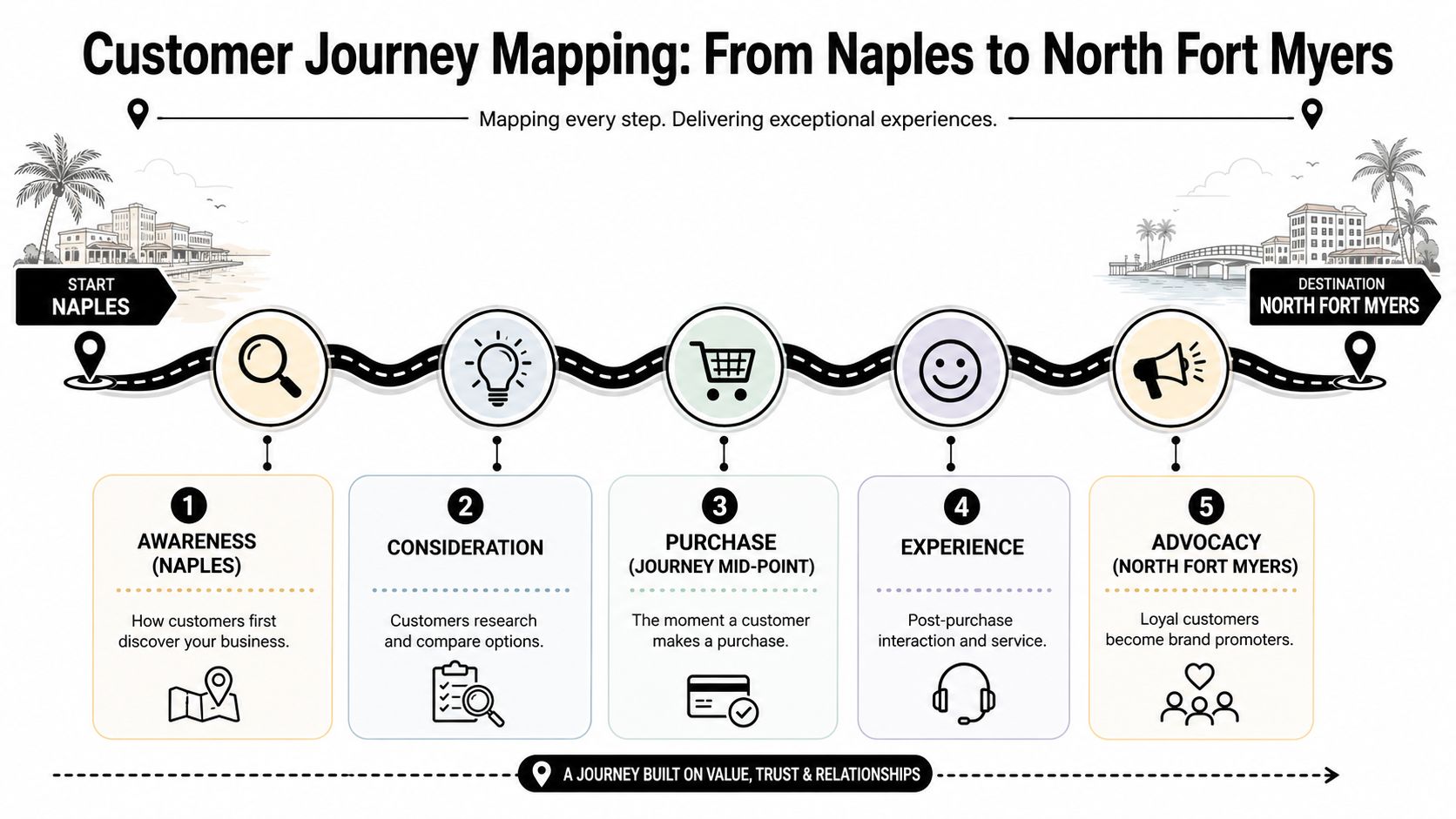
Before you add a loyalty program, start with a yellow pad, a spreadsheet, or a whiteboard. Write down every step a customer goes through from first contact to repeat business. Most owners skip this because they think they already know the process. They usually know the intended process, not the actual one.
Start with one real customer path
Take a Cape Coral HVAC company as an example. A typical journey might look like this:
Awareness
The homeowner searches Google during an AC issue, sees your Google Business Profile, website, or reviews.Consideration
They compare you with two or three other companies, check service areas, and decide whether to call.First contact
They call or submit a form. This is one of the biggest make-or-break moments.Scheduling
They want a clear date, time window, and confirmation.Service visit
The tech arrives, explains the issue, does the work, and communicates next steps.Payment and closeout
The invoice needs to be clear. So does warranty info, maintenance advice, or future recommendations.Follow-up
Repeat business is often won or lost at this stage.
Now do the same for your business. If you're an Estero law firm, swap the service visit for consultation, case onboarding, document requests, updates, billing clarity, and follow-up after the matter closes.
Find the moments where loyalty is won or lost
You don't need a giant flowchart. You need to find friction.
Look for the spots where customers ask themselves:
- Can I trust these people?
- Are they organized?
- Do they respect my time?
- Do they remember what I told them?
- Will they be hard to deal with if something goes wrong?
Those are the moments of truth. In most small businesses, there are usually three or four that matter more than everything else.
A simple way to map this is to create a table like this:
| Stage | What the customer wants | Common friction | Better approach |
|---|---|---|---|
| First call | Quick answer, clarity | Long hold, rushed answers | Answer with a script, log needs, promise next step |
| Scheduling | Confidence and convenience | Vague windows, no reminders | Send confirmation and reminder text |
| Service delivery | Competence and respect | No explanation, late arrival | Set expectations before arrival |
| Follow-up | Closure and reassurance | Silence after payment | Send check-in and ask for feedback |
Segment before you personalize
Not every customer should get the same follow-up. That's where segmentation helps. Practical guidance from this audience segmentation resource lines up with broader loyalty best practices. A repeat maintenance customer, a one-time emergency customer, and a commercial account don't need the same message.
The mistake isn't failing to send more marketing. It's sending the same message to people with different needs.
If you want a stronger loyalty system, map the journey for your top customer types separately. For a roofer, that might mean storm repair versus full replacement versus annual inspection. For a CPA, it might mean tax prep clients, bookkeeping clients, and business advisory clients.
What to do after you map it
Circle the friction points that show up most often. Then fix those before you launch anything that looks like a formal loyalty initiative.
A few examples:
- If customers keep asking for status updates: build a simple update cadence.
- If people seem confused by invoices: rewrite the invoice language and attach a plain-English summary.
- If no one remembers to follow up after service: assign one person that task and make it part of the closeout checklist.
- If repeat customers get treated like strangers: log past jobs, preferences, family notes, property details, or communication preferences in one place.
That's how loyalty starts. Not with points. With fewer headaches.
Build Loyalty Without Breaking the Bank
Small business owners hear "customer loyalty" and often picture software fees, discount campaigns, and another system staff won't use. In practice, that's usually the wrong starting point.

For service businesses, loyalty often comes from doing ordinary things unusually well. Yotpo's guidance on customer loyalty makes this point clearly. Many small and mid-sized businesses over-rely on promotional discounts, even though the most actionable loyalty lever in service businesses is often problem prevention, fast recovery, and consistent follow-through rather than a formal program.
Reliability beats discounts more often than owners think
A homeowner in Fort Myers doesn't stay loyal to a pest control company because of a small coupon if the tech misses appointments. A client doesn't stay loyal to a lawyer because of a gift card if calls go unanswered for days.
People come back when they trust the experience.
Three low-cost loyalty levers work especially well in SWFL:
Proactive communication
Most businesses wait until the customer asks. Better businesses answer the question before it's asked.
A roofer in Bonita Springs can send a hurricane prep checklist to past clients before storm season. A pool company in Naples can text customers about weather-related scheduling changes before they call the office angry. An immigration lawyer can send a short status update even when there isn't major movement, just so the client knows the file hasn't gone cold.
That kind of communication doesn't require a discount. It requires discipline.
Fast recovery when something goes wrong
Mistakes happen. Materials arrive late. An employee misses a note. A billing issue slips through. Loyalty isn't destroyed by every mistake. It's destroyed when the customer feels ignored or dismissed.
Use a simple recovery script:
- Acknowledge the problem clearly
- Own the next step
- Give a real timeframe
- Follow up after the fix
If your office says, "We're looking into it," and then disappears, you've created doubt. If your office says, "I see the issue. We'll call you by 3 p.m. today with the updated schedule," you've lowered stress immediately.
Customers can forgive a problem faster than they forgive confusion.
Consistency is what customers remember
A lot of owners focus on the heroic moments. The memorable save. The major favor. The one huge gesture. Those help, but repeat business usually comes from consistency.
That means things like:
- Same-day acknowledgment: Even if you can't solve the issue immediately, respond quickly.
- Clear handoffs: The person answering the phone should leave usable notes for the person doing the work.
- Visible next steps: Customers shouldn't have to guess what happens after they pay, sign, or schedule.
- Simple promises: Only promise what your team can repeat under pressure.
This short video does a good job reinforcing the bigger point that loyalty grows from experiences customers want to repeat, not just perks.
Practical no-discount examples for local firms
Here are a few low-cost plays that work better than another coupon blast:
- Home services: After a completed job, send a photo recap, maintenance tip sheet, and one named contact for future questions.
- Professional services: Log personal details that matter, such as preferred call times, spouse name, property address, business type, or renewal month, then use them appropriately.
- Healthcare and wellness: Reduce intake friction. Pre-send forms. Confirm appointments clearly. Follow up after treatment with care instructions.
- Property and association vendors: Give board members a clean summary they can forward, not a messy email chain they have to interpret.
If you're trying to figure out how to build customer loyalty on a budget, start here. Fix the experience customers already have. That's cheaper than bribing them to return.
Smart Retention Tactics That Actually Work
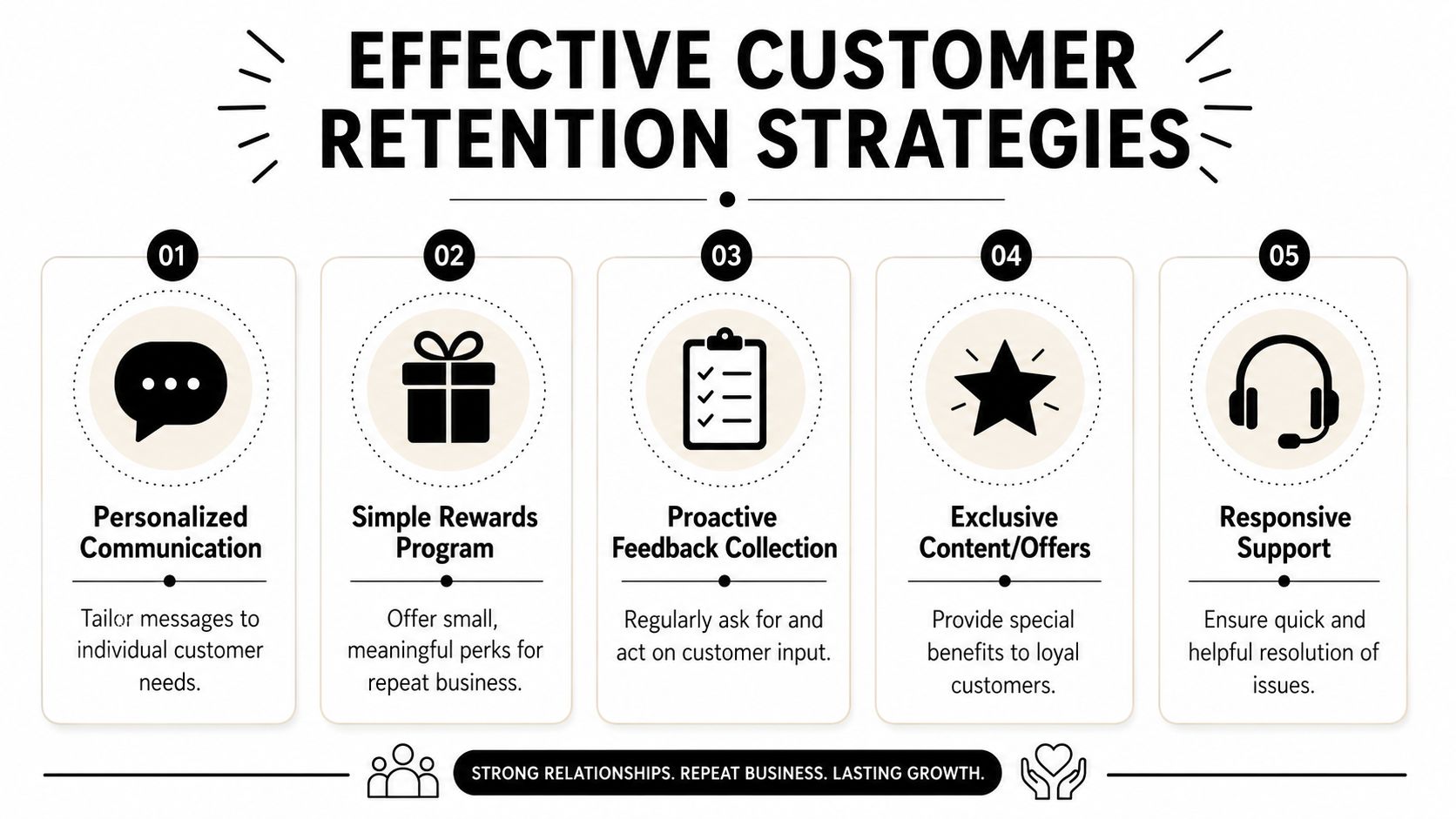
Some businesses do good work and still lose repeat business because they never build a retention system around that work. Others make retention easier with a few simple habits.
Two local examples worth copying
Take a pressure washing company in Cape Coral. Before improving retention, the business did solid work but treated every job like a one-time transaction. Names were in QuickBooks, but no one tracked when the customer last booked, what service they bought, or whether they preferred text or email. Follow-up happened only when things were slow.
Now compare that with a Naples estate planning firm. The firm also had satisfied clients, but after signing documents, communication mostly stopped unless the client reached out first. The service was competent, but the relationship faded.
Both businesses fixed the same core issue. They started documenting customer context.
Use a CRM or even a clean spreadsheet
This doesn't need to be complex. You can use a CRM, or start with a spreadsheet if that's what your team will maintain. What matters is logging information you can act on.
Track things like:
- Last service date
- Service type or matter type
- Preferred communication channel
- Important notes from past conversations
- Upcoming renewal, maintenance, or review point
- Referral source
- Open issue or unresolved concern
Guidance from RingCentral emphasizes a practical approach. Ask customers how they prefer to communicate, log those preferences in your CRM, recall past conversations, and reach out ahead of renewals or key events. That's a better loyalty model than generic engagement campaigns. It also aligns with the idea that friction reduction and proactive service create stronger retention over time.
The pressure washing company now sends a reminder before the property starts looking neglected again. The estate planning firm sends a check-in when major life events or periodic reviews are likely to matter. Neither message feels random because it's tied to the customer's actual situation.
Field note: The fastest route to repeat business is often a well-timed, relevant follow-up that proves you remember the customer.
Keep rewards simple and attainable
Not every business needs a formal rewards program. But if you use one, keep it easy to understand.
Square's implementation guidance offers two useful benchmarks in its merchant loyalty program advice. A strong loyalty program should make a reward feel attainable, ideally within 30 days. It also reports that rewards perceived as worth at least 10% of what customers spent to earn them are associated with higher satisfaction.
That matters because many local programs fail for one reason. The first reward feels too far away.
A few examples:
| Business type | Simple retention offer | Why it works |
|---|---|---|
| Pressure washing service | Buy a set number of recurring cleanings, get one maintenance add-on included | Easy to understand and tied to repeat service |
| Coffee shop or juice bar | Simple digital punch-style reward | Quick path to redemption |
| Family law or business law firm | Client referral thank-you process and white-glove follow-up, not discounting legal work | Protects positioning while rewarding trust |
| Salon or med spa | Priority booking or member-only scheduling perks | Adds convenience, not just price reduction |
If you want more ideas on structuring repeat-purchase systems, Selling resources for businesses is a useful reference point for evaluating what kind of offer or process fits your model.
Value-first communication works better than constant selling
The pressure washing company sends short seasonal emails like "What salt air does to exterior surfaces" or "When to schedule before HOA inspection season." The estate planning firm sends plain-English reminders about document reviews after major life changes.
Notice what both are doing. They're staying relevant without becoming annoying.
Good retention content usually has one of these jobs:
- Prevent a problem
- Answer a common question
- Remind customers at the right time
- Make the next step obvious
That's what works. Not a generic "Just checking in" message with no reason behind it.
Own Your Local Reputation and Turn Reviews into Revenue
A lot of businesses treat reviews like a separate marketing task. In reality, reviews are often the visible result of whether your loyalty process works.
If customers feel taken care of, asking for a review becomes natural. If the experience was sloppy, asking for a review feels awkward because it is.
Build a repeatable review request
RingCentral's guidance on trust and loyalty notes that loyalty is increasingly built through friction reduction and proactive service. It also points out that asking for feedback and responding publicly to reviews demonstrates commitment to service across customer communication channels.
The key is timing. Ask when the customer has clearly expressed satisfaction, not days later when the emotional moment has passed.
A simple process works well:
- Finish the job or service cleanly
- Confirm the customer is happy
- Send the review request while the experience is fresh
- Make the link easy to access
- Thank them whether they leave a review or not
Copy and paste templates you can use
SMS template
Home services: Thanks again for choosing us. We're glad we could help with your project. If you'd be open to it, we'd appreciate a quick Google review. It helps other local homeowners know what to expect from our team.
Professional services: Thank you for trusting our office. If you found the process helpful, we'd be grateful if you shared your experience in a Google review. That feedback helps other people choose with confidence.
Email template
Subject: Thank you from our team
Hi [First Name],
Thank you again for choosing us. We appreciate the opportunity to work with you.
If you're comfortable sharing your experience, a short Google review would mean a lot to our team and help other local customers who are comparing options.
Thank you again,
[Business Name]
Respond to every review like future customers are reading
Because they are.
Positive review responses don't need to be long. Thank the customer, mention the service if appropriate, and sound like a human. Negative review responses need more care. Don't argue in public. Acknowledge the concern, show willingness to help, and move the detailed resolution offline.
A review response isn't just for the reviewer. It's for the next prospect deciding whether your business is trustworthy.
A few practical rules:
- For positive reviews: thank them by name if appropriate and reinforce what mattered.
- For negative reviews: stay calm, avoid blame, and offer a clear next step.
- For vague complaints: don't speculate publicly. Invite direct contact.
- For loyal repeat customers: thank them with more warmth and recognition.
If your process for getting and managing reviews is inconsistent, tighten that next. A stronger local review strategy for service businesses can turn happy customers into a durable source of future leads.
Measuring What Matters and Planning Your Next Move
A loyalty strategy isn't complete until you can tell whether it's working. Most owners don't need a dashboard packed with vanity metrics. They need a short list of numbers they can review consistently.
According to Data Axle's loyalty program planning guidance, a robust loyalty strategy starts by benchmarking current performance with KPIs such as repeat purchase rate and customer lifetime value, then using segmentation to tailor efforts to high-value customers. The same guidance recommends setting goals first, benchmarking current performance, using segmentation such as RFM, mapping friction points and moments of delight, aligning the program model to the brand, and testing reward structures before scaling.
Track the metrics a small business can actually use
For most SWFL service companies and professional firms, start with these:
- Repeat purchase rate: How many customers come back.
- Purchase frequency: How often customers buy or book.
- Revenue per customer: Whether retained customers are becoming more valuable.
- Customer lifetime value: The long-term value of keeping a customer.
- Engagement and conversion rates: Useful if you send email or SMS follow-ups.
You don't need perfect attribution on day one. You need a baseline. If you don't know where you're starting, every tactic feels like a guess.
A simple five-step playbook
If you want one practical framework for how to build customer loyalty, use this:
Map the customer journey Find the friction points customers remember.
Fix service gaps before adding promotions
Reliability, communication, and recovery come first.Create a retention system
Use a CRM or spreadsheet. Track preferences, timing, and follow-up needs.Turn good experiences into public proof
Ask for reviews and respond well.Measure and adjust
Keep what improves retention. Drop what adds work without improving relationships.
The businesses that keep customers longest usually aren't the flashiest. They're the ones that make repeat business feel easy.
Pick one customer segment this week. It could be annual maintenance clients, former legal clients, repeat homeowners, or long-term commercial accounts. Map their experience, fix one friction point, and create one follow-up touchpoint. That's enough to get momentum.
If you want help turning these loyalty ideas into a practical local growth system, Polaris Marketing Solutions works with Southwest Florida businesses that need stronger retention, better visibility, and more repeat business. From local SEO and review management to websites and lead generation, the focus stays on what helps Fort Myers area companies grow.