
You're probably doing some version of this right now. One ad runs for everyone in Lee County. One email goes to every past customer. One website headline tries to speak to first-time shoppers, repeat buyers, price-sensitive leads, and high-value clients all at once.
That usually feels efficient. In practice, it creates bland marketing.
A Fort Myers HVAC company doesn't need the same message for a homeowner with an emergency AC issue in July and a property manager planning routine maintenance. A family law practice shouldn't use identical messaging for someone researching divorce options and someone who needs immediate legal help. When the message stays generic, people tune out.
That's where audience segmentation starts to matter. It's not a big-brand luxury. It's a practical way to stop wasting attention, clicks, and budget on people who need different conversations.
What Audience Segmentation Actually Means for Your Business
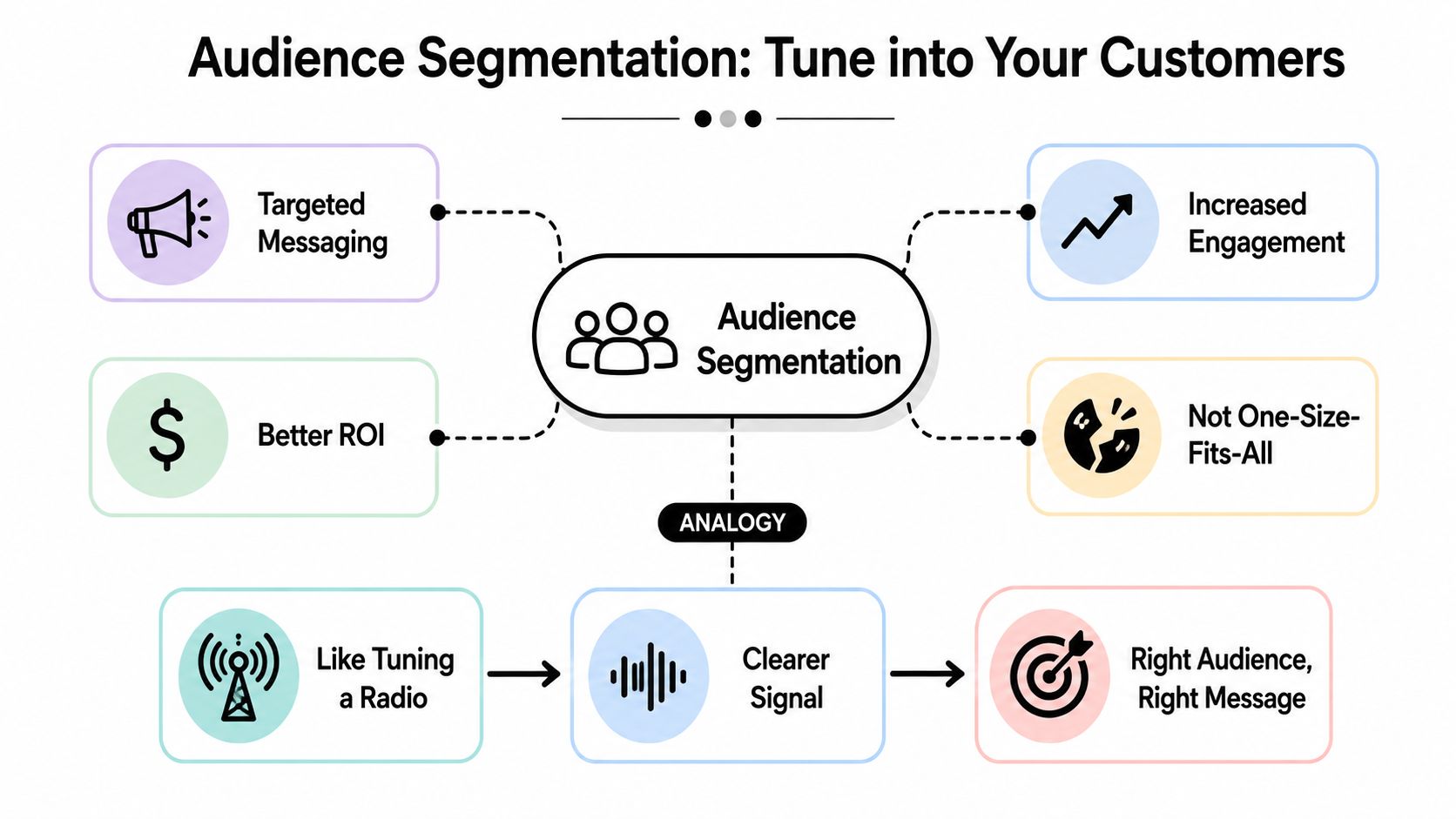
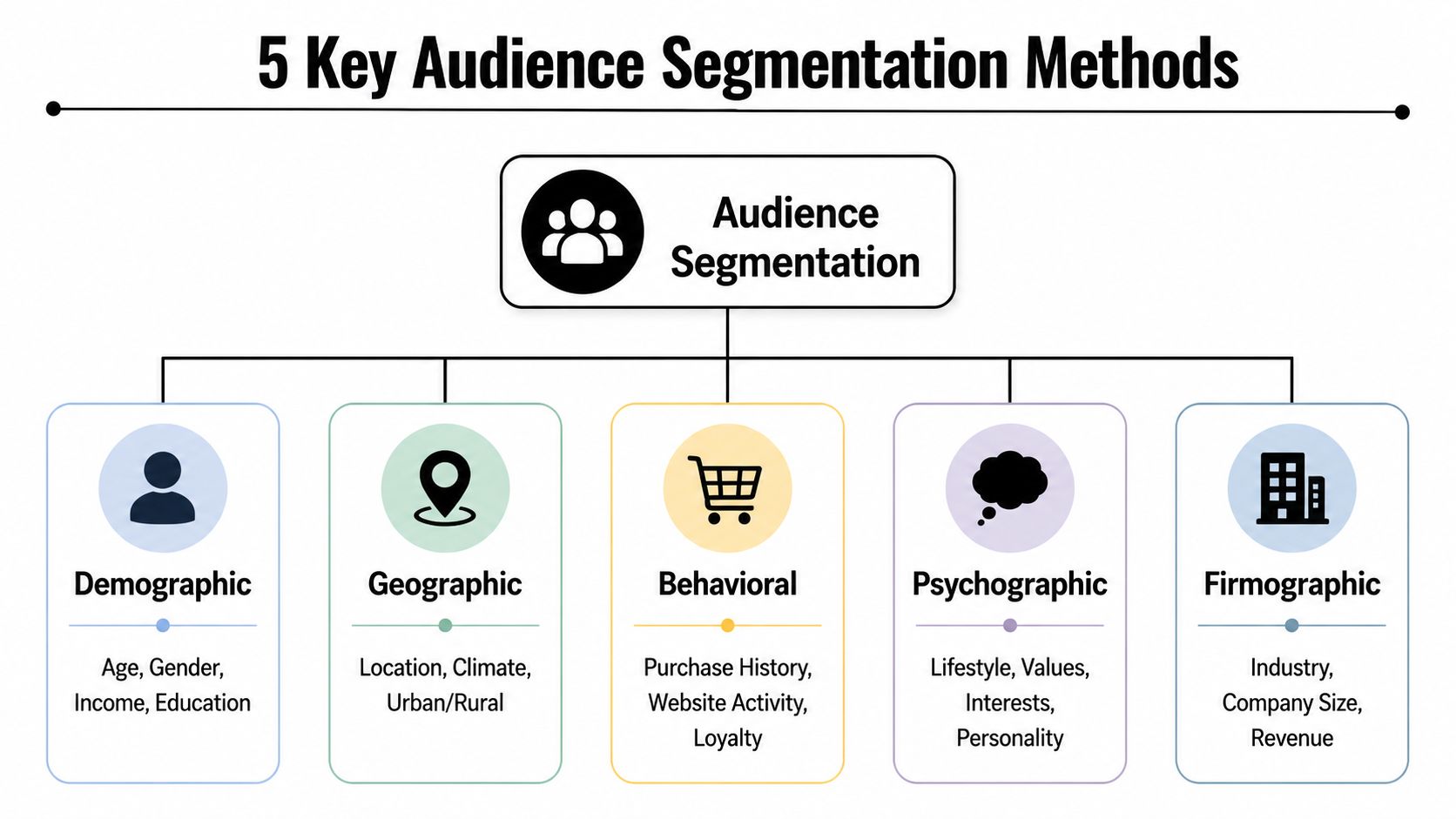
Audience segmentation is the process of grouping people into smaller audiences based on shared traits so you can tailor your message to them. Common segment types include demographic, behavioral, psychographic, and geographic, with B2B marketers also using firmographic and technographic data, as explained in Zuora's overview of audience segmentation.
Imagine fishing in Southwest Florida. You wouldn't use the same bait, location, and timing for every species. Marketing works the same way. If you cast one message everywhere, you'll catch some attention, but much of your effort misses the right people.
It's not about splitting hairs
Small business owners sometimes hear “segmentation” and assume it means enterprise software, giant datasets, and dozens of campaigns. It doesn't.
At a basic level, it means asking a simple question: Which groups of customers need different messages to take action?
For a Fort Myers roofer, that could mean:
- Storm-damage leads who need fast help and insurance guidance
- Older homeowners comparing roof replacement options
- Investors or landlords who care more about durability, scheduling, and cost control
Those are not the same buyers. They don't search with the same urgency, and they won't respond to the same offer.
Practical rule: If two groups care about different problems, ask different questions, or buy for different reasons, they probably need different marketing.
What changes when you segment
Once you understand what audience segmentation is, the benefit becomes obvious. You stop broadcasting and start matching the message to the situation.
That can shape your marketing in several ways:
| Marketing channel | Broad message | Segmented message |
|---|---|---|
| Google Ads | “Call for roofing services” | “Emergency roof tarp after storm damage” |
| “Book your next appointment” | “It's been a while since your last maintenance visit” | |
| Website | “We serve all customers” | “Service pages for Fort Myers, Cape Coral, and Estero” |
| CRM follow-up | Same script for all leads | Different follow-up for estimate requests vs repeat customers |
For local companies trying to improve local marketing for small business, that shift matters because local buyers usually arrive with very specific intent. Your marketing gets stronger when it reflects that intent instead of flattening it.
Why Smart Segmentation Drives Growth for Local Businesses
Local marketing gets expensive fast when every click goes to the wrong person. In Fort Myers, Cape Coral, Estero, Bonita Springs, and Naples, you're not just competing with the company down the street. You're also competing with bigger firms that can afford broader campaigns and more trial and error.
Segmentation helps smaller businesses avoid that waste.
One industry source reports that segmented, targeted, and triggered campaigns generate 77% of marketing ROI, and that email campaigns using audience segmentation see 101% more clicks than non-segmented campaigns in Aerospike's write-up on real-time audience segmentation. Those numbers explain why segmentation isn't just a marketing theory. It changes how efficiently your budget works.
Where the ROI shows up locally
For a home service company, the first win is usually less wasted ad spend. If an electrician advertises the same message to everyone, the budget gets spread across people with very different needs. Some need emergency service. Some need panel upgrades. Some are only browsing.
If that electrician separates those audiences, the campaign gets tighter:
- Emergency intent gets urgency-focused ads and fast-call landing pages
- Quote shoppers get trust signals, service details, and financing language
- Past customers get maintenance reminders or upgrade offers
A professional practice sees similar gains. A Fort Myers med spa, accounting firm, or law office can improve lead quality by separating research-stage visitors from ready-to-book prospects. That keeps the first message relevant instead of forcing one page or one ad to do every job.
Relevance is what beats bigger budgets
Small businesses rarely win by shouting louder. They win by speaking more clearly.
A local pest control company can't outspend a statewide chain in every channel. It can, however, create different campaigns for gated communities, seasonal residents, and year-round homeowners. A dental office can tailor follow-up for overdue hygiene appointments versus new-patient cosmetic inquiries. A paving contractor can split residential driveway prospects from commercial property managers.
Better segmentation usually doesn't mean more marketing. It means fewer irrelevant messages.
That same principle is becoming more important in AI-influenced search and discovery too. If you're thinking about how visibility is changing online, this guide for small business AI growth is useful because it connects content relevance and search visibility in a way local businesses can apply.
The 5 Key Ways to Segment Your Fort Myers Audience
Most explanations of what is audience segmentation stop at definitions. That's not enough. You need a practical way to use it in your business, with the customer base you already have.
The five segment types below are the ones most small and midsize businesses can act on without building a complicated system.
Demographic segmentation
Demographic segmentation groups people by traits like age, income, family status, or similar life-stage factors.
A Fort Myers estate planning attorney might use this when shaping service pages and ad copy. A younger family with children may respond to messaging about guardianship and long-term planning. An older homeowner may care more about wills, trusts, and asset protection. Same practice, same city, different concerns.
This method works best when the trait changes the reason someone buys.
Geographic segmentation
Geographic segmentation groups audiences by location.
For local companies, this is often the fastest win because service needs change by neighborhood, city, and travel radius. A roofer serving Fort Myers, Cape Coral, and Naples shouldn't lump every service area into one campaign. A homeowner in a coastal area may care more about storm resilience and premium roofing materials. A homeowner inland may focus more on repair cost and turnaround time.
Here's a simple version:
| Business | Segment by area | Message example |
|---|---|---|
| Roofer | Naples | Premium roof replacement and tile expertise |
| Roofer | Cape Coral | Shingle repair and leak response |
| HVAC company | Fort Myers | Fast AC service during peak heat |
| Personal injury firm | Lee County | Local accident representation and consultation |
A location page, ad group, or email offer becomes stronger when it reflects where the customer lives.
To see the concepts in another format, this quick video gives a helpful visual overview:
Behavioral segmentation
Behavioral segmentation uses what people do. Purchase history, booking frequency, website visits, and response patterns all fit here.
In such instances, many local businesses leave money on the table.
An HVAC company might create a segment for customers who haven't had service in a long time and send a maintenance reminder. A cleaning company might identify one-time customers and follow up with recurring-service messaging. A law firm might separate people who downloaded a consultation guide from people who started a contact form but never submitted it.
When behavior and message line up, follow-up stops feeling like follow-up and starts feeling useful.
Psychographic segmentation
Psychographic segmentation focuses on interests, attitudes, values, and lifestyle.
This sounds abstract until you apply it. A Fort Myers fitness studio might market differently to people who want convenience and stress relief than to people who want performance and discipline. A cosmetic dentist may need one message for appearance-driven patients and another for patients who mainly want confidence in professional settings.
Psychographics are most useful when buyers choose based on identity, preference, or motivation, not just price.
Firmographic segmentation
Firmographic segmentation is especially important for B2B companies. It groups businesses by factors like industry, company size, or business model.
A commercial cleaning company in Southwest Florida shouldn't market the same way to a small medical office and a multi-location property management company. One buyer may care about reliability and simple scheduling. The other may care about reporting, staffing coverage, and consistency across multiple sites.
If you sell to businesses, this category usually matters more than surface-level demographics. The buying process, the budget, and the stakes are different.
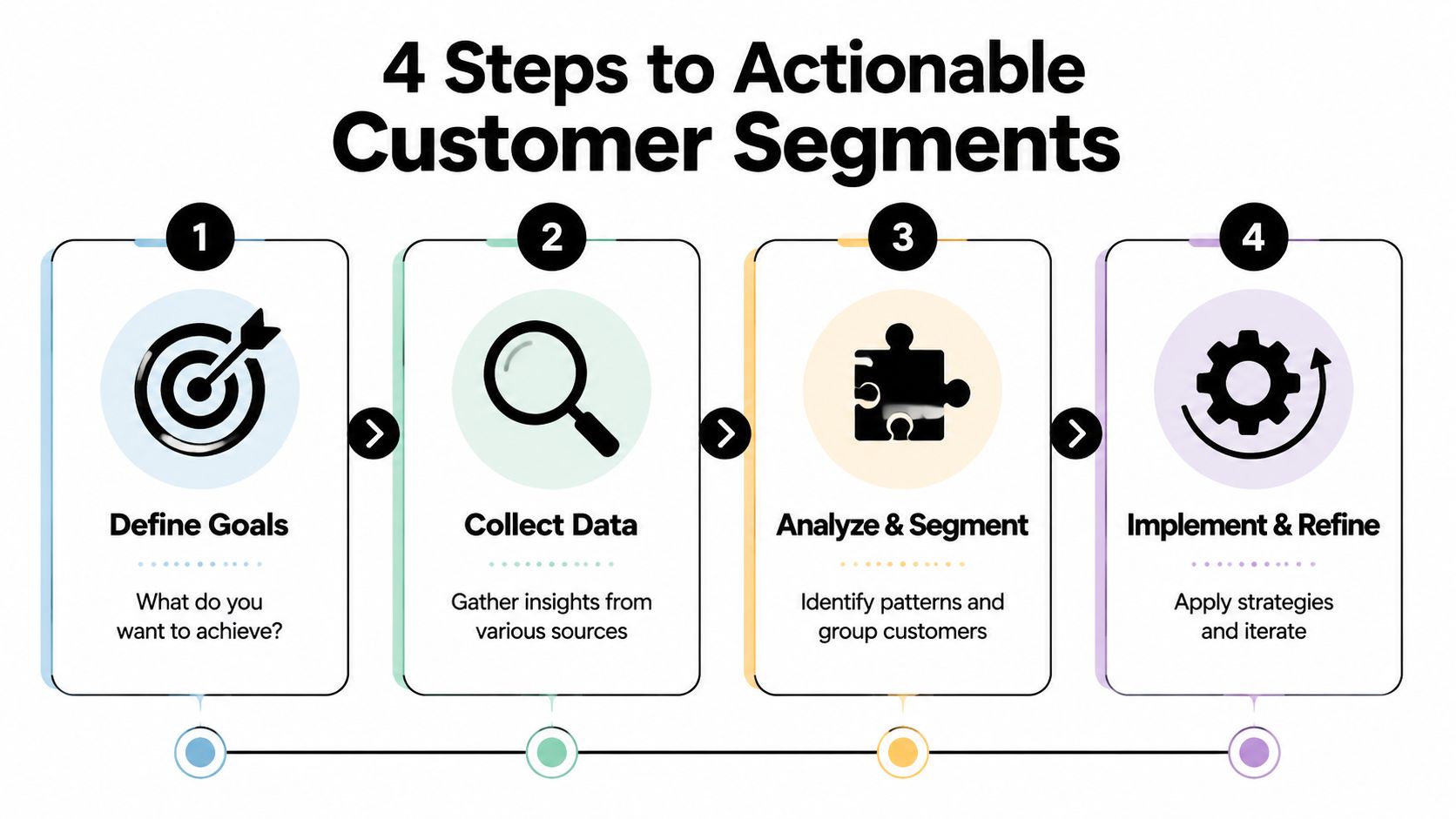
Your 4 Step Guide to Building Actionable Customer Segments
A workable segment earns its keep. If it does not change the message, offer, follow-up, or channel, it is just extra tagging.
That matters for a Fort Myers business with a small team. A two-location dental office or a home service company does not need a complicated segmentation model. It needs a few customer groups that lead to better bookings, better close rates, or more repeat work. The Compass guide on how to do audience segmentation makes the same point. Build segments only when the groups are different enough to deserve a different approach.
Step 1 Define the business goal
Start with the result you want.
If an HVAC company wants more maintenance agreements, it should segment around service history, seasonality, and homeowner readiness. If a family law practice wants more consultations from qualified leads, it should separate people who are researching from people who are ready to call. Different goal, different segment logic.
This step keeps you from building neat-looking groups that never affect revenue.
Step 2 Pull data from the systems you already use
Useful segments usually start with ordinary business data, not expensive software.
Review your CRM for repeat customers, stalled leads, and lead sources. Check website analytics for service pages people visit before they contact you. Look at scheduling tools for no-shows, rebookings, and service frequency. Review email engagement to spot people who still pay attention versus contacts who have gone cold.
If your sales process needs a clearer way to rank leads, this explanation of how lead scoring software works shows how teams sort high-intent prospects from lower-priority inquiries before spending too much time on follow-up.
You can also sharpen your segments by studying how competitors position similar offers. Reviewing local ads, service pages, and calls to action with these competitor analysis tools for marketers can reveal gaps you can use in your own messaging.
Step 3 Create small segments you can actually use
Keep the first version tight.
For many local businesses, four segments are enough to start:
- New prospects who need proof, reviews, and a clear next step
- Warm leads who asked questions or requested an estimate but did not book
- Past customers who are good candidates for repeat service, seasonal reminders, or referral asks
- High-value accounts that justify personal follow-up, priority scheduling, or a customized offer
A segment should lead to a different action. If your message to two groups would be the same, combine them.
For example, a Fort Myers roofer might separate storm-related estimate requests from long-planned replacement projects. Both need roofing help, but the first group cares about speed and insurance coordination, while the second is more likely to compare options, timing, and financing.
Step 4 Activate, then refine
Put the segments into live marketing and sales activity. Use them in ad groups, email sequences, landing pages, call scripts, intake forms, or follow-up reminders.
Then measure response. Some segments will produce a clear lift in bookings or replies. Others will look different on paper but behave the same in real campaigns. Cut or merge those quickly so your team is not maintaining complexity that does not pay off.
A practical setup might look like this:
| Segment | Channel | Message angle |
|---|---|---|
| Inactive HVAC customers | Email and SMS | Seasonal maintenance reminder |
| Recent estimate request | CRM follow-up | Fast scheduling and objections handled |
| Repeat legal referrals | Email and direct outreach | Trust, responsiveness, next-step clarity |
| Commercial leads | Landing page and sales call | Process, scheduling, service consistency |
Find Your Best Customers Using Tools You Already Have
A lot of owners assume segmentation starts after they buy new software. Usually, it starts with tools they already log into every week.
Your website analytics can show which service pages attract real interest. Your CRM can show who books repeatedly, who disappears, and who asks for estimates but never moves forward. Your Google Business Profile can reveal where searchers are finding you and which services pull engagement.

Start with your existing stack
A Fort Myers home service business can often build useful segments from:
- Google Analytics for location trends, landing pages, and return visits
- Google Business Profile for service-area and intent clues
- Jobber, Housecall Pro, ServiceTitan, or scheduling software for customer history
- Email platforms for opens, clicks, and dormant contacts
If you need more ways to turn website traffic into identifiable leads, this roundup of best lead capture tools can help you compare practical options for forms, chat, and intake workflows.
You can also sharpen your segment ideas by reviewing competitor positioning. Looking at ad messaging, service pages, and keyword gaps often reveals which local customer groups are being ignored. A structured process for that starts with these competitor analysis tools and methods.
Use platform-defined audiences carefully
Segmentation no longer depends only on the data people give you directly. Modern ad platforms now build audiences from inferred signals.
Matomo notes that newer segmentation approaches include predictive and platform-defined audiences, and that platforms such as Google Ads offer options based on detailed demographics, life events, in-market intent, website visitors, Customer Match, and lookalike audiences, with some of those groups inferred by the platform rather than declared by the user in its article on audience segmentation in 2025.
That's useful, but it comes with a trade-off. You gain scale and convenience, but you lose some control over how the audience is defined.
For a local business, the safest approach is simple:
- Use your own first-party data first
- Layer in platform audiences second
- Check whether the segment aligns with real lead quality
- Don't assume an inferred audience is automatically accurate
Platform-defined segments can expand reach. They shouldn't replace your own customer knowledge.
Start Marketing Smarter Not Harder
Audience segmentation sounds technical until you strip it down to what it really is. You're deciding which customers deserve a different conversation.
That makes it one of the most practical tools a Fort Myers business can use. A roofer can separate storm-damage urgency from planned replacements. An HVAC company can split repeat maintenance customers from emergency calls. A law office can stop treating every inquiry as if it comes from the same stage of decision-making.
The point isn't to build a massive targeting system. The point is to make your marketing more relevant, easier to act on, and more efficient across the channels you already use.
If your current marketing feels busy but uneven, segmentation is often the fix. It helps you focus on the people most likely to buy, write stronger ads and emails, and measure what's producing return. If you need a clearer way to evaluate performance, this guide on how to measure marketing ROI gives you a practical framework for tying marketing activity back to business results.
If you want help turning broad marketing into segmented campaigns that fit your local market, Polaris Marketing Solutions offers a complimentary analysis to help Fort Myers businesses identify where their messaging, targeting, and lead flow can improve.