
A lot of Fort Myers business owners are already doing “voice search SEO” without calling it that. A homeowner in Cape Coral asks their phone for a roofer. A parent in Estero asks for urgent care that's open now. A traveler in Naples asks where to get lunch nearby. If your business shows up with a clear answer, accurate hours, and an easy way to call, you're in the game. If not, someone else gets the lead.
That's the core point of learning how to optimize for voice search. It's not a separate marketing fad. For most Southwest Florida businesses, it's strong local SEO built around the way people talk.
Why Voice Search Matters for Your Fort Myers Business
In Southwest Florida, a lot of searches happen when someone's busy, sweating, driving, or dealing with a problem right now. An AC goes out in July. A pipe starts leaking in North Fort Myers. Someone needs a walk-in clinic on a Sunday. They don't sit down and type a polished search phrase. They speak.
Google has said that over 20% of mobile searches are conducted by voice, and one industry guide cites 8.4 billion voice-assisted digital devices in use globally. That's why local businesses need content that matches spoken questions, not just short typed keywords, according to the Digital Marketing Institute's voice search overview.
Spoken searches have different intent
Typed searches tend to be clipped. Someone might type “HVAC repair Fort Myers.”
A voice search sounds more like, “Who can fix my AC near me today?” That wording matters because Google and other assistants look for the page or listing that gives the fastest, clearest answer.
Practical rule: If your page makes a person work to find the answer, a voice assistant probably won't favor it either.
For a contractor, the business outcome is simple. Clear spoken-query targeting can lead to more calls, more direction requests, and more appointment-ready visitors. These aren't casual browsers. Many voice searches happen when someone wants help now.
Voice search is tied to mobile, local, and AI answers
Many generic pieces of advice fail to grasp a key aspect. In Fort Myers, voice search usually overlaps with mobile search, map results, and direct-answer boxes. It also overlaps with the broader shift toward optimizing for AI search, because the same habits help your business get picked up by systems that summarize and read answers aloud.
What works is not stuffing pages with “near me” phrases. What works is:
- Answering real questions: “Do you offer same-day drain cleaning in Fort Myers?”
- Making local details obvious: service area, hours, phone number, and city pages
- Formatting for quick extraction: short answers near the top of the page
- Keeping mobile usability tight: fast load, clean buttons, tap-to-call
What doesn't work is treating voice search like a standalone trick. You won't win by adding one FAQ block and calling it done. You win by becoming the easiest local business for Google to trust and quote.
Think Like Your Customers Speak Not Just Type
Most businesses start voice optimization the wrong way. They take their regular keyword list and add a few question marks. That's not enough.
If you want to know how to optimize for voice search, start with how customers phrase problems out loud. People don't speak like keyword tools. They ask complete questions, often with urgency, location, and context built in.
Start with real customer language
The best source material is usually already in front of you:
- Google Business Profile questions: Look at what people ask before they call.
- Sales calls and front desk notes: Write down the exact wording customers use.
- Google's People Also Ask results: Good for seeing common related questions.
- AnswerThePublic: Useful for expanding a service into dozens of spoken variations.
- Search Console queries: Especially helpful if you already rank for service terms.
If you're writing service pages, follow the same fundamentals you'd use for strong on-page copy. A practical guide to SEO content writing best practices can help you turn those questions into pages that rank and convert.
Turn short keywords into spoken questions
Here's what that shift looks like for local businesses.
| Service | Traditional Typed Keyword | Conversational Voice Query |
|---|---|---|
| HVAC | AC repair Fort Myers | Who fixes AC units near me in Fort Myers? |
| Roofing | roofer Cape Coral | How do I find a roofer in Cape Coral after a storm? |
| Paver sealing | paver sealing Bonita Springs | How much does paver sealing cost in Bonita Springs? |
| Personal injury law | car accident lawyer Fort Myers | Who should I call after a car accident in Fort Myers? |
| Dental | emergency dentist Naples | Is there an emergency dentist near me open today in Naples? |
| Cleaning | house cleaning Estero | What's the best house cleaning service near Estero? |
That's the difference between ranking for a term and matching the way someone asks for help.
Examples by business type
Home services usually revolve around urgency, cost, and availability.
- HVAC company: “Do you offer same-day AC repair in Fort Myers?”
- Plumber: “Who fixes a leaking water heater near me?”
- Paver company: “How often should I seal pavers in Southwest Florida?”
Legal and healthcare searches sound different. They're more trust-based and concern-specific.
- Family law attorney: “How do I file for divorce in Lee County?”
- Chiropractor: “Can a chiropractor help with lower back pain after a car accident?”
- Pediatric dentist: “When should a child first see a dentist?”
The wording customers use before they hire you should become the wording on your site.
A quick way to build a voice-ready keyword list
Use this simple workflow once per service:
Pick one core service
Start with something like roof repair, AC maintenance, or teeth cleaning.List the questions people ask before booking
Think cost, timing, service area, insurance, availability, and how it works.Add local modifiers naturally
Fort Myers, Cape Coral, Bonita Springs, Estero, Naples, and neighborhood names where appropriate.Group similar questions together
That helps you avoid writing five thin pages that say the same thing.Match one question to one page section
Don't bury answers in long paragraphs.
What doesn't work is writing for a search engine first. If the phrase sounds awkward out loud, it's probably the wrong target for voice.
Optimize Your Digital Storefront for Immediate Answers
For local voice searches, your Google Business Profile often does more heavy lifting than your website. When someone asks for a nearby service, Google wants to return a business it can trust quickly. That trust starts with a complete and accurate profile.
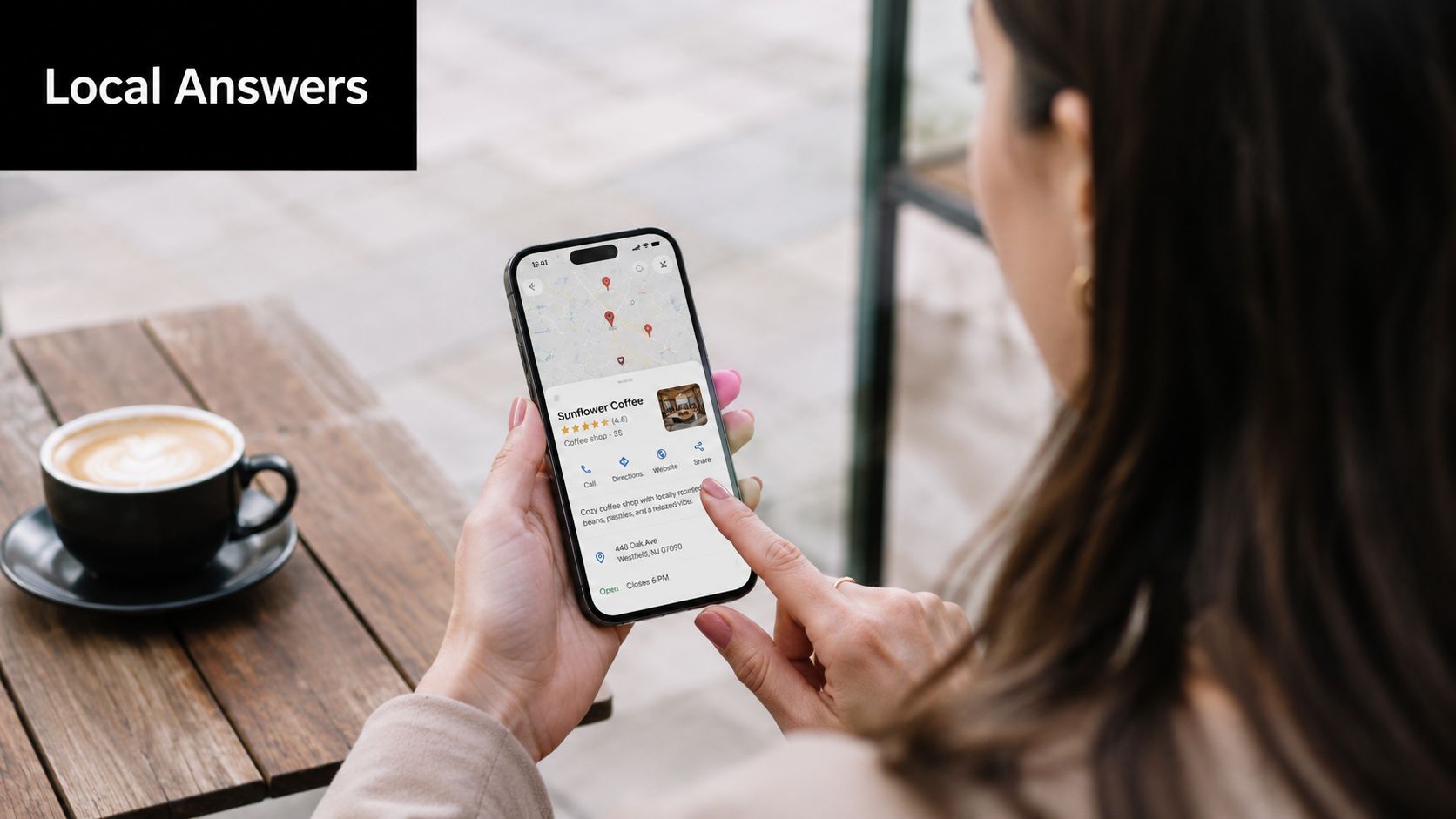
One guide reports that 58% of voice searches are local, and another notes that location-based searches have surged 150% since 2020, which shows how often voice queries are tied to nearby service needs, as explained in this voice search optimization guide.
Your Google Business Profile is your first answer
If your hours are wrong, your category is off, or your phone number doesn't match what's on your website, you make Google hesitate. For a contractor, that hesitation can cost real jobs.
Think about the most common voice search outcomes:
- “Call this business”
- “Get directions”
- “Is it open now?”
- “Show me nearby options”
- “What do reviews say?”
That's why your profile needs to answer those questions immediately.
The Fort Myers contractor checklist
A strong profile isn't complicated, but it does require maintenance.
- Choose the right primary category: Don't settle for something broad if a more accurate option exists.
- Set accurate hours: Especially holiday hours and emergency availability.
- Add services clearly: Include actual service names people recognize.
- Use a local phone number: Make calling easy and consistent.
- Write a plain-English business description: Say what you do and where you do it.
- Upload current photos: Trucks, team, storefront, projects, before-and-after shots.
- Turn on messaging if you can respond fast: Don't enable it if replies will lag.
- Monitor the map pin: It needs to land in the right place.
If you need a step-by-step process, this guide on how to optimize Google Business Profile covers the basics in a practical way.
Use Q and A before customers do
One underused feature is the Q and A section. Most businesses leave it empty until a random user posts something inaccurate.
Seed it yourself with common questions such as:
- Do you offer free estimates in Fort Myers?
- Are you open on weekends?
- Do you serve Cape Coral and North Fort Myers?
- Do you handle emergency calls?
- What payment methods do you accept?
Write answers the way a real person would want to hear them. Short. Direct. No fluff.
After your profile basics are in place, this video is a useful walkthrough on how local search listings support discovery and action.
Reviews help assistants trust your business
Reviews don't just influence humans. They also strengthen the credibility of your listing. For voice-driven local discovery, they support phrases like “top-rated” and “highly reviewed” that shape who gets attention.
Field note: The businesses that get more calls usually aren't the ones with the fanciest websites first. They're the ones with accurate profiles, recent reviews, and no confusion around hours, service area, or phone number.
What works is asking for reviews consistently after completed jobs. What fails is asking in bursts and then going quiet for months.
Build Website Content That Answers Questions Directly
Once someone clicks through, your website has one job. Answer the question fast, then make the next step easy.
Many small businesses often lose the lead. Their service page starts with a giant banner, a stock slogan, and three paragraphs of general marketing copy before saying anything useful. That setup is bad for users and bad for voice visibility.
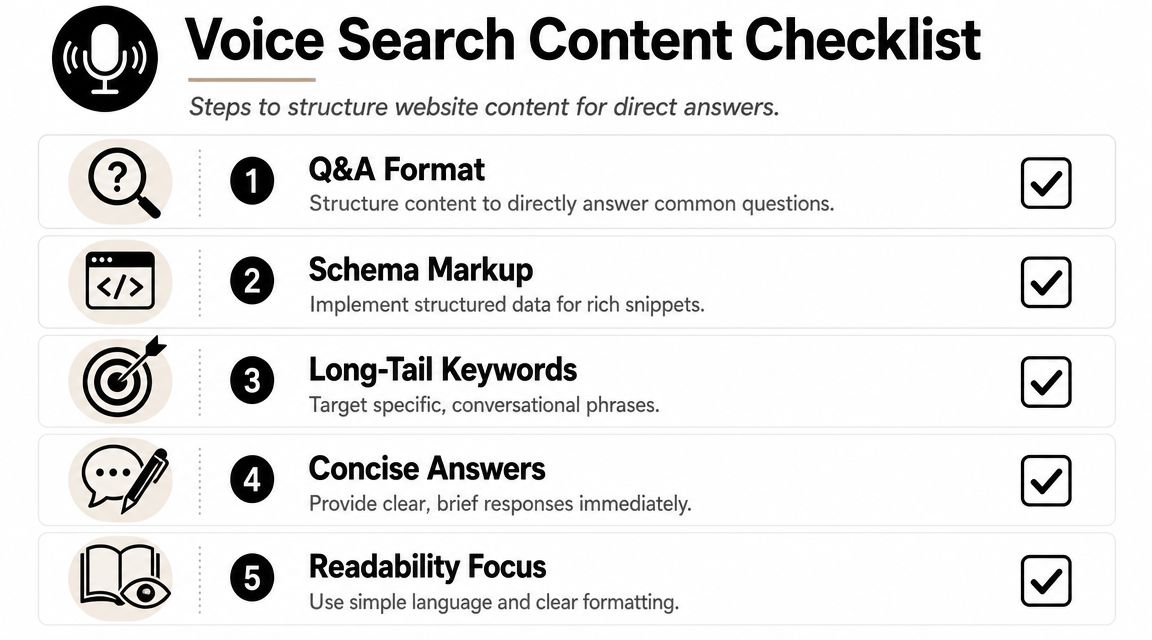
Use a question-first content structure. Voice queries are typically 3 to 5 words longer than typed queries and often come as complete questions. Guidance also recommends direct answers near the top, around 30 to 40 words, written at roughly a 9th-grade reading level, as explained in this voice search content guide.
Use one question per section
A strong service page is usually easier to build than people think. Stop trying to make one block of text do everything.
Instead, structure pages like this:
Roof repair page example
H2 How do I know if I need roof repair or replacement
Give a direct answer first. Then explain signs like leaks, missing shingles, or storm damage.
H2 Do you offer roof repair in Fort Myers and Cape Coral
Confirm the service area right away.
H2 How quickly can you inspect storm damage
Answer the timing question clearly.
H2 Will insurance cover roof damage
Give a simple, careful explanation and advise on next steps.
That format works for HVAC, law firms, dental offices, med spas, plumbers, and cleaning companies. It works because it matches user intent.
Keep answers tight at the top
The best voice-ready sections usually open with a short paragraph that could stand on its own if Google lifted it.
For example:
If your AC is blowing warm air, leaking, or won't turn on, you may need repair right away. In Fort Myers, fast service matters because heat and humidity can turn a small issue into a major comfort and air-quality problem quickly.
That's direct. It sounds natural. A person can scan it fast. An assistant can read it aloud without rewriting it.
Add FAQs where they belong
Some businesses dump every question onto a separate FAQ page. Sometimes that helps. Often it just hides useful answers away from the service page where they belong.
A better approach is:
- Put service-specific FAQs on the service page
- Put general company FAQs on a dedicated FAQ page
- Use location FAQs on city pages when they answer local concerns
Polaris Marketing Solutions also has a helpful resource on content marketing strategies for small business if you need a broader plan for turning customer questions into useful pages.
Use schema without overcomplicating it
Schema markup helps search engines understand what kind of content they're looking at. For voice search, FAQ schema and local business schema are usually the most useful starting points.
You don't need to become a developer to use it well. You do need to avoid two common mistakes:
- Adding FAQ schema to content that isn't visible on the page
- Marking up weak questions nobody asks
Schema supports good content. It doesn't rescue bad content.
A practical page template
For a local service page, use this order:
- Clear headline with service and location
- Short intro answering the main question
- Question-based H2 sections
- Proof elements like reviews, service area, and credentials
- FAQ block
- Strong call button and contact form
That's how to optimize for voice search on the page itself. Make it easy to quote. Make it easy to trust. Make it easy to call.
Ensure Your Site Is Fast and Mobile-Ready
Voice search usually starts on a phone, and mobile users are impatient. If your site loads slowly, shifts around, or makes basic actions annoying, you've already lost ground before your content gets a chance.
That's why speed is not a side issue. It affects whether Google wants to send people to you in the first place, especially when the search is immediate and local.
What matters most on mobile
If you're a contractor, healthcare office, or law firm, your mobile visitor usually wants one of three things. Call you. Confirm you serve their area. Book or request help.
Anything that slows those actions down hurts.
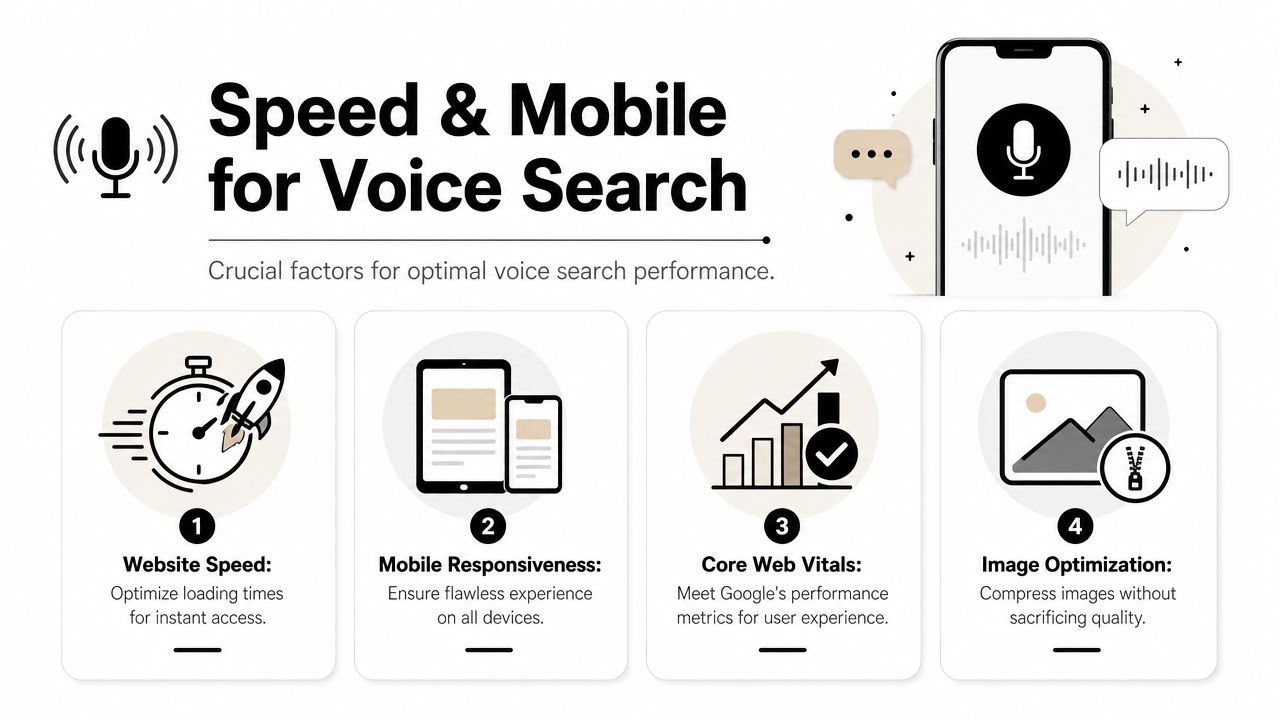
Here's what to fix first:
- Compress oversized images: Job site photos and hero banners are common culprits.
- Use responsive design: Your site should work cleanly on any phone size.
- Keep buttons tappable: Especially call, quote request, directions, and form buttons.
- Reduce clutter above the fold: Don't force users to scroll through fluff.
- Check font size and contrast: If it's hard to read outside in bright Florida sun, it's a problem.
Core Web Vitals matter because users notice the experience
Most business owners don't need a deep technical lecture. They need the plain-English version. Your site should load fast, respond quickly, and stay stable while it loads.
If you want a non-technical rundown of practical fixes, these ARPHost website performance tips are a solid reference for common speed problems.
A slow mobile page doesn't just frustrate visitors. It interrupts the exact moment when someone was ready to act.
Don't ignore technical basics
A surprising number of local sites still have small technical issues that add up. Broken internal links, bloated plugins, old theme files, missing image compression, and forms that don't behave well on phones all chip away at performance.
For a more structured look at the technical side, this resource on technical on-page SEO covers the areas that commonly affect visibility and usability.
What works is focusing on the pages that make money first. Homepage, main service pages, location pages, and contact pages. What doesn't work is chasing obscure technical tweaks while your quote form still breaks on iPhone.
Putting It All Together From Voice Search to Valued Customer
Here's the part most business owners care about. You don't need a separate “voice search campaign” with its own dashboard and buzzwords. You need a local search setup that answers questions clearly and turns those answers into calls, form fills, direction requests, and booked jobs.
Recent guidance increasingly treats voice search as a layer on top of conversational queries, Google Business Profile completeness, mobile usability, and structured data, rather than a separate channel, as noted in this 2026 voice search guidance.
What to measure instead of “voice traffic”
You probably won't get a clean report labeled voice search. That's fine. Track business actions that reflect the work you've done.
Good signals include:
- More click-to-call actions from your Google Business Profile
- More direction requests
- More impressions for question-based searches in Google Search Console
- Better engagement on service and FAQ pages
- More leads from mobile visitors
- More calls tied to local service pages
Those metrics tell you whether your voice-ready local SEO is creating real opportunities.
What works and what wastes time
The Southwest Florida businesses that usually improve fastest do the basics well and do them consistently.
What tends to work:
- Clear Google Business Profile data
- Service pages built around customer questions
- Location details that are easy to verify
- Fast mobile pages with obvious calls to action
- FAQ content based on actual objections and buying questions
What usually wastes time:
- Forcing “near me” into every paragraph
- Publishing shallow city pages with almost no useful content
- Stuffing FAQs with generic questions no customer asks
- Ignoring reviews while chasing advanced tactics
- Treating voice search like a trendy add-on instead of local SEO discipline
The practical way to approach it
If you're busy, start in this order:
- Clean up your Google Business Profile.
- Rewrite your top service pages around spoken questions.
- Add concise answers near the top of each section.
- Make sure your mobile site is fast and easy to use.
- Review Search Console and customer questions each month for new FAQ ideas.
That's the cleanest answer to how to optimize for voice search for a Fort Myers business. It's not about gaming a device. It's about removing friction so search engines and customers can trust you faster.
If you want help turning your Google Business Profile, local pages, and service content into a voice-ready lead system, Polaris Marketing Solutions works with Southwest Florida businesses on practical local SEO, content, and website improvements built to drive more calls and appointments.