
If you're running a small business in Fort Myers right now, you're probably dealing with the same problem I hear every week. You know your service is in demand, but your phone doesn't ring consistently enough to trust the pipeline. One month feels solid, then seasonality shifts, a competitor gets more visible, or storm-related demand changes what customers seek and where they seek it from.
That's where PPC starts to make sense.
For a home service company, law office, medical practice, or local service brand in Southwest Florida, PPC isn't just about buying clicks. Done right, it puts your business in front of people when they're actively looking for help. Done better, it gives you a stream of real search data you can use to strengthen your local SEO, your Google Business Profile, and your service pages. Most local competitors still treat those as separate channels. That leaves an opening for businesses willing to connect them.
Why PPC Delivers Immediate Value for SW Florida Businesses
At 2:15 on a Friday in Fort Myers, a homeowner notices water spreading across the garage floor. They are not looking for a brand story. They are searching for “emergency plumber Fort Myers” and calling one of the first credible businesses they see.
That is where PPC earns its keep for a small business. It puts you in front of high-intent searches at the moment someone needs help, whether that search is “AC repair Fort Myers,” “estate planning attorney Naples,” or “urgent care Bonita Springs.” For service businesses, that speed matters because the lead often goes to the company that shows up clearly and makes the next step easy.
Google Ads works best when the problem is already real. The customer is not browsing. They are comparing options, checking reviews, and deciding who to contact. In a local market where visibility shifts with seasonality, storm activity, and population changes, paid search gives you a direct way to stay in the mix.
The bigger advantage is what happens after the click.
A well-run PPC campaign shows you the exact phrases people use before they call, book, or request an estimate. That gives you more than leads. It gives you language you can use to improve your service pages, Google Business Profile categories, FAQ content, and local SEO targeting. Businesses that connect those dots can lower wasted ad spend over time and build stronger organic visibility from the same demand signals. That leaves an opening for companies willing to connect paid search and SEO in a way many competitors overlook.
Why this matters in Fort Myers
Southwest Florida is not a flat market. A campaign that works for a year-round Fort Myers law office may need a different approach than one for a Naples med spa or a Cape Coral restoration company dealing with storm-driven demand.
A few patterns show up often:
- Home services: A homeowner searching “water damage cleanup near me” usually wants a fast response, clear service area, and proof you can handle the job today.
- Professional services: A search like “divorce lawyer Fort Myers consultation” signals a person looking for a next step, not broad educational content.
- Medical and wellness practices: Patients in Naples or Bonita Springs often compare a short list of providers that appear first and look trustworthy.
If the search shows immediate intent, paid search usually deserves attention before broad awareness campaigns.
PPC also gives small businesses tighter control over lead quality. You can limit ads to the areas you serve, run them when someone can answer the phone, and send traffic to a page built for one service instead of a general homepage. That control matters in Fort Myers because wasted clicks add up fast when your budget is built around booked jobs, not vanity metrics.
For many local businesses, PPC is the fastest way to get visibility now and the clearest way to learn what your market is asking for. Used that way, it does more than produce leads. It helps build a smarter local marketing system.
Building Your PPC Foundation Before Spending a Dime
A Fort Myers business owner can burn through a week of ad budget before realizing the problem was never the clicks. It was the setup. I see this with home service companies and local practices all the time. They launch fast, send traffic to a general page, skip call tracking, and end up with no clear answer on what produced a lead.
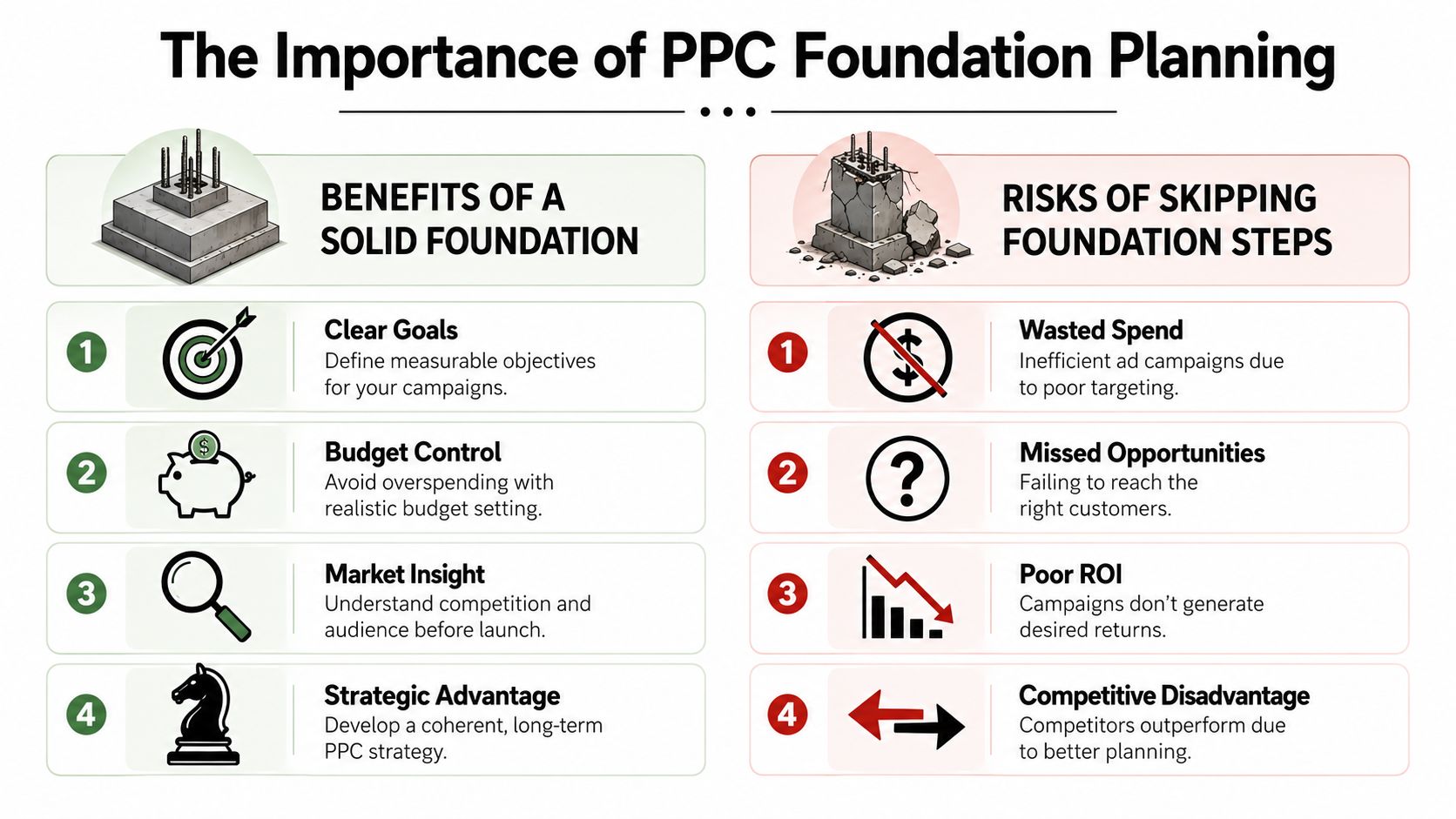
The foundation work decides whether PPC becomes a lead source or an expensive guessing exercise.
Pick the platform based on the job
Different platforms solve different problems. A homeowner searching “emergency plumber in Estero” has immediate intent. Search ads fit that situation because the prospect is already asking for help. A new med spa in Naples promoting a seasonal offer may get better traction from Facebook or Instagram, where the goal is to generate interest and stay visible.
Here's the practical split:
| Platform | Best fit | Local example |
|---|---|---|
| Google Search Ads | Direct demand from people ready to act | “HVAC repair Fort Myers” |
| Facebook or Instagram Ads | Awareness, promotions, remarketing | New med spa promotion in Naples |
| Microsoft Ads | Extra search reach, often useful for older or office-based audiences | Estate planning or tax services |
For many Southwest Florida service businesses, Google Search is the best first move because intent is clearer and lead quality is easier to judge.
Set the goal before the budget
Budget comes after the target.
If the goal is vague, the campaign usually fills up with low-value clicks. A better starting point is a concrete business outcome tied to one service. That could mean booked recurring cleanings, consultation requests, or estimate calls for a profitable repair job.
Examples that make sense in Fort Myers:
- Cleaning company: 30 booked recurring cleanings this month
- HVAC contractor: qualified calls for service and replacement estimates
- Family law firm: consultation requests from Fort Myers and Cape Coral
- Dental practice: appointment requests for one high-value service
A click does not pay for itself. A booked job does.
That goal also shapes the rest of your local marketing. If PPC search terms keep showing strong demand for “tile roof leak repair Fort Myers” or “same day AC repair Cape Coral,” that language should influence your service pages, Google Business Profile posts, and FAQ content. This is the part many local competitors miss. PPC is not just a paid channel. It is one of the fastest ways to learn which local SEO topics deserve attention first.
Start with a controlled test
Small businesses do not need to cover all of Southwest Florida on day one. They need a focused test that produces usable data.
A smart first campaign usually keeps the scope tight:
Choose one service
Start with a service that has steady demand and healthy margins.Limit the geography
Fort Myers, Cape Coral, Estero, Bonita Springs, and Naples often perform differently. Separate them if service times, competition, or lead value changes by area.Track one primary conversion
Pick the action that matters most, calls, form submissions, or appointment requests.Use a dedicated landing page
Match the page to the ad and the service. A generic homepage usually lowers conversion rates.Review search terms and lead quality early
Good PPC management starts with what actual prospects typed, not what the business assumed they would type.
That early review does more than improve the ad account. It also gives you a list of high-intent phrases, service modifiers, and local wording you can reuse in SEO. If you want to sharpen that research before launch, this guide on competitor analysis tools for local marketing planning can help you see how nearby businesses frame their offers and target local demand.
Build tracking before traffic
Tracking should be in place before the first click.
For a home services company, that usually means call tracking, form tracking, and a clear record of which campaign produced the lead. For a law firm or dental office, it may also mean separating new patient or new matter inquiries from existing client calls. Without that setup, it becomes hard to tell whether the campaign is producing revenue or just activity.
Polaris Marketing Solutions also offers PPC and digital marketing services alongside SEO and landing page support. What matters is that the account is built around clear goals and clean tracking from the start.
Mastering Keywords and Audience Targeting
Keyword strategy is where PPC advertising for small business either gets sharp or gets expensive. Most wasted budget starts here.

A simple way to think about it is fishing. A broad keyword is a wide net. You'll catch a lot, but much of it won't be what you want. A long-tail keyword is a specific lure. Fewer people may search it, but the ones who do are often closer to hiring.
“Roofing” is broad. “Metal roof replacement quote Fort Myers” is much closer to a buying decision.
Go after intent, not volume
Small businesses usually don't need the biggest keyword. They need the most useful keyword.
A few examples:
Bad fit: roofing
Better fit: roof repair Fort Myers
Stronger fit: tile roof leak repair Fort Myers
Bad fit: lawyer
Better fit: probate attorney Naples
Stronger fit: probate attorney Naples consultation
Bad fit: cleaning service
Better fit: house cleaning Fort Myers
Stronger fit: recurring house cleaning Fort Myers
The stronger keyword does two jobs. It improves targeting and usually leads to more relevant ad copy and landing page messaging.
Protect your budget with negative keywords
This is the part many local advertisers skip, and they pay for it.
Salesforce's PPC guide for small businesses notes that small businesses must filter out irrelevant traffic using negative keywords such as “free,” “reviews,” or “jobs” to avoid wasting budget on non-converting clicks, focusing instead on high-intent long-tail keywords that are often cheaper.
That means a Fort Myers plumbing company should often exclude terms like:
- Free: attracts people with no buying intent
- Jobs: job seekers are not service customers
- DIY: they want instructions, not a paid visit
- Reviews: sometimes useful for brand protection, often weak for service acquisition
- How to: often research intent, not hire-now intent
Don't pay for curiosity when you need buyers.
A local HVAC company might bid on “emergency AC repair Fort Myers” and exclude “DIY,” “salary,” “jobs,” and “free.”
Watch what competitors are doing, then improve the gaps
Competitor research helps, but copying blindly doesn't.
Review the ads that keep showing up in your market. Are they emphasizing same-day service, financing, family ownership, or fast estimates? Are they using call extensions, pricing language, or location-specific copy? That review can sharpen your own angle.
For a practical process, use tools that show ad patterns, keyword overlap, and landing page themes. This roundup of competitor analysis tools for marketers is useful if you want a structured way to compare what nearby businesses are doing.
After that, build tight ad groups around themes. Don't mix “drain cleaning,” “water heater install,” and “emergency plumbing” into one mess of keywords and generic ads. Separate them so the ad and landing page can match the search.
A helpful walkthrough on keyword thinking is below.
Winning the Local Battle with Geo-Targeted Ads
A campaign targeting “Southwest Florida” as one broad area usually leaves money on the table. Fort Myers is not Cape Coral. Naples is not North Fort Myers. Search behavior, competition, and service expectations shift by location.
That's why geo-targeted structure matters.
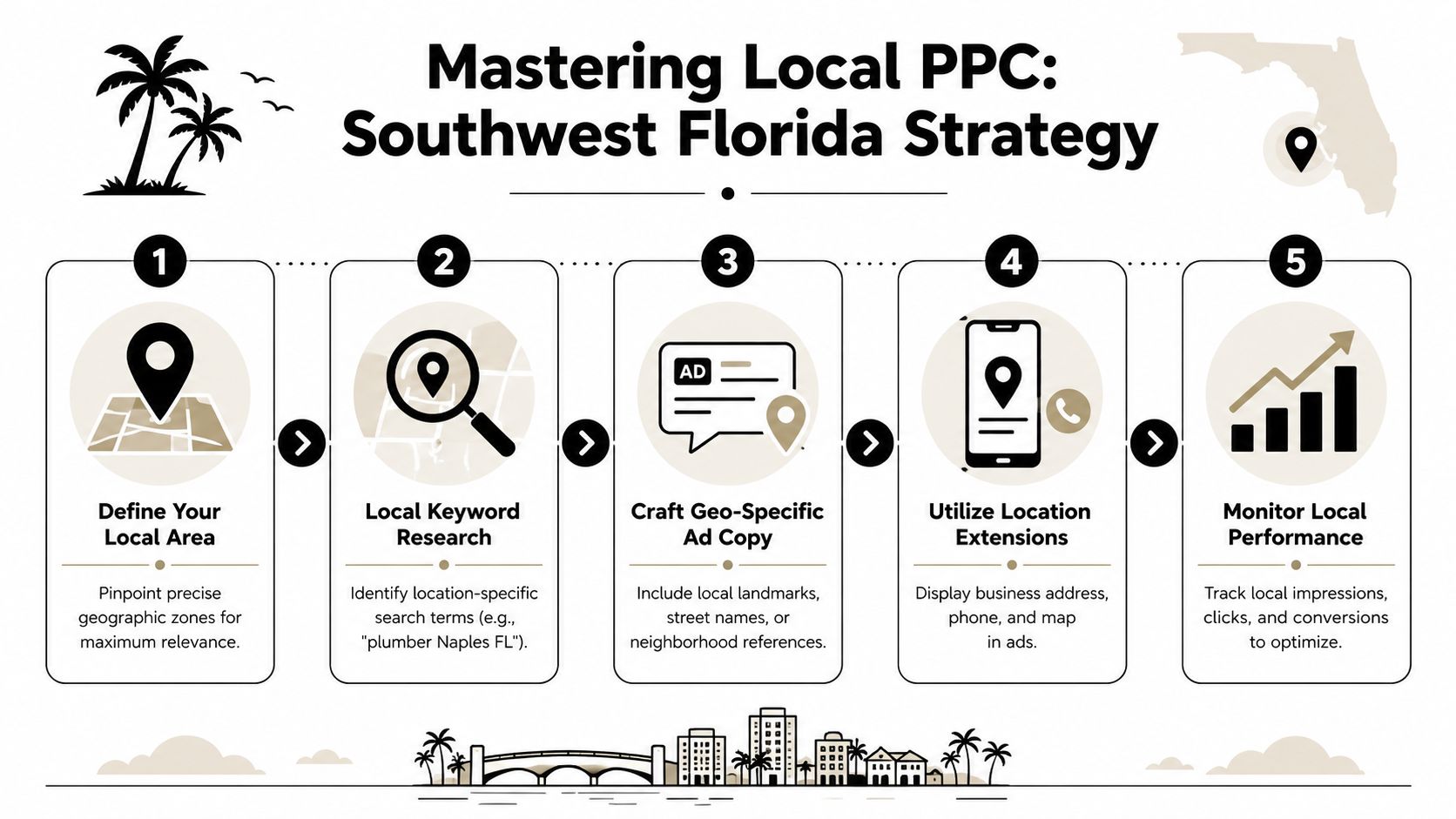
Split campaigns by service area
If you serve multiple cities, don't force them into one generic campaign with one generic ad.
A better setup for a paving company might look like this:
| Campaign | Focus | Example keyword |
|---|---|---|
| Fort Myers | Core city leads | driveway paving Fort Myers |
| Cape Coral | Separate message and landing page | driveway paving Cape Coral |
| Bonita Springs | Higher-value localized intent | paver driveway Bonita Springs |
| Naples | Premium market positioning | driveway resurfacing Naples |
That structure lets you change ad copy, budget, and landing page details by location. It also shows you where leads are profitable, instead of blending every city into one report.
Use PPC data to improve local SEO
This is the part most businesses miss.
PPC and local SEO shouldn't sit in separate silos. Paid search gives you fast feedback on the exact phrases people use before they call, book, or submit a form. That information can strengthen your unpaid visibility if you use it correctly.
Network Solutions' small business PPC article states that 60% of top-performing local SEO campaigns originate from PPC keyword insights, yet 50% of small businesses still waste budget by bidding on generic keywords that don't align with local intent.
That creates a clear opportunity in Fort Myers.
Here's what the feedback loop looks like in practice:
Run local PPC campaigns by city and service
Example: “emergency HVAC repair Fort Myers” and “AC repair Cape Coral.”Identify which search terms convert
Not just which terms get clicks.Update your Google Business Profile
Use those high-intent phrases naturally in service descriptions, posts, and Q&A topics where appropriate.Rewrite or expand location pages
If “mini split installation Bonita Springs” performs well in PPC, your Bonita Springs service page should reflect that demand clearly.Carry over ad language that resonates
If users respond to “same-day service” or “financing available,” test that language in title tags, headings, and page copy where it fits.
PPC gives you fast market feedback. Local SEO turns that feedback into long-term visibility.
Make ads sound local
A geo-targeted ad shouldn't read like it could belong to any company in any state.
Use city names where it matters. Reference the service area clearly. Align the landing page headline to that same location.
For example:
- Weak ad: Trusted Plumbing Services. Call Today.
- Stronger ad: Fort Myers Emergency Plumbing. Fast Local Service.
- Landing page match: Emergency Plumbing in Fort Myers
That message continuity helps both click quality and conversion quality. It also gives you sharper language to reuse on local pages, service area pages, and Google Business Profile content.
Crafting Ads and Landing Pages That Convert
A homeowner in Fort Myers searches for "AC repair near me" at 2:15 p.m. in August. They click your ad, land on a generic homepage, see five services, three sliders, and no obvious next step. That lead is usually gone in seconds.
Paid traffic is expensive enough without sending people to a page that makes them work. The ad and landing page need to carry the same message from search to click to contact. That is how small businesses turn PPC spend into booked jobs instead of loose traffic. It also gives you a clean read on which offers, headlines, and service angles deserve a bigger place in your local SEO pages later.
Match the click to the page
Here is a weak setup for a Fort Myers law firm.
Ad
Experienced Attorneys
Trusted Legal Help
Visit Our Website Today
Landing page
Homepage with multiple practice areas, generic banner, full navigation, and no clear next step.
Here is the stronger version.
Ad
Fort Myers Probate Attorney
Schedule a Probate Consultation
Local Guidance for Estate Matters
Landing page
Headline: Probate Attorney in Fort Myers
Subheadline: Talk with a local firm about the next step in the probate process
CTA: Request a Consultation
Trust signals: attorney bio, local reviews, office contact details, focused form
The second path works because it stays on topic. A person looking for probate help sees probate language in the ad and probate language on the page. That consistency lowers friction and usually improves lead quality, too.
What a landing page needs to do
Good PPC pages are built for one service, one audience, and one action. They do not need clever copy. They need clarity.
A practical landing page should include:
- A headline that matches the ad: If the ad says "Fort Myers AC Repair," the page should repeat that promise clearly.
- One primary call to action: Call now, request an estimate, or book an appointment. Choose the action that fits the service and the buying cycle.
- Local proof: Reviews, nearby city references, photos of your team, and contact details that show you serve Southwest Florida.
- A mobile-friendly layout: Local PPC clicks often come from phones. Buttons need to be obvious, forms need to be short, and the page needs to load cleanly.
- Fewer distractions: Trim excess navigation, competing offers, and filler copy so the visitor can make one decision fast.
This is also where PPC becomes useful beyond lead generation. If one headline gets stronger conversion rates, that language can inform your service page H1, your title tag, and even parts of your Google Business Profile content.
Why homepages waste paid clicks
For many small businesses, the homepage is the default destination because it already exists. It is rarely the best destination for paid traffic.
A homepage has to introduce the whole business. A PPC landing page only has to answer one search. That difference matters.
| Search | Bad destination | Better destination |
|---|---|---|
| emergency water extraction Fort Myers | homepage | emergency water damage service page |
| family dentist Naples | homepage | Naples dental service page |
| DUI lawyer Fort Myers consultation | homepage | DUI consultation landing page |
A Fort Myers cleaning company is a good example. If someone clicks an ad for recurring house cleaning, do not send them to a homepage that also pushes move-out cleans, post-construction cleanup, and commercial janitorial work. Build a page for recurring house cleaning. Keep the offer narrow. Keep the form short. Put the phone number where a thumb can tap it.
If you want a practical reference, these tips for high-converting landing pages are useful because they focus on clarity, message match, and reducing distractions. For more real-world inspiration, this collection of high-converting landing page examples can help you spot what your current pages are missing.
The ad gets the click. The landing page gets the lead.
That is the standard to use when reviewing your own account. If a campaign brings in traffic but the page is broad, cluttered, or off-message, fix the page before assuming the keyword or ad is the problem.
Measuring ROI and Optimizing for Long-Term Growth
A Fort Myers owner can look at a Google Ads report and see clicks, impressions, and a decent click-through rate, then still have no clear answer on whether the campaign produced revenue. That is the problem to solve here. PPC only becomes a growth channel when it is tied to booked jobs, retained clients, and sales conversations your team wants.
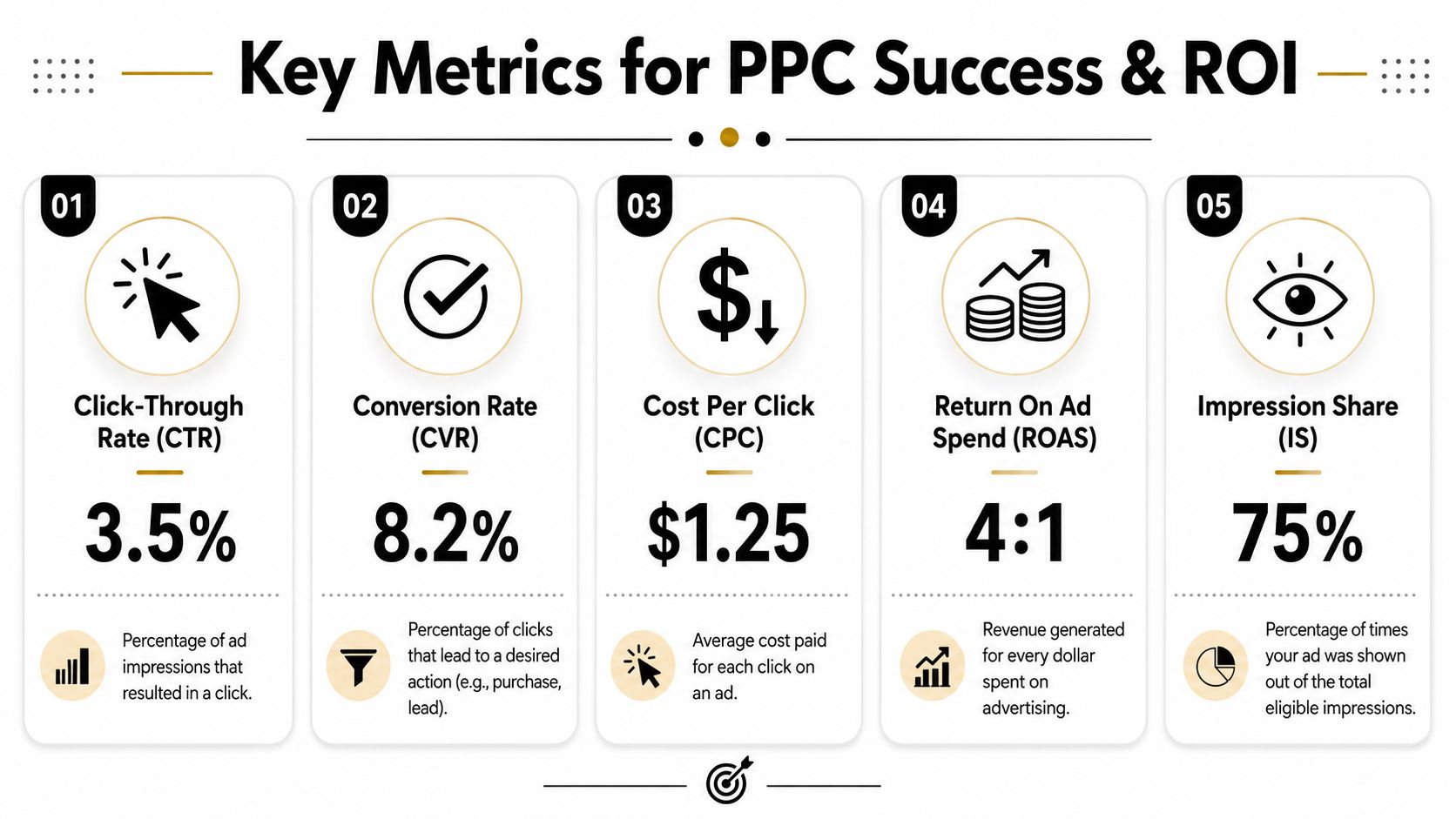
Start with business KPIs, not ad platform vanity
The best PPC accounts for small businesses are built around a few plain questions. How many qualified calls came in. How many form leads turned into estimates or consults. Which campaigns produced those leads. Which ones became real revenue.
For a home services company, that might mean booked inspections, emergency calls, or service appointments. For a dental office or law firm, it might mean consult requests that show up, not just form fills from people price shopping.
Set that standard before you touch bids or budgets. If conversion tracking is missing, or if every phone call is counted the same whether it lasts 8 seconds or 8 minutes, the account will look healthier than it is.
Know which numbers help you make decisions
Small businesses do not need a bloated reporting deck. They need a scorecard that helps them decide what to cut, what to keep, and where to invest more.
Focus on metrics like these:
- Qualified leads, not raw lead volume
- Cost per qualified lead, not just cost per click
- Close rate by campaign or keyword
- Revenue by lead source, when your CRM or intake process allows it
- Search term quality, so you can spot wasted spend and strong intent
- Landing page conversion rate, because weak pages distort campaign performance
If you want a simple way to pressure-test return, use this calculator to optimize ad campaigns with ROI metrics.
Optimization happens after the lead comes in
Many small businesses often leave money on the table. They review ads inside Google Ads, but they never compare campaign cost against what happened in the office, on the phone, or in the field.
A plumber in Fort Myers might find that drain cleaning leads are cheap but often turn into small tickets. Water heater replacement leads may cost more and still be the better buy because the jobs are larger and the close rate is stronger. A family law firm might learn that one keyword produces many calls, but consultation quality is poor. Those are not ad platform problems. They are business decisions informed by ad data.
That is also where PPC can improve local SEO. Search term reports show the exact language local buyers use before they call. Use that language in service pages, FAQ sections, title tags, and Google Business Profile updates. If paid search keeps producing strong leads for "emergency AC repair Fort Myers" but your organic pages barely mention that phrase or its close variants, you have a gap. Fixing that creates a useful loop. PPC reveals demand quickly, then SEO captures more of it over time without paying for every click.
Improve profit with steady account cleanup
Long-term growth usually comes from routine adjustments, not dramatic changes.
Pause search terms that attract the wrong jobs
Clicks from broad, low-intent terms drain budget fast.Shift budget toward higher-value service areas
In Southwest Florida, cheaper leads are not always better leads. Some areas produce lower costs but weaker close rates.Rewrite ads to match real buyer concerns
Response time, insurance help, financing, availability, and local credibility often matter more than generic claims.Review lead handling
If calls are going unanswered or forms sit for hours, campaign performance will stall even if the traffic is good.Send PPC insights into SEO and content
Winning search terms can guide new location pages, stronger service copy, and better Google Business Profile posts.
For a practical framework that ties ad spend back to actual business performance, this guide on how to measure marketing ROI is worth reviewing.
The small businesses that get strong results from PPC are usually the ones with clean tracking, fast follow-up, and the discipline to cut weak traffic early. The extra advantage in Fort Myers is using that paid search data outside the ad account. Done well, PPC does more than produce leads. It shows you what local customers are asking for, which helps your SEO get sharper and your marketing gets cheaper over time.
If you want help building a PPC system that also strengthens your local SEO in Fort Myers, Polaris Marketing Solutions works with small and mid-sized businesses across Southwest Florida on Google Ads, landing pages, local SEO, and conversion-focused strategy. A practical review of your current campaigns or search visibility can show where budget is leaking and where the strongest local growth opportunities are.