
A lot of Fort Myers business owners end up in the same spot. The phone is quieter than it should be, the work is good, referrals still come in, but nearby competitors keep showing up first when someone searches on Google for the exact service you provide.
If you run a roofing company in Cape Coral, a plumbing business in North Fort Myers, or a cleaning company covering Lee County, that gap usually isn't about who does better work. It's about who shows up when a customer needs help right now. That's what local SEO services are for.
When people ask what are Local SEO services, the simple answer is this. They are the work required to make your business visible in local search results, especially Google Maps, the Map Pack, and location-based organic searches. The practical answer is even simpler. It's the system that helps the right local customer find you, trust you, and call you.
Why Your Fort Myers Business Is Invisible to Local Customers
A Fort Myers contractor can have a solid website, great technicians, and years of experience and still lose jobs every week because the business barely appears in search. That usually shows up in a familiar way. A prospect says they found another company in Google Maps first, called them, and booked before they ever reached your site.
For home service businesses, that first layer of visibility matters more than most owners realize. Local SEO for contractors increases visibility by helping businesses appear in the Google Map Pack for searches like “plumber near me” or “HVAC repair Naples FL,” where customers are often ready to hire immediately, as noted in Get Found Fast's guide for home service contractors.
That's the core problem local SEO solves. It doesn't exist to make reports look prettier. It exists to put your business in front of a person who has a leak, a broken AC, a damaged roof, or a packed move schedule and needs someone local.
What invisibility looks like in practice
A business is usually “invisible” when one or more of these issues stack up:
- Weak map presence: Your Google Business Profile isn't fully built out, updated, or aligned with your actual services.
- Thin location signals: Your website says you serve Southwest Florida, but it doesn't clearly show where and how.
- Messy trust signals: Reviews are sparse, old, unanswered, or inconsistent with the services you want to rank for.
- Confused business information: Your phone number, address details, or business name vary across directories.
Practical rule: If a customer has to work to figure out what you do, where you work, or whether you're trustworthy, Google usually has the same problem.
In Fort Myers, that hurts because the search demand is local and urgent. People don't browse for long. They scan the top few options, compare reviews, tap the listing that looks legitimate, and move on. If your business isn't built to win that moment, a competitor gets the call.
Winning the Near Me Search Game
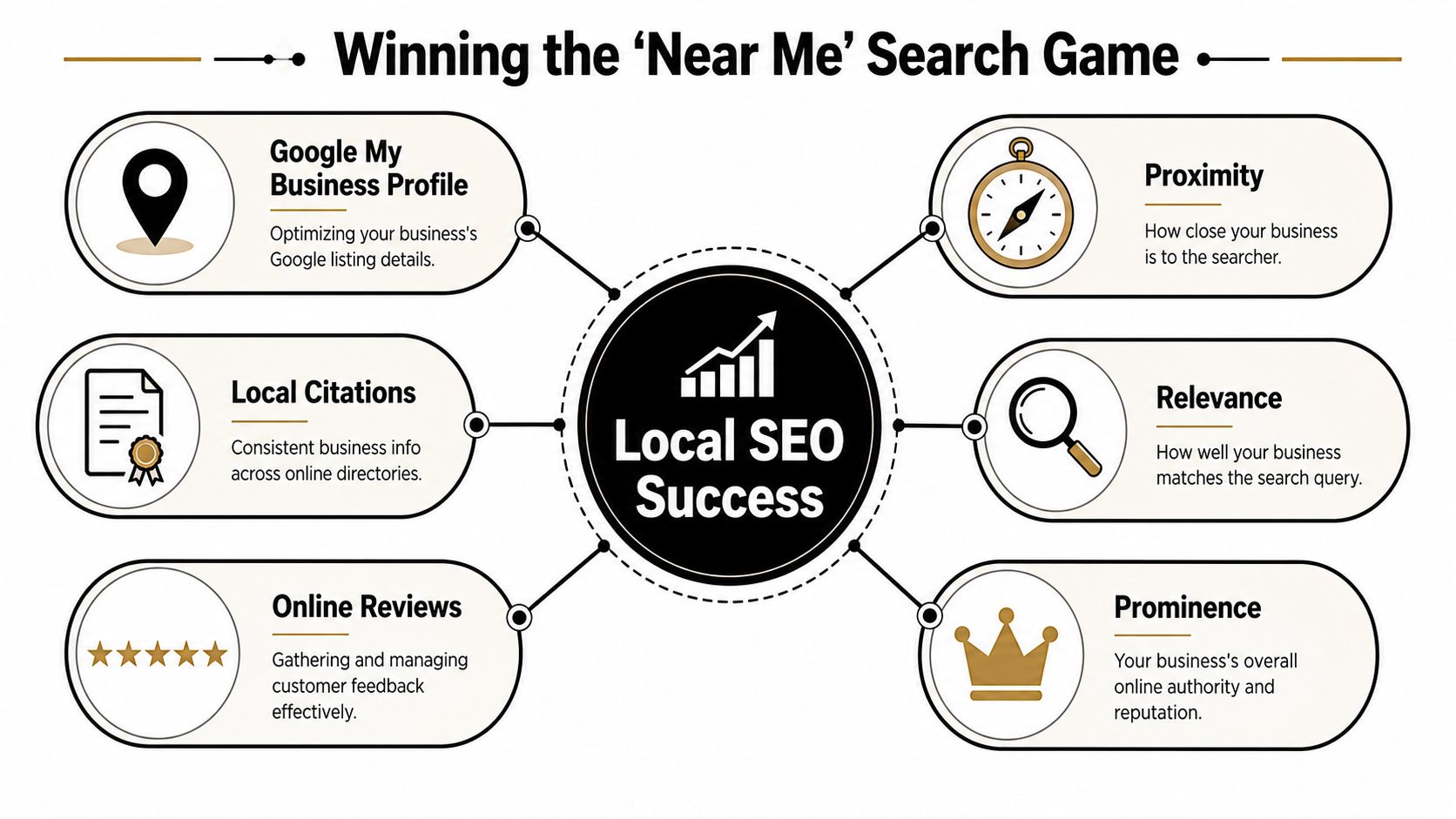
Local SEO works like the modern version of the Yellow Pages, except Google doesn't just list every company in a category. It filters. It tries to show the business that best matches the search, is reasonably close to the searcher, and looks trustworthy online.
That's why “near me” search results don't go to the company with the nicest truck wrap or the longest history in town. They go to the business that gives Google the clearest proof.
The three filters Google uses
Think in terms of three simple ranking forces.
| Factor | What it means | Fort Myers example |
|---|---|---|
| Relevance | How closely your business matches the search | A profile and service page clearly built around “water heater repair” will outperform a vague “plumbing services” page for that search |
| Distance | How close you are, or how clearly you serve that area | A service-area business with a well-structured Estero service page can compete even without a storefront there |
| Prominence | How established and trusted you appear online | Strong reviews, consistent citations, and local backlinks help validate your business |
What actually improves those signals
The basics still matter. Your Google Business Profile has to be accurate. Your website has to match it. Your categories, services, photos, service pages, and reviews all need to support the same story.
If you want a practical walkthrough for the profile side, this guide on optimizing a Google Business Profile covers the pieces owners tend to miss.
Prominence also gets a lift from industry-specific strategy. For example, moving companies often need stronger service descriptions, review framing, and local proof than a generic SEO checklist provides. This breakdown of premium tactics for moving companies is a good example of how niche positioning can shape local visibility.
Google doesn't rank businesses for trying. It ranks businesses for clarity.
That's why generic local SEO advice often falls short. A profile can be “claimed” and still underperform. A website can be live and still fail to rank. Winning near me searches comes from aligning the entire local presence, not checking one box.
The Core Components of Local SEO Services
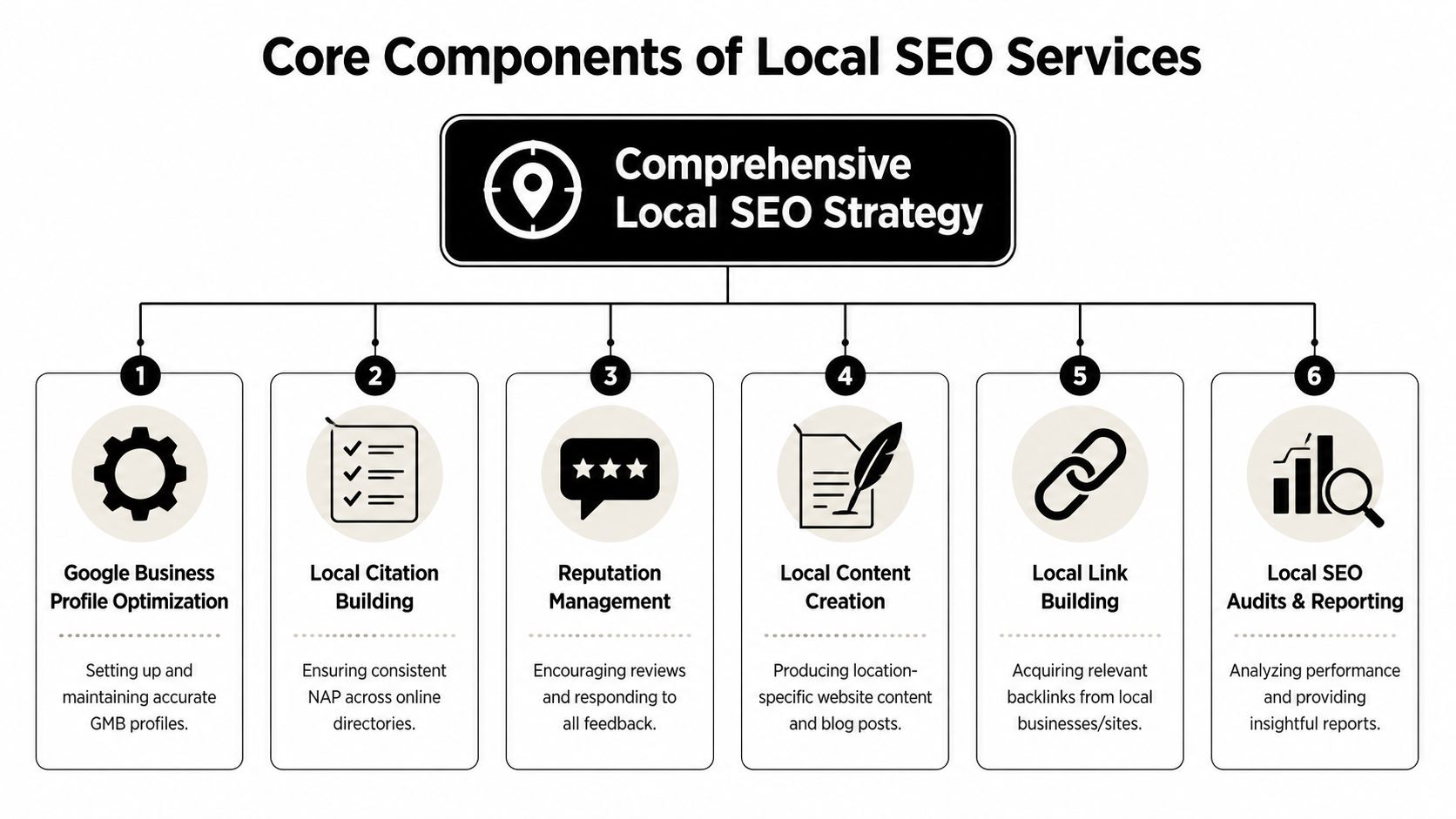
Owners usually ask this question like local SEO is one task they can buy and cross off the list. It is closer to a system. The profile, website, reviews, citations, links, and tracking all have to line up, or leads leak out somewhere in the process.
That is why Google Business Profile work and on-site optimization show up so often in agency service lists, as noted in SeoProfy's local SEO statistics roundup. In plain terms, the map listing gets you seen, and the website helps convert that visibility into calls.
Google Business Profile optimization
For many Fort Myers service businesses, this is the first place to fix because it affects whether you show up in Maps at all. A strong profile has the right primary and secondary categories, accurate service details, current hours, real photos, active review responses, and service areas that match the website.
Specificity matters. A plumbing company should not stop at "plumber" if it also does slab leak repair, water heater replacement, drain cleaning, and after-hours emergency calls. The more clearly the profile matches what the company sells, the easier it is for Google and the customer to understand it.
Profile work is not a one-time setup either. Hours change. Photos get old. New services get added. Questions sit unanswered for months. I have seen solid businesses in Lee County lose momentum because nobody maintained the profile after it was claimed.
Local content creation
Generic website copy rarely ranks and rarely converts. Service businesses need pages built around buying intent, not filler.
A structure that works usually includes:
- Core service pages: One page for each primary money-making service
- City or area pages: Pages for Fort Myers, Cape Coral, Estero, Bonita Springs, and other places you actively serve
- Support content: Useful articles that answer real pre-sale questions customers ask before they call
The trade-off is simple. More pages are not automatically better. Thin pages created just to target every nearby city usually waste time and can weaken the site. A strong location page needs original details, local proof, clear service information, and a reason for that page to exist.
This matters even more now that AI-driven search results are summarizing businesses before people ever click. If your site has vague copy, weak service explanations, or no local detail, you give AI systems very little to work with.
Citation building and NAP consistency
Citations are mentions of your business across directories, maps, and business databases. They still matter because they help confirm that your company is real, active, and consistently represented online.
Small inconsistencies cause bigger problems than owners expect. If your business is listed as "Gulf Coast Pressure Washing" in one place, "Gulf Coast Pressure Washing LLC" somewhere else, and an old tracking number appears on a third listing, trust signals get messy. That does not always tank rankings overnight, but it creates avoidable friction.
If you need a cleaner process for that work, local citation building services usually focus on auditing old listings, fixing mismatches, and building consistent directory coverage.
Review generation and review management
Reviews influence rankings, click-through rate, and conversion. More important, they shape whether a homeowner feels comfortable calling you instead of the next contractor on the screen.
The businesses that do this well usually follow a simple process:
- Ask right after a good job is finished
- Send a direct review link by text or email
- Encourage specific feedback about the service and area served
- Respond to every review in a professional way
A Fort Myers pest control company gets more value from "cleared up a roach problem fast in Gateway" than from "great service." Specific reviews build trust fast. They also give search engines and AI summaries more useful context about what the business does and where it does it.
The best reviews sound like a real customer talking about a real job.
Local link building
Local links still help, but quality matters more than volume. A contractor does not need a pile of random backlinks from unrelated sites. They need relevant mentions that support local authority.
Good opportunities often come from chambers, supplier relationships, trade associations, community sponsorships, neighborhood publications, and local business organizations. For example, if a landscaping company in Bonita Springs sponsors a youth league, gets listed by the chamber, and earns a mention from a local publication, those links carry more weight than generic placements on sites no customer would ever visit.
Local technical SEO and reporting
Technical work is where many campaigns stall quietly. The profile may be solid and the content may be decent, but the site still struggles because pages load slowly, call buttons are hard to use on mobile, internal links are weak, or service and city pages are poorly structured.
The basics are straightforward:
- Page structure: Clear titles, headings, and page focus
- Internal linking: Logical connections between service pages, area pages, and supporting content
- Mobile usability: Fast loading pages and obvious ways to call or request an estimate
- Tracking: Reliable reporting for calls, forms, booked jobs, and landing page performance
This is also where ROI gets clearer. Rankings are useful diagnostic signals. Revenue comes from qualified calls, estimate requests, and booked work. If reporting stops at keyword movement, you still do not know whether the campaign is helping the business grow.
How Service Businesses Dominate Local Search Without a Storefront
A lot of local SEO advice still assumes every business has a storefront. That doesn't help the companies that do real work in the field. Plumbers, cleaners, roofers, pavers, electricians, and mobile service providers often operate as service-area businesses. They go to the customer. The customer doesn't visit them.
That model can still win in local search.

An important point gets missed in most generic guides. 45% of local searches are distance-based, not address-based. That means a service-area business can rank in the local pack without a customer-facing storefront if it builds hyperlocal content architecture with unique landing pages for each neighborhood it serves.
What that means for Fort Myers contractors
If you run an HVAC company from a home office and serve Fort Myers, Cape Coral, Estero, and Bonita Springs, you don't need to fake a storefront. You do need a profile and website setup that reflects how the business operates.
That usually means:
- Hide the home address when appropriate: Follow the service-area business model instead of forcing a visible address that creates policy risk.
- Define service areas clearly: Keep them aligned with your real operating footprint.
- Build location-specific landing pages: One page per city or neighborhood, written as unique pages, not copied templates.
What a hyperlocal page should include
A page titled “Roof Repair in North Fort Myers” should do more than swap the city name in a template. It should include details that prove the page belongs to that area.
A useful structure looks like this:
| Page element | What to include |
|---|---|
| Headline | The exact service and area served |
| Service details | What the job includes and who it's for |
| Local proof | Testimonials, job references, or area-specific examples |
| FAQ | Questions local customers actually ask |
| Map context | Embedded map or geographic context tied to the service area |
| Call to action | One clear next step, such as request an estimate |
A cleaning company could create separate pages for “House Cleaning in Cape Coral” and “Move-Out Cleaning in Fort Myers,” each with different copy, different FAQs, and different customer proof. That's the difference between a real local asset and thin filler.
Service-area businesses don't need to look like storefronts. They need to look unmistakably relevant to each place they serve.
That's where many agencies miss the mark. They optimize one profile, build a few citations, and stop. For service businesses, the website has to carry much more of the local targeting load.
Measuring the Real ROI of Local SEO
Rankings don't pay payroll. Traffic by itself doesn't either. Local SEO earns its keep when it drives calls, estimate requests, appointment bookings, and jobs.
The strongest reason businesses keep investing in local SEO is buying intent. 18% of local mobile searches lead to a purchase within one day, and businesses that publish two or more local content pages per month see 326% more traffic than those that don't, according to this local SEO ROI analysis.
What to track instead of vanity metrics
A Fort Myers business owner should care about a short list of numbers:
- Phone calls from Google Business Profile
- Contact form submissions from service and location pages
- Quote requests by city and service
- Landing pages that produce leads, not just visits
- Review volume and response activity
If you need a framework for tying marketing activity back to revenue, this guide on how to measure marketing ROI is a practical starting point.
How the math works in the real world
Local SEO compounds because one improvement supports another. Better service pages create more relevant traffic. Better reviews improve trust. Better trust improves click-through and conversion. Better local links strengthen authority.
Here's how that typically looks operationally:
- A customer searches with immediate intent
- Your listing or page appears clearly for the service and area
- The customer sees recent reviews and consistent business info
- They call or submit a form instead of comparing five more companies
That's why review management matters so much. A business can earn visibility and still lose the lead if the trust layer is weak. Fast response times, recent feedback, and specific service mentions often make the difference between a click and a call.
Local SEO works best when every asset answers the customer's next question before they ask it.
For most service businesses, the useful benchmark isn't “Did we move up for a keyword?” It's “Did the local pages and listings produce more qualified inquiries this month than last month?” That's the standard worth using.
How to Choose the Right Local SEO Partner
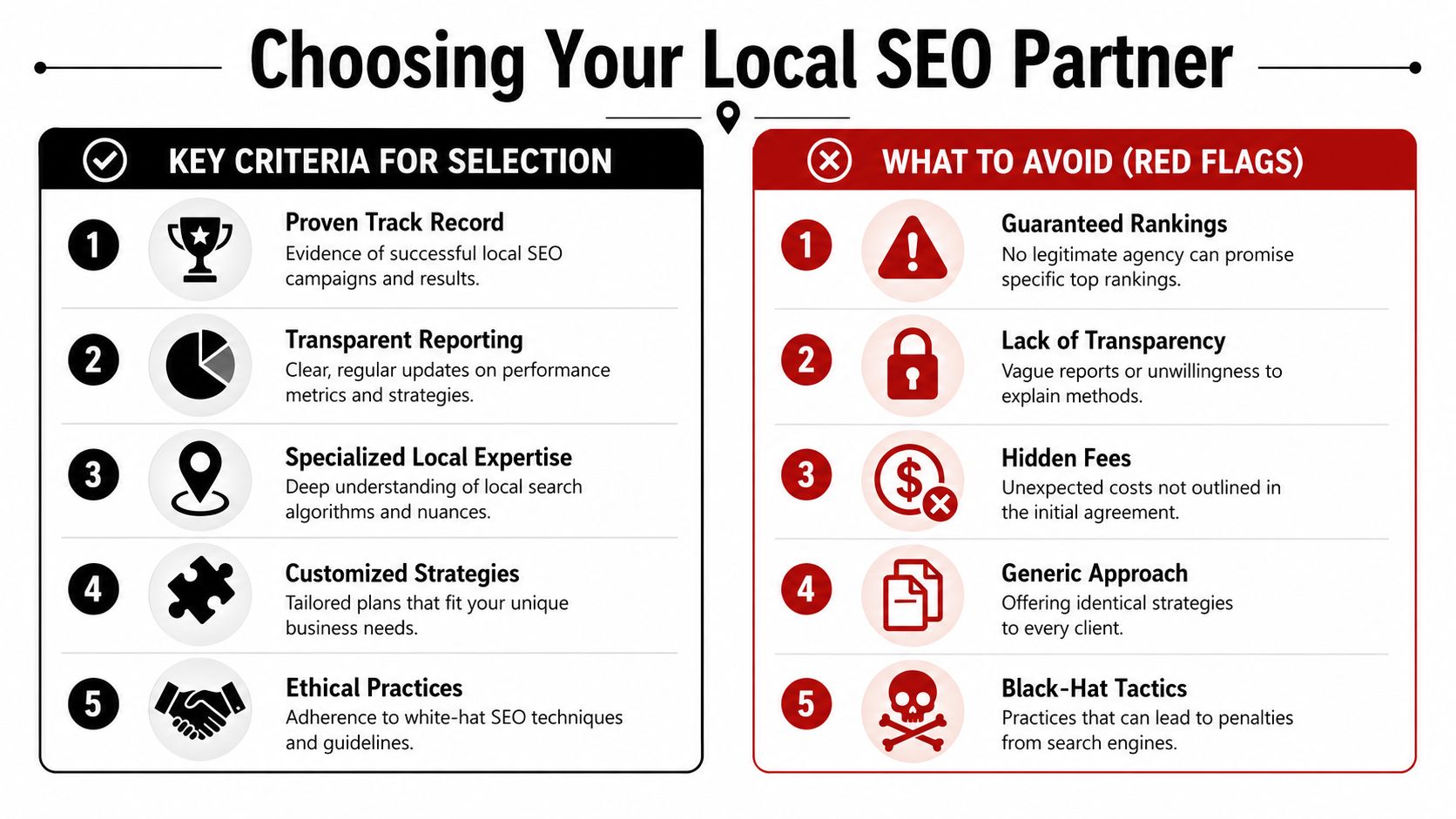
Most owners don't need an agency that talks in circles. They need one that can explain what it's doing, why it matters, and how success will be measured in business terms.
Pricing is part of that conversation. The average monthly cost for local SEO services for a small business is around $497, while dedicated local SEO experts charge an average of $1,557 per month, as reported in the earlier cited ROI source. The spread makes sense. A basic cleanup is different from an ongoing campaign with content, technical work, review systems, and reporting.
What to ask before you sign
Use direct questions. If a provider struggles to answer them plainly, keep looking.
| Question | Strong answer | Weak answer |
|---|---|---|
| What will you work on in month one? | Audit, profile fixes, service pages, citations, tracking setup | “We use our proven system” |
| How do you handle service-area businesses? | Clear explanation of SAB setup and hyperlocal page strategy | “You need an address in every city” |
| What will you report on? | Calls, forms, page performance, review progress, visibility trends | “Keyword screenshots” |
| Who writes the content? | A named process with local service understanding | “AI handles most of it” |
| How do you build links? | Relevant local outreach and citation work | “We submit to hundreds of sites” |
Red flags that usually lead to disappointment
Some warning signs are obvious once you've seen enough campaigns.
- Guaranteed rankings: No legitimate provider controls Google's results.
- One-size-fits-all packages: A law firm, roofer, and med spa shouldn't get the same local plan.
- No discussion of reviews: That usually means they don't understand conversion.
- No mention of content quality: Thin city pages still fail all the time.
- Vague ownership terms: You should know who owns the website content, listings work, and tracking setup.
One practical option in the Fort Myers market is Polaris Marketing Solutions, which provides local SEO services alongside website, PPC, and reporting support for small and mid-sized businesses. The key isn't the logo on the proposal. It's whether the provider can show a process that fits your service area, your budget, and your lead goals.
A good partner won't oversell speed. Local SEO can create early wins, but durable performance comes from consistent execution.
Your Next Step to Local Market Dominance
Local SEO isn't one task. It's an operating system for local lead generation. When the Google Business Profile, service pages, citations, reviews, and technical setup all point in the same direction, the phone tends to ring more consistently.
That matters even more now because search behavior is changing. In the last 12 months, Google's AI Overviews have begun filtering local search results, prioritizing businesses with rich, conversational schema and descriptive review sentiment, and businesses relying on traditional keyword-only strategies are seeing a 30% drop in AI-driven visibility. That's a real shift, not a trend to ignore.
What to do first
If you're a Fort Myers business owner, don't start by chasing every SEO tactic at once. Start by finding the gaps that are costing you visibility right now.
A practical first move is to review:
- Your Google Business Profile completeness
- Your service pages by city
- Your review quality and response habits
- Your citation consistency
- Your conversion tracking
That gives you a clearer picture of what local SEO services should include for your business. A storefront, a mobile service business, and a multi-location company won't need the same plan.
The companies that win locally over the next stretch won't be the ones with the flashiest pitch. They'll be the ones that make it easy for Google, customers, and AI-driven search experiences to understand exactly who they help, where they work, and why they're trusted.
If you want a practical starting point, Polaris Marketing Solutions offers a complimentary online analysis and competitor report for Fort Myers area businesses. It's a straightforward way to see where your local visibility is weak, which competitors are taking the calls you want, and what improvements are most likely to produce qualified leads.