
A Fort Lauderdale owner usually notices local SEO after the phone gets quieter. You search your main service, see the same businesses in the map results, and realize prospects in Coral Ridge, Rio Vista, or Flagler Village are calling whoever shows up first.
That is the job of local SEO. It puts your business in front of nearby customers at the moment they need a lawyer, plumber, med spa, roofer, accountant, or restaurant.
Fort Lauderdale is crowded, and local search rewards clarity more than seniority. A business with a weaker brand can still outrank you if Google has a cleaner read on what they do, where they serve, and why local customers trust them.
The mistake I see is treating local SEO like a generic checklist. That wastes time because different business models win in different ways. A storefront on Las Olas needs to strengthen location signals that drive visits, directions, and appointments. A service-area company has to match services to the right cities and neighborhoods, then prove coverage without confusing Google about where the business is based.
Sequence matters if you want ROI. Start with the assets that influence map visibility and lead volume first. Then make the website support those signals. After that, build reviews, citations, and local trust around what is already working.
That approach gets results faster because it matches the work to how the business earns customers in Fort Lauderdale.
Winning the Battle for Fort Lauderdale Customers
A Fort Lauderdale owner usually feels this shift before they can explain it. Calls slow down. Form fills get thinner. Then a search for the service that used to bring steady leads shows another company in the map results, often one with a simpler site and a less established brand.
That happens because local search rewards relevance and clarity before polish.
The businesses that win here usually do one thing better. They make it easy for Google to match a specific service, in a specific part of Fort Lauderdale, to a business that looks trustworthy enough to recommend. If that sounds mechanical, it is. Local SEO is less about broad visibility and more about demand capture at the exact moment someone needs help.
The part owners miss is prioritization. A Las Olas restaurant, a Coral Ridge dental office, and a mobile AC repair company serving Fort Lauderdale, Wilton Manors, and Oakland Park should not follow the same task list in the same order. The right sequence depends on how the business gets customers.
Practical rule: In a crowded city, local SEO works best when you make it obvious which service you offer, where you offer it, and why a nearby customer should trust you now.
Use that rule to set priorities:
- Storefront businesses should fix the assets that influence visits, calls, and directions first. That usually means Google Business Profile setup, categories, photos, hours, and location consistency.
- Service-area businesses should start with service alignment. Get the primary categories right, define service areas carefully, and build landing pages that match how people actually search across nearby neighborhoods and cities.
- Multi-service businesses should separate high-value services instead of hiding them on one general page. A Fort Lauderdale personal injury firm and a family law firm may share an office, but they should not rely on the same local search page to rank for both.
I usually tell owners to judge every local SEO task by one question: will this improve visibility for a money service in the next 60 to 90 days? If the answer is no, it drops down the list.
That is why smart local SEO work starts with the business model, not with a generic checklist. If you need a framework for the first priority set, this Google Business Profile optimization checklist for local businesses is a useful place to begin.
Your Google Business Profile The Digital Storefront
For many Fort Lauderdale businesses, your Google Business Profile matters more than your homepage in the first interaction. That's where a searcher sees your reviews, business hours, service category, photos, call button, directions, and service highlights before they ever visit your site.
That's why the smartest local SEO Fort Lauderdale strategy starts here. A high-value angle often missed in generic SEO advice is that businesses should prioritize Google Business Profile and map-pack visibility over generic SEO tactics, because local search results are increasingly shaped by the local pack rather than just organic rankings (local pack priority in Fort Lauderdale SEO).
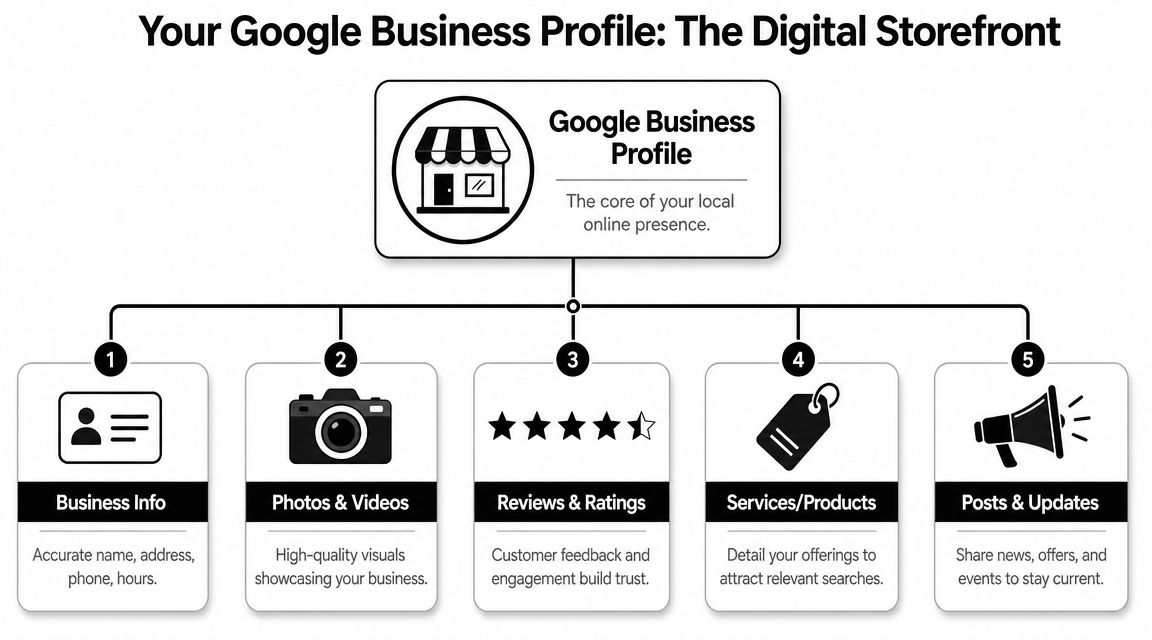
Claim the profile and finish every field
A half-complete profile is common. It's also a gift to your competitors.
If you run a plumbing company in Victoria Park, don't stop at business name, phone number, and hours. Fill out services, service areas, categories, description, products if relevant, booking link, and attributes. If you're a downtown law firm, list the exact practice areas you want to win locally, not a vague summary about legal support.
Use this sequence:
- Verify ownership first. If someone in your office, a former agency, or an old employee controls the profile, fix that before anything else.
- Choose the right primary category. This is one of the most important decisions in the profile. Be specific.
- Add secondary categories carefully. Cover legitimate adjacent services, but don't pile in irrelevant options.
- Complete service descriptions. Write them in customer language, not internal jargon.
- Set real hours and holiday updates. Wrong hours create bad user signals and bad reviews.
If you want a field-by-field reference while optimizing, a practical resource is this Google My Business optimization checklist.
Categories and services decide relevance
A marine supply store near the 17th Street Causeway shouldn't choose a broad category if there's a more accurate one available. A personal injury firm downtown shouldn't rely on a generic legal category if a more precise one better matches how people search.
That's where many businesses lose map-pack opportunities. They optimize for what they call themselves, not what the customer types into Google.
For example:
| Business type | Weak setup | Better setup |
|---|---|---|
| Plumbing company | General description only | Primary category aligned to plumbing intent, service list for drain cleaning, leak repair, water heater work |
| Law firm | “Legal services” language | Practice-area language tied to actual case types and local intent |
| Med spa | Broad beauty positioning | Specific services listed individually, each matching search demand |
| Roofer | One generic roofing mention | Distinct services such as repair, replacement, inspection, emergency work |
Photos, posts, and Q&A separate active businesses from stale ones
A strong Google Business Profile doesn't look abandoned.
Add real photos of the exterior, interior, team, work in progress, completed jobs, branded vehicles, and recognizable local context. For a Fort Lauderdale restaurant, that might mean patio photos, dishes, bar area, and nearby visual context that helps a searcher decide fast. For a service business, before-and-after photos usually outperform stock images because they show competence.
Use posts to keep the listing active. Don't overthink them. A roofer can post seasonal inspection reminders. A med spa can post about a featured treatment. A law office can post a short FAQ about what to do after an accident. The point is freshness and clarity.
Later in the buying process, this walkthrough can help if you want to see how profile elements affect visibility in practice:
A neglected Google Business Profile tells both customers and Google the same thing: this business may not be the safest choice.
Priority changes by business model
If you have a storefront, emphasize:
- Directions and access details so people know where to go
- Exterior and interior photos so the location feels real
- Hours accuracy because foot-traffic intent is immediate
- Amenities or attributes that remove friction
If you're a service-area business, emphasize:
- Exact service descriptions tied to buying intent
- Proper category selection
- Service area settings that reflect where you work
- Photos of your crew and jobs, not just a logo
What doesn't work is treating GBP like a set-it-and-forget-it directory listing. In Fort Lauderdale, inactive profiles lose attention fast because another business nearby is usually doing a better job of signaling relevance and trust.
Building Your Website's Local Authority
A Fort Lauderdale business can have a solid Google Business Profile and still lose the lead once a customer clicks through to the site.
That happens all the time. A searcher finds a med spa, plumber, or attorney in the map pack, lands on the website, and gets a vague homepage, a thin services page, or no clear proof that the business serves their area. Google notices that mismatch, and so do prospects.
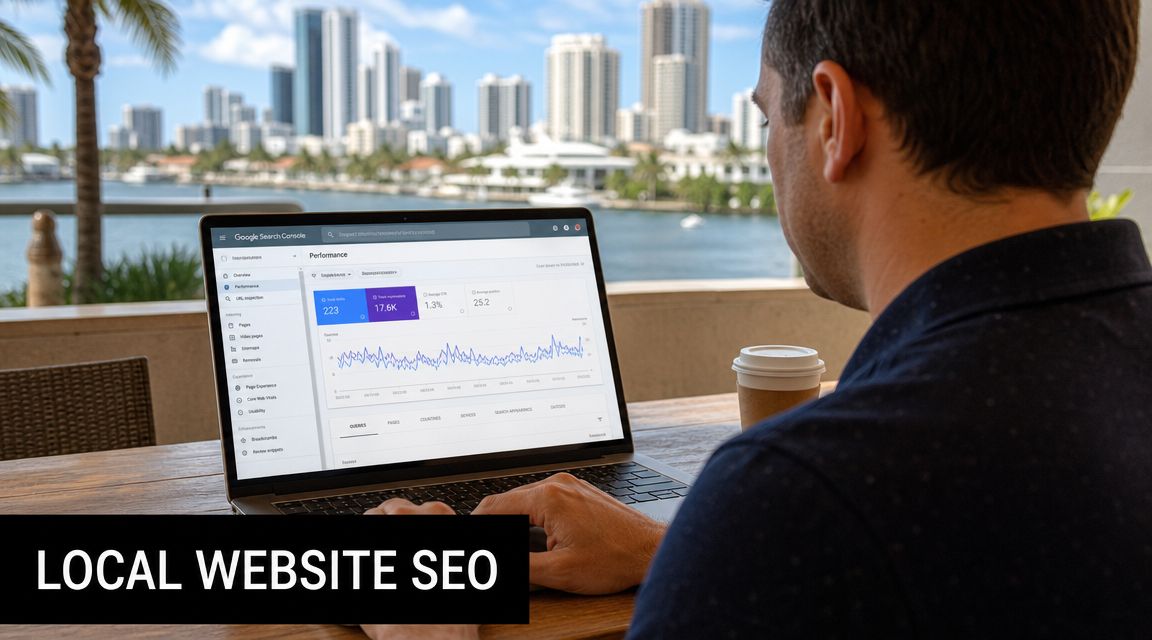
Build pages in the order that pays back fastest
Local SEO priorities should change by business model.
For a storefront business, the fastest return usually comes from tightening the pages tied to your physical location. That means a strong homepage, a clear location or contact page, and service pages that support searches with local intent. A Fort Lauderdale dentist near Las Olas does not need ten thin city pages first. They need one credible local presence that supports branded searches, service searches, and direction-based visits.
For a service-area business, the priority is different. Start with your highest-margin services and the areas where you can realistically win. A roofing company might build pages for roof repair, roof replacement, and emergency tarping before touching lower-value services. A law firm might lead with personal injury or family law pages instead of trying to rank every practice area at once.
The sequence matters because broad coverage usually creates weak pages. Focused coverage gives Google and customers a clearer reason to trust what they see.
Generic pages rarely rank or convert well
A single “Services” page is usually too weak to do much in local SEO Fort Lauderdale.
If you run a contractor business, “Roofing Services” tells Google almost nothing about which jobs you want. If you run a law office, “Practice Areas” works as navigation, but it is rarely the page that should carry search intent. Local authority grows when each important service has its own page, and each page is built around one real buying need.
A stronger structure usually includes:
- Core service pages for the jobs that drive revenue
- Location-relevant supporting pages only where they add real value
- FAQ content that answers objections and buying questions
- Internal links between related services, service areas, and contact points
For example, an HVAC company in Fort Lauderdale might start with pages for AC repair, AC installation, and emergency service. After those are solid, it can add supporting content around condo cooling issues, older homes east of I-95, or weekend breakdowns during peak summer demand. That sequence usually produces better ROI than publishing fifteen shallow location pages at once.
Match each page to one service, one intent, and one area
Broad optimization leaves money on the table.
A generic “personal injury lawyer” page may struggle against firms with a page focused on Fort Lauderdale car accidents, another for slip and fall claims, and another that explains what happens after a crash near Broward Boulevard or Federal Highway. The same pattern shows up in home services. “Plumbing services” is too broad if the primary lead value comes from emergency drain cleaning, water heater replacement, or leak detection.
The page should line up with how people search and how they buy. Someone looking for an emergency electrician is not browsing for a company history lesson. Someone comparing cosmetic dentists wants treatment details, trust signals, and a clear next step.
Build around one service, one search intent, and one local use case per page.
Technical local signals still matter
Good local pages need clean technical basics behind them. This part is not glamorous, but it affects both rankings and conversion rates.
Focus on the items that have the clearest payoff:
- Keep NAP details consistent with your Google Business Profile and the rest of your web presence
- Make phone, address, and service area information easy to find
- Use local business schema so search engines can connect your business details to the page
- Fix mobile friction because local prospects are often searching from a phone and ready to call
- Write useful title tags and headings that reflect the service and location naturally
I see businesses waste time on minor SEO tweaks while their contact page has an old phone number or their mobile form barely works. Those are not small issues. They cost leads.
Fort Lauderdale relevance has to feel earned
Local pages should sound like they come from a business that knows Fort Lauderdale.
That does not mean repeating the city name every other sentence. It means using details that reflect the jobs you do and the customers you serve. A roofer can reference storm prep, flat roofs, tile repair, and the wear that salt air causes over time. A cleaning company can explain the difference between condo turnovers near the beach and recurring service for single-family homes farther inland. A family law office can address whether consultations happen in person, by phone, or by video for busy professionals working downtown.
Thin city pages with swapped place names rarely hold up. Useful local pages do.
You can strengthen that authority further with relevant local mentions and links from credible sites. If that piece is missing, this local link building service shows the kind of outreach and citation support businesses use to reinforce local relevance.
Earning Trust with Citations and Reviews
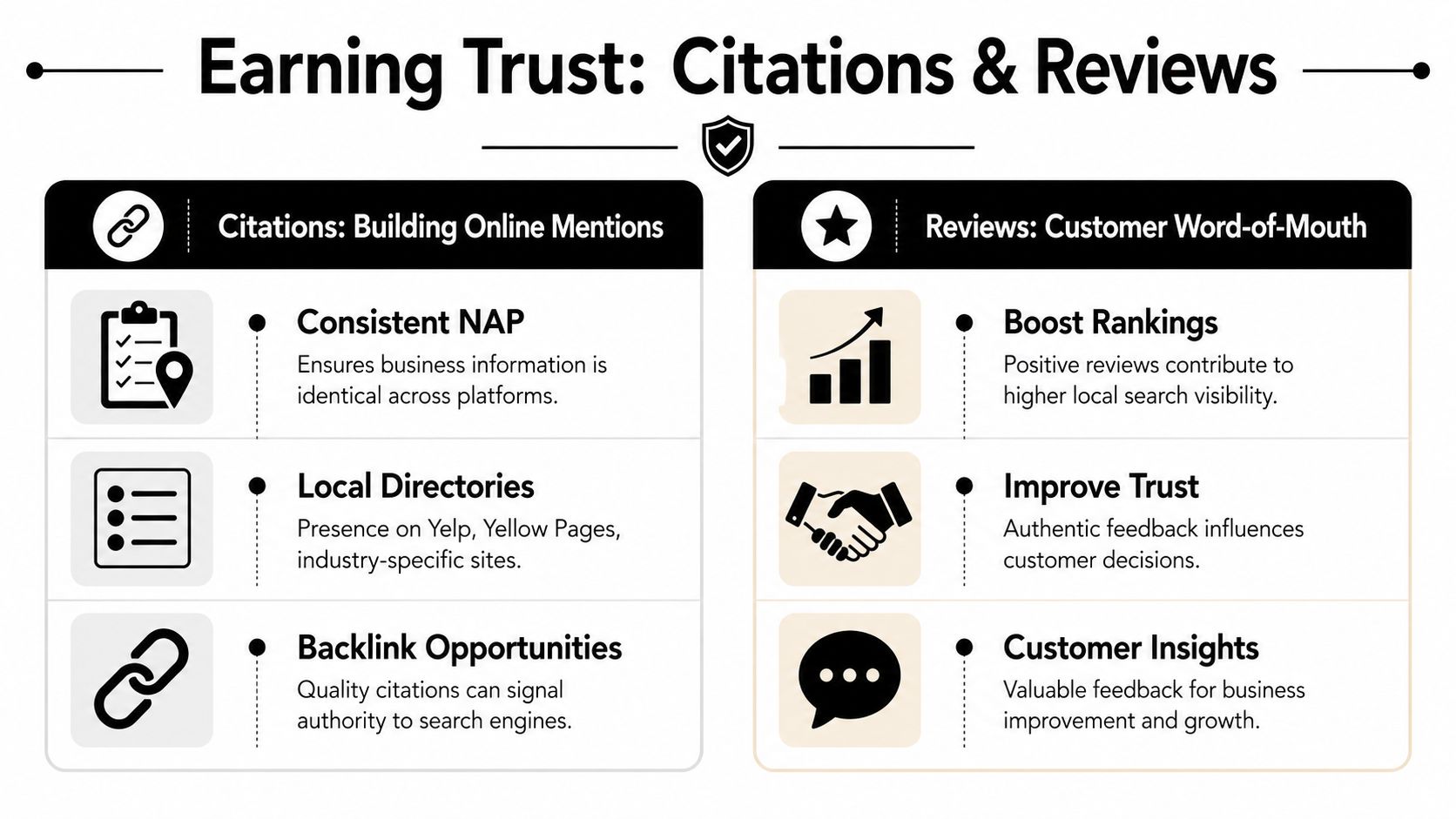
Citations and reviews do the same job from two angles. They help search engines confirm your business is real, and they help customers decide whether you're trustworthy.
That's why I think of them as digital word-of-mouth. One is structured validation. The other is public reputation.
The mistake most businesses make is chasing volume before accuracy. More listings won't help if your business information is inconsistent. More reviews won't help as much if nobody asks with any regularity.
Fix your citations before building more
Start with a citation audit.
Look up your business name, address, and phone number exactly as they appear on your website and Google Business Profile. Then check whether those details match on major platforms and local listings. Watch for old suite numbers, tracking phone numbers, abbreviations, duplicate listings, and outdated business names.
For a Fort Lauderdale business, I'd check these first:
- Core platforms such as Google, Apple Maps, Bing Places, Facebook, Yelp
- Major directories that often rank for brand searches
- Industry-specific directories relevant to legal, healthcare, home services, hospitality, or real estate
- Local organizations such as chambers, associations, and neighborhood business groups
You don't need a massive directory blast. You need consistency on the listings that matter.
If you want a starting point for directories and listings, this local listing sites resource is useful for organizing where to submit and what to verify.
Review strategy should be simple enough to repeat
Most owners wait too long to ask for reviews because they make it awkward in their heads. It doesn't have to be.
Ask after the customer has clearly experienced the result. For a cleaner, that's after the house looks great. For a lawyer, that may be later in the client journey when the relationship supports it. For a roofer, it's after the walkthrough. For a med spa, it's when the client is happy and relaxed, not when they're rushing out the door.
Use one method and make it habitual. Text usually works well because it's immediate. Email works if your follow-up process is strong.
Here are two templates you can use.
Text message
Hi [First Name], thanks again for choosing [Business Name]. If you have a minute, would you mind sharing your experience in a Google review? It helps other Fort Lauderdale customers know what to expect. [Review Link]
Subject: Quick favor
Thanks for working with us. If we helped you, would you leave a quick Google review? A short note about the service you received helps future customers and helps our local visibility. Here's the direct link: [Review Link]
Notice what's missing. No begging. No gimmicks. No weird incentives. Just a direct request at the right moment.
Better reviews mention specifics
A review that says “great service” is fine. A review that mentions the actual service, timing, professionalism, or problem solved is better for persuasion and usually better for local relevance too.
Coach gently without scripting. For example:
- Home services can ask customers to mention the type of job completed
- Legal firms can ask for feedback on communication and professionalism
- Restaurants can ask about dishes, atmosphere, or service
- Healthcare practices can ask about scheduling, bedside manner, or office experience
Respond to reviews as if prospects are reading, because they are.
For positive reviews, thank the customer and reference the work. For negative reviews, stay calm, acknowledge the concern, and offer to resolve it offline. Public arguments repel prospects fast. A measured response often does more for trust than the original review itself.
Citations build confidence, reviews close the gap
If citations help Google verify you, reviews help a buyer choose you over the listing beside yours.
That matters in Fort Lauderdale because many categories are crowded with lookalike businesses. Same service. Same city. Similar promises. Reviews are often where the decision gets made.
Connecting with the Fort Lauderdale Community Online
Most business owners hear “link building” and immediately picture spammy outreach emails, sketchy directory packages, or blog comments that do nothing. That's not the kind of local authority that helps.
The best local links usually come from actual participation in the community.
A Fort Lauderdale roofer can earn local mentions after a storm by publishing practical cleanup or inspection guidance and sharing it with local reporters, neighborhood groups, and property managers. A restaurant can partner with a nearby event, chef collaboration, or community fundraiser and get listed on the event page. A med spa can collaborate with a non-competing wellness business for a joint promotion and pick up a local mention from both businesses' websites and social channels.
What good local links look like
Think about relationships first, links second.
A business in Las Olas might partner with a nearby boutique, salon, or fitness studio for a co-hosted event. Each business gets content, photos, social proof, and potentially a website mention. That's much more useful than paying for random links from sites with no South Florida relevance.
A contractor can sponsor a local charity run, school event, or community drive and receive a business listing on the organizer's website. A law firm can contribute a practical safety article to a neighborhood publication. A real estate-adjacent business can collaborate with condo associations or local relocation guides.
The easiest local links to earn are the ones attached to something your business is already doing offline.
Three practical plays for Fort Lauderdale businesses
Here's how this can look without turning into a full-time PR campaign.
Local event sponsorship
If your business already supports youth sports, school programs, or community fundraisers, ask for a linked business mention on the event website. Don't overcomplicate it. A simple sponsor profile can help confirm local presence.
Helpful local expertise
A roofer, HVAC company, or restoration firm can prepare short, useful commentary when weather creates local demand. Reporters and bloggers often need a quote or practical checklist. If your advice is clear and timely, you can earn a mention naturally.
Non-competing partnerships
A wedding venue can partner with florists, photographers, and caterers. A med spa can partner with a fitness studio or skincare brand. A family lawyer can connect with financial planners or therapists for educational content. These relationships often produce referral traffic and stronger local trust, not just links.
What doesn't work well
A lot of local businesses waste money on tactics that sound scalable but produce weak signals:
- Mass outreach campaigns sent to irrelevant websites
- Cheap backlink packages with no geographic relevance
- Thin guest posts on sites nobody local reads
- Directory spam submitted without checking quality or accuracy
Good local SEO Fort Lauderdale is more grounded than that. Google wants evidence that your business belongs in the area and serves people there. Community visibility helps prove that.
If your business is already known offline, your job online is to make that reputation easier for search engines to see.
Tracking What Matters for Local Growth
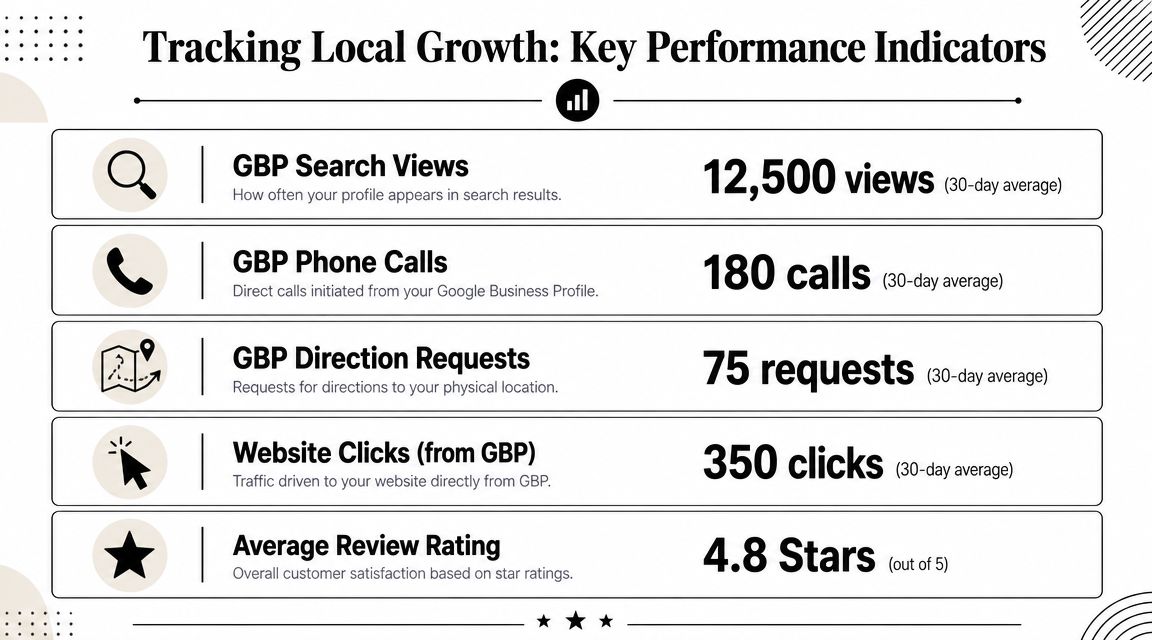
A Fort Lauderdale business can show up more often in search and still feel no real lift in revenue. I have seen this with Las Olas restaurants that got more profile views but no increase in reservations, and with home service companies that added traffic from outside their service area that never turned into booked jobs. Better visibility only matters if it produces the right actions from the right local audience.
That is why tracking needs to match your business model first, then your SEO work second.
Measure the outcome your model depends on
Storefront businesses and service-area businesses should not look at the same scorecard.
A coffee shop near downtown Fort Lauderdale should care about direction requests, click-to-call actions, peak-hour visibility, and whether branded searches are turning into visits. A mobile detailer, roofer, or plumbing company should care more about qualified calls, quote requests, and which service pages bring in leads from the neighborhoods they want to serve.
That sequencing matters. If you run a storefront, start by measuring whether your Google Business Profile is creating foot traffic signals. If you run a service-area business, start by measuring whether local intent on the site turns into calls and forms. Owners get faster ROI when they track the conversion point closest to the sale.
Use GBP insights like an operator
Google Business Profile reporting is useful if you read it with context.
Watch these actions closely:
- Phone calls from the profile
- Website clicks from the listing
- Direction requests for storefront locations
- Search term patterns that show how people are finding you
- Photo views and review activity that reflect listing quality and buyer trust
The trade-off is simple. GBP data is good for spotting demand and behavior trends, but it is not detailed enough to explain every lead quality issue. If calls rise but booked jobs do not, the problem may sit with the offer, the intake process, or the landing page experience after the click.
Review local pages by lead quality, not just traffic
A Fort Lauderdale page that gets visits from the right searchers is useful. A page that gets a few visits and produces actual inquiries is usually more valuable.
Check which pages attract local intent and what happens next. If your Fort Lauderdale AC repair page brings in traffic during a heat wave but nobody calls, the page may be too generic, too weak on trust, or aimed at research intent instead of urgent service intent. If your Victoria Park or Coral Ridge page gets fewer visits but brings in form fills, that page deserves more attention first.
A simple review process works well:
| What to review | Why it matters |
|---|---|
| Service pages | Shows which services attract local buyers, not just browsers |
| Location or neighborhood pages | Reveals where geographic relevance is strong and where it is thin |
| Contact page activity | Confirms whether visitors are moving toward a call or form submission |
| Call and form patterns | Shows which pages and search intents actually produce leads |
Tie the metric to the fix
Good reporting should make the next decision obvious.
If service pages get impressions but weak engagement, the relevance is probably off. The page may target a term too broadly or fail to match what Fort Lauderdale searchers want. If a storefront gets profile visibility but weak direction requests, proximity or map-pack presentation may be the issue. If rankings improve but lead volume stays flat, prominence may not be the problem at all. Conversion friction may be.
That is the part many SEO reports miss. Ranking movement is useful, but owners need to know what action follows from it.
Owner's filter: If a metric does not help you decide what to fix next, it does not deserve much attention.
Watch patterns over time. Are calls from the profile increasing in the ZIP codes you care about? Are a few local pages consistently producing leads? Are reviews and listing activity improving buyer confidence enough to raise conversion rate? That is how local SEO Fort Lauderdale becomes a reliable customer acquisition channel instead of a monthly report with pretty graphs.
Your Fort Lauderdale SEO Next Steps
Local SEO works best when you stop treating it like a one-time cleanup project. In Fort Lauderdale, it's an ongoing visibility system. You tighten your Google Business Profile. You make the website support that relevance. You strengthen trust with citations, reviews, and local mentions. Then you measure what produces calls and leads and double down there.
You also need realistic expectations. Fort Lauderdale SEO providers commonly describe local SEO as a 3- to 6-month process for visible results, and pricing data from a 2026 agency directory shows local SEO firms in the area averaging $100–$149 per hour and often starting projects at $5,000 (Fort Lauderdale SEO pricing and timeline data from DesignRush). That doesn't mean every business needs a large engagement. It means this is a competitive market where sustained work usually beats quick fixes.
The right starting point depends on your business model
If you run a storefront, your first priority is map-pack presentation. Fix the profile, categories, photos, hours, and review flow. Then improve location signals on the site.
If you run a service-area business, start with category accuracy, service definitions, local service pages, and review generation tied to completed work. Then expand into citations and community-based authority building.
If you're a multi-location or multi-service business, don't try to rank one page and one profile for everything. Separate the signals. Give each location or service line enough clarity to stand on its own.
A practical first 90 days plan
This is the sequence I'd use if I wanted the fastest sensible ROI.
First month
- Claim and clean up your Google Business Profile. Verify ownership, correct every field, select the best categories, and add strong photos.
- Standardize business information across your website and major listings.
- Audit your reviews and begin responding consistently.
- Identify your highest-value local searches by service and by area.
Second month
- Build or improve core service pages so each important service has its own page.
- Create at least one strong local page tied to a real service area or neighborhood you want to grow.
- Add local business schema and tighten mobile usability.
- Launch a repeatable review request process by text or email.
Third month
- Fix citation inconsistencies and claim the local listings that matter.
- Start community-based link building through partnerships, sponsorships, or local content contributions.
- Review GBP and website performance to see which actions are producing calls, clicks, and leads.
- Refine underperforming pages instead of endlessly creating new ones without a plan.
What to avoid while you're doing this
A lot of wasted SEO spend comes from bad sequencing.
Don't start with blog volume if your profile is incomplete.
Don't buy backlinks if your website still has weak service pages.
Don't create ten thin location pages when one well-built service page would do more.
Don't judge success only by traffic if your real goal is booked jobs, consultations, or appointments.
If you need outside help, one option is Polaris Marketing Solutions, which offers SEO services relevant to local businesses and focuses on practical local fundamentals like Google Business Profile optimization, location-specific content, review management, and citation building.
Local SEO Fort Lauderdale doesn't reward busywork. It rewards clarity, consistency, and the discipline to prioritize what affects local buying intent first.
If you want a second set of eyes on your local visibility, Polaris Marketing Solutions can help you review your current search presence, spot gaps in your Google Business Profile, website, and citations, and build a practical plan around the services and areas that matter most to your business.