
If you run a local business in Southwest Florida, this decision usually shows up at the worst time. Leads feel uneven. A competitor pops up on local TV during the evening news. Another one keeps following people around on Facebook and YouTube. Your phone should be ringing more than it is, and every dollar has to justify itself.
A Fort Myers roofer feels this acutely after storm season. A Naples HVAC company feels it when service demand spikes for a week and then cools off. A Bonita Springs law firm feels it when they need visibility now, but also know that trust is built before someone ever fills out a form. The question sounds simple: should the budget go to TV or the internet?
For most small and mid-sized businesses, that's the wrong way to frame it. What matters is which channel can produce real business outcomes for the job in front of you. Sometimes that means broad visibility. More often, it means qualified calls, estimate requests, booked consultations, and a pipeline you can track.
The Local Business Owner's Dilemma
A home services owner in Fort Myers might have this exact conversation on a Monday morning. One rep from a local station says TV builds trust fast because people see your name on a real screen in their living room. Another marketer says skip all of that and put everything into Google Ads, Meta, and retargeting.
Both are partly right. Both can also waste money if used badly.

A Cape Coral plumber doesn't need the same media plan as a new restaurant in Estero. The plumber needs demand capture. When someone searches “burst pipe repair near me,” the best ad isn't the prettiest one. It's the one that shows up immediately, answers the need, and gets the call. A restaurant opening, on the other hand, may benefit from broader local awareness because many potential customers weren't actively searching for it yesterday.
What makes this decision hard
Local businesses usually deal with three pressures at once:
- Tight budgets: There's rarely room to “test everything” for long.
- Short decision windows: You need to know what's working before the quarter is gone.
- Mixed goals: You want leads today, but you also want people to know your name next month.
Practical rule: If a channel can't be tied to a business goal, it doesn't deserve budget.
What usually goes wrong
The most common mistake isn't choosing TV or digital. It's using either one without a clear role.
A contractor buys TV because it feels credible, but never sets up a way to measure what happened after the ad aired. A med spa runs social ads with polished creative, but targets too broadly and reaches people who like beauty content without any intent to book. An attorney throws budget into search, then sends traffic to a weak landing page that makes every click more expensive than it should be.
The businesses that win in tv advertising vs internet advertising usually do one thing better than everyone else. They match the channel to the buying situation.
Understanding Your Two Main Options in 2026
When business owners compare TV and internet advertising, they often compare outdated versions of both. TV is no longer just a traditional commercial on cable. Internet advertising is no longer just banner ads and boosted posts.
In market terms, the scale difference is already clear. In the U.S., TV advertising remained a substantial market at about $60.6 billion in 2024, while the internet advertising market reached $259 billion in 2024 according to Statista's television advertising market overview. That doesn't mean TV stopped mattering. It means advertisers shifted more of their money to channels with more targeting, more flexibility, and more direct response options.
What TV advertising includes now
TV advertising in 2026 usually falls into a few buckets:
- Linear TV: Traditional broadcast or cable placements tied to scheduled programming.
- Local cable buys: Ads shown in a defined service area.
- On-demand TV inventory: Video placements within television content.
- Streaming on the big screen: This increasingly overlaps with connected TV, which deserves its own section later.
A simple way to think about TV is this: you're paying for attention in a lean-back environment. People are watching content, often with sound on, on a large screen. That can help with memorability and perceived legitimacy, especially for businesses that need trust.
Sports also show how blurred viewing behavior has become. If you look at practical viewing guides like Knicks vs Cavaliers streaming information, you can see how audiences now move between traditional channels and streaming access without caring much about the old platform boundaries.
What internet advertising includes now
Internet advertising is the broader performance ecosystem. For local businesses, the most relevant pieces are usually:
- Google Search Ads for high-intent demand
- Google Display for visibility and retargeting
- YouTube ads for video reach
- Meta ads on Facebook and Instagram
- Local service and map-driven visibility
- Retargeting across web and social platforms
If you want a practical overview of the options available to smaller companies, this guide to online advertising for small business gives a useful breakdown of where each format fits.
TV still sells presence. Internet advertising sells control.
The core difference
TV usually starts with audience context. You choose programming, geography, and time slots, then place your message in front of likely viewers.
Internet advertising usually starts with user signals. You target searches, behaviors, interests, prior site visits, or specific geographic areas.
That's why tv advertising vs internet advertising isn't really a debate about which one is “better.” It's a debate about whether you need broad local visibility, precise intent capture, or both.
A Side-by-Side Comparison for Local Businesses
Here's the comparison most local business owners need. Not theory. Just how the channels behave when real money is on the line.
| Criterion | TV Advertising | Internet Advertising |
|---|---|---|
| Reach | Broad local exposure across a market | Flexible reach, from hyperlocal to broad |
| Targeting | Best for geography, programming, and general demographics | Best for search intent, interests, behaviors, and retargeting |
| Speed to Launch | Slower planning and placement process | Faster setup and faster adjustments |
| Creative Needs | Strong video creative matters a lot | Can use search copy, static images, short video, and landing pages |
| Lead Intent | Better for awareness and trust-building | Better for capturing active buyers |
| Measurement | Harder to attribute precisely | Easier to track clicks, forms, calls, and on-site actions |
| Optimization | Mid-flight changes are more limited | Budgets, audiences, and ads can be adjusted quickly |
| Best Local Use | Brand presence across a service area | Immediate lead generation and follow-up nurturing |
Reach and local visibility
TV still works when the goal is broad awareness in a defined market. If you want a large portion of a local audience to see your name in a familiar setting, TV can do that faster than many digital channels.
A Fort Myers roofing company launching a storm-response campaign may value that broad local presence. Even people who don't need a roof today may remember the name after seeing it repeatedly in local programming.
Internet advertising can also build reach, but it usually does so with more segmentation. You can choose only homeowners, only certain ZIP codes, or only users who visited your site before and didn't convert.
If you need everyone in the market to know you exist, TV has an edge. If you need only the right people to see your ad, digital usually wins.
Targeting precision
The channels quickly diverge.
TV targeting is generally broader. You can often choose geography, program type, and broad demographic groupings. That's useful, but it still leaves waste for many local businesses.
Internet advertising lets an HVAC company target users searching “AC repair Naples,” retarget visitors who checked financing options, and exclude existing customers from acquisition campaigns. That level of control matters when budget is tight.
Cost structure and budget efficiency
TV often asks for stronger upfront commitment. Production can be more demanding, placement is less flexible, and weak creative burns money fast because the buy is less forgiving.
Internet advertising is easier to scale up or down. A business can put more budget behind the campaigns that are producing calls and cut spend on what isn't. That doesn't make digital cheap by default. It just makes it easier to manage with discipline.
Creative demands
TV needs a commercial that feels credible on a large screen. Weak visuals, vague messaging, and generic calls to action stand out in a bad way. If you go on TV, your creative has to match the medium.
Internet advertising gives you more formats to work with:
- Search ads: Best when your offer is clear and urgent
- Meta ads: Useful for visual proof, before-and-after work, and audience nurturing
- YouTube video: Strong when you need demonstration or trust
- Display retargeting: Good for staying visible after a site visit
That flexibility helps local businesses that don't have the budget or time to build one polished TV spot and hope it carries the campaign.
Measurement and attribution
This is one of the biggest practical differences in tv advertising vs internet advertising.
For TV, the classic performance stack still centers on reach, frequency, GRPs, impressions, and CPM, with more advanced evaluation adding incrementality and attribution. But TV measurement has a precision problem. Tinuiti notes that traditional TV methods can overestimate ad effectiveness, and one study found those methods inflated results by 55% when compared with second-by-second household viewing and buying data in a food-delivery campaign, as explained in this review of performance TV advertising measurement.
That doesn't mean TV fails. It means sloppy TV measurement fails.
What tends to work best
For most local businesses, the strongest split looks like this:
- Use TV when: you need market presence, credibility, and broad awareness.
- Use internet advertising when: you need calls, quote requests, bookings, and trackable intent.
- Use both when: one channel creates demand and the other captures it.
A business owner doesn't need a philosophical answer. They need to know where the next qualified lead is most likely to come from.
When to Choose TV vs Internet Real-World Scenarios
Different businesses should make different bets. The right choice depends less on the category and more on how the customer decides.
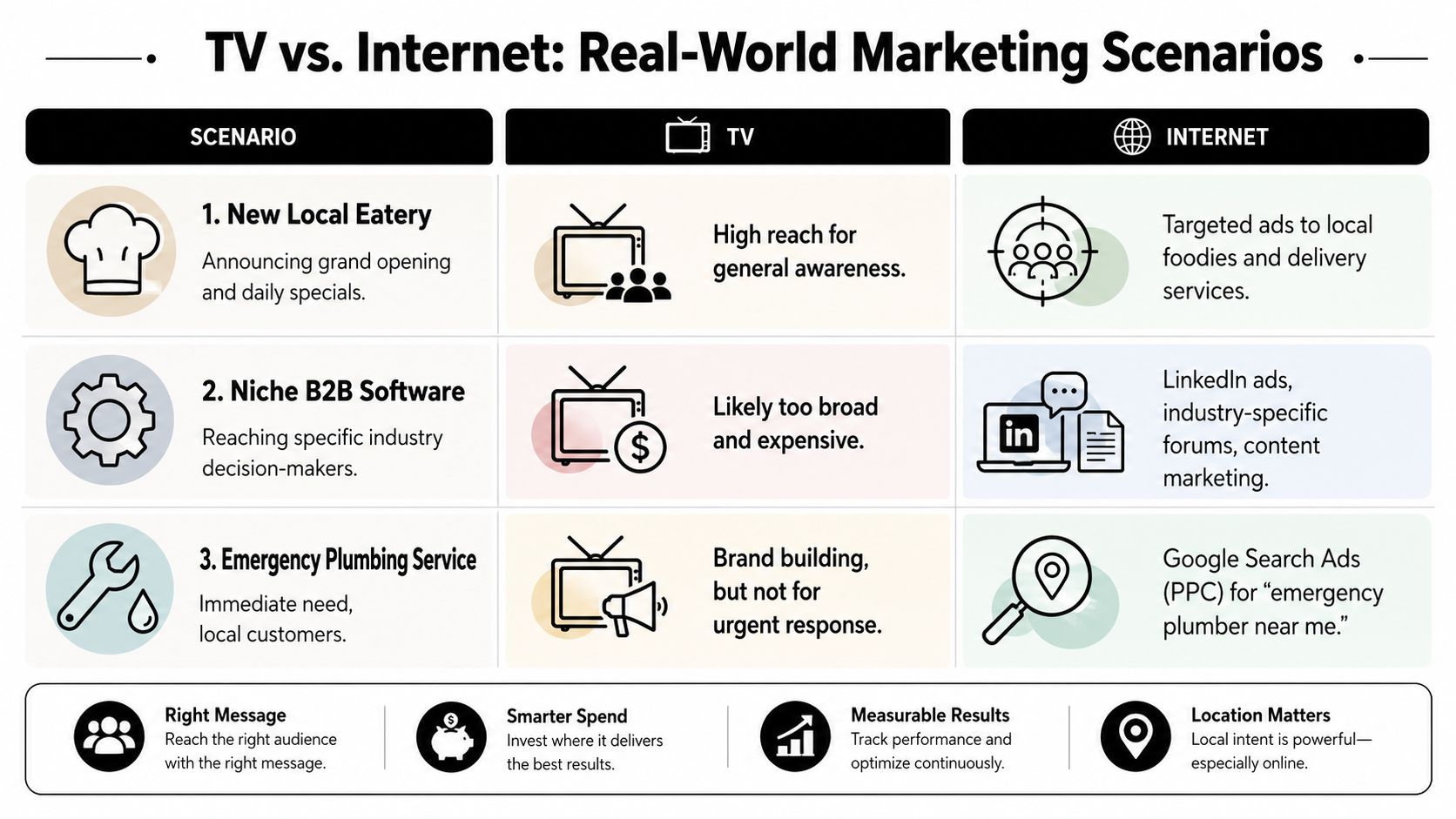
A new local eatery in Bonita Springs
A restaurant opening has an awareness problem before it has a conversion problem. People won't search for your lunch specials if they don't know you exist.
TV can help create broad local familiarity, especially if the message is simple: location, cuisine, opening date, and a reason to visit this week. Internet advertising then does the sharper work. Facebook and Instagram can target nearby residents, showcase dishes, and keep your name in front of people deciding where to eat.
In this case, TV can introduce. Digital can follow up.
An emergency plumber in Cape Coral
This one is almost always an internet-first decision.
When someone has water on the floor, they don't sit back and absorb a brand message. They search. They call. They hire the company that looks available, credible, and close. Google Search Ads, strong Google Business Profile visibility, and a fast mobile landing page usually outperform TV for urgent service categories.
TV still has value here, but mostly as support. It can make your name more familiar when the search happens later.
A plumber doesn't need more impressions. The plumber needs to be present at the exact moment of intent.
A personal injury law firm in Fort Myers
Legal is a category where trust and repetition matter. TV can help establish legitimacy because repeated exposure on a television screen can make the brand feel established. That matters when the decision carries risk and emotion.
But digital often closes the loop. Search campaigns can capture people looking for a lawyer after the event. YouTube and display retargeting can keep the firm visible while prospects compare firms, read reviews, and delay the call.
A niche B2B software company
For this one, TV is usually too broad.
If the buyer is a specific operations leader, IT decision-maker, or industry executive, internet advertising offers better tools. LinkedIn campaigns, search ads around commercial-intent queries, remarketing, and useful content usually beat mass local reach.
A roofer after a storm
This is one of the more interesting local examples because both channels can make sense at once.
A roofer can use TV to show up broadly across affected communities and reinforce trust with simple proof points, such as licensed service, local presence, and fast inspections. Internet advertising can then narrow in on service-area searches, retarget site visitors, and keep the brand visible during quote comparison.
The mistake would be picking one channel for every stage. The buyer doesn't move that way, so the media plan shouldn't either.
The Game Changer Connected TV Advertising
Connected TV changed the old TV versus digital argument because it sits between them. It puts video on the television screen, but delivers it through internet-based systems that allow more targeting and better optimization than traditional linear TV.
That shift is no longer marginal. Industry reporting in 2025 said CTV accounts for one-third of total TV ad spend and that 80% of advertisers use it for more precise, addressable campaigns, according to Strategus on whether TV advertising is still effective.
Why CTV matters to local businesses
For a Southwest Florida business, CTV solves a real problem. Traditional TV can feel too broad. Standard digital can feel too small-screen and fragmented. CTV gives you a TV-style ad experience with more control over who sees it.
A local roofer, med spa, or law office can use CTV to put polished video in front of households inside selected service areas while keeping the campaign more targeted than a standard local broadcast buy.
If you want to see how agencies in other local markets explain the value of streaming-based campaigns for regional growth, this article on how to grow your Prescott business with streaming ads is a useful example of how that shift is being framed outside Florida too.
Where CTV fits in the budget
CTV is rarely the first thing I'd recommend for a business that still hasn't fixed search intent capture. If your Google Ads, landing pages, call handling, and remarketing are weak, CTV won't rescue the system.
But once those basics are working, CTV becomes a strong middle layer:
- Above search: It creates demand and familiarity before the search.
- More targeted than linear TV: It reduces wasted reach.
- More premium-feeling than many social placements: It can lift perceived credibility.
CTV works best when you already know what happens after someone becomes interested.
What it doesn't solve
CTV still needs strong creative. It still needs a clean offer or message. It still performs better when tied into other channels that can capture and retarget demand.
So the modern choice for many local advertisers isn't TV or internet. It's whether linear TV, CTV, or a blended plan fits the way customers buy.
Measuring the True Return on Your Ad Spend
Most businesses don't struggle with spending money. They struggle with knowing what caused the lead.
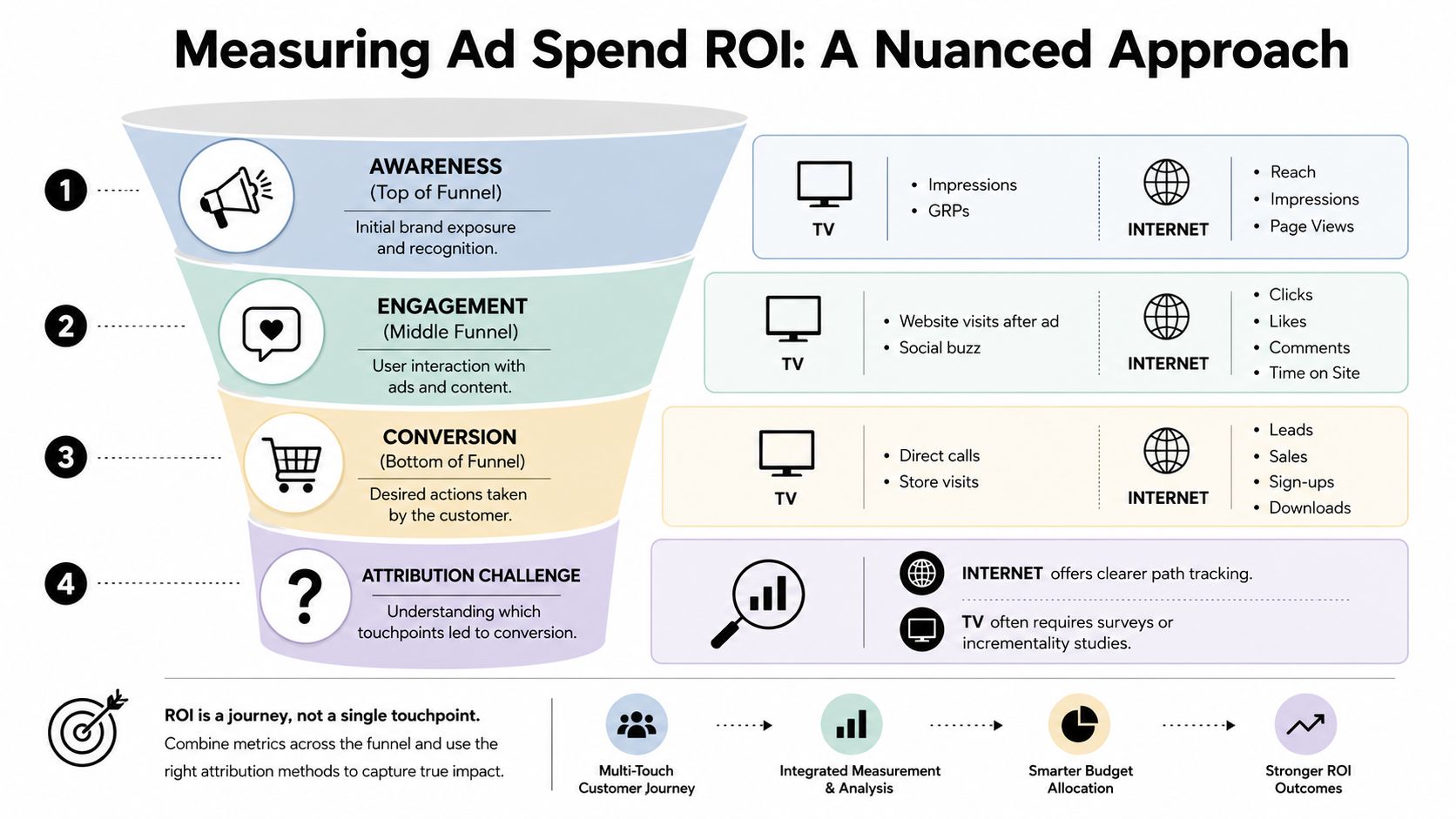
That's easy to see in digital when someone clicks a search ad, fills out a form, and books a service call. It gets murkier when someone sees a TV ad on Monday, searches your name on Thursday, reads reviews on Friday, and calls on Saturday. The lead is real. The path is messy.
What to track by channel
For internet advertising, your measurement stack usually includes clicks, calls, form fills, booked appointments, and what happens on the landing page. If you're evaluating traffic quality, resources like this explanation of what is a good click-through rate can help, but CTR by itself never tells the whole story.
For TV and video-led campaigns, use a broader lens:
- Branded search lift: Did more people search your business name after the campaign?
- Direct traffic changes: Did more people type your site in directly?
- Call tracking patterns: Did inbound volume shift around flight dates?
- Offer-specific response: Did unique landing pages or promo language generate movement?
A more complete framework for these decisions is laid out in this guide on how to measure marketing ROI.
The branding assumption that deserves scrutiny
Many business owners assume TV is automatically better for branding. That assumption is too lazy.
A Stanford study found that once pre-campaign brand awareness was controlled for, the brand-message recall lift from internet display ads was statistically indistinguishable from TV, as described in Stanford Graduate School of Business research on internet vs TV advertising and brand building. In plain English, TV can look stronger partly because brands often start with different levels of awareness before the campaign even begins.
That matters for local advertisers because it changes the question. The issue isn't “Which channel sounds more premium?” The issue is “Which channel produced more real lift after accounting for where the brand started?”
Good attribution doesn't just count conversions. It challenges assumptions about why they happened.
A practical ROI view
If you run a local service business, measure channels according to their job.
Search should be judged hard on leads and cost efficiency. Social should be judged on audience quality and downstream response. TV and CTV should be judged on market visibility, assisted conversions, and whether they improve the performance of the channels that close business.
That's a more honest way to decide what stays in the budget.
How to Build Your First Hybrid Ad Strategy
The best local plans usually don't pick one side. They assign each channel a role and make them work together.
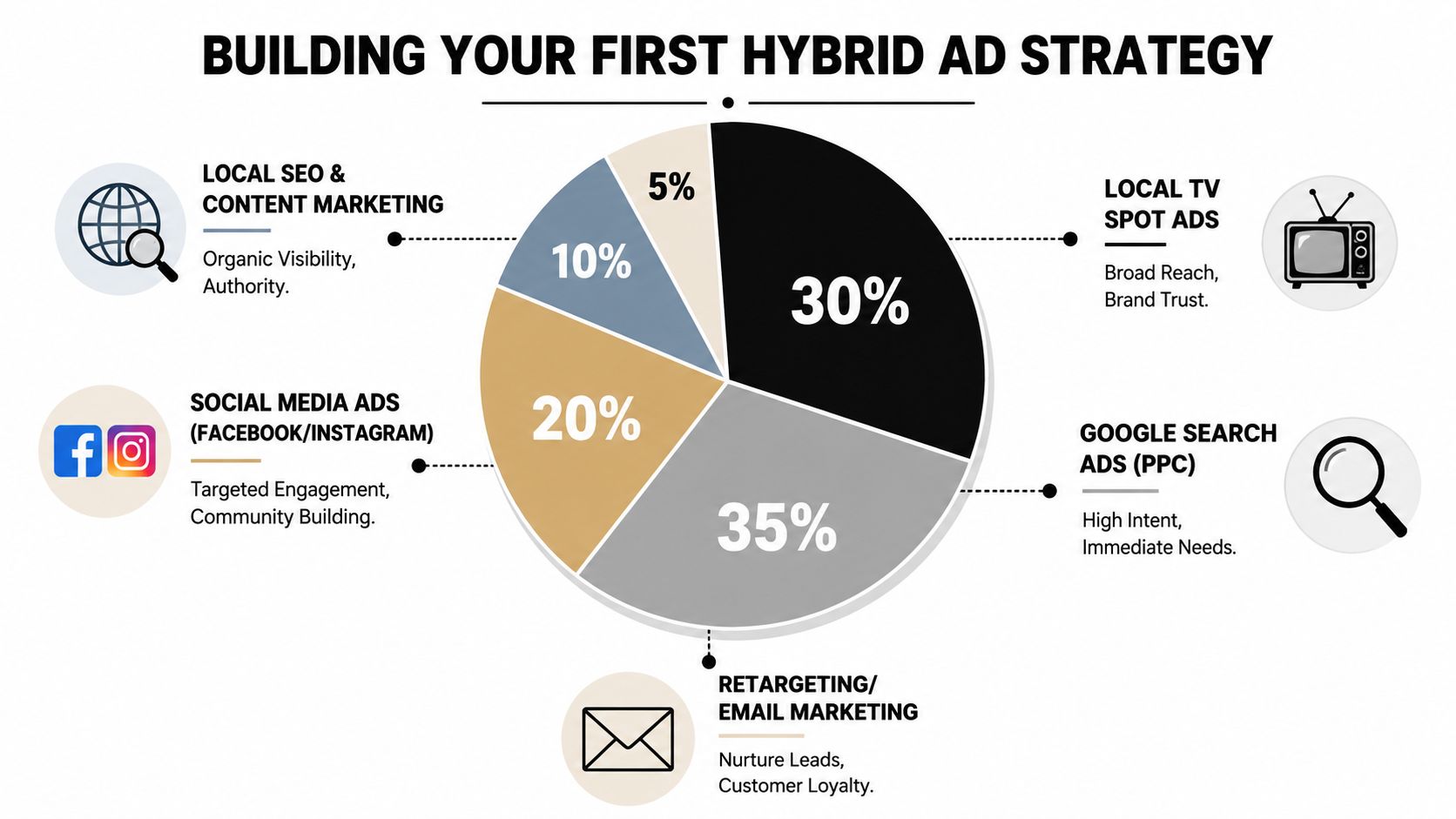
A useful starting point for a home services business is to keep most of the budget in intent-driven digital while reserving a smaller portion for broader visibility. The exact split depends on category, seasonality, and sales cycle, but the logic is consistent. Capture demand first. Expand awareness second. Retarget throughout.
Industry coverage also points in this direction. The strongest results often come from combining TV and digital, and for many advertisers the primary question is now linear TV, CTV, or a mixed plan, as discussed by TVScientific in this piece on TV advertising vs digital advertising.
A simple starting model
For many local businesses, this is a sensible first hybrid approach:
- Google Search Ads: Put the largest share here if people actively search for your service.
- Social ads: Use Facebook and Instagram to stay visible, showcase proof, and retarget visitors.
- CTV or local TV: Add this when you need more market presence or want to support a trust-heavy sale.
- SEO and local content: Keep improving organic visibility so paid channels don't carry the entire load.
- Retargeting: Follow site visitors and warm audiences until they act.
If paid search is central to your lead flow, a focused PPC management strategy for small business should be part of the foundation.
Three rules for the first ninety days
- Pick one primary objective. If the goal is calls, don't judge the campaign like a branding exercise.
- Build one message per audience. Don't run the same pitch to emergency buyers and early-stage shoppers.
- Review by business outcome. Calls, booked jobs, consultations, and close quality matter more than vanity metrics.
A short explainer can help if you're evaluating how channels fit together in a broader plan:
For a Fort Myers contractor, that might mean search ads for active demand, social retargeting for comparison shoppers, and CTV for local brand reinforcement. For a new retail location, it might mean a heavier awareness layer up front. For a law firm, it may mean steady search plus video support over time.
The right hybrid strategy isn't complicated. It's disciplined.
If you want help building a practical local ad strategy that ties spend to real leads, Polaris Marketing Solutions works with Southwest Florida businesses on search, paid ads, social, SEO, and integrated campaigns designed around clear ROI.