
If you run a business in Fort Myers, you probably know the pattern. One month brings estimate requests, calls, and form fills from all directions. The next month feels flat, and nobody can tell you exactly why.
That kind of lead flow makes hiring risky and marketing frustrating. It also causes owners to jump from one tactic to another. They try boosted posts, then Google Ads, then a referral push, then a website tweak, without a system connecting any of it.
Lead generation for small business works better when you stop thinking in terms of isolated tactics and start building a repeatable operating process. In Southwest Florida, that process has to fit how local buyers behave. They search by city, compare reviews, call from mobile, and often choose the business that responds first and looks easiest to trust.
From Unpredictable Trickle to Steady Stream
A lot of small businesses in Southwest Florida don't have a traffic problem first. They have a consistency problem.
A roofer in Cape Coral may get busy after a storm. A med spa in Naples may see bookings spike during seasonal population increases. A law firm in Fort Myers may get plenty of inquiries one week and low-quality ones the next. The pattern feels random, but usually it isn't. The business is relying on scattered channels instead of a lead system.
Across industries, 50% of marketers say lead generation is a top priority, but about 80% of those leads never convert, according to Databox's lead generation statistics roundup. That gap matters more than most owners realize. It means getting more leads isn't enough if your process can't qualify, route, and follow up with them properly.
What a system looks like
A real system has four parts working together:
- Attraction. Show up where local prospects are searching and comparing.
- Conversion. Make it easy to call, book, or request help.
- Follow-up. Respond fast and keep leads moving.
- Measurement. Track which channels produce real customers, not just inquiries.
If one part breaks, the whole thing leaks money. That's why a business can spend on SEO or ads and still feel like marketing "doesn't work."
Practical rule: If your team can't answer where your best leads came from, how quickly they were contacted, and how many became customers, you don't have a lead generation strategy yet. You have activity.
Follow-up is where many local businesses lose deals. If you're interested in how speed and automation affect response quality in another high-pressure market, this piece on automating real estate lead follow-up offers a useful operational parallel.
A steady pipeline comes from process, not guesswork. If you want a practical baseline before changing channels, start with this breakdown on how to get more leads.
Building Your Lead Generation Blueprint
Businesses waste money when they market to "everyone in Lee County." That sounds broad and safe, but it usually creates weak messaging, weak offers, and weak lead quality.
A better starting point is a blueprint. Before you buy ads, write blogs, or hire an SEO company, define who you're trying to attract and why that person should choose you.
Start with your ideal customer profile
Your ideal customer profile, or ICP, isn't a vague age range. It's a practical description of the kind of buyer who is most likely to need your service, trust your process, and become a profitable customer.
For a Southwest Florida business, that might look like this:
- Estate planning attorney in Naples. Retirees or near-retirees who want clear guidance, privacy, and a firm that explains the process in plain English.
- Pool service company in Estero. Busy homeowners in gated communities who value reliability, recurring service, and quick communication.
- Pediatric dental office in Fort Myers. Parents who care about scheduling convenience, online reviews, and a calm first-visit experience.
- HVAC company in Bonita Springs. Homeowners with urgent cooling issues who want same-day response and confidence that the technician will show up.
That level of specificity changes everything. It tells you what pages to build, what keywords to target, what objections to answer, and what kind of offer to put in front of people.
Write a value proposition that actually helps sales
Most small businesses mistake a slogan for a value proposition. "Quality service you can trust" doesn't separate you from anyone.
Your unique value proposition should answer three questions fast:
- Who do you help
- What problem do you solve
- Why are you a better fit than the other options nearby
Here are stronger examples:
- "Flat-fee estate planning for Naples retirees who want clear documents without legal jargon."
- "Weekly pool cleaning for Estero homeowners who are tired of missed visits and murky water."
- "Fort Myers AC repair with live phone answering and clear arrival windows."
The easiest way to sharpen your message is to listen to your calls. Customers usually tell you the real buying criteria in their own words.
Build around real buying friction
Strong positioning doesn't stop at the headline. It has to reflect the frictions buyers feel before they contact you.
Use this simple framework:
| Question | What to identify |
|---|---|
| What are they worried about | Cost, trust, speed, scheduling, quality |
| What makes them hesitate | No reviews, slow site, unclear pricing, vague service pages |
| What do they compare you against | Larger brands, cheaper competitors, referrals, DIY options |
| What proof do they need | Reviews, photos, FAQs, certifications, quick response |
If you run intake-heavy services such as family law, immigration, or personal injury, the front-end process matters almost as much as the ad itself. This guide on automating legal intake is a useful example of how operations and lead capture connect.
Choosing Your Lead Generation Channels
Most owners ask the wrong question first. They ask, "Should I do SEO, ads, social, or referrals?" The better question is, "Which channels match buyer intent, budget, and sales process for my business?"
Not every channel deserves equal attention. In local markets like Fort Myers, Naples, and Cape Coral, the right mix depends on how urgently people need your service, how expensive the job is, and how much trust they need before contacting you.
According to Dux-Soup's 2025 B2B lead generation report summary, SEO leads have a 14.6% close rate compared to 1.7% for outbound leads, and content marketing is described as generating 3x more leads than outbound while costing 62% less. For small businesses, that doesn't mean outbound never works. It means high-intent inbound channels usually deserve the stronger foundation.
The channel trade-offs that matter
A local service business usually needs a mix of demand capture and demand creation.
Demand capture channels reach people who already want help.
Demand creation channels build awareness before that need becomes urgent.
Here is a practical comparison.
Lead Generation Channel Comparison for Small Businesses
| Channel | Typical Cost | Time to Results | Lead Quality | Best For |
|---|---|---|---|---|
| Local SEO | Medium upfront, lower ongoing relative to ads once established | Slower at the start | High | Home services, legal, healthcare, professional services |
| Google Ads | Flexible but can rise quickly in competitive markets | Fast | High when tightly targeted | Urgent services, high-intent searches, seasonal pushes |
| Organic Social Media | Lower cash cost, higher time cost | Slower | Mixed | Brand familiarity, community presence, repeat engagement |
| Referral Programs | Low to medium | Medium | High | Trust-driven local businesses with happy customers |
| Local Partnerships and Events | Low to medium | Medium | Mixed to high | Businesses with strong community fit or complementary partners |
Where each channel wins
Local SEO
Local SEO is usually the most durable asset for a Southwest Florida business. If someone searches "plumber Fort Myers" or "estate planning lawyer Naples," they already have intent. You're not interrupting them. You're meeting demand that already exists.
It works especially well for:
- Home services with city-based service areas
- Healthcare practices where reviews matter
- Legal and professional services where trust and relevance drive calls
The downside is patience. SEO compounds, but it doesn't switch on overnight.
Google Ads
Google Ads are useful when speed matters. If you're a water damage company, AC repair company, urgent care clinic, or criminal defense attorney, waiting months for organic visibility may not make sense.
Ads work best when you already know:
- which keywords bring qualified calls
- which landing pages convert
- who answers the phone and how fast
Without those pieces, ad spend can become very expensive testing.
Organic social media
Organic social rarely captures bottom-of-funnel demand as efficiently as search. But it still matters for local credibility.
Use it for proof, not just posting. Show work completed in Bonita Springs. Share before-and-after photos. Answer common customer questions on video. Highlight staff and process. Buyers often check social after finding you elsewhere.
A weak social feed usually doesn't kill the lead. An inactive or sloppy one can hurt trust right before contact.
Referrals and local partnerships
This channel gets overlooked because it doesn't feel like "marketing," but for many small businesses it's one of the cleanest lead sources.
Examples that work in SWFL:
- a roofer partnering with an insurance restoration company
- a pediatric practice building relationships with local schools or family-focused businesses
- a real estate agent referring cleaners, movers, and contractors
- an estate attorney connecting with financial planners and CPAs
Referrals convert well because trust is preloaded. The limit is scale. You can't build your whole growth plan on hope and word of mouth alone.
A simple selection rule
Use this decision filter:
- Need leads fast. Add Google Ads.
- Need long-term lead flow. Build local SEO.
- Need stronger trust signals. Improve reviews, social proof, and referrals.
- Need better efficiency. Fix conversion and follow-up before adding channels.
Small businesses lose money when they spread thin. Pick one primary channel, one support channel, and one retention or referral lever. That combination is usually more effective than trying to be everywhere.
How to Dominate Local Search in Southwest Florida
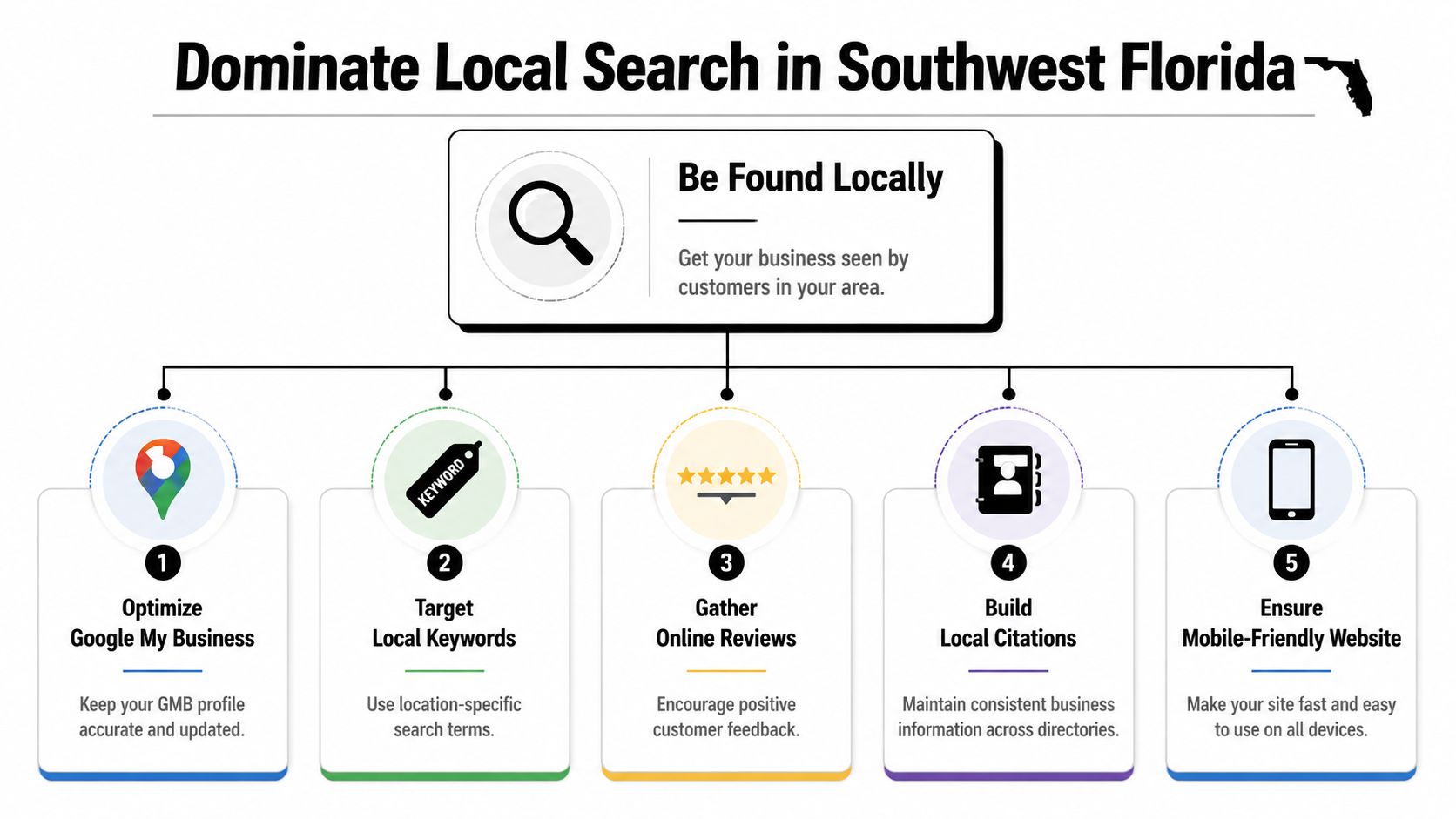
When people need a local service, they rarely start by browsing random websites. They search Google, scan the map results, compare reviews, and contact one of the businesses that looks trustworthy and easy to reach.
That makes local search one of the strongest forms of lead generation for small business. It captures people with immediate purchase intent, and tactics like geo-targeted keywords, accurate local listings, and review management on a consistent Google Business Profile improve visibility in the local pack, as noted in Close's guidance on small business lead generation.
Clean up your Google Business Profile first
Your Google Business Profile is often the first impression. It needs to be complete, accurate, and actively managed.
Use this checklist:
- Primary category. Choose the category that matches your core service, not a broad catch-all.
- Service areas. List the actual cities you serve, such as Fort Myers, Cape Coral, Estero, Bonita Springs, and Naples.
- Business description. Explain what you do and where you do it in plain language.
- Photos. Upload recent work, team, office, vehicle, or location photos.
- Services. Add clear service entries instead of leaving the profile bare.
- Hours and contact info. Keep them current, especially during holidays and seasonal shifts.
- Posts and updates. Use them to highlight offers, new services, and recent jobs.
If you want a more detailed checklist, this guide on how to optimize Google Business Profile covers the practical setup points.
Build pages for the way locals search
Your website should mirror real search behavior. A single generic services page won't rank well for every city and service combination.
Create focused pages around combinations like:
- roofing in Fort Myers
- family dentist in Cape Coral
- med spa in Naples
- paver sealing in Bonita Springs
- estate planning attorney in Estero
Don't clone the same page with city names swapped. Each page should reflect local context, nearby landmarks, service area specifics, common questions, and proof tied to that location.
Reviews and citations do more work than people think
Reviews are both a trust signal and a visibility signal. Ask for them consistently, not only after your best jobs. Make the request part of your operating process after service completion.
Also check your citations. Your business name, address, phone number, website, and hours should match across major directories and profiles. Inconsistent listings create friction for both customers and search engines.
If your reviews mention the city, service, and customer experience naturally, they often help both click-through and trust.
Prepare for search without the click
Search behavior is shifting. More people discover businesses directly in map packs, profile panels, and AI-generated summaries instead of browsing deep into websites. That means your digital presence needs surface area, not just blog posts.
For local businesses, that means:
- stronger service definitions in your profile
- clear review signals
- mobile-friendly click-to-call paths
- location pages that answer common questions quickly
In local search, the business that looks easiest to trust often gets the lead.
Turning Clicks into Customers with Conversion Optimization
More traffic isn't always the answer. Many Fort Myers businesses already get enough visitors to generate more leads, but they lose those opportunities on slow pages, weak forms, confusing layouts, and missed calls.
Google reports that as page load time goes from 1 to 5 seconds, bounce probability increases by 90%, according to Thomasnet's small business lead generation article. For local, mobile-first searches, that means a slow site can kill a lead before the phone ever rings.
Fix the friction before buying more traffic
A small business website should do one thing very well. It should move a visitor from interest to action with as little resistance as possible.
The common leaks are familiar:
- Slow mobile pages. Large images, bloated themes, and unnecessary scripts hurt load time.
- Weak calls to action. "Learn More" is vague. "Request a Free Estimate" is clear.
- Overbuilt forms. If you ask for too much too early, people abandon.
- Buried phone numbers. Service businesses should make calling obvious.
- No trust signals. Reviews, certifications, service guarantees, and photos should be visible near the action point.
A cleaner site often beats a prettier site. Visitors don't reward complexity. They reward clarity.
What a high-converting page usually includes
For local lead generation, a strong page often has these elements above the fold or close to it:
| Element | Why it matters |
|---|---|
| Clear headline with service and location | Confirms relevance immediately |
| Primary call button | Gives users an obvious next step |
| Tap-to-call phone number | Helps mobile users act fast |
| Short form | Reduces abandonment |
| Reviews or testimonial snippets | Builds trust quickly |
| Service-area references | Reassures visitors you work in their location |
If you're reviewing your own site, compare every page against that list. If several elements are missing, the site isn't supporting your marketing spend.
The phone process is part of conversion
Many local companies lose easy revenue at this critical stage. A great SEO campaign doesn't help much if calls go unanswered or form leads sit untouched until the next morning.
The fastest responder often gets the job. That can mean:
- call answering during business hours
- missed-call text back after hours
- form alerts sent to the right team member
- a simple script so staff know how to qualify and book
This walkthrough on how to improve website conversion rates is useful if you're diagnosing leaks between click and contact.
A short visual explainer can also help teams think through page structure and conversion flow:
Your marketing doesn't stop when someone lands on the page. It stops when they contact you and your team responds well.
Tracking and Measuring What Actually Works
A lot of owners look at marketing reports and still can't answer the basic question. Which channel produced customers, not just clicks?
That's why tracking matters. Think of it as a financial statement for your marketing. If you wouldn't run your business without knowing revenue and expenses, you shouldn't run lead generation without knowing source, quality, and follow-up outcome.

A modern lead generation stack uses tools to capture visitor data, score leads, and trigger automated follow-ups. CRM systems are central because they collect demographic and channel data to separate qualified leads from noise and improve follow-up speed, as described in Zendesk's overview of lead generation systems.
Use simple attribution first
You don't need an enterprise dashboard to get useful clarity.
Start with three basics:
- UTM parameters. These are tags added to links so you can tell whether a lead came from Google Ads, email, Facebook, a partner campaign, or another source.
- Call tracking and form tagging. Your forms and phone calls should feed source data into one place.
- Lead source fields inside your CRM. Every inquiry should be categorized, even if manually at first.
If your team says, "We get leads from everywhere," that's usually a sign the sources aren't being tracked consistently.
What to watch every week
Don't drown in metrics. A small business usually needs a short operating view.
Track these items:
- Lead source. Which channel brought the inquiry.
- Lead quality. Was it a fit, a maybe, or a waste.
- Response status. Was the lead contacted fast, later, or not at all.
- Booked outcome. Did the inquiry turn into an estimate, consultation, or appointment.
- Closed revenue by source. Which channels are producing real business.
One clean spreadsheet can handle this early on. A CRM makes it easier as volume grows.
Build routing around the way you sell
Not every lead should go through the same path. A homeowner requesting paver sealing in Fort Myers should not get the same intake flow as a prospective client looking for legal help in Naples.
That means using different workflows for different categories, such as:
- home services by city and urgency
- healthcare inquiries by treatment interest
- legal leads by practice area
- real estate or professional services by service type
For businesses that need help connecting website performance, paid traffic, local SEO, and conversion tracking, Polaris Marketing Solutions is one local option that handles those services in an integrated way for Southwest Florida companies.
The key is simple. Make your data useful enough to guide action. If a channel produces poor-fit leads, cut it back. If one source brings qualified calls that close, feed it.
Your Path to Sustainable Growth
The businesses that grow steadily in Southwest Florida usually aren't doing dozens of things at once. They're doing a few important things consistently, and they've connected those actions into one working system.
That system starts with a clear customer profile. It gets stronger when you choose channels based on intent instead of hype. It becomes profitable when your website converts, your team follows up quickly, and your reporting shows which leads turn into revenue.
Spray-and-pray marketing feels busy, but it doesn't create control. A measured process does. That's what breaks the feast-or-famine cycle for a contractor in Fort Myers, a healthcare office in Cape Coral, or a law firm in Naples.
Sustainable growth comes from repeatable decisions. Not random wins.
If you want another practical perspective on building smarter acquisition habits, EmailScout's growth strategies offers useful reading for owners trying to prioritize what matters.
The next step isn't doing everything. It's identifying the biggest leak in your current process and fixing that first. For one business, that's visibility. For another, it's the website. For many, it's follow-up discipline.
Frequently Asked Questions
| Question | Answer |
|---|---|
| How long does lead generation for small business take to work? | It depends on the channel. Google Ads can create visibility quickly, while local SEO takes longer to build. Most owners should think in terms of building both a short-term pipeline and a long-term asset. |
| What's the best lead generation channel for a local business? | Usually the best starting point is the channel that matches strongest buyer intent. For many local businesses, that's local search. If your service is urgent, paid search may deserve earlier attention. |
| Do I need social media to generate leads? | You may not need social media as your primary lead source, but it often supports trust. Prospects who find you in Google often check your social profiles before contacting you. |
| Why am I getting leads that don't close? | Weak close rates usually come from one of three problems: poor targeting, weak qualification, or inconsistent follow-up. The traffic source may be wrong, but the offer, page, or intake process can also be the issue. |
| How many pages should my website have? | There isn't one correct number. What matters is whether your site has clear service pages, location relevance, strong calls to action, and proof that helps someone decide. A small site with the right pages can outperform a large unfocused one. |
| Should I buy leads from third-party platforms? | Sometimes they can help, especially when you need volume fast. But they usually work best as a supplement, not your foundation. Shared leads often create price pressure and weaker control over lead quality. |
| What should I do first if my budget is limited? | Start with fundamentals. Tighten your positioning, improve your Google Business Profile, make your website easy to convert on mobile, and put a basic follow-up process in place. Then add paid traffic once your conversion path is solid. |
| Do I need a CRM if I'm still small? | Yes, even if it's simple. Once inquiries start coming from multiple places, you need one system to log source, status, and outcome. Otherwise leads get missed and marketing decisions turn into guesswork. |
If your business in Fort Myers or the wider Southwest Florida market needs a clearer lead system, Polaris Marketing Solutions can help you evaluate where you're losing opportunities across local SEO, paid traffic, website conversion, and follow-up. A practical starting point is a review of your current visibility, conversion path, and lead flow so you can fix the biggest bottleneck first.