

A prospective client in Estero has a problem that feels urgent. They search “family law attorney near me,” scan the Map Pack, and call a firm within minutes. In that moment, visibility, credibility, and ease of contact matter more than the polish of your homepage copy.
That is how legal search works across Fort Myers, Cape Coral, Bonita Springs, Estero, and Naples. Firms are competing for high-intent searches in a market where proximity, reviews, local relevance, and page quality all influence who gets the call. A brochure-style website rarely carries its weight anymore.
For small and mid-sized firms, SEO often becomes the most reliable channel for attracting qualified cases without depending entirely on paid ads or directory leads. The challenge is that many partners hear broad advice about rankings but do not get clear guidance on what to fix first, what can wait, and which agencies can deliver results in Southwest Florida.
In practical terms, effective SEO for law firms comes down to three priorities. Show up in the local map results for the cities and neighborhoods you serve. Build practice-area and question-based pages that answer how clients search. Remove technical and structural problems that keep strong pages from ranking.
That sounds simple. Execution is where firms lose ground.
A Fort Myers firm may need tighter Google Business Profile categories, better review generation, and location pages that reflect Lee County search intent. A Naples-focused practice may need stronger service-area signals, cleaner internal linking, and attorney bios that support trust before a prospect ever calls. The right plan depends on your footprint, your practice mix, and the value of a signed case.
It also depends on choosing the right SEO partner. Some agencies are built for national campaigns and large retainers. Others are better suited to local firms that need a steady flow of calls from Lee and Collier County. If you are comparing options, this guide to choosing an SEO company for your business gives a practical framework for evaluating fit, process, and accountability.
This guide takes a two-part approach. First, it clarifies the SEO pillars law firms in Southwest Florida need to get right. Then it walks through vetted agencies, from hyper-local providers to national legal SEO specialists, so you can match strategy to execution and turn search visibility into signed cases.
1. Polaris Marketing Solutions
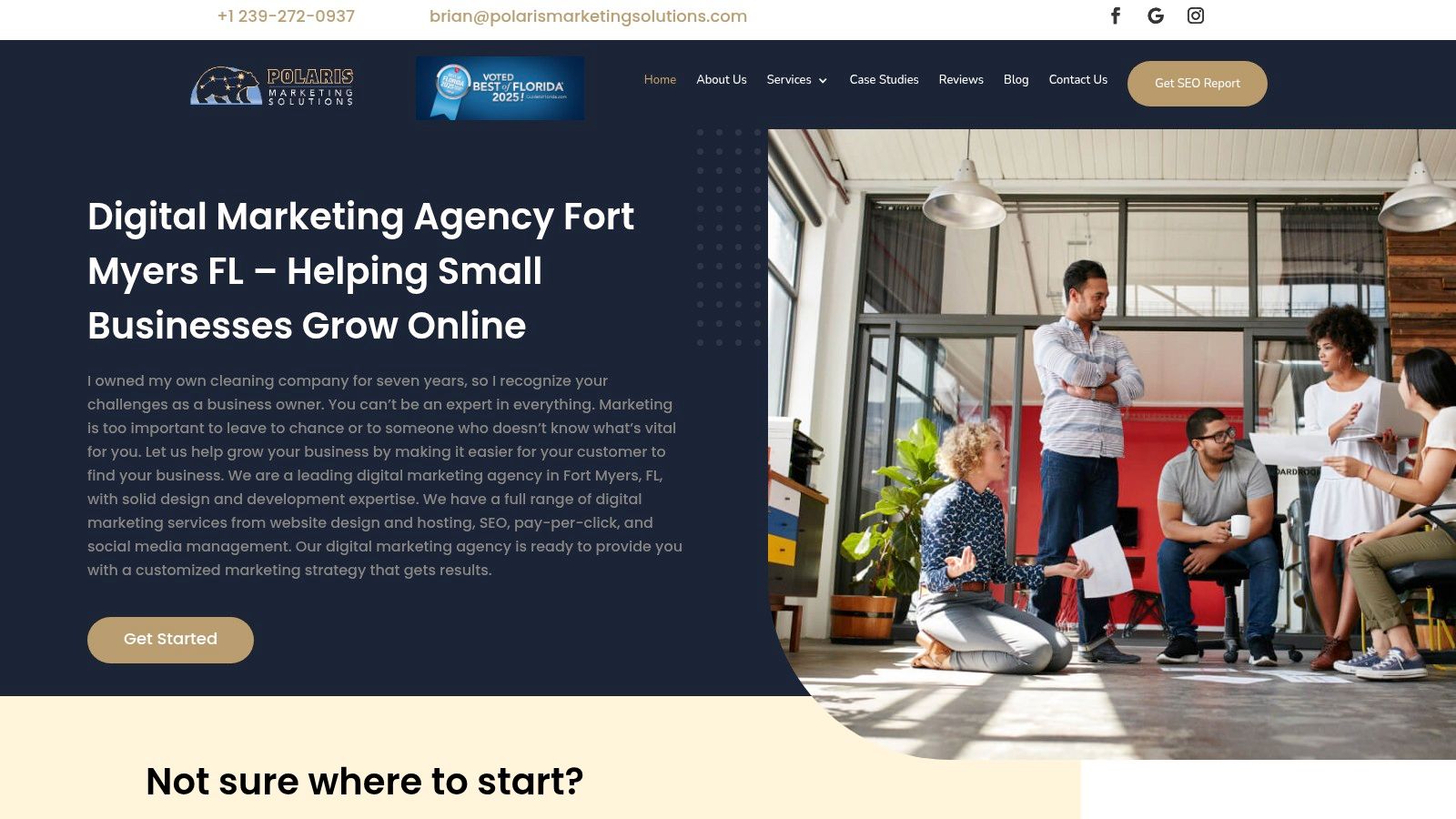
Polaris Marketing Solutions is the clearest fit for small and mid-sized firms in Fort Myers that want practical execution, not a bloated national playbook.
What stands out is the local operating logic. A law firm in Southwest Florida does not need generic SEO advice. It needs someone who understands how a Naples estate planning page should differ from a Cape Coral personal injury page, how a Google Business Profile should be tuned for neighborhood intent, and how review acquisition affects local trust before a prospect ever fills out a form.
Why Polaris works well for SW Florida firms
Polaris is built around services that match how local legal leads are won. That includes website design and hosting, local and national SEO, PPC, social media management, and e-commerce support, but the primary advantage for law firms is local search execution.
For many firms, the first wins are not glamorous. They are cleanup work and local relevance work:
- Google Business Profile tuning: Add accurate categories, service details, photos, Q&A coverage, and location-relevant descriptions.
- Citation consistency: Keep firm name, address, and phone number aligned across the site, Google Business Profile, Avvo, Justia, FindLaw, and other directories.
- Review generation: Build a repeatable post-matter workflow so happy clients are asked for feedback.
- Location pages: Create pages for places like Fort Myers, North Fort Myers, Estero, Bonita Springs, Cape Coral, and Naples that are useful, not duplicated.
Google Business Profile is central to local strategy anyway. One of the verified benchmarks in this brief notes that it is the primary directory in local strategies, alongside platforms like Avvo, FindLaw, Justia, Yelp, and Bing Places, in this legal SEO overview. That lines up with what smaller firms need most. Clean local signals first. Bigger authority plays second.
If your firm serves only Southwest Florida, a local agency should be able to explain how it would rank you in Bonita Springs separately from Fort Myers. If it cannot, that is a warning sign.
Practical strengths and trade-offs
Polaris also benefits from an owner background grounded in running a small business, which usually shows up in better communication and more realistic prioritization. Small law firms do not need abstract strategy decks. They need a list of what gets fixed this month, what gets published next month, and which lead sources produced consultations.
The agency emphasizes transparent monthly reporting and offers a complimentary online analysis plus competitor report. That is useful for partners who want a starting point before committing. If you are comparing vendors, review their thinking alongside guidance on how to choose an SEO company.
The trade-off is straightforward. Polaris is strongest for firms that care about Fort Myers and the broader Southwest Florida market. If you need a multi-state legal SEO program with dozens of office rollouts, a larger national specialist may fit better.
Pros
- Strong local market fit: Especially good for firms targeting Fort Myers, Cape Coral, Estero, Bonita Springs, and Naples.
- Integrated services: Useful when your SEO, site updates, and paid campaigns need to work together.
- Transparent approach: Monthly reporting and a clear emphasis on measurable ROI.
- Good for growing firms: Better aligned with SMB budgets and practical pacing than many enterprise-focused agencies.
Cons
- Regional focus: Less ideal for firms seeking a national or multi-region legal marketing partner.
- No public pricing: You need a conversation to understand scope and cost.
- SEO still takes time: This is not a shortcut vendor. It is a build-the-asset partner.
For a Fort Myers law firm that wants the best seo for law firms without overbuying, Polaris is the most grounded option on this list.
Visit Polaris Marketing Solutions
2. Rankings.io
A Fort Myers partner usually reaches Rankings.io after a specific realization. The firm does not just need better visibility in one city. It needs a larger search program that can support competitive practice areas, multiple locations, or a serious push for case growth.
Rankings.io has earned attention by focusing on law firms and building around that niche. That matters in legal SEO because the work is not limited to getting pages indexed and adding blog posts. The agency needs to understand intake value, practice-area competition, location intent, and how search traffic turns into consultations.
Where Rankings.io fits best
Rankings.io is usually a better fit for firms with real competition and real expectations. Personal injury is the obvious example, but the same logic applies to criminal defense, mass torts, and other categories where strong rankings can change the volume and quality of signed cases. Their service mix covers technical SEO, content strategy, link acquisition, local SEO, web design, and paid media support.
That broader scope is the main reason firms consider them.
A firm with weak rankings often has more than one problem. The site structure may be thin. Practice pages may not match search intent. Location pages may be underbuilt. Conversion paths may be weak on mobile. If that sounds familiar, it helps to review law firm website design tips that improve trust and conversion before signing with any agency, because design and SEO usually rise or fall together.
There is also a market reality behind the demand for this kind of service. Analysts at MyCase note in these law firm marketing statistics that law firms continue to put serious attention on marketing channels that produce qualified leads. For firms competing in organic search, SEO remains part of the core growth plan.
What Fort Myers firms should weigh carefully
For a small or midsize firm focused on Fort Myers, Cape Coral, Bonita Springs, or Naples, Rankings.io can be more agency than you need. That is not a criticism. It is a fit question.
If your goal is to improve visibility in a defined Southwest Florida service area, a national legal SEO provider may bring more process, overhead, and cost than the campaign requires. If your goal is to expand into tougher markets, build a stronger practice-area footprint, or fix a site that has already hit a ceiling, the value equation looks different.
That is the primary trade-off. Rankings.io is built for firms that want an aggressive growth partner and have the budget, patience, and internal buy-in to support that level of work.
Pros
- Legal-only focus: Better understanding of legal search intent, intake quality, and practice-area competition.
- Full execution capacity: SEO, content, links, local work, design, and paid support can stay aligned.
- Stronger fit for competitive markets: Useful for firms targeting high-value cases or broader geographic reach.
- Growth-oriented strategy: More aligned with lead and case outcomes than surface-level ranking reports.
Cons
- Higher likely cost: Often a stretch for smaller firms or firms starting SEO for the first time.
- Potential overfit for local-only campaigns: Many Southwest Florida firms need a sharper local plan, not a national-scale program.
- Custom pricing: You will need a sales conversation to judge fit and scope.
Visit Rankings.io
3. LawRank
A Fort Myers firm often reaches this point after a frustrating run with disconnected vendors. The website looks dated, local pages are thin, paid search is expensive, and no one owns the full pipeline from click to signed case. LawRank tends to appeal to firms that want one legal-focused partner to rebuild the site, tighten local SEO, and support lead generation without surrendering control of the assets.
That ownership point deserves attention. Small and mid-sized firms usually feel it only after a redesign goes sideways, the relationship sours, or the firm learns it does not fully control the site, content, or backend access. LawRank's model is attractive to partners who want cleaner long-term control over what they are paying to build.
Best fit for firms fixing the foundation
LawRank works only with law firms, and that usually shows up in the structure of the work. Practice area pages, attorney bios, location pages, and conversion paths matter more in legal than they do in a generic local services campaign. A legal-only agency is more likely to treat those pages as business assets rather than filler content.
Their strongest fit is a firm dealing with several problems at once. The site needs to be rebuilt or cleaned up. Mobile performance needs work. Local intent pages are weak. SEO content is inconsistent. Google Ads is still necessary because organic growth takes time. In that situation, keeping strategy, design, SEO, and paid support under one roof can reduce finger-pointing and make accountability clearer.
That matters in Southwest Florida, where many firms are not trying to dominate the entire state. They need to win searches tied to a defined service area, specific practice types, and high-value case intent. The agencies that help most are the ones that can connect the SEO plan to actual page quality and intake friction, not just monthly ranking charts.
Where the trade-offs show up
LawRank makes more sense when the website is part of the problem. If your current site already performs well, your local presence is established, and you only need lighter local SEO support, their model may be more agency than your firm requires.
Pricing also appears to follow a consultative sales process rather than a public rate card. That is common in legal marketing, but it does mean partners need to ask harder questions up front about scope, asset ownership, content standards, reporting, and what success should look like in the first six to twelve months.
For firms evaluating a redesign alongside SEO, page credibility still matters. Attorney photos, trust signals, mobile usability, and clear contact paths shape whether traffic turns into consultations. If your current site feels dated, review these law firm website design tips before hiring any agency. It will help you judge whether the proposal improves both rankings and conversion quality.
Pros
- Legal-only focus: Better alignment with law firm search intent and practice-area structure.
- Website and SEO together: Useful when the site is limiting lead growth.
- Asset ownership emphasis: Helps firms protect long-term control.
- Organic and paid support: Gives firms a way to generate leads while SEO work matures.
Cons
- No public pricing: You need a sales conversation to assess fit.
- Broader scope than some firms need: Less efficient if your site is already strong.
- Best value shows up in bigger rebuilds: Firms seeking only modest local SEO help may prefer a narrower engagement.
Visit LawRank
4. Consultwebs
A Fort Myers firm with three practice areas usually hits the same wall at some point. Rankings improve on a few terms, calls come in unevenly, paid search gets expensive, and nobody is fully accountable for how the website, intake flow, local visibility, and lead quality connect. Consultwebs is built for firms that want one agency handling more of that system.
That is the main reason to consider them. Consultwebs has been in legal marketing for years, and their model is broader than pure SEO. For firms that need help aligning local search, paid campaigns, website updates, content production, and conversion paths, that breadth can be useful.
Best fit for firms with a real growth plan
Consultwebs makes more sense once a firm is past basic local SEO cleanup and into coordinated growth. That often includes multi-office targeting, several practice areas competing for budget, and a need to connect marketing work to signed cases instead of ranking reports.
In Southwest Florida, that distinction matters. A firm trying to grow personal injury, criminal defense, and family law at the same time should not treat every service page and every city page as equal. The better question is which practice areas produce the strongest case value, which geographies are still winnable, and what should be fixed on the site before more traffic is pushed to it. Agencies that can answer those questions are usually more useful than agencies selling a fixed monthly checklist.
Consultwebs also offers support beyond search visibility. For some firms, that is the right trade-off. One team, one reporting structure, and one strategy can reduce the friction that shows up when SEO, PPC, and web work are split across separate vendors.
Where the fit can break down
Smaller firms should still be careful.
A two-lawyer firm that mainly wants stronger Google Business Profile performance, better city pages, and tighter practice-area content may not need a large agency relationship. In that situation, a narrower local SEO engagement can be easier to manage and easier to judge.
The practical test is simple. Ask what they would do in the first six months for a Fort Myers firm in your practice area. A solid answer should cover page priorities, local intent, conversion bottlenecks, and how results will be measured. If the answer sounds interchangeable with what they would pitch to a firm in any city, keep looking.
Ask every agency which pages they would build or improve first. The answer usually tells you whether they understand legal search intent, local competition, and case value.
Pros
- Long legal marketing track record: A credible option for firms that want an established legal-focused agency.
- Broader service mix: Useful if your firm wants SEO, paid media, website support, and conversion strategy under one roof.
- Good fit for operational complexity: Better suited to firms with multiple offices, several practice areas, or more structured intake.
- Strategy can extend beyond rankings: Helpful for firms focused on lead quality and signed-case outcomes.
Cons
- No public pricing: Partners need a sales conversation before they can judge budget fit.
- May feel too large for some firms: Smaller local practices often want a tighter working relationship.
- More scope than every firm needs: If your immediate problem is local visibility in one market, this can be a heavier engagement than necessary.
Visit Consultwebs
5. PaperStreet

A Fort Myers firm usually feels the need for PaperStreet after living through the same problem for too long. The site looks dated, practice pages read like placeholders, and every content edit turns into a support ticket.
PaperStreet is a credible option for firms in that position because its legal marketing work has long centered on the connection between website structure, content quality, and lead generation. That matters for firms trying to turn SEO strategy into actual execution, not just monthly ranking reports. In Southwest Florida, where firms often compete market by market and practice by practice, that operational piece matters as much as the strategy.
Where PaperStreet fits best
PaperStreet stands out for firms that need the foundation rebuilt correctly. Their website background is a real advantage if your current site makes SEO harder than it should be. Slow templates, weak page hierarchy, thin attorney bios, and hard-to-edit service pages all create drag.
Their emphasis on attorney-written content is also a practical differentiator. Legal content underperforms when it sounds interchangeable, misses local search intent, or answers the wrong stage of the client’s decision process. A firm in Fort Myers does not need fifty blog posts that chase traffic with no connection to signed cases. It needs service pages, supporting articles, and trust signals that match how prospective clients search and evaluate counsel.
That is why PaperStreet tends to make more sense for firms fixing content discipline than firms looking for a narrow local SEO cleanup.
Practical use for a Southwest Florida firm
For a small or mid-sized firm, the value here comes from setting page priorities early and tying them to case value.
A Naples estate planning firm should usually start with core service pages, trust-centered attorney profiles, and articles that answer the questions clients ask before they ever call. A Fort Myers family law firm often needs stronger pages for divorce, custody, support, and post-judgment modifications, supported by local FAQ content that reflects real intake conversations. A Cape Coral personal injury firm may need city pages and accident subtopics, but only if those pages are written with enough substance to earn trust and support conversions.
One related tactic that can support authority, especially when launching a new practice focus or office page, is Press Release SEO. It is not a substitute for local SEO, but in the right hands it can support discoverability and brand reinforcement.
Pros
- Strong website and SEO overlap: Useful when your firm needs design, structure, and search performance fixed together.
- Attorney-written content model: Better fit for firms that care about legal accuracy and tone.
- Clearer ownership of assets: Helpful for partners who do not want long-term dependency on a vendor-controlled setup.
- Florida roots: A reasonable fit for firms that want a provider familiar with this region.
Cons
- Custom pricing: You will need a sales conversation to judge fit.
- Less appealing for narrow technical work: If you only need citation cleanup or a small local push, this may be more agency than you need.
- Best results require internal input: Firms still need to help shape priorities, review content, and align intake with campaign goals.
Visit PaperStreet
6. AttorneySync
A Fort Myers firm with decent rankings can still hit a ceiling. The usual signs show up fast. Traffic inches up, intake quality stays uneven, and no one on the agency side can clearly explain how practice area pages, Google Business Profile activity, attorney bios, and newer AI-influenced search features are supposed to work together.
AttorneySync is worth a look for firms that want a legal-only agency with a tighter strategy process and stronger accountability than the standard monthly report call. Their pitch is less about flashy volume and more about explaining why a tactic belongs in the plan, what it should affect, and how to adjust if the results stall.
Where AttorneySync stands out
AttorneySync focuses on legal SEO, local search, and broader digital coordination. That makes them a plausible fit for firms that already understand a website alone will not carry the load in Southwest Florida. Search visibility now depends on how well your core assets support each other, especially across practice pages, local intent signals, reviews, and entity-level trust.
Their emphasis on AI-influenced local search also deserves a serious interview question, not a passing mention. Analysts at First Page Sage point out a real gap in practical GEO guidance for smaller law firms in this analysis of law firm GEO agencies. That gap matters for small and mid-sized firms here because most do not need experimental theory. They need clear execution that protects traditional rankings while improving how the firm is understood across search systems.
Ask AttorneySync how they would structure service pages, FAQ sections, attorney bios, internal linking, and schema for a Fort Myers or Cape Coral firm that wants both local map visibility and stronger visibility in AI-assisted search results. The quality of that answer will tell you a lot.
Practical fit for Southwest Florida firms
I would shortlist AttorneySync for a firm that already has the basics in place and now needs a more disciplined operating plan. They may also fit firms that want SEO, paid media, social, and video coordinated around case-value priorities instead of managed as separate channels with separate goals.
A useful way to test them is to ask for one-quarter priorities, not a generic annual roadmap. Have them explain what they would change first on your Google Business Profile, attorney profile pages, and top city or practice pages, and why those changes come first. Firms usually get better results from agencies that can set sequence and trade-offs, not just list tactics.
Pros
- Legal-only focus: Better suited to law firm ethics, intake realities, and practice-area nuance than a generalist shop.
- Stronger strategy accountability: Helpful for partners who want regular performance review tied to decisions, not just rankings.
- Research-backed positioning: Useful if your firm wants a rationale for the plan before committing budget.
- Attention to AI search behavior: Relevant for firms preparing for how legal search is changing.
Cons
- No public pricing: You will need a proposal to judge fit.
- May be better for firms with a base already built: If your main problem is basic citation cleanup or a thin GBP, this may be more strategy than you need right now.
- Capacity can matter: Boutique agencies often provide sharper attention, but bandwidth should be discussed upfront.
Visit AttorneySync
7. Scorpion

A Fort Myers firm signs decent traffic, but partners still cannot answer a simple question: which calls came from SEO, which came from ads, and how many turned into retained cases? That is the problem Scorpion is built to solve.
Scorpion combines website management, SEO, paid search, LSAs, intake tools, and reporting in one system. For firms with multiple practice areas, several attorneys, and a front desk that needs tighter follow-up, that setup can reduce friction fast. It also fits the broader theme of this guide. First get clear on the SEO pillars that matter in Southwest Florida, then decide whether you want one provider to execute across the full lead pipeline or a narrower specialist.
The main advantage is operational alignment. If your firm loses leads because marketing, intake, and reporting sit in separate systems, a bundled provider can create more accountability around response time, booked consultations, and signed cases. I usually see the best fit with firms that already have meaningful lead volume and need cleaner attribution, not firms that are still fixing basic local SEO issues.
There is a trade-off. Platform-based providers rarely feel as close to the work as a smaller legal SEO shop. If you want direct access to the strategist shaping your practice pages, city pages, internal linking, and content priorities, Scorpion may feel more process-driven than partner-driven.
That does not make it a poor choice. It makes it a specific choice.
For Fort Myers and the broader SW Florida market, I would press Scorpion on local execution before signing. Ask how they handle Google Business Profile management, review generation, attorney bio optimization, and location-page strategy for nearby markets like Cape Coral, Bonita Springs, and Naples. A national platform can work well here, but only if the team can translate broad systems into local legal search intent.
Another practical consideration is brand control. Firms comparing Scorpion often want stronger visibility not only in search, but also in how they appear across reviews and branded results. That is why some firms also compare broader providers in categories like best reputation management companies when evaluating their online brand footprint.
Pros
- One provider for multiple functions: Website, SEO, paid media, LSAs, intake, and reporting under one roof.
- Better fit for firms with operational complexity: Useful when several people touch the lead before it becomes a case.
- Clearer attribution potential: Helpful for partners who want to connect marketing spend to consultations and retained matters.
- Scales across channels: A practical option for firms that do not want separate vendors managing separate goals.
Cons
- No published pricing: You need a proposal to assess value.
- Offers less customization than a boutique legal SEO shop: Some firms want closer strategist access and more customization.
- Can be too broad for smaller local firms: If your immediate need is GBP cleanup, location-page improvement, and citation work, this may be more system than you need.
Visit Scorpion
Top 7 SEO Agencies for Law Firms: Comparison
| Provider | Implementation Complexity | Resource Requirements | Expected Outcomes | Ideal Use Cases | Key Advantages |
|---|---|---|---|---|---|
| Polaris Marketing Solutions | Moderate, full-service local stack with multi-month SEO work | Low–Moderate, budget-friendly, scalable plans; PPC lifts fast | Improved local/map visibility and qualified leads; PPC in 24–48h; SEO gains 3–12 months | Small–mid businesses in Southwest Florida seeking cost-effective local growth | Local SEO mastery, hands-on small-business experience, transparent reporting |
| Rankings.io | High, specialized, aggressive law-firm playbooks and AI integration | High, premium pricing (mid–high five to six figures) | Significant case-growth in competitive metros when fully resourced | Mid–large law firms aiming aggressive organic case growth in competitive markets | Law-firm-only expertise, AI search optimization, outcome-driven playbooks |
| LawRank | Moderate–High, end-to-end legal SEO with site and link work | Moderate, custom quoting; emphasis on owning assets | Traffic and lead gains with owned web assets and blended paid/organic acquisition | Firms wanting hands-on legal expertise and ownership of their website assets | Legal-first team, asset ownership emphasis, demonstrated case wins |
| Consultwebs | Moderate, proven full-funnel legal programs with established processes | Moderate–High, custom scopes for local or national campaigns | Reliable lead generation and intake improvements across funnel stages | Firms seeking a long-tenure agency for scalable national or local programs | 25+ years in legal marketing, full-funnel integration, proven case studies |
| PaperStreet | Moderate, durable web design plus attorney-written content and SEO | Moderate, transparent a-la-carte content pricing; custom retainers for broader work | Durable sites and balanced SEO+PPC lead generation with clear deliverables | Firms prioritizing site ownership, attorney-written content, and transparent pricing | Two decades of legal experience, attorney content, clear content pricing |
| AttorneySync | Moderate, data-informed programs with monthly accountability and AI local focus | Moderate, boutique team; proposals required, limited bandwidth possible | Measured, research-backed growth and early gains in AI-influenced local search | Firms wanting data-driven strategy, monthly reporting, and AI local optimization | Research-backed strategies, monthly accountability, early AI local adoption |
| Scorpion | High, integrated marketing + proprietary tech and intake automation | High, platform costs and complex package options | Unified marketing-to-intake funnel, automated lead handling, improved conversion tracking | Firms seeking an all-in-one tech + services stack to tie marketing directly to cases | Mature proprietary platform, integrated reporting, built-in intake automation |
Turning Strategy into Signed Cases and Your Next Steps
A Fort Myers partner reviews the monthly marketing report, sees more traffic and more ranked keywords, then asks the only question that matters. Did any of this turn into signed cases? If the answer is fuzzy, the SEO plan is still incomplete.
Choosing the best seo for law firms starts with strategy, but firms get paid on execution. The firms that win in Southwest Florida usually do a few things well and do them consistently. They build the right practice area and city pages, fix technical problems that block visibility, strengthen local trust signals, and track which efforts produce qualified consultations.
That last part gets missed often. Agencies show activity because activity is easy to report. Signed cases are harder. A small or mid-sized firm in Fort Myers, Cape Coral, Estero, Bonita Springs, or Naples needs reporting tied to business outcomes, not just search visibility.
Start with high-intent rankings. Track the terms a prospective client uses when they are close to hiring, such as practice area plus city. A family law firm should care more about “divorce lawyer Fort Myers” and “child custody attorney Cape Coral” than broad educational phrases that attract researchers, law students, or other lawyers.
Then check Google Business Profile performance. Calls, direction requests, and website visits from the profile often reflect local buying intent better than blog traffic. In legal search, many prospects decide whether to contact a firm before they ever reach the website.
Organic traffic still has value, but only if you segment it. Traffic to practice pages, attorney bios, city pages, and consultation-focused content matters. A traffic spike driven by low-intent blog posts can look good in a report and do very little for revenue.
Conversion tracking needs to be plain and reliable. Form submissions, tracked calls, chat leads, and clear attribution should be in place from day one. If an agency cannot show which pages generated inquiries, weak execution can hide behind polished reporting.
The technical baseline matters too. As noted earlier, many law firm websites still struggle with basic internal linking, page structure, and keyword targeting. Those are foundational issues. If your site architecture is thin and your internal links are weak, publishing more content rarely fixes the underlying problem.
Ask your agency for a page-level roadmap. Which pages will they create, which pages will they improve, what internal links will they add, and what local assets will they clean up first?
SEO also needs to be judged fairly against the alternatives. Paid search can produce leads faster. SEO usually takes longer, but it can create a steadier source of qualified inquiries if the firm commits to the right pages, local authority signals, and conversion tracking. That is the practical trade-off.
For smaller firms in Fort Myers or Naples, scope discipline matters. You do not need to rank everywhere. You need to win in the practice areas and cities that drive profitable matters. One strong divorce page, one well-built child custody page, an optimized Google Business Profile, accurate citations, and a consistent review process can outperform a large site filled with weak pages.
That is also why this guide is structured the way it is. First, get clear on the SEO pillars that matter in Southwest Florida. Then choose an agency that can execute that plan without wasting budget on work your firm does not need.
If you are comparing agencies, use a simple filter. Pick the team that can explain your local market, your case mix, and your growth goals in plain language. Ask for a practical first-quarter plan. Ask how they handle attorney bios, city pages, GBP management, review generation, internal linking, and call tracking. Then judge clarity, follow-through, and fit.
For many Southwest Florida firms, Polaris Marketing Solutions is the strongest match because it pairs local market familiarity with practical execution and a small-business mindset. That matters when the goal is not broad visibility for its own sake, but signed cases from the communities you serve.
If your law firm wants a clear picture of where you stand in Fort Myers, Cape Coral, Estero, Bonita Springs, Naples, or nearby markets, Polaris Marketing Solutions offers a complimentary online analysis and competitor report. It is a practical way to see your current search visibility, spot local SEO gaps, and identify the next moves that can turn your website into a stronger source of qualified legal leads.