
When a homeowner in Fort Myers spots a trail of ants marching across their kitchen counter, their first move isn't to check the mailbox for a flyer. They pull out their phone and search for “ant exterminator near me.”
Digital marketing is all about making sure your pest control company is the first and best answer they find in that moment of need. It’s a system designed to make you highly visible right when customers are actively looking for a solution to their pest problems.
Your Blueprint for Local Pest Control Marketing
For a pest control business in Southwest Florida, a smart digital strategy is your single most powerful weapon. Forget about old-school, expensive ads like billboards or mailers that hit everyone but persuade no one. Think of digital marketing as a precision-guided tool.
Instead of casting a wide, costly net and hoping for the best, you’re placing your hook exactly where panicked homeowners are searching for help. This approach connects you directly with customers at their point of pain, turning your marketing from a frustrating expense into a predictable lead-generation machine.
Why Digital Marketing Matters Now More Than Ever
The pest control industry is booming. The U.S. market is exploding, projected to climb from $22.7 billion in 2022 to an estimated $29.1 billion by 2026. This incredible growth means more competition is flooding into markets like Naples and Cape Coral, making it absolutely critical for local companies to stand out online.
A strong digital presence ensures you’re not just another name in a long list, but the obvious, trusted choice for local customers. It’s about building a system that delivers measurable growth and a clear return on every dollar spent. Much like other home services, pest control runs on trust and speed—two things a powerful online presence delivers perfectly. You can learn more about effective digital marketing for home services in our guide.
Key Insight: Digital marketing isn't just about having a website. It’s an interconnected system where Local SEO, Google Ads, and online reviews work together to create a continuous stream of inbound calls and service requests.
To give you a clearer picture, here’s a quick breakdown of the most effective channels and the role each one plays in getting your phone to ring.
Key Digital Marketing Channels for Pest Control
| Channel | Primary Goal | Best For |
|---|---|---|
| Local SEO & GBP | Rank on Google Maps & local search | Building long-term, free visibility in your service area. |
| Google Ads (PPC) | Generate immediate leads | Capturing urgent jobs and high-intent customers right now. |
| Service Area Pages | Rank in surrounding cities/towns | Attracting customers in specific neighborhoods you serve. |
| Social Media Marketing | Build brand trust and awareness | Engaging with the community and showcasing your expertise. |
| Reputation Management | Build social proof and trust | Converting prospects by proving you’re the best choice. |
Each of these channels works together, creating a powerful marketing engine that drives consistent business growth. Now, let’s look at how the most critical pieces fit together.
How the Pieces Fit Together
Think of your marketing strategy like a well-oiled machine. Each part has a specific job, but they’re most powerful when they work in harmony toward one goal: making your phone ring with new business.
- Local SEO & Google Business Profile: This is what gets you on the map—literally. When a customer in your area searches "pest control near me," a well-optimized profile makes you a top result on Google Maps. It’s your digital storefront.
- Pay-Per-Click (PPC) Ads: These ads are your express lane to the top of Google. They’re perfect for getting in front of customers with emergency jobs or those ready to hire immediately.
- Online Reviews & Reputation: Glowing reviews are your social proof. They build instant trust and convince potential customers that you’re the most reliable and effective choice in town.
Mastering Local SEO to Attract Ready-to-Hire Customers
For any pest control company, Local Search Engine Optimization (SEO) isn't just one piece of the puzzle—it's the foundation of your entire marketing strategy. Think of it as owning the best, most visible storefront on your town’s digital main street.
When a homeowner in Cape Coral discovers an army of ants in their kitchen, their first move isn't to check the Yellow Pages. They grab their phone and search "ant exterminator near me" or "emergency rodent removal." Local SEO is the work you do to make sure your business is the first one they see.
The goal is simple: show up in the valuable Google "map pack." This is the block of three local businesses Google displays with a map, and getting your business in one of those spots puts you directly in front of customers with an urgent problem who are ready to hire now.
Optimize Your Google Business Profile
Your most powerful tool for winning local search is your Google Business Profile (GBP). This free profile is a digital snapshot of your business, and frankly, optimizing it is the most important first step in any real digital marketing for pest control plan. A complete, active profile signals to Google that you're a legitimate, trusted business ready to serve the community.
Here's how to turn your profile into a magnet for new leads:
- Complete Every Single Section: Fill out all the fields—business name, address, phone number, hours, and website. Inconsistency or missing info is a red flag for Google.
- Be Specific with Service Categories: Don't just list "Pest Control Service." Add secondary categories like "Termite Control Service," "Rodent Control Service," and "Bed Bug Treatment Service." This helps you show up for more targeted searches.
- Upload Geo-Tagged Photos: Consistently add high-quality pictures of your team, your branded trucks, and your technicians on the job. Actionable Example: Take a photo of your truck parked in front of a well-known local landmark, like the Cape Coral Yacht Club, and label the file
pest-control-cape-coral-yacht-club.jpgbefore uploading. Use a tool like GeoImgr to add GPS coordinates to the image file, which adds location data that proves to Google you’re active in places like Fort Myers, Naples, and Bonita Springs.
Expert Tip: Treat your GBP "Products" section like a service menu. Create a separate "product" for each of your core services, like "Annual Termite Inspection." Add a price, a clear description, and a direct link to that service's page on your website. This gives potential customers a frictionless path from discovery to conversion.
Create Hyper-Local Service Pages
While your Google Business Profile gets you on the map, your website is where you convince customers you're the right choice. To truly dominate local search, you need to build out dedicated pages for each service in each city you cover. We call these service area pages.
Think about it from Google's perspective. A generic "Termite Control" page is okay, but a page titled "Termite Control in Bonita Springs" is far more relevant to someone searching for that exact service. This hyper-local strategy signals that you are the go-to expert for that specific need in that specific town. A great guide on Local SEO for Small Business can offer more insights into how this focus amplifies your reach.
Actionable Examples of Service Area Pages:
yourwebsite.com/pest-control-cape-coralyourwebsite.com/termite-treatment-fort-myersyourwebsite.com/rodent-removal-naples
Each page needs unique, genuinely helpful content. Talk about the specific pest problems common to that area, mention local landmarks to establish geographic relevance, and feature testimonials from customers in that city. Actionable Example: On your "Rodent Removal in Naples" page, include a sentence like, "From Port Royal to Pelican Bay, Naples homeowners trust us to safely remove rodents from their attics and keep them out for good." This detail does more than just boost your rankings; it builds incredible trust with homeowners who see you as a true local authority.
For a deeper dive into these tactics, our guide on local SEO for home services breaks down even more advanced strategies. By combining a perfectly tuned Google Business Profile with targeted, hyper-local website content, you create a powerful marketing engine that consistently brings qualified leads right from your own backyard.
Generating Immediate Leads with PPC Advertising
While Local SEO is building your long-term foundation, Pay-Per-Click (PPC) advertising is your express lane to the top of Google. Think of it as renting the best real estate on the search results page. It puts your business right in front of customers the very moment they realize they have a problem.
That kind of immediate visibility is a complete game-changer in the pest control world. When a homeowner in Estero discovers a termite swarm, they aren't casually browsing for next month—they need an expert now. PPC ensures you're the first solution they see.
For pest control companies, two types of Google Ads are especially powerful: Google Search Ads and Local Services Ads. Both get the job done, but they play slightly different roles in your digital marketing for pest control strategy.
Google Search Ads vs. Local Services Ads
Google Search Ads are the classic text ads you see at the top of a search page. You bid on keywords, and when someone searches for those terms, your ad shows up. They give you a ton of control over your messaging, targeting, and landing pages.
Local Services Ads (LSAs) are a different beast entirely. They show up even above the standard search ads and are built specifically for local providers like you. The best part? Instead of paying per click, you only pay for a qualified lead—a direct phone call or message from a real customer in your service area.
Key Takeaway: The single biggest advantage of LSAs is the "Google Guaranteed" badge. This little green checkmark tells potential customers that Google has vetted and backs your business. It builds instant trust and makes them far more likely to call you first, especially during a pest emergency.
High-Intent Keywords That Drive Calls
The secret to a profitable Search Ad campaign is targeting the right keywords. You have to focus on high-intent keywords, which are the exact phrases people type in when they’re ready to pull out their wallet, not just do research. There’s a world of difference between someone searching "what do termites look like" and someone searching "emergency termite treatment Fort Myers."
Your goal is to capture that second searcher.
- Actionable Example (High-Intent): Bidding on "emergency rodent removal Estero" targets a user with a serious, urgent problem who is ready to hire someone immediately.
- Actionable Example (Low-Intent): Bidding on "how to get rid of ants" will mostly attract DIY-ers and people looking for information, leading to a lot of wasted ad spend.
Focus your budget on keywords that combine a service, a location, and an action-oriented word like "emergency," "company," or "exterminator."
Budgeting for a Profitable PPC Campaign
Running a winning PPC campaign means knowing your numbers inside and out. PPC can deliver incredibly fast results. Google Local Service Ads, with that powerful 'Guaranteed' badge, often dominate the top of search results. While traditional search ads for urgent terms like 'termite infestation' might cost $5-20 per click, they convert at a very high rate because the need is so immediate.
To make sure you’re actually making money, you need to track your key metrics. Aim for a website conversion rate of 2-5%, a cost per lead (CPL) under $50, and a return on ad spend (ROAS) of at least 3:1. As you can find out in this guide about managing PPC for small businesses, keeping a close eye on these numbers is non-negotiable. You can also discover more insights about pest control marketing benchmarks on worldlightmedia.com.
Advanced PPC Tactics for Pest Control
Once you have the basics down, you can start using more advanced tactics to stretch your ad budget further and target customers with surgical precision.
Geofencing: This tactic lets you draw a virtual "fence" around a specific area, like a neighborhood or even a single commercial block. Actionable Example: If a community in Naples is suddenly dealing with a major ant problem, you can draw a digital "fence" around the Pelican Bay neighborhood and push hyper-targeted ads directly to the phones of residents in that zone, with a message like "Ant Problem in Pelican Bay? We're in the area now. Call for a fast response."
Remarketing: Ever looked at a product online, only to see ads for it following you around the internet? That’s remarketing. We can set up a campaign to show ads to people who visited your website but didn’t call or fill out a form. Actionable Example: If someone visits your
yourwebsite.com/termite-treatment-fort-myerspage but leaves, you can show them a simple display ad on Facebook or other websites that says, "Still worried about termites? Get your free, no-obligation inspection today." It's a gentle, effective way to remind them of your services and bring them back to become a customer.
Beyond the Urgent Call: Building Trust with Content and Social Media
Local SEO and PPC ads are fantastic for catching homeowners with an immediate, urgent need—think ants in the kitchen or a wasp nest by the front door. They are your sprinters. But the marathon of building a dominant pest control brand in Southwest Florida is won on trust.
Homeowners want more than just a one-time fix; they want an expert they can rely on for the long haul. This is where your content and social media come in. By shifting your focus from just "getting the sale" to educating your community, you transform your company from another service provider into the go-to local authority on all things pests. You build a relationship before they even have a problem, ensuring you're the first and only call they make when they do.
Educate Homeowners with Content That Solves Problems
Your website’s blog is the perfect stage to prove your expertise. Instead of just listing your services, create content that directly answers the questions and eases the worries of homeowners in your area. This isn't about you; it's about their problems.
Get inside the head of a local homeowner. What bugs are they seeing this season? What are they hearing about from neighbors? What can they do right now to protect their property? Content built around these real-world concerns will attract the right kind of traffic and build unshakable credibility.
Actionable Blog Post Ideas for a Southwest Florida Audience:
- "A Southwest Florida Homeowner’s Guide to Preventing Termites": This topic hits on a major local fear. By providing proactive advice, you immediately position yourself as a helpful, preventative expert, not just a reactive exterminator.
- "Are Those Lovebugs Damaging Your Home? Separating Fact from Fiction": Taps into a common, seasonal annoyance specific to Florida. It provides clear, reassuring information that builds trust.
- "5 Signs You Have a Rodent Problem in Your Naples Attic (And What to Do)": A perfect example of targeting a specific location (Naples) and a common problem with a clear, solution-focused approach.
Engage Your Community on Social Media
Think of your social media, especially Facebook, as your digital front porch. It’s where you can have conversations with your community, show off your team's knowledge in a more visual way, and build a base of loyal local followers. For a local service business, this community trust is everything. Creating a modern social media strategy for small businesses is the key to engaging potential customers and showcasing what makes you the best choice.
Word-of-mouth has always been the lifeblood of the service industry. While traditional referrals still drive 19% of new customers for pest control businesses, today's word-of-mouth happens online. Social media and reviews are how you build that same trust at scale, especially in a competitive market like Fort Myers.
Actionable Facebook Post Examples:
- Short "Pest ID" Video: Have a technician shoot a quick 30-second video on their phone identifying a common local pest, like ghost ants. Have them explain one simple tip to keep them out. It’s visual, valuable, and highlights your team's expertise.
- Seasonal Maintenance Tip: Post a simple, eye-catching graphic that says, "It's Mosquito Season in Cape Coral! Tip: Clear standing water from birdbaths and planters to cut down on breeding grounds." It’s timely, locally relevant, and genuinely helpful.
Master Your Online Reputation
Your online reviews are your single most powerful form of social proof. In 2026, a long list of recent, positive Google reviews is often the final nudge that makes a homeowner choose you over a competitor with a weaker online presence.
You need a simple, repeatable process for getting reviews and a professional plan for responding to every single one—good or bad.
Actionable Script for Requesting a Review:
After a job well done, your technician or office staff should send a quick follow-up text or email. Keep it simple and direct.
"Hi [Customer Name], it was a pleasure helping you with your pest issue today. Would you be willing to take 30 seconds to share your experience on Google? Your feedback helps our local business immensely! [Link to Google Review Page]"
Responding to Reviews Professionally:
- Positive Reviews: Always say thank you! Use the customer's name and reference a specific detail from their feedback to show you actually read it. Actionable Example: "Thanks so much, Sarah! We're glad we could quickly resolve the ant issue in your kitchen. We appreciate you trusting us with your home."
- Negative Reviews: Respond fast. Acknowledge their frustration, apologize that their experience wasn't up to your standard, and immediately take the conversation offline to fix it. Actionable Example: "Hi Robert, we're very sorry to hear this. We pride ourselves on excellent service and clearly missed the mark. Please call our office at [Phone Number] so we can make this right."
Using Seasonal Trends for Year-Round Growth
Here in Southwest Florida, we know pests don’t exactly take a vacation—they just swap out their game plan with the seasons. A homeowner’s worst nightmare in spring isn't what keeps them up at night in the fall. Your marketing needs to move in lockstep with these natural cycles, making sure your message always connects.
Think of it like a smart retailer getting ready for the holidays. You wouldn't push swimsuits in December, right? In the same way, dumping your ad budget into mosquito control during a dry Florida winter just doesn't make sense. When you align your marketing with what’s actually crawling, flying, and scurrying around, your services stay relevant and your phone keeps ringing all year.
This is how you shift from being reactive to proactive. You start to anticipate what your customers need before they even realize it, meeting them with the right solutions at the perfect time. It solidifies your company as the go-to expert who truly gets the unique challenges of living in our corner of paradise.
Your Southwest Florida Pest Marketing Calendar
Let’s map out the year for a business serving places like Fort Myers, Cape Coral, and Naples. By building campaigns around these pest "seasons," you can grab a homeowner's attention exactly when they're most anxious for a solution.
Spring: The Termite Swarm
Spring in Florida brings one thing to a homeowner's mind: the dreaded termite swarm. As the weather heats up, these destructive pests get active, and those visible swarms trigger a wave of panicked phone calls. Your marketing should be all about inspection, prevention, and—most importantly—a fast response.
- PPC Ad Headline Example: "Termite Swarm in Fort Myers? Fast, Free Inspections. Call Now!"
- Blog Post Title Idea: "Termite Swarm Season Is Here: A Bonita Springs Homeowner's Guide"
- Social Media Post Idea: A short, clear video or infographic showing the difference between a flying ant and a termite swarmer. Caption it: "Don't guess. Get a professional inspection. We're here to help our Naples neighbors."
Summer: The Mosquito Takeover
Once summer hits, so do the heat, the rain, and the relentless mosquitos. Families want to enjoy their pools, lanais, and backyards without getting eaten alive. It’s time to pivot your marketing to focus on outdoor comfort, family safety, and reclaiming their space.
- PPC Ad Headline Example: "Reclaim Your Yard! Expert Mosquito Control in Cape Coral. Get a Quote."
- Blog Post Title Idea: "5 Ways to Mosquito-Proof Your Lanai This Summer"
- Social Media Post Idea: A Facebook post showing a happy family enjoying their backyard. The caption could read, "Don't let mosquitos ruin your summer fun. Our treatments are family and pet-friendly. Ask us how!"
Key Insight: Seasonal marketing isn't just about running ads. It's about creating genuinely helpful content that solves a specific, urgent problem. A blog post on "termite prevention tips" published in March will absolutely crush one posted in November.
Fall & Winter: The Rodent Invasion
When the temperatures finally start to cool off (even just a little), rodents like rats and mice begin their hunt for a warm, safe place to ride out the winter. Suddenly, attics, garages, and wall voids in homes across Southwest Florida become prime real estate. Your message needs to switch to home protection, exclusion, and peace of mind.
- PPC Ad Headline Example: "Hearing Scratching? Rodent Removal for Estero Homes. Guaranteed Results."
- Blog Post Title Idea: "Is Your Attic a Haven for Rats? How to Spot the Signs This Fall"
- Social Media Post Idea: An image that clearly shows common rodent entry points on a house, like the small gaps around pipes. Caption it with something like: "A space the size of a quarter is all they need. We find and seal entry points to keep them out for good."
Your Pest Control Marketing Action Plan
Okay, we’ve covered a lot of ground. From dominating local search to building a brand on social media, it’s easy to feel overwhelmed by all the options. So, where do you actually start?
Let's break it down into a simple, phased plan. This isn't about doing everything at once; it's about building momentum with smart, sequential steps.
Think of it like building a house. You have to pour a solid concrete foundation before you can even think about putting up the walls and roof. This roadmap ensures you’re building a strong, stable marketing system that will deliver real, measurable results for your pest control business.
Phase 1: The Foundation (Months 1-2)
For the first couple of months, our focus is purely on building that rock-solid foundation. These are the absolute non-negotiables that get you on the map and start generating trust from day one. Skipping these steps is like building on sand—any money you spend on ads later will just sink.
Action Step 1: Max Out Your Google Business Profile (GBP): This is, without a doubt, your single most valuable digital asset. Your mission is to fill out every single field. That means selecting multiple, specific service categories (like "Termite Control," "Rodent Control," "Mosquito Extermination Service"), and uploading at least 10 high-quality, geo-tagged photos of your team, your trucks, and your work in action.
Action Step 2: Launch a 5-Star Review System: Your reputation is everything. It’s time to get intentional about it. Set up a simple process to text or email every single customer a direct link to your Google review page right after you finish a job. Then, make it a policy to respond professionally to every review you get, good or bad, within 24 hours.
This foundational work ensures that when potential customers find you online, they see a professional, trusted, and active local business.
Phase 2: Driving Traffic (Months 2-4)
With your foundation firmly in place, it’s time to open the floodgates. This phase is all about getting your phone to ring with qualified customers who have an immediate pest problem and are ready to hire someone.
Key Metric to Track: Your main focus here should be your Cost Per Lead (CPL). This number tells you exactly how much you're spending to get one new, qualified customer on the phone. A low CPL is the clearest sign that your marketing is efficient and profitable.
Action Step 3: Launch a Google Local Services Ads (LSA) Campaign: This is the fastest way to get the “Google Guaranteed” badge and start getting direct calls from homeowners. Start with a conservative daily budget, targeting your primary service area and your most profitable services first.
Action Step 4: Build Out Core Service Area Pages: It's time to show Google you're the authority in your entire service area, not just one city. Create three dedicated pages on your website for your top service locations. Actionable Example: Build out pages for "Pest Control in Cape Coral," "Termite Treatment in Bonita Springs," and "Rodent Removal in Naples." Make sure each page has unique, locally-focused content.
Phase 3: Scaling and Engagement (Month 4+)
You now have a steady stream of leads coming in. The final phase is about scaling that success, building your brand, and becoming the undeniable go-to expert in your community for the long haul.
This is where you start aligning your marketing message with the seasons here in Southwest Florida, hitting customers with the right offer at the right time.
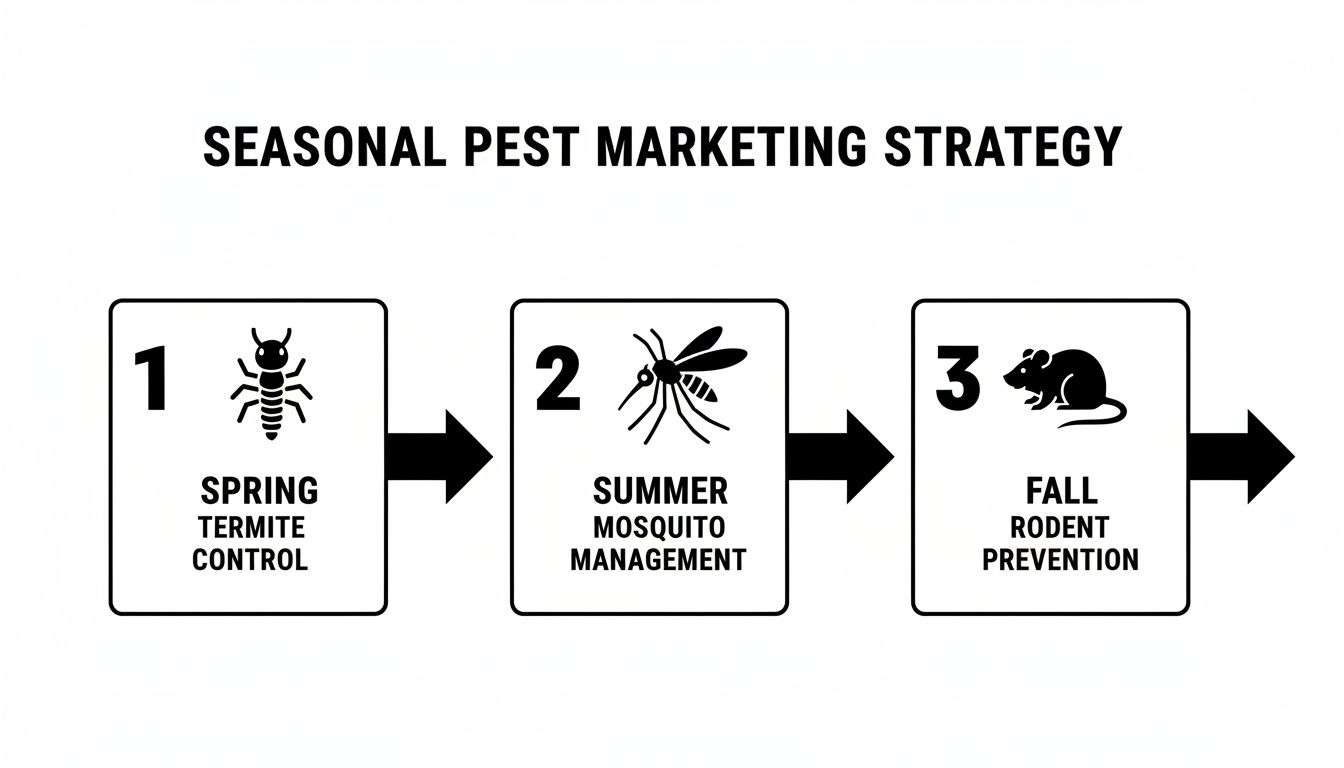
As you can see, the strategy pivots throughout the year. We lean into termite control campaigns in the spring, shift to mosquito management in the thick of summer, and then focus on rodent prevention as fall rolls in.
Action Step 5: Create a Simple Content Calendar: You don't need to become a full-time publisher. Just plan for one helpful blog post and four social media posts per month. Actionable Example: For March, plan a blog post titled "SWFL Termite Swarm Season: What Every Homeowner Needs to Know" and four related Facebook posts (e.g., a video showing termite vs. ant, a tip on checking window sills, a testimonial from a termite job, an ad for free inspections).
Action Step 6: Measure Your Return on Ad Spend (ROAS): Now we get to the good part. Track how many leads from your ad campaigns actually turn into paying jobs. You should be aiming for a ROAS of 3:1 or higher. That means for every $1 you put into ads, you’re generating at least $3 in new revenue. That's how you build a profitable growth engine.
A Few Common Questions We Hear
When you're running a pest control business, you don't have time for vague marketing answers. You need to know what works, what it costs, and where to start. Here are the straight answers to the questions we get asked most often by owners here in Southwest Florida.
What’s a Realistic Budget for Pest Control Ads?
For a small or mid-sized pest control company jumping into pay-per-click (PPC) ads, a realistic starting point is between $1,000 and $2,500 per month. That's not a random number we pulled out of a hat; it's the budget needed to actually compete and see a return.
That level of investment gives you enough firepower to show up for valuable keywords in hot markets like Naples or Fort Myers. More importantly, it gathers enough data for us to see what’s working and what isn't. If you start too small—say, under $500 a month—you often won’t get enough clicks to make smart decisions, and that’s how money gets wasted.
Here's a Real-World Example: With a $1,500 monthly budget, the goal would be to generate around 30-40 qualified leads. If your average Cost Per Lead (CPL) is in the $40-$50 range, you've got a solid pipeline of opportunities to turn into profitable jobs.
How Long Does SEO Really Take to Show Results?
While PPC can get your phone ringing tomorrow, Search Engine Optimization (SEO) is a long game. Think of it like planting an oak tree, not flipping a light switch. You're building real, lasting authority with Google, and that simply takes time.
Generally speaking, you can expect to see real traction in your local search rankings within 3 to 6 months of consistent, focused effort. That means dialing in your Google Business Profile, building out content for all your service areas, and creating a system for getting new customer reviews. The best part? The results build on themselves over time, creating a powerful lead source that costs less and less per lead.
What's the Very First Thing I Should Do?
If you do only one thing after reading this guide, make it this: Completely and thoroughly optimize your Google Business Profile (GBP). It is, without a doubt, the single most powerful and cost-effective first step in any digital marketing for pest control plan.
And I don't just mean filling in your name and address. A properly optimized profile means:
- Getting specific with service categories: Don't just list "Pest Control Service." Actionable Example: Add "Termite Control," "Rodent Exterminator," "Bed Bug Treatment," and everything else you do.
- Uploading at least 10 geo-tagged photos: Show off your branded trucks in Naples, your team in Cape Coral, and your technicians on a job in Fort Myers. This proves to Google you're a real, local operation.
- Building out your services: Use the "Products" or "Services" feature to list every single service you offer, complete with descriptions and even starting prices if you want. Actionable Example: Create a service listing for "Quarterly Pest Prevention Plan," add a description of what it covers (ants, roaches, spiders), list the price, and link it to the sign-up page on your website.
Your GBP is your digital storefront, especially on Google Maps where homeowners with an urgent problem are looking. Getting it right costs you nothing but a little bit of your time, and the payoff is huge.
Ready to stop guessing and start getting calls? The team at Polaris Marketing Solutions builds practical, ROI-focused marketing plans that make the phone ring for home service businesses across Southwest Florida. Get your free, no-obligation competitor analysis and see exactly where you stand. Learn more at https://polarismarketingsolutions.com.