

If you're a business owner staring at a keyword list and wondering why none of it seems tied to actual revenue, you're not alone. Most keyword research advice is built for marketers chasing traffic charts, not for a roofing company in Fort Myers, a law office in Naples, or an HVAC contractor in Cape Coral trying to generate calls this month.
That's the problem. Traffic alone isn't the win. A term can bring visitors and still waste your time, your content budget, and your patience. If the keyword doesn't line up with what a buyer wants right now, it may never turn into a form fill, booked estimate, or phone call.
Profitable keyword research looks different when you run a local business. You care about whether someone is ready to hire, compare options, request pricing, or solve an urgent problem nearby. That changes which keywords matter, how you evaluate them, and what kind of pages you build around them.
Shift Your Focus from Volume to Value
The first change is mental, not technical. A profitable keyword is not the one with the biggest search volume. It's the one most likely to lead to business.
A lot of small business owners fall into the same trap. They see a broad term like "roofer" or "roofing materials," assume bigger traffic means bigger opportunity, and start building content around it. Then they attract people doing research, browsing product ideas, or looking for something they don't even sell.

Ahrefs makes this point clearly in its guide to keyword research for business-focused SEO. It says keyword research is about finding keywords that make the most sense for the business, and it recommends prioritizing terms that align with what a buyer wants to do, such as compare, hire, buy, or book.
What profitable intent looks like
A Fort Myers contractor doesn't need random visitors. They need someone searching with urgency and local intent.
Here's the difference in plain terms:
| Keyword | Likely intent | Business value |
|---|---|---|
| roofing materials | Research | Low for a local service company |
| how long does a roof last in florida | Information gathering | Medium if used in blog content |
| roofer fort myers | Vendor search | High |
| emergency roof repair fort myers | Immediate service need | Very high |
| metal roof vs shingle florida | Comparison | High if you offer both |
The keyword isn't valuable because it sounds important. It's valuable because it reflects where the searcher is in the buying process.
Use this quick test before adding any keyword
Before you keep a keyword, ask:
- Would this search lead naturally to a phone call? If yes, keep it high on the list.
- Does the searcher sound like a buyer or a browser? "Hire," "repair," "cost," "near me," and city-modified service terms usually signal stronger intent.
- Do you offer the service? This sounds obvious, but many sites target loosely related phrases and pull in traffic that never converts.
- Would you want your sales team spending time on this lead? If the answer is no, the keyword probably isn't profitable.
Practical rule: If a keyword brings the wrong visitor, ranking for it can still be a loss.
Intent matters more than vanity metrics
There are three broad intent types that matter most in local SEO:
- Informational searches like "how to stop AC from freezing up" can support blog content and build trust.
- Navigational searches like your company name or a competitor's name matter for brand visibility.
- Transactional and commercial searches like "paver sealing Bonita Springs" or "family lawyer Fort Myers consultation" are usually where the money is.
If you're learning how to find profitable keywords, this is the filter that changes everything. Start with buyer intent, then evaluate the rest. A lower-volume local phrase with a clear need often beats a broader term that never turns into business.
Generate Keyword Ideas Beyond the Obvious
The best keyword ideas often don't come from a tool. They come from the conversations you're already having with customers.
Standard tools are useful, but they miss a lot of the language real buyers use. One independent guide on profitable low-competition keywords points out that many high-value opportunities are found outside keyword tools, including forums, on-site search data, brand mentions, and customer interviews.
Start with customer language
If you want better keywords, listen closer. Customers rarely speak in polished SEO phrases. They describe problems in plain language, often with details that reveal intent.
A paving company might think the target keyword is "paver installation." A customer might ask:
- can you fix sinking pavers around a pool
- how much does a permeable paver driveway cost
- who installs driveway pavers in Fort Myers
- do pavers need sealing in Florida
Those are not small details. They're clues about service demand, urgency, and the exact wording buyers use before they hire.
Three reliable ways to find keyword ideas without a tool
Review emails, texts, and estimate requests
Go through recent inquiries and highlight repeated phrases. Look for patterns in how people describe services, problems, and locations.
Examples:
- "screen enclosure repair after storm"
- "tile roof leak around chimney"
- "weekly office cleaning Fort Myers"
- "urgent AC repair in Estero"
These phrases often turn into strong service page or FAQ targets because they come directly from buyers.
Check competitor service pages
Pick a few local competitors and review their main pages, subpages, FAQs, and blog topics. You're not copying them. You're checking which services they emphasize and where they go deeper.
If one competitor has separate pages for "pool deck pavers," "driveway pavers," and "patio paver repair," that's a signal that search behavior may be more segmented than you assumed. If you want a helpful primer on more specific phrase structures, this guide to long tail keywords for contractors is useful.
Browse local groups and community discussions
Facebook groups, Nextdoor threads, Reddit discussions, neighborhood forums, and local comments sections are full of unfiltered demand. People ask questions there the same way they'd type them into Google.
Look for hyperlocal modifiers and recurring concerns:
- South Fort Myers
- Gulf access home
- HOA pressure washing rules
- storm damage cleanup
- mold smell in AC vents
Buyers don't search the way marketers label services. They search the way problems show up in real life.
Build your seed list from demand, not assumptions
A simple spreadsheet is enough at this stage. Create columns for:
- keyword phrase
- customer source
- likely intent
- local modifier
- page type idea
That last column matters. If a phrase sounds like someone wants a quote, it may belong on a service page. If it sounds like someone is comparing options, it may fit a blog post or FAQ.
When people ask how to find profitable keywords, they're often expecting a tool recommendation. The better answer is this: start by listening to the market, then use tools to validate what you found.
Use SEO Tools to Quantify Keyword Potential
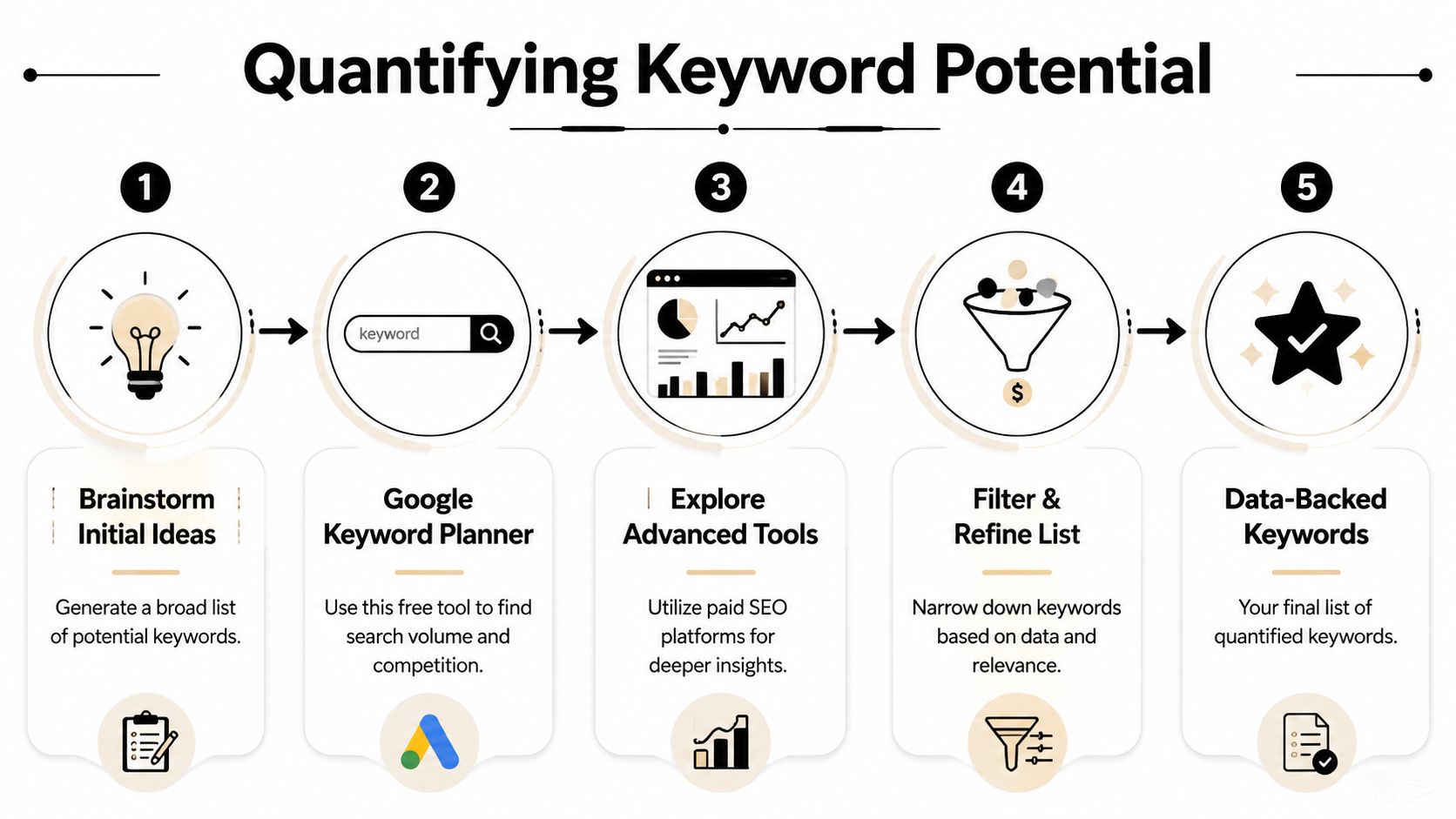
Once you have a real list of ideas, tools help you stop guessing. They won't tell you what your customers mean better than your own sales inbox will, but they do help you compare opportunities with more discipline.
Google says Keyword Planner is built to "find the keywords that are most relevant for your business." More advanced platforms also use data points like monthly search volume, trends, and competition to isolate opportunities. The same source context notes that some experts recommend filters such as greater than 100 search volume and fewer than 200 competing products to surface less competitive terms.
What to check in a keyword tool
For a local business, three metrics usually matter most.
Search volume
Search volume tells you whether people search for the term often enough to justify attention. But local businesses need to read this carefully. A lower-volume phrase can still be excellent if the intent is strong and the geography is tight.
"Emergency plumber Fort Myers" may matter more than a much broader phrase with more searches because the buyer is closer to action.
Competition or difficulty
This helps you estimate how hard it may be to rank. Small business sites usually shouldn't build their whole strategy around the hardest terms first. If your site is newer or thinner than the businesses already on page one, choose targets where you can plausibly compete.
CPC as a commercial signal
If you also run paid search, cost-per-click can offer a useful clue about commercial value. In practice, a keyword that advertisers are willing to pay for often signals stronger buying intent than a purely informational phrase. CPC isn't a perfect filter on its own, but it can help you separate "interesting topic" from "likely revenue topic."
A simple way to score local keyword opportunities
Don't overcomplicate this. Use a short scoring system in your spreadsheet.
- High fit if the keyword matches a real service you sell
- High intent if the searcher sounds ready to call, book, or request pricing
- Winnable if the competition looks realistic for your current site
- Local relevance if the phrase includes city, neighborhood, or service-area context
If a keyword checks all four, it's worth serious attention even if the volume looks modest.
Use free tools first, then go deeper if needed
A practical stack for many small businesses looks like this:
- Google Keyword Planner for relevance, variations, and broad demand signals
- Google Search Console for discovering terms you're already showing up for
- Paid platforms if you want deeper data on keyword clusters, competitor overlap, and content gaps
If competitor research is part of your process, this overview of competitor analysis tools for SEO can help you compare options without buying more software than you need.
Long-tail terms often give small businesses the best shot
Helium 10 defines long-tail keywords as phrases with 3 or more words in the verified background material, and that matches what local businesses see in practice. These phrases are usually narrower, closer to a specific need, and often less competitive than broad head terms.
Examples:
- AC repair
- AC repair Fort Myers
- emergency AC repair Fort Myers FL
- AC capacitor replacement Estero FL
Each step adds specificity. That usually sharpens buyer intent and reduces wasted traffic.
A good keyword isn't just searched. It's relevant, winnable, and tied to a service you can profitably deliver.
Analyze SERPs to Vet Your Keyword List
Tool data gives you a shortlist. Google's live results page tells you whether the keyword is worth pursuing.
That manual check matters because the search results reveal what Google believes the searcher wants. A keyword can look promising in a tool and still be a poor target if the page one results are dominated by giant brands, mismatched content types, or SERP features that push organic listings down.

A strong technical filter is to evaluate each candidate by search volume, competition, and relevance, then inspect the current top results to see what content types rank and whether features like local packs or featured snippets appear, as explained in this guide to SERP-based keyword evaluation.
What to look for on page one
Search your target term in an incognito browser and study the results like a buyer would.
Is there a local pack
If Google shows a map pack, that usually signals local service intent. That's good news for contractors, clinics, law firms, and other local operators. It means your Google Business Profile and local SEO signals matter alongside your website page.
What kind of pages rank
Check whether page one is filled with:
- service pages
- homepages
- listicles
- blog posts
- directories
- forum threads
If the results are mostly service pages, Google likely expects a commercial page. If the results are mostly informational guides, trying to rank a sales page may be an uphill fight.
Who owns the results
Look at the actual sites ranking. Are they local competitors with similar authority, or are they major national brands and giant directories? A small Fort Myers business can compete in many local searches. It may struggle on broader terms where page one is stacked with heavy domains.
A quick example of a bad fit and a better fit
Suppose you target "HVAC repair." The term sounds attractive, but page one may include large directories, established brands, and broad pages that aren't localized enough for a smaller site to outrank.
A more practical target could be something like "AC capacitor replacement Estero FL" if that reflects a real service and the SERP shows more reachable competition.
This is also where a lightweight option like ShuttleSEO's free keyword competition tool can help you pressure-test a phrase before committing content time to it.
Use keyword gaps carefully
Keyword gap analysis is useful, but only when paired with SERP review. If a competitor ranks for a term and you don't, that doesn't automatically mean you should chase it.
You need to know:
- whether the keyword fits your services
- whether the ranking page type matches what you can build
- whether your site can realistically earn a spot
If you want a clearer process for that comparison, this guide on keyword gap analysis gives a workable framework.
A short walkthrough helps here:
A simple pass or fail checklist
Use this before approving any keyword:
| Question | Pass if | Fail if |
|---|---|---|
| Does the SERP match your page type? | Service pages rank for service intent | Only blogs rank and you want a sales page |
| Is local intent visible? | Map pack or local businesses appear | Results are mostly national |
| Can your site compete? | Similar local sites are ranking | Results are dominated by stronger brands |
| Is the topic relevant to your offer? | It maps to a real service or buying-stage question | It attracts curiosity, not leads |
If page one tells you Google wants a different answer than the one you're planning to publish, trust the SERP.
Prioritize and Map Keywords to Your Website
A keyword list becomes useful when you turn it into page decisions. Until then, it's just inventory.
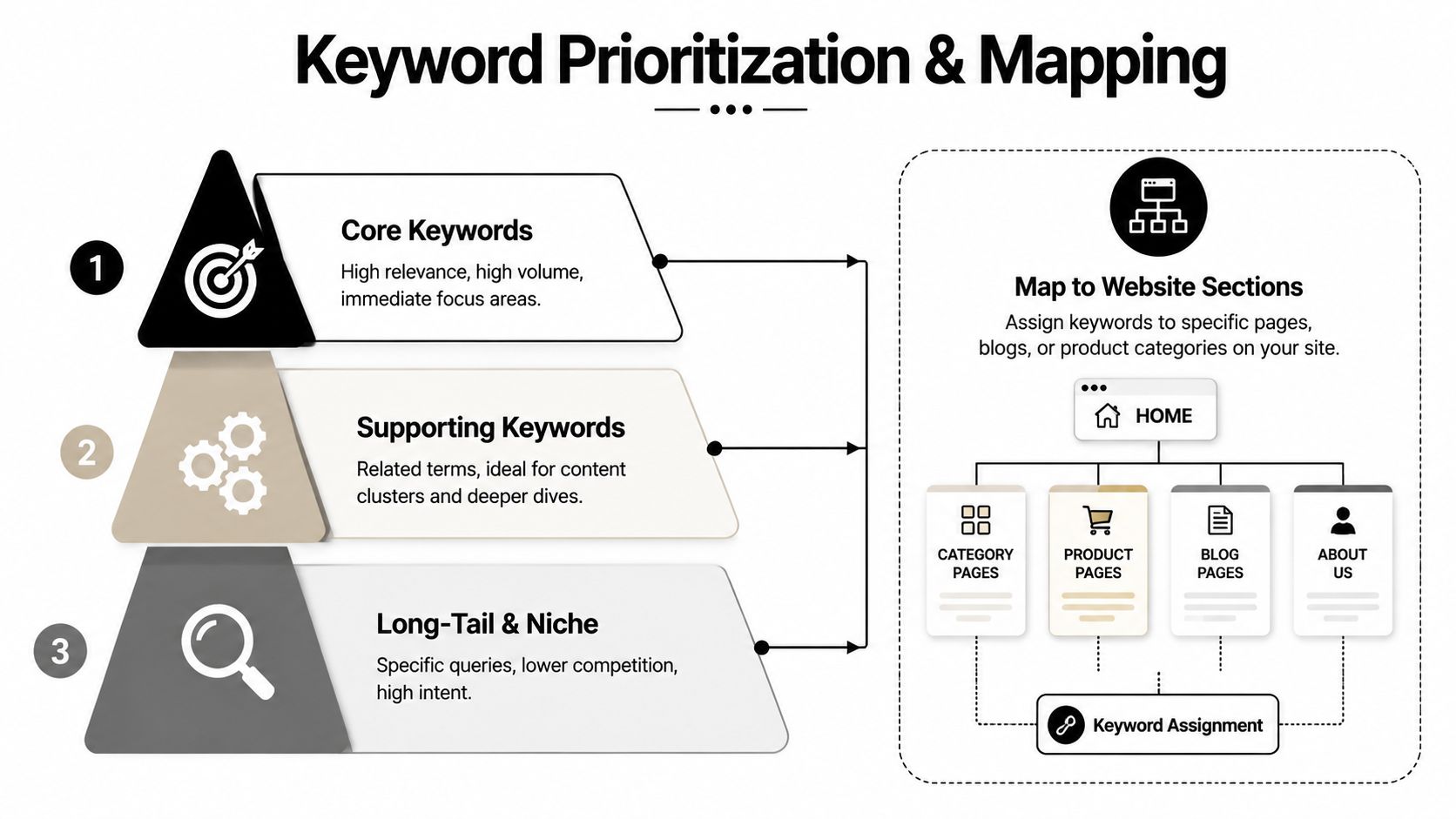
The most practical way to organize your list is to sort keywords into two working groups: high-value keywords and low-hanging fruit. Kinsta describes an expert workflow that includes seed expansion, competitive gap analysis, and then intent filtering into those buckets, while clustering related terms to avoid keyword cannibalization in its guide to keyword research workflows.
Two buckets that keep the plan practical
High-value keywords
These are the phrases most tied to revenue. They usually have strong service intent and deserve their own core pages.
Examples:
- roof repair fort myers
- family lawyer naples
- paver sealing bonita springs
- emergency plumber cape coral
These are often harder than niche phrases, but they belong near the center of your SEO strategy because they're closely tied to leads.
Low-hanging fruit
These are narrower opportunities with clearer specificity and a more realistic ranking path.
Examples:
- tile roof leak repair fort myers
- how to clean lanai pavers
- AC not cooling after storm estero
- commercial janitorial service for medical office fort myers
These terms can produce earlier wins, support topical authority, and often convert well because the query is specific.
Map each keyword to the right page type
Many sites often go off track. They target a good keyword with the wrong page.
Use this matching logic:
- Service pages for transactional phrases such as "water damage restoration Fort Myers"
- Location pages for city-specific service combinations
- Blog posts for question-based and educational searches
- FAQ sections for short, recurring objections or comparison queries
- Content hubs for larger service themes with many related subtopics
This is what that can look like in practice:
| Keyword type | Example | Best destination |
|---|---|---|
| Transactional | paver sealing Bonita Springs | Service page |
| Local commercial | divorce lawyer Fort Myers | Location or service-location page |
| Informational | how long does a shingle roof last in Florida | Blog post |
| Comparison | metal roof vs shingle Florida | Blog post or guide tied to service page |
| Specific niche service | pool cage screen repair Estero | Dedicated service page |
Avoid cannibalization before it starts
Cannibalization happens when multiple pages compete for the same idea. A common example is creating separate weak pages for "roof repair Fort Myers," "Fort Myers roof repair," and "roofers Fort Myers repair." Those usually belong in one strong page, not three near-duplicates.
Cluster close variants into a single page when the intent is the same. Split them only when the service, location, or user need is clearly different.
Working rule: One primary keyword theme per page, supported by close variations that share the same intent.
If you want one mention of a done-for-you option, agencies like Polaris Marketing Solutions handle keyword research, mapping, and local SEO implementation for businesses that don't want to build this process internally.
Track Performance and Prove Profitability
A keyword isn't profitable because it ranks. It's profitable because it helps produce business.
That sounds obvious, but a lot of SEO reporting still stops at impressions, rankings, and traffic. Those metrics matter, but they don't answer the question most owners care about: did this keyword help generate leads?
Start with Google Search Console
Moz recommends using Google Search Console to find queries with high impressions but low clicks as untapped opportunities in the verified guidance provided earlier. That's one of the best places to spot pages that are visible but underperforming.
In Search Console, pay attention to:
- Impressions to see which keywords Google is already testing your pages for
- Clicks to see whether searchers choose your result
- Click-through rate to spot pages that may need stronger titles and descriptions
- Landing pages to see which pages attract search demand tied to business goals
A local service page that earns impressions but few clicks may need a clearer title, better service language, or stronger location relevance.
Then connect traffic to lead actions
Google Analytics helps you see what those visitors do once they arrive. For local businesses, the useful events usually include:
- phone number clicks
- contact form submissions
- appointment requests
- direction requests
- quote form completions
Keyword strategy is held accountable. If a page brings modest traffic but consistently drives calls, that page is probably doing its job. If a page pulls in lots of visits and no meaningful actions, it may be attracting the wrong searches.
Review performance like an owner, not just a marketer
A simple monthly review works well:
- Check Search Console for gains in impressions and clicks on target pages.
- Check Analytics for lead actions tied to those pages.
- Compare page intent to outcomes. Are informational pages assisting conversions later? Are service pages generating direct inquiries?
- Adjust the plan. Expand pages that attract qualified traffic. Rework or retire pages that don't.
If you want a broader primer on mastering SEO analytics, that resource is a useful companion for building a cleaner reporting habit. For tying all of this back to business outcomes, this guide on measuring marketing ROI is also useful.
The businesses that get the most from SEO don't just ask, "Where do we rank?" They ask, "Which pages produce calls, forms, and sales conversations?" That's the standard to use when judging whether you've really learned how to find profitable keywords.
If you want help turning keyword research into a local SEO plan that targets real leads in Fort Myers, Cape Coral, Estero, Bonita Springs, and nearby markets, Polaris Marketing Solutions can help you identify high-intent opportunities, map them to the right pages, and track whether they drive ROI.