

If you're running an HVAC company, you already know the pattern. The phone spikes when weather turns ugly, slows when the season shifts, and too often depends on whatever ad or referral source happened to work that month. Local SEO changes that. It gives you a system for showing up when someone nearby needs AC repair, furnace service, or a same-day estimate.
That matters because 84% of consumers contact an HVAC company after searching online according to MAK Digital Design's HVAC local SEO guide. In other words, most of the buying journey starts before your dispatcher says hello.
Good local SEO for HVAC companies isn't a bag of tricks. It's an operating process. Your Google Business Profile has to reflect your real service area. Your website has to mirror how people search. Your team needs a review habit. Your off-site signals need cleanup. And your reporting has to tell you whether this work is producing calls, forms, and booked jobs.
The Foundation Your Google Business Profile
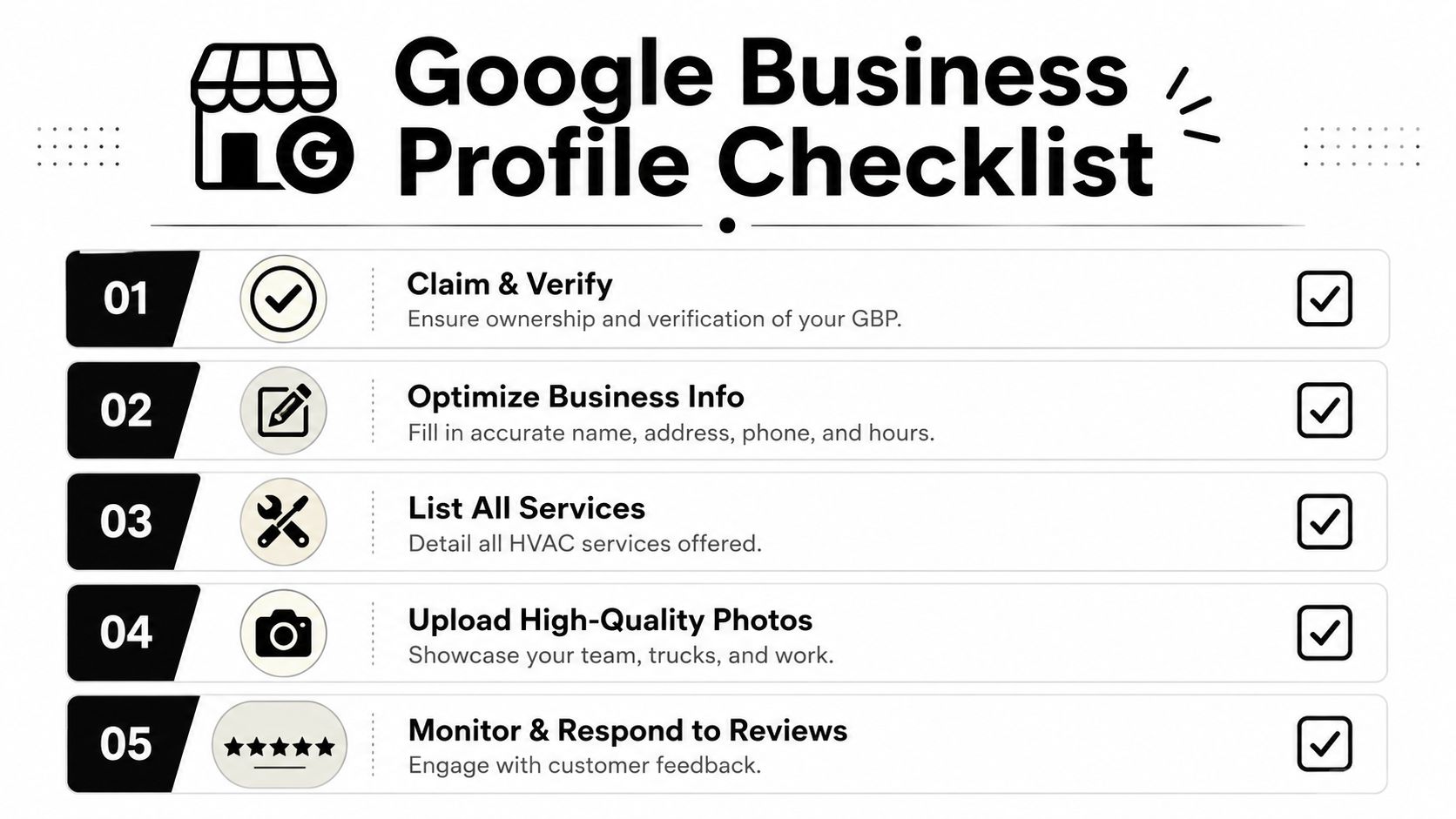
Your Google Business Profile is usually the first thing a homeowner sees. Before they read your About page, they see your hours, reviews, service category, photos, and whether you look like a legitimate local contractor. If that profile is incomplete or sloppy, you lose trust before the click.
Fill every field like it affects revenue
It does.
A technically sound setup means your profile details and your website details match. Comrade Web's HVAC local SEO guidance recommends validating all Google Business Profile fields and aligning them with a site structure built around one core service per page and one core location per page. That alignment helps Google map a search to the right business and page.
Start with these basics:
- Business name: Use your real trading name. Don't stuff in extra city names or services.
- Phone number: Use the main line your office answers.
- Hours: Set normal hours and update holiday hours.
- Categories: Pick the closest primary category to your main revenue service. Then add secondary categories only if they reflect real work you perform.
- Services: List actual services like AC repair, furnace installation, heat pump service, ductless mini-split installation, indoor air quality, and maintenance agreements.
If you offer emergency work, mention it clearly in services and business description. If you don't, don't imply it.
Practical rule: Your profile should describe the company your dispatcher can support today, not the company you hope to become next year.
Photos matter more than most owners think. Upload branded truck photos, team photos, office shots, jobsite images, and before-and-after equipment installs. Avoid stock images. Homeowners can tell.
Set your service area honestly
A lot of HVAC companies hurt themselves in this regard.
HVAC businesses should set their service radius truthfully and avoid creating location pages for places they don't realistically serve, because overstating coverage can weaken Google's proximity and relevance signals according to Gushwork's local SEO advice for HVAC contractors. If your trucks rarely go two counties away, don't pretend that market is part of your daily footprint.
Use your real dispatch map:
- Primary zone: Areas you serve daily with no hesitation.
- Secondary zone: Areas you serve when schedule and margin make sense.
- Edge zone: Jobs you only take for installs, high-ticket replacements, or commercial accounts.
Your Google Business Profile should focus on the first two. Your website should do the same.
Use posts and products like a sales rep would
Most HVAC companies either ignore GBP Posts or treat them like social filler. Use them for buyer intent.
Examples:
- Spring AC tune-up special
- Same-day no-cool diagnostic availability
- Heat pump rebate consultation
- Indoor air quality add-on for allergy season
- Financing options for full system replacement
If your profile supports Products, use it to showcase categories homeowners understand. You can feature system types, maintenance plans, thermostats, air purifiers, or premium install packages. Keep the copy practical: what it is, who it's for, and how to call.
If you want a tighter process for calls and profile actions, this guide on how to turn local searches into phone leads is worth reviewing alongside your own call handling workflow.
For a field-by-field review, use a working checklist instead of memory. This Google Business Profile optimization checklist is a good format to hand to whoever owns the task internally.
Building Your Digital Service Area with Website Content
A homeowner in Fort Myers searches “AC repair near me” at 6:30 p.m. If your site only has a general Services page, you make Google guess which city you serve and which job you want. That guess usually favors a competitor with a page built for that exact search.
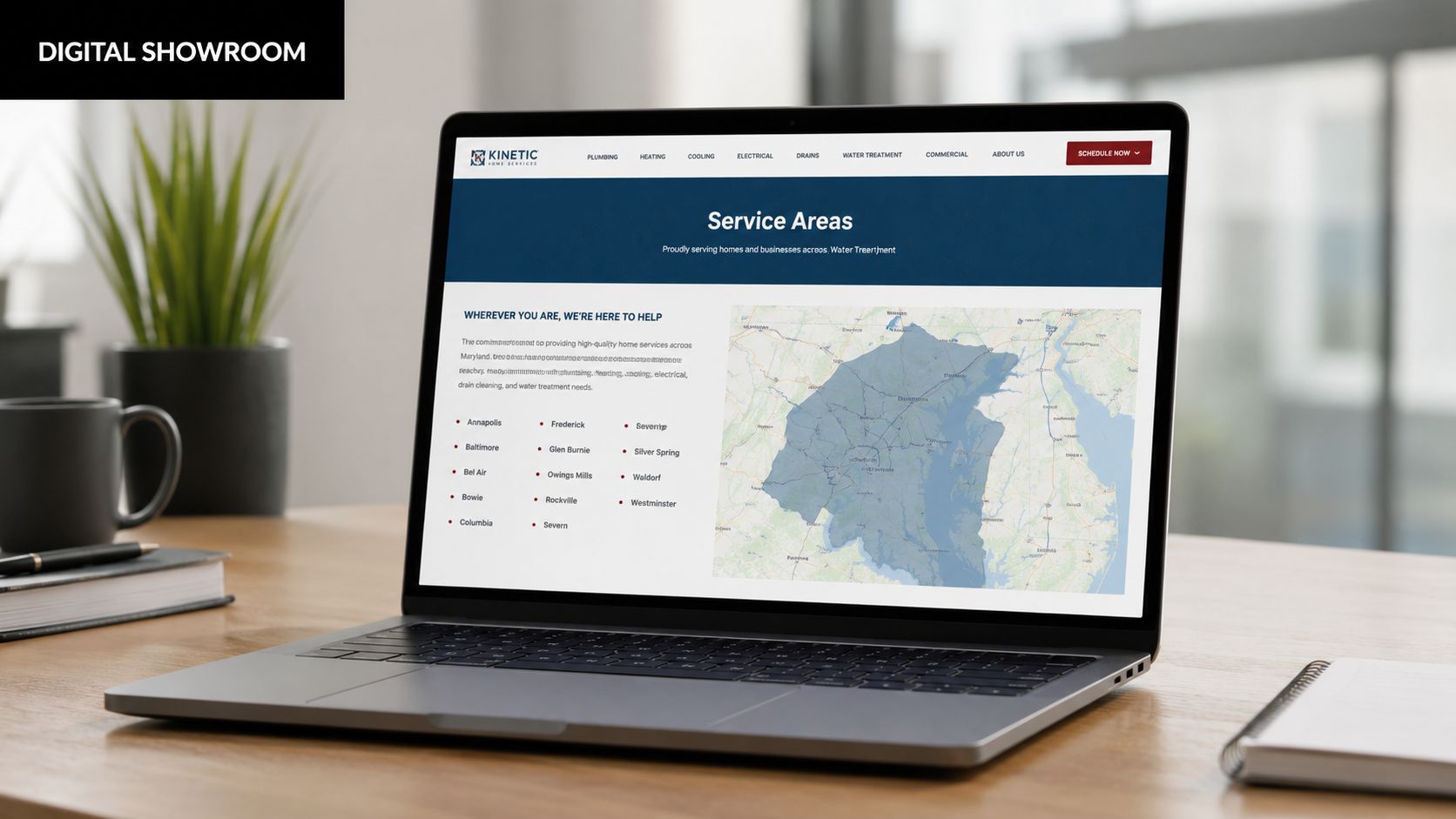
Your website needs to mirror how your business operates. If your trucks handle AC repair, furnace installs, and mini-split work across specific cities, your site should map those service and location combinations clearly.
Build around one service and one location
The cleanest setup is one page for one service, then separate location pages where search demand and revenue potential justify the work.
Start with core service pages:
- One page for AC repair
- One page for furnace repair
- One page for heat pump installation
- One page for ductless mini-split service
Then build location-specific versions for the combinations that matter:
- AC Repair in Fort Myers
- Furnace Installation in Cape Coral
- Ductless Mini-Split Service in Naples
That one-service, one-location structure is a practical fit for HVAC because it matches search behavior and keeps the page intent clear, as noted in Comrade Web's HVAC local SEO guide.
Resist the urge to build 40 pages at once. Start with the services that drive the best margin and the cities you already serve consistently. A smaller set of useful pages beats a large set of weak pages every time.
What a strong location page actually includes
A location page has one job. Prove you do this work in this area and make it easy to contact you.
Use this structure.
| Element | Content Example / Purpose |
|---|---|
| Page title | “AC Repair in Fort Myers, FL” or “Furnace Installation in Cape Coral” |
| H1 heading | Match the main service and location clearly |
| Opening paragraph | State the service, the area served, and the customer problem you solve |
| Local proof | Mention neighborhoods, common housing types, or climate-related service issues in that area |
| Service details | Explain what's included in repair, installation, or maintenance work |
| Trust elements | Add reviews, technician photos, certifications, or financing info |
| Call to action | Use a clear next step such as call now, book service, or request estimate |
| Map or service area reference | Reinforce geographic relevance and help users confirm coverage |
| Internal links | Link to related services like maintenance plans, indoor air quality, or emergency service |
| FAQ block | Answer local buyer questions such as same-day availability, system types serviced, or maintenance timing |
Thin duplication is where HVAC sites usually fall apart. Swapping city names into the same copy across ten pages wastes time and rarely ranks well. Homeowners can tell when the page was written for a search engine instead of a real service area.
Copy-and-use location page template
Use this as your base, then tailor it with details your dispatch team would recognize.
H1
AC Repair in [City]
Intro
When your system stops cooling in [City], you need an HVAC team that can diagnose the issue quickly and explain the repair clearly. We handle residential AC repair across [City] and nearby service areas, including [Neighborhood 1], [Neighborhood 2], and [Neighborhood 3].
Section heading
Common AC problems we fix in [City]
Then list issues your techs see:
- Frozen evaporator coils
- Capacitor failure
- Refrigerant leaks or low charge
- Thermostat problems
- Drain line clogs
- Weak airflow
Section heading
Why homeowners in [City] call us
Add operational proof:
- Trucks already scheduled in the area
- Familiarity with local home age, layouts, or builder-grade systems
- Clear repair-versus-replace recommendations
- Direct phone contact and realistic scheduling windows
Section heading
What to expect when you book service
Set expectations in plain language:
- Call or form submission received
- Dispatch confirms timing
- Technician diagnoses the issue
- Repair options explained before work starts
Section heading
Related HVAC services in [City]
Link to installation, maintenance, indoor air quality, and emergency service pages.
CTA
Need AC repair in [City]? Call [Business Name] to schedule service.
This works best when it becomes a repeatable process, not a one-off writing task. Give your office staff a short intake form for each target city: neighborhoods served, common equipment brands, common repair calls, financing offers, and technician notes. That gives your writer enough real detail to make each page distinct.
The same process applies to trust elements on-page. Pull two or three relevant reviews into the city page, then give your team a script for collecting more. If you need a repeatable way to ask customers after a completed job, this guide on how to get more online reviews is useful to build into your closeout process. For follow-up language and review workflow support, The AI CMO home service tools can help your team respond without sounding canned.
A good location page should read like your service manager reviewed it before it went live. That is usually the difference between a page that sits there and a page that brings in calls.
Creating Trust with Citations and Reviews
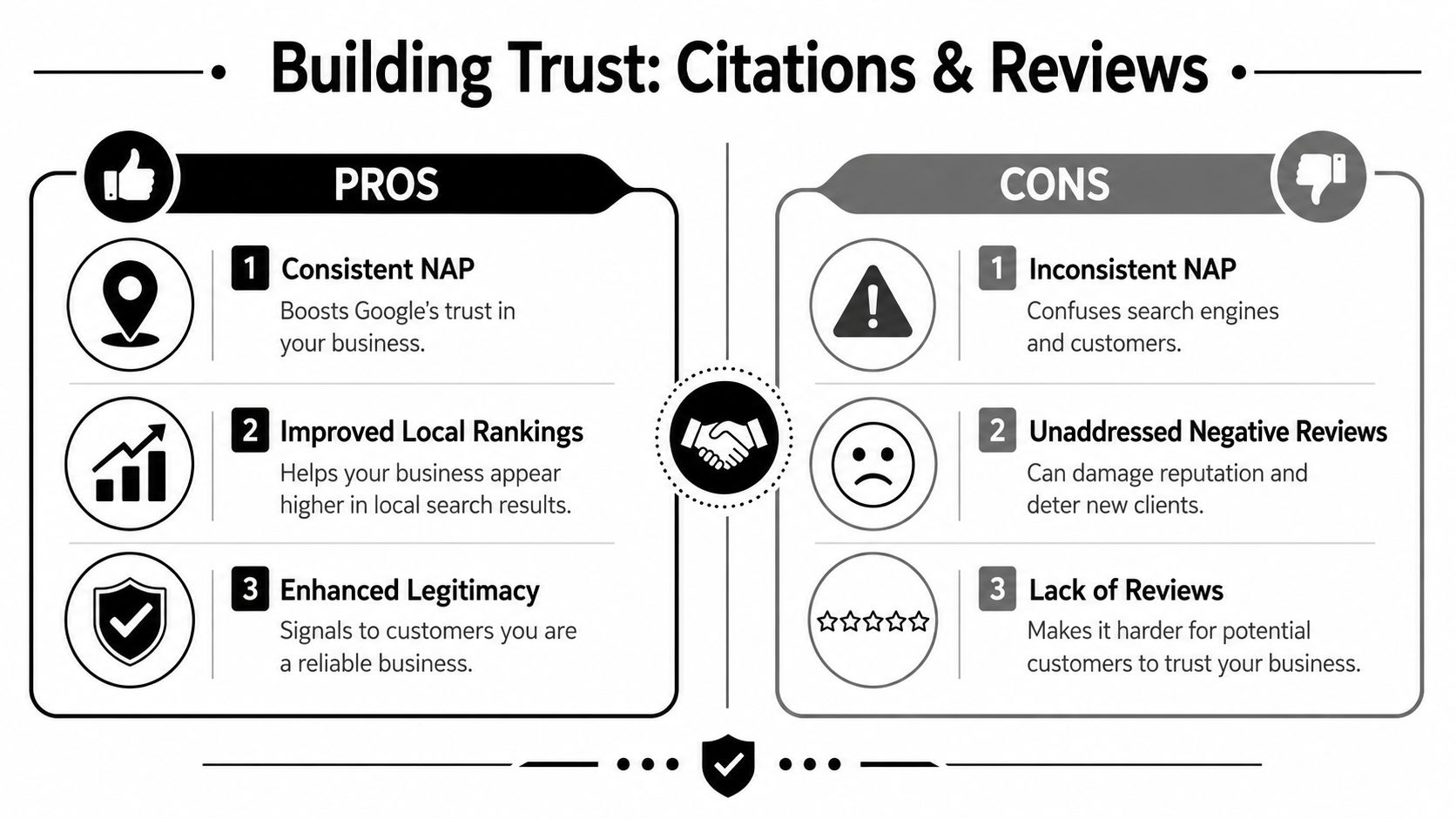
Local SEO isn't just what sits on your site. Google also looks at what the rest of the web says about you. For HVAC companies, that usually comes down to two off-site trust signals: citations and reviews.
Citations tell search engines your business information is consistent. Reviews tell both Google and homeowners that your company is active, real, and trusted.
Run a citation audit before chasing anything new
A lot of HVAC owners keep adding directory listings while old ones still show the wrong suite number, an outdated phone line, or old branding from a previous website.
Audit your core listings first:
- Google Business Profile
- Yelp
- Angi
- Better Business Bureau
- Apple Maps
- Bing Places
- Major local directories
- Industry associations or chambers
Check four things every time:
- Business name: Same formatting everywhere
- Address: Same spelling, suite format, and punctuation
- Phone number: Same primary number
- Website URL: Same canonical version
If your company changed names, moved offices, or switched tracking numbers years ago, clean that up before you spend money on more SEO work. Inconsistent citations muddy local trust.
Build a review system your technicians can actually follow
Review management is a measurable ranking factor. One HVAC SEO guide recommends targeting at least 50 reviews, asking after completed service, and responding to every review according to Nopio's HVAC SEO guide. The important part operationally isn't just the number. It's the process.
Here is a simple field script a technician can use right after a successful job:
“I'm glad we got that fixed for you today. If you're comfortable with it, would you mind leaving us a quick Google review? It helps other homeowners know we're a real local company, and I can text you the link now.”
That works because it's direct, low-pressure, and tied to the completed service moment.
Here is a short SMS follow-up template:
Hi [First Name], thanks for choosing [Company Name] for your HVAC service today. If you have a minute, we'd appreciate your feedback here: [review link]
And a short email version:
Subject: Thanks for choosing [Company Name]
Thanks again for trusting us with your HVAC service. If you'd share a quick review, it would mean a lot to our team and helps other local homeowners choose with confidence.
[review link]
If you want help drafting replies at scale without sounding robotic, The AI CMO home service tools can be useful for response structure. You still need a human to review tone before posting.
A stronger internal process for collecting customer feedback is also worth documenting. This guide on how to get more online reviews lays out a simple workflow you can adapt.
Here's a useful walkthrough on review handling and local visibility:
Respond to every review, especially the awkward ones
Positive review response template:
Thanks, [Name]. We appreciate you trusting us with your [service type]. Glad our team could help.
Negative review response template:
Thanks for the feedback, [Name]. We're sorry the experience didn't meet expectations. We'd like to look into it and make it right. Please contact our office so we can review the service details with you.
Don't argue in public. Don't copy-paste the same response ten times. Don't ignore bad reviews and answer only good ones. That pattern tells people more than the rating itself.
Generating Local Links That Matter
A citation is a mention. A link is a recommendation. Those are not the same thing.
A lot of HVAC companies waste time buying junk placements or submitting to low-value directories that never send traffic, never produce a call, and barely move rankings. Local links that matter usually come from relationships, partnerships, and visible community activity.
The links worth chasing have business value outside SEO
Think about the local websites that a homeowner might trust.
Good examples include:
- A property management company listing preferred HVAC vendors
- A local builder or remodeler naming trade partners
- A real estate blog recommending pre-sale HVAC inspections
- A chamber of commerce member profile
- A youth sports sponsorship page
- A local charity event page featuring sponsors
- A supplier or manufacturer dealer locator page if you qualify
Those links help because they make sense in the actual world. They reflect actual local presence. That's what search engines want to see.
By contrast, random blog network links and mass directory blasts usually create busywork. They may look impressive on a spreadsheet, but they rarely connect to local buying intent.
A simple partner outreach angle
Most business owners overcomplicate link outreach. Keep it grounded in mutual benefit.
If you already work with a local realtor, property manager, plumber, electrician, insulation company, or restoration firm, ask for a resource-page mention. You don't need a long pitch.
Use something like this:
We work with a lot of homeowners in overlapping situations, so it may help your clients if you list us as a local HVAC resource on your site. Happy to return the favor where it makes sense.
That works better than generic “would you link to my website” emails because it's tied to actual customer usefulness.
Local links are strongest when you'd still want the relationship even if Google didn't count the link.
Where to look this month
If you want a practical starting list, pull these from your existing business network:
Vendors and suppliers
Ask whether they maintain dealer or contractor directories.Referral partners
Realtors, plumbers, electricians, roofers, and restoration firms often have partner pages.Community involvement
Any team, fundraiser, school event, or nonprofit you support should mention your company online.Trade and civic organizations
Chamber listings, BNI groups, and local business associations can be useful when they are legitimate and maintained.
For companies that need a structured outreach process, local link building service options can help organize prospecting, outreach, and follow-up. The important part is quality control. A few relevant local links beat a pile of irrelevant ones.
Advanced Technical Signals for Local Dominance
Technical SEO scares a lot of contractors because it sounds like developer-only work. Most of it can wait. One technical task doesn't have to wait: local business schema.
Schema is structured data placed on your site so search engines can understand your business details more clearly. For local SEO for HVAC companies, that means reinforcing who you are, where you operate, what you do, and how customers should contact you.
Why schema matters more now
As local search becomes more conversational and AI-driven, HVAC companies need structured service pages and entity-level clarity that can answer question-based prompts about emergency repairs, pricing, and same-day availability, as noted in Hook Agency's SEO guidance for HVAC contractors.
That doesn't mean schema alone will rank you. It means schema helps search engines interpret the content you've already built.
What to include in your HVAC schema
Give your web developer a short brief. Your schema should include:
- Business type: HVAC contractor or local business classification
- Company name
- Phone number
- Website
- Address
- Business hours
- Service area
- SameAs profiles: Your main social or profile URLs
- Service pages: If structured separately
- Review references: If implemented correctly and within platform rules
Here is a simple starter template your developer can adapt:
{
  "@context": "https://schema.org",
  "@type": "HVACBusiness",
  "name": "Your HVAC Company Name",
  "url": "https://www.yourdomain.com",
  "telephone": "Your Main Phone Number",
  "address": {
    "@type": "PostalAddress",
    "streetAddress": "Your Street Address",
    "addressLocality": "Your City",
    "addressRegion": "Your State",
    "postalCode": "Your ZIP",
    "addressCountry": "US"
  },
  "areaServed": [
    {
      "@type": "City",
      "name": "Fort Myers"
    },
    {
      "@type": "City",
      "name": "Cape Coral"
    }
  ],
  "openingHours": [
    "Mo-Fr 08:00-17:00"
  ],
  "sameAs": [
    "https://www.facebook.com/yourcompany",
    "https://www.google.com/maps?cid=yourprofile"
  ]
}
Keep technical work tied to customer intent
If someone asks a voice-style query like “Who fixes AC units near me today?” your site has to do more than exist. It needs clean service pages, clear local signals, and structured business data that supports those answers.
Technical SEO isn't about showing off. It's about reducing ambiguity.
Tracking What Works and Planning Ahead
Monday morning is when weak SEO systems show up. The phones rang over the weekend, a few forms came in, and now you need to know which leads were worth the cost of getting them.
That requires tracking tied to revenue, not pageviews.
Watch the metrics your office can act on
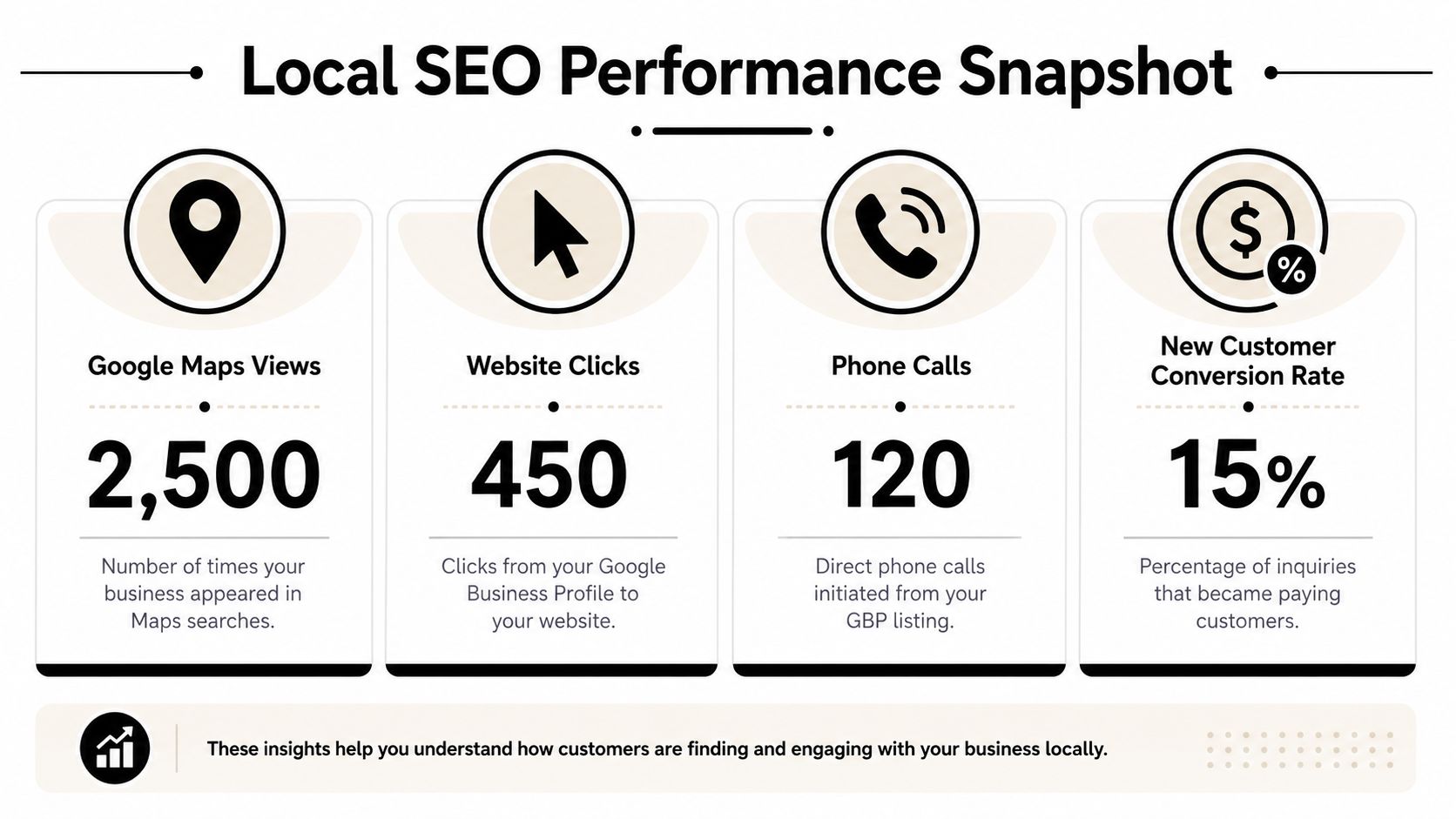
Online search drives a lot of first contact for HVAC companies, so the monthly review should stay close to contact behavior and booked work.
Track these numbers every month:
- Google Business Profile calls
- Website clicks from GBP
- Contact form submissions from service and location pages
- Phone calls from organic landing pages
- Top-performing service and city combinations
- Review growth and response completion
- Lead quality by page, service, or service area
Those numbers need context. A page that brings in fewer visits but more estimate requests is doing its job. A page with traffic and no calls usually has a mismatch somewhere: weak copy, the wrong intent, poor offer framing, or a city-page strategy that looks good in a report but does not match how people buy.
Build a monthly review process your team will keep doing
Keep the process simple enough that it survives busy season. If a reporting routine takes an hour to explain, it usually dies after two months.
Use a basic monthly scorecard:
Pull Google Business Profile performance
Review calls, direction requests, website clicks, and any noticeable visibility changes.Check your analytics and call tracking
Look at organic landing pages, form completions, tracked calls, and which pages started the lead.Match leads to booked jobs
Have your CSR, dispatcher, or office manager tag whether the lead turned into maintenance, repair, replacement, or nothing at all.Review by city and service line
One city may produce profitable replacement leads. Another may bring low-ticket repair calls with long drive times. Treat those areas differently.Choose one action for next month
Update a page, add internal call tracking notes, request more reviews after installs, or build out a service area that is already converting.
That last step matters. Reporting without a next action is just filing paperwork.
Plan SEO around seasonality and capacity
The best HVAC SEO plans follow the calendar your business already lives by. If cooling season is coming, AC repair, tune-up, and emergency service pages should be current before demand spikes. If fall is slower, use that time to improve furnace pages, clean up underperforming location pages, and tighten review follow-up.
There are trade-offs here. Chasing every nearby town can spread your effort too thin. Pushing hard on replacement keywords during a month when your install schedule is full can create service issues. Good local SEO supports operations. It should send the kind of work you want, in the areas you can serve well, at the times your team can handle it.
A simple planning template works well:
- Next 30 days: fix tracking gaps and improve pages already producing leads
- Next 90 days: expand into service and city combinations with proven demand
- Next 6 months: align content, reviews, and staffing with heating and cooling peaks
If your close rate drops after the lead comes in, the problem may not be SEO at all. Quoting speed, follow-up, and estimate quality often decide whether organic leads turn into revenue. That's where tools like Exayard HVAC estimating software can help tighten the handoff from inquiry to job.
The shops that keep growing from local search usually do the boring work well. They review results every month, keep what produces booked jobs, and cut what does not.
Conclusion Your Blueprint for HVAC Lead Generation
Local SEO works best when you treat it like dispatch, not decoration. Every part of the system needs an owner, a schedule, and a standard. Your Google Business Profile has to be accurate. Your service and location pages have to match real demand. Your review process has to happen after every completed job. Your local links need to come from real relationships, not shortcuts.
There is also a clear conversion case for doing the work. One HVAC industry source says SEO-driven traffic can convert at 14.6% versus 1.7% for traditional channels, which is more than 8 times higher according to Rohring Results' HVAC SEO overview. That's why this channel deserves operational attention, not occasional marketing leftovers.
The practical takeaway is simple. Don't try to do everything at once.
Start here:
- Fix your Google Business Profile
- Build or clean up your core service pages
- Add location pages only for places you serve
- Standardize citation data
- Train your team to ask for reviews
- Pursue local links through real partnerships
- Track calls and form leads monthly
If you're also trying to tighten the handoff from lead to estimate, tools like Exayard HVAC estimating software can help on the operations side after the inquiry comes in. SEO gets the opportunity. Your estimating and follow-up process closes it.
A strong local SEO process won't remove seasonality from the HVAC business. It will make your lead flow more stable, your map visibility stronger, and your dependence on feast-or-famine channels a lot lower.
If you want help turning this into a repeatable lead system, Polaris Marketing Solutions works with local service businesses on Google Business Profile optimization, location content, review strategy, and SEO reporting built around actual lead generation.