
Online reputation management is the process of monitoring, influencing, and controlling what customers see about your business online. Because 96% to 97% of consumers read online reviews for local businesses and read an average of 10 reviews before they trust a business, ORM has become a core part of how local companies win calls, form submissions, and booked jobs.
If you run a business in Fort Myers, Naples, or Cape Coral, you already know how this plays out in real life. A prospect hears about you, searches your name, checks your Google Business Profile, scans your latest reviews, and makes a decision fast. They don't see your intentions. They see your star rating, your responses, your photos, your listings, and whatever Google puts on page one.
That first search is your digital handshake. If it looks solid, you get the call. If it looks neglected, someone else does.
Your Digital Handshake What Is Online Reputation Management
A Fort Myers business owner usually doesn't start thinking about online reputation management on a calm Tuesday morning. It starts when a bad review shows up, a competitor looks stronger in Google, or a referral says, "We almost didn't call because of what we saw online."
That's why what is online reputation management matters beyond marketing jargon. It's not just review replies. It's the ongoing work of making sure the right information shows up first, the wrong information gets addressed quickly, and your online presence gives people a reason to trust you.
For a local business, ORM usually includes a few moving parts working together:
- Reviews and responses on Google, Facebook, Yelp, and industry platforms
- Business listings that show the right name, address, phone number, hours, and service details
- Search results for your brand name, owner name, and service terms
- Social and web mentions that shape perception
- Owned content like your website pages, service pages, team bios, and local articles
One of the most important local assets in that mix is your Google Business Profile. For many Southwest Florida service businesses, that profile becomes the first thing a prospect studies before they ever reach your website.
What ORM is and what it isn't
ORM isn't a magic delete button for negative content.
It is a practical operating system for trust. You monitor what people can see, improve the assets you control, respond where you need to respond, and strengthen the pages and profiles that should rank first.
Practical rule: If a prospect can see it before contacting you, it belongs inside your reputation strategy.
What this looks like on the ground
For a Naples law firm, ORM might mean tightening directory listings, improving attorney bios, and responding carefully to reviews.
For a Cape Coral roofer, it might mean getting more recent Google reviews, adding project photos, and fixing inconsistent phone numbers across directories.
For a Fort Myers med spa, it might mean monitoring branded search results, improving review response quality, and making sure social profiles reflect the same message as the website.
Same discipline. Different priorities.
Why Your Reputation Matters in Fort Myers and SWFL
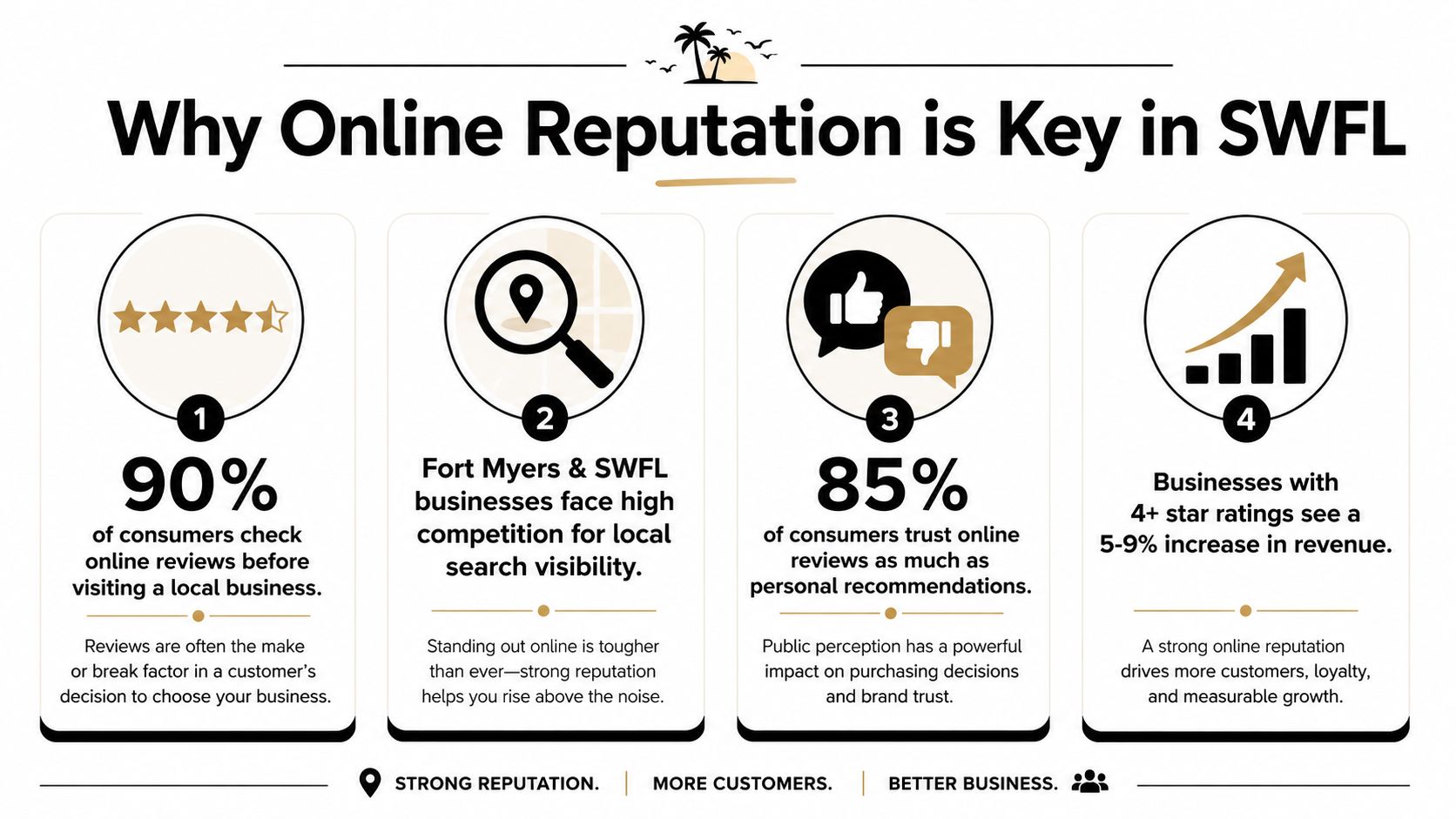
Southwest Florida is competitive in a very specific way. Buyers often compare several providers quickly, especially in home services, healthcare, legal, and professional services. Seasonal residents may not know who the established local names are. Visitors and new residents rely even more on search, maps, and reviews because they don't have a long referral network here.
That means your online reputation isn't a side issue. It's often the first filter.
One 2026 industry report says 96% to 97% of consumers read online reviews for local businesses, and they read an average of 10 reviews before they trust a business. That's why reputation functions like demand generation, not just brand protection, according to this online reputation management statistics roundup.
Why local buyers move fast
In SWFL, buyers often make decisions under time pressure. An AC issue in August, a roof problem after a storm, a plumbing leak, an urgent care need, a legal issue that can't wait. They aren't writing a spreadsheet-level comparison. They're scanning for risk.
If one company has recent, credible reviews and a complete profile, and another looks half-maintained, the stronger profile usually wins the first call.
A clean reputation reduces friction. It gives people fewer reasons to hesitate.
Why this hits small businesses harder
Large brands can absorb mixed perception because they have reach, brand familiarity, and larger budgets. Local businesses don't get that cushion. A few weak first impressions can slow lead flow fast.
In practice, a small business in Cape Coral or Naples doesn't need to dominate every platform. It needs to own the ones buyers check first. That's also why local search strategy increasingly overlaps with broader discovery strategy. Teams exploring visibility beyond standard SEO often look at firms such as a GEO Agency to understand how search behavior is changing as AI tools influence discovery.
The real business outcome
A strong reputation helps you:
- Win more first conversations because prospects trust you sooner
- Support referrals because referred prospects still search before calling
- Reduce wasted leads from people who bounce after seeing weak reviews or stale profiles
- Compete on trust, not just price when buyers compare similar providers
In Southwest Florida, trust isn't abstract. It's visible.
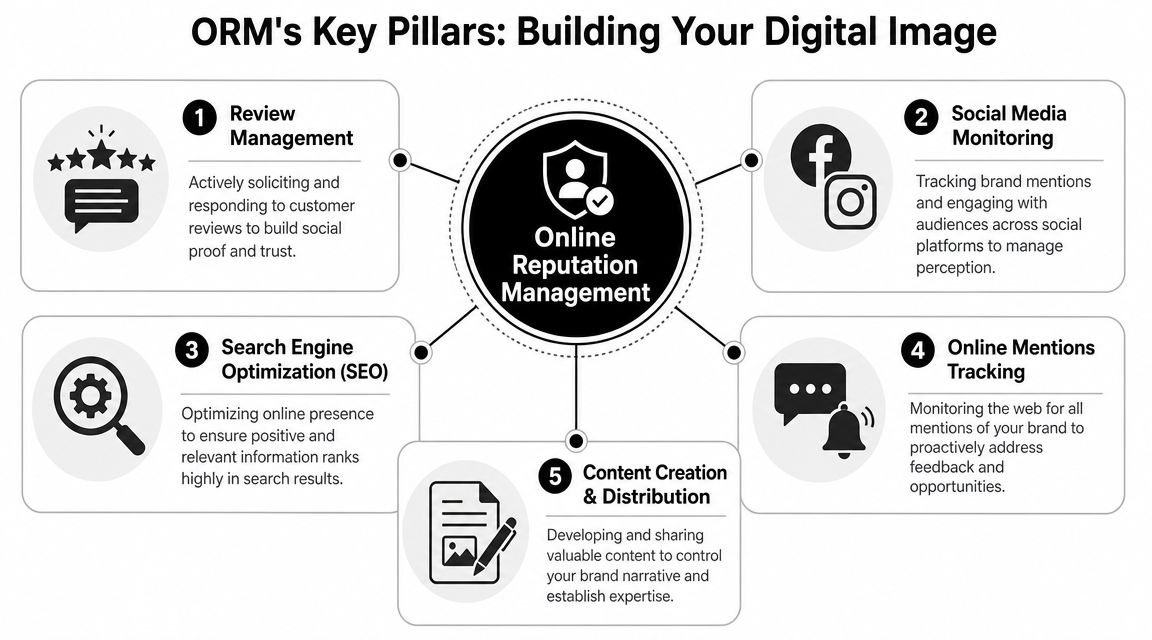
The Core Components of Online Reputation Management
ORM gets easier once you stop treating it like one task. It's a stack of assets and actions. Some build trust, some protect visibility, and some correct bad first impressions.
Review management
Reviews are the clearest social proof most local buyers will see. The work here isn't just "get more reviews." It's to create a repeatable system for asking, monitoring, and responding.
What works:
- Ask soon after a good experience when the customer still remembers the details
- Make it easy with a direct link by text or email
- Respond to both positive and negative feedback with a calm, human tone
What doesn't work:
- Asking sporadically when business is slow
- Writing robotic responses that sound pasted in
- Arguing in public when a customer leaves a negative review
A simple response framework for a negative review is often enough:
- Acknowledge the issue
- Show willingness to help
- Move the conversation offline
- Follow through internally
Example:
"Thanks for the feedback. We're sorry your experience didn't meet expectations. We'd like to look into this and make it right. Please contact our office directly so we can review what happened."
Listings management
Listings management sounds boring until a bad phone number costs you a lead. Your Google Business Profile, Apple Maps, Yelp, Facebook, and industry directories should match. Same business name. Same contact details. Same service area. Same core description.
For local providers, this is often a quick-win category because the fixes are straightforward. You claim profiles, update missing fields, add real photos, and remove outdated information.
Search-result shaping
A core ORM function is search-result shaping, where SEO tactics help favorable pages rank above weak or negative results. That can include your Google Business Profile, branded service pages, leadership bios, directory listings, and third-party mentions, as explained in this guide to search-result shaping in online reputation management.
That matters because many reputation problems aren't review problems. They're visibility problems. If page one shows an old complaint, a thin directory listing, or an irrelevant result, buyers form opinions before they ever reach your best content.
Useful test: Search your business name, owner name, and brand plus "reviews." What shows up first is what you're really managing.
Monitoring and content
You also need basic monitoring and content support.
Monitoring means watching for new reviews, social mentions, and branded search changes. Content means publishing pages that deserve to rank, such as service pages, FAQs, team bios, local project highlights, and helpful articles.
If you want a broader outside perspective on reputation-oriented content strategy, this guide on best practices for brand building is a useful companion read.
Here's the practical point. ORM isn't one tactic. It's reviews, listings, search visibility, monitoring, and content working together.
How to Measure Your Online Reputation
Most small businesses don't need enterprise software to start measuring ORM. They need a short list of signals that tell them whether trust is improving or slipping.
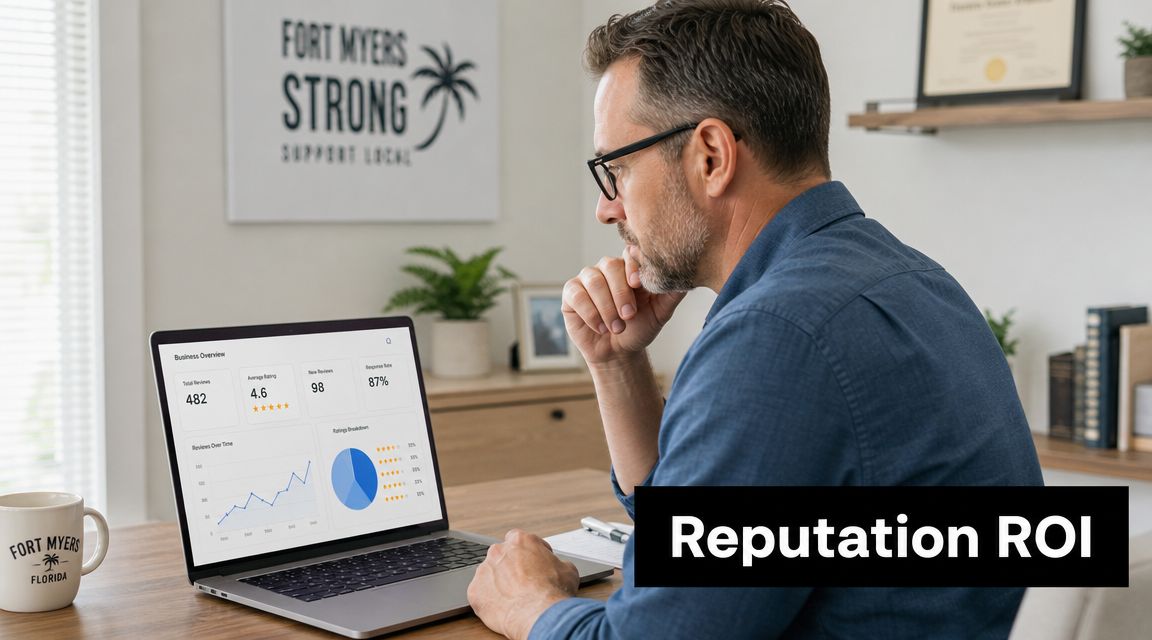
Effective ORM works as a measurement-and-control system. Teams track quantitative indicators such as review volume and average rating, but they also read the comments themselves to separate one-off complaints from real service issues. That's the core idea in this breakdown of metrics for robust online reputation management.
The metrics that actually matter
You don't need dozens of KPIs. Start with these:
| Metric | What it tells you | Why it matters |
|---|---|---|
| Average star rating | Overall public sentiment | Prospects use it as a shortcut for trust |
| Review velocity | How many new reviews you're getting over time | Recency signals that the business is active |
| Response rate and response speed | Whether you're engaging consistently | Slow or missing replies suggest neglect |
| Branded search results | What appears when someone searches your name | This is your first-page reputation in action |
| Comment themes | Repeated praise or repeated complaints | Patterns point to real operational issues |
A simple way to track it
A spreadsheet works fine at first. Create one tab for reviews, one for branded search results, and one for recurring themes.
Check the basics each month:
- Google reviews and key platform reviews
- Top search results for your business name
- Common phrases in complaints
- Mentions of staff, service quality, scheduling, or communication
Reputation starts connecting to business decisions. If multiple reviews mention poor follow-up, that's not a marketing issue first. It's an operations issue that happens to be visible online.
For a more complete view of business impact, it's worth understanding how to measure marketing ROI so reputation work doesn't sit in its own silo.
A short walkthrough can help if you want to see how teams think about reputation metrics in practice.
How to know if it's working
Look for directional improvement, not perfection.
If review flow is becoming more consistent, negative themes are getting addressed, and branded search results look cleaner and more credible, the program is working. If your profiles look better but buyers still complain about the same thing, then the reputation issue is exposing a service issue that still needs fixing.
Practical First Steps for Your SWFL Business
Most local businesses don't need a complicated ORM rollout. They need the right order of operations. The biggest mistake is spreading effort across too many platforms before fixing the assets that shape first impressions.
For local service businesses, broad ORM advice often misses the core issue, which is measurement and prioritization. A few high-visibility review sites and your Google Business Profile usually dominate first impressions, as noted in this small business ORM guide focused on prioritization.
Your first 30 days
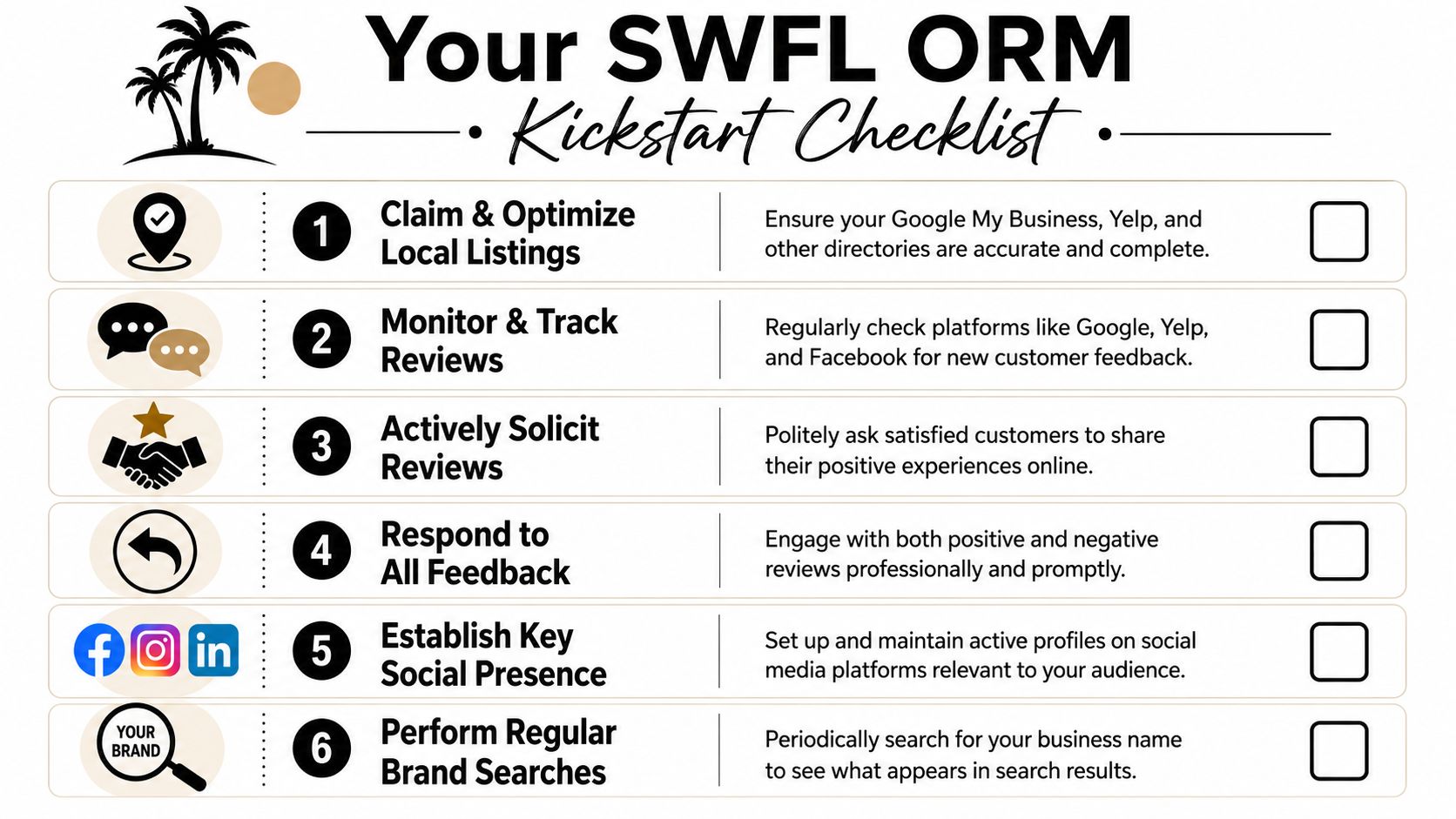
Start here:
Claim and complete your Google Business Profile
Add the correct business name, category, phone number, service area, hours, website, services, and photos. If you're in home services, include jobsite photos. If you're in healthcare or legal, focus on professionalism, office images, and clear service descriptions.Pick your top review platforms
Don't chase every directory. A roofer may focus on Google and a major home-service platform. A doctor may care about Google plus a healthcare-specific review site. A law firm may need Google and legal directories.Set up a review request process
Use a short email or text after a successful job. Keep it simple. Thank the customer, ask for honest feedback, and give them a direct review link. If you need ideas, this guide on how to get more online reviews is a practical place to start.
What to do weekly
Consistency is more effective than intensity.
- Check for new reviews and respond
- Search your business name and note what appears
- Look for listing errors on major platforms
- Save screenshots of anything unusual, especially suspicious reviews or impersonation attempts
If you only have an hour a week, spend it on Google Business Profile, your top review platform, and branded search results.
What to ignore at first
Small businesses lose time by overbuilding.
Skip these until the basics are solid:
- Too many social channels you won't maintain
- Low-value directories that no prospect uses
- Overly polished response templates that sound scripted
- Vanity activity that doesn't improve trust or visibility
A good starting ORM system is plain and disciplined. Accurate listings. Steady review requests. Timely responses. Regular brand searches. That's enough to create momentum for most SWFL businesses.
From Defense to Offense Your Next Steps in ORM
Once the basics are in place, ORM becomes more strategic. You stop playing defense on every review and start building assets that protect the business long term.
That usually means publishing content that deserves to rank for your brand. Useful FAQ pages. Strong service pages. Leadership bios. Local project writeups. Community involvement pages. Positive, accurate content gives Google more quality options to show when someone searches your business.
The other side of modern ORM is defense. That's the part many business owners don't think about until something ugly happens. False claims, review fraud, impersonation, and AI-generated misinformation can distort how a business appears online. That shift from simple reputation-building to active defense is discussed in this article on reputation defense in a misinformation-heavy environment.
A stronger long-term approach
Businesses that handle ORM well usually do three things at once:
- They monitor for changes before problems grow
- They document suspicious or false content fast
- They build stronger owned assets so one bad result has less power
That's the move from reactive cleanup to durable visibility.
If your business has reached the point where reviews, branded search results, local SEO, and response workflows all need to work together, ORM isn't a side task anymore. It's part of sales, operations, and brand protection.
Frequently Asked Questions About ORM
Can I delete a bad Google review?
Usually, no. You can't remove a review solely because you don't like it. If a review is fake, abusive, or violates platform rules, you can report it. In most cases, the better move is to respond professionally, document anything suspicious, and keep generating legitimate positive reviews so one complaint doesn't define the business.
What's the difference between ORM and PR?
ORM is ongoing digital reputation work. It covers reviews, listings, search results, mentions, and owned content. Public relations is usually more focused on communication with media, announcements, and brand storytelling tied to specific events or campaigns.
A local business may need both, but they solve different problems.
How long does ORM take to work?
Some parts move quickly. You can improve a profile, fix listings, and start responding to reviews right away. Search-result changes and stronger review patterns take longer because you're building trust signals over time.
Should I respond to every review?
In most cases, yes. Positive reviews deserve thanks. Negative reviews deserve a calm, useful response. Buyers read those replies as evidence of how you handle real problems.
What if the real issue is inside the business?
Then ORM is doing its job by exposing it.
If reviews repeatedly mention missed calls, late arrivals, billing confusion, or poor communication, don't try to market around it. Fix the process, then let the improved customer experience generate better feedback naturally.
If you want a clear picture of how your business looks online right now, Polaris Marketing Solutions can help you assess the basics that shape local trust in Southwest Florida, including reviews, search visibility, listings, and your Google Business Profile presence. A practical analysis gives you a starting point, shows what to fix first, and helps you focus on the reputation work most likely to support real lead generation.