
Forget random acts of marketing. To win in the pest control business, you need a coordinated digital strategy that brings in customers who need your help right now. It's about building a powerful online presence, starting with a website that turns visitors into leads and a Google Business Profile that puts you at the top of local search.
Building Your Pest Control Marketing Foundation
Thriving as an exterminator in a crowded market isn't about luck—it's about having a smart, integrated playbook. A scattergun approach, where you try a little bit of everything, just wastes time and money. The real goal is to build a system that attracts a steady stream of high-value customers who are actively looking for a solution to their pest problems.
And the opportunity is huge. The global pest control market is on track to grow from $26.66 billion in 2025 to almost $40 billion by 2030. A solid marketing foundation is what will allow you to capture your piece of that pie.
A Simple Framework for Getting Found and Getting Hired
Your marketing should follow a simple, logical flow that guides a potential customer from discovering your business to picking up the phone. We break it down into three core stages.
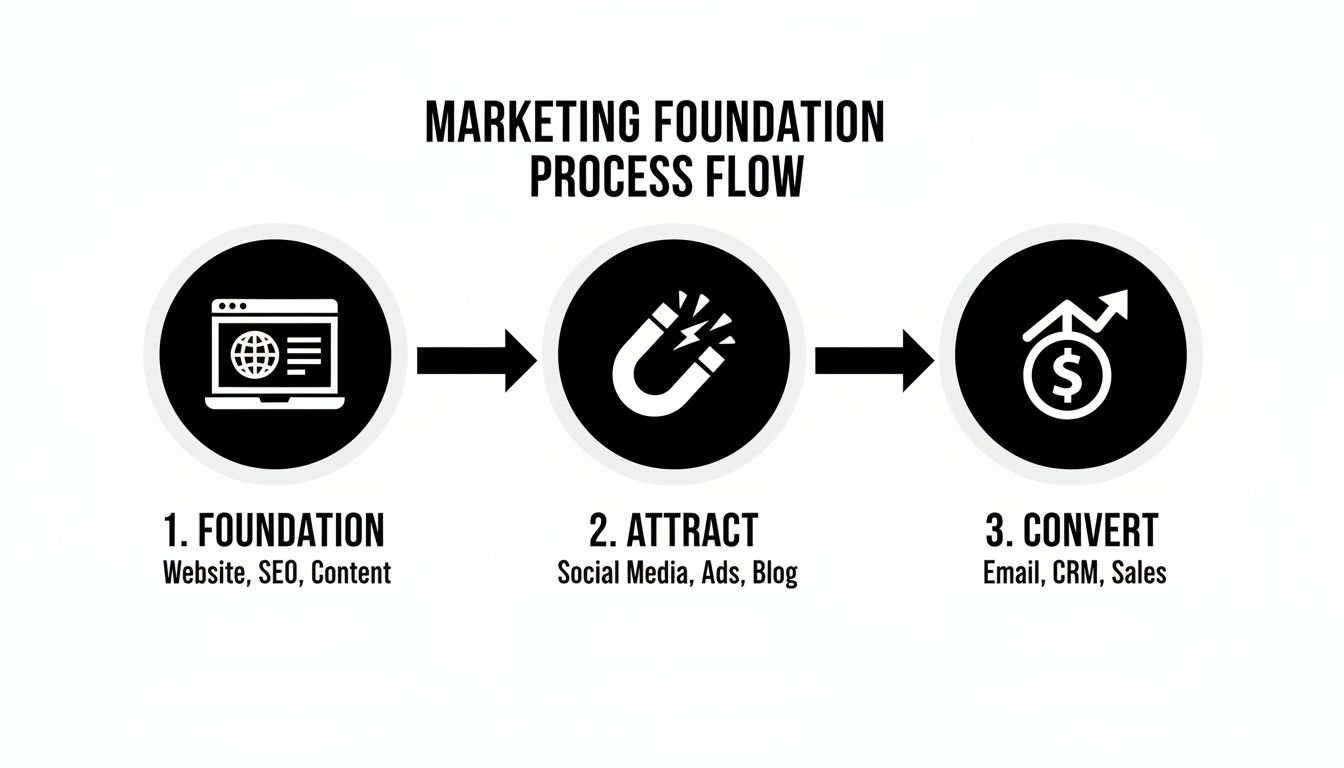
This process is straightforward: first, you build a professional online presence (your foundation). Then, you use specific tactics to attract the right audience. Finally, you have systems in place to convert that attention into paying customers.
A strong marketing foundation doesn’t just generate a few leads here and there. It builds a resilient business that consistently brings in jobs, no matter the season. It’s the best long-term investment you can make.
To really succeed, your strategy needs to use a mix of essential digital marketing channels. Each one has a specific job to do when it comes to winning new customers.
Essential Digital Marketing Channels for Exterminators
Here's a quick look at the most critical channels for a local pest control business. Think of these as the core components of your marketing engine.
| Marketing Channel | Primary Goal | Example Tactic |
|---|---|---|
| Website & Service Pages | Establish credibility and convert visitors into leads. | Creating a "Bed Bug Removal" page with testimonials from families you've helped and a clear "Get a Free Inspection" button. |
| Local SEO & Google Business Profile | Appear when locals search for exterminators on Google. | Getting your business to show up in the Google Maps "3-pack" when someone in your city searches "pest control near me." |
| Paid Search (PPC & LSA) | Generate immediate calls from customers with urgent needs. | Running a Google Ad targeting the keyword "emergency rodent removal near me" that appears at the top of search results. |
Each of these channels plays a distinct role in keeping your phone ringing and your schedule full.
While the pest control industry has its unique challenges, many of the marketing principles are universal for any local service provider. For a deeper dive, check out a practical guide to marketing for local service businesses for some more great strategies.
Mastering Local Search to Win on Google
For an exterminator, the most important marketing battles are won on Google. Think about it. When a homeowner discovers a trail of ants marching across their kitchen counter or finds a scorpion in their shoe, what’s their first move? They don’t dig out the yellow pages. They grab their phone and search “exterminator near me.”
This is where you need to be, front and center.
The demand is massive and it's not going anywhere. North America is the single largest market for pest control services on the planet, with the U.S. market alone projected to hit $5.33 billion by 2026. This isn't just a number; it represents a constant stream of homeowners and businesses who need your help right now.
Supercharge Your Google Business Profile
If you only focus on one thing in your local marketing, make it your Google Business Profile (GBP). This is the interactive snapshot of your business that appears in Google Maps and the all-important local "3-pack" results. Simply setting it up and forgetting about it is a rookie mistake.
You have to manage it actively. An empty, neglected profile sends all the wrong signals—it tells potential customers you might not be open, responsive, or even in business anymore.
A fully optimized Google Business Profile is like having your best salesperson working for you 24/7. It answers questions, showcases your work, and builds trust before a customer even clicks through to your website.
Here’s how to turn your GBP into a lead-generating machine:
- Proactively Use the Q&A Feature: Don't just wait for customers to ask questions. Seed your own Q&A section with common queries. Actionable Example: Post a question like, "Do you offer pet-safe treatments for fleas?" and then answer it yourself with: "Yes, we offer several pet-safe treatment options. Our technicians will discuss the best approach with you during the initial inspection to ensure your family and pets are safe."
- Create Service-Specific GBP Posts: Generic "Call Us!" posts are a waste of time. Instead, create weekly posts focused on timely services. Actionable Example: Create a post titled "Termite Swarm Season is Here in South Florida!" with a clear picture of swarmers, a short description of the danger, and a button that says "Learn More" linking to your termite service page.
- Geo-tag Your Job Photos: This is a simple but powerful trick. Before uploading photos of a successful job, use a free online tool to add the GPS coordinates. Actionable Example: After finishing a rodent exclusion job in a specific neighborhood like "Bayshore Gardens," geo-tag the 'after' photo with that location. When you upload it to GBP with the description "Completed another successful rodent-proofing project in Bayshore Gardens," it sends a direct signal to Google that you perform that service in that exact location.
If you want a complete walkthrough, our Google Business Profile optimization checklist is a step-by-step guide to make sure you haven’t missed a single detail.
Build Your Foundation With Local Citations
Beyond your GBP, Google cross-references your business information across the web to verify you are who you say you are. This is where local citations—mentions of your business's Name, Address, and Phone number (NAP)—are critical.
Absolute consistency with your NAP is the bedrock of local SEO. Even a small difference, like using "St." on one directory and "Street" on another, creates confusion for Google's algorithm and can seriously hurt your local rankings. Your NAP must be 100% identical everywhere.
Start by locking down your information on the biggest directories for home service businesses. This isn't just a "nice to have"; it proves to Google you are a legitimate, established local company.
Top Citation Sources for Exterminators:
- Yelp
- Angi (formerly Angie's List)
- Thumbtack
- HomeAdvisor
- Nextdoor
- Better Business Bureau (BBB)
Securing and standardizing your listings on these key platforms is a foundational step. It signals to Google that you are a serious player in your service area, making it much more likely to show your business to customers who are ready to hire.
Building a Website That Actually Generates Leads
Think of your website as your hardest-working salesperson, not just an online brochure. For a pest control company, a strategic website is what turns a panicked visitor with a bug problem into a paying, long-term customer. Every single element should be designed with one goal in mind: getting that person to pick up the phone or fill out a form.
When someone lands on your site—especially when they’re stressed about spiders in the basement or ants in the kitchen—they need to immediately feel like they’ve found a legitimate, professional company that can solve their problem. You don't get a second chance to make a first impression.
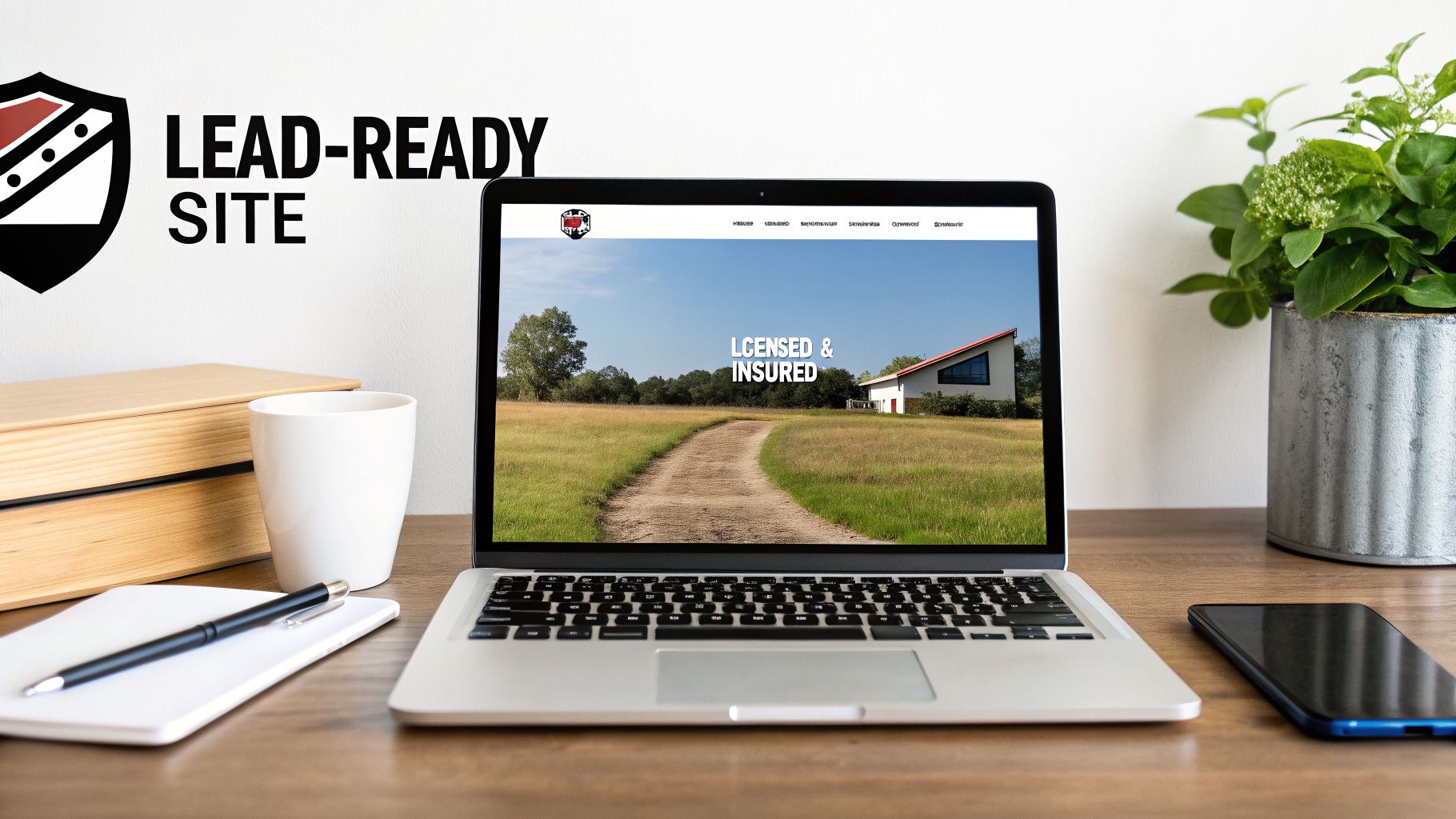
Honestly, you have about three seconds to build that initial trust. This is why placing "trust signals" above the fold—the part of your site they see without scrolling—is non-negotiable.
Immediate Trust-Building Elements:
- A prominent "Licensed & Insured" badge.
- Logos from review sites where you have great ratings (think Google, Yelp, or Angi).
- A highly visible, clickable phone number like
(555) 123-4567.
These simple additions instantly signal to a visitor that they’re in good hands.
Ditch the Generic "Services" Page
The single biggest mistake I see exterminators make on their websites is lumping every service onto one generic page. It's a huge miss. This approach doesn't answer specific customer questions, and it tanks your performance in search engine results.
You have to think like your customer. Someone frantically searching for "termite control" doesn't care about your general pest services—they have a very specific, expensive problem. Your website needs to reflect that reality.
This is also where a simple, well-placed lead capture form becomes so important. It gives visitors an easy way to request a quote right when they're most interested.
By creating specific pages for each pest and each location you serve, you're essentially building a digital net. This net is designed to capture highly-motivated, ready-to-buy customers who are searching for the exact solutions you provide.
Your navigation shouldn't just have a single "Services" link. It should be a dropdown menu with direct links to your most valuable service pages.
High-Value Service Page Examples:
yoursite.com/termite-controlyoursite.com/rodent-removalyoursite.com/emergency-bee-removal
Each of these pages should be its own complete resource. Actionable Example: On your termite-control page, include a section on "Our Termite Treatment Process" with step-by-step photos, a video of a technician performing an inspection, and a testimonial from a happy customer who had that exact problem. Finish with a crystal-clear call-to-action button like "Get a Free Termite Inspection". If you want to dive deeper, you can learn more about how to improve website conversion rates and turn more of those visitors into solid leads.
Dominate Your Territory With Local Service Pages
To really capture the leads in every corner of your service area, you need to build out hyper-local pages. These are pages that specifically target customers searching for an exterminator in their town or even their neighborhood. The best part? You can create a simple template to deploy them quickly.
| Page Element | Example for "Exterminator in Cape Coral" |
|---|---|
| H1 Title | #1 Exterminator in Cape Coral, FL |
| Intro Paragraph | "As a local Cape Coral exterminator, we know how to handle the unique pest challenges in our area, from aggressive fire ants in the yard to mosquitos near the canals. We're your neighbors, and we're here to help." |
| Local Proof | "See what your Cape Coral neighbors are saying: 'Amazing service! They got rid of the spiders in our lanai fast.' – Jane D., Cape Coral, FL" |
| Map | Embed a Google Map showing your service radius with Cape Coral at the center. |
| Call to Action | "Live in Cape Coral? Get Your Free Pest Quote Today!" |
This targeted strategy does two things at once: It tells local residents you’re their neighborhood expert, and it signals to Google that you are the most relevant authority for that specific location. The result is a steady stream of qualified local leads calling your phone.
Generating Immediate Calls with Paid Advertising
While your organic marketing efforts are quietly building momentum, paid advertising is how you get the phone to ring today. For an exterminator, it's the most direct path to connecting with homeowners who have an urgent, non-negotiable problem and are actively looking for a pro to solve it.
Unlike long-term SEO, paid ads can put your business at the very top of Google search results in a matter of hours. The secret is knowing which platforms to use and how to structure your campaigns so you attract high-quality leads without burning through your budget on worthless clicks.
The Power of Google Local Service Ads
For any home service business, Google Local Service Ads (LSAs) are an absolute game-changer. These are the special ad boxes you see at the very top of the search results—often appearing above traditional ads and the organic map pack. Their biggest advantage is the coveted "Google Screened" badge.
That little green checkmark instantly tells a potential customer that Google has already verified your licenses and insurance. It builds immediate trust, positioning you as a vetted, legitimate professional before they even click on your ad.
LSAs work on a pay-per-lead model, not pay-per-click. This means you only pay when a qualified customer actually contacts you through the ad, either by phone or by message. It's a far more efficient way to spend your marketing dollars, especially when you're just starting out.
Mastering Traditional Google Ads
While LSAs are fantastic for capturing ready-to-buy customers, traditional Google Ads (PPC) give you much more control and customization over your marketing message. A smart PPC strategy is essential for a growing pest control business, especially as the industry continues to boom. The pest control market is projected to skyrocket from $22.64 billion in 2023 to $34.3 billion by 2030, and PPC is one of the best ways to grab your piece of that growth.
To get the best return on your investment, you have to think beyond a single, generic ad campaign. The most effective approach is to structure your ad groups around what the customer is actually looking for.
Campaign Structure Example:
- Emergency Services Ad Group: Target high-intent keywords from people in a panic, like "emergency rat removal," "24/7 bee exterminator," or "same day pest control." Your ad copy needs to match that urgency.
- Actionable Ad Example: Headline: Fast Ant Infestation Control. Description: Seeing Ants Everywhere? We Can Be There Today. Get a Free Quote Now. This ad speaks directly to the user's urgent problem.
- Research-Based Ad Group: Target keywords from people who are still figuring things out, such as "signs of termites," "how to get rid of cockroaches," or "what do bed bug bites look like." These ads should point to helpful blog posts or service pages that answer their questions and establish you as the expert.
- Actionable Ad Example: Headline: Termite Signs & Damage? Description: Free Expert ID Guide. Learn the 5 Telltale Signs of Termites. See Photos & Protect Your Home. This ad links to a blog post, not a sales page.
Segmenting your campaigns like this ensures your ads and landing pages perfectly align with the searcher's needs, which dramatically boosts your conversion rates. Getting this structure right is a fundamental part of effective PPC management for small businesses.
Finally, to stop wasting money, you need to build a solid list of negative keywords. These are terms you add to your campaign to prevent your ads from showing up on irrelevant searches.
Essential Negative Keywords for Exterminators:
-DIY-home remedy-jobs-hiring-spray-trap
Adding these simple terms ensures you aren't paying for clicks from people looking for a job or a do-it-yourself solution. It focuses your budget entirely on customers who are ready to hire a professional.
Building Trust with Content and Social Media
Paid ads are fantastic for getting the phone to ring right now. But if you want to build a long-term reputation as the go-to pest control expert in your area, you need to lean into content and social media. This is where you stop just selling a service and start building genuine, lasting trust.
Think about it from a homeowner's perspective. Imagine it's swarm season in Florida, and they stumble across your blog post, “How to Protect Your Home from Termite Swarmers This Spring.” You’re not just another ad—you’re an expert offering a solution. This educational approach immediately positions you as a credible authority, not just a company looking for a quick sale.
Create Content That Solves Problems
Your content needs to be intensely practical. Focus on answering the specific, timely pest questions that people in your service area are typing into Google. This isn't just about building goodwill; it’s a killer local SEO strategy that creates a library of pages ranking for valuable, long-tail keywords.
The easiest way to start is with a simple seasonal content calendar. What are the top pest problems that pop up each season in your town? That's your goldmine for blog topics.
Example Seasonal Content Plan:
- Spring: "Is It a Termite Swarmer or a Flying Ant? (Photos Included)" or "How to Keep Carpenter Bees from Destroying Your Deck This Spring."
- Summer: "The 3 Most Common Ants Invading Florida Kitchens and How to Stop Them" or "Backyard Mosquito Prevention: 5 Tips That Actually Work."
- Fall: "Why Spiders Are Moving Inside and How to Keep Them Out."
- Winter: "Hearing Scratching? 4 Signs You Might Have Rodents in the Attic."
Each one of these articles should be a genuinely helpful resource that answers common questions and cements your status as the local pro.
Use Social Media to Showcase Your Work
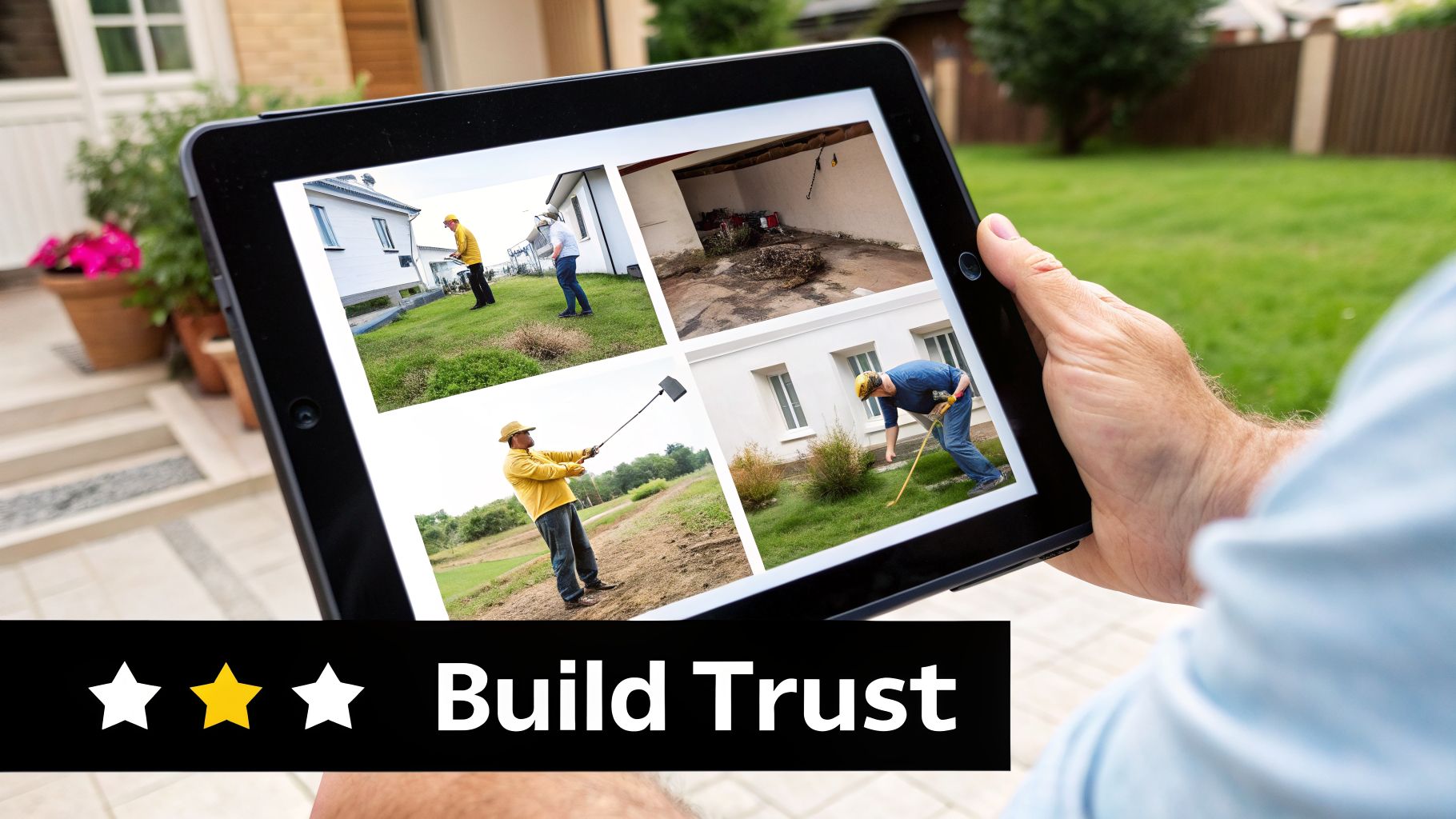
If your blog is for educating, your social media is for proving you get results. This is the perfect stage for building social proof—the real-world evidence that tells potential customers you’re the right choice. Ditch the generic stock photos; your audience wants to see what you can actually do.
People hire exterminators to solve a problem they can see. Showing them you've successfully solved that exact problem for their neighbors is one of the most effective marketing tactics you can use. It makes the decision to call you feel much less risky.
Quick, simple video is your best friend here. You don’t need a fancy production crew; a 30-second video from your smartphone is more than enough to get the job done.
Simple but Powerful Social Media Ideas:
- Quick Tip Videos: Actionable Example: Film a short clip where a technician points a flashlight at frass (termite droppings) on a windowsill and says, "See these little pellets? That's not sawdust. This is a classic sign of drywood termites. If you see this, call a pro immediately."
- Before-and-Afters: Actionable Example: Post a picture of a huge, nasty hornet's nest on a client's eave. The next picture shows the clean eave with no nest. The caption reads: "Another successful (and safe!) hornet nest removal in the books! Don't risk doing this yourself. #HornetRemoval #PestControl"
- Video Testimonials: Actionable Example: After a job, ask a happy client, "Would you mind saying a quick word for our Facebook page?" Then record them saying, "These guys were great, they solved our ant problem in one day, and I feel so much better." A 15-second authentic clip is incredibly powerful.
This kind of authentic, in-the-field content builds confidence like nothing else. It shows potential customers that you deliver real, tangible results, turning your social media from a boring billboard into a dynamic portfolio of your best work.
Answering Your Top Marketing Questions
When it comes to marketing, pest control owners often have the same handful of questions about where to put their money, what to expect, and what to do first. We get it. You need straightforward answers to make smart decisions.
Here are the direct, no-fluff answers to the questions we hear most often.
How Much Should an Exterminator Budget for Marketing?
For a well-established pest control company, a good rule of thumb is to invest 5-10% of your target annual revenue back into marketing. If you're a newer business or you're in a serious growth mode, you'll need to be more aggressive—plan on 10-15% to really start making some noise and capturing market share.
Actionable Example: If your goal is to hit $300,000 in revenue this year, a 7% marketing budget would be $21,000 for the year, or $1,750 per month. A sample monthly breakdown could be:
- $750 for Google Local Service Ads (pay-per-lead)
- $500 for Google Ads (PPC) targeting "termite control" and "rodent removal"
- $500 for ongoing local SEO and content creation
Your first dollars should always go toward the non-negotiables: a professional website and a completely optimized Google Business Profile. Once those are solid, your next move should be funding Google Local Service Ads to get the phone ringing immediately with high-intent leads. From there, you can invest the rest into long-term plays like local SEO and content that build a pipeline of organic customers for years to come.
The real secret is tracking your cost per lead from every single channel. That data tells you exactly where your money is working hardest, so you can double down on what’s profitable and cut the dead weight.
How Long Does Local SEO Take to Work?
Everyone wants to know when they'll see a return on their SEO efforts. While you can sometimes see a little bit of early movement in as little as 3-4 months, you need to be realistic. It typically takes 6-9 months of consistent work to achieve the kind of significant, predictable results you're looking for.
Of course, that timeline isn't set in stone. It really depends on a few key things:
- Your Market's Competition: Are you up against a dozen other exterminators who are all marketing aggressively online?
- Your Website's Authority: Are you starting from scratch with a brand-new site, or do you have a website with some history and existing backlinks?
- Your Consistency: Are you consistently publishing new content, earning reviews, and building out your local citations month after month?
Actionable Example: An early win (3-4 months) might be ranking in the Google Map Pack for a niche service in a specific neighborhood, like "ant exterminator in South Naples." The long-term victory (6-9+ months)—ranking on the first page of organic results for a competitive, high-volume term like "pest control Fort Myers"—takes a dedicated, sustained effort.
What Is More Important: Reviews or Citations?
This is a classic question, and the answer is: both are absolutely critical, but they have different jobs at different times. Think of it as a one-two punch to build your local credibility with Google and with customers.
When you're just starting out, your first priority has to be building a strong foundation of local citations. This is all about getting your business name, address, and phone number (NAP) listed accurately and consistently across major directories like Yelp, Angi, and the Better Business Bureau. This simple step proves to Google that you're a real, legitimate business operating where you say you are.
Once that foundation is set, your focus needs to pivot to an ongoing priority: generating a steady stream of new customer reviews. Fresh, positive reviews are a huge signal to Google that boosts your rankings, especially in the all-important Google Map Pack. More importantly, those reviews are often the final piece of social proof that convinces a homeowner to choose you over a competitor with older or fewer reviews.
Ready to stop guessing and start getting real results from your marketing? The team at Polaris Marketing Solutions specializes in creating integrated strategies for home service businesses in Southwest Florida. We combine expert website design, local SEO, and paid advertising to help you dominate your local market. Get your complimentary online analysis and see how you stack up against the competition.