

Local SEO for contractors is about one thing: making sure your business shows up when local homeowners are frantically searching for your services. It’s how you get found in the Google Map Pack and top search results the moment someone types "roofer near me" or "emergency plumber in Naples."
Think of it this way: you’re connecting with customers at their point of highest need.
Why Your Contracting Business Needs Local SEO
When a homeowner's AC unit gives out during a brutal Florida heatwave, they're not flipping through the yellow pages. They're grabbing their phone and searching "emergency HVAC repair near me." This is where local SEO becomes your single most powerful tool for capturing ready-to-buy customers.
It’s all about meeting clients at the exact moment they need your expertise. The numbers don't lie—a staggering 46% of all Google search queries have local intent. That means nearly half of all searches are from people looking for services right in their own backyard.
Even more compelling? 76% of consumers who make a 'near me' search will visit a business within 24 hours. For contractors in competitive markets, that's not just a statistic; it's a direct line to new jobs.
To get a better handle on these numbers, you can read more insights about contractor SEO statistics on leadadvisors.com.
The Core Pillars of a Winning Strategy
A successful local SEO plan doesn't have to be overly complicated. It really boils down to three core areas that build trust with both potential customers and search engines. I like to think of it as building your digital foundation for real, sustainable growth.
This simple flow chart breaks it down perfectly.
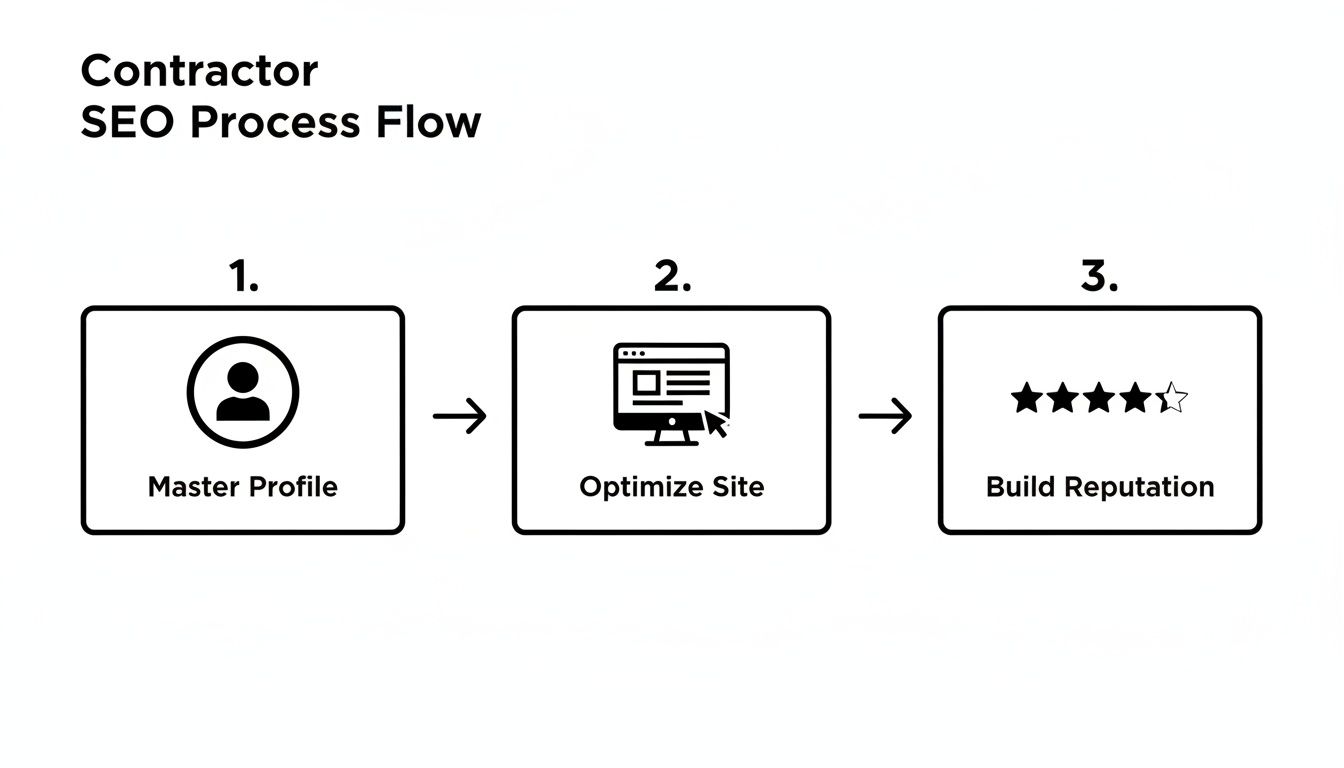
As you can see, it all starts with mastering your Google Business Profile, optimizing your website for local search, and then actively building your reputation online. Getting these three pillars right is what directly translates into more phone calls, quote requests, and booked jobs. Period.
This isn't just about climbing a search results page. It's about becoming the go-to, trusted contractor in your community. A strong local presence ensures that when a homeowner has a problem, your business is the one they find—and trust—first.
The goal of local SEO is simple: Be the first and best answer when a local homeowner needs your services. It transforms your online presence from a passive brochure into an active lead-generation engine that works for you 24/7.
To kick things off, here is a quick checklist of the essentials we'll be covering in detail.
The Contractor's Local SEO Starter Checklist
This table gives you a bird's-eye view of the foundational steps. Think of it as your roadmap for what's to come in this guide.
| Action Item | Why It Matters | Time to Implement (Approx.) |
|---|---|---|
| Claim & Verify Google Business Profile | This is your digital storefront. It's the #1 factor for showing up in map searches. | 1-2 hours (plus mail verification time) |
| Optimize Key Profile Sections | A complete profile with services, photos, and hours builds trust and helps Google understand what you do. | 2-3 hours |
| Create Service & Location Pages | Dedicated pages for each service and city tell Google you're the local expert for those specific needs. | 4-8 hours (for initial pages) |
| Set Up a Review Request System | Reviews are social proof. A steady stream of positive reviews is critical for ranking and conversions. | 1-2 hours (to set up a process) |
| Build Foundational Citations | Consistent business info across key online directories validates your location and contact details for Google. | 3-5 hours (for top 20-30 sites) |
Following this checklist is the first step toward building a reliable system for attracting qualified local leads. This approach not only gets you seen but also has a major impact on small business growth by creating a predictable pipeline of customers.
Now, let's dive into exactly how to execute each part of this strategy.
Mastering Your Google Business Profile
Think of your Google Business Profile (GBP) as your digital storefront on the busiest street in town. For a contractor, it’s often the very first impression a potential customer gets, especially when they’re frantically searching on a map for "plumbers near me" or "roof repair in Bonita Springs."
This isn't just about having a listing; it's about building a lead-generating machine. A fully optimized profile tells Google you're a legitimate, active, and relevant business in your local market. That's a huge deal because GBP signals are the #1 factor for ranking in the coveted local map pack. We're not just saying that—it’s what the data shows time and time again.
Nail Down Your Categories and Services
Getting your categories right is a foundational step that so many contractors mess up. Your primary category has to be the most accurate description of what you do. Don't be vague. If roofing is your bread and butter, choose ‘Roofing Contractor’—not ‘General Contractor.’
Then, use your secondary categories to capture all the other things you do. An HVAC company, for instance, should have a setup that looks something like this:
- Primary Category: HVAC Contractor
- Secondary Categories: Air Conditioning Repair Service, Furnace Repair Service, Heating Contractor
This detail helps Google match you to a much wider net of specific customer searches. But don't stop there. Go into the 'Services' section and list every single thing you offer, from 'emergency leak repair' to 'new shingle installation,' and give each one a solid description.
Craft a Compelling Business Description
You get 750 characters for your business description. Treat it like your company's elevator pitch. It needs to grab a homeowner's attention while also being packed with the keywords that define what you do and where you do it.
Forget the generic stuff like, "We are a full-service contractor." That tells people nothing. Get specific and local:
Actionable Example: "As a trusted roofing contractor in Naples, FL, we specialize in tile roof repair, hurricane-proof shingle installation, and gutter cleaning services. Our family-owned team has served Collier County for over 15 years, delivering reliable solutions for storm damage and routine maintenance."
See the difference? This example clearly states the service, location, and what makes them unique. It’s useful for both the homeowner reading it and for Google's algorithm.
The Power of Visuals and Ongoing Activity
A static profile is a dead profile. It’s that simple. Google rewards businesses that are active and constantly feeding it fresh content. This is where photos and regular updates become a critical part of your local SEO for contractors strategy.
Upload High-Quality, Geotagged Photos
Photos are your proof of work. They build instant trust. Make it a habit to upload clear, high-quality images of:
- Finished Projects: Before-and-after shots are pure gold.
- Your Team at Work: This puts a human face to your business and shows you have a real, professional crew.
- Your Branded Vehicles: This reinforces your brand and proves you're out there serving the community.
Here's a pro tip: Before you upload, geotag your photos with the coordinates of the job site. This sends a subtle but powerful signal to Google about the specific areas you serve, like Fort Myers or Cape Coral.
Leverage Google Posts for Timely Updates
Think of Google Posts as free mini-ads that show up right on your profile. They are perfect for showing off a recently completed job or promoting a seasonal special.
- Actionable Example Post: "Just wrapped up a beautiful new paver driveway for a homeowner in the Gateway community of Fort Myers! Check out the before-and-after. Call us for a free estimate on your next hardscaping project."
To keep things consistent, a tool like the GMB Post Generator can help you create a steady stream of updates and offers that keep your local audience engaged.
Proactively Manage Questions and Answers
The Q&A section is an often-neglected goldmine. Homeowners use this to ask critical questions before they decide to call you. If you don't answer them, someone else might—and their answer could be wrong or unflattering.
The best approach is to get ahead of it. Seed your own Q&A section by posting the questions you get all the time, and then answer them yourself.
Actionable Example Q&A Seeding
- Question: "Do you offer free estimates for roof repairs in the Bonita Springs area?"
- Answer: "Absolutely! We provide no-obligation, free estimates for all roofing projects in Bonita Springs and the surrounding communities. Give us a call to schedule yours today."
This simple tactic helps you control the narrative, handle objections upfront, and show off your expertise before a potential client even picks up the phone. When you treat your GBP as a dynamic tool instead of a static listing, you turn it into a consistent source of qualified local leads.
Building a Website That Dominates Local Search
If your Google Business Profile is the digital storefront, your website is the showroom. It’s where you turn a curious searcher into a paying customer by showing off your expertise, your project portfolio, and what makes you the right contractor for the job.
A well-built website does more than just look good; it sends powerful signals to Google about the services you offer and, more importantly, where you offer them. This isn't about slapping up a simple online brochure. It's about creating a strategic asset designed to rank for high-value local searches and convert that traffic into actual leads.
Create Hyper-Local Service and Location Pages
Here’s the single most effective website strategy for local SEO: create dedicated pages for each service you offer in each location you serve. A generic "Services" page just won’t cut it anymore. To compete, you have to get specific and prove to Google that you're the go-to expert for a certain job in a certain town.
Let’s say you're a plumber in Southwest Florida. Instead of one generic page, you’d build out individual pages like:
- Drain Cleaning in Fort Myers
- Water Heater Repair in Cape Coral
- Emergency Plumbing Services in Bonita Springs
Each of these pages needs to be a unique, valuable resource. Talk about common plumbing issues you see in that specific area, mention local landmarks or neighborhoods, and drop in a testimonial from a client who lives there. This is how you prove your local authority to both potential customers and search engines.
Write Unique Content That Converts
Creating dozens of pages might sound like a lot of work, and the biggest mistake contractors make is falling into the duplicate content trap. Simply copying and pasting the same text and swapping out the city name is a fast track to poor rankings. Google is smarter than that.
The key is to write genuinely helpful, unique content for every single page. Put yourself in the shoes of the customer looking for that specific service.
Actionable Example Content Angle: "Paver Sealing in Naples"
Instead of generic fluff, address local pain points:
"In Naples, the intense sun and heavy seasonal rains can quickly fade and damage unsealed pavers. Our specialized paver sealing process is designed for the Southwest Florida climate, protecting your investment from UV damage and preventing mold growth during the humid summer months. We recently completed a lanai sealing project in the Pelican Bay community and the results were stunning."
See the difference? This approach is far more compelling and sends much stronger local relevance signals. In fact, on-page signals like these dedicated service pages and geo-keywords account for a massive 36% of local organic ranking influence. The contractors who dominate their markets are the ones who build out these service-area pages with unique local proof, like project photos and specific FAQs.
Embed Critical On-Page Trust Signals
Once your pages are structured, it's time to layer in the technical elements and trust signals that lock in your local presence. These are the details that separate a basic website from one that truly owns local search.
- Embed a Google Map: On every location page, embed a Google Map showing your service area or office. It’s a direct, visual confirmation to Google of where you operate.
- Add Local Business Schema: Schema markup is code that helps search engines understand your business. Implementing 'LocalBusiness' schema clearly tells Google your name, address, phone number, and service area, making it easier to rank you correctly.
- Showcase Local Testimonials: Feature reviews from customers in the specific city that page is targeting. Nothing builds trust faster than seeing a review from a neighbor.
- Mobile-First is Non-Negotiable: The vast majority of "near me" searches happen on a phone. Your website absolutely must follow mobile-first design principles to provide a fast, seamless experience for customers searching on the go.
By combining a smart page structure with unique, localized content and these essential trust signals, your website becomes a powerful engine for attracting qualified local customers. If you're looking to build a new site from scratch or overhaul an existing one, exploring comprehensive web design services for modern businesses can give you the solid foundation needed to implement these strategies effectively.
How Your Reputation Becomes a Ranking Signal
In the contracting world, your reputation is everything. It's built job by job, handshake by handshake. The same exact principle holds true online—only instead of word-of-mouth, your digital reputation is built through customer reviews and consistent business listings.
Search engines like Google are paying close attention. They want to recommend contractors who are trusted, reliable, and genuinely active in their local community. When you have a steady stream of positive reviews and accurate business information splashed across the web, it proves you're a legitimate, respected pro. That directly influences how visible you are in local search results.

Building a Five-Star Reputation with Reviews
Think of online reviews as the modern-day version of a neighbor's recommendation. They act as powerful social proof, helping potential customers feel confident choosing you over a competitor down the street.
But there's more to it than that. Google actually uses review signals—like the quantity of reviews, the velocity (how often you get them), and even your responses—as a key factor in its local ranking algorithm.
A consistent flow of fresh, positive reviews tells Google that your business is not only active but also delivering a great customer experience. This is a non-negotiable part of any strong local SEO for contractors strategy.
The real challenge isn't doing great work; it's making it dead simple for your happy customers to share their experience.
Actionable Review Generation Tactics
Here’s how you turn every satisfied customer into a powerful marketing asset:
- Equip Your Technicians on the Spot. The absolute best time to ask for a review is right after the job is done and the customer is smiling. Give your team a simple script like, "We're so glad we could help you out today. If you have a moment, leaving us a review on Google would really help our small business. I can text you a direct link right now."
- Send a Simple Follow-Up Email. A day after the job, send a short, personalized email. Keep it direct. Thank them for their business and provide one clear, clickable link to your Google review page.
- Respond to Every Single Review. This is crucial. Thank customers for positive feedback and, just as importantly, address negative comments professionally and promptly. A thoughtful, calm response to a bad review can often win over more new customers than a dozen five-star ratings. To dig deeper into this, check out our detailed guide on the importance of managing online reviews.
To get the best results, you need to avoid the common pitfalls that make customers ignore your request. Here’s a quick look at what works versus what doesn't.
Review Request Template vs. Common Mistakes
| Effective Approach (Do This) | Ineffective Approach (Avoid This) |
|---|---|
| Personalized and Simple: "Hi [Customer Name], thanks again for choosing us for your [service] today. If you have a minute, we'd be grateful for your feedback on Google: [Direct Link]" | Generic and Vague: "Dear Valued Customer, please review our company online." |
| Timely Follow-Up: Ask within 24 hours of completing the job, while the positive experience is still fresh. | Delayed or Inconsistent: Sending requests weeks later or only asking sporadically. |
| Single, Clear Call-to-Action: Provide one direct link to your most important review platform (usually Google). | Overwhelming the Customer: Sending links to 5 different review sites at once, causing confusion and inaction. |
| Empower Your Team: Train your field technicians to ask in person when the customer is happiest. | Passive Approach: Simply hoping customers will find your profiles and leave a review on their own. |
The takeaway is simple: make it personal, make it timely, and make it incredibly easy for them to say "yes."
A proactive review strategy isn't something that just happens. It's a system you build directly into your business operations, turning every completed project into a chance to strengthen your online reputation and boost your local SEO.
Demystifying Citations and NAP Consistency
Beyond reviews, another core piece of your online reputation is what's called a citation. A citation is just an online mention of your business's Name, Address, and Phone number (NAP). These mentions pop up on hundreds of websites, from major directories to niche industry portals.
Think of it like this: every time Google's crawlers find your business information listed consistently across the web, it's like another vote of confidence. It confirms that your business is real, located where you say it is, and can be trusted. This consistency is absolutely essential.
Why NAP Consistency Is Non-Negotiable
Inconsistent NAP information is a massive red flag for search engines.
If your business is listed as "Smith Roofing Co." on one site, "Smith Roofing Company" on another, and has two different phone numbers floating around online, it creates confusion. That confusion erodes Google's trust in your business information and can seriously hurt your local search rankings.
Your NAP has to be 100% identical everywhere it appears online. No exceptions.
Actionable Example:
- Correct & Consistent:
- Google Profile:
Joe's Plumbing LLC, 123 Main St, Naples, FL 34102, (239) 555-1234 - Yelp Profile:
Joe's Plumbing LLC, 123 Main St, Naples, FL 34102, (239) 555-1234
- Google Profile:
- Incorrect & Inconsistent:
- Google Profile:
Joe's Plumbing, 123 Main Street, Naples, Florida 34102, 239.555.1234 - Yelp Profile:
Joe's Plumbing LLC, 123 Main St., Naples, FL, (239) 555-1234
- Google Profile:
Key Directories for Contractors
You don't need to be listed on every single directory out there. Instead, focus your energy on getting the most important ones right first. For home service pros, these are the heavy hitters:
- Google Business Profile (This is your #1 priority)
- Angi (Formerly Angie's List)
- HomeAdvisor
- Yelp
- Better Business Bureau (BBB)
- Houzz
Making sure your business details are perfectly aligned across these platforms sends a powerful signal of stability and trustworthiness to Google. This foundational work, combined with a steady stream of genuine customer reviews, creates a rock-solid reputation that both customers and search algorithms will reward.
Local Link Building and Content That Attracts Customers
While having a sharp website and a dialed-in Google profile is non-negotiable, Google also cares about your authority and trust within your local community. It figures this out by seeing which other local websites link back to yours.
This is what we call "link building." For contractors, it’s not about pulling off complex technical tricks. It’s about genuine community engagement that translates into digital credibility.
Forget about trying to get links from some big national publication. The links that actually move the needle for a contractor come from other local businesses, community organizations, and news outlets right in your service area. Each one is like a digital vote of confidence, telling Google you're a legitimate, respected player in your town.
Actionable Local Link Building Opportunities
You'd be surprised how straightforward it is to build a strong local link profile. It’s all about creating real-world relationships that show up online, sending powerful geographic signals that directly boost your local SEO.
Here are a few practical, no-fluff ways to earn these valuable local links:
- Sponsor a Local Team or Event. This is one of the easiest wins. Sponsoring a little league team, a high school football team, or a local 5K charity run almost always gets you a link from their website. It's authentic and it works.
- Partner with Other Good Contractors. Build a referral network with other non-competing trades. If you're a drywall guy, team up with a great painter who can link to you from their "Partners" page, and you can return the favor. It’s good for business and great for SEO.
- Join the Local Chamber of Commerce. Most chambers have an online member directory that links back to your website. This is a high-authority, hyper-local link that’s easily worth the membership fee.
- Get Quoted on a Community Blog. Reach out to local bloggers or community news sites. Offer to give them an expert quote or a few tips for an article on seasonal home maintenance, storm prep, or a local DIY trend.
These simple strategies will do more for local SEO for contractors than any complicated, expensive national link-building campaign ever could.
Creating Content That Answers Real Customer Questions
Once you start building that local authority, you have to back it up by proving you know your stuff. Your website's blog isn’t just a place to stuff keywords; it’s your best opportunity to answer the exact questions your potential customers are typing into Google every day.
Think about it. What are the common questions you get on the phone all the time? Every single one of them is a potential blog post that can attract highly qualified local customers.
Your best content ideas come directly from your customers' biggest headaches and worries. When you create content that solves their problems, you build immense trust before they even pick up the phone.
This is how you become the go-to local expert. A homeowner who finds your detailed article explaining their specific problem is far more likely to trust you with the job than a competitor whose website is just a generic digital brochure.
Hyper-Local Blog Post Ideas for Contractors
The secret sauce is getting specific—with both the service and the location. You need to tailor your advice to the unique challenges people face right here in your area. This shows you have real local knowledge and helps you rank for those valuable, long-tail search terms.
Here are a few real-world examples to get the gears turning:
- For a Roofer in Naples, FL: "How to Choose the Right Shingles for Florida's Hurricane Season"
- For an Electrician in Fort Myers: "5 Signs Your Electrical Panel is Outdated and Unsafe for SWFL Homes"
- For a Paver Contractor in Cape Coral: "The Best Paver Sealing Methods to Prevent Weeds in Our Rainy Season"
- For an HVAC Tech in Bonita Springs: "Is Your AC Unit Ready for the Southwest Florida Summer? A Maintenance Checklist"
See the pattern? Each topic hits on a specific local need, blending your service expertise with geographic relevance. That’s a powerful combination that drives targeted traffic and, more importantly, builds the kind of trust that turns a curious searcher into a confident, paying customer.
Common Questions About Local SEO for Contractors
Even with a solid plan, you're bound to have some questions about how all this local SEO stuff works in the real world. I get it. Below are some of the most common—and practical—questions we hear from contractors every single day. My goal is to give you direct answers, clear up the noise, and help you move forward with confidence.
How Long Does It Take for Local SEO to Work?
This is the million-dollar question, and the only honest answer is: it depends.
While some updates, like a deep-dive optimization of your Google Business Profile, can start moving the needle in a few weeks, a real local SEO strategy is a long-term play. It's not a light switch.
Most contractors start seeing a real, noticeable bump in their local rankings, website traffic, and lead flow within 3 to 6 months. But that timeline can shift based on a few key things:
- Your Market's Competition: Trying to rank for "roofing contractor in Fort Myers" is going to be a tougher, longer fight than ranking for "paver sealing" in a small, less crowded town.
- Your Starting Point: If you already have a decent website and a handful of reviews, you've got a head start. A brand-new business starting from absolute zero will naturally take longer.
- Your Consistency: The more you stay on top of it—getting reviews, uploading project photos, building local links—the faster you'll build momentum.
Think of it as building your digital reputation. The results you get from consistent effort will compound over time, creating a powerful, lead-generating asset for your business.
Do I Really Need a Physical Address for Local SEO?
You absolutely need a real, physical address for Google to verify your business is legit. But—and this is a huge but—you do not have to show it to the public. This is a critical point for contractors who run their business from home or don't have a storefront customers visit.
The right way to handle this is by setting up a Service Area Business (SAB) on Google.
When you're setting up your Google Business Profile, you can tell Google that you serve customers at their locations. This lets you hide your street address and show a defined service area on the map instead. For nearly every home service contractor, this is the correct and most effective setup.
Crucial Tip: Whatever you do, never use a P.O. Box or a virtual office address for your Google Business Profile. This is a direct violation of Google's rules and one of the fastest ways to get your profile suspended, which will wipe out your local visibility overnight. Don't risk it.
Is My Website or Google Business Profile More Important?
I hear this one all the time, but it’s the wrong question to ask. It’s like asking if your hammer or your drill is more important. You need both, and they do different jobs. Neglecting one will absolutely cripple your ability to generate leads from local search.
Here’s a simple way to think about their roles:
| Component | Role | Primary Goal |
|---|---|---|
| Google Business Profile (GBP) | Your Digital Billboard | To get maximum visibility in the map pack and drive that first click or call. |
| Your Website | Your Digital Showroom | To convert that visitor by building deep trust, showcasing your work, and proving your expertise. |
Your GBP is what gets a homeowner's attention when they're scanning the map results for a highly-rated plumber. But it's your professional, easy-to-use website that convinces them you're the right pro for the job.
Your GBP opens the door; your website closes the deal.
Ready to stop wondering and start ranking? The team at Polaris Marketing Solutions specializes in building powerful local SEO strategies that get contractors noticed in Southwest Florida. We handle the technical details so you can focus on running your business. Get your complimentary online analysis and see where you stand today.